Showing posts with label Zen. Show all posts

Thursday, 27 June 2019

Non western aesthetics: Japan (Part one)


Muqi Fachang: Six Persimmons
One of the main reasons I have been drawn towards a study of non-western aesthetics is because of the dangers now threatening us as a species, in particular climate change and global warming. I believe that because of these threats we need to change entire sets of behavior patterns. In the West we have tended to separate art out from the rest of what we do and in doing so apply certain aesthetic ideas into very elite areas of human experience, which leads to a situation whereby most people dismiss art as totally irrelevant to their lives. For instance the long Greenberg influenced debate surrounding the specificity of painting as an art form, or Danto’s writings on the specific nature of art as something defined and bounded by the art world itself. When faced with the reality of existence and how precious life is these sorts of art bound definitions seem irrelevant. This is why I have in a recent post celebrated the writings of John Dewey, a philosopher who did value the way art could reflect real life experience and why in earlier posts I have looked at object orientated ontology as a way of using philosophy to help see how everything is both connected and relatable.


I have touched upon the issue of non-western aesthetics a couple of times recently, looking at both Indian and Chinese approaches to aesthetic form, but this time I would like to dig a little deeper and open out ideas that might help us to think of how to apply aesthetics to much wider areas of our experience. This is because I believe that aesthetics is fundamentally about what we care about and if we don't care about the wider world, we won't have it to care about for much longer. Aesthetics has a much greater relevance within Japanese culture than is accorded to aesthetics in the West, therefore it is perhaps useful to explore how this situation arose.
In her fascinating book, ‘Bonds of Civility’ Eiko Ikegami describes how the people of Japan incorporated aesthetic awareness into the very social fabric of their daily lives. Japanese people becoming both producers and makers of aesthetically significant productions. Ikegami points out that identity, culture and meaning are emergent properties and that by focusing on aesthetic issues people within a very structured and hierarchical society could develop meaningful relationships with the world and their place in it without coming into direct conflict with those that sought to hold on to power. In our own society we also have many disenfranchised people who feel that they have no meaningful relationship with the world. Our current art practices are not designed to help with this and in many ways totally ignore or turn away from the problem. If you walk through the local streets where I live in Leeds you immediately sense that something is wrong, litter and rubbish is tossed everywhere and very little effort is put into the aesthetics of day to day communication between people. If people's lives don’t matter why should they bother? But their lives do matter, and so does the life of the planet. If people don’t value their local environment, they definitely won’t value the rest of the Earth outside of that locality.

 In Japan the aesthetic sensibility must have taken a thousand years to fully develop. Capitalism as an idea has also taken a long time to become part and parcel of people’s everyday lives in the west. But the urgency of the environmental situation might speed the different processes that stimulate change and we might still be able to reframe the way that our society sees itself.
The Japanese aesthetic tradition stems from two religious beliefs. The oldest being Shinto, whereby there is a deep awareness of nature as an energy generating phenomenon, this is reflected in a celebration of the divine nature of trees, rocks, objects, places, animals and people, all of which are seen as being interconnected and sharing the world's resources between themselves.  Buddhism in its Japanese form arrived later but there was a similar aspect to Shinto in that there was no human/God divide as there is in Christianity, both Buddhism and Shintoism seek to open people out to what is already there and to help them to achieve some sort of oneness or peace with the world. In the Buddhist tradition, all things are considered as illusions, they are simply points in time on a journey whereby they are evolving from or dissolving into nothingness. Everything has potential to be something else. Nature is seen therefore as a dynamic force and one that humans need to attune to, rather than try to shape. Both these traditions seek to maintain some sort of balance with nature,  making humans aware that they are not separate from nature. The Anthropocene understood in this context is a product of natural forces; because we cannot step outside of nature if we are ourselves part of nature. Any effect on the planet we might have as a species, is something that is caused by nature and nature it could be argued, will therefore have a solution. Imagine a particularly strange bird that needed to build ever more larger and complex nests, as it did so it began to decorate them with glittery things that seemed to add some sort of extra value to these ever growing larger nests, until one day everyone began to realise all of the Earth’s resources were being used up in their nest making. We are like these birds, unaware of anything else but the need to build our nests but at some point these birds will either die out or change their habits. 

Muqi Fachang's 'Six Persimmons' is a meditation on a movement between nothingness and being, it captures the moment of seeing the differences and yet similarities between a family of objects. A moment caught by a few spins of the hand/wrist and a flick of the fingers, enough to embed the human into the persimmons' action. It is in this holding on to a few moments of looking that we can see the bigger picture. Life is indeed wonderful, the simple yet complex pattern of relationships we find in a simple group of objects, echoing the patterns we find all around us. We are just too busy to notice them. This is why aesthetics are so important. They ask us to look and to see the beauty in the looking.


Gibbons Reaching for the Moon, Ito Jakuchu

At other times a visual image can become an entry into a meditative experience. 'Gibbons reaching for the moon' being both an image that highlights human hubris and folly as well as offering a space for further meditation on the nature of life itself. (I have looked at a similar Zen drawing in the past and have opened out its meaning in more detail here

It has been argued by Donald Richie that, 'if aesthetics in the West is mainly concerned with theories of art, that of Japan has always been concerned with theories of taste. What is beautiful depends not upon imagination (as Addison thought) nor qualities proper in the object (as Hume said) nor in its paradoxes (as Kant maintained) but rather on a social consensus'. (Richie in 'A Tractate on Japanese Aesthetics') In relation to this argument, I believe that we as a society need to recognise the fact that our aesthetic social consensus is basically broken and unfit for purpose and I further believe that it is going to be part of the job of artists to help build a new one. 

If we can spend more time appreciating the world around us, we might not be so quick to destroy it. This awareness is something that should unite the arts and sciences. When you look at a field of growing wild flowers, it is not only beautiful to look at and challenging to draw, but the hidden dynamics of soil structure, the below ground fungal biochemical systems, the plant/insect communication networks, the various interconnected life cycles, can all be understood and more importantly seen as an extension of our own eco-system. Scientific research and sensitive observation leads to an interconnected awareness, which can be something that we tune ourselves into and in this tuning we will find ourselves and the field and all the things of that field to be beautiful. 

The posts put up in this blog are part of my own self education, they are also a response to what I strongly believe is the moral duty of an artist/educator. The making of art cannot take place in a vacuum and if you look at any society that has used art forms, be these multi-media ones or very specific ones such as dance or decorative pottery, you will find that the indigenous art form was something that helped that society develop bonds with both its members and with the world outside of the social group. Whether this is the Australian Aboriginal 'Dreamtime' or a Finnish shaman's singing in of animal spirits, a Japanese tea ceremony or Michelangelo's Sistine Chapel ceiling. So as you communicate what it is you are trying to do, try to ensure that what you are doing is of benefit, ask others whether it helps them in some way, check on whether or not what you are doing hinders or helps our relationship with the planet. I'm not suggesting all artists should become eco-warriors but I am suggesting that artists need to think about their role in society and what they are communicating. If Shakespeare hadn't bothered to think about how well his work communicated to others he would never have had any of his plays staged. It is not easy and it is also a road lined with traps. The role of the artist is often confused and mythologised by the media, sensationalism often offered up instead of communication. Sometimes artists can get carried away with their own importance. Consider the case of Christoph Büchel and his moving of what is in effect a mass grave from its resting place at the bottom of the sea to the Venice Arsenale.
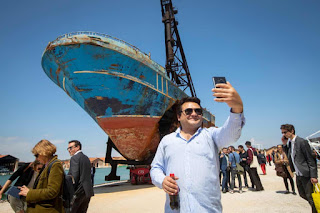

A visitor to the Venice Biennale takes a selfie of himself with the sunken migrant ship in the background
The cost of raising the ship and transporting it was over £30,000,000. Two fully equipped field hospitals with staffing could have been put into operation to serve one of the world's huge refugee camps for that type of money. Büchel states that he is raising awareness of the plight of migrants, but in effect what he has done is to set up a publicity stunt that ensures that the one name we remember is that of Christoph Büchel. It is work like this that makes me believe that our aesthetic social consensus is basically broken and that what we call the art world is by that very definition also not fit for purpose. Art doesn't need its own world, it should be part of all our worlds. 

If you go to Venice as well as attending to the Biennale you could visit the church of San Zaccaria. Inside the church is Bellini's 'Virgin and Child'. In response to the painting's position Bellini has painted two marble pillars that operate as a frame in order to echo the painting's positioning alongside real marble pillars, these pictorial devices of framing ensuring that we understand that this image is separate from life and is designed to meditate upon both life and its connection to the world of the spirit. If you visit the church at the right time of the day a sunbeam will brightly illuminate the face of the angel, and then slowly but surely this light beam will move across the painting giving 'divine' illumination as it does so. Both the architect and Bellini must have been aware that this would happen. If you go to Newgrange in Ireland, you will find that its alignment captures a sunbeam from the rising sun during the time of the winter solstice, this is something that is of cosmic significance. 


Bellini: Virgin and Child

As I walk to work in the morning I often draw, it helps me look at things and slows me down. When I draw trees I often notice that they collect moss on one side, and that there are more spiders on the other side. The sun is a powerful shaper of life and where we are in relation to it is fundamental to our awareness of what we are and where we fit in; as important for the moss and the spiders as it is for ourselves. The artist Roger Ackling devoted his entire working life to this idea and his austere approach owed much to his awareness of Japanese aesthetics. His small meditations, whereby he focused the rays of the sun so that he could burn simple lines on a washed up piece of wood, were small acts of thoughtfulness that anyone could aspire to. As simple as choosing to not eat red meat, or to re-use a plastic container, not all gestures have to be grand ones, but if we are to live a more aesthetic life, it will be these small gestures that signify that life and art are becoming unified. 


References

Ikegami, E (2005) Bonds of Civility Cambridge University Press: Cambridge


Richie, D. (2007) A Tractate on Japanese Aesthetics Stone Bridge Press: Berkeley

Carlson, A. and S. Lintott (eds) (2008), Nature, Aesthetics and Environmentalism: From Beauty to Duty. New York: Columbia University Press.

See also:

More reflections on tone and emotional value and why the tilt of the Earth is vital to our understanding of these things.  I.e. the influence of the sun on drawing


More on Japanese aesthetics 

Tuesday, 7 May 2019

Drawing and Mindfulness: Part five: Weaving in your own story


Zen Buddhist drawing of a meditating frog

Before we get serious, I need to remind everyone that from many points of view this whole activity is very funny. Don't take yourself or this process too seriously, the point about stepping lightly is to not leave dirty boot prints all over the place. Hence the meditating frog drawing.
One of the reasons for immersing yourself into the working processes of another artist is to try and push your own ego into the background. In order to develop our sensitivity to the world and others, we need to clear a path through that dense thicket of me, me, me and accepting the fact that someone else might have an approach to life that can be of benefit is part of that process.

However at some point you will need to build into your world view an acceptance of yourself as a human being, as a process equally as valuable as anything else. Your way of being and existence is as wonderful as the processes of sky, as beautiful as the construction of a stream and as kind as the ecology of a tree. The place you find yourself in, is simply a moving point in space, a point interconnected to all other points in space and therefore to all other things, and their possible combinations and existences. You are entangled into the process of being and as your point in space moves, so does the matrix of connections with everything else. Time and gravity combine to give weight to your actions, and in many ways shape what you might in the past have called ‘intentions’ but from a different position of acceptance, see as ‘fate’ or simply the playing out of possibilities.
This stage of drawing and mindfulness simply asks you to pick out something you have already done and to repeat it, but this time to reduce it down to an essence. Then to repeat the process again and again, until you feel you have gone as far as you can. Now review all your drawings and decide which of them you have the most affinity with. Now meditate on your bond with this drawing and finally create a family of forms that emerge naturally from the processes that you have evolved in your drawing's making.

By finding a relationship with materials, drawing hopefully opens the door to a new way of being. An acceptance that other things have agency, leads to an acceptance that the paper and dyes you have been using have their own ways of being and as you learn their languages you become more conversant in the ‘touch’ of material thought. This sensitivity leads to a type of caring, a kindness towards the non-human, hopefully carried through into the rest of your life as an attitude towards others, whether people, animals, plants or inorganic materials. It hopefully also leads to the establishment of a point of view that always searches for the processes of interconnection, rather than looking for the isolated, atomised thingness of reductionist thought.

This blog is written as a series of encounters with thoughts about drawing. Thoughts are triggered by various encounters with drawings, conversations about drawing with other people, books and journal articles about drawing, conferences on drawing and exhibitions and sometimes those everyday connections with drawing that can happen at any time in any place. What ties them all together is a search for how drawing can be used to help be at one with the world. At times this can be thought of as a way to develop a spiritual response to life, at others to foster a deeper awareness of the underlying mathematical structures that underpin reality. A historical perspective can be as important to our awareness as an emotional register and this as vital as an awareness of the chemical composition of a material. As you look through various posts you will become aware that no one approach is favoured over another, philosophy and politics being as important as genre or gender. The continuing search for connections is what counts and hopefully the somewhat rambling nature of the various posts can give you an insight into how wonderful an activity drawing can be. Buddhists are very aware of how important the shaping of an attitude to life is. Buddhist belief also encompasses an awareness of the limitations of verbal language, for instance the chanting of “Nam-myoho-renge-kyo” is much more to do with the sound of the words than the individual meaning of them. It is the sound and rhythm of chanting that activates the human potential and there is no word for word translation. This is about faith and practice. In repetition you begin to cultivate a state of sensitive awareness. However this does not mean that things don’t evolve. The “Nam-myoho-renge-kyo” chant is made of words that have evolved out of ancient Indian and Chinese languages and are pronounced in Japanese. ‘Nam’ is from the Sanskrit, “myoho-renge-kyo” are Chinese words, the fusion of the two being “Nam-myoho-renge-kyo”. This historical fusion is often referred to as embodying a universal language, the sound of the chant being understood by all who have been inducted into Buddhist traditions. The sound is understood as one that creates a unity with the fundamental rhythm of the cosmos. This chant was developed during the 13th century and the fusion of languages that shaped it was formed out of a poetic consciousness. The poetic consciousness is very similar to that one attained as we are attuned to the finer adjustments in a drawing. It is this type of consciousness that leads to a deeper understanding of entanglement, an activity that shapes new forms and in their shaping reveals an interconnectedness that underpins the morphing and reshaping of process. An image will hopefully arrive out of the constant making of drawings that you can return to over and over again. Each time you return to it, it should reveal new layers of connections.

This stage of drawing is also about letting go of drawing. It is not about words, it is not about drawing, it is about finding a way of experiencing a relationship with something that isn’t yourself. This relationship being something that can become a model for future conduct, something to use as you prepare food, cultivate your garden or work with other people. As you move beyond this stage, you should sense a growing relationship with the universe, an acceptance of your own being arriving alongside an acceptance of other processes of become-ing, world-ing, plant-ing, forest-ing, animal-ing, sky-ing, sea-ing, rain-ing, sun-ing, moon-ing and all those other processes of interconnection that you are part of.

A brushstroke being itself


Drawing and mindfulness part two
Drawing and mindfulness part three


Monday, 6 May 2019

Drawing and Mindfulness: Part four: A Material Conversation

Sohan Qadri

If I had to pick out one artist that would be an example for any of us that wish to take the drawing and mindfulness approach onto a further level, it would be Sohan Qadri. He used to approach his work in a way that was very similar to a ritual or religious experience. Qadri was influenced by both Tantric-Vajrayan yogi practices and Sufi mysticism.  He developed his spiritual ideals through meditation, dance and music, eventually deciding to focus his art making on the potential inherent in the properties of paper. Qadri worked with heavyweight papers that gave him the opportunity to engage with his paper's structural and surface textural potential. In particular by soaking it and carving into it in several stages, and by applying inks and dyes between each stage, he was able to attune himself to the paper's properties. In the process, paper was transformed from a two-dimensional surface into a three-dimensional medium, or thin sculpture. In particular he developed controlled rhythmic ways of marking the papers, often using a careful repetition of incisions into the paper as he meditated. Each layer of marks would be followed by another layer of intense colour wash, the inks and dyes soaking into the newly disturbed paper creating powerful saturations and glowing surfaces of colour, that grew even more intense as each colour layer was absorbed into the surface below. Layer after layer of colour would be applied, each application regarded as if it was a paper's ritual bath of colour immersion. Qadri worked for many years, looking for a way to shape an art practice that would be an effortless method of creation perfectly in tune with his yogic practices. By respecting the crafting of paper, and by then furthering his awareness of that craft by engaging at an intense level with the fibrous nature of his material, he developed a way of working that was in total harmony with his paper's inception. 


Sohan Qadri

Before embarking on this next stage you will need to make a decision as to whether or not to make your own paper. If you have access to the right resources this can be a very useful thing to do because you will develop a deeper understanding of your paper's nature and it will help you to become engaged with it's materiality. There are lots of resources on 'You Tube' and the university has resources and technicians that will advise you on how to do this. If you want to begin with ready made paper, that's also fine, but you may need to spend more time exploring the surface properties of your paper in order to develop an understanding of its nature and how it can be worked with. See older posts on paper to get an idea of the possible range of papers to use. 

You will need to use colour in order to reveal the changes you make to the paper, and colour will need to be applied between every stage of your paper transformation, so you will also need to experiment with dyes and inks and explore the way they effect your chosen paper. 

Once you feel confident that you understand your paper, you need to familiarise yourself with the tools you will work with to make marks into it as well as the applicators for your dyes and inks.

Your paper marking tools and colour applicators will be vital to you. The process of making these tools can itself be part of the mind letting go, by gathering up objects and transforming them into tools for marking paper, you begin to see the world from the point of view of inter-object relationships. Perhaps as you take apart an old cheese grater and fit handles to its various parts, this activity might take you into thinking about your hand and how it holds things, of the sharpness of the different surfaces of the grater, of the potential for these surfaces to be used as scratching tools for roughening up your paper. (Typically you will make or find scratching tools, but also sandpapers, incising implements, polishing things and embossing tools) We have looked at making your own tools before.


The development of an organised almost ritual approach is going to be vital and you will need to embody or materialise your thoughts as part of this process. 

You will need to begin with at least 20 sheets of your chosen paper.
Take your first sheet of paper and position it in a portrait relationship with yourself. It may be lying on the ground in front of you or on your table. You need to see it as a whole. It is like you bilaterally symmetrical, the right half mirrors the left half. Meditate on this for a while, what does it mean to you? Are there any 'off centred' aspects that you might want to think about? Are you left sided or right sided? 

Now make a mark on the paper. Just one. But be as inventive as you can about how you make this mark. Look at the paper and feel for how this mark has effected your awareness of the the rest of the paper. What are its qualities, where is it? Is this mark nearer the top, or closer to one side or the other? Now put the paper to one side and make another mark on a new sheet of paper. Do this carefully and each time try to vary the quality of the mark and positioning. Carry on until 19 sheets of paper have a mark and one is left unmarked. As you make each mark, feel for how it relates to your own body, does that mark down on the left relate to your left foot, if so what does it feel like?

Now take up the first sheet again and make a line down the centre of the paper that represents your own awareness of the fact you have a backbone. Is this a single incised line, is it composed of several short marks that visually appear to become a line when seen from a distance? Once the first line is made, pass on to the next sheet and the next until you have made 18 different vertical lines. These can be lines made by pushing pins through the paper, dragging a compass point across the paper surface, incising with an empty biro, drawing with your fingernail, scraping with a knife or scratching with your cheese grater tool. 

Once you have made these lines paint a colour selected from your dye mix across the first one and spread this colour right to the edges of the paper. Now look at what you have done and let your mind wander into it. 
Do this with 17 of the sheets.

Put the papers aside and begin the same process on the first sheet once again, make a mark, look at how this changes the relationships set out between what you have done already. Then once you have done this with 16 sheets, move on and make another vertical line on 15 sheets. 

Now paint your dye across 14 of these sheets. 

Put these images in a row and look at them, what is happening, look at the difference between a mark that has had only one covering of dye and the others with two, compare the white sheet with dyed sheets.

Take 13 sheets. Look at your two lines on the first sheet and in your minds eye thicken one. It will become a rectangle, perhaps a long thin one, or if it expands out to the edge of the paper a much more regular rectangular shape. Now make the rectangle you see by building a surface of regular marks. These could be horizontal or vertical scratches, regular punch holes, overlapping hammered marks, regular scratchings from your cheese grater. What ever you can do to make a continuous surface that stops at 4 straight edges. 

Paint a dye over 12 of these sheets of paper. 

Take 11 sheets and look at what has happened to your other line. Is it lost under the rectangle you have made, does it stand clear, can you still see part of it? Make another line designed to reinforce awareness of this line. Do you make a shattered disjointed line next to a clear sharp line, or do you echo it by making another sharp line but how far away should it go? Once you have made these 11 new lines, paint the dye over 10 of your sheets of paper. 

Now lay out all 20 sheets, look at them closely. You have in effect been playing with a particular variation of Paul Klee's idea of moving 'from point to line to plane'. However by adding colour you have included a very emotional ingredient to the sequence that will hopefully ensure that this is not a cerebral exercise. The fact that only changes in the paper surface are used to capture changes in colour intensity should also make you far more aware of the paper as a material, rather than as a background on which to work.

As you look at the sheets you have worked on hopefully one will stand out as being of interest in some way, you will be drawn to one of the sheets for whatever reason. Take it out of the presentation, look at it for a little longer and add a fold to the structure. Work on the back of the paper to ensure the fold is sharp then flatten out the paper and fold the paper again in the opposite direction. Then flatten back out. Now paint your dye over the whole surface. 

Pick another sheet of paper from your remaining sheets and look at this. Now cover a proportion of the surface with a sheet of thick clear paper. Whatever is left uncovered lightly sand with rough sandpaper, or scratch over with a set of regular marks. Now paint your dye over the whole surface. 

Take another sheet. This time close your eyes and feel with your hand over the surface. With your eyes still closed take a sharp implement and scratch into the surface feeling for the difference you are making. Now look at what you have done and dye the paper surface. 

Take another sheet and do nothing to it. Now take a different coloured dye and paint it all over the surface.

Take out another sheet. Using a bowl of clean water and a rag wipe away as much dye/colour as you can from one area of the sheet of paper. 

On another sheet make a straight line one inch wide from one side of the image to another. This can be an any angle. Make the line in anyway you want, it can be dyed, scratched into, embossed, whatever you feel is right.

On the next sheet make a square anywhere on the paper in any way you wish using any of the techniques already used to mark the paper. 

Now take a sheet and make a tear into it. 

Take another sheet and make another tear, this time you are to dye the sheet once the tear is made.

Draw a circle into the next sheet of paper using any of the paper marking techniques you have been using. 

Now lay out all of your sheets of paper again, look at them and think about how they might relate to yourself. This is a very personal thing and how you make the connection is up to you, remember there is no right or wrong way to do this. 

Pick one sheet, close you eyes and feel it, follow the lines and surfaces with your fingers and build up a picture in your head. Now look at it from a distance, and feel for the differences between sight and touch. Now decide how to respond to what you have felt or seen or both by making either a mark, a series of marks, a line or a shape.  You could work on this sheet with eyes closed, by working whilst looking very hard, or alternating between looking and feeling. Use any combination of the techniques you have introduced. 

Pick another sheet and reinforce one element by painting into it with a different coloured dye. 

Pick another sheet and do the same but this time using the dominant coloured dye found on the chosen sheet. In effect this would be blue on blue or red on red, a heightening of saturation or intensity. 

On another sheet remove a large area of information by sanding or any other appropriate erasure technique.

On the next sheet to do the same thing but this time to erase within a sharp boundary. Such as working within a taped out boundary or using a clean sheet of paper to mask out the area you are working in. 

Repeat this process on two more sheets and then apply dye across both sheets. 

Finally, choose a sheet and simply dye the edges, letting the colour fade out into the existing colour field.  

At this point it is time to stop. Go back reflect on these images and see what has happened. 

The next stage is up to you. 

You will now have a much better understanding of your chosen paper. Do you move on to explore a different sort? Are there any sets of marks or forms that particularly intrigued you? Do you begin the next exploration by starting with these? Do you begin this time with a square sheet of paper rather than a rectangle? Do you use tearing techniques alone? What if all your marks were punched into the paper? What is it about the colour that works for you? How would you approach dyeing paper if you had to do this again? What if all your marks were confined to one half of the paper? 

The next stage will be about focus and it is your decision as to what that is. 

Sohan Qadri


How paper is made in Nepal