Before we get serious, I need to remind everyone that from many points of view this whole activity is very funny. Don't take yourself or this process too seriously, the point about stepping lightly is to not leave dirty boot prints all over the place. Hence the meditating frog drawing.
One of the reasons for immersing yourself into the working
processes of another artist is to try and push your own ego into the
background. In order to develop our sensitivity to the world and others, we
need to clear a path through that dense thicket of me, me, me and accepting the
fact that someone else might have an approach to life that can be of benefit is
part of that process.
However at some point you will need to build into your world
view an acceptance of yourself as a human being, as a process equally as valuable
as anything else. Your way of being and existence is as wonderful as the processes
of sky, as beautiful as the construction of a stream and as kind as the ecology
of a tree. The place you find yourself in, is simply a moving point in space, a
point interconnected to all other points in space and therefore to all other
things, and their possible combinations and existences. You are entangled into the
process of being and as your point in space moves, so does the matrix of
connections with everything else. Time and gravity combine to give weight to
your actions, and in many ways shape what you might in the past have called ‘intentions’
but from a different position of acceptance, see as ‘fate’ or simply the playing
out of possibilities.
This stage of drawing and mindfulness simply asks you to pick out something you have already done and to repeat it, but this time to reduce it down to an essence. Then to repeat the process again and again, until you feel you have gone as far as you can. Now review all your drawings and decide which of them you have the most affinity with. Now meditate on your bond with this drawing and finally create a family of forms that emerge naturally from the processes that you have evolved in your drawing's making.
By finding a relationship with materials, drawing hopefully
opens the door to a new way of being. An acceptance that other things have
agency, leads to an acceptance that the paper and dyes you have been using have their own ways of being and
as you learn their languages you become more conversant in the ‘touch’ of
material thought. This sensitivity leads to a type of caring, a kindness
towards the non-human, hopefully carried through into the rest of your life as
an attitude towards others, whether people, animals, plants or inorganic
materials. It hopefully also leads to the establishment of a point of view that always searches for the
processes of interconnection, rather than looking for the isolated, atomised
thingness of reductionist thought.
This blog is written as a series of encounters with thoughts
about drawing. Thoughts are triggered by various encounters with drawings,
conversations about drawing with other people, books and journal articles about
drawing, conferences on drawing and exhibitions and sometimes those everyday connections
with drawing that can happen at any time in any place. What ties them all
together is a search for how drawing can be used to help be at one with the
world. At times this can be thought of as a way to develop a spiritual response
to life, at others to foster a deeper awareness of the underlying mathematical
structures that underpin reality. A historical perspective can be as important
to our awareness as an emotional register and this as vital as an awareness of
the chemical composition of a material. As you look through various posts you
will become aware that no one approach is favoured over another, philosophy and
politics being as important as genre or gender. The continuing search for
connections is what counts and hopefully the somewhat rambling nature of the
various posts can give you an insight into how wonderful an activity drawing
can be. Buddhists are very aware of how important the shaping of an attitude to
life is. Buddhist belief also encompasses an awareness of the limitations of
verbal language, for instance the chanting of “Nam-myoho-renge-kyo” is much
more to do with the sound of the words than the individual meaning of them. It
is the sound and rhythm of chanting that activates the human potential and
there is no word for word translation. This is about faith and practice. In
repetition you begin to cultivate a state of sensitive awareness. However this
does not mean that things don’t evolve. The “Nam-myoho-renge-kyo” chant is made
of words that have evolved out of ancient Indian and Chinese languages and are
pronounced in Japanese. ‘Nam’ is from the Sanskrit, “myoho-renge-kyo” are
Chinese words, the fusion of the two being “Nam-myoho-renge-kyo”. This
historical fusion is often referred to as embodying a universal language, the
sound of the chant being understood by all who have been inducted into
Buddhist traditions. The sound is understood as one that creates a unity with
the fundamental rhythm of the cosmos. This chant was developed during the 13th
century and the fusion of languages that shaped it was formed out of a poetic
consciousness. The poetic consciousness is very similar to that one attained as
we are attuned to the finer adjustments in a drawing. It is this type of
consciousness that leads to a deeper understanding of entanglement, an activity
that shapes new forms and in their shaping reveals an interconnectedness that
underpins the morphing and reshaping of process. An image will hopefully arrive
out of the constant making of drawings that you can return to over and over
again. Each time you return to it, it should reveal new layers of connections.
This stage of drawing is also about letting go of drawing.
It is not about words, it is not about drawing, it is about finding a way of
experiencing a relationship with something that isn’t yourself. This
relationship being something that can become a model for future conduct,
something to use as you prepare food, cultivate your garden or work with other
people. As you move beyond this stage, you should sense a growing relationship
with the universe, an acceptance of your own being arriving alongside an
acceptance of other processes of become-ing, world-ing, plant-ing, forest-ing, animal-ing,
sky-ing, sea-ing, rain-ing, sun-ing, moon-ing and all those other processes of
interconnection that you are part of.
If I had to pick out one artist that would be an example for any of us that wish to take the drawing and mindfulnessapproach onto a further level, it would be Sohan Qadri. He used to approach his work in a way that was very similar to a ritual or religious experience. Qadri was influenced by both Tantric-Vajrayan yogi practices and Sufi mysticism. He developed his spiritual ideals through meditation, dance and music, eventually deciding to focus his art making on the potential inherent in the properties of paper. Qadri worked with heavyweight papers that gave him the opportunity to engage with his paper's structural and surface textural potential. In particular by soaking it and carving into it in several stages, and by applying inks and dyes between each stage, he was able to attune himself to the paper's properties. In the process, paper was transformed from a two-dimensional surface into a three-dimensional medium, or thin sculpture. In particular he developed controlled rhythmic ways of marking the papers, often using a careful repetition of incisions into the paper as he meditated. Each layer of marks would be followed by another layer of intense colour wash, the inks and dyes soaking into the newly disturbed paper creating powerful saturations and glowing surfaces of colour, that grew even more intense as each colour layer was absorbed into the surface below. Layer after layer of colour would be applied, each application regarded as if it was a paper's ritual bath of colour immersion. Qadri worked for many years, looking for a way to shape an art practice that would be an effortless method of creation perfectly in tune with his yogic practices. By respecting the crafting of paper, and by then furthering his awareness of that craft by engaging at an intense level with the fibrous nature of his material, he developed a way of working that was in total harmony with his paper's inception.
Sohan Qadri
Before embarking on this next stage you will need to make a decision as to whether or not to make your own paper. If you have access to the right resources this can be a very useful thing to do because you will develop a deeper understanding of your paper's nature and it will help you to become engaged with it's materiality. There are lots of resources on 'You Tube' and the university has resources and technicians that will advise you on how to do this. If you want to begin with ready made paper, that's also fine, but you may need to spend more time exploring the surface properties of your paper in order to develop an understanding of its nature and how it can be worked with. See older posts on paper to get an idea of the possible range of papers to use.
You will need to use colour in order to reveal the changes you make to the paper, and colour will need to be applied between every stage of your paper transformation, so you will also need to experiment with dyes and inks and explore the way they effect your chosen paper.
Once you feel confident that you understand your paper, you need to familiarise yourself with the tools you will work with to make marks into it as well as the applicators for your dyes and inks.
Your paper marking tools and colour applicators will be vital to you. The process of making these tools can itself be part of the mind letting go, by gathering up objects and transforming them into tools for marking paper, you begin to see the world from the point of view of inter-object relationships. Perhaps as you take apart an old cheese grater and fit handles to its various parts, this activity might take you into thinking about your hand and how it holds things, of the sharpness of the different surfaces of the grater, of the potential for these surfaces to be used as scratching tools for roughening up your paper. (Typically you will make or find scratching tools, but also sandpapers, incising implements, polishing things and embossing tools) We have looked at making your own tools before.
The development of an organised almost ritual approach is going to be vital and you will need to embody or materialise your thoughts as part of this process.
You will need to begin with at least 20 sheets of your chosen paper.
Take your first sheet of paper and position it in a portrait relationship with yourself. It may be lying on the ground in front of you or on your table. You need to see it as a whole. It is like you bilaterally symmetrical, the right half mirrors the left half. Meditate on this for a while, what does it mean to you? Are there any 'off centred' aspects that you might want to think about? Are you left sided or right sided?
Now make a mark on the paper. Just one. But be as inventive as you can about how you make this mark. Look at the paper and feel for how this mark has effected your awareness of the the rest of the paper. What are its qualities, where is it? Is this mark nearer the top, or closer to one side or the other? Now put the paper to one side and make another mark on a new sheet of paper. Do this carefully and each time try to vary the quality of the mark and positioning. Carry on until 19 sheets of paper have a mark and one is left unmarked. As you make each mark, feel for how it relates to your own body, does that mark down on the left relate to your left foot, if so what does it feel like?
Now take up the first sheet again and make a line down the centre of the paper that represents your own awareness of the fact you have a backbone. Is this a single incised line, is it composed of several short marks that visually appear to become a line when seen from a distance? Once the first line is made, pass on to the next sheet and the next until you have made 18 different vertical lines. These can be lines made by pushing pins through the paper, dragging a compass point across the paper surface, incising with an empty biro, drawing with your fingernail, scraping with a knife or scratching with your cheese grater tool.
Once you have made these lines paint a colour selected from your dye mix across the first one and spread this colour right to the edges of the paper. Now look at what you have done and let your mind wander into it.
Do this with 17 of the sheets.
Put the papers aside and begin the same process on the first sheet once again, make a mark, look at how this changes the relationships set out between what you have done already. Then once you have done this with 16 sheets, move on and make another vertical line on 15 sheets.
Now paint your dye across 14 of these sheets.
Put these images in a row and look at them, what is happening, look at the difference between a mark that has had only one covering of dye and the others with two, compare the white sheet with dyed sheets.
Take 13 sheets. Look at your two lines on the first sheet and in your minds eye thicken one. It will become a rectangle, perhaps a long thin one, or if it expands out to the edge of the paper a much more regular rectangular shape. Now make the rectangle you see by building a surface of regular marks. These could be horizontal or vertical scratches, regular punch holes, overlapping hammered marks, regular scratchings from your cheese grater. What ever you can do to make a continuous surface that stops at 4 straight edges.
Paint a dye over 12 of these sheets of paper.
Take 11 sheets and look at what has happened to your other line. Is it lost under the rectangle you have made, does it stand clear, can you still see part of it? Make another line designed to reinforce awareness of this line. Do you make a shattered disjointed line next to a clear sharp line, or do you echo it by making another sharp line but how far away should it go? Once you have made these 11 new lines, paint the dye over 10 of your sheets of paper.
Now lay out all 20 sheets, look at them closely. You have in effect been playing with a particular variation of Paul Klee's idea of moving 'from point to line to plane'. However by adding colour you have included a very emotional ingredient to the sequence that will hopefully ensure that this is not a cerebral exercise. The fact that only changes in the paper surface are used to capture changes in colour intensity should also make you far more aware of the paper as a material, rather than as a background on which to work.
As you look at the sheets you have worked on hopefully one will stand out as being of interest in some way, you will be drawn to one of the sheets for whatever reason. Take it out of the presentation, look at it for a little longer and add a fold to the structure. Work on the back of the paper to ensure the fold is sharp then flatten out the paper and fold the paper again in the opposite direction. Then flatten back out. Now paint your dye over the whole surface.
Pick another sheet of paper from your remaining sheets and look at this. Now cover a proportion of the surface with a sheet of thick clear paper. Whatever is left uncovered lightly sand with rough sandpaper, or scratch over with a set of regular marks. Now paint your dye over the whole surface.
Take another sheet. This time close your eyes and feel with your hand over the surface. With your eyes still closed take a sharp implement and scratch into the surface feeling for the difference you are making. Now look at what you have done and dye the paper surface.
Take another sheet and do nothing to it. Now take a different coloured dye and paint it all over the surface.
Take out another sheet. Using a bowl of clean water and a rag wipe away as much dye/colour as you can from one area of the sheet of paper.
On another sheet make a straight line one inch wide from one side of the image to another. This can be an any angle. Make the line in anyway you want, it can be dyed, scratched into, embossed, whatever you feel is right.
On the next sheet make a square anywhere on the paper in any way you wish using any of the techniques already used to mark the paper.
Now take a sheet and make a tear into it.
Take another sheet and make another tear, this time you are to dye the sheet once the tear is made.
Draw a circle into the next sheet of paper using any of the paper marking techniques you have been using.
Now lay out all of your sheets of paper again, look at them and think about how they might relate to yourself. This is a very personal thing and how you make the connection is up to you, remember there is no right or wrong way to do this.
Pick one sheet, close you eyes and feel it, follow the lines and surfaces with your fingers and build up a picture in your head. Now look at it from a distance, and feel for the differences between sight and touch. Now decide how to respond to what you have felt or seen or both by making either a mark, a series of marks, a line or a shape. You could work on this sheet with eyes closed, by working whilst looking very hard, or alternating between looking and feeling. Use any combination of the techniques you have introduced.
Pick another sheet and reinforce one element by painting into it with a different coloured dye.
Pick another sheet and do the same but this time using the dominant coloured dye found on the chosen sheet. In effect this would be blue on blue or red on red, a heightening of saturation or intensity.
On another sheet remove a large area of information by sanding or any other appropriate erasure technique.
On the next sheet to do the same thing but this time to erase within a sharp boundary. Such as working within a taped out boundary or using a clean sheet of paper to mask out the area you are working in.
Repeat this process on two more sheets and then apply dye across both sheets.
Finally, choose a sheet and simply dye the edges, letting the colour fade out into the existing colour field.
At this point it is time to stop. Go back reflect on these images and see what has happened.
The next stage is up to you.
You will now have a much better understanding of your chosen paper. Do you move on to explore a different sort? Are there any sets of marks or forms that particularly intrigued you? Do you begin the next exploration by starting with these? Do you begin this time with a square sheet of paper rather than a rectangle? Do you use tearing techniques alone? What if all your marks were punched into the paper? What is it about the colour that works for you? How would you approach dyeing paper if you had to do this again? What if all your marks were confined to one half of the paper?
The next stage will be about focus and it is your decision as to what that is.
Colour study and accompanying observational drawing
Ilana Halperin is exhibiting her drawing led practice ‘Minerals of New York’, at the Leeds Arts University's new Blenheim Walk Gallery from the 29th of March to the 9th of May, and an examination of her practice is an ideal opportunity to think about how current theories associated with what has been called 'the material turn' work as conceptual tools.
In a Studio International interview with Janet McKenzie, Halperin had this to say about her relationship with drawing, "Drawing is a trace fossil of a moment, an idea, proof of life. We make contact. Movement through space and time, layers of thought (material) accumulate. Drawing is like a stratum of activity – layers are laid down one upon another. It allows a process to develop through time. Every object (drawing) is a record (trace fossil) of its own formation. For me, drawing and printmaking – especially in relation to etching – is a physical and narrative process that allows me to make poetic links across time and space".
I found her interview fascinating, as she refers to some of the central themes that have been explored in this blog over the last few years, in particular the need for human beings to become much more aware of the entangled part they play in the physical processes of life and how drawing can itself be regarded as a deeply metaphorical material process.
In 'Anti-Oedipus', Deleuze and Guattari put an idea of human immersion into the physical nature of the world like this; "He thought that it must be a feeling of endless bliss to be in contact with the profound life of every form, to have a soul for rocks, metals, water and plants, to take into himself, as in a dream, every element of nature, like flowers that breath with the waxing and waning of the moon." (1983, p.2) Deleuze and Guattari point towards a need to re-merge with the world we inhabit, to sink into its very grain; reminding us that we are part of the Earth's texture, even if we are the bit that gets stuck under the world's fingernails. We are after all, as they state, 'only a process'. (Ibid)
Exhibition view
Halperin's drawings line the walls of the gallery, each one framed behind glass, each sheet of which is held in a wooden frame. The fact that each drawing is a focus on a material fact, immediately shifted my own focus onto the material presentation of the work itself. Ordinary glazing glass is composed of approximately 75% silicon dioxide (SiO2), glass 'forma' being sand (silica) which when looked at closely is made of millions of tiny quartz pebbles. However something happens when at 1700°C the crystalline quartz melts and becomes glass, this new structure combines some of the properties of a crystalline solid with some of the properties of a liquid, becoming in the process neither. Glass being something that floats in between states, its very transparency, seeming to suggest a ghost like material that isn't quite there. Often formed into glass doors, doors that seem to be designed to facilitate that comic routine of walking straight into them, an activity also designed to ensure we are all well aware that glass is also a solid. As well as silicon, there are other elements that are required to make glass sheets for these drawings' protection. An alkali, oxide of sodium in the form of soda ash, will have been used as a flux, which is used to lower the melting temperature of the silica. Traditionally soda ash was made from burning sodium rich marine plant life such as kelp and seaweed, and it can also be mined or produced in chemical factories, but before its use as a flux, it had another use, that of a dryer or desiccant in Egyptian mummification rituals. Calcium, in the form of limestone, that sedimentary rock made of billions of crushed organic bodies, is used as a stabiliser, without which water would gradually dissolve the glass, its removal a catastrophe for all aquariums and finally we find lead, which is added to make the glass as shiny as it is, it gives the best glass that clear brilliance that allows us to see the fine details in these drawings laid out beneath its surface. It is as if by placing these drawings beneath glass, Halperin echoes the process of material conversations that she has already had, conversations that carry on without her, as we mentally dig down through the drawings into the wall beneath them, a wall that was once part of a lecture theatre, a wall erected on the site of a previous school building that itself had brick walls made of Yorkshire terracotta clay, a school that this writer once used to go to on an evening, so that he could visualise his ideas in a ceramics evening class.
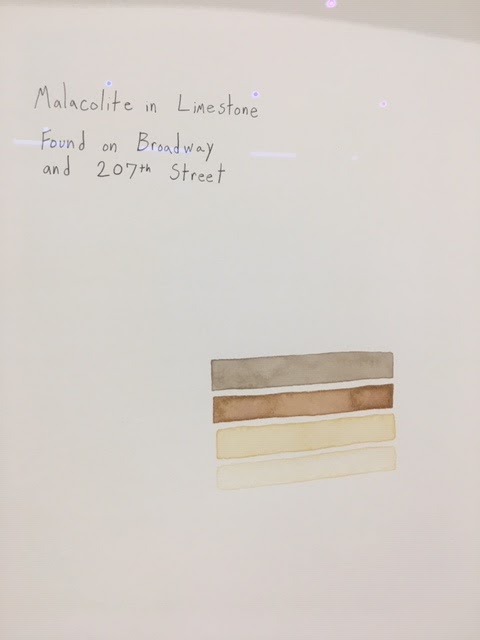
Halperin has made small studies of the rocks she has found, in particular making pairs of drawings, one always analysing the colour range of minerals discovered, and the other presenting an observational drawing done in pencil (graphite). All materials have colour, and as was pointed out in the last post, artists such as herman de vries have made us very aware of the relationship between soil colour and location, each soil sample for instance, being (when dried out and crushed to the same consistency), of a different colour value. Halperin, like herman de vries relies on a formal presentation technique to give verification or honorific value to her collections of colour and observed form. It is as if she regards the streets of New York as being a place for the collection of exotic species and I was reminded of pages of Charles Darwin's notebooks from his Beagle voyages as I walked along past the framed pages of Halperin's observations of New York's minerals.
Malacolite in limestone.
The free e book, Mineralogy of New York: Comprising Detailed Descriptions of the Minerals of New York (State), Natural History Survey by Lewis Caleb Beck, is an excellent companion for this exhibition, because you can immediately delve down into the deeper complexities of mineral formation. For instance malacolite is a type of pyroxene, a stranger to fire, named as such because it was at one point thought that although these types of rocks are often found in lava flows, that these prismatic crystals of four or eight sides, shouldn't, it was reasoned at the time, be there. It could be regarded therefore, that malacolite in limestone, is a mineral with a strange type of agency, that it is a type of 'vibrant matter'.
In Jane Bennett's book 'Vibrant Matter' she stated; “Each human is a heterogeneous compound of vibrant matter. If matter itself is lively, then not only is the difference between subjects and objects minimised, but the status of the shared materiality of all things is elevated." She points us towards other stories, ones that are about an in-common materiality and in doing so she can help us appreciate what Halperin is trying to do. By simply identifying a mineral as being 'found on Broadway and 207th street', Halperin is able to link the narrative of the streets with the narrative of the minerals.
There is a German animation film called 'Das Rad', which takes the point of view of two rocks set into a hillside. For them human action is but a blur of fast movement, far too fast to comprehend, and they puzzle over the various strange things they experience as they become more and more aware of human technology's impact on their environment, but they fail to realise that such short lived ephemeral things as humans could cause such changes. It is as if we failed to realise that mayflies were in fact having a big impact on our lives, which in fact they may. As the advert for the film states, "Apparently, rocks are having conversations all around us, but they talk very, very slowly..."
In the animation, the point of view of human beings is represented in “real-time”, and there are necessary points of contact between the two narratives, which allow us as observers to 'understand' what is happening. Halperin's exhibition operates in a similar way, she provides us with a Rosetta Stone to help us listen to the mineral stories that thread their way through New York and by implication Leeds and every other human habitation that sits upon the Earth's solid ground. As Karen Barad would put it, we have to meet the universe halfway, we need to acknowledge how matter and meaning are entangled and this shift in our thinking is vital if we are to begin thinking about our relationship with the world as a symbiotic one, and one that understands that humans cannot own the world, cannot simply regard it as something to mine for its riches, and that if we don't change our attitudes, the world will at some point become uninhabitable for beings such as ourselves.
Halperin's narrative map of New York (detail 1)
Minerals of New York: (Map detail 2): Graphite and watercolour on Fabriano paper
During the 13thcentury the Eastern Italian town of Fabriano due to its close proximity to the port of Ancona, a port that was particularly open to trade with the Arab world, began to develop a specialisation in papermaking, using the skills that Arab artisans had themselves learnt from Chinese traders. The specialist skills that these artisans developed included the use of the hammer mill, a water driven device that superseded the old stone mortars and wooden beaters that had previously been used to break up old rags and vegetable fibres and which did not produce large enough quantities of pulp or homogenous fibre mixes. This ability to manufacture much larger amounts of paper pulp, alongside the development of animal gelatine for surface sizing, meant that as the Renaissance in Italy developed, Fabriano was ideally placed to supply the paper needed for artists, writers and the new booming business of accountancy. After a period of decline in the seventeenth century fortunes rose again, mainly due to a Fabriano specialism in security paper production. In 2002, the year the Euro became the single European currency, the Fedrigoni corporation acquired the historic Fabriano paper mills; its production of the paper used for Euro bank notes, being a factor of Fedrigoni’s decision to acquire Fabriano. The Fabriano paper mills still continue to produce high quality art papers and in particular make specialist watercolour papers, examples of which you will find on the walls of the gallery, carrying the watercolour and graphite marks left by Halperin as she attempts to record her mineral observations. The Fabriano name has remained central to papermaking in Europe not least because of the company’s decision to make both paper for art making and paper for money making. However Picasso’s portrait of the art dealer Vollard made in pencil on Fabriano paper is perhaps a more interesting story of art and money; initially bought by Vollard for 500 francs, if put up for auction today it would possibly become one of the most expensive sheets of paper in existence. However values change and as theAnthropocene unfolds we may well have to renegotiate our relationship with both art and money and find that we have a much closer affinity with the minerals of our everyday environment than we thought we had.
Picasso: Drawing of Vollard
References and Links
Deleuze, G. and Guattari, F. (1983) Anti-Oedipus London: Bloomsbury
Barad, K (2007) Quantum Physics and the Entanglement of Matter and Meaning New York: Duke University Press
Bennett, J (2010) Vibrant Matter: A Political Ecology of Things New York: Duke University Press Exhibition details
Polar opposite: From a series of drawings of fast disappearing animals
In my last post about sub-atomic particles and drawing, I was hedging around having to try and explain what is normally called quantum theory. So once again I’m going to have a go at trying to communicate what I think a complex scientific principle is and explain how I am trying to use my personal awareness of it (awareness rather than understanding, because I don’t think I have a hope in Hell of really understanding it), to inform my approach to making and thinking about drawing.
Quantum theory sets out an explanation of the nature and behaviour of matter and energy on the atomic and subatomic level. Its history is very interesting because as different scientists have attempted to explain it, our understanding of things such as energy, radiation, mass and matter have needed to change.
Right at the beginning of the twentieth century the physicist Max Planck first developed a quantum theory. He had set out to understand why radiation from a glowing body changes in colour as it gets hotter. We have all seen this when heating metal, it gets red, then orange, then yellow and then if you can heat it up far enough, it can get to be a blue colour. Think of our sun, this emits radiation and it’s yellow, but if we are in in the DC fictional universe, Superman comes from Krypton, a planet that circles a red sun that must have been cooler. But what is radiation? In Planck’s time it was thought to be a constant electromagnetic wave, but he couldn’t get the maths right when applying that idea to the reason for the change in colours. So he decided to think about the emission of individual units of energy, which he called ‘quanta’. Quanta being a term that covers all sorts of energy, a photon being a quantum of the electromagnetic radiation that we associate with light. (‘Quanta’ is the plural form of ‘quantum’) What had been sorted out during the previous century was that electricity, magnetism and light were all different sorts of electromagnetic radiation and we are now aware that there are waves of energy moving all around us in the form of TV and audio transmissions, gamma radiation from space, light and heat in the atmosphere, x-rays etc. Scientists understand them all as electromagnetic radiation, their waves of energy being called electromagnetic because they have oscillating electric and magnetic fields.
But we need to go back in time a little to sort out how these what appear to be very different things were seen to be all related.
But first of all there is that diagram that I’m sure many of you have seen before that shows how the various types of electromagnetic field are related. The visible light spectrum is enlarged because it is the one most important to us.
Electromagnetic spectrum
It was James Clark Maxwell who first unified the fields of electricity, magnetism and optics. He described light as a propagating wave of electric and magnetic fields. My understanding of propagating is that it refers to something’s ability to transmit something, or bring something forth (like a new plant) in this case light, through a medium. So this particular wave carries light, whilst others carry for instance radio waves. But I also think this is a problem with words, I cant see how a field can also be a propagating wave through a medium, unless the field is its own medium, within which the photon moves.
I think it is reasonably easy to visualise the relationship between electricity and magnetism because we have all seen experiments such as the moving of a magnet over a wire to induce an electric current. The one seems to be caused by the other and vice versa.
Maxwell relied on Faraday’s visualisation of magnetic and electrical forces as being like fields that extend into space. These fields allow for the transmission of forces to other charges. Such as in a magnet positively charged elements will head towards a negative charge.
Faraday visualised electric charges as producing fieldsthat extend through space and which transmit electric and magnetic forces to other distant charges. But he had to visualise a field, so I can sort of see another word based problem. I think of farmers’ fields as extending to two dimensions, but these ‘fields’ must be far more complicated than that. So how did Faraday think of fields? The term was originally used in mathematics to represent any physical quantity whose value changes from one point in space to another. So and I’m sure I will have got this wrong, if I want to measure the average temperature of lets say a brick, there would be lots of different temperatures to measure, all of which would be contributing to something I could call the overall temperature. For instance a point in shadow near the brick’s surface might be cooler than another point in full sunlight, but colder than a point near the bottom of the brick. This would mean that I am specifying a distribution of numbers, one for each spatial point. The temperature “field” would therefore be an accounting of those numbers. As a visual person, I could visualise this as a three-dimensional graph, having x, y and x axes. In this way I could think about a field as an expression of the spatial coordinates. The temperature would however be constantly changing, the brick being much colder at night, so the field would also vary with time. If a field is expressed as a function of spatial coordinates together with time it would look like this as an equation; T(x, y, z, t), where T is the temperature field, x, y, and z are the spatial coordinates, and t is the time. But electrical fields flow and bricks don’t.
How to plot a vector within three dimensional axes
Plotting velocities using vectors
Using vectors to visualise changes in a fluid
If you want to work out the mathematics of things that move, you use vectors, because if things are moving they don’t have a fixed position, but they do have magnitude and direction at each point in space as they move. When measuring the temperature of the brick we were using ascalar method or way of measuring a fixed single measurable entity. A bit like using bit maps to draw with on a computer instead of vector graphics. Vector graphics are comprised of paths, which are defined by start and end points. (See this earlier post) Because they are not made up of a specific number of dots, they can be scaled to a larger size and not lose any image quality. I know it might feel that I’m drifting off the point here but bare with me, because from what I can see so much of what science at this level is about is metaphor, trying to grasp something by thinking about something else, so I’m following my nose again and thinking about something else. Unlike raster graphics, vector images are not resolution-dependent. But I feel that I am resolution dependent, in the sense that my scale sits between the tiny sub atomic and the vast operation of stars like the sun. Vector images have no fixed intrinsic resolution, they display at the resolution capability of whatever output devices (monitors or printers) are rendering them. So are vector images a way of thinking about how electromagnetic and other energy fields can operate at both microscopic and cosmic scales? Am I in effect when I try to think of my day to day operation in the world as I think I see it, more like a raster graphic, having to hold on to the contents of millions of tiny bits of information, rather than being shaped by an idea of an energy field, an idea that can be applied at both macro and micro levels. Is this why everything around me gets fuzzy edges when I begin to look closely at them?
“It’s not what it is but where it is”, was a favourite phrase of myself and other drawing tutors during the time I was teaching students to draw from observation. Drawing accurately was about searching for points in space. Drawing with an attention to your perceptual awareness within this process was about recognising how eye and body movement caused a constant repositioning of relationships, therefore all you could actually draw was the record of the search for something that could by definition never be found. When you are looking to measure movement in space, a vector can deal with speed, as well as direction, something that I had not really thought about when undertaking those now distant drawing classes. The speed of the two eyes’ sweep through a space and of their scan of the objects and their relationships was not something we considered, it was simply taken for granted that a constant oscillation of movement was the actual state within which the situation of looking existed. We did not treat the world as something that consisted of static lumps, but we did ask questions, such as how can mass be visualised on a flat surface? Giacometti was the artist often cited as being someone who understood these things.
Giacometti
Going back to the world of mathematics, if instead of the brick we decide to measure the changing temperatures of a fluid in motion, such as in a flowing stream, or going back to that old life studio, changes in temperature in the air in a room, we would need to use vectors.
What I find interesting at this point is that by trying to understand what is going on I’m becoming more aware of how important it is that I’m always in motion, and if I step back from the world a little, I can see that everything else is in motion too. There is a wonderful Sam Taylor Wood video of a still life that reveals that a still life is in fact never still.
Sam Taylor Wood: Still life
When particles interact, their wavefunctions briefly overlap and when this happens these particles are forever linked, and they change their nature, a single wavefunction describing both particles simultaneously, in a process known as "quantum entanglement". When a measurement is taken, it triggers a series of entanglements beginning with the first particle hitting a detector, and ending with molecules shifting around in the brain of the observer to make them consciously aware of what just happened. However every particle in the universe becomes entangled with every other particle, leading to a single universal wavefunction that describes the entirety of the universe. This seems to me to have a direct parallel with looking. As you look what in word descriptions were objects (chairs, carpets, tea cups, plates etc.) become transformed into a single entanglement of shifting light. Scanning eyes picking up a small percentage of this and a brain/body trying to interpret this conglomerate of light emissions in terms of its potential effect on the observer.
Sam Taylor Wood’s ‘still-life’ is of course about time and the reality is that time is a dimension that non scientists rarely think about at a quantum level. It could be that time is an emergent phenomenon resulting from entanglement, in which different quantum particles effectively share an existence, even though physically separated, so that the quantum state of each particle can only be described relative to the other entangled particles. This entanglement, does seem to keep re-occurring, just as a photon is not a separate particle, it is a flux in an energy field, it is what happens when I take away things and let processes take over.
A never stillness seems to lie behind the way to think about everything, so I think I need to return to science again. The relationship between optics and electromagnetism is a fundamental one and central to what it means to be a visual artist because vision is itself something that would never have developed if light had not existed. On Earth light from the sun provides energy for all living things, it fact it could be argued that we are just a very strange physical form of the Sun's energy. So how does the Sun produce light?
The Sun mainly consists of plasma. Plasma is sometimes called the forth state of matter, (solid, liquid, gas and plasma) and is called plasma because Irving Langmuir who was the first scientist to name it, thought it reminded him of "the way blood plasma carries red and white corpuscles and germs". The Latin word plasma was taken from the Greek and meant 'something formed', 'a mouldable substance' or 'jelly', and although I have to keep reminding myself of how words trap you into thinking about things in a certain way, I think this is a useful metaphor to hold on to. In our blood it is the carrier for vital ingredients such as cells and proteins around the body. In the Sun, plasma is in constant movement and acts as both a carrier and emitter of radiation.
In the Sun’s core energy is produced by hydrogen atoms being converted into the nuclei of helium. This is actually what is happening when plasma, which occurs when an ionized gaseous substance, in this case hydrogen, becomes highly electrically conductive to the point that long-range electric and magnetic fields dominate the behaviour of the matter. This is possible thanks to the extreme pressure and temperature that exists within the core. The fusion of four protons (hydrogen nuclei) into one alpha particle, two protons and two neutrons bound together into a particle that is identical to a helium nucleus, releases two positrons, as well as two neutrinos (which changes two of the protons into neutrons), and energy. This energy is electromagnetic and works its way through the Sun’s outer layers getting less powerful as it does so, finally getting to the surface, where it leaves the Sun in the form of radiation. I.e. energy travelling as rays.
The sun emits all of the different kinds of electromagnetic radiation, (see the chart above) 99% of its rays are though in the form of visible light, ultraviolet rays, and infrared rays (what we call heat). Energy waves travel out from their source in straight lines, which is why they are also called rays. (These are Maxwell’s travelling harmonic waves) The confusion is that energy is sent out as a wave, even though it travels in straight lines, this is called the rectilinear propagation of light. But now I think it gets hard to think about. I have tended to think of photons as being particles of light, but now understand that there are no such things as particles, just bundles of energy, so a photon would bethe quantum of the electromagnetic field, or the force carrier or mover within the electromagnetic force. But it looks as if the scientists want to deal with it as both a particle and a wave. Again it’s a problem with words, if the situation is thought of as a certain moment in a series of events we call light, perhaps it’s easier to reconcile, but this does mean including time as a constant factor and therefore movement, in the way we think of everything.
It is as if our way of ‘knowing’ is being challenged, and my guess is that it has always been the case, because if there are so many energy states interpenetrating my existence, including the energy state that is myself, there must be a sort of built in awareness that allows me to navigate life, because I am just one example of a species that has developed out of many other species over millions of years. This could be very similar to the way that some birds navigate by being able to detect the nonlocal quantum signature of electromagnetic waves. The protein that apparently allows this to happen, it has been theorised, can be found in all living creatures that have evolved to move over distances. Perhaps this is something we have lost the ability to use, but which occasionally trips into our awareness. This could be why we hear echoes of things that aren’t there, intimations of other presences, or portents that drive us to make decisions about which we have no real understanding as to why, things that Janice Radway points to in her introduction to Avery F. Gordon’s ‘Ghostly Matters’, whereby she makes the point that we need to develop a way of negotiating between what we see and what we know and I would add what we feel or tacitly grasp to be the case. This shadow world is usually associated with the subconscious but perhaps this is the way things are, the subconscious being like the awareness of subatomic electromagnetic fields, more to do with being a process than a thing.
But here is the maths, here is the stuff that I’m also suspicious of, because of the way I think it suggests its own answers. In copying this information from the web I’ve tried to leave in the hyper-links so that you can follow the detail.
What Maxwell did was to show that electromagnetic waves describe propagating oscillations in the strengths of electric and magnetic fields. Maxwell’s wave equation showed that the speed of the waves, labeled c, is determined by a combination of constants in the laws of electrostatics and magnetostatics. This is the equation that demonstrates that this is the case:
Where ε0, the permittivityof free space, has an experimentally determined value of 8.85 × 10⁻¹² square coulomb per newtonsquare metre, and μ0, the magnetic permeabilityof free space, has a value of 1.26 × 10⁻⁶ newton square seconds per square coulomb.
The calculated speed, about 3 × 10⁸ metres per second, agreed with the known speed of light, and led Maxwell to conclude that, light itself—including radiant heat and other radiation, is an electromagnetic disturbance in the form of waves propagatedthrough the electro-magnetic field according to electro-magnetic laws.
So here we have the bringing together of a whole series of things that previously were separate, and more recently spacetime itself has been described as a product of the entanglement between objects. It does appear as if gradually everything dissolves into everything else and if so, this helps me as a maker of images to think about their nature and how I try to control them or not, as they arrive. Whether I am drawing in three dimensions in clay or in two on paper, the same issues haunt me. How does the process itself reflect what it is to be alive, to be entangled in the now of existence and yet recognise links to the past and create a space within which to meditate upon possible futures? Conundrums indeed, but ones that are central to this type of thinking. Dualities seem to abound in contemporary thinking, not least the ones I used to find fascinating when I was reading Hegel.
Thinking of dualities the 'is light a particle or a wave?' issue became even more problematic when Heisenberg proved that precise, simultaneous measurement of the position and momentum of a subatomic particle was impossible. The more precisely one value is measured, the more flawed will be the measurement of the other value. This is the uncertainty principle, which became a very important part of what we now know as quantum theory.
The two interpretations of quantum theory that develop the implications of the uncertainty principle are the Copenhagen interpretation and the many-worlds theory. Niels Bohr proposed the Copenhagen interpretation of quantum theory, which asserts that a particle is whatever it is measured to be (for example, a wave or a particle), but that it cannot be assumed to have specific properties, or even to exist, until it is measured. Bohr was therefore suggesting that objective reality does not exist. This translates to a principle called superposition that claims that while we do not know what the state of any object is, it is actually in all possible states simultaneously, as long as we don't look to check. The analogy of Schrodinger's Catis often used to illustrate this idea. Place a live cat in a thick lead box, inside of which is an unbroken glass cyanide capsule and seal the box. We can’t know if the cat is alive or if the cyanide capsule has broken and the cat has died. Since we do not know, the cat is both dead and alive, according to quantum law, it is in a superposition of states. It is only when we break open the box and see what condition the cat is in that the superposition is lost, and the cat must be either alive or dead.
Schrodinger's bears
Schrodinger put a cat in the box to test his theory, he was as human as the rest of us and was quite happy to use another animal instead of a human being. The problem is that we have been putting animals to the test for too many years. Our heavy use of pesticides now decimating the world's insect population, which could be seen as a very slow form of suicide. On the cosmic scale of things I doubt this matters, the Earth is a tiny mote within a universe far too large for us to comprehend. But if we look at anything closely enough it looks just like us and how would we think of a thought experiment of such dramatic possibilities if it was called Schrodinger's son.
The second interpretation of quantum theory is the many-worlds or multiverse theory. It holds that as soon as a potential exists for any object to be in any state, the universe of that object transmutes into a series of parallel universes equal to the number of possible states in which that the object can exist, with each universe containing a unique single possible state of that object. Furthermore, there is a mechanism for interaction between these universes that somehow permits all states to be accessible in some way and for all possible states to be affected in some manner.
This seems to me to be scientists trying to avoid the problem, perhaps what they are really saying is, 'we don’t know the answer'. The fact that all of this stuff only applies to the 5% of the universe that we can access, also suggests that when and if we begin to understand what the other 95% of dark matter and dark energy consists of, we may well find that everything is interconnected and that a common belief in ghosts and other such phenomena has roots in those somethings that we just feel are there but cant experience empirically.
Quantum vanitas
Which brings me back to drawing and drawing’s ability to take us places where logic doesn’t go. I’m not going to argue that drawing in some way taps into other possible worlds or existences, but I will suggest that what drawing can do is allow you to take flight, allow you to become lost in the absorbsion of doing and in that absorbsion perhaps you might be able to tap into fields of energy, in a way unavailable to words or mathematical equations. After all if bees, like dolphins can understand the concept of zero and use what seems like maths to solve problems, we may well have over estimated our skill base. Perhaps what we are missing is simply that bees are more perceptually attuned to magnetic or other fields and from their point of view we are bee-blind.
Diagram from an article looking at the map-like spatial memory of a bee, suggesting that a bee dance is like a drawing whereby they are mapping territory.
In my own work I often find I am wondering through space directed by something I'm unsure of. I believe that I am magnetically charged and in that charge sometimes I find a form.
Drawing in a quantum library
Artists looking to develop structures based on the implications of mathematical forms as indicated by this type of investigation often move into animation. Equilibrium by Memo Akten is a good example of this type of controlled response to the implications of mathematical possibilities.
References
If you want to read about birds and their ability to tap into magnetic fields, this is one of several articles on the subject: A Pauls, James & Zhang, Yiteng & Berman, G & Kais, Sabre. (2013). Quantum Coherence and Entanglement in the Avian Compass. Physical review. E, Statistical, nonlinear, and soft matter physics. 87. 062704. 10.1103/PhysRevE.87.062704.
Honey bees navigate according to a map-like spatial memory: Find the article on honey bees here: Randolf Menzel, Uwe Greggers, Alan Smith, Sandra Berger, Robert Brandt,Sascha Brunke, Gesine Bundrock, Sandra Hülse, Tobias Plümpe, FrankSchaupp, Elke Schüttler, Silke Stach, Jan Stindt, Nicola Stollhoff, SebastianWatzl Proceedings of the National Academy of Sciences Feb 2005, 102 (8) 3040-3045; DOI:10.1073/pnas.0408550102