Showing posts with label ageing. Show all posts

Monday, 29 July 2024

Katja Heitmann and Embodied Memory

Notebook page: The movement archivist trying to retrieve someone.

I recently went to a workshop at Yorkshire Dance led by the choreographer Katja Heitmann. Since 2019, she has been building an archive for human movement: Motus Mori. Working with what she calls movement-archivists, people that I would call observational dancers, (similar to observational drawers), she collects and preserves movements from people of all ages, bodies and backgrounds. From these observations Katja creates new artworks.    

For instance in her work COMMUNITAS, she states, '16 performers aged between 20 and 75 exchange their personal movements amid everyday reality. They support and follow each other’s movements until a collective body emerges. COMMUNITAS brings together 6 self-taught movers and 10 academic dance students from Fontys Academy of Arts, in a moving theatrical ritual. Accompanied by bubbles of spatial sound, they form ritual islands of focus and devotion'.

I was very impressed with her work on embodied memory, and in the workshop I became very aware of how each and every body is a record of its own history; the way we walk, sit, stand etc. each movement of our bodies telling stories, as well as expressing emotion. The workshop also focused on how memories are triggered by physical movement and during the lecture/performance, Katja Heitmann worked with a German dancer who had been operating as a body archivist. As she shared findings from her research around body memory and dementia, she asked this dancer to illustrate what she was referring to.

The dancer sits in the style of a remembered person

I had taken a sketchbook, so was able to do a little drawing between the sessions where the audience was invited to perform. The drawings didn't amount to much, but the work done with our bodies did. We were for instance introduced to the different ways that certain people walk. The professional archival dancer, was asked by Heitmann to remember particular individuals and then to concentrate on how they walked. He would then physically seem to reshape himself and go into the body form of each remembered person, which was an amazing thing to watch, as his neck lowered or straightened, his torso twisted or lent over and his whole body changed. But then he would walk. We would watch and follow. Some people stride heel first, some are flat footed, others raise their knees, some make short chopped movements, others almost skip, some feet splay outwards, some knees touch, some legs bow, whilst some walkers have toes that point to an invisible line passing underfoot. We also explored how each person sits, how we hold our hands when at rest, and how we rise as we stand. We have all developed unique, bespoke body movements and these movements are the language of our embodied being. 

I was gripped by the workshop and wanted it to go on and on, and once it had finished began to ruminate on how all this new information could be processed and brought into the work I have been doing in relation to interoception and the visualisation of embodied thinking. What was so refreshing about Heitmann's work was that it eliminated poor translation technologies. She didn't trust photographs as a body archive technology as they were flat static things, she similarly didn't trust video footage as it was also disembodied and written descriptions were similarly faint echoes of the body's reality. Drawing I felt at least captured traces of a moving hand, but I could see what she was getting at, only another body could truthfully and accurately archive the embodied reality of human beings.  


Notebook pages

I felt I was being taught a lesson. She was right in stressing the limitations of other media as body archive technologies, and it made me think about what I was doing. I am I hope still doing something useful, but it is not archiving how we think and experience our lived reality. My work is to open out the imaginative and poetic potential of experience and its visualisation, rather than to capture the outward visual experience of it. I am not an observational documenter of the world, I am a visual explorer who seeks to tap into the possibilities that sit underneath observations of perceived reality. 

The imagined interior begins to bleed into an external reality

See also:

On horizontality, the body and other things

Drawing and dance

Is drawing a language?

Drawing as translation

Documentation and drawing practices

Thursday, 18 October 2018

Garry Barker 'False Starts' Exhibition

'False Starts' was an important exhibition as far as my own practice was concerned, because it brought together several different strands of my visual research and allowed me to think about how I could use more performative approaches to art making alongside the more traditional gallery exhibition display. I was calling it 'False Starts' because it felt like I was beginning all over again.

Exhibition opened 6pm to 8pm Friday October the 19th. There were drawings, ceramics and prints on display. All of which in various ways were related to getting older and I was looking at mixing between my own story and the stories of others, always looking to develop something equivalent to that moment of epiphany, or divine realisation, that can come when you contemplate ordinary things for long enough. 


The invite was developed from a linoprint I had made in response to having a frozen shoulder. The print was both an image to remind me of how as you get older you seem to get more and more aches and pains and something supposed to act like a votive. If I could transfer my pain into it, the idea was that the pain would go away from my shoulder. Once the pain had been transferred the idea was to then burn the print in a special ceramic oven based on a Roman design. It had a small chimney which meant oxygen was quickly used up and the fire would go out leaving the print only partly burnt. The remains were then framed as a visual reminder. 


The foot and hand containers were made out of ceramic to hold the burnt remains of prints. 

A framed 'burnt' print

Prints in production

'Leg' with radiating pain lino print.

I made prints of several parts of the body and they were made available for people to buy very cheaply and then if on buying one, they wanted to use them to cure a pain, I would burn them. 
However the votives that really took off were ceramic ones. I had made quite a lot of these including ones for toothache. The idea was that you held the ceramic as tightly as possible in your hand and as the rough edges of the fired clay began to hurt the pain in your tooth  would transfer and go away. 


Toothache votive 

I made ceramics for fingers, arms, legs, eyes, nose bleeds, wounds, operation scars, sore throats and anything else people told me they needed curing. 

Operation scar


A few of the many variations of body parts made as ceramic votives

It was however the toothache votives that seemed to do the trick. The most important thing was though that as I became more involved with this, I seemed to be fulfilling some sort of need. I know dentists are the last places people want to go to, but I hadn't realised how many people had been struck off their NHS dentist because they had failed to attend an appointment. I also began to develop short texts to go with the votive objects when I presented them, this one for a ceramic version of a frozen shoulder. 


Dear..........,

This is your personalised votive
It not just represents your shoulder
It is your shoulder

When you get home, find a quiet moment

Look at it
Think about your pain and try to mentally transfer it into 
your new ceramic shoulder

Do this as well as you can

You can hang it on the wall, 
Put it on a shelf 
or 
Lay it down

There is no right way 

As the pain goes you can either move the votive to some other place or smash it and bury the parts


XXXXX

The person that bought this ceramic frozen shoulder votive reported back that the pain went away after two days. 


This is a drawing for a ceramic votive that was never made

But this was only one aspect of the exhibition, it was however the aspect that seemed at the time to have a lot of potential for future development.

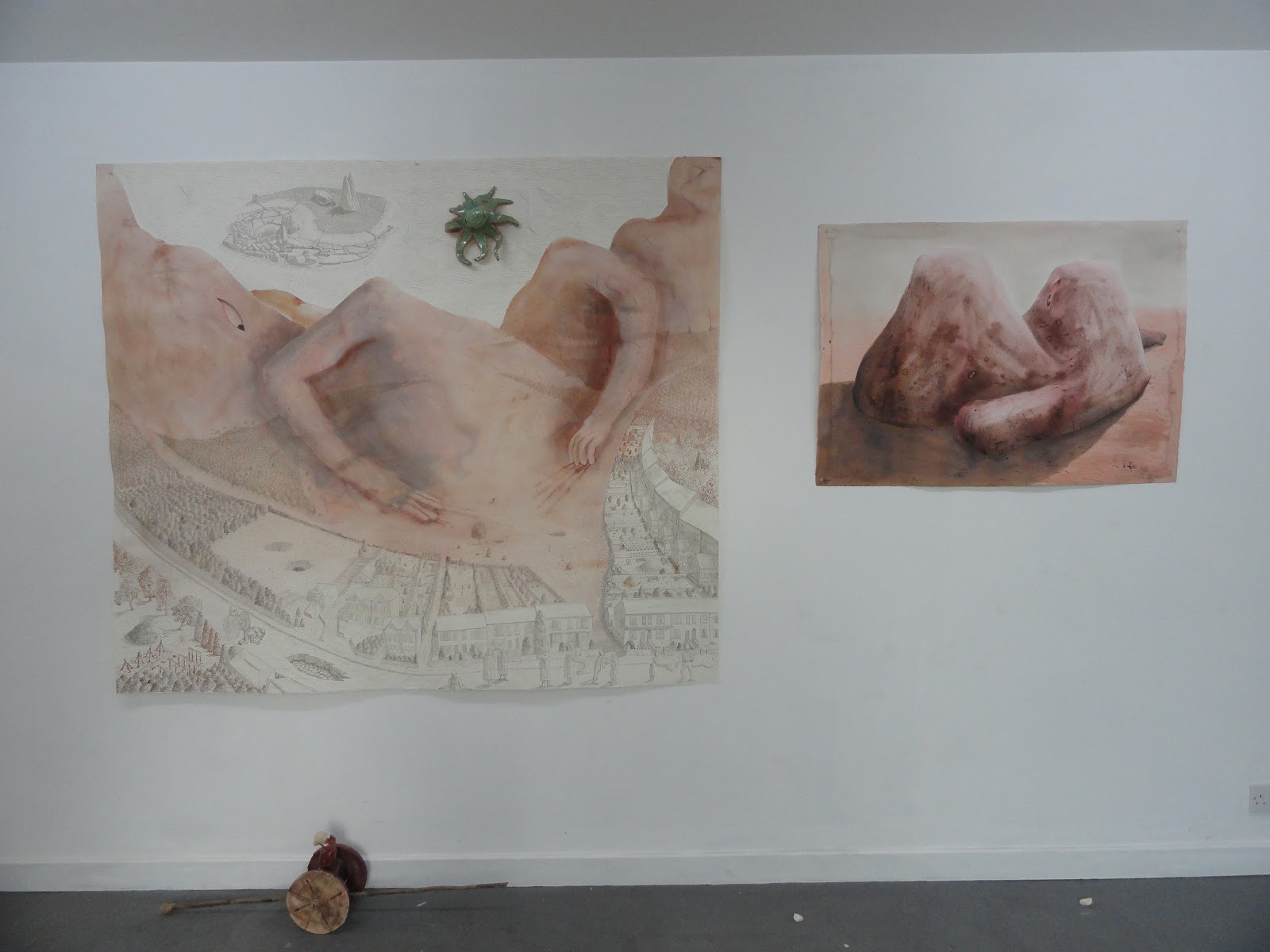
The exhibition was divided into two rooms, the votives were in the first room and the second room was devoted to representations of the ageing body in conjunction with its memories. The experiences I have had about a gradually developing arthritis as I get older, together with my slowly changing memory patterns, were fused with imagery developed in response to me talking to other people as they get older. In particular I had recently joined the group, 'Life hacks for a limited future' a small group of professional people who are all getting older and who wish to face this fact together, rather than as isolated individuals. So in many ways I was becoming an ageing 'professional', or an artist that was more and more drawn to the process of ageing as a subject matter. Because there is an architect in the group who is keen to visualise needs, I was also keen to help develop other supportive resources. The diagrams that I drew as part of a process of trying to visualise what was happening, were as far as I was concerned, just as much 'art', as the more emotive realisations. 


A diagram I made for 'Life hacks...' of the ageing process in the form of a scarab beetle

The main part of the exhibition was centred around this drawing below, which is approximately five feet wide. 


The drawing represents the ageing body as a landscape. In this case it has embodied within it two sets of fused memories. Those of my reminiscence of a particular place in Dudley in the West Midlands of England, a place of huge pigs and slag heaps together with memories told me by a neighbour, of a time when she was a girl who lived on the island of St Kitts and of how she ran everywhere and was called, 'Three speed grey dove'. 


Detail: Huge pigs peer over walls

Detail: The runner nears home

Detail: Shooting targets

Detail: Mythic island

The drawing went through several stages and its final form was suggested after a phone call from my cousin, who reminded me that when he used to sleep over as a boy he always brought with him a soft toy octopus, a toy I really envied. I therefore decided to make it from memory in ceramic and embed it in the drawing. 


Final image with ceramic octopus embedded. 

I made lots of variations of body forms, often thinking about the body's weight and of how as you get older you seem to carry your body and not simply inhabit. Sometimes my imagery was about how if you are not careful your body feels as if it is slipping away from you and you need to pull it back on. At other times I was trying to get across the idea of the body as this lump that needs scratching to give itself relief. 


Studio view when the work was in process


An attempt to visualise the way old knees no longer feel as if they belong to you, they become islands in foreign seas. 

The way your hand becomes incapable of gripping things properly. 


I am sometimes short of breath and these paper bag pieces (above) seemed a simple way of visualising this. I then made ceramic versions which didn't seem to be right, but the ceramic of an arthritic hand did. Sometimes it's useful to switch between two and three dimensional thinking, if an idea isn't working in one it might in the other. 


A detail of the runner from the image above perhaps gives an indication of what was happening in some of the drawings as they became more about scale and of how insignificant you can feel as a young boy or girl when outside in the landscape. Gradually though the landscape and the body became interchangeable, both becoming places to inhabit. 
The exhibition has given me serious food for thought and I continue to look at possible projects that might help me visualise this process of getting older. 

See also:

(im)Material Disarray: Another exhibition