Showing posts with label drawing ideas. Show all posts

Wednesday, 13 September 2023

Electroplating as drawing

I've decided to use electroplating technology to further my ideas about energy flow and transfer. I often draw three dimensionally with clay and so it makes sense to me to think about how I might bring fired clay into the electroplating process. I have now found out that in order to create a surface on my bisque fired ceramics that can undergo electroplating, it is necessary first to coat them with something that can carry an electric current. Looking at industrial processes this seems quite difficult as you need to submerge your object in a bath of electrolytes which then act as catalysts to enable nickel to coat the ceramic material. Once this is done it can be electroplated with the metal of your choice. However I am going to try and short circuit the process and use a graphite spray to coat unfired ceramic material. However there are various sorts and so I am trying a couple of different ones out in order to see what works and I have ordered more graphite power, so that I can also try rubbing it into the surface of forms more directly and then using the spray as a final coat. I like to use graphite as it seems to fit into the extended idea of drawing and I have used it in the past as a lubricant during casting, coating the interior of a plaster mould with graphite powder, so that the cast object could be released easily. I was at that time casting in lead, and it was about 50 years ago, so I'm interested to see how graphite application has changed over the years. Graphite is a crystal allotrope of carbon that can conduct electricity and in order for it to do that, graphite powder can be mixed with a binder such as an acrylic glaze to make a conductive paint.  Apparently there is a commercial version of this material called 'wire glue' available which is used for no-solder electrical connections but I'm initially going to look at graphite spray as I want to keep the surface as thin as possible, so that the texture of the fired clay is not lost. As I'm very much a low technology person I shall just play around with these elements until something happens, it being for myself a process emanating from a form of thinking closer to alchemy than chemistry. If you want to try electroplating yourself there are lots of 'how-to' videos out there. 


How to do it at home electroplating videos

However I'm also thinking of diagrams about how electroplating works and how these can be developed metaphorically; in this case I'm thinking about Benjamin Brett's diagrams that emerged from his explanations of the geometry of the unconscious. These thoughts sit alongside memories of Dada diagrams, that remind me that the diagrammatic form is a very persuasive form of visual rhetoric and that we should be able to play with it. 

Benjamin Bett

The unconscious geometry of the liquid electrolysis of thought

Francis Picabia, Portrait of Marius de Zayas, 1915

Francis Picabia was a car fanatic, he had the money to buy them and they fascinated him. The diagrammatic drawing 'Portrait of Marius de Zayas' is a crazy diagram of a car's electrical circuitry. The two headlights that hang like bells are linked by a black line circuit diagram and a spark plug is connected into a red line version. Schematic electro-mechanical components and circuitry vitalise a women's anatomy and corset in order to give life to a portrait of the Mexican multi creative Marius de Zayas. Yes of course its nonsense, but it is a nonsense that arises out of an understanding of Pataphysics. Pataphysics has been described as the branch of philosophy that deals with an imaginary realm additional to metaphysics. It has also been described as a "philosophy" of science invented by French writer Alfred Jarry, and it is intended to be a parody of science. Difficult to be simply defined or pinned down, it has also been described as the "science of imaginary solutions".

I like the fact that I have had to mix up a solution in order to achieve my electroplating idea and that I am also trying to acknowledge the science of imaginary solutions.

The electroplating is only one part of the sculptural 'solutions' I'm trying to work with, as I'm trying to build objects in a similar way to how you might write a novel. I've been reading Ali Smith again and I love her way of weaving various stories together and how some voices might just have a page within which to articulate a thought and this can be interjected into a main story line or simply put there as a sort of marker or breathing space that allows another idea to emerge. I see no reason for sculptural objects to also have that sort of complexity. 


Drawings for sculpture made to be shown at night

You can just about see that fish tanks sit beneath these drawings for sculptural objects. The images are an attempt to depict how they would be seen at night; these are objects/situations that are designed to both reference furniture and animal forms, the idea being that they give birth to new forms by various processes, including electroplating. I am thinking about this as a type of morphogenesis, or the shaping of organisms by a metaphorical embryological processes of differentiation. The process uses the development of ideas according to the genetic “blueprint” of the initial 'potential' organism, (a drawing) and then it becomes about adapting each object to whatever environmental conditions emerge in the studio, or wherever else I'm drawing or making these objects. 

The forms were initially thought through as a series of drawings, but they are now emerging more on their own volition as objects down in the studio. All of them had to be in some way connected to an electrical power source, either to drive an inserted component, such as a TV or computer screen, or to power other things such as crystal sets or an electrical plating set up. 


Drawings of ideas for furniture/animal objects

I have already drawn an animation that is designed to be run on embedded screens that sit within these constructions and this has been passed on to someone else who will 'upgrade' it from hand drawn cells to CGI using sophisticated animation software. Both versions will eventually be played on the embedded screens. The final sculptures will then become 3D realised diagrams, sort of sculptural versions of Kurt Vonnegut's idea of diagrammed stories. 

I'm not really a sculptor, even though I'm a member of the Yorkshire Sculptors Group. I tend to think as a drawer, whether I'm painting or making. This is why this blog is called 'Drawing', although more and more things are touched upon that might not come under the umbrella of 'drawing', in my mind they emerge out of the practice of drawing as a way to externalise thinking. 


Sculptural constructions in progress

See also:


Tuesday, 6 December 2022

William Anastasi and conceptual drawing

William Anastasi: Pocket Drawings

In 1969 William Anastasi folded a sheet of paper into eight rectangles, making them the same size as his back trouser pocket. As he walked, he held a tiny, soft pencil against the exposed paper inside the cramped space of his pocket; the resulting marks on the unfolded sheet of paper graphed the activity. When he decided a drawing on one section was finished, he refolded the sheet, creating a new blank surface, and the process began again until all eight rectangles had been used. 
He was the first artist I ever came across to suggest that walking was good for thinking, something I still believe is true. “I love walking,” he said, “I find that walking does something to my thinking, to my mental process, that is different from sitting or lying down.” 

When I was an art student in the late 60s and early 70s undertaking my DipAD, conceptual art was a very powerful shaper of possibilities and the musician John Cage and the artists associated with his practices were vital to the milieu that these ideas were emerging from. One of the artists central to these practices was William Anastasi and I thought it would be useful to remind both myself and those of you that read this blog, how influential at the time his work was. 

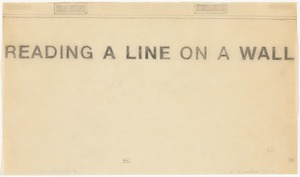
William Anastasi: Reading a Line on a wall: 1967

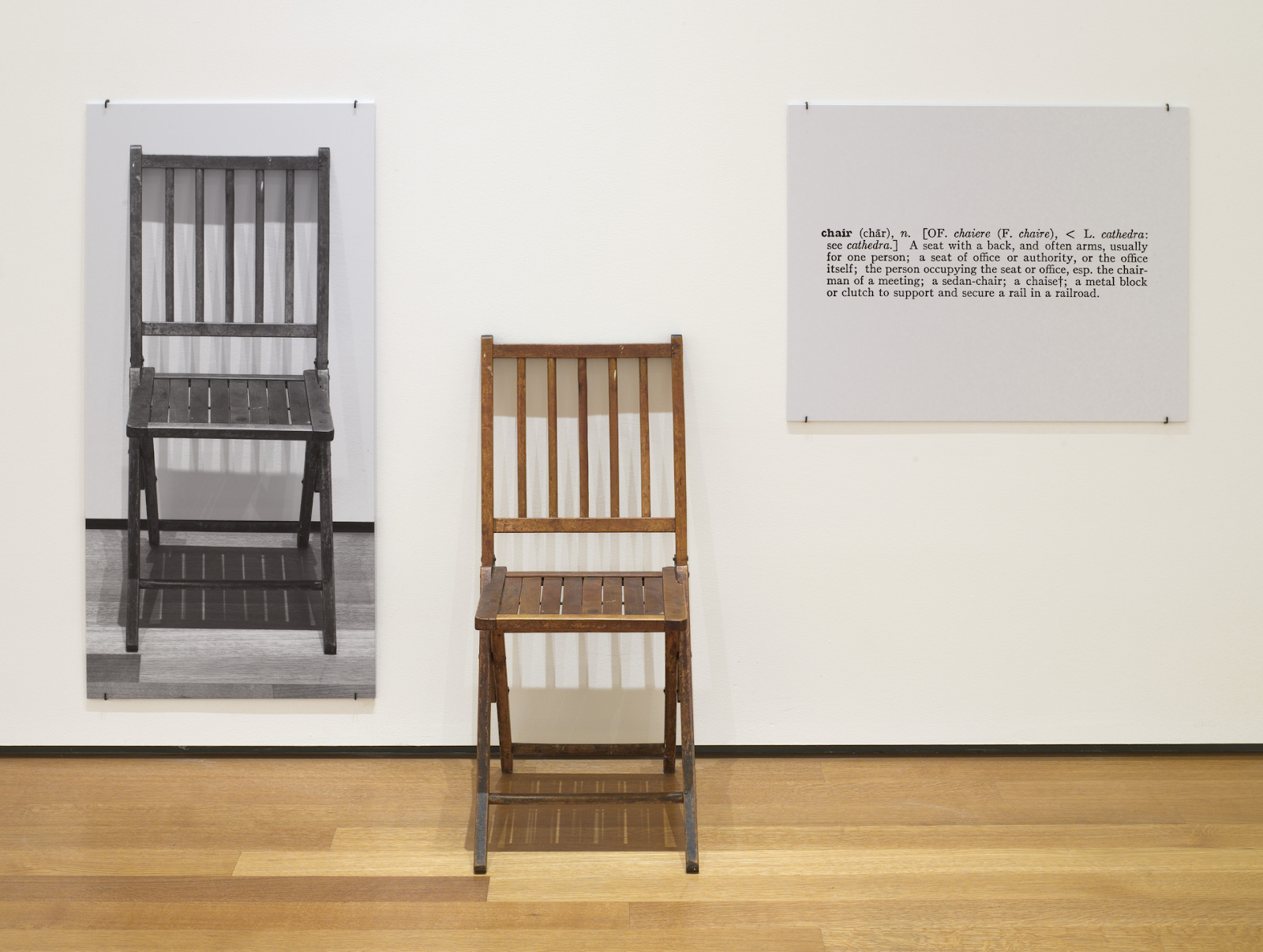
READING A LINE ON A WALL is one of those art pieces that seems almost about nothing and appears devoid of any content aside from the fact of its own legibility. However just like Joseph Kosuth's 'One and Three Chairs' of 1965, it opened up debate as to what was actually going on when we encountered an artwork. Kosuth like Anastasi belived that “art is making meaning,” and like the theorist Greenberg, he believed that most of the art of the Western canon was about artists trying to make responses to what it was to make art. For instance Gombrich's 'Art and Illusion' was a very important text at the time and it was centred on the history of the 
psychology of pictorial representation, suggesting that each new generation of artists was concerned to push the possibilities of visual representation, and that art history could be seen as an ever unfolding set of approaches to getting us to 'see'. 

Joseph Kosuth 'One and Three Chairs' 1965,

In Kosuth's case, by assembling three alternative representations of a wooden chair, he constructs a platform for exploring representational meaning or how we come to determine what things are; he asks the question, "What are the differences between a 'real' thing, its representation and its definition?" In Anastasi's case, the work's content is also about definitions, and it is also firmly in the present tense, as it refers directly to our reflective sense that during the moment when we read 'READING A LINE ON A WALL', we are reading and all distinctions between the content of the work and the activity of the beholder dissolve into a state of self-awareness, immediacy and a truth statement. It is what it is or a 'what you see is what you get' moment, a type of position that also reflects Frank Stella’s famous statement ‘What you see is what you see’, that became the mantra of Minimalism.

As a viewer you are 'asked' to reflect on the implications of reading the word 'reading', an activity fraught with intellectual pitfalls. It is easy to forget but this was a time of complex aesthetic yet conceptual but also semiotic and philosophical niceties, as unpicked very astutely by Tom Wolfe in his essay 'The painted Word'. As a student in the late 1960s I was quickly made aware of the need to 'read' a work of art as a text. Because of the still heavy influence of Clement Greenberg these 'texts' also had to be self referential, Greenberg's 'Towards a New Laocoon'* advocating a development of Lessing's position that different types of art could only carry certain types of content. For instance according to Greenberg painting could only carry messages about paint, surface and colour and that any additional 'narrative' was false and would be an additional interference. Therefore the most highly regarded paintings and sculptures of the day were those that most thoroughly manifested the essence of their own means of expression through various modes of self-referential production. These might be certain types of brushstrokes, or ways of dividing the canvas into areas of colour, or the artist leaving traces of painterly actions, (Abstract expressionism, the abstract sublime and minimalism were all movements influenced by these theories). Like many of the most conceptually rigorous works from the late 1960s, Anastasi’s drawing confronts the criteria of that narrow aesthetic paradigm in a way that is meant to demonstrate some of the flaws in the argument. For instance the sparse white wall in the drawing is an illusion of a white wall. Typical art galleries now hung art against large clean white walls, which was an idea that will soon be picked apart by Brian O'Doherty in his essay, 'Inside the White Cube, The Ideology of the Gallery Space'. What seems very non figurative is in fact a very highly figurative image, of a gallery wall, therefore a dreaded illusion. In fact it is a drawing of a particular gallery wall, the arrangement of air vents, electrical sockets and moulding corresponding precisely to one particular wall of the Virginia Dwan Gallery in New York. The physical flatness of the sheet of paper itself participates fully in the imitation of the wall that the drawing depicts, its size for size correspondence with the actual gallery wall, adding to the conundrum, especially when exhibited on an even larger gallery wall, such as those at MOMA.

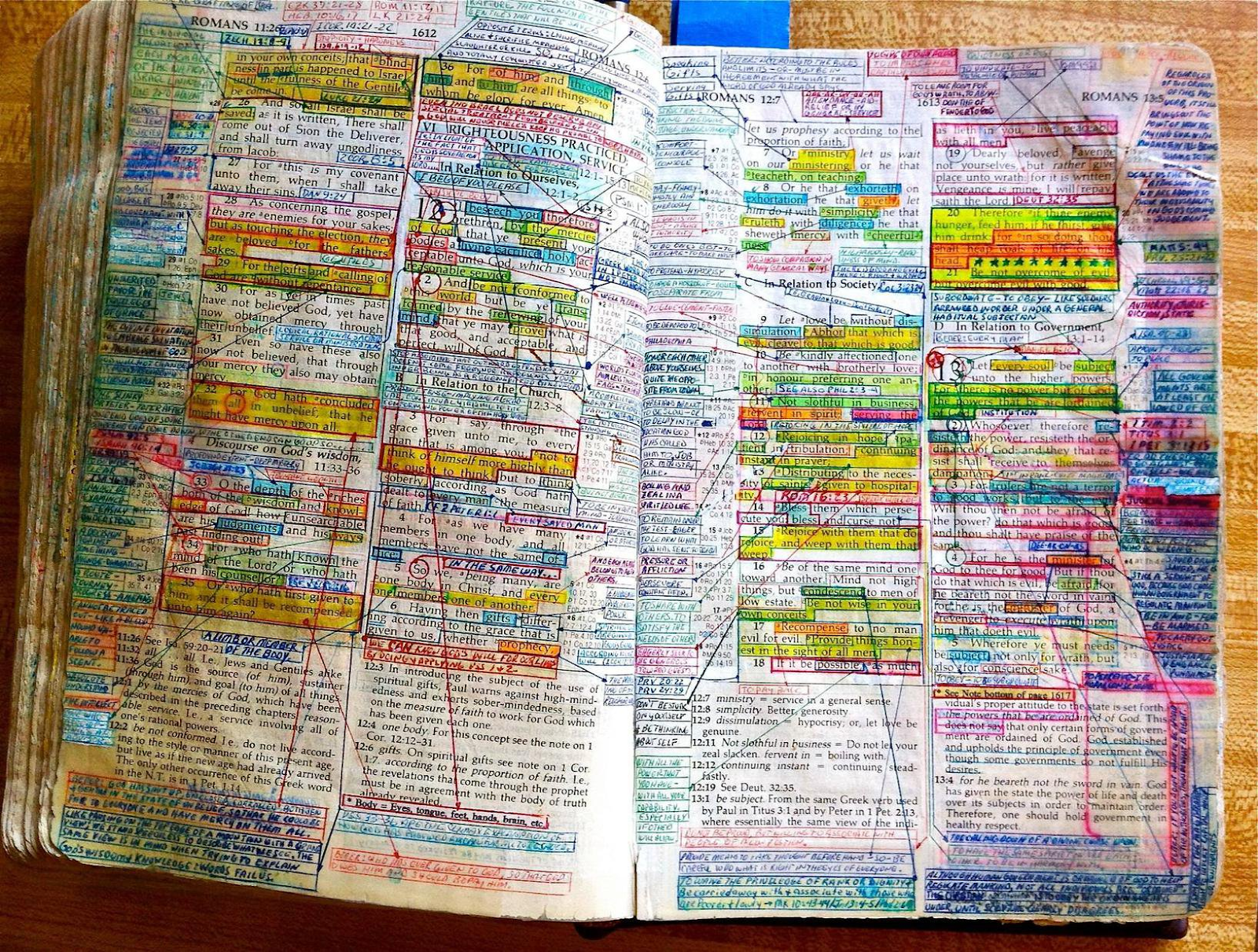
But which line are we reading? The line that suggests moulding or the line of text? The drawn line or the written line? Both lines are central to their relevant disciplines. Lines are the bedrock of both drawing and writing. However the words 'READING A LINE ON A WALL' are in upper case blocked letter forms and as such they are solid forms rather than lines, which they could have been if Anastasi had used a lower case cursive text. Upper case or capital letters suggest something important, like the capital letters surrounding Roman civic buildings, they are authoritative. As you can see by now, 'READING A LINE ON A WALL' takes a fair bit of reading and for a young lad like myself this set of readings within readings was quite liberating and it opened a door to what is known as 'hermeneutics', the branch of knowledge that deals with interpretation, especially of the Bible, where various interpretations are often found surrounding earlier texts. Layers of meaning nested with layers of meanings. 

An annotated Bible 

You can find some old Bibles with already printed 
hermeneutic annotations and when these include the individual annotations made by the Bible's owner the reflective layers begin to get more and more fascinating as you begin to realise how as human beings we strive for the 'right' interpretation. However what we only ever arrive at are interpretations, never answers. This is perhaps the central meaning if there is one to Anastasi's 'Reading a Line on a wall'. No matter how carefully a text is read, even with expert guidance it will always remain unknowable. It is easy to forget the powerful role of critics at that time in determining what was good and bad art. In a post-modern world there are as many answers to what is good or bad as there are questions, but back in a time when people still went to Sunday school and were made to read and make sense of their Bible, it didn't seem so strange that someone in 'authority' might try to lay down a definitive interpretation of art. 

Garry Barker: Handmade Bottle Rack: 1972
This type of self referential art was very popular when I was a student and I was at the time sucked into the game, making several pieces of art that 'cleverly' commented (or so I thought at the time) on the activity of art making. I was bamboozled by theory and persuaded that all good and interesting art was always to some extent a reflection on the nature of art itself, by the staff that taught me at that time, Keith Arnatt in particular. It was not until I read Tom Wolfe's text 'The Painted Word' in 1975 that I was able to get past the what had become a block on my own ability to use art to reflect on the wider issues that I had begun to see as being much more worthy of taking up my time. Gradually I began to see that art's spectrum of human awareness included everything from philosophical debates as to how many angels could be found dancing on the head of a pin, to stories about leaving the washing up until tomorrow. In fact the older I got the more I began to realise that the best and most important stories weren't even told by humans, it was just that we like to hear the sound of our own voices. The 'Handmade Bottle Rack' was very much a response to my own history at the time. I had come to art college directly from working in a steel works and I decided to make Duchamp's readymade by hand. I was trying to make a comment about the way his intellectual achievement, had negated the achievement of the 'workers', those who laboured in factories to produce objects like the bottle-rack and who's labour was usually forgotten especially by the sort of people who would use a bottle-rack. (At that time wine drinking was seen as a very middle-class thing to do, working class people drank beer). I was also making a point about the artist's labour and that 'Judd's dictum', "That anything is art as long as somebody calls it art", was another middle class attempt to take away the meaning of labour, skill and craft from those who worked with their hands. Looking back on the work, perhaps its most important aspect was the fact that I made it in such a way that all the materials could be recycled. After exhibition and it being photographed, it was taken apart, and all the materials given back to the workshop where it was made, so that next year's students could use them. If the job of an artwork was to communicate an idea, then once done, like yesterday's newspaper, it was redundant, and the idea of keeping work for posterity was I argued, a middle class idea about the creation of an elite culture and a way of supporting an evil capitalist art world economy that relied on the monetisation of curated ideas. 

As a young man I was far more 'militant' in my thinking and found a harsh conflict between what I was being taught and how I felt as someone coming from a working class background. For instance my parents loved 'tranculments', (a Black Country word for ornaments) or as I had begun to think of them, small scale domestic sculptures. They carried ideas such as memories of places visited, (souvenir porcelain miniatures carrying names of seaside towns), reminders of old traditions, (horse brasses), a love of animals, (miniature ceramic dogs) and reminders of war (polished and engraved brass shell cases), but I was quickly educated to see these things as kitsch objects. They were I was told cheesy or tacky, this was apparently not art, these were objects that appealed to popular or uncultivated tastes because they were overly sentimental, and I was being taught to see these things as ugly, without style, false, or in poor taste. But in order to fight back I had to learn the language of middle class art and of course in doing so I received the approval of my tutors, who thought my work at that time was good. I had moved over to the other side and become middle class,  my 'educated' stance was understood by other middle class people as clever and the work I did was totally incomprehensible to the rest of my family who still collected souvenirs and polished the horse brasses on weekends. 

As contemporary students you may well have similar experiences. What I found as I got older was that all these things are simply aspects of a human condition that is a reflection of how we make sense of the world around us. The problem is that at certain times you will find gatekeepers to the profession that you want to enter. Whether this is your tutor, Clement Greenberg or your local arts council officer, people will have ideas about what art is and what it is for, and you will have to form your own beliefs and set of convictions if you are to practice art on your own terms. 

* 'Towards a Newer Laocoön' by Clement Greenberg, was a very influential critical text, the title refers both to Gotthold Lessing's Laocoön: An Essay upon the Limits of Poetry and Painting, of 1766, and to Irving Babbitt's The New Laokoön: An Essay on Confusion of the Arts, of 1910. Greenberg is interested in the existence of limits or boundaries that distinguished the differences between the various arts.  According to Greenberg's argument, it is a truth value characteristic of modern art that each type of art had to define itself in terms of the limitations of its 'proper' medium, or in other words to preserve a 'truth to the materials' involved in the practice of the various art forms. 

See also:

The Painted Word by Tom Wolfe

Who's afraid of Tom Wolfe: Judith Goldman's repost to the Painted Word

Walking and drawing More reflections on the influence of Keith Arnatt but also an introduction to the work of Stanley Brouwn another late 1960s conceptual artist who drew. 

Drawing and measurement Another Keith Arnatt reflection

Drawing and philosophy

Facing a blank sheet of paper One of my own attempts to make work that reflects on similar issues

The word 'art' and its history


Sunday, 29 September 2019

The evolution of an idea

I have a piece of work in an exhibition in Halifax at the moment. The exhibition, Temporal Terrains: an exhibition on wheels - is a Yorkshire Sculptors Group exhibition at Dean Clough  and it lasts from 7 Sept to 6 Oct 2019 and like (im)Material Disarray is another fringe exhibition linked to the Yorkshire Sculpture International 2019 festival. The piece is a complex one and I thought it might be interesting to look at how it evolved because I rarely show anyone the scrappy little drawings I do to work my way around a problem, but in many ways without them an idea would never get to fruition. 

This is the piece I have in the exhibition. 


‘How to move a plant in flower’  Garry Barker: A sculpture in three parts: 2019
Ceramic with metal, textile and wooden additions. 

This was the short text written for the exhibition:
Plants are supposed to be fixed to the soil, but in a post-truth age where nothing is as it was or as it ought to be, the distinction between plants and animals begins to break down. Therefore plants will move and as they do they will take on the characteristics of animals.  A selection of a small group of hybrid creatures that totter on the brink of self-discovery, as they ask themselves, “are we animal, vegetable or mineral?”

I belong to the Yorkshire Sculpture Group and they often set particular challenges to group members; challenges designed to ensure we don't get too complacent in our approaches to art making. I enjoy these responses but don't engage with all of them because I also need to keep focused on the issues I'm mainly concerned with, but this particular challenge did intrigue me.  

In particular I had been reading and thinking a lot about how as humans we have privileged ourselves in such a way that other things were ignored or simply seen as resources for humans to use. I had therefore set myself a task to try and make work that in different ways gave agency to non-human things. Such as allowing materials to work in dialogue with myself and trying not to force them to do my bidding, or to use recycling more (as in the (im)Material Disarray work), or to open my conversations out to include non-humans and to try and act as if my role as an artist was more like a conduit between things, or someone that revealed the interconnectedness between everything. Because sculptures had to be on wheels for this exhibition I thought this an ideal opportunity to test out some ideas related to the removing of distinctions between animal, vegetable and mineral categorisations. 

These are some studio shots taken when the sculpture was nearing completion. 


Flower heads develop animal tongues

A fleshy ceramic (mineral) flower emerges from a wooden branch

There is nearly always some book research that bears fruition in terms of ideas development and in this case it was an image I came across in a Medieval book of herbal remedies. The way the roots were drawn looked to me as if they were turning into bear's claws and it reinforced the concept of plants and animals being both things that moved. It is just that they have different time frames. 

Nightshade from a Medieval book of herbal remedies

I had already been making ceramic plants for an exhibition in Patching in Nottingham and had devised a system of stems made from ceramic exteriors with steel rod centres. I had made lots of these as test pieces so I could continue to play with them and see if there were other possibilities. 
This was where drawing came back in. 

Ideas for bases

 The 'flower' sculptures for Patching had rods that went straight down into the ground, a solution that would be impractical for what I needed, so I began to think about other forms and how these could perhaps sit on a flat base and be screwed into place. 

Ideas for 'bone stems'

As I was thinking about the way stems fitted bases I realised that if a plant was to become an animal its stems would have to be more like bones, so I began to look at the green stems becoming white. 

First animal head ideas

The stems needed flowers and the first ideas were simple animal head flowers, which as you can see were far too uninventive and a poor fit. 

As always when stuck for an idea I tend to return to objective drawing and feed my ideas with what nature invents. 

Plant heads drawn from life

There is something already animal like in plant heads (the fact we call them flower-heads indicates the connection). 
Bird flower

The bird head idea was then morphed with the flower drawing, it was better but still not right. 

I then returned to thinking about bases again. 

Rabbit base

Ungainly and too much like rabbit, but it was a germ of an idea. I liked the feet if nothing else.

A badly remembered Renaissance idea

The next drawing tried to morph several ideas of animal forms together and was based on something I had seen before. 

Simplified version of above

Ceramic version of the drawing above, mounted on a wooden base with wheels attached. 

In a simplified form it worked much better, but was now a bit boring, so I persisted. 


Slug base

The slug base

It seemed to me that the slug was a creature between animal and plant forms, (remember I'm an artist and can just decide on any form an invented life might take) I now had several ideas I could take into making and so I made about six or seven variations of these bases and began to test them out in the studio. But I soon came up with a problem and this was how to get everything moveable.

Idea for a cabinet in wheels

The first idea was to deconstruct an old piece of furniture and put all of my ceramic ideas into it, cutting holes for the plants to grow through. I went so far as to make the cabinet by reconfiguring a piece of furniture I took from my bedroom, but it just didn't work. However one of the heads I had come up with interested me and you can see its form in the final piece. I decided to use the idea of cutting holes through things in another exhibition, yet to be realised but coming up in October. 

I had been out walking and brought home with me some branches from a tree that had been recently cut down. There was something about the way the branching worked that gave me a clue how to embed the interconnection into the base construction. 


Thoughts about branches on wheels

I began to see in my head an idea of wheels being attached to the branches and then I could perhaps put rods into them to 'grow' the stems directly upwards as if they were simply further 'growths'. 

But this was far too unstable, and I added an extra branch.


My attention begins to return to bases that can then be attached to wood

Final idea of wooden bases with wheels attached, screwed into the branches.

Eventually with lots of trial and error I made wooden bases for the ceramic bases and then attached the wheels directly to these, rather than to the branches. 

However it was this sketchbook drawing below of a related idea that really helped the concept come to fruition. A ghost of a human confronts a bird and a plant, in a scene that could be from anywhere.

Animal and vegetable actors playing out a scene

I have missed out lots of other drawings of plants with tongues and other bases but hopefully you get the idea of how I use drawing to think through an idea. The textile hanging from the head of the 'Jar Jar Binks' type creature was printed by Spoonflower a company I have used for a lot of my textile designs. 

Design for headscarf

I had made several drawings of men attempting to climb ladders and these were based on ideas coming from reading about Raymond Lull and the ladders of his art. In these minerals are on the bottom rung and God at the top. Humans are above plants and animals, but not quite at the level of angels. My idea was to have a human endlessly trying to climb upwards but getting nowhere. We are at a quantum scale at the same level as minerals, animals and plants and that is something to be celebrated rather than dismissed. The work was about the interconnectedness of everything and so was meant to appear complex. 

So what looks like a pretty confusing mess of a sculpture, (well it does when you photograph it), does have quite a lot of thinking behind it. This is perhaps my greatest problem, I don't think through the lens. This is because I'm someone trained to draw rather than work from photographs and also I forget to try the ideas out as potential photographic images. I still spend a lot of time walking around my sculptures as we were told to do as students. As I do so I try to look for those awkward areas which just don't seem to allow the eye to move on and connect with something else. I strongly believe that the best sculptures make you want to walk around them. 

References

Nightshade from a Medieval book of herbal remedies is from Plant Series, No. 1. Manuscript MS408. Portfolio 2 by Gerard E. Cheshire

The 'Jar Jar Binks' Star Wars character first appeared in Star Wars: Episode I – The Phantom Menace. I wasn't thinking of it, but once the head was made lots of people began remarking on how similar the creature with the textile hanging from its head was to the Star Wars character. I quite liked this, it seemed to connect me to all those other artists that have tried to invent creatures by mixing various animal and plant forms. 

First version of the 'Binks' head

All those early years of reading comic books has something to do with how my imagination works too. The character 'Metamorpho' able to take on the characteristics of any mineral element being a particularly memorable well of ideas. 


For my early thoughts about interconnected 'hyper-objects' see this post.

See also other posts related to my art practice:

When the past overhauls the present Includes link to 360 degree view of exhibition
Drawing it all together
3D thinking Trying to use a 3D printer
(im)Material Disarray More ramblings on how I work)

More posts on sketchbooks