Showing posts with label frame. Show all posts

Saturday, 1 November 2025

Rafts, plinths and islands

If you type into Google "Rafts, plinths and islands", you get a reply that points to the different types of land and structures found in the survival game 'Raft'. However I'm thinking about how we present artwork and how we sometimes try to isolate the work from the world, so that we can contemplate it.
Rafts, plinths and islands are three dimensional ways of thinking about framing. They are also usually associated with sculpture rather than drawing, however there is a fair amount of territory that overlaps and I have in the past looked at drawing as very thin sculpture, a reminder that all physical things, no matter how flat are all three dimensional. 

A building raft

Before I begin my normal ramble, perhaps the most interesting thing for myself is that a raft can be what we build a foundation of a house upon, as well as it being something on which to sail over seas. 

Gericault: Raft of the Medusa

Some rafts are more famous than others and Gericault's 'Raft of the Medusa' is perhaps the most famous of all. The book 'Wreck: Géricault’s Raft and the Art of Being Lost at Sea' by the artist Tom de Freston, being a fascinating reflection on the wider cultural and private significance of the raft.  

As a sculptural base, a raft supports the activity that stands upon it, it also when set flat on a horizontal floor, stabilises it; the plinth instead isolates and raises whatever sits upon it up above what surrounds it and an island is something isolated from a larger mass, a fixed point sitting within a fluid space. You could therefore think of an artwork placed on an island as something that 'inhabits' it, rather than sitting upon it. Each of these things can be seen as supports, in this case for artworks, but what if they have no extra support. 

I can remember first coming across Anthony Caro's work in the late 1960s and one of the things that was fascinating about it, was that it didn't need to stand on a plinth. 

Anthony Caro, Prairie: 1967


By eliminating the plinth the work became part of the world you were in, it occupied the same space as you did. This was such a different feeling to encountering sculpture on a plinth. It felt at the time liberating and democratic, to bring sculpture down from off its aristocratic pedestal. 

Rodin: Hand of God: 1898

Sculpture presented on a plinth, such as 'The Hand of God' by Rodin, is presented to us as if it belongs to another place, in effect it occupies an island that you have to get to in order to appreciate it. The island plinth is rather like another country, the game 'Raft' taps into the psychic feeling tone we have when we encounter islands as places of intrigue, mystery and/or danger
; islands hold within themselves secrets that can only be discovered by exploration and getting there is sometimes a struggle. The plinth standing isolated in a gallery space, operates in a similar way to an island, the work that stands upon it may be new and uncharted, but we know someone has presented this work to us as something worth contemplation. 
The aesthetic 'struggle' to understand what art means is often encountered in galleries, especially if the work on display is of classical provenance. The 'special' nature or 'aura' of the work is signified by the plinth, you immediately know it is of cultural and monetary worth by the fact that it has been three dimensionally 'framed' and presented.  

From the Dauphin website

Companies such as Dauphin operate as art display consultants and if you are thinking about how to present work, it is always worth looking at what they do, if only to steal ideas. If you go to their website you will find that they operate as a service that adds value to the work they present. Compare what they do to shop window displays, where expensive items are spotlit and are given small pedestals to isolate them from other objects or set into felt or silk. For 
art display consultants the art object is no different to any other culturally valuable item, the job is to heighten the allure of the object and at times to give it an almost religious significance. 

Jewellery shop display

St Mark's Basilica treasury

Spotlit and behind glass, the religious treasures of St Mark's in Venice, are presented as objects for veneration. The sculpture as presented by Dauphin it is suggested ought to have a similar level of veneration. However the relics in St Marks are set into a vitrine, a way of presenting things that is closely related to plinths and pedestals but more concerned with religious value than monetary value. I shall preserve the issues related to vitrines for another post, as they not only signify religious value, but the idea of the museum gaze and the sanctity of research. 

The plinth is a modern version of the pedestal. The pedestal is a sort of shorthand version of the column and it signifies Classicism, which was and still is, an aesthetic attitude that suggests the primacy of the culture of ancient Greece and Rome. 

A classical pedestal.

If you place modern sculpture on a classical pedestal or niche, as I have done with one of my ceramics, or in the work of Lee Bul further below, it is framed or separated out from life, as well as curiously, unframed, the incongruity making the observers very aware that they are meant to see that a point is being made. 


Ceramic votive fetish presented on a classical pedestal

Lee Bul: Long Tail Halo 2024

Of course you can simply place your work on a domestic object such as a chair.


Contemporary artists are very aware of these issues, but perhaps the first modern artist to play with the idea of the plinth was Brancusi. 

Brancusi display currently at the Pompidou centre

Brancusi shapes his plinths into forms that chime with the sculpture placed upon them.

Dogon: Kambari style

Certain sculptures made in the area of Africa that we call Mali by the Dogon people are given the attribute, 'Kambari' style. Made at exactly the same time as Brancusi made Portrait de Mme L.R, and for many years before he began carving, these sculptures also integrated their bases into their body forms. They remind us that the carvings are made from tree trunks, the base often being both something that is a 'ground' for the figure to stand on and a formal device that echoes the shape and form of the material that the figure was carved from. Brancusi used to celebrate his 'primitive' approach, often by incorporating elements from Romanian folk art and African sculpture into his work, which he saw as a source of more authentic artistic feeling.

Brancusi: Portrait de Mme L.R. 1914–17

Brancusi's 'Portrait de Mme L.R.', is like the Dogon sculpture shaped out of wood, the supporting base, or plinth, is an integral component of the sculpture, you can't take the top part off and put it on another base. If Brancusi had been a painter, it would be as if he had begun painting onto the frame of his painting. Something that we see happening in the work of Howard Hodgkin, 60 years later.


Howard Hodgkin:Blue Movie: 1986/7

Picasso of course got there first. He realised you could use the frame to play a perceptual game.

Picasso: Still life with chair caning and rope frame. 1912

Picasso asks us questions as to how we see and what we see. The chair caning is a print, a slice of existing life, but non the less an illusion. The letters are real letters, the fractured viewpoints of the painted still life are reminders of the various positions taken by the artist as he looked at the still life and the rope frame asks us to think about the caning again, as its twisted material is of the same material family. But it also asks the question, "`Where does the image stop?" Does it stop inside the frame, or is the rope part of the experience? This conundrum is opened out in some of my earlier posts in particular in relation to the parergon.

We have now returned to the wall space and framing a flat image, hopefully it now makes sense as to why I'm looking at the plinth within a blog focused on issues related to drawing. 

There is a sort of halfway house for sculpture and that is the raft, something that in the case of a flat image is not that dissimilar to the shelf. 

Sébastien de Ga: Aluminium Sculpture on Pallet 1, 2017

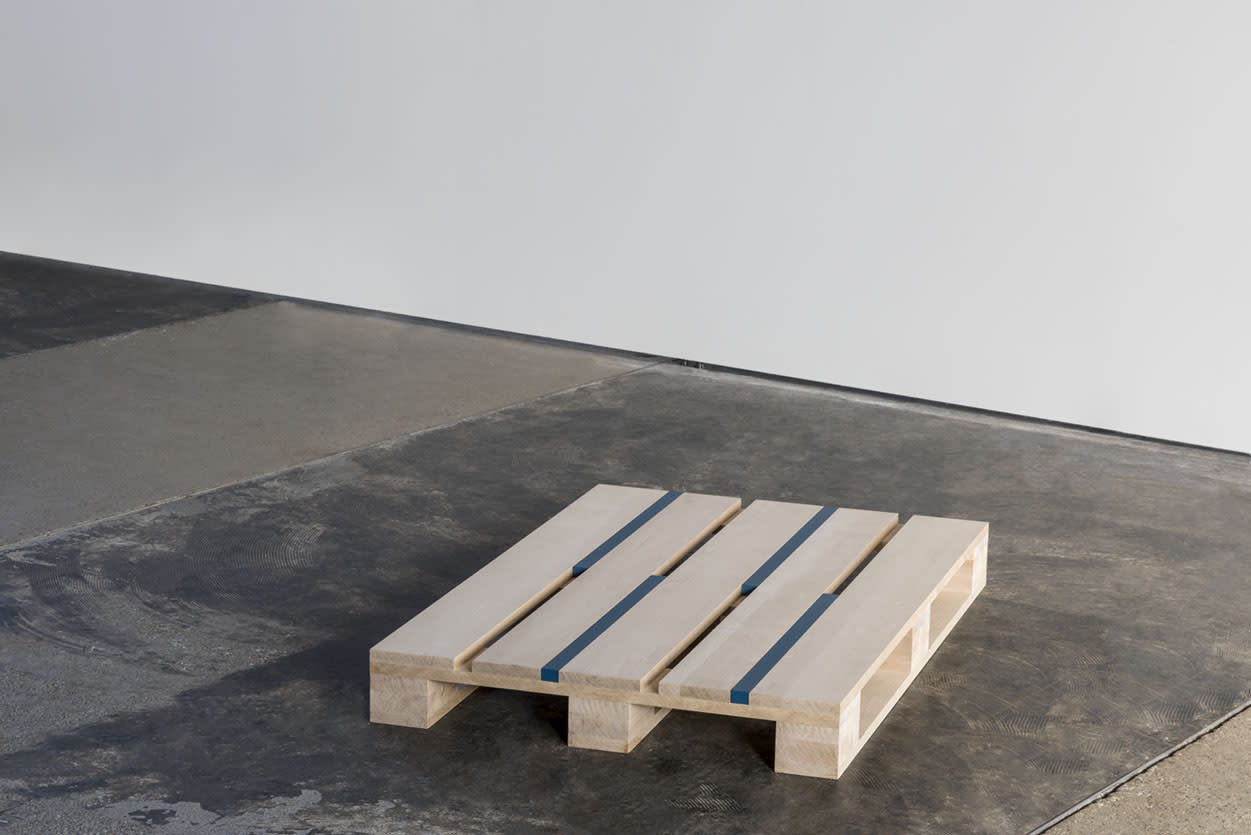
The wooden pallet is often used as a type of raft when presenting work. It is high enough to separate the work out from the floor, but low enough to suggest that the work still bears some sort of floor relationship. Pallets also have a sense of a working life or everyday reality associated with them. They are made for easy manoeuvrability and suggest therefore impermanence. 
The raft can also be a small island, in the case of Hans Op de Beeck's still lives, he 'frames' the work by installing it on a low platform. That halfway house between a full blown plinth and the raft is as I pointed out similar to the relationship between the frame and the shelf, another presentation technique de Beeck uses.

Hans Op de Beeck

Hans Op de Beeck

Standing frames on a shelf or ledge

Standing a frame on a ledge reintroduces the physical presence of the frame. It is another of those contradictions that we sometimes encounter when displaying work. On the one hand we want to cut the work out of an everyday space to suggest that it is something different and that you ought to spend time focusing on the ideas that the work is holding. On the other hand we may want to suggest that the work is available or 'domesticated' is some way. There was some work presented in the last Venice Biennale on old chests of drawers. The sculptures therefore feeling more like ornaments. 

Objects sitting on top of a contemporary chest of drawers

Michael Samuels

Michael Samuels has made sculpture from furniture, therefore the plinth is an integral part of the sculpture, table legs still operating as table legs, even though the table is no longer a table. 

The image above could be a plan view of a gallery floor with island positions marked for sculptures or an elevation view of a gallery wall with flat works displayed as isolated images. On a flat wall the space between images set out like this can feel vast. The difference being that in plan view you are actually in the room space, standing on the floor, therefore you are also activating the room space as an additional three dimensional object, this is not the case on the wall. On the wall you can cluster a group of works together rather like islands and then put one larger work some distance away, suggesting a larger land mass off in the distance. The viewer it is suggested needs to travel between these images, just as you would when sailing at sea. However you travel in the mind, your eyes do the work, as you stand on the outside of the situation. 

So yet another series of things to think about when displaying work. There are always more issues and the next subject related to presentation methods I shall deal with is that of the display case and how that effects and affects the meanings associated with art work. I'll leave that for another post. 
See also:

Hanging work for an exhibition
Trapping and framing
More on framing
The frame and the screen
More theories about drawing (Includes more on the parergon)

Sunday, 2 August 2020

Drawing, the theatre, perspective, photography, light and film

Marion Palace, Ohio: Hiroshi Sugimoto

The word 'photography' means literally 'drawing with light', and I have referred to this connection with drawing several times before. But sometimes a photographer seems to make the connection so clear that it is useful to unpick why a little more. 
Hiroshi Sugimoto came to the attention of the art world in the 1980s because of his photographs of cinema interiors. The images were made while films were showing, but in order for the details of a cinema's interior to register on the film, the camera's shutter was held open for very long exposures. This resulted in a series of images whereby the films being shown were all whited out, their over exposure erasing them and yet in some way also 'recording' the time of their passing, condensing the durations of various films into the frozen moment of a still photograph. These photographs are for me very close to a drawing practice, because they are photographs that can be both read as images that belong to the 'simultaneous now' and as images that can be used to unfold time. 

Movie Theatre, Canton Palace, Ohio, 1980: Hiroshi Sugimoto

The fact that these images also highlight the older relationship between film and theatre is also important. The older use of cinemas was as theatres, hence several conventions of the theatre continued as the use was changed, in particular the continuing use of the stage curtain and of decorative interiors that often echoed the forms that the architect Inigo Jones (1573–1652) had devised as sets for royal masques, and which he later used to design 17th century theatre interiors. Jones was in many ways referring back to the work of Vitruvius and in response to his reflections on Vitruvius he also introduced the first proscenium arch into theatres in England; the decorative architectural frame that presided over the stage. Echoes of all of these things can be seen in the cinema photographs of Hiroshi Sugimoto. 

The drama of the theatre interior has always interested film makers and the type of compositions that result in framing composites of close and far views was something storyboard artists such as Mentor Huebner, have often used very powerfully. It is as if the history of film becomes embedded into the ideas of how 'dramatic' viewpoints are arrived at, in particular those views we have of the stage from high up in the gods or upper balconies. 

Mentor Huebner

I think the rectangular 'crop marks' in the shape of a film frame that Huebner draws on top of his image, forms a beautiful moment of connection between the edges of the two disciplines of film and drawing. The drawn frame sitting astride both disciplines as the image beneath moves from the world of drawn thinking into the world of lens selection. This 'framing' of things being an aspect of language that opens out into a set of related ways of thinking that 'frames' ideas and presents them as if they can be cut out from the world. Essentially the frame of the lens, gives us the idea or reinforces the idea that certain things can be selected and plucked out of the wholeness that is the world. But in reality this isn't the case, all things are in fact interconnected and any one action will impact on everything else. Sometimes I think it is the framing of lens based media that lies behind the fact that we cannot see how consumerism is destroying the world. A photograph of plastic islands floating in the sea is not connected to me, it is cut out of the world by the sharp edges of the image's frame. 

These edges are old ones and they belong to the world of the theatre and the perspective frame. The events that take place on the stage have edges, the front edge of the stage is a dividing line between the audience and what occurs, and the audience understands that this edge is a line between what is real and what is an enactment. A theatrical production can unfold through time, with a beginning and an end and in doing so is designed to help the audience understand or become aware of some aspect of what we often call the human condition. This 'human condition' is itself a sort of framing device. In cutting our experiences and life away from the rest of the world, we have come up with a way of presenting situations as if the world itself is simply a stage for humans to act out their various lives. Early perspective drawings, the layout of the theatre and the invention of camera obscuras, are very closely linked in this conception. As lens based images become ubiquitous, we find our society experiencing the real world as if it is theatre. 


During the Renaissance there were several attempts to create stage perspectives, including those drawn by Sebastiano Serlio (1475-1554), and published in his book 'Architettura'. Serlio's drawings show stadium seating set out around an orchestra, in the centre of which only the duke or prince would sit.  The stage is set at the eye level of the duke, who therefore is the only one with a perfect view of the spectacle. The space is also raked, to increase the illusion of depth via perspective. This control of the eye point essentially gives the viewer power. A power that we forget is still there when a viewpoint for a photograph is selected.  Serlio designed three all purpose settings to place in this 'picture frame', one for tragedy, one for comedy, and one for pastorals. These needed rapid changes of scene and this was initially achieved by the use of a periaktos, an ancient theatrical device consisting of a revolving triangular form made of wood. While one scene was presented to the audience, the other two could be changed. Not only was the eye point controlled but the 'mood' or content of the play was suggested by the set design. Together these controls simplify and clarify the fictive world of the theatre, so that audiences can experience a fable like view of life. It is the frame that allows this to happen, but the things framed by cameras are not fables they are slices of reality and this is I would suggest a big problem.  

In the image below a slice of the world is captured inside a camera obscura and is being contemplated upon by a human being, who in effect turns his back on the world in order to contemplate it. In many ways the interior of the camera obscura resembles a theatre, a box like space within which an isolated set of events can be explored. 


The world of microscopes and telescopes takes the concept of separation and moves it on into an even further dimension of literal distancing.

Galileo in his studio


A 148 feet long focal length Keplerian astronomical refracting telescope 1673

As more and more optical devices were invented, you could argue that human beings became more and more distanced from reality. Humans were no longer 'believing their own eyes' and were beginning to rely on enhanced optical instruments to reveal what had previously not been apparent. The craters on the moon shown by this drawing by Galileo below, are evidence of a new reality born of a fusion between humans and technology. 

Galileo: drawing of the moon:1611

If we no longer believe our own eyes everything becomes fictional and if it is, it is very hard to respond in ways that reflect the actual reality of a situation. This is why we find it so hard to respond to global warming or other threats to our environment revealed to us via technology. Like Sugimoto's photographs the central content is wiped away, whited out due to overexposure, which is perhaps why a return to old fashioned looking and drawing might help us take situations for real.
Cornelia Hesse-Honegger a Swiss scientific draughtswoman, draws images of mutant insects that she finds around nuclear power plants, she finds them by collecting insect samples from contaminated areas, first of all spotting them by eye, but then she does use a microscope to ensure precision, as she makes her very precise renderings. Her work reminds us that we can still use hand made imagery to question the status quo and that it is possible to work outside of the lens based imagery frame. 

Cornelia Hesse-Honegger: Mutant insects


See also:


Friday, 12 June 2020

The frame and the screen

I have posted before on the frame and the screen but have yet to bring together the various ideas associated with them both.
Framing is both a physical and an intellectual idea. The physical act of putting a frame around something operates as if it cuts whatever is framed away from the rest of the world. But it is not quite as simple as that.
Each type of physical framing changes the way we think about what is framed. 


How to window mount

The window mount

The window mount is probably the most common form of presentation and you will see images framed in this way in most art shops. It has various concepts behind it. One is the window of course, a window we look through in order to view the world like a picture, 'the picturesque'. It relates to the 'view finder' in a camera, a frame of selection, whereby the artist presents the best view, or a special selected image for contemplation. But there are other issues at work. Framing is often about degrees of separation, the cutting away or separating of the artwork out from everything else. If we look at the image of the landscape above it is framed by a wooden edge, as well as by a window mount. The physical edge of the wooden frame, creates a certain 'objectness' for the image, it brings it into the realm of 'other furniture', so that although the artwork is not necessarily 'furniture' it can be pulled into an association that allows it to be included within a 'domestic' frame of reference. For instance I'm sure you will have been in a hotel room with a framed abstract image installed within it that is obviously chosen to chime with the curtain design rather than to make you think deeply about existence. This doesn't always work of course, I often find myself thinking a lot about my existence after looking at the framed images on my hotel walls but I doubt these images are designed with me in mind. 

Image of an Edward Hopper painting taken from a framing service website

This is why when you go to a framing service website they will often have images showing you how the artwork will look framed alongside other items of furniture. However, sometimes within the frame, we have a second frame, or a third or even a fourth. 

This frame within a frame, is a device to make it appear as if you are entering into the image. It is meant to make you feel like you are walking down a corridor towards a window that is directly in front of you. You are in effect walking into the image and in doing so you are stepping from one world into another, rather like stepping into the mirror in Alice through the looking glass. This is a very powerful effect, but one that takes you away from reality, so only use this framing method if that is the effect you want.  

A frame within a frame


The card cutout we often call a window mount is called in the framing business a passe-partout, and is put between the picture and actual frame, which is the physical surround that holds everything together.

A collection of passe-partout window mounts


'French matting' uses gold lines to separate the image even further, to enhance the 'aura' of the image. The frame in many ways 'celebrates' the image as a possession. In cutting it out from the world, it can also be a way of making it easier to possess. If you look back at the framed image of a bird in a landscape above, you will also notice that the framing cuts into the edges of the image, (in this case the printing process has cut the edges away to leave a white border, but it is often the window mount that hides the edges of images) a small amount of the image will therefore never be seen and this is another issue artists have to think about when deciding whether or not to have work framed and window mounted. Compare the French matted landscape above with the image below by the Connor Brothers. 


Image 'floated' within a window mount.

The Connor Brothers' presentation fits two ideas together. On the one hand they are trying to reassert the 'objectness' of the image by showing us the edges of the paper by 'floating' the image within a window mount, which itself operates to separate the image out from the world and enhance its 'aura'. The wooden frame, operates to establish both an overall physicality or 'furniture', as well as establishing a degree of separateness from the world, which is furthered by the large expanse of white card between the image and the surrounding wooden frame. We are again looking at frames within frames and the corridor effect is still in play. 


Art Museum framing of a Vermeer

It's interesting to look at how as an object's worth increases, both as financial and cultural capital, its framing becomes more elaborate. In this case it is a complex double framing because the older frame that sits around the painting, is itself now an object of cultural capital, the black surrounding frame having the simplicity of a more 'Modernist' aesthetic. We still in effect walk down that invisible corridor into the image, but it is a corridor decorated in both modern and classical styles. 


Allan McCollum: Forty Plaster Surrogates

Back in the late 1970s Allan McCollum began making his plaster surrogates. What was interesting to me was the fact that they made you very aware of the framing process of art and of how this process was making new objects that were themselves part of the art idea. Take away the artist's work from inside the frame and you still have a powerful signifier, which is the frame itself. In McCollum's case his casts also make you very aware of the objectness of the frame. The paradox being that what began as surrogates were now very definitely art objects in their own right. 

Artists, myself included, sometimes want to reinforce the 'objectness' of their drawing or painting by floating the work within a larger box frame, in order to avoid the entrapment or suggestion of a window on the world which comes with a window mount. But in floating an image within a frame, there is an in-built contradiction. Looking back at Allan McCollum's Plaster Surrogates, you can see that the frame never goes away, it still operates as a separator between to put it very crudely, 'art and life'. 

So you may say, "Why not simply hang the painting or drawing directly on the wall?" The issue here is though that walls in the art world are also frames. 

If you look at the 'salon hang' from the late 19th century above, the first thing you become aware of is that there is no wall space. The heavy frames do all the work separating each image one from each other. The owner has bought the lot, and is showing off his or her purchase power. 


In the spotlit image above it is the lighting that frames the work, in fact it is the lighting that reinforces the idea of the 'aura'  of the work of art. The gallery has literally given each art-piece its own individual auratic glow. Turn the lights on and we are left with a white cube space.


The white cube, as written about by O’Doherty is not as a gallery space a neutral container. It is a historical construct that operates to 'frame' the artwork within it in a particular way.  It is an aesthetic object itself, with a particular aesthetic history, which we can trace back to sanitarium design and the need for hygiene. O’Doherty would go on to argue that this aesthetic actually overpowers the work that resides within it. Those white walls are not context free, the apparent neutrality of the gallery walls is just that, apparent, and the gallery's attempts to attain an aura of timelessness by either spotlighting the art or giving it lots of surrounding white space is a sort of salesperson's trick or slight of hand. 

O’Doherty looks at the gallery as a sacred space that is like an archeological tomb, undisturbed by time and containing cultural riches. The gallery is thus constructed to give the artworks lasting value; it is a space designed to immortalise the cultural values of our elite i. e. very rich people. Reminding us that galleries are also shops and like most shops they are designed to get you forget the worries of the outside world, the white cube establishing a crucial distance between that which is to be kept outside (the social and the political) and that which is inside (the everlasting value of art). In this case the artwork is framed to ensure that it is separate from the rest of the world, so that the buyer can clearly purchase its aura. In the case of this sort of art the buyer is also buying into the elite world of art and in doing so, establishing a certain set of credentials. 

Of course once you understand the game you can enter into it. You can play with the conventions and subvert them to your own ends. Framing and presenting can be a political decision as well as an aesthetic one. But it is important to remember that as the number of paintings are removed from the old collection that we see in the 19th century stereoscopic image above, more and more wall space is revealed, and this wall space operates as a frame. It might not be the golden, florid, decorative thing of the late 19th century, but it is just as much a frame, but this time it is masquerading as a neutral space. 

As you can see from this argument, the frame operates in the real world. It operates as a way of giving the observer a cut off or separate space within which to contemplate the artwork, but this operation is a complex one. The space of the frame oscillating between the 'real' world and an ideal space, a space within which art's spiritual or aesthetic values may be cultivated. As the world outside meets the world inside there is a complicated arena within which a certain duality comes into play. Deridda is fascinated by this and he calls it the parergon. 

It was Kant that linked the idea of the parergon to that of a painting's frame. On the one hand the frame is seen as an addition or ornament. It embellishes the artwork, but suggests Kant, it doesn't add anything to it. On the other hand Kant sees the frame as an example of something that is neither one thing or another, it is something detached or separate; detached not only from the thing it enframes but also from its surroundings, (the wall where a painting is hung). According to Kant, the parergon is like the gold leafed frame for a painting, a mere attachment added to gain superficial charm or grace, and which could in reality detract from the genuine beauty of the art. The frame belongs neither to the artwork nor does it operate as an article of useful furniture, you can't sit on it, eat from it or keep yourself warm, but in sitting between the two it operates as a permeable boundary, a space between the domain of the artwork and the environment of the room the work is hanging in. 

These 'liminal' or 'threshold' moments are essential to an understanding of animism and other forms of web-of-life spirituality that encompass both human and non human understandings of the world and I personally have thought of them as being similar to what Lewis-Davis in his book 'The Mind in the Cave' calls the membrane, or how neolithic peoples perhaps regarded cave walls that were used to support paintings. On the one hand they were just that, walls of caves that you could paint or draw on, but they also served as permeable barriers that allowed people to imagine a space beyond the depictions, one that included the world of spirits and a space in which negotiations between different animals and environments could be performed, often with a spirit guide or shaman. 

My understanding of Derrida in relation to this comes via Hegel. Hegel wrote extensively about the master/slave dialectic. The idea being that in a relationship where there is an imbalance of power what can happen is that gradually the one begins to depend on the other and as this dependency deepens the power begins to move from one to the other. I'm not sure how much this happens in reality, but it is a very interesting idea. 

Derrida is interested in dualities, he is always looking for openings that allow him to point out that what you think is happening is one thing but in reality it is something else. So in the case of the frame he suggests that what was thought of as an addition is in fact more important than the actual artwork. In doing this he spends a lot of time discussing the position of the frame as both in and out of the world and this is where I would like to bring the screen into the discussion. Like the frame, the screen also sits between one thing and another. It frames the images that appear within it and operates as a physical object in the 'real' world, you can hold it and touch it and treat it like a piece of furniture, but you can also forget it exists and fall into the world it contains. 


The selective frame and the circular lens

The formal issue that has always intrigued me is the relationship between the circle and the rectangle that happens between the lens and the sensor. The cartoon above epitomises the problem, the lens has a circular focus that cuts away the rest of the world, thus whatever that part of the world is linked to and shaped by is cut away, but then this cutaway is further re-framed within a rectangle. This action often totally changing the meaning of the event. Framing part of a wider complex event can even reverse its meaning; in the drawing's case, the left hand now threatening the right hand half of the image.

The Edinburgh camera obscura


If you go to see a working camera obscura, such as the one in Edinburgh, the first thing you become aware of is the nature of the curved image. This is what it is like inside the camera, but imagine a frame that is then placed over this circular image, and this is where the film or other photosensitive area is positioned.


The reframing is for a technical reason, the quality of the circular image worsens as we move farther from the lens' point of convergence. As we move towards the edge of the circle, images are dimmer, blurred and smudged. This is due to the lens, not the sensor. The lens converges light towards its centre, which means as you approach its edges you get less and more diffused light, hence the image edge's fuzzy-ness. This can be compensated for by the camera's sensor. A camera sensor compensates for a circular lens that distorts towards its edges in various ways, and because of a range of distortions, including aspherical elements, chromatic aberration, coma, low dispersion, and a high refractive index, has a lot of work to do. Sometimes it is worth looking at technical issues just to highlight how much the nature of a specific medium is shaping communication, so in this case because we are looking at how framing in photography effects meaning and the fact that framing is also a way of minimising but not eliminating lens distortion, I'm going to try and non-scientifically pass on some information.
At the centre of the problem with a lens in relation to focus is field curvature. Curvature of field, is a natural aberration of all lenses, due to their curved structure and how light moves through them and onto a flat plane. The edges of an image can therefore appear soft or distorted compared to the sharper central area. One of the most difficult things to resolve is chromatic aberration, which is when a lens can't focus the different colour wavelengths all at the same point. Wavelengths of light enter a lens and disperse as they pass through it, in order to get all the different wavelengths to come back together at the point of the sensor, these wavelengths need reorganising in order to become focused. Some very high quality lenses can do that, but there is always some difference in diffraction, the problem is technically called colour fringing. A drawing will as always clarify the issue, so let's look at a few technical drawings of the issues involved.

Colour fringing due to the different diffraction rates of light wavelengths
Lateral Chromatic Aberration is what occurs when different wavelengths of light are focused on the same plane, but at different positions, this being due to the angle of light entering the lens and is visible at the edges of the frame, rather than near the centre, which is why post-production or in-camera solutions are needed to alleviate this.
Spherical Aberration is caused by light rays entering the lens and not converging at the same point. This impacts on image clarity, sharpness, and resolution and is more likely to be seen further away from the centre of the image.
Light entering at different parts of the lens is not refracted accurately
Coma or comatic aberration occurs when light rays pass through a lens at an angle, as opposed to straight on. When a lens design cannot focus these angular light rays at the same point, the point light source will be depicted as a teardrop highlight, rather than a circular highlight. This can be minimised by stopping down your lens.

Light coming at the lens from an angle

Photographers are used to compensating for these things, in particular stopping down helps enormously. Stopping down means using a higher f-stop number which decreases the size or diameter of the lens aperture. Reducing the aperture size increases the depth of field, i.e. the focus is sharper over a greater distance. This is why pin-hole cameras really do need a tiny 'pin hole' for light to pass through.

We still haven't quite squared the circle, which is why we still rectangularly frame photographs, when the lens is circular and the resultant image is circular too. The corners of a rectangle are further away from the centre than the middle of edges to the left, right, top or bottom, therefore if there is going to be distortion it will be still be revealed in those corners. In fact early cameras often had circular plates such as Thompson’s Revolver Camera from 1862 and 'button' cameras, designed to make small images button sized and shape that could be actually worn like a button. So it wasn't as if the circular format hadn't been considered. The frame as a rectangle, is a powerful concept and somehow it feels right to slice out recorded segments from life with a hard straight edge rather than a circular one. The telescope and the microscope both retain the circular form that reflects the shape of a lens, but as soon as we wanted to record directly what was seen through these optical devices, it was the picture within a rectangular frame that was the right format.
Thompson’s Revolver Camera 

As soon as an image is made it has to fit a 'rectangular' world. Walls are rectangles and so are tables and shelves. Its easier to make right angled frames and film on a roll or as a plate is easier to use with rectangular formats. So there are a lot of simple practical reasons for retaining a rectangle for the photograph, but they are all linked to our overall shaping of the world with geometry. Cave paintings were not in rectangles, it is only when geometry begins to impose itself on construction methods that the circular or more organic form becomes relegated to history.

Buildings have been built using geometric principles for thousands of years, but the idea of the frame in relation to a moveable image is quite recent. It is believed that Egyptian Fayum mummy portraits from around 2,000 years ago were made before the person died. They were then hung on a wall until they died and then the portrait was fixed onto the coffin. Whether or not this is true, and there are arguments about how they were used, these images were portable and they would have been placed around the painter's workshop and probably taken into various residences in order for the artists to catch a likeness of the person. There are traces of a surrounding frame on many of them, there frames may have been to fix them to the coffin or to display them on a wall or for both reasons, whichever reason is right, these were portable images that were at one point framed.

Fayum mummy portrait

Before the portable frame, there was the border and the border operated as a frame. I have been to see the mosaic of the stag hunt at Pella near Athens and you can look down on the floor from a balcony above, as well as walk up to the edges of it on the ground floor. The surrounds operate as a powerful set of symbolic forms, setting the scene of human /animal inter-action within an environment that signifies the wider 'cosmic' arena of nature. The frame in this case is a floor and the image an incident or moment to be picked out within a surrounding world of land and sea life. 

Stag hunt: Pella

We can see the link between architecture and the frame in Classical Greek ceramics. Columns are often used to divide spaces up, the artists obviously linking the idea of an important three dimensional architectural space, often signified by tall columns outlining the entrance, with two dimensional scenes operating around the continuous surface of a ceramic vessel. 


Although borders, or columns acting as frames in ancient art were used to divide scenes as well as provide space for ornamentation in both pottery and wallpaintings, the first wooden frames surrounding images as we know them today appeared on small panel paintings in twelfth and thirteenth century Europe. Often painted onto one solid piece of wood, the area to be painted was carved out, leaving a raised border around its edge. The outer edges were usually gessoed and gilded, before any painting was done, which was often the last part to be completed. Much of the meaning was embedded in the cost of the materials and records from this time emphasise the cost of various materials in craftsmen's contacts, the idea of worth being given to an image by artistic invention was something that would have to wait for the Renaissance.  

The use of mitred moulding strips for making the edges of panels came later, and gradually replaced the simple wooden moulding strips that were attached to the outside edges, especially as larger pieces of wood became harder to get hold of, because more and more of Europe's forests had been cut down for fuel as well as for ships, furniture and housing. 

Paolo di Giovanni Fei: 14th Century painting on wooden panel using an engaged frame

The image above has a frame built around it, (an engaged frame) the frame is deeply carved out, the golden space that the figures exist in being a religious space rather than an actual space, the frame being in effect a spiritual building or architecture to place the iconic image of Mary and Jesus within. The frame is used to give the effect that you are stepping from one world into another, an idea that artists in western Europe will return to many times. 

As you can see a frame is a complex idea and one I shall probably return to again and again. It links newer forms of image presentation with older ones and has always been related to cutting something out of reality and making it special. 

The TV when looked at historically has had a wide range of framing concepts engaged with it, and the particular time periods within which these surrounds were developed also have stylistic impacts on the situation. Because the TV was always associated with the idea of 'modern communications' it was also often placed in a containing surround that was designed to state that modernity.


The state of the art TV screen immediately above has a very thin black border and we are often sold an idea that suggests this border is so thin, it creates no separation between you and the reality the TV depicts. The ultra real 'high definition' screen, allowing you into a world that is as real as the one you are in. Although this frame is wafer thin, in some ways the belief in a new 'realistic' technology is not that dissimilar to the belief in a religion. 


In both cases, the argument is that you can escape your messy, difficult reality by passing through the frame into another world. One is a world of sophisticated technology and imagined universes and the other is of sophisticated technology and imagined universes, we just think they are very different, but the panel painting was at the cutting edge of image technology during its time and the high-definition TV screen is too, but for how long?

See also: