Showing posts with label graphic novel. Show all posts

Sunday, 23 June 2024

Kirby dots and Kirby crackle

 
Jack Kirby

In my last post on invisible rays I mentioned the fact that Jack Kirby had devoted much of his career to the depiction of both physical and psychic energies. I have also decided to devote a full post to this issue because a blog on drawing at some point has to acknowledge the influence of Jack Kirby on any artist who read American superhero comic books when growing up in the 1960s. I have in the past referred to Steve Ditko's surreal visionary landscapes, that made up the backgrounds of Doctor Strange comics, but it was Jack Kirby that developed visual languages that gave me an insight into the possibilities of depicting invisible energies.  

An explosion of Kirby Krackle

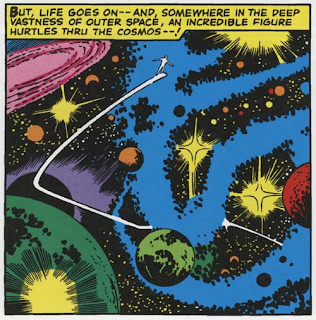
Jack Kirby in cosmic visualisation mode

I'm not alone in recognising Kirby's importance when it comes to visualising cosmic energies, Jeffery Kripal has stated;

 'For Kirby, the human body is a manifestation or crystallization of finally inexplicable energies... What Mesmer called animal magnetism, Reichenbach knew as the blue od and Reich saw as a radiating blue cosmic orgone becomes in Jack Kirby a trademark energetics signaled by "burst lines" and a unique energy field of black, blobby dots that has come to be affectionately known as the "Kirby Krackle" ... The final result was a vision of the human being as a body of frozen energy that, like an atomic bomb, could be released with stunning effects, for good or for evil. These metaphysical energies, I want to suggest, constitute the secret source of Kirby's art'. (Kripal, 2011, p. 286 ) 

Kirby Krackle is also known in the comic book trade as Kirby Dots, when depicting a directional energy ray rather than an energy field. These overlapping dots are a way of visualising a crackle of energy such as a lightning bolt or what has been called in comic book jargon, 'a battle aura', This is a visual sign that lets the comic book reader know that the hero or villain is psyching themselves up for battle. They are drawn as emitting a coruscating, Kirlian-like glow around their bodies as a sign of great inner power. 

The technique consists of drawing a series of overlapping spots or dots along the edge of the energy effect being created, and as you do so you create a white negative space that begins to optically oscillate. 

Bridget Riley

The Op artist Bridget Riley was using a similar effect at the same time, but Kirby was more organic in his approach, which allowed him to be more suggestive in his metaphoric impact. When I was teaching, an interesting visual exercise for Foundation students, was to take a regular grid and begin to set out dots within it. Then to distort the grid and to make the dots follow the distortion. You can do this within a grid made by using curved perspectives if you want to be spatially playful.


Once you have begun to achieve something like the forms directly above, you can start to copy elements and overlap or push some of the dots together.

There now exists a CGI tool for automatically creating Kirby Dots, and an analogous technique called 'particle emission' is used in video game graphics for rendering particle emissions and energy fields. 

Screenshot from a 'particle emission' CGI showcase


Kirby Crackle

The illustration above was adopted from an online Kirby dot tutorial. The negative space around the dots is vital and you can see how they can either represent moving, directional energy or the porous edge of an energy field.

By combining the dots with lines, especially if the lines were in a deep perspective, Kirby (and other artists working with him) was able to give an idea of a sudden blast of energy, as in an explosion. 


Kirby and Sinnott: Captain America

I was first introduced to this idea of spots as a visual language by my school art teacher, Paul Rudall and I reflected upon it in a previous post on Dots and spots. Both of these approaches to using spots or dots as visualisations of energy, came into my life during the mid 1960s and they have stayed with me, becoming more personally meaningful as I get older. 

Live objects breathing and embedded within an energy flow

References

Kripal, Jeffrey J. (2011). Mutants and Mystics: Science Fiction, Superhero Comics, and the Paranormal. Chicago, IL: University of Chicago Press. pp. 286–287

Foley, Shane (November 2001). "Kracklin' Kirby: Tracing the advent of Kirby Krackle"Jack Kirby Collector. No. 33.

Pencil Jack online tutorial for Kirby Krackle

See also:

Parascientific visions and Rayonism

Dots and spots

Stitched, dashed or dotted lines

Visualising energy flow

Lines as symbols of invisible forces

Friday, 17 November 2017

Jasper Johns at the Royal Academy and Paradise Lost by Pablo Auladell

From Paradise Lost by Pablo Auladell


Sometimes an artwork comes to my attention that I'm in awe of. Coming across two things in the same week is a rarity but last week was one of those weeks. I had been down to London on the weekend to see the Jasper Johns exhibition and I thought it was wonderful and then during the week I came across the illustrated version of Paradise Lost by Pablo Auladell. Both of these experiences made me think about drawing but in totally different ways. 


From Paradise Lost by Pablo Auladell

Pablo Auladell is one of those artists that straddles the divide between illustration and fine art. It's a difficult line to tread but one that I'm convinced lies very close to what makes drawing a powerful and significant art form. In some ways both Johns and Auladell tell a story. Auladell is revisiting Paradise Lost like so many artists before him, he has to reinvent the images relying on the same text that stimulated Dore and Blake, but he has to find a way to do this that makes the drawings relevant to us now, to people of the post Modern era, a time of agnosticism and little faith in religion or politics. Auladell develops an image of Satan as an ordinary man, as a man struggling to find a place for himself. The images are post-Freud, they reflect on a son who has disobeyed his father, who choses a hat to single himself out, who can fly, but who has wings that never quite seem to fit. 

Gustave Dore: Paradise Lost

William Blake: Paradise Lost

Jasper Johns is an old man now and the exhibition at the Royal Academy covers the whole range of his life's work. From his flags and numbers and on through to much more autobiographic images made as he gets older. 

Jasper Johns

The rich variations of mark making in this charcoal drawing of numbers above makes for both a beautiful drawing and a space for contemplation. Numbers are peculiarly human inventions and in drawing them with such sensitivity they are elevated in status and in effect they become portraits of humanity. Kant spoke about, "an intuition of the bare two-oneness" when reflecting on the moment numbers came into being, at some point he theorised, one individual human must have had an intuition of the idea of counting, of the difference between one and two and that two was twice one. 


Jasper Johns

As Johns gets older he begins to reflect on the stages of life that he has been through and attempts to develop metaphors from the various types of iconography that he has developed over the years.It is as if the various elements of his practice come back to haunt him and he can't let them go, they have in effect supplanted him. By trying to avoid making images of himself, and instead using objects and fragments of images from other artists he has encountered during his own career as an artist, he has in effect created another self portrait. Just as the numbers become substitutes for humanity, the images full of references to a lifetime's work become substitutes for portraits of Johns in his old age. 


Jasper Johns

The drawing of numbers above was in particular a fascinating image. It is a large drawing that drifts in and out of focus, some areas dark with heavy mark making and others faint with repeated erasures. The drawing pulses with life, it flickers between one number and another as if trying to count itself, as if trying to count for the first time and stumbling over the effort. 

Pablo Auladell

Pablo Auladell also uses the full emotional range of charcoal, he rubs out the greys of a streaky sky and his angels become black ragged birds, beings without their former power. His Satan a gangly ungainly man, who is still trying to stand up for himself even in defeat. 


Pablo Auladell

Auladell inhabits the world of the graphic novel, a tradition of comic art rather than the one of fine art. However I would argue that in these small isolated frames, he is able to make us think again of a moment in literature when for the first time Satan began to have attributes of humanity, Milton perhaps intuiting the man written figure as a product of literary invention rather than a story handed down from God, and in that intuition saw that Satan and his fall was simply yet another metaphor for all of us humans, that in effect we all fall when leaving our parents. We all have to face both a rejection and a realisation that we are both our own worse enemies and the solution to our own problems. Both Johns and Auladell using the rich possibilities of charcoal to give materiality to ideas about what it is to be a human being, to be a creature that creates its own signs and languages, to be a creature with a limited life span and one that is born into a family and to be a creature that has to at some point stand up on its own two feet, but that will at another point have to relinquish all that he or she has achieved. 

The Johns exhibition is on until the 10th of December, do try and get there if you can, Pablo Auladell's Paradise Lost is available from Jonathan Cape and was published in 2016.