Showing posts with label perceptual flow. Show all posts

Saturday, 20 August 2022

The wave form

Representing music

Time lapse image of a bird in flight

Every now and again I like to look at those very basic visual forms that are also entoptic images, and wave forms are one of them. I have touched upon wave images before; they are like zig-zags, and are related to the way we try and depict moving water, especially the sea and they are often associated with the various ways that we try to visualise music. As I'm very interested in energy flow and how something that appears to be one thing such as a solid mass can either be converted into energy or represented as an energy field, the wave form is something that helps me to both visually and mentally weave thoughts together about these issues, so forgive me but I'm about to go on another tangental weaving run in order to find out what I am getting at. 

I first became interested in entoptic forms after reading The Mind in the Cave by David Lewis Williams. The text explores ideas in relation to the origins of image-making. He attempts to relate the foundations of art to the nature of our own consciousness and how we perceptually experience the world. In doing so he looks at Upper Palaeolithic European cave painting and he links the development of shamanic rituals with experiencing the world of the dark cave and parallels between the hidden mind and the hidden interior of the earth. A lot of Lewis Williams' text is devoted to passages between things, (energy flows), for instance the wall of the cave that is used to make images on becomes a membrane through which the world of the everyday can touch the world of the spirit. One of the key developments he picks out is that of self generated entoptic images, generated by the brain when derived of normal visual stimuli, such as when we are immersed for long times in darkness, gradually dissolving into hallucinations of remembered forms, such as animals that are vital to the survival of the tribe and becoming the starting point for a type of image making that could operate as a conduit between material and psychic states. In this process he sees the origins of abstract symbols, like dots and zig-zags and waves alongside iconic forms, images that have a physical resemblance to what is being signified, such as drawings of horses, bison and lions and this introduces other issues about representation itself and various approaches to 'realism' or 'verisimilitude' thousands of years before the camera came into being. Did our ancestors 'find' existing images in the rocks and other surfaces they used to depict things on and simply clarify them, or could they render images from scratch? Did they draw from memory or was there any form of observational drawing practice? Many depictions of animals are well observed, so did artists from this time simply have better memories of animal form, or did they take time to look so that they could bring fresh memories of recent perceptions into their cave depictions. I.e. did they actively work on being able to render these forms, or was it simply that some people were better at drawing animals than others? 


The shaman figure became central to this type of experience, being the guide who learnt how to control an environment that flickered between different states of reality and the spirit world. Shamans knew how to re-enact the stages of animism, or the entry of human minds into the lives of the landscape and its inhabitants and the entry of the world's various animal and environmental spirits into the minds and bodies of humans, by using drugs, chanting, drumming and images that would often be found flickering in tallow made lights. In a semi-dreamlike state our ancestors would enter a cave and emerge from it after a shamanic experience as if reborn. In this situation Lewis Williams feels was also born 'art' and as such it would always be associated with transformative experiences. 

The wave form is fascinating for myself because it very elegantly straddles the abstract, the abstracted and the formal issues surrounding representation. In doing so it can carry ideas about energy flow through various disciplinary areas and demonstrate that they are all in fact variations of the same idea, that everything is in reality some sort of vibration, an awareness that supports the interconnectedness of everything and the fluid nature of our experience. Flow is central to this, the continuous change that we experience, being one of constant energy and material exchanges. 

Perhaps if I start with waves in the sea and how we understand how they operate, as this very physical understanding eventually leads on to how we can think about both quantum and sound wave forms. 

Waves in the sea are partly a result of the Earth's relationship with the moon. The moon's gravity pulls the ocean water on the earth towards it. Because the moon rotates around the Earth sometimes the moon is closer to one side of the earth than another, as it changes its relationship, it pulls the ocean water towards it and this constant changing pull results in tidal waves. So the energy of gravity is transformed into the energy of water movement. This monthly cycle is one that can also be seen to affect many other aspects of our life on Earth and is therefore a powerful signifier in itself. 
Most waves are caused by wind. Wind-driven waves, or surface waves, are created by friction between wind and surface water. 
Both gravity; (gravitational energy is the potential energy associated with a gravitational field, which is converted into kinetic energy when objects fall towards each other), and friction; that can also be converted into kinetic energy, can be thought of as types of energy containers and transmitters and waves are created by these energies passing into and through water. Waves transmit energy, not water, across the ocean and that is what is interesting about them. Because this is about the fundamental idea of matter carrying, converting or transmitting energy from one place to another, wave mechanics become useful as a way to think about other forms of energy transmission. A diagram illustrates the issue clearly 

The water stays in one place, revolving on the spot as it bobs up and down, but the energy travels longitudinally, in this case from left to right.  

It is interesting to compare the propagation of waves through a cracking whip with how waves carry energy through sea water. When a whip is cracked, the whipper moves an arm up and down, which imparts energy to the handle end of the whip. This motion of the arm creates a kinetic wave in the whip. This wave propagates through the whip and by the time it reaches the tip of the whip, that tip is moving at supersonic speeds, which is why you get a loud cracking of a whip. There is no way the whip hand can move at the speed of sound but the velocity of the whip's tip as we can see becomes supersonic. It is in some ways easier to think about the whip and energy transfer, than a sea wave, because we know the material of the whip cant go anywhere, it is just moving up and down, but in the up and down movement something complicated is also going on. 

Images of a whip being cracked. 1: The initial curve given by the user's rapid back and forth motion. 2: The curve has moved out toward the end of the whip, and the portion of the whip that is on the outside of this curve has decreased. 3: This is just before the curve reaches the tip of the whip. 4: When the curve does reach the tip, supersonic velocities occur and the whip cracks.

Wow, all that energy coming from a decreasing curve. 


So how does it work? Time for another diagram. Point A represents the end of the whip held by the user and moved with force P(t) at velocity v. Point B represents the tip of the whip. X represents a fixed point on the whip toward the handle. Y represents an expanding section of the whip from X to a point that is at the same position as the tip. Z represents a shrinking section of the whip that is the size of the arc from the tip to the curve. The total length of the whip is X + Y + 2Z. As energy travels along the length of the whip, it has shorter curves to carry it, therefore eventually the short curve of the tip of the whip will move twice as fast as it moves at the loop of the whip. The energy within the big curve of the whip hand's initial movement has to be contained in the small curve of the tip and this is expressed by increased speed. The whip lines as captured in the time lapse photographs are also like drawn lines and you can feel the energy changes in a curve as you draw it. The energy from an arm movement, just like with the whip, is transmitted via the pen, that is itself subject to friction drag as it moves over the paper surface and the energy expenditure captured in the frozen mark, just as the whip energy is captured as it is released by the high speed photography. Each linear mark made can therefore be regarded as a type of wave form carrying energy. 
Energy is also about power. When power is blocked it becomes one sided because the energy cannot flow between the elements. Whip energy has its own history, the way that whips allow energy to be built up to an explosive tip, made them ideal inflictors of ritual pain. The crack that magically speaks as speeds reach supersonic levels, becoming a sound of subjugation. In England the Whipping Act of 1530 authorised the use of the whip on thieves, the insane, blasphemers, poachers as well as something to use on men and women even if only guilty of minor offences. People were tied to the end of a cart with their bare backs facing the punisher up until the 1590s, which was when a dedicated whipping post was introduced. The power of the courts to order a whipping was only finally terminated in England, Scotland, and Wales by the Criminal Justice Act of 1948. As a means of subjugation it is most commonly associated with the history of slavery; sometimes wave forms can have cruel histories. 

Drawing of a tomb, Chapel Allerton cemetery, Leeds

In the pen and ink drawing above, several energy systems are seen to converge. The energy of looking is itself translated into the pen strokes that make up the drawing. The plant life is transferring the sun's energy into starches, whilst at the same time their visual forms are energised by moving air currents, both facts represented by pen strokes that have more arm/hand energy movement in them than the marks representing the tomb. The energy of the marks in this case being more to do with the flicker of the eyes needed to see this complex form. There is also an intellectual awareness that a tomb like this represents another related idea of energy transformation, that that takes place when a body dies. Some peoples believe that at the beginning stages of death, the body's energy field starts to separate. Accounts of near death experiences have alluded to perceived changes in how the body's energy field manifests itself during the advent of death. People experiencing being drawn up, lifted, or sucked from their body. Some people remembered a sensation of their whole body going out through their head, others a sensation of a peeling away of their skin as they are being released from their body. (Peck, Corse & Lu, 2017) However on death itself, finally all the energy leaks out. 

Peck, Corse & Lu, (2017), argue that several non-western conceptual frameworks believe that electromagnetic fields underlie the pattern and organisation of biological systems, including traditional Chinese  and Indian Ayurvedic medicine. 'The putative energy “life force,” referred to as prana in Ayurvedic medicine, and qi in traditional Chinese medicine, it is believed flows through pathways called meridians in the traditional Chinese system, or nadis and chakras in the Ayurvedic system. Free flow of this “life force” through the body is thought to support health, whereas disturbances or blockages in the flow of this energy are thought to cause impaired function in organs and tissues, and ultimately illness.... Putative subtle energy centres, convert fast-moving energy obtained from the environment into slow-moving energy in the body. They serve as collection and transmission centres for both subtle and biophysical energy, interfacing with physical organs'. (Ibid) Whether or not we believe in these types of ideas, underlying them is the concept of energy conservation and transmission. I might look at the body as a chemical energy deposit, that slowly releases its energy back into the surrounding environment on death. A tomb and in this case one that is designed to look like one belonging to a Roman citizen, represents an attempt to hold onto the energy flow in order to preserve the memory of someone who has died. Part of the effect is the making of this tomb out of stone. Spirals and plant forms are carved into it, a way of freezing or solidifying things that are normally fleeting and in constant flow. The whole tomb now however beginning to weather away, as rain and wind and ice and snow expend their relative energies to erode and dissolve the stone away. By drawing the tomb in a field of open wave like rhythmic marks, it is as if all the various energy flows are gathered together in one and in doing this an image is produced that will hopefully communicate existence as more like a vibrating pattern than as a solid reality. 

Wave energy is also a central component of quantum mechanics. 

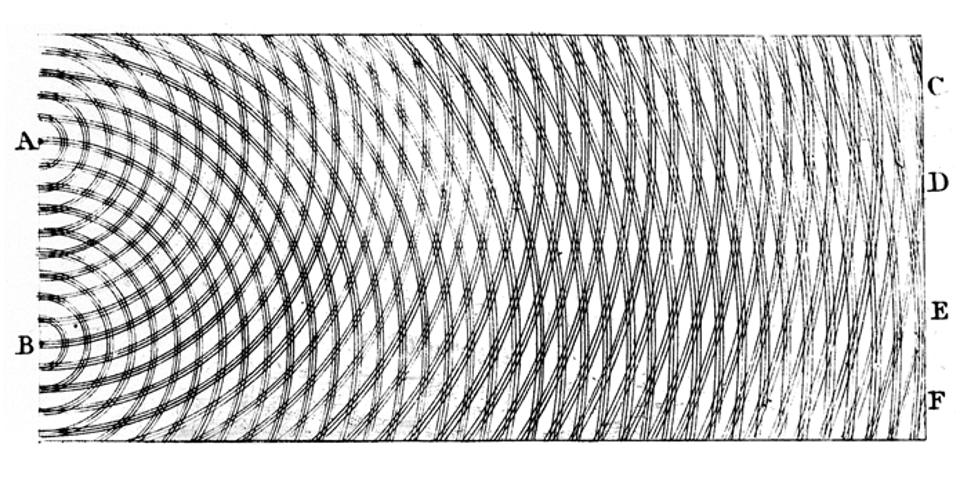
The wave-like properties of light, originally hypothesised by Christiaan Huygens, used an image derived from observations of water. Like waves in water, light waves encountering the edge of an object appear to bend around the edge and into its geometric shadow, which is a region that is not directly illuminated by a light beam. This behaviour is analogous to water waves that wrap around an object, instead of being reflected away.

The combination of an interference pattern with alternating regions of constructive (additive) and destructive (subtractive) interference is a hallmark of wave behaviour and as well as operating in water, it is seen in light and other electromagnetic energy types. However there is the dual nature of quanta to also consider, as they behave as both waves and particles depending on how you interact with them. Experiments have though revealed a wave-like behaviour for many different forms of matter, including forms that are significantly more complicated than the point-like electron. Composite particles, like protons and neutrons, display this wave-like behaviour as well. So the wave goes deep down into the structure of the universe, indeed physicists are looking to mathematically describe the wave function of the universe as a whole. A fluctuation of a quantum wave being perhaps at the heart of how everything began. 


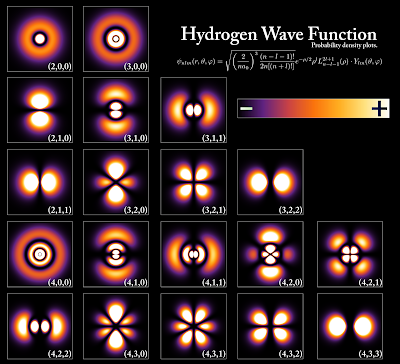
When developing a way of defining wave functions of an electron it was gradually realised that you needed three co-ordinates just as you do when defining a point using an x, y, z axis system. You need a principal quantum number that relates to the average relative distance of an electron from the nucleus and thus its energy level; the Azimuthal Quantum Number, which describes the shape of the region of space occupied by an electron, which in turn will define how the electron sits in the space it occupies and the Magnetic Quantum Number, that describes the orientation of the region of space occupied by an electron with respect to an applied magnetic field. The image above illustrates an electron in a hydrogen atom visualised at different probable energy levels. Quantum mechanics cannot predict the exact location of a particle in space, only the probability of finding it at different locations. The brighter areas represent a higher probability of finding the electron. 

The images that result from the process of visualising quantum wave functions are very similar to those we find when visualising sound or acoustic waves. A visualisation of the wave forms generated by a piano as an octave is played, being very similar to the one used to visualise the wave functions of an electron. Sound is a type of energy made by vibrations. These vibrations create sound waves which move through mediums such as air, water and wood. When an object vibrates, it causes movement in the particles of the medium. This movement is what we call a sound wave.
Sound waves like waves in the sea are longitudinal waves. This means that the propagation of vibration of particles is parallel to the energy wave propagation direction. When the atoms are set in vibration they move back and forth. This continuous back and forth motion results in high-pressure and a low-pressure regions in the medium.
Sound as such doesn't exist, however the rapid mechanical vibrations of various elastic bodies is transmitted to auditory nerves of mammals such as human beings, and are then translated by the brain into what we hear as sound as a way of understanding what is happening. Things need to be moved or struck so as to make them vibrate, and as this happens we observe another energy exchange. 
One of the best visual illustrations of how all this works is the Rubens tube sound wave visualisation, which graphically shows the relationship between sound waves and sound pressure, and which works as a type of sculptural oscilloscope.The original Rubens’ Tube used a four-meter section of pipe that had about two hundred holes across the top which were evenly spaced apart. Both ends of the tube were sealed shut, flammable gas was pumped into the pipe, and a speaker was attached to one of the ends. When the tube was filled with the flammable gas, there was only one route for the gas to escape through, thus creating a row of diffusion flames across the top of the pipe. Since the pressure inside the tube was equalised, the row of flames would stand at the same height. As soon as you play sound through the attached speaker, the height of the flames then changes. The height differences that you see are equivalent to the wavelength of the sound being played. The sounds that we hear are audible vibrations that require a medium to travel through. In the Rubens’ Tube, the sound waves that we hear from the music are traveling through the flammable gas within the tube. As the sound travels down the length of the tube, localised pressure areas will occur. When these areas of pressure are higher, the gas will escape the surrounding holes faster, creating taller flames. When the area of localised pressure is lower, the gas escaping the surrounding holes will cause shorter flames. These high and low-pressure areas are created by the sound waves traveling through the gas. In this way a spoken poem could become a fiery sculpture. 

A Rubens tube: the sound wave is changing the internal gas pressure

Most of us are now used to editing sound on a computer and as we do we often see a graphic representation of the sounds we are editing in oscilloscope form. The image of three sound lines at the top of this post is a typical example. However for myself seeing a guitar string vibrating is perhaps the most fundamental idea, reminding me that the mechanical energy in a curving finger can be transferred to a taut metal string, which in turn transfers its metallic vibrational energies via the air to my ear. The fact that I cant see the air, makes the process far more magical, an unseen energy is out there and at times its propagating waves have affected me deeply. 
One of the fundamental things that art can try and do, is to visualise the invisible, be this the spirit world of an animist or the emotive feelings I have when hearing certain music and at the centre of my visual understanding of all this, is the wave form. 


If art is still capable of offering a transformative experience, I suspect it is in the making of structures that allow for the contemplation of this sort of awareness. In particular drawing as a way to make images has a breadth that allows us to communicate a scientific principle with a diagram, use materials as metaphors that reflect the way things operate out in the world, be a symbolic language that can carry ideas, as well as being able to present all these aspects together as a simultaneity; everything, the materials, the image and the way it is drawn, all these things can be seen and perceived at once, a wholeness which is in itself a deep metaphor for existence. Because of this, even at its most basic level, for instance when making an observational drawing of the perceived world around us, drawing can be a wonderful means of capturing a flow of ideas and percepts within a material framework that externalises thought and coheres it within the frame of a small sheet of paper.  


References

Friday, 6 May 2022

Why interoception?

Days of coughing brings back pains in my ribs that I haven't had since breaking them some years ago

Nighttime itch
Lying in bed and unable to do much exercise causes the body/mind to return to an awareness of its own surface irritations and the need to scratch an itch

Interoception is defined as the sense of the internal state of the body. (Khalsa & Lapidus, 2016, p. 2) This can be both conscious and non-conscious. I have been looking at how to visualise our internal awareness for a while now and the more I do so the more I believe it is central to our grasp of what it is to be in the world. I have finally gone down with Covid and this is the first day since being taken to my bed that I have been able to type anything. My last post on visualising energy flow was put up just as I was starting to feel ill, then I have had three days when my own energy levels were virtually it felt, non-existent. As I start to rest and have more energy, I'm fully alive to the fact that without all that energy flow I have been thinking about, I can do nothing. My awareness of the importance of energy levels feels a bit like an affirmation for what I have been exploring recently, so as I emerge from brain fog, and attempt the re-insertion of my own body back into the flow of experience, I'm going to attempt to clarify for myself and hopefully for any one still interested, what I'm doing and how an artist like myself can even begin to think that what they are doing is any form of research. 

So a few bits of information that I think are central. The relationship between the mind and the body is now understood to be one of a symbiosis between them. (Fogel, (2013), Varela, Thompson and Rosch (2017), Merleau-Ponty, (1969). For instance our body secretes hormones that change our psychological state in response to physical events. In a fight or flight situation, adrenaline is released so that the heart pumps faster and limbs can move quicker. However any stressful situation does the same, so prolonged periods of stress can lead to over compensation by the body, eventually extra releases of various hormones, (basically chemicals, because hormones are our body's chemical messengers), will cause problems and both the body and mind will suffer because of that. If we look at a few more of these chemicals, we can begin see how and why they are so important. The wrong levels of estrogen can increase the risk of certain cancers, lead to depression, weight gain, difficulty sleeping, headaches, low sex drive, anxiety, and menstrual problems. In particular too little estrogen can cause weakened bones (osteoporosis), menstrual problems, loss of fertility and mood disorders. Testosterone can effect sex drive, fat distribution, muscle strength, bone mass, and red blood cell production in both men and women. Insulin converts glucose (sugar) in the things we eat so that our bodies can use the stored energy, if this is not working properly our energy levels become uncontrollable and one symptom of that is diabetes. If you know someone who suffers from this you will be very aware of how this effects mood swings. Cortisol is a type of steroid hormone and is produced by the adrenal glands. It has many responsibilities that keep you healthy and energetic. Cortisol is responsible for helping regulate metabolism, regulating blood pressure, acting as an anti-inflammatory, and even forming memories. Cortisol is secreted during higher levels of stress; if secreted for extended periods it can cause hypertension, anxiety, sleep loss, and autoimmune problems. Too little cortisol is associated with low blood pressure, weakness, and fatigue. Your thyroid gland's hormones regulate metabolism. An imbalance can cause problems with weight management and energy levels. As you can see from this very basic introduction hormones are central to both how our body works and how our mind operates; lack of drive, fatigue, depression, over anxiety and memory loss are just as much a response to hormone production as weight gain, speed of response, the development of cancers, weak bones and our general health or not as the case may be. 

There are direct feedback loops between our heart and our stomach and our brain. These facilitate deeply embedded types of information processing that our logical, language driven part of the brain often ignores, but which in reality are often far more right about the state of the world. For instance people with aphasia; a loss in language ability resulting from brain damage, appear to have a significant advantage in spotting liars, particular when untruths are given away by changes in body language. You know it in your guts and in your heart. 

As interoception is so important to the day to day regulation of our body and mind, it would therefore seem to myself that as an artist I need to embed my processes of visualisation into an awareness of this fact. 

The central issue in terms of visualisation is metaphor. What can work and how to establish a communicable language? For instance growth hormone triggers are produced in the hypothalamus (these are also hormones). which stimulate the pituitary gland to produce and release growth hormone into the bloodstream, which in turn floods out into the body to control metabolism and growth. In my mind I see various coloured waters, each one carrying tiny bits of chemical information that I represent as grains of undissolved pigment and the capturing of colour blending as one mixture begins to intermix with another. 

Like so: 


or


or

Fluids interacting

The suggestion I am trying to make, is that the movement of fluids carrying various pigmented substances can represent the fact that everything that is being depicted is in constant flow, both inside, (hormones, blood etc.) and outside, (the constant perceptual flow). 

Rodin

If you get a chance to see Rodin's watercolours, many of these have a surface that sits between representation and re-creation. On the one hand a figure in movement is suggested by a pencil line and yet at the same time a spreading, pooling sequence of watercolour marks feels as if it is trying to recreate the situation as a material flow. The eye/mind tik-toks between one reading and another and as it does so, the movement originally perceived by Rodin re-enters my own perception of the image. An image can hold within itself competing and various readings, this very ambiguity allowing it to be more capable of communicating some types of experiences than words. 

A flow of energies between inner and outer embodied worlds

Which brings me back to the other issue that I have been trying to deal with, the problem with verbal language. Language it seems to me is a very controlling way of understanding the world. It sort of fixes it or glues it down. Of course words are brilliant at carrying ideas, without them I wouldn't be able to think about things in the way I do, but words do have a way of turning the solid physicality of experience into something both chimerical and at the same time fixed down by the very words used to describe it. I'll try and explain what I think the problem is. Once something is named it seems to take on a life of its own. Look at countries. The Earth is a physical continuity with no edges or boundaries, but once you put a name to a particular area you can draw a boundary around it and as that area is defined by a name such as England, France, Saudi Arabia or the Ukraine, it begins to evolve a definition of itself separate from all the other bits of the world. In point of fact there is no such thing as a solid object called England, only an idea of one. For the brain, a memory is as real as a perception, an idea as potent as a feeling. A written language can be used to differentiate these things and as it does the separation seems to reinforce meanings that were initially only chimerical but which in terms of how humans make decisions is now central, our need for flight or fight now triggered as much by ideas as perceptions. In fact every perception is in some respects a memory idea, and we know that some people have from their own experience developed world views that blur the distinction between ideologies, facts, fictions and memory. Some studies have demonstrated that language loss improves our ability to spot lying*, which suggests that language is not so much about truth but about conviction or the telling of believable stories. The thing is that these believable stories are told with and about words, as well as without words and not about words but they are acted upon as if they are a reality. The situation is that in many ways words are shaping what we think of as reality. In the world of particle physics it is understood that when you measure a particle the apparatus of measurement is in some way shaping what can be observed of the particle. The reality of the situation being a joint state or compound 'apparatus + particle' system, which is not separable because its parts are not independent of one another. The apparatus of measurement produces an entanglement between the measuring and the measured and language I would suggest operates as a type of very sophisticated apparatus that is also shaping what can be observed. Part of its shaping is the construction of nouns to identify separate things and in doing this the world is atomised into small separate bits and these can of course be owned or categorised or listed. 
In novels there are often stories within stories. In Vasily Grossman's great novel of war and ideological tyranny, 'Life and Fate', Viktor Pavlovich Shtrum is a physicist who when he goes to work can be inspired by a wonderful idea, such as of the universe being an entangled unity. He enthuses over the fact that the new physics rejects the concept of individual entities and acknowledges only aggregates. Grossman puts it like this, "But space - measured by metal rods and rulers - and time - measured by the most accurate of watches - had suddenly begun to bend, to stretch and to flatten. Their stability had turned out not to be the foundation-stone of science, but the walls and bars of its prison." However Viktor also realises that the reality of the life he leads will lead to "doubt, suffering and lack of belief". In his day to day experience the tyranny of words that emanate from the communist party and its various committees, can be like nails hammered down into meaning. Throughout the book people are shown to be capable of the most heinous crimes, their language twisting and reshaping reality to fit whatever power happens to be in place at any one time, only a rare few being able to hold fast to a position of moral certainty within a corrupt world of war and terror. 

The interconnectedness of the perceptual flow that we are immersed into is a key concept in Buddhism: “When there is this, that comes to be; with the arising of this, that arises. When there is not this, that does not come to be; with the cessation of this, that ceases” (Ñāṇamoli and Bodhi 1995, p. 655) The belief that everything is interconnected can obviously be expressed in words, but the problem is that the sentence, "Everything is interconnected" has the same conceptual force or truth weight as the one that states, "The concept of global warming was created by and for the Chinese in order to make U.S. manufacturing non-competitive." This quote from Donald Trump, epitomises the issue, he operates as if words have their own reality and anything he disagrees with is 'fake news'. Trump has at least made us realise how slippery words are and how we can become trapped by them. Before the written word verbal language simply floated out into the air and what was said was quickly gone, only retaining a sense of permanence via stories that were passed on orally. It was also clear that the stories were just stories, storytelling being an art that ensured important concepts were passed on, legends were created and elaborated over many years of retelling, what would over time become powerful myths. But once written down, words become fixed, and once fixed they start to sit outside of the flow of life. Words as you can see, tend to generate more words, they don't let you go, you keep writing more and more of them, trying to control what it is you are trying to say, but in reality being controlled by the apparatus called writing. Each letter a nail, each noun a rivet and every sentence a straightjacket. 

The body and its immersion in energy fields

I began this post by detailing the effects hormones have on our emotional state. The apparatus that produces them being our bodies. During war or other highly fraught times, stresses are so high that hormone secretion goes through the roof, and the balance between decision making fuelled by good judgement or by instinct begins to break down. Just as I'm arguing language shapes the world, the body shapes the world too. In making images I'm arguing for an area of thinking outside of verbal language to be considered as a way of decoding experience. Interoception begins in the body and as Merleau-Ponty explained in relation to what he called the “flesh of the world” awareness arises as an event, an event where perception and meaning are born, not as a relationship between a constituting subject and a constituted object but as an intertwining or ensemble of being. The image below is my attempt to diagram this situation, adding into the mix the issue of time. For many peoples, past, present and future are events that occur within a simultaneity, just as the body cant be separated out from the mind, or from its environment, the past cant be separated from the present or the future, all are entangled. I have therefore decided to design an enamel badge to represent this, something very small, but which I believe can be used to represent all of the words not just written in this post, but in this blog. 


I hope I have been able to argue a case for the mind's ability to think using clay and ink and paper as well as other materials, and that by thinking in that way outside of the written word, ideas that are less polemic can be opened out, ways of thinking more open to hybridity and constant metamorphosis can perhaps take centre stage, rather than arguments as to what is right and what is wrong. Hopefully thinking with objects and materials concerns us less with constructions of difference and is more about raising awareness of the connections between things.

Finally and forgive the rambling, as I slip in and out of consciousness I'm also reading and the novel, you may already have guessed that has filled most of my Covid time, has been Vasily Grossman's 'Life and Fate'. Throughout the book there are characters arguing, old Mensheviks and Bolsheviks still bringing up differences, even when the German army sits on people's doorsteps; there are the scars left of Stalin's repressive slaughtering of millions of fellow Russians who didn't follow the party line, a reminder of the Holocaust and how a policy of extermination could be 'logically' embarked upon by a society of believers and what seemed to be the worst thing in my half dreaming state, this Jewish Ukrainian writer, who lived through it all, at times seemed to be writing about the Ukraine now. Radio Four reports of mass graves being dug in Ukraine merging with Grossman's stories of people having to dig mass graves for jews and gipsies. The need to burn disinterred bodies in order to destroy evidence of mass slaughter was systematically developed during the later part of WW2 and tales of the collecting of contemporary evidence of supposed genocide now flows into a nightmare state of unease, slaughterhouse images and worry about the evil nature of human beings and their failure to learn. The book asks a question of each and every one of us, "How would I act in similar circumstances?" I was also reminded of an old image of mine from many years ago now. I was walking through a council estate, and came across a group of people standing round watching a group of lads kicking someone. Something had kicked off, but what it was I never knew, but just like at school when boys got into a fight, by magic a small crowd had formed, not to intervene but to watch. I was deeply disturbed, because I realised my own 'me too' moment. I had quickly walked on, I hadn't been brave enough to step in, I was intimidated by the collective, afraid of the consequences of making people aware that I might think differently . It was much easier for me to make an image about the situation after the event than to step in and try and stop it. Society brings us into close physical proximity but fails to bind us together. Our internal worry as to how others might judge us, it appears to me, becomes more powerful in relation to our subjective decision making, than how we judge ourselves. Wondering what other people say or think about us has probably been the reason why many potentially great ideas have never made their way into the full light of day, but far more worrying is that the same internal fear has also allowed the most awful and distressful crimes to be committed on others, because no one stepped in, no one opened their mouth to say no, until it was too late and the situation became irreversible. 

Watching the wheel turn (1990)

*Ref: 

Khalsa, S. S., & Lapidus, R. C. (2016). Can Interoception Improve the Pragmatic Search for Biomarkers in Psychiatry? Frontiers in psychiatry, 7, 121. From: <https://www.frontiersin.org/articles/10.3389/fpsyt.2016.00121/full> accessed on 06. 05. 2022

Massachusetts General Hospital. "Study Shows Language Loss May Improve Ability To Spot Lying." ScienceDaily. ScienceDaily, 15 May 2000. From <www.sciencedaily.com/releases/2000/05/000512082608.htm> accessed on 06. 05. 2022

Fogel, A., 2013. Body sense: The science and practice of embodied self-awareness (Norton series on interpersonal neurobiology). London: ww norton & company.

Freund, P.E., 1988. Bringing society into the body. Theory and society, 17(6), pp.839-864.

Merleau-Ponty, M (1969)The Visible and the invisible New York: Northwestern University Press

Grossman, V. (2006) Life and Fate London: Vintage

Ñāṇamoli and Bodhi (1995) The middle length discourses of the Buddha, a translation of the Majjhima Nikāya. Boston: Wisdom Publications.

Varela, F.J., Thompson, E. and Rosch, E., (2017) The embodied mind, revised edition: Cognitive science and human experience. New York: MIT press.

See also:

Using pigments suspended in water

Visualising energy flow

Hybridity and permeability 

Paul Klee and Markov Blankets 

Texture and perception