
Walt Disney in front of a storyboard wall
Video games like animation often begin as drawings. Just as some artists use animation as their main communication channel, some artists use video games and video games like animations begin as storyboards. However a game storyboard is set out differently because you have different event levels or plot points that define the game world that you are devising. There will be structural issues related to how many levels and main characters or scenarios you want to develop. (A game doesn't have to have people in it) You may have more traditional animation storyboarding alongside structural diagrams, such as secondary event frames detailing dialogue, character meeting rules, or steps in a sequence.
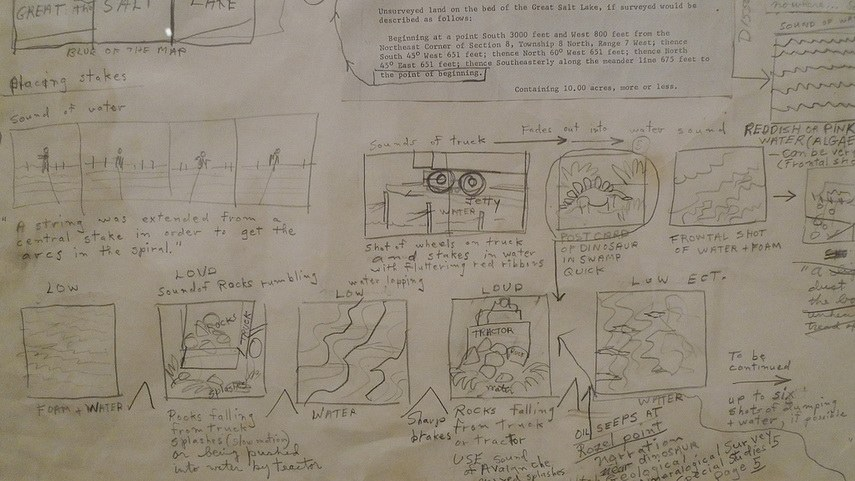
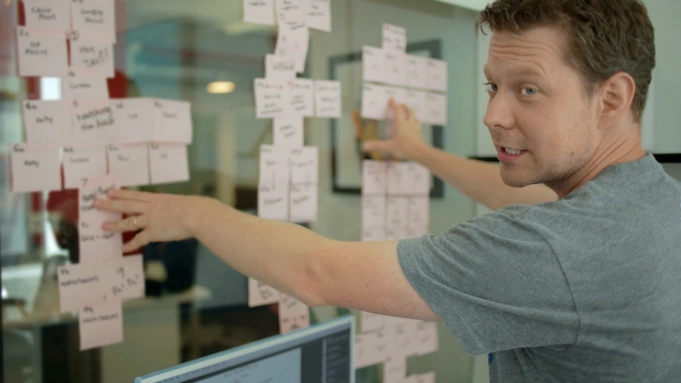
Back in the 1930s Webb Smith, an animator at Walt Disney Studios, started drawing rough sketches of frames needed for his animation drawings on different bits of paper, then he stuck them up on a wall to communicate a sequence of events. If you are wanting to undertake some visual storytelling, whether for a sequence of drawings or paintings, animation, graphic novel or in this case a game, this is a vital tool. Even sculptors such as Robert Smithson used storyboards to work out how their work would be communicated, in the case of Robert Smithson he carefully plotted out how a film of his work 'Spiral Jetty' would be made. If he was working now I'm pretty sure he would have considered the implications of making a game based on his sculptural work.


I'm interested in the Andrew Stanton directed WALL-E, because there is very little verbal dialogue, the character communicating mostly in mime using hand signals, facial expressions and body language. Even if you are not interested in animation, you can learn a lot about how to deal with non verbal communication by watching how character interaction with inanimate objects can be used to emotional effect.



Steve Gaynor, Karla Zimonja, and Johnnemann Nordhagen who are collectively known as 'The Fullbright Company', developed 'Gone Home' which is a game that puts the player in the role of a young woman returning from overseas to her rural family home to find the house empty, leaving her to piece together what has happened. The player has to explore the house and determine what has transpired by examining items, journals, and other items left around the various rooms. Very like Janet Cardiff's walking audio narratives, you build up a story in your mind as you invest time trying to follow what has happened. The story unfolds as you pick up scraps of paper, notes, letters, photos, cassette tapes and other bits and pieces littering the house, which effectively makes it an environmental piece but one with echoes of an artist's work such as Sophie Calle's 'Dumped by E mail'. Each piece of found text helping to build up a picture of what really happened. It is interesting that the game had to be set in 1995 because the designers considered it the most recent year in which technology had not made the majority of communication digital in nature. Perhaps that year will in the future be seen as a watershed year in relation to how society operates.


