Video games like animation often begin as drawings. Just as some artists use animation as their main communication channel, some artists use video games and video games like animations begin as storyboards. However a game storyboard is set out differently because you have different event levels or plot points that define the game world that you are devising. There will be structural issues related to how many levels and main characters or scenarios you want to develop. (A game doesn't have to have people in it) You may have more traditional animation storyboarding alongside structural diagrams, such as secondary event frames detailing dialogue, character meeting rules, or steps in a sequence.
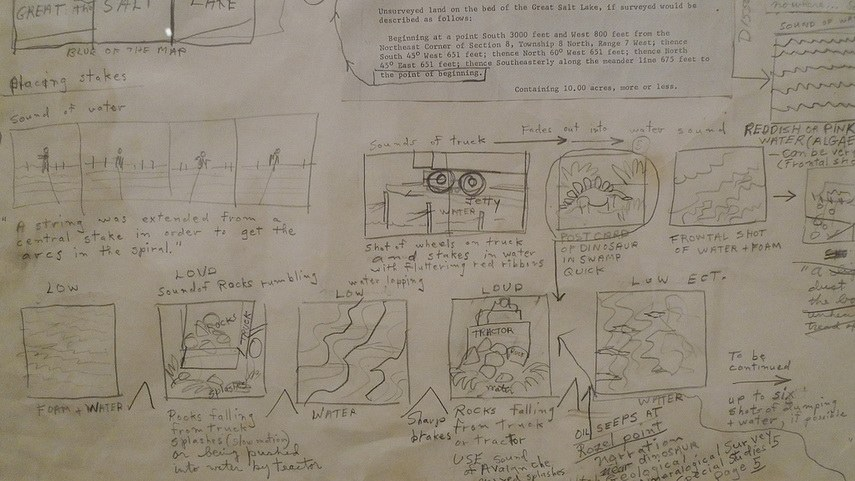
Back in the 1930s Webb Smith, an animator at Walt Disney Studios, started drawing rough sketches of frames needed for his animation drawings on different bits of paper, then he stuck them up on a wall to communicate a sequence of events. If you are wanting to undertake some visual storytelling, whether for a sequence of drawings or paintings, animation, graphic novel or in this case a game, this is a vital tool. Even sculptors such as Robert Smithson used storyboards to work out how their work would be communicated, in the case of Robert Smithson he carefully plotted out how a film of his work 'Spiral Jetty' would be made. If he was working now I'm pretty sure he would have considered the implications of making a game based on his sculptural work.
Notebook ideas for a storyboard of 'Spiral Jetty': Robert Smithson
Movie Treatment storyboard for Spiral Jetty
WALL-E storyboards
I'm interested in the Andrew Stanton directed WALL-E, because there is very little verbal dialogue, the character communicating mostly in mime using hand signals, facial expressions and body language. Even if you are not interested in animation, you can learn a lot about how to deal with non verbal communication by watching how character interaction with inanimate objects can be used to emotional effect.
Wes Anderson is also an animation director who uses storyboarding to think with. He used the storyboard artist Jay Clarke for 'Isle of Dogs', asking Clarke to reference Akira Kurosawa films, for certain visual ideas such as silhouetted framing and dwarfing characters against a backdrop. If you look at the sequence below you can see how closely the storyboard artist has to work with an understanding of camera angle and the emotional impact of camera movement.
Storyboarding roughs, worked up images and final animation
The interaction of human beings with non human others, such as cameras, is also something that is not mentioned enough in books on art theory. As an artist I am aware that unless I am very sensitive to these issues my work will be very poor. The skills that arrive with that of empathy with other forms of being are vital to our survival and all of these skills are used in storyboarding for games.
Super Mario storyboard
Roller Rally storyboard concept
Design for a platform game
The art world has taken a while to accept that games can be developed as a fine art form, but over the last few years like photography and film making, video game design has become more and more accepted as an art form.
Video games as contemporary art
Artists like Alan Butler have involved themselves directly with existing video games, in his case with 'Grand Theft Auto' a game that has detailed sections of real streets as a background against which the gameplay takes place. His work Down and Out in Los Santos (2016-ongoing) is a series of photographs that are created by exploiting a smartphone camera feature within the video game Grand Theft Auto V. Players of GTAV can take photos within the game environment. This operates in basically the same way as ‘real’ cameras do. Butler walks around a simulated three-dimensional space, finds a subject, points the camera, composes the shot and shoots it; which means that Butler is the author of the imagery.
Alan Butler: Photograph taken from Grand Theft Auto
Alan Butler talks about his work
Why video games are art
There are particular games that stand out as being personal expression. Papa y Yo a game designed by Vander Caballero, is centred on a young Brazilian boy, Quico, who while hiding from his abusive, alcoholic father, finds himself taken to a dream-like favela, where he meets a strange creature. The player, as Quico, can interact with the creature and manipulate the buildings of the favela in order to complete puzzles and progress in the game.
Papa y Yo
Sam Barlow the designer of 'Telling Lies' describes it as a "desktop thriller", where the player becomes involved in a drama that is played out through stored video clips and other information presented on a virtual computer desktop. It provides the player with numerous video segments that in the game's narrative, cover a two-year period. Like Janet Cardiff's audio walk pieces such as 'The Missing Voice: Case Study B' from 1999, this game involves you in a complex unravelling of an event.
Sam Barlow storyboarding Telling Lies.
Scenes from 'Telling Lies'
Steve Gaynor, Karla Zimonja, and Johnnemann Nordhagen who are collectively known as 'The Fullbright Company', developed 'Gone Home' which is a game that puts the player in the role of a young woman returning from overseas to her rural family home to find the house empty, leaving her to piece together what has happened. The player has to explore the house and determine what has transpired by examining items, journals, and other items left around the various rooms. Very like Janet Cardiff's walking audio narratives, you build up a story in your mind as you invest time trying to follow what has happened. The story unfolds as you pick up scraps of paper, notes, letters, photos, cassette tapes and other bits and pieces littering the house, which effectively makes it an environmental piece but one with echoes of an artist's work such as Sophie Calle's 'Dumped by E mail'. Each piece of found text helping to build up a picture of what really happened. It is interesting that the game had to be set in 1995 because the designers considered it the most recent year in which technology had not made the majority of communication digital in nature. Perhaps that year will in the future be seen as a watershed year in relation to how society operates.
A scene from 'Gone Home'
The complexities of contemporary game design mean that it is done in teams but that doesn't as far as I'm concerned make it less of an art form.
An introduction to the complex world of a video game artist
I think we will have to readjust our idea of what an artist does in the future. This sort of technology requires, like a movie, a whole bunch of people with various skill sets and it is the result of a cooperative effort rather than individual genius. However well known artists are beginning to see how they can use video gaming to extend their existing practices. For instance KAWS (Brian Donnelly) has used an augmented reality artwork at the Serpentine Gallery
A visiter at the KAWS exhibition at the Serpentine Gallery
For one week at the beginning of 2022, 400 million existing 'Fortnite' video game followers could access a fully accurate replica of the Serpentine Gallery within the game, the artworks effectively becoming a game level that allowed a player to walk around with their avatar, and engage with the works.
Lawrence Lek, Nepenthe Zone (2021–ongoing)
In Lawrence Lek’s Nepenthe Valley (2022), the artist has created an installation inspired by the fictional medicine for memory in Greek mythology. Nepenthe Valley consists of an installation of virtual reality environments and was originally made for the virtual gallery AORA, something that is going to get more and more important, especially if Covid19 returns. The work revolves around nine “resting spots,” and it has virtual mountainous landscapes that come complete with meditation and breath-work sessions, infusing into the ethos of gaming a space for health and well-being.
LuYang
The Great Adventure of Material World, 2019, video game and video installation
In Lu Yang’s The Great Adventure of Material World (2019), players encounter a three-channel installation that, at first, appears like a typical role-playing game, with typical graphics, animations, quests, and battles. But players soon realise that the artist has changed the normal game narrative by forcing gamers to work with characters that shatter the illusion of the game’s narrative structure.
For those of you embarking on a fine art career, I think the status and relevance of art in relation to video gaming poses interesting questions as to the nature of art in the future. Many of you will play video games in your spare time, but how many of you have considered that video games could be the best art form to carry your ideas?
Most artists that want to get into working in this area begin by exploring game engines, which are the reusable components developers use to build the framework of games. By using an existing game engine you have more time to focus on the unique elements of your own idea, like character models, textures, how objects interact, etc. At the moment the Unity multi-platform game engine is free. It allows you to create interactive 3D content and I am told that a lot of indie developers use Unity for its ability to be used for pretty much any type of game. I'm also told it is very easy to master, but when I looked at it I found it a pretty steep learning curve, but that shouldn't put anyone off as I'm a pretty poor user of any software.
'Tableau Machine' created abstract images
Finally I'll leave you with an idea. 'Tableau Machine' was an AI based, interactive, visual art generator for shared living spaces. It was as its creators stated, 'an instance of...“alien presence”: an ambient, non-human, embodied, intelligent agent'. Overhead video cameras were placed in key places within someone's house, Tableau Machine interpreted its videoed environment by displaying a sequence of abstract images. At the core of the idea was an AI art generator with deep and long-term connections to its physical and social environment.
Tableau Machine at work: Notice the abstract pink image on the monitor over the fireplace.
It seems a long time ago when this was done, and AI technology has advanced a long way since then. Perhaps it is time for a return to the ideas behind the project, but to this time turn the technology around and to use the idea to make everyone aware of the ubiquitous presence of surveillance camera technologies. You don't need to install any new cameras, they are everywhere, what I would though like to do would be to use the thousands of cameras to generate footage that would be interpreted as abstract art. The audience would be all those thousands of security guards and others who are employed to daily watch over our lives and they would have to interpret the abstract images fed to them, in order to make decisions as to whether or not to take action in response to what was seen. A wishful vision but one that hopefully encourages you all to think about possible new uses for game technology in relation to the existing technological infrastructures that surround us. Perhaps a game that might save us from climate disaster, by getting us to redirect all our energies into saving the planet.
Coda
A recent review of the year's best video games by Lewis Gordon in ArtsReview, illustrates how far games have come as an art form and as carriers of ideas. Check out the review here.
The Royal Academy exhibition whereby some of the drawings of Michelangelo are exhibited alongside the video installations of Bill Viola has just closed. It had been severely slated by critics, therefore I wanted to make my own mind up about how well Viola video installations stand up against Michelangelo and other classical drawings. Adrian Searle had this to say about the exhibition when he reviewed it in the Guardian: "Michelangelo is always engaging, on the level of drawing as much as subject matter. Drawing cheats time. Viola’s art is so much of its own time that it is already dated, dead in the water. So what I wondered was Searle so dismissive about when it came to Bill Viola's work?
Michelangelo
Michelangelo
I went to see the Bill Viola installations in St Paul's Cathedral and on entering that religious space had to ask myself some serious questions as to the nature of art in a secular society. This it felt was the first question to consider, before a secondary one of whether or not contemporary media can have as powerful an effect as traditional drawing techniques. This is how the cathedral prepares its audience for Viola's work.
'Our visitors are able to encounter the universal spiritual questions of life and death that this extraordinary work lays before us. A contemporary medium that so often controls mass culture is slowed and shaped to unravel that control, allowing us to face ourselves alone in our fragility and potential. The rumour of God is very loud in the work, as enigmatic as it is profound, and I have no doubt the work will be a spiritual encouragement to those who spend time with it.
Today martyrdom is often spoken of in terms of what people kill themselves for and others with them. It is more authentically a word that focuses on what a human being might be willing to die for – faith, conscience, justice, love of others. This work deepens our perceptions by slowing them down. We see the courage and resilience of the human in the face of all that would destroy what is true and good. We each have been given the gift of being. The gift we have to offer in return is who we become and how our lives, and deaths, might transform the world.' This was not about something that was 'dead in the water', so someone has got the wrong end of the stick. The writer of the cathedral's text begins with a presumption that 'spiritual' questions of life and death are universal and that Viola's work allows us to 'encounter' these questions in some way that allows us to face ourselves.
The first thing that you are aware of with the Viola is that people have come to see the work who expect a spiritual reaction. The art's position in the cathedral is designed to make you feel that these works are important to what you are experiencing, not just some art fitted in somewhere, which can often be the case. Positioning within a ritual building is vital to the context and Viola has been given two excellent spots.
Because you have to stand alongside other people, you become aware that they are also investing time into thinking about what these two works mean for them. This like all communal experiences heightens the feeling of engagement and you don't want to dismiss feelings that you sense are being shared by others looking at the work. The introductory text tells us that what we are experiencing is a 'contemporary medium that so often controls mass culture', but it...'is slowed and shaped to unravel that control'. Now this is something else, it is suggested to us that in some way by looking at this work we can understand how contemporary screen based media controls mass culture. Is this I wondered a reference to Marshall McLuen's the medium is the message? Or is this a reference to changing values? It used to be thought that religion controlled the masses. It was argued that for thousands of years, power over populations was maintained by a very close association between rulers and ruler sanctified religions. In particular some of the central planks of the Christian faith, such as 'Blessed are the meek for they shall inherit the Earth', it was argued, were used by the not so meek, to ensure that people understood their place in society and accepted it as a good thing. Looking around at the building we were in, all its visual rhetoric was designed to assert authority; huge intimidating spaces, over life sized statues of important state figures and an entrance designed to ensure you have no doubt that this is a building of the most highest importance. Religion and the state would in this form appear to be fused. Friedrich Nietzsche in particular stated that Christianity fostered a kind of slave morality. He argued that it had been used to suppress free will and that it was used to contain and restrict natural human desires. Nietzsche in ‘The Gay Science’ went as far as stating that even though God is dead, there are still caves within which his shadow still exists and that ‘we still have to vanquish his shadow’. So is what I am experiencing in looking at Viola's work some sort of 'shadow' of God? Nietzsche would no doubt argue that what Viola is doing is providing a way for us to continue to hold on to old belief systems, without having to 'sign up' for the religion. It would seem that we need our rituals, and they are important to us in our day to day negotiation of life, but are old recycled Christian beliefs the best and is Viola in using the media technology we associate with the world of advertising and mass communication, in the end simply selling us an old idea repacked as some sort of extended bath salts advert. Those adverts where water is slowed down and naked people are seen to emerge slowly from their showers or baths, whereby we are led to believe that they have also undergone some sort of 'spiritual' change, this time in the name of a commercial product and one that as long ago as 1972 John Berger in 'Ways of Seeing' had picked out as being sold using a deliberately constructed fantasy. I'm afraid I was beginning to side with those that criticised Viola's work. But perhaps for other reasons. I felt that he was using certain visual conventions without really questioning them. Instead of searching for new rituals, that we all, as I have already pointed out seem to need, he was recycling old ones and merging them with certain conventions that have been used in advertising to suggest 'spiritual' change. These tropes can be seen in adverts for alcoholic drinks as much as for bathroom relaxation products, slow motion hair dripping shots can be used by hair conditioner sellers just as easily as artists.
This is very different to the more private experience of looking at old master drawings. Leeds City Art gallery has an exhibition of Leonardo's anatomical drawings on at the moment. The lighting is kept low and each image is presented in such a way that you can see that it is very special, and something to be revered. Again something that the commercial world is aware of, and I have been in some expensive jewellery shops, where tiny spotlights have been used to give some sort of almost religious 'aura' or glow to expensive items of jewellery. In this case the low lighting, it is argued is to protect these drawings from the corrosive power of bright light. Even so the low lighting levels make you feel that you are entering a cave like experience.
Leonardo
Entering Leeds City Art gallery you find the Leonardo exhibition immediately on your left opposite the entrance to the cafe. Although the building has that solid worthy presence that so many of our civic buildings have that were built during Victoria's reign, it is of course not a building designed to 'house God' or his spirit and therefore there is not that same sense of religious participation and control that St Paul's has. This is of course a similar situation to the Royal Academy and this is where another problem for the reception of Viola's work might come from.
The Royal Academy as a place to show work is all about 'art'. As a building it has been a centre around which debates as to art's worth and meaning have taken place many times. It is a building that in many ways stamps its authority on what is shown within it. It gives a formal secular 'blessing' to what it shows, raising the status of art on display and in doing so, reinforces its own reputation as a world art measuring stick. Therefore expectations are different and what Searle is writing about is how Viola's work measures up to the art world 'measuring stick'. Is it worthy of standing company with contemporary practices as well as does it compare with older practices?
I have seen Viola's work in several different religious settings, Durham, Venice, the church in the Yorkshire Sculpture Park and now London, all of which I found to various degrees emotionally moving and I have also seen his work in more secular surroundings and I found it far less moving. As I have argued above, I have caveats about his work in these places but at least there is a sort of recognition that the 'spiritual' nature of the siting reinforces the message and that whether or not I like that, it is a better place to explore possibilities for new responses to the need for post-Christian religious experiences than an art gallery.
But what about Michelangelo's drawings? Perhaps it’s best to separate out the drawings from the finished works. If you have to compare Viola to Michelangelo it would be more appropriate to look at frescos rather than drawings for ideas. It is in this separation that I can find a more personal reading of the differences. Michelangelo's drawings show us a thinking and searching hand/mind. The drawings demonstrate to us how his ideas were unfolding. The frescos are 'finished' productions of their time that fulfilled their remit as statements about the power of the Christian idea, statements that were made right at the centre of the Christian power base for the then ruling Pope. The Michelangelo drawings still speak to us of the man, whilst the frescos tell of history and the changing reality of power structures. The frescos might be wonderful works of art, but they are works that have a charge that comes from their synthesis with the architecture of St Peter’s, they are inseparable from their context. So is this how we should be looking at Viola’s work? Situated in St Paul’s cathedral, we again have that pomp and majesty associated with official Christian religion and Viola’s videos are housed in casings not too dissimilar to those units devoted to holding relics or significant church ornaments. They are though clearly recent additions, their technology is of the 21stcentury. If we look at this technology, we are immediately aware of other uses for it, as the ‘blurb’ we are asked to read suggests, Viola has used modern methods but slowed them down in order to ask his audience to meditate on the experience. However, once aware of this, I was forced to think carefully about his production values.
One problem I felt with these videos was that they were over produced, the struggle that he must have gone through in order to realise his ideas is hidden behind the slick finish of the various edits used. Beautifully lit, composed carefully, his videos somehow become anodyne, their underlying visual tropes, referencing commercial advertising as much as historical painting. I was reminded of those beautiful adverts for tonic water, whereby water is poured over ice cubes, the bubbles and flowing liquid enlarged to a scale that references a slow motion natural waterfall.
From Schweppes adverts
Bill Viola
Liril advert
But what would be Viola’s equivalent to Michelangelo’s drawings? Would it be the pre-edited footage, would it be a documentary of the making of the work, such as the 'The Road to St Paul's'
Documentary 'The road to St Paul's'
I find the documentary interesting and it makes us aware of several technical issues that lie behind Viola's work, however there is nothing quite like a drawing in the way it can reveal intimate thoughts. Perhaps the nearest is a poem’s original note form, those handwritten stanzas that are crossed out and edited in such a way that you see the final form emerging out of the making, such as the one by Wilfred Owen below.
Dulce et Decorum est by Wilfred Owen
Both the edited poem and the adjusted drawing are things that any of us could contemplate working on. Most of us have had ideas about what to say or what to visualise and have attempted to put those down on paper, so we can have an immediate affinity with a small drawing or written note. The technology of a fresco or a video is complex and only really understood by a specialist practitioner. The necessary distancing required by the power holder, (the Catholic Church or the High Anglican Church), suits the grandeur of high production technology, but spiritual experience for myself would seem to require personal intimacy and I feel confused by the differences between ‘church’ and ‘religion’. It’s the word ‘organised’ that is missing here and this is my own problem, I have a deep suspicion of ‘organised’ anything. From my horror of the scout troop I was made to go to as a boy, to organised sports and especially organised belief systems. I don’t want to belong to anything that smacks of masonic rituals or enter into a compact with something that absolves me of my own responsibility for what I do.
Michelangelo: Study for crucifixion
So finally I have to point to the democratic nature of a small drawing and suggest that whether or not Viola’s work is effective depends as always on the observer. I am too suspicious of the High Church and its motives, which means that I am also worried that Viola has not thought through the implications of placing his work in these contexts. However for a devout Anglican Christian, entering this place of worship and coming across Viola’s works may well be a life affirming and spiritual experience, it’s just that I am of a different cultural set. The struggle of any individual to arrive at an image that can be used to carry an idea is one I can empathise with, so if asked which of these works I would point to if I was asked to pick out the ones that had influenced me, it would always be Michelangelo’s adjusted and worried over images of the crucifixion.