Showing posts with label tattoos. Show all posts

Thursday, 6 June 2024

The fine art of the tattoo

Tattooing is now featured in major museum exhibitions. In the tradition of the tattoo artist, the Romantic outsider artist as a lone genius stereotype disappears and an even older tradition based on a more communal art form re-emerges. In particular the tattooist works very closely with the client, because they will be 'wearing' the images created on their body for the rest of their lives. The client is in effect, curating their skin as a developing image and the tattoo artist is working with them to do this. This is a symbiotic relationship, but of course the tattoo artist still has to have all the skills necessary, to ensure that once agreed upon, the design can be created. Skills in the use of the equipment, whether traditional or new approaches, need to be combined with excellent design skills and good hand eye co-ordination. The conceptual skills needed to create images that make us think about the human condition or that tap into deep mythic traditions, are also just as much in evidence in the world of tattoo design as they are in other art forms. 

There are some overlaps with the art world. For instance Coco Loberg is an Australian artist who develops tattoo ideas by taking images from a wide range of contemporary sources. For example the sardine tattoo below, is based on one of Kate Jarvik Birch's paintings, who is an artist that lives in Salt Lake City, USA. The internet now eliminates distances and artists can tap into influences or copy images from virtually anywhere. 

Sardines: Kate Jarvik Birch

Coco Loberg

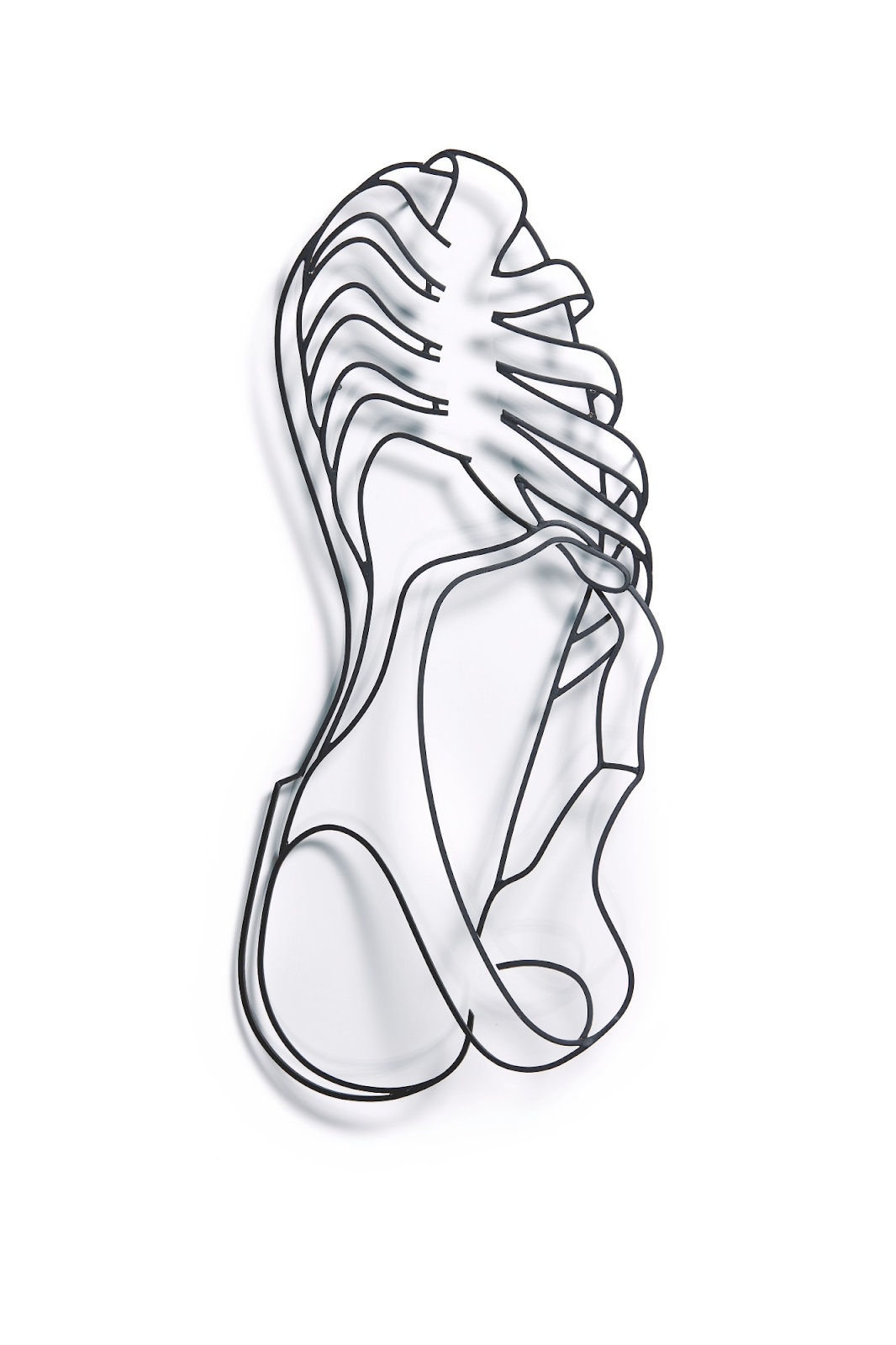
Loberg's images are not too far away in style from the line drawings of Michael Craig-Martin. In order to arrive at an essence, they both strip down their subject matter to a few clear lines. Michael Craig-Martin is of course a world renowned fine artist and Coco Loberg is a tattooist. It would of course normally be argued that Craig-Martin was there first and that as a fine artist he laid the ground for the public's appreciation of such stripped down line imagery. 

Michael Craig-Martin: Sandle

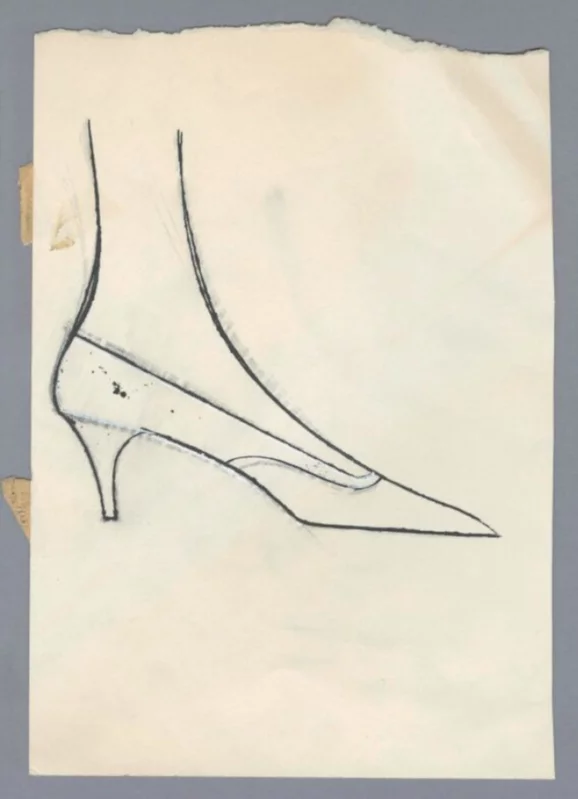
Craig-Martin's 'Sandle' is one of several images he developed that were regarded as a type of conceptual commentary on the nature of imagery, rather than a depiction of a type of shoe. However, the 1950s designer drawn images of food, (below) were done so that they would reproduce well on paper as printed images, using what were still in those days mainly black and white printing processes. It could be argued therefore that the graphic designer/illustrators of the 1950s were preparing the public for the Pop-Art imagery of the 1960s.  Indeed Warhol's experience as an illustrator in many ways prepared him for his fine art career.

1950s objects line drawing

Warhol: Shoe drawings: 1956

All these types of line drawings need to go through a process of visual simplification. Formalist thinking is therefore central to all three outputs. Hokusai would have understood this process, as it is clearly central to the production of his own stripped down drawings of everything from plants and animals to people and objects. 

Hokusai

Because of the nature of Japanese art, it lends itself very easily to tattoo designs and you can find traditional Japanese images, adjusted for tattoo use in tattoo studios all over the world.

Foo dog / Fu Dog / Shi Shi / Chinese Guardian Lion by @wootattoo_1

Koi Dragon by @horisumi

Heikegani / Samurai Crab by @sootattoo_1

The tattoo designs above are recreations that exploit hybridity as a powerful inventive force. All of the studios cited above also do highly complex body and sleeve designs and as these have to wrap around arms or backs or chests, an excellent knowledge of how two dimensional forms will work when following a spatially curved surface is needed. In the tattooists' jargon this means that designs need to consider 'wrap'. An inner forearm design must consider the visual drop off at either side of the area. A wide design will appear narrower as it curves around the arm, therefore when for instance, designing for the inner forearm, it is thought of as having a flat surface from the ditch, (in tattoo jargon, the indentation behind your elbow) to the wrist, an area around 3 to 4 inches wide. Then as the surface area curves around and becomes the outer forearm, any design that is wider than 3 to 4 inches, will start to distort, the more it extends out on either side. In order to visually work with this, good tattooists locate key visual elements on a centre vertical line, well inside the 3-4 inch flat plane, locating less important details in the areas that fall away on either side. Body maps are sometimes used to help think about these issues. 

Tattooist's body map: From https://www.tattoospace.com/

Tattoos are now seen as a major art form, and art galleries are beginning to think about how they can be displayed. 

Tattoo. Art Under the Skin: CaixaForum: Barcelona 

The ‘Tattoo. Art Under the Skin’ exhibition held at the CaixaForum art centre in Barcelona, documented tattoos past and present and explored the development of the art form as a global artistic expression.

I was as interested in how tattoos were presented as much as the various different approaches to the medium. It is a very strange thing to see a disembodied leg, standing alone in a clear perspex vitrine. Once you get past the dismembered body feeling, you then have the secondary experience of the tattoos themselves and how they combine to form a three dimensional surface. In this case the Spanish tattooist Laura Juan, shows how to combine colour and realism, in an emotively hot blend.  

Laura Juan

Laura Juan's work is 'painterly' in its application, her use of colour is a result of the way she lays in the early layers of her work, which allows her to simplify form and yet at the same time suggest a very lively and accurate understanding of light reflecting off her various surfaces. I suspect she has looked at a lot of Impressionist paintings.


Kari Barba

Kari Barba has made it her mission to highlight the role that women can play both as tattooists and as skins. (A skin or canvas is the tattoo jargon for someone who has been tattooed) Her scenes are dramatic, and they feel as if they could come directly out of illustrations from adventure fantasy novels. Her work was exhibited in “Tattoo: An Exhibition,” at The Natural History Museum in Los Angles, which provided a historical overview of the social and religious significance of tattoos worldwide. The museum text describing tattoo art as “a process [whose] results can be a sign of identity, a rite of passage, a type of protection, a form of medicine, a memory made visible, or a piece of art to be collected and worn on the most intimate of canvases, the human skin.”

Colin Dale

I personally really like the work of Colin Dale. For instance when working with a beekeeper, he developed a "Honey Hunter" pictograph image that could be put onto the calf of the leg. The designs come from European cave paintings from about 10 thousand years ago and they depict people climbing vines to harvest honey from hives in the upper branches of trees. 

Jee Sayalero

Jee Sayalero in contrast is a 
post-modern artist, in the image above he combines the contemporary Japanese Nintendo game figures of Super Mario and Yoshi with a traditional Japanese tattoo design. 

The Quai Branly Museum in Paris held a large exhibition of tattoo work a few years ago and this exhibition toured both the USA and Canada and in doing so raised the profile of the tattoo as an art form. This was the exhibition on which was based the “Tattoo: An Exhibition,” selection at The Natural History Museum in Los Angles, and the echoes that have been resonating out from such a prestigious series of exhibitions are yet to fade away and tattoo artists are beginning to be seen as the keepers of very important world wide folk art traditions. 

An introduction to the Quai Branly Museum tattoo exhibition

My interest in tattoos has resurfaced because I have been thinking about them as a way to hold images as they pass between the inner world of the body and the exterior experiences of the world. For instance, some tattoos depict the inner body on the outer body, thus sort of making the skin invisible.


Other tattoos make you aware of the skin, but then create an illusion of the skin being opened out or pulled away to reveal what is inside the body. 


I first encountered this particular aspect of the tattooist's art in Barcelona. We had been for a swim in the olympic pool on Montjuïc hill; from the hill you can look out over a magnificent view of the city and on this particular day we needed to cool off after going to the Miró Museum. At one point we were inside the building, looking down on one of the pools, it was empty except for one lone swimmer. The man was swimming lengths, very powerfully, and smoothly, using a good front crawl stroke, but what fascinated me was the fact that he had a full-sized body tattoo of the inside anatomy of his body and as he swam, his back activated illusionary muscles and bones. 

Back Tattoo: Matt Doherty: Empire Tattoo Studio 

'Biomech' tattoo: Never Say Die: Croydon

I can still see the man's body in my mind as it swims, and in my chemical memory it becomes a deep metaphor for myself, the body cleaving its way through the water, cutting into the pool's blue skin, whilst the body is revealing its own inner reality as it stretches itself to its physical limit. 

On the other hand some tattoos bring the outer world into the body. 

Paul Owen: Naughty Needles Studio

Jolly Octopus: Christchurch

I still remember back in the mid 1960s reading Ray Bradbury's short story "The Illustrated Man", it had a deep affect on me at the time, A creepy, overweight carnival worker is given tattoos by a  witch who creates images with magic needles. She tells him that they will show the future. One of his tattoos is of the man strangling his own wife, something that does come to pass and another is of the man being attacked and beaten by the other carnival workers when they realise what he has done. There is something very disturbing about the idea of the body being able to tell a story about its future life. There was also a film made based on the story, with a slightly different plot, whereby a man sees his own fate on his murderer's body. 

The Illustrated Man: 1969 Director: Jack Smight: staring Rod Steiger

The body can be a surface on which to place images that remind us of our encounters with the world. My grandfather had served in India during the time of the First World War and he had tattoos from his time of travelling out there; he had had one done at each port that he had docked at and so he then had a mnemonic of his experiences, which, over 30 years later, he was still able to use to help tell his grandson some amazing stories. 
However, the body also tells stories about its life, without any outside interventions. The skin ages and as it does it communicates the facts of its own mortality. Certain illnesses, infections and diseases communicate their existence through the skin; eczema, psoriasis, acne, shingles, moles and fungal infections all have unique visual properties. Sometimes the skin displays pigment distribution abnormalities such as in the case of people with vitiligo and this reminds us that skin colour is simply a result of the distribution of different amounts of melanin. When someone has an irregular distribution of melanin they can in effect be more than one colour, a state that asks many questions as to why humans attach so much importance to skin colour. 

Old human skin

Guttate psoriasis

Acne

Shingles

Vitiligo

The skin has its own memory, which we call 'scarring' and different cultures use this process to decorate bodies using various scarification techniques.

Operation scars


Scarification

Recent images of sunburn tattoos have been circulating on Instagram, Playboy magazine even markets its own “sun tattoo” bunny stencils, however the fine artist Dennis Oppenheim had the idea way back in 1970, when he decided to make a before and after image of himself 
lying in the sun. 

Reading position for second degree burn: 1970 Dennis Oppenheim

My thoughts are still coming together about this, I have yet to decide how to use these various ramblings, but I have an intuition about how inside and outside experiences, can combine to make us what we are. Somewhere in my making process I'm attuned to this instinctively, but have yet to clarify exactly what this means to me. These types of posts are a sort of edging around the subject, precursors to the main event, which is about me finally deciding what to do.  


Notebook thoughts on possible use as tattoo 

See also:


Wednesday, 20 November 2019

The Tattoo: drawing and the body

Some of the oldest drawings we have evidence of were done on human bodies. Tattoos have been central to the way humans communicate meaning through drawing for tens of thousands of years and have been used by cultures across the world. So perhaps it is about time this blog looked at such a fundamental area of drawing. It is interesting in terms of my own self-awareness that I have not posted on tattoos before. Perhaps I'm still at the back of my mind suffering from that old high/low culture divide and an art form that if I look around me is ubiquitous, has somehow been not taken as seriously as it should have been, because at some point in my past it was introduced to me as an art form only taken up by criminals and sailors. It is in fact one of the most vital and living art forms around; it supports the making of wonderful images and it clearly works as a communication tool.

Scythian mummy tattoo, Pazyryk, Russia. 200 to 400 BC


Drawings of other Scythian mummy tattoos

One of the oldest examples I am aware of is this Scythian mummy tattoo from Pazyryk in Russia from around 200 to 400 BC. It is a very rare thing to find a tattoo as old as this, and what interested me was how zoomorphic junctures, or the mixing of one animal with another is central to the design. I have been thinking a lot recently about our position in the world and if we see ourselves as another animal like others, perhaps we might be more sympathetic to our fellow creatures and less likely to treat them simply as things to do with as we may. One reading of this tattoo is that it represents the fluid nature of animal identities and that there were no clear distinctions between them and people in the mind of the person who had been tattooed. The world of the shaman, often dissolved the differences between people and animals or landscapes, moving beyond empathy into a positive energy giving relationship that gave people meaning. I would like to think that these tattoos were part of the communication to one's self and others of something of that nature. Animism and other early pre-organised religious ways of coming to terms with the world, seem to me to link these very early ideas of how we relate to the world and each other, with contemporary thinking in relation to how we are responding to an awareness of the Anthropocene. (The name we are all becoming more aware of for the period during which human activity has been the dominant influence on climate and the environment)

I think it's fascinating that someone in Leeds can walk into a tattoo parlour and ask for a Maori tattoo design. These designs use 'Manawa' lines which represent your life, or life journey during your time spent on this Earth. This idea which seems so similar to the idea of the 'wyrd', a Northern European tradition from pre-Christian times, feels as if it is really needed in a society where so many people feel uncoupled from the world and anxious because their lives lack meaning. Branching out from the 'Manama' lines are 'Koru'  lines and these can represent both people and new growth. Their shapes originally deriving from the tiny spiral growth shoots of a New Zealand Fern plant. As 'Koru' or growth lines are added, important people are linked into your life journey, such as mothers, fathers, children, loved ones etc. 


A contemporary tattoo based on a 'koru' form

It could be argued that taking an idea from one culture and using it within another is a debased concept. But I'm not so sure. If something is needed in one culture and an answer for that need can be seen as part of another culture, I see no reason to argue against it. I would rather celebrate it and help to communicate a wider cultural awareness of what the symbolism might mean. For instance if a Fern type image represents new growth and new relationships, shouldn't this be part of a ritual that celebrates the fact? 

People that involve themselves in tattoo culture are part of a unique collaborative art form. The person that has their body tattooed will build a close relationship up between themselves and one or several tattoo artists. It is a relief to see that each image does not come associated with a tattooist's signature, there being some sort of recognition that this is a proper collaborative art form. 

A full body tattoo combining a variety of styles.

This full body tattoo combines eastern mysticism with western Op Art and old style symbolism. Bi-lateral symmetry gives overall compositional coherence to the imagery and the effect is very powerful. 

Eastern symbolism 

Eastern symbolism dominates this torso, but other images such as a picture of Big Ben are also used to give a global worldwide cultural expression to the projected image. 

The all over animal

The old animist urges are still around and I was surprised at how many tattoos are designed to create some form of metamorphosis between human and animal forms. 

I am only just beginning to research this area of drawing and the more I do so the more interesting I think it is. Especially in the cross fertilisation of tattoo images from various cultures. Homi K Bhabha's 'The Location of Culture' could be rewritten in relation to the way that various traditions have now been morphed into totally new forms (what Bhabha termed at the time, "hybridisation"), because of the need for contemporary cultures to find expressive forms that can do justice to the various needs that people have within them. I have been recently doing some work with a jewellery designer who has long been aware of the power of body decoration, so I have been making my own drawings for the body. I shall in the near future put up more posts on my growing awareness of body decoration as time goes on, but for now I just wanted to break through an old mental barrier, one that had me thinking that tattoos were something for other people; outsiders, not things that are central to nearly all world cultures, and which in some instances, seem to be the dominant form of inter-personal communication.

Auschwitz number tattoo

Tattooing was introduced at Auschwitz in the autumn of 1941, and this may be why I have avoided looking at tattoos before now. I had long associated tattooing with branding, with a way of numbering people, so that they were demeaned and reduced to a disposable thing. I need to both never forget this and yet at the same time respond to the fact that many people  find the tattoo a way of deepening their ability to make meaningful inter-personal communication. 

The tattooist Inaki Aires is an interesting example of an artist that has decided to use the tattoo as his selected platform and his spiritual diagrams are very clearly of an interest to a growing community of the tattooed. 
Inaki Aires 

I have been working on ideas myself but they are not yet properly realised.


Saturday, 2 September 2017

Drawing into installation

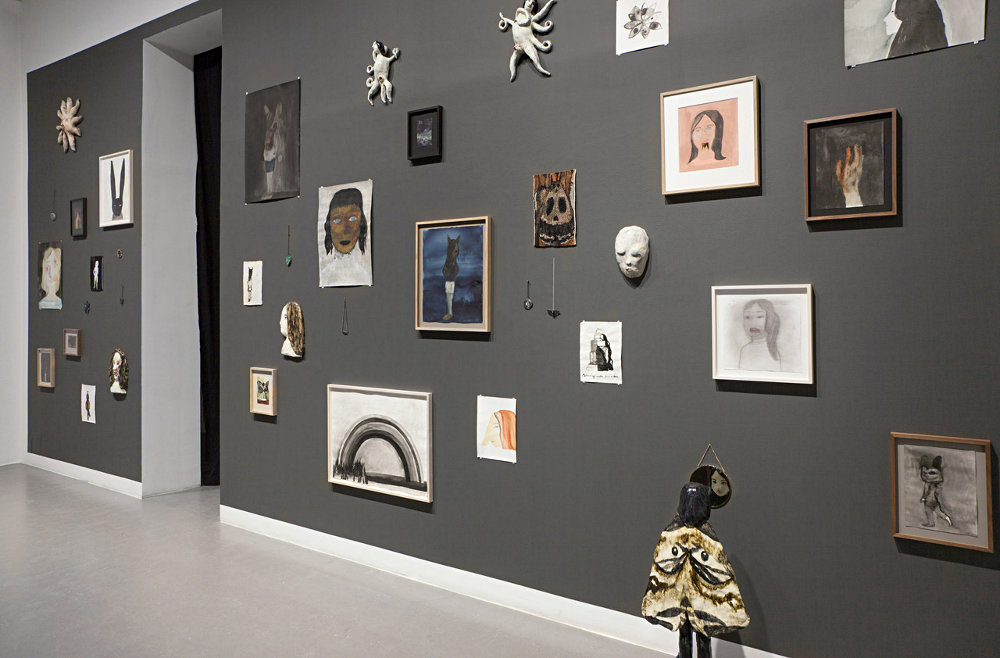
There is a move towards a scattering of work across walls and using both high and low hanging and I think it's because artists are wanting to make their exhibition presentations more physical. Using a dispersed arrangement of smaller works of different sizes and at different heights, you can get your audience to read your images as an integral part of an activated environment. Flat images begin to work more as dispersed low relief objects; if framed these are usually a mixture of frame styles, and if unframed drawings are often pinned directly to the wall with no attempt to hide the fixings, thus ensuring that the objectness of the individual elements is heightened. All these things emphasise the physicality of the situation and take you away from the idea of drawing being a window on the world or a space for meditation. 
If you look at the presentation of drawings by the ceramic artist Klara Kristalova below you can see what I mean. She also attaches some of her flatter ceramics to the wall, which further reinforces the idea. She pins some drawings, others are framed in what look like junk shop frames and a few items of jewellery are attached beneath a couple of images.


Klara Kristalova

The colour of the wall will also make a difference, notice how the dark grey wall lends an additional presence to the work. This dispersed way of presenting work also allows other objects to be integrated into the presentation. In Kristalova's case a ceramic moth figure stands facing the wall looking into a mirror, in a space between drawings. The mirror acts as an object that links the ceramic figure with the wall and in doing this engages all the other things hung on the same wall into the dialogue. As you stand looking at the images, you extend the idea, each observer, mirroring the action of the ceramic figure. As the work's audience arrives the presentation becomes an installation. 


Klara Kristalova

Ida Applebroog has taken this idea on a step further, she arranges and stacks her images in gallery spaces. It feels as if she is much more interested in how comic book pages work, images are cut and stacked one on top of each other, but in this case literally stacked, because her images are constructed on the sides of shallow box type frames. 


Ida Applebroog

Sometimes the work is held up by a supporting bar such as in the image on the right below, again this reinforces the idea of the image as object. 


In the exhibition view below you can see that very few of Applebroog's images are wall mounted, some are simply leant against the walls and one is laid flat on the floor. 


Applebroog has also used large open frames to make supports for her drawings. Sometimes she puts a light source inside, once again this adds to the objectness of the situation. These frames are often added to by drawings attached to ladder type supports, or stand alone single frames, the work becoming more sculptural as each additional element is added. 


This sculptural approach has been used by Applebroog to build a house of drawings, the images now becoming part of the texture of the building's surface.  


Ida Applebroog

Applebroog is an artist well worth investigating as an image maker, and not just because of her presentation skills. She uses composition in a very physical way. As you can see in the drawing of the boy with the Pinocchio nose below, when wanting to extend the image she very straightforwardly simply adds an area on. 


Ida Applebroog

Applebroog uses a range of styles but always seeks to capture the dramatic potential of the image. The yellow childlike figure with the sophisticated shoes is a good example of her use of separate sheets of paper to develop the image, two sheets make the simple split between child and adult and the third reinforces the idea by allowing her to establish the woman's shoe. As an exercise in composition, look at the difference between the two images of the couple kissing. The landscape format allows them to be about to gently kiss, the portrait format squeezes them together much more urgently, but both images rely on the noses as their 'punctum'. As the noses touch they also make you much more aware of the space between the two heads, the noses effectively separating the faces in such a way that they will never be able to touch lips. A moment of tenderness, stopped by the awkward interjection of noses. (In the work of the philosopher Roland Barthes the 'punctum' is a touching detail or a small aspect of an image that allows the reader to understand the whole image in a particular way).

I think the first time I saw a show hung with images splattered across the walls was a Raymond Pettibon exhibition in Berlin, his images were both drawn directly on the walls and attached to them within frames. Pettibon also added text into the mix which in effect turned the walls of the gallery into giant comic book pages. 


Raymond Pettibon

Pettibon has also exhibited work done in co-oporation with other artists, and this informal way of presenting work works well, as it physically mixes up their styles, the presentation echoing the concept. 

Marcel Dzama and Raymond Pettibon

This desire to get away from the nicely framed image and escape the formal need for a regulation height for framed work* is perhaps a response to Sol Lewitt's work. Lewitt by working directly on the wall, in effect took us back to drawing's earliest manifestation on the wall of a cave. 

Constructing a Sol Lewitt wall drawing

Cave painting from Kimberley Australia thought to be even older than Lascaux. 

By integrating images into the fabric of a structure, whether this is a cave or a room, artists effectively embed their ideas into the very foundations of the environment.  The wall can be thought of as a sensitive membrane, and when it is drawn on it is as if it has been tattooed. Think of the difference between having a body tattoo and wearing an image on a 'T' shirt, the tattoo is just so much more authentic. 

'Tribal' 'T' Shirt

'Tribal' Tattoo

*The regulation height for framed work is often set at 57 inches. This distance is measured from the middle of the image, so that all the images in an exhibition share a midline. Some galleries state a 60 inch midline and the highest I have seen is a 62 inch midline. What they all have in common is the idea of a midline. However I have always thought that sticking to an average means that no one is then at the right height, people are either too tall or too short, so having a variety of heights means that at least some work will be for some people hung at the right height. Most gallery directors would argue that the one thing about a consistent height is that it gives coherence to their exhibitions, so if you do want to approach hanging your work in a much more informal way, make sure you have a good argument for it.