Showing posts with label the city. Show all posts

Tuesday, 13 November 2018

Jeanette Barnes drawings in Halifax

Jeanette Barnes


I was in Halifax over the weekend and unexpectedly came across some of Jeanette Barnes's drawings in the main Dean Clough Gallery. If you are in Halifax it is well worth a visit to the Dean Clough arts complex, not just for Barnes's drawings but to explore the full range of work that they have on display.
However it is Barnes that I wanted to look at in more detail, especially as she is an artist I have long admired and have posted about before. See this post on drawing the city.  
Barnes has one of her large drawings on exhibition, alongside several smaller drawings and images that mix print processes with drawing. It is the large, approximately five feet wide drawing that captures your attention, both because it is so well worked and because the spaces she develops are so convincing. The surface vibrates with her many decisions, some left and others removed, some sure and others not so sure, the whole surface gradually knitting itself together not as a smoothly woven cloth but as a constantly emerging and retreating exploration of perception. Her work has that quality of uncertain certainty that I have also commented on before and of course it is another practice that stems from Cezanne's questioning of what is out there and this relates to a philosophy of doubt.


Jeanette Barnes


When looking at Barnes' drawings above all I find them life affirming, they capture the excitement of looking, the looking is translated into the energy of life in the mark, the size of each drawing being directly related to the body's experience of the drawing's making.


Jeanette Barnes


The smaller drawings are also worth looking at because she changes the quality of the marks, obviously as she makes a small drawing she can see everything at once, so there is less moving backwards and forwards in order to see how different marks sit in relation to the surface of the picture plane. When printmaking, she sometimes responds to the first pulls of an etching plate, working against the surety of the printed mark, and adding a layer of more discovered spaces that interpenetrate the initial printed spaces and at other times in mono-prints she works with the flow of the surface as it emerges out of the turpentine/ink chaos of movement.


Jeanette Barnes: Print


Jeanette Barnes continues an old and important tradition of going out into the streets of the city and drawing and this is something that can still reap rich rewards.

Sunday, 8 May 2016

Drawing and the City

Ahmet Doğu İpek’s intense drawings have very strong ties with the city of Istanbul where he works.  These large scale drawings are made with graphite and watercolour and reflect what it can feel like when living in a city that is constantly being built around you. The last time I was in Istanbul parts of the city really felt like this. You could move from the deep gloomy dark magic of the Basilica Cistern and come out into the light of day only to be surrounded by the noise of constant building, building that never seemed to finish, lots of new buildings appearing to be left half finished as new ones began to be constructed in their footprint. 

This is one of the columns that you can see in the cisterns below Istanbul. If you look at the ceiling structure you can see how it might have influenced Ipek's drawings.

Ahmet Doğu İpek


Ahmet Doğu İpek at work

Jeanette Barnes is another example of an artist that uses her native city as  source material. London is seen as a city in constant change, she celebrates the hustle and bustle of its surging population and ever changing skyline. In contrast to Ipek who you feel sees the city as a necropolis, she sees it as a fountain of life. 


Jeanette Barnes at work.

Barnes works in charcoal, using a rubber to create an energetic surface mark quality, as well as allowing her to constantly adjust her drawings in relation to the unfolding spatial matrix she is creating. What both artists have in common is the scale they work on. When you see the actual drawings you can immerse yourself in them and this is an essential part of their quality. 

My own particular hero of city drawing is the architectural draftsman Hugh Ferriss.


Hugh Ferris

 His 1922 charcoal sketches of imaginary Manhattan skyscrapers. sketched out the implications of the new 'setback'  laws, which were brought in to ensure that light would still penetrate down to street level.  His images became iconic and still have a direct influence on my own drawings. 

The Phantom of Liberty
You can see the original 6ft high drawing of mine in the current LCA gallery exhibition 

The image above is one of two drawings that I made of monumental skyscraper type buildings, that were meant to stand for the idea of the modern city and its architecture in the mind of someone travelling to a Western European city from a 'third world' country. The drawings worked as a pair, one standing with the building standing upwards and the other upside down. The landscapes that these images joined were those of the urban landscape of Leeds and the rural landscape of the coastline of West Wittering. In particular there is a site in West Wittering called 'Roman Landing', which is where the Romans initially found access to our shores over 2000 years ago. I go down to West Wittering every year to draw, and that year I had been reading in the local paper about refugees landing on the coast and being picked up by local police. In my mind I began to tie together all these things; migration, a long view of history, the link between city and country, the idea of desire and how it shapes itself in the mind, the brutality of architecture and how an image might link all of these things together. In particular, I had been drawing tower blocks in Leeds, one of which had been used as temporary accommodation for asylum seekers. I was during this time also holding conversations with the people who lived in these towers and using these conversations to make other drawings that reflected the fact that people's ideas of what things might be like in England, had had to change dramatically once they confronted the reality of being here. 

Not here not there

I was also making other analogies at that time, As an artist one of the problems you are constantly faced with is whether or not to keep the focus narrow, or to look for several different ways to address the same issues. 

For instance one analogy was landing on the island of England as a sort of unwinnable game or diabolic fairground ride. I made several drawings of this idea, the one below being based on those water slides that weave their way down to a swimming pool, but this time of course, it is a slide for a boat, one that would direct it straight back into the sea. 

Island in the sun

Another analogy was that of the use of a ladder to be able to climb away from or out of the situation you find yourself in. 

This is not an oracle

The ceramic and wallpaper piece, This is not an oracle, tried to fuse together several ideas, the terracotta fragment of a building was based on the broken buildings we see in so many bombed out cities. The ladder is wobbly and leans against a wallpapered wall, the repeating pattern being when looked at closely a decent into hell. The base on which the whole thing stands is an inverted mountain, an analogy that had emerged from my then feeling that there was no logic to anything any more, everything was upside down. 
All of these images of mine began with making drawings in sketchbooks. This is the way I work. I do though have a flighty mind, so have a tendency to go off script. I'm not sure if this is a good thing or a bad thing, but it's just how I am and why I'm an artist rather than a scientist. As students you will also at some point have to make a decision as to what sort of approach you have to the world. All I can say about that is have the courage of your own convictions. Several times in the past I have had tutors or critics tell me my approach is wrong, but the longer I have stuck to my guns, the easier I find it is to make work that I see as mine and not me trying to make work that I think others might like. 

See also:

Earlier Images of the City posts part 1 and 2

Tuesday, 9 December 2014

Images of the city part 2

There are many ways of responding to the city in drawing and more contemporary practices have included animation, mapping, performance and installation. Francis Alÿs, is always interesting, he can paint, draw, make films and construct installations.  Pacing, 2001 is a very simple work that records the way he walks.

Francis Alys: Pacing
 
Shoe Shine Blues is a much more complex piece that evokes the tedium and class differences that lie at the core of much manual labor. 366 animation cells break the act of polishing a shoe down into individual motions and the resultant accompanying ten-minute animation shows the same act repeated over and over, to the sound of clarinet notes and a voice singing lines such as "nothing to see." The result is complex and poetic. The cell drawings as they sprawl across the walls reflect the idea that art making can be as monotonous as other forms of labour.

 
Francis Alys: Shoe Shine Blues

Interesting responses to the city are not always found under the umbrella of fine art practice, this Map quilt of Providence, R.I. (below) by Robin Camille Davis is a personal response to making something for a partner, however it points to an alternative possibility when making images of the city.


Han Feng: Floating City
 
Han Feng’s Floating City is neither sculpture nor drawing, it is composed of hundreds of tracing paper buildings of various sizes, their laser-printed details deriving from images of city architecture, which are grouped in dense clusters and hung from the ceiling with transparent thread. The city becomes weightless, semi-transparent and fragile; something imagined, impossible to realise in reality.

Kathy Prendergast: City Drawing
 
Kathy Prendergast’s ‘City Drawings’ and ‘Black Maps’ explore the potential of the city map. She obsessively draws penciled connections between significant points of the city, her hand tracing the journeys that the mind takes as it mentally inhabits a map. Her more current series ‘Black Maps’, is produced by a laborious process of inking-out areas of road maps from countries around the world, leaving visible small white dots that denote areas of habitation. On closer inspection, roads, place names and geographical details can still be discerned underneath the densely hatched black marker surface and viewed from a distance, they have the appearance of a star charts.
 
Kathy Prendergast: Black Map
 
plan b are the artists Sophia New and Daniel Belasco Rogers. They perform together and collaborate on each other's solo works. In particular they are interested in the city as a place to walk through and they often use GPS messaging systems to record their activities. There is a lot of information about this on plan b’s website

plan b

Whether making drawings from direct observation or constructing drawings in order to create a dialogue with the city and its processes and activities, there is an unending stream of information to be unpicked and responded to if you live in a dense urban environment. In particular new technologies are opening out fascinating potential areas for artists to explore and make new work within.

However the issue for most art students will be the type of lens that you might use to look at the city. For instance if you see the city as a type of living organism, is it a healthy one or a diseased one? How would you show this? Would you look at the city's transport systems as being types of blood flow or as some sort of neurological network? Could the city operate like some sort of gigantic amoeba? If so, perhaps you might need to think of its outlying regions as arm-like projections that surround and engulf those that are new to the city, just as an amoeba would do in order to digest food particles like bacteria, algae or organic matter. Like the city an amoeba lacks a mouth, so it has to ingest food from any of the parts of its body. As you can see, as soon as you construct an analogy, the idea very quickly impels itself forwards. The next step would probably be what sort of materials to use. Would you use flowing materials that you could then block, to suggest a blocked artery? Would you embed yourself into a city and observe it as if you were a pathogen taking photographs? There is a link in the 'see also' section at the bottom of this post to an idea of urban acupuncture, whereby you think of the sites where there are certain types of healthy activities going on in a city, as being acupuncture points. 

Coda

A few years later I was included in an exhibition about the city and a there was a video review of it. 

The imagined city

See also:


Thursday, 4 December 2014

Images of the city

The city is one of the richest environments for artists to live in and as a subject matter it continues to be something that artists find exciting and worthwhile. For you as drawing students it is a subject matter on your doorstep and as an artist myself I use everyday experiences to feed my imagination, and in order to keep new ideas coming I make drawings of the city most days when I walk to work.

It is though hard to make full scale images out there on the streets and most artists rely on sketchbooks and small sketches to build up their image-banks before working up larger scale pieces.  This is an old tradition, but one that can still be very rewarding.

I first came across the drawings of John Virtue back in the 1980s. He had been working as a postman to make ends meet, and as he walked the streets he made small drawings. He was at the time working out in a rural area and so what he was confronting everyday was a landscape of trees and fields, so he developed hundreds of small drawings documenting the experience of these daily walks. He then worked on these in the studio after finishing work as a postman. This is a detail (below) from one of the worked up images, as you can see they are constructed out of small sections, a useful lesson in itself; if you don’t have a big studio space you can still have ambition for your work.


The drawings were mainly pen and ink, but when massed together they had a powerful impact and were a wonderful vechicle for his dark passinate romantic soul. He made his name with these drawings and so he was able to stop working as a postman and become a full-time artist. In 2003 he was appointed as artist in residence at the National Gallery and he continued working as he had always done, by making lots of small drawings and then working these up into much larger images. The drawings (below) are from his sketchbooks and small studies, often done from the rooftop of the National Gallery. As you can see they are fairly traditional in format and mainly concerned with getting basic details down.


However, once back in the studio, he was able to work these small images up into wonderful atmospheric landscape views of London, his previous experience of making dark emotional views of rural landscapes allowing him to control dark and light in order to orchestrate and open out the information that he had collected in his sketchbooks.
“Drawing is the compost from which painting develops.”
John Virtue


The tradition of working from observation in urban landscapes is of course one that is founded on the work of the Impressionists. If you look at this drawing by Seurat, (below) you can perhaps see a Post-Impressionist influence on Virtue's vision.


The intense pen and ink cross hatching from this night-time view by Seurat must have influenced Virtue's approach to his early landscape drawings. However one of Seurat's most poignant drawings is for myself his chalk drawn view of the Place de la Concord. The unlit streetlamp becomes a metaphor for the state of loneliness that many find themselves in when coming to a vast metropolis. It is one of those drawings that seem to be about a void or emptiness that we can all at times find in our lives, even in the midst of a bustling city. 

Seurat: Place de la Concord

One of the defining characteristics of an English city is that it has to have a cathedral. Denis Creffield, an artist who used to be based in Leeds, at one time toured all the cathedrals of England making large charcoal drawings of them as he went. A cathedral is meant to be the spiritual heart of a city and Creffield’s drawings are an attempt to capture that sense of spirituality that you get as you gaze up into the heights of the mainly Gothic architecture.


Both drawings above from Creffield's Cathedrals of England series


Creffield lived in Leeds for a while and the drawing above is a view over Leeds. You can see the Town Hall over on the far top left.

Leon Kossoff and Frank Auerbach were both like Creffield deeply influenced by the teachings of David Bomberg and you will find many fine drawings made by both artists of the city of London. 

Kossoff

Auerbach

Claes Oldenburg used to walk the streets of New York drawing everything whatever seemed to fascinate him. He had different sketchbooks for the three basic shapes; triangle, circle and square and recorded all the square things he saw in one and all the triangular things in another, and because he wasn’t trying to classify things beyond their basic shape, he ended up drawing everything from drainpipes to cigarette butts. This period of his life gave him enough imagery to build an entire career on. His drawings can sometimes be very technical and at other times quite loose, reflecting perhaps the collision between technology and human life that makes up city living.


Sandwiches, lollypops, fag butts and office fans, all become subjects for Oldenburg to make images of.
The city is an endless source of information and if you are ever stuck for something to do, just walk out there with your sketchbook. I keep little tiny sketchbooks that fit easily in my pocket, as I walk through Leeds I stop and make notes, they then get either used in larger more complex drawings or simply help me build my visual imagination.


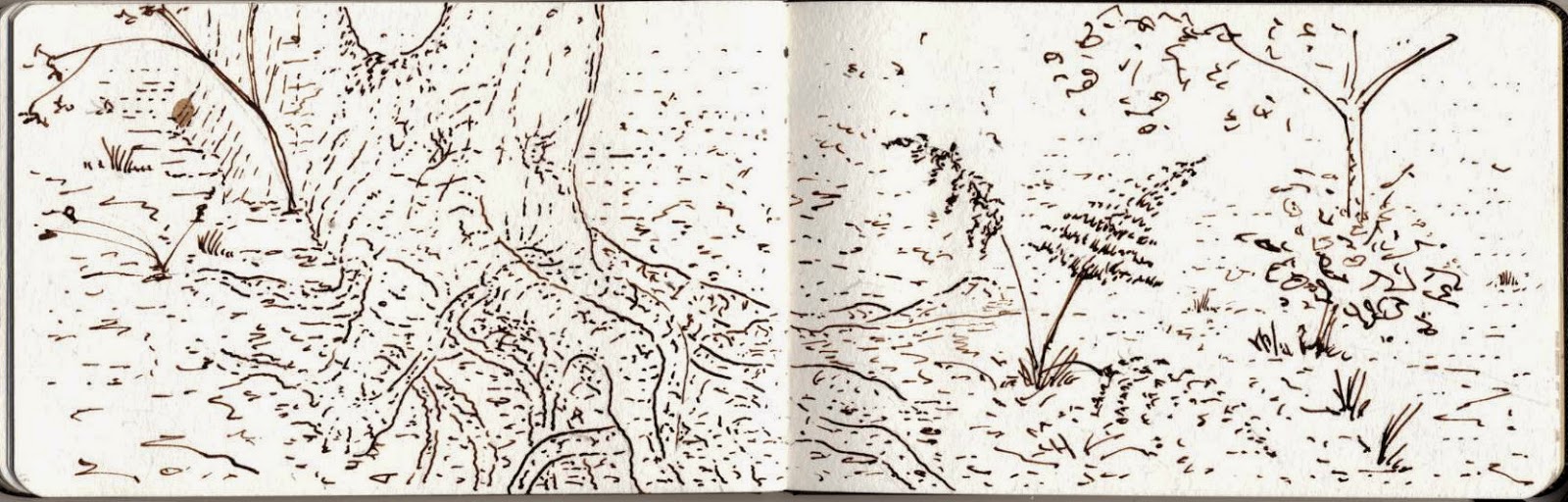
Even bits of earth at the bottom of an old tree can make for something interesting to draw, gradually your brain starts to 'see' things much more clearly, simply because you are exercising it.
But what is it about the city that makes it a reality for you? We live our lives not just embedded into the city; the city is a mental extension of our embodied minds. We make cities in our own image. The transport and sewage systems we devise, reflect our own needs to have transported around our bodies nutrients and waste products. The city’s maze of wiring is a mirror to our own complex nervous systems. Houses and other architectural features are based on the measurements of human bodies and our psychological relationship with the city’s spaces, is one deeply connected to the way the city inhabits our unconscious as much as it being something we inhabit physically.  We grow into a city as much as it grows into our minds. Our internal map of the city, is built from our day to day experience of it, each of us possessing a different version of the same city, some of us experiencing just a thin thread that follows the same route every day and others weave a complex pattern out of years of following the frayed edges of broken threads. The city is in your mind as much as it exists as a geographical entity. This is why it fascinates so many artists and as a student looking for a subject to make art from, you may find it useful to research significant places, such as the waste disposal centres, a supermarket or a shopping mall, but perhaps just as profitable might be your own vision of what it is to you, how do you fit into it? Are you like an ant, busy doing your bit for the colony or are you someone who never quite fits in, who sees the city as an alien environment and all the other inhabitants as potential threats?
See also: