My last post was written on the 16th of March, because of what is going on in the world the date has triggered a memory, one that is usually forgotten or more likely hidden under the psychic floorboards of our Western mind. On March 16, 1968, American soldiers from Charlie Company entered the Vietnamese hamlet of My Lai and what would happen would change the way we thought of ourselves.
Like many people, I found out about what happened on the 30th of November 1969, I was at the time a young art student on the Wolverhampton Pre-Diploma course and just as I am now and have done almost all of my working life, I was searching for what I ought to be making artwork about. I used at that time to listen to Alister Cooke's 'Letter From America', I loved his comforting voice and take on life, he seemed humane and deeply insightful as to what was happening in a country that always seemed to culturally lead into places where we would follow and especially if like myself you were an art student, all the interesting new directions in art practice seemed to emerge from New York.
This is a quote from Cooke's broadcast:
...it's not often possible to say that a whole nation is haunted at any one time by a single preoccupation. This is one of those times. I don’t think there is any need to go into the details of the ghastly and deliberate massacre of a village and all its inhabitants in South Vietnam, which has only now come to light.
It’s a story of almost numbing horror; what haunts Americans this weekend is why they haven’t been numbed long ago. For though the story is, no doubt, detailed and complicated and will be straightened out in the coming courts martial, the moral issue is horribly simple, it’s been there for several years, and it ought to have plagued us long before this.
Only in the last few days has it been brought home to people that the massacre at Son My is not an isolated incident but simply a brazen variation on a regular policy of modern war. In spite of President Nixon’s regretful statement to the effect that the massacre violated the American rules of war, the truth had already anticipated him; that the men of Company C 1st Battalion 20th Infantry, did with rifles what the air force and the artillery had been doing for years, as standard procedure – namely wiping out the people of any village that were suspected of harbouring, or being under the control of, the Vietcong.
At the end of his broadcast Cooke had this to say:
...the moral riddle will not go away. Is it valiant to bomb a hundred women and children from the air, and despicable to shoot them on the ground? I leave it to you, and don’t care to stay for an answer.
I was at the time deeply affected by the news and I tried to make artwork about what I had heard, but it was of course totally useless and poor, my tutors at the time advising me to make work about something I had directly experienced and they were right, I had no visualisation skills of the order needed to make sense of what I had heard. It needed an artist of the calibre of Goya to say anything of meaning in a situation of this sort.
Recently I have again been writing about the development of a moral framework out of which I try to develop an art practice and alongside that a life. For instance in my last post I was thinking about how the holding of drawn conversations could develop empathy for other people and help us learn from them. I was also trying to articulate a need to develop conversations with plants and other things, if we are to thoughtfully embrace and care for the wider world we inhabit. Without a moral compass we are all lost and our current global condition, suggests that that compass is broken or temporarily lost. Therefore I feel I need to remind myself, of what can happen if we lose track of what it is to be a humane being. The word 'humane' is defined as showing kindness, care and sympathy towards others, especially those who are suffering. Its etymological roots remind us that 'humane' was used in the mid-15th century as a word for both being human and being kind and refined, it had evolved out of the Latin 'hūmānus', meaning "of man, human," which also encompassed the idea that to be 'of a human nature' was to be also "kind, gentle, polite or refined". Humane therefore shares its roots with the word 'human', but it diverged in the 18th century to specifically denote compassion and benevolence, separating itself from the earlier meaning of being a human. Today a 'human' is defined as being a member of the species homo sapiens, that belongs to the family Hominidae (the great apes) and is characterised by hairlessness, obligate bipedality, manual dexterity with opposable thumbs precision grip, and high intelligence. As we have developed a more scientific awareness of ourselves, it would seem we have uncoupled an earlier awareness of our moral capacity to be kind or gentle, becoming 'only human'.
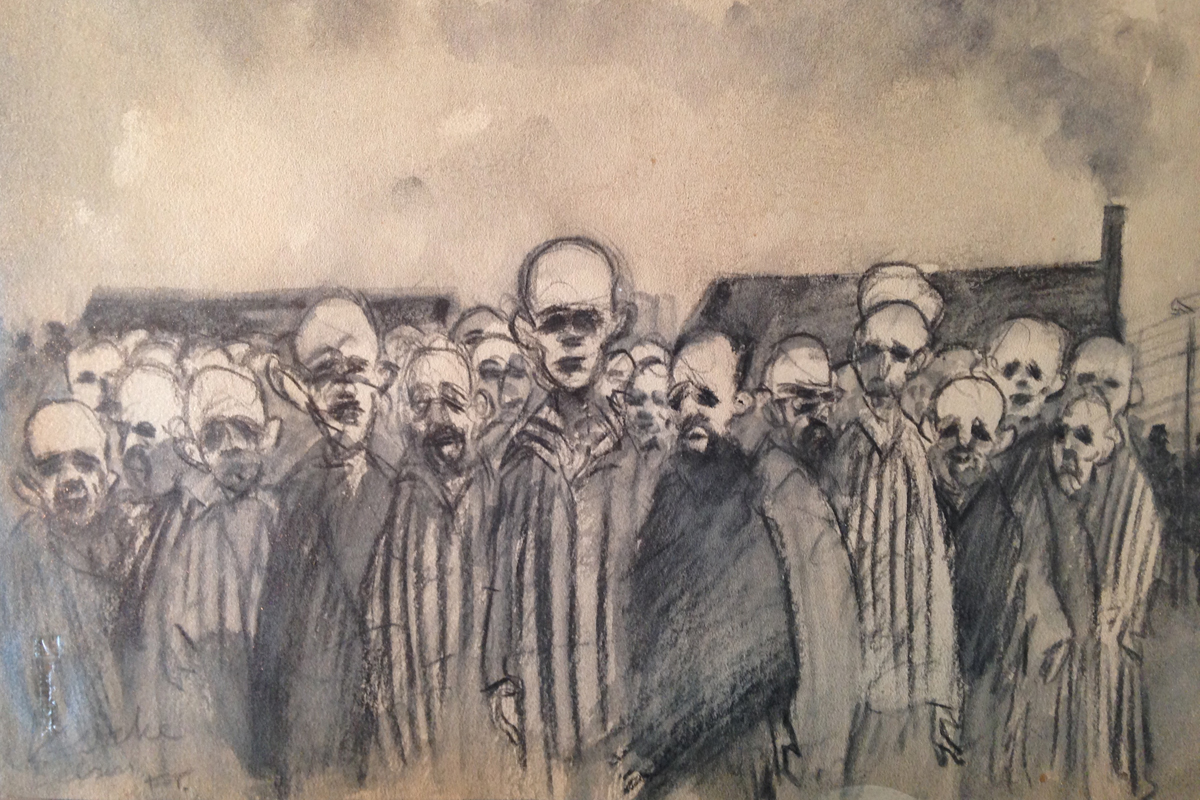
On March 16, 1968, American soldiers destroyed the Vietnamese hamlet of My Lai. Vernon Janick, a former US soldier when reminiscing about the way he was trained for service in Vietnam stated that, "we were trained that they were more animal than anything. You just didn’t trust any of them. We were always told that kids or women were just as much your enemy as anybody else. We never trusted any of them. I already hated them before I went over there. ...You always thought they were snakes - sneaky, which they are. Slant-eyed people, you couldn’t trust them." Janick's observations remind us that wars are not just fought with the weapons of combat, they are fought with language and imagery; how the enemy is shaped by the stories we tell, determines how far we are justified in our actions and how far those actions themselves might become divorced from any form of morality. We must never forget that Nazi propaganda used dehumanising language to describe Jews, portraying them as subhuman and parasitic, eventually calling them vermin, rats and disease-carrying agents. This rhetoric would eventually persuade ordinary people to take part in actions that would lead to the mass murder of millions. The shockwaves of that holocaust still propagate the current disturbances. The State of Isreal founded in 1948 was in many ways, a result of that horror. After discovering the extent of Nazi atrocities people in the Western World that thought they were civilised had to confront a realisation that one of the most 'civilised' nations could fall into barbarism. No nation, it seemed was immune to the committing of atrocities. When language is distorted, eventually moral failure emerges. Isreal it could be argued, evolved out of a collective guilt. After many years of unrest, on the 7th October 2023, Hamas and the Palestine Islamic Jihad, attacked Israeli civilian communities including attendees at the Nova Music Festival, where some 400 young Israeli civilians were murdered. On that day 1,189 civilians were not just killed, they were often mutilated and the perpetrators documented their own atrocities using live-streaming body cameras. We are now having to live with the consequences, consequences taken to such extremes that at the present count almost ten percent of the Palestinian population of Gaza have been killed. Barbarism incites barbarism.

The proposal lines on a map can in future become a war zone. What at one time is a map of conjecture at another becomes a certainty. These drawings change the world; all maps are political.Recently the United States Secretary of War, has described the ruling regime in Iran as a "death cult” driven by "prophetic Islamist delusions.” A description that suggests that the state of Iran, as far as the Secretary of War is concerned, is morally illegitimate and therefore war is the only reasonable response. This creates an idea in people's minds that it is a good thing to go to war, as Iran is an evil that needs destroying. He recently recited Psalm 144: "Blessed be the Lord, my rock, who trains my hands for war and my fingers for battle.", as justification for his stance.
Like many people, I found out about what happened on the 30th of November 1969, I was at the time a young art student on the Wolverhampton Pre-Diploma course and just as I am now and have done almost all of my working life, I was searching for what I ought to be making artwork about. I used at that time to listen to Alister Cooke's 'Letter From America', I loved his comforting voice and take on life, he seemed humane and deeply insightful as to what was happening in a country that always seemed to culturally lead into places where we would follow and especially if like myself you were an art student, all the interesting new directions in art practice seemed to emerge from New York.
This is a quote from Cooke's broadcast:
...it's not often possible to say that a whole nation is haunted at any one time by a single preoccupation. This is one of those times. I don’t think there is any need to go into the details of the ghastly and deliberate massacre of a village and all its inhabitants in South Vietnam, which has only now come to light.
It’s a story of almost numbing horror; what haunts Americans this weekend is why they haven’t been numbed long ago. For though the story is, no doubt, detailed and complicated and will be straightened out in the coming courts martial, the moral issue is horribly simple, it’s been there for several years, and it ought to have plagued us long before this.
Only in the last few days has it been brought home to people that the massacre at Son My is not an isolated incident but simply a brazen variation on a regular policy of modern war. In spite of President Nixon’s regretful statement to the effect that the massacre violated the American rules of war, the truth had already anticipated him; that the men of Company C 1st Battalion 20th Infantry, did with rifles what the air force and the artillery had been doing for years, as standard procedure – namely wiping out the people of any village that were suspected of harbouring, or being under the control of, the Vietcong.
At the end of his broadcast Cooke had this to say:
...the moral riddle will not go away. Is it valiant to bomb a hundred women and children from the air, and despicable to shoot them on the ground? I leave it to you, and don’t care to stay for an answer.
I was at the time deeply affected by the news and I tried to make artwork about what I had heard, but it was of course totally useless and poor, my tutors at the time advising me to make work about something I had directly experienced and they were right, I had no visualisation skills of the order needed to make sense of what I had heard. It needed an artist of the calibre of Goya to say anything of meaning in a situation of this sort.
Recently I have again been writing about the development of a moral framework out of which I try to develop an art practice and alongside that a life. For instance in my last post I was thinking about how the holding of drawn conversations could develop empathy for other people and help us learn from them. I was also trying to articulate a need to develop conversations with plants and other things, if we are to thoughtfully embrace and care for the wider world we inhabit. Without a moral compass we are all lost and our current global condition, suggests that that compass is broken or temporarily lost. Therefore I feel I need to remind myself, of what can happen if we lose track of what it is to be a humane being. The word 'humane' is defined as showing kindness, care and sympathy towards others, especially those who are suffering. Its etymological roots remind us that 'humane' was used in the mid-15th century as a word for both being human and being kind and refined, it had evolved out of the Latin 'hūmānus', meaning "of man, human," which also encompassed the idea that to be 'of a human nature' was to be also "kind, gentle, polite or refined". Humane therefore shares its roots with the word 'human', but it diverged in the 18th century to specifically denote compassion and benevolence, separating itself from the earlier meaning of being a human. Today a 'human' is defined as being a member of the species homo sapiens, that belongs to the family Hominidae (the great apes) and is characterised by hairlessness, obligate bipedality, manual dexterity with opposable thumbs precision grip, and high intelligence. As we have developed a more scientific awareness of ourselves, it would seem we have uncoupled an earlier awareness of our moral capacity to be kind or gentle, becoming 'only human'.
On March 16, 1968, American soldiers destroyed the Vietnamese hamlet of My Lai. Vernon Janick, a former US soldier when reminiscing about the way he was trained for service in Vietnam stated that, "we were trained that they were more animal than anything. You just didn’t trust any of them. We were always told that kids or women were just as much your enemy as anybody else. We never trusted any of them. I already hated them before I went over there. ...You always thought they were snakes - sneaky, which they are. Slant-eyed people, you couldn’t trust them." Janick's observations remind us that wars are not just fought with the weapons of combat, they are fought with language and imagery; how the enemy is shaped by the stories we tell, determines how far we are justified in our actions and how far those actions themselves might become divorced from any form of morality. We must never forget that Nazi propaganda used dehumanising language to describe Jews, portraying them as subhuman and parasitic, eventually calling them vermin, rats and disease-carrying agents. This rhetoric would eventually persuade ordinary people to take part in actions that would lead to the mass murder of millions. The shockwaves of that holocaust still propagate the current disturbances. The State of Isreal founded in 1948 was in many ways, a result of that horror. After discovering the extent of Nazi atrocities people in the Western World that thought they were civilised had to confront a realisation that one of the most 'civilised' nations could fall into barbarism. No nation, it seemed was immune to the committing of atrocities. When language is distorted, eventually moral failure emerges. Isreal it could be argued, evolved out of a collective guilt. After many years of unrest, on the 7th October 2023, Hamas and the Palestine Islamic Jihad, attacked Israeli civilian communities including attendees at the Nova Music Festival, where some 400 young Israeli civilians were murdered. On that day 1,189 civilians were not just killed, they were often mutilated and the perpetrators documented their own atrocities using live-streaming body cameras. We are now having to live with the consequences, consequences taken to such extremes that at the present count almost ten percent of the Palestinian population of Gaza have been killed. Barbarism incites barbarism.

The original UN approved map of the new state of Isreal
This matters because it changes how people think. Iran is no longer a state that can be negotiated with, it is now a threat that lies outside the normal rules of political exchange. This type of language, as used by the United States Secretary of War (not 'Defence' any more) is embedded with rhetoric tropes, such as repetition and the use of metaphor or irony; it is a not very subtle propaganda, but it still infects people's brains, like a virus. This language is even worse when woven into the language of a new Christian crusade against Islam. US military commanders have recently being reported as invoking extremist Christian rhetoric about biblical “end times” to justify the war in Iran to troops. It was stated that one commander had said that it was "all part of God’s divine plan." and he specifically referenced numerous citations out of the Book of Revelation referring to Armageddon and the imminent return of Jesus Christ. Whether this is true or not, (like so much information taken from the Internet it is hard to verify), this is why we should never forget the St. Bartholomew's Day massacre in1572 of Huguenots in France or the Albigensian Crusade against the Cathars or the Lisbon massacre of Jews in 1506 or much closer to home, the 17th-century Cromwellian conquest of Ireland, which resulted in a population loss estimated as up to 50%. All of these bloodbaths were perpetrated in the name of Christ.
On March 16, 1968 the US soldiers that entered the village of My Lai were expecting to face Viet Cong fighters; instead, they found mostly women, children and elderly men. In just four hours, these soldiers systematically murdered between 347 and 504 unarmed villagers; raping women and girls, mutilating their bodies and finally burning the village to the ground in order to obliterate the horrors they had just committed.
Iran is now we are told an "existential and imminent threat.” The United States president has stated that after many Iranian civilians have already died in air strikes; “We may hit it a few more times just for fun.”


Mustafa al Hallaj lost most of his work to bombing when he had a studio in Beirut. His 'Self portrait as man, God and the Devil' is a black and white visual narrative that is over ninety-seven metres long. It is hard to see what is going on from a small on screen image, so perhaps I can give a description of a tiny section to show how his visual logic worked. Imagine a figure bent at right angles from the waist, carrying a graveyard on his back, with an Afro-Eurasian Hoopoe or 'Stink bird', standing over him. In local folktales it was said that this bird carried its dead mother buried in its head. Mustafa al Hallaj explained his visual connection in this way; "Our friends when they die are buried in us...Their bodies go to the graveyard but their personalities stay with us. We Palestinian artists are an orchestra. We are one choir...We have many friends and many dead. We are a walking graveyard of these personalities who left." Like the bird, the man carries the dead, however on his back rather than in his head. The artist also takes the weight of the dead, a weight carried by his images. His images may not have changed anything but they remain a testament to the conditions of the place and time he lived through.
One of the strongest opponents of the Iraq war was the Labour politician Tony Benn, who's son Hilary is a current Leeds Labour MP. His House of Commons speech at the time could just as easily be used today as a warning to all those that think war is a good idea.


The drawings of Goya and Käthe Kollwitz often confront the dark reality of the human condition, but still growing out of the hedgerow are clumps of grasses and brambles, the former looked at wondrously by Durer many years ago and the later beautifully if more scientifically observed by Stella Ross-Craig. We have to remind ourselves that the love and care that Durer and Ross-Craig invested in the making of their images, are the very qualities that will save our souls from the horrors that Goya and Käthe Kollwitz witnessed.
On March 16, 1968 the US soldiers that entered the village of My Lai were expecting to face Viet Cong fighters; instead, they found mostly women, children and elderly men. In just four hours, these soldiers systematically murdered between 347 and 504 unarmed villagers; raping women and girls, mutilating their bodies and finally burning the village to the ground in order to obliterate the horrors they had just committed.
Iran is now we are told an "existential and imminent threat.” The United States president has stated that after many Iranian civilians have already died in air strikes; “We may hit it a few more times just for fun.”
It was one of those air strikes that killed over one hundred Iranian school girls, a fact I find hard to digest. I have just returned from visiting my two granddaughters, girls of the same age as those killed in Tehran. If those girls had been in that school, I don't know if I could have carried on, their deaths would have built a fire in my soul that nothing would quench and I would have become a something other than I am now; something nasty in the world. Today in Iran over a hundred grandparents and parents will be grieving and hating and not knowing what to do with themselves, as at the same time the United States Secretary of War, tells reporters that he believes the war should have "no stupid rules of engagement".
I wonder if he had ever been asked to answer Alister Cooke's question; "Is it valiant to bomb a hundred women and children from the air, and despicable to shoot them on the ground?"
The My Lai massacre demonstrated to us what happens when moral principles are abandoned in war. Soldiers become murderers and the state becomes complicit in an unacknowledged approval of their murderous actions. After the My Lai atrocity those of us in the Western World that thought we were civilised had to confront the real darkness of the human condition. The massacre still stands as a warning that no nation, however exceptional it believes itself to be, is immune to committing atrocities when poor leadership and moral failure converge.
The My Lai massacre demonstrated to us what happens when moral principles are abandoned in war. Soldiers become murderers and the state becomes complicit in an unacknowledged approval of their murderous actions. After the My Lai atrocity those of us in the Western World that thought we were civilised had to confront the real darkness of the human condition. The massacre still stands as a warning that no nation, however exceptional it believes itself to be, is immune to committing atrocities when poor leadership and moral failure converge.
In 2003 my wife Sue and myself joined a huge antiwar march in London, held to try to dissuade the UK Government from going to war with Iraq alongside the United States. At that time lies about the existence of weapons of mass destruction were used to drag the then Labour Government into the conflict. It feels as if we live in similar times; Tony Blair again stepping in to advise us that we should jump when the Americans say we should jump. The mind state of the man in unbelievable, he must be made of teflon or worse, especially if he has been infected with right-wing Christian fundamentalism.
Antiwar demonstration 2003
A card I made at the time to instigate conversation about the value of antiwar protest marches
At times like this I find that drawing can still give me comfort, even though it can't offer any solution. There exists a monumental image that was drawn and printed by Mustafa al Hallaj. It fused folklore and myth with what were then the realities of Palestinian history. His images open out a visual narrative that mourns for those who have suffered after many years of conflict. It visualises the communal trauma of the Palestinian people and asserts that art can be a vessel for collective memory. It was never really finished, as he died in a fire before the idea was completed. This being perhaps the secret power of the work, in it not coming to an end, it reminds us that the suffering of the Palestinian people continues.
Mustafa al Hallaj: 'Self portrait as man, God and the Devil'


Mustafa al Hallaj: Details taken from 'Self portrait as man, God and the Devil'
One of the strongest opponents of the Iraq war was the Labour politician Tony Benn, who's son Hilary is a current Leeds Labour MP. His House of Commons speech at the time could just as easily be used today as a warning to all those that think war is a good idea.
Tony Benn reminds the UK Government about the reality of war
I can feel completely helpless in times like this, my internal feeling state can be of deep depression, anxiety and grief, even though I am removed by thousands of miles from the reality of the conflict in Iran. This blog is supposed to be about drawing and related matters, it is important to therefore flag up the fact that I do take comfort in knowing that artists like Mustafa al Hallaj continued to make work when much closer to the front line than I have ever been and even after losing most of his work to a bombing raid, he still had enough belief in the power of image making to continue working. If we are brought to a stop by the words of the powerful, their words will prevail, this is why remembering the My Lai atrocity still matters. Artists I believe have a moral duty to confront the sometimes dark reality of the human condition and visualise it. But to do this alongside all those other qualities of life, such as being in love, caring for others and being able to appreciate the fragile delicate reality of a Spring morning.

Goya: The disasters of war
Käthe Kollwitz: Raped

Durer: Turf
Stella Ross-Craig: Bramble: 1955
The drawings of Goya and Käthe Kollwitz often confront the dark reality of the human condition, but still growing out of the hedgerow are clumps of grasses and brambles, the former looked at wondrously by Durer many years ago and the later beautifully if more scientifically observed by Stella Ross-Craig. We have to remind ourselves that the love and care that Durer and Ross-Craig invested in the making of their images, are the very qualities that will save our souls from the horrors that Goya and Käthe Kollwitz witnessed.
Reference:
See also: