Tuesday, 13 July 2021

Looking at contemporary drawing

Barry McGee

It's been a while since I have simply put up a range of contemporary artists' drawings to look at. I've been distracted because there have been a few agendas floating around and I have had several irons in a research fire to heat up. But there are always new artists to look at and many different approaches to thinking about contemporary drawing, watch this video and this video to get an idea of how the art world talks about the contemporary drawing climate. 

Another example is this article on contemporary drawing by Mike Brennan who at the end of the article picks out several artists to watch. As soon as you bring a few of them together though, we become aware that Brennan's interest is
 in a revival of Surrealist influenced post-modern image making, (see earlier post on pop/expressionist/surrealism) a type of work that relies heavily on fragmented juxtaposition of often seemingly unrelated images or styles so that implied narratives emerge out of the conjunction. Here are a few of the artists I think it is interesting to look at and as you can see not one style proliferates and often the formal concerns are how to balance one element against another, so that more than one thing is readable at the same time. You might argue that this simply causes visual confusion, but a counter argument would be that this reflects the complexity of life as it is experienced today. 

Sara Thustra often constructs her images over old off cuts of wood, hardboard, thrown away card or paper. She is interested in surfaces that have some sort of previous life. She then makes images with a variety of styles ranging from the crudest, simplest ways of making a surface, to sophisticated moments of touch that reminded me of Rose Wiley's approach to image making. I liked the fact that I wasn't sure whether or not the image below with the dog was the artwork, or whether it was the wall hung work behind the dog. 


Sara Thustra

Andrew Schoultz paints murals, develops installations, and makes drawings to tell stories about everyday life in America. His images are a sort of mash-up between comic art, western and eastern medieval painting styles, graffiti and mural art.  


Andrew Schoultz

Travis Millard when still a boy had a revelation that he "was able to draw things that would just make people laugh". A starting point that would ensure his work would always operate on that edge between illustration and fine art that so many people find hard to just accept as art. I found that his drawings cover a fascinating range of emotional relationships with the world and that his humour is a necessary entry point into a very personal approach to resolving the difficulties that life throws at us. 


Travis Millard
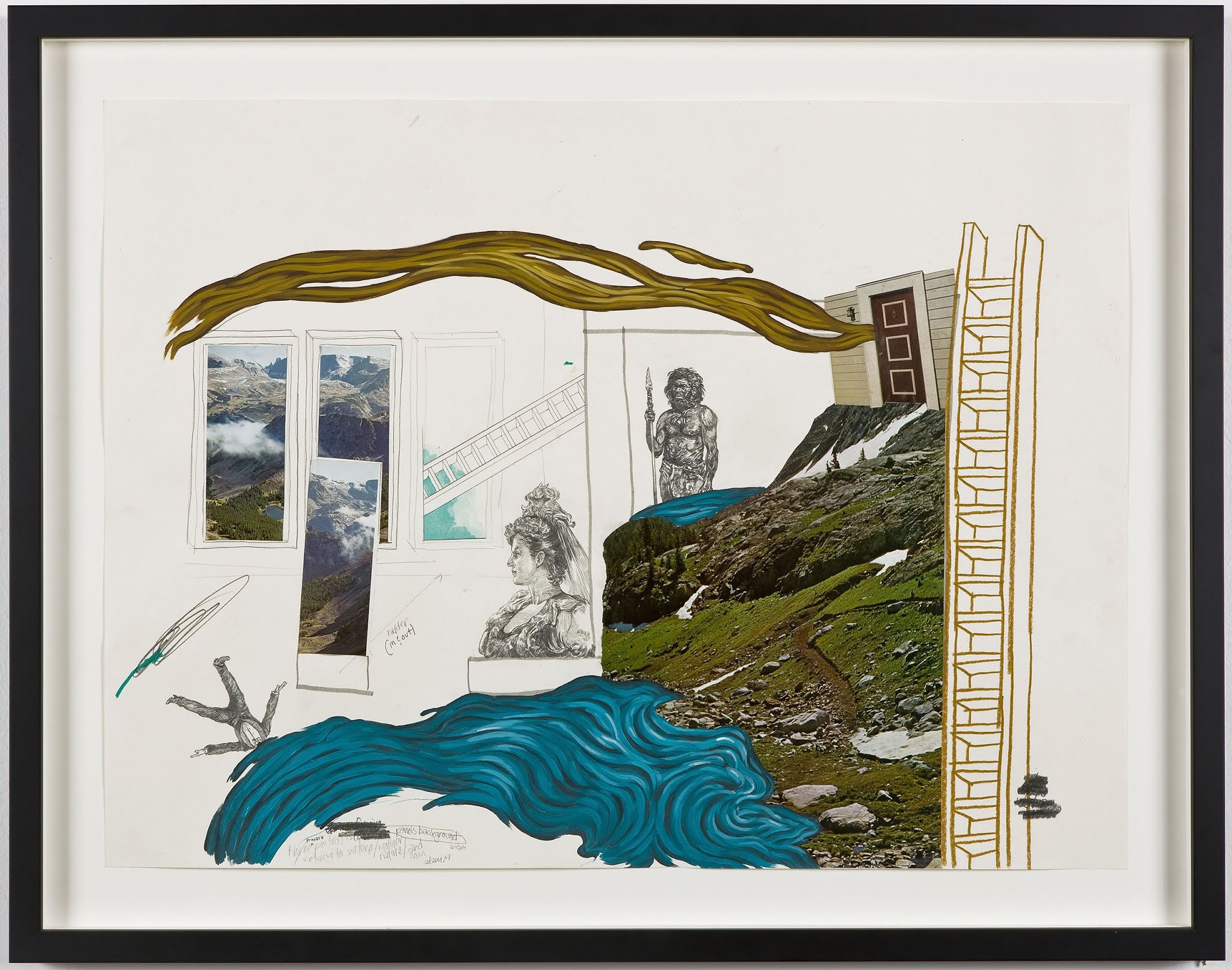


Adam Janes

Adam Janes makes drawings in a similar way to his installations. He combines collage with drawing to produce conjunctions between things that begin to generate new totalities or narratives, in such a way that you are almost able to grasp what is being 'said' but not quite. Human life is here and it's complicated, and like all good detective stories its in the unravelling backwards from the central event that the interest lies. 


Chris Johansen

Chris Johansen, Barry McGee and the San Francisco Mission School, or 'Rustic Art' and low brow aesthetics still seem to be an influence on contemporary drawing, and Robert Crumb and Philip Guston are also still there in the background. There is a desire to validate all those areas that used to be outside of the art canon, such as folk art, illustration, cartoons and naïve or outsider art. 
Robert Crumb: From Genesis 

Maurizio Cattelan uses drawing to continue to poke fun at the art world and anything else he thinks is worth making fun of. Taking on Guston's legacy and trying to raise silliness into an artform. 
Maurizio Cattelan: Self portraits

Maurizio Cattelan

Aurel Schmidt is one of the more stylistically diverse contemporary artists that focuses on drawing. She talks about finding beauty in ugliness and sees the human condition as a cyclical process of renewal and decay. She sometimes uses the detritus of our lives as her subject matter, throwaway ephemera operating as a sort of memento mori, a reminder of our own vulnerability and mortality. She also makes much more 'crafted' drawings, teasing out visual suggestions of sex and death.

Aurel Schmidt 

Aurel Schmidt: Exhibition view


Aurel Schmidt 

Dominic McGill operates with word and image locked together to create very complex narratives that cover large surfaces, his drawings creating epic voyages through time as he links historical facts with personal imaginings and crazy stories. 

Dominic McGill 

Dominic McGill 

Dominic McGill 

Sarah Woodfine returns to the tradition of model making and the use of vitrines as a form of display. Her flat cutouts are rather like toy theatres and they sit on that juncture between drawing and sculpture that allows an artist to maintain a physical presence, whilst still being able to remain a flat image maker. 

Sarah Woodfine
Sarah Woodfine

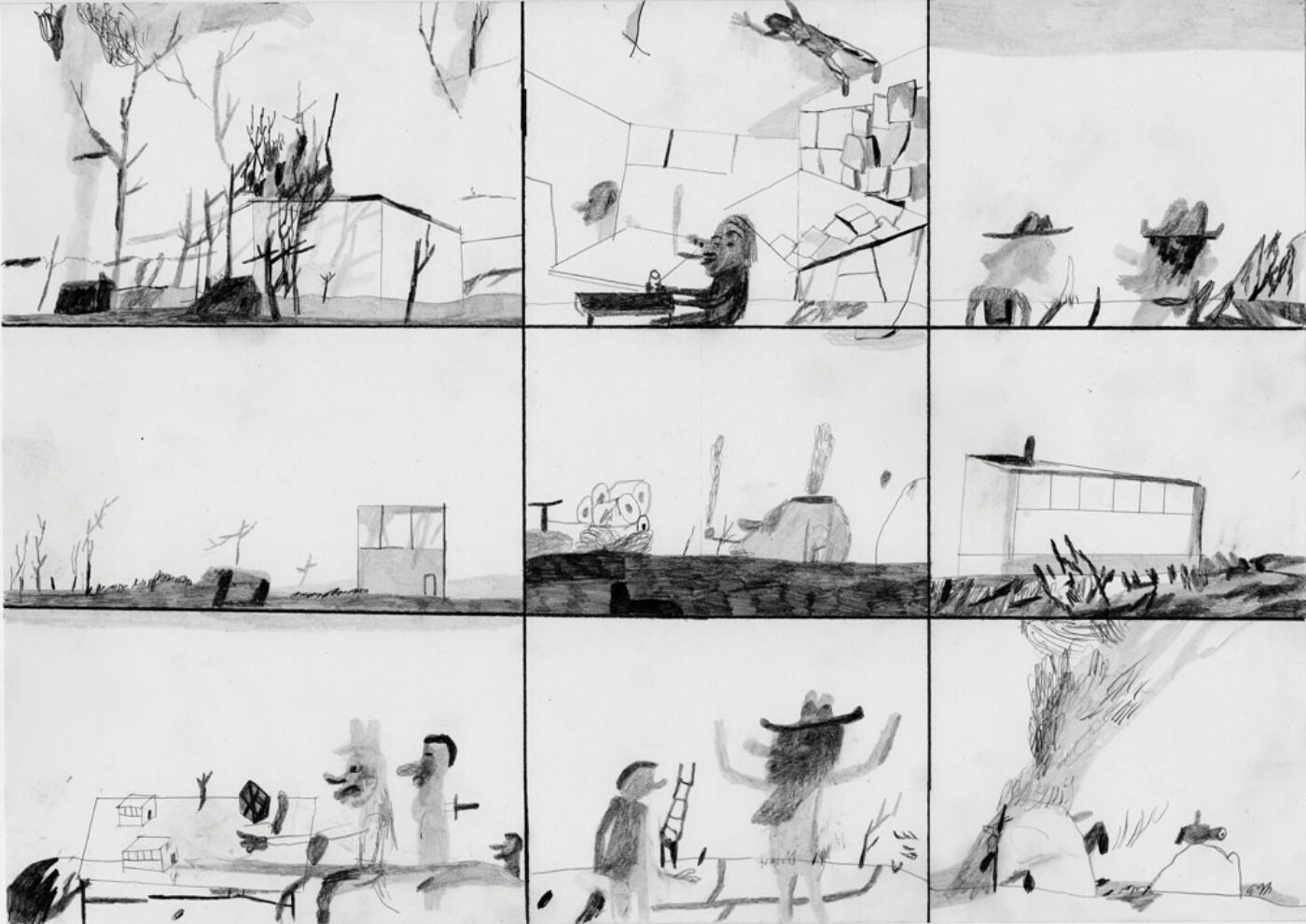
Kim Hiorthøy reminds us that the pencil can still be used to make interesting and inventive images. His visual narratives reflect the fact that he is also a film maker and that storyboards are very important to him. That crossover between film and drawing, will I believe become more and more important as we are prevented from visiting gallery spaces and artists explore ways to communicate ideas online. Perhaps drawings will be made for physical exhibition and films for online distribution, artists using a media most appropriate to the situation that presents itself, rather than being seen as painters, drawers, film makers, sculptors or performers. One one thing we do know is that after covid nothing will be quite the same and traditional ways of exhibiting and making work will be challenged. 

Kim Hiorthøy

Wangechi Mutu's images begin with collage and she then works back into their surfaces using watercolour and washes. She uses hybridity as a central concern and working between Kenya and New York and her awareness of growing up in a post colonial society feed into the way that she thinks about image development. Her sculptures follow a similar path and are montages of various found elements that are then reworked using local clays and other materials so that the various elements are brought together into a coherent whole. 


Wangechi Mutu

Kate Lyddon's images arrive via free association and found imagery that comes out through the process of drawing itself. Her starting points come from observation but through erasure and reworking, she can discover new forms and hybrids. This is a process I'm very familiar with myself, so I'm glad to see her work represented in the latest Drawing Room exhibition 'Drawn Out'. that opens on the 17th of July. The Drawing Room is also moving to a new gallery space in 2022, to a purpose-built gallery in Bermondsey, southeast London, a fact that reflects how seriously the art world now takes drawing as a stand alone discipline and as a very important way of thinking.

Kate Lyddon

As it's the summer break, this post is also a reminder that in these days of covid rules relaxation, that you can go and visit art exhibitions again and that there is nothing better than going to see physical, hand made art. The lens reduces physicality to pixels on a flat screen and gives you no idea of scale or texture. Looking at actual drawings is always an exciting experience, and they tell you so much more about an artist's intentions or particular understanding of the world than any screen image. For instance I went to see the Rachel Kneebone ceramic installation '399 Days' this weekend in the chapel at the Yorkshire Sculpture Park and upstairs there was a small display of her working drawings.  A reminder that behind even the most technically accomplished three dimensional work, there are drawings whereby ideas were initially worked out. 

Rachel Kneebone

Rachel Kneebone
See also:


Monday, 5 July 2021

Paul Klee and Markov blankets

The mind in the body in the world (study for stained glass)

Biological systems are autonomous, or self regulating. We tend to think of the things inside a biological system, such as a forest as being lots of separate things, but they are all interdependent, however when each of the elements is looked at it can appear as if it has boundaries. For example an individual tree can be thought of as just that, a tree. But it cant exist as that, its roots tap down deeply into the soil and its leaves are breathing in carbon dioxide. I.e. although for the sake of identification it might be useful for us to be able to nominate a tree as a separate thing, in reality it is an event or aspect of a process. But we can also think of a collection of atoms we call a tree being nested within another set of atoms we call a forest. The boundaries of biological systems, from individual cells to trees (or indeed people) can be thought of as the supporters of free energy, or places where that energy meets other forms of energy and where interactions take place that help to stabilise the entity. If so, something called a Markov blanket can be used to define its boundaries in a statistical sense, i.e. instead of a solid wall you have a series of probabilities whereby something is and isn't at the same time, called in this instance, the active inference scheme. You can infer something is in existence but when you look at it directly it hardens up and becomes a fixed probability. If this sounds like something from quantum mechanics, well it sort of is. For a long time physicists have realised that things are only fixed as they are if you look for them. On a larger scale a collective of Markov blankets can self-assemble into a global system that itself has a Markov blanket that links it to the larger universe; these linked autonomous systems can therefore be understood as having layers of nested and self-sustaining but permeable boundaries. It has been proven mathematically that any living system can be described as a Markov blanketed system and, this is the interesting thing, that the boundaries of such systems need not be co-extensive, or extending over the same area as the biophysical boundaries of a living organism that exists within it. I.e. there is a certain amount of give and take. If you look at the diagram below try to think of the dark spots as a tree, or at least the tree event or fluctuating core of what we tend to think of as a tree. However as part of a Markov blanketed system the edges of 'tree-ness' are not that clear and the tree extends out into the surrounding system, lets say the air or the soil, whereby it is hard to differentiate tree-ness from soil-ness or air-ness. Moving the light grey dots about will eventually disturb the pattern of the dark dots, but on a good day the pattern is pretty predictable statistically and on the whole the dark dots are stable enough for long enough to be at times seen as a tree or whatever else words try to isolate from the situation. Everything is though never static, hence the animated gif version. 


Object/space folding into Markov blankets

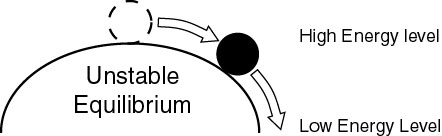
If you randomly generate a mess of dots, apparently after a time these dots begin to form patterns, i.e. free energy systems eventually appear to become self regulating. As I'm into diagrams at the moment perhaps another diagram might help. If I place a ball on top of a smooth curved hill as in the diagram below, it is unstable and will seek stability by rolling down until it reaches the ground and a state of stable equilibrium.


But as a human being you tend to take your ball, (your head) and have it kept in a vertical position. If it was up to physics we would be always be lying flat on the ground (lowest energy level), i.e. we tend to spend most of our lives in a state of unstable equilibrium. This is because we are part of a system. If you look at things as separate entities they work as separate entities. We know a lot about parts but very little in comparison about wholes. But a tree is as we have seen, a part of a system. This situation is called an open systems exchange. Energy, matter and information all enter and leave the system, forms can change, interactions occur and energy can be stored and released. These systems are regulated by feedback loops, which can be either positive or negative. Earth as a whole is warming up and cooling because of these systems, and we have seen this as part of our awareness of how global warming works. If the ice caps are large they form bright, reflective surfaces and they will reflect more of the sun's energy back into space, therefore less heat remains on the Earth's surface; thus cold conditions lead to more cold. However, when air cools, it holds less moisture and relative humidity goes up and condensation will occur. Condensation is water changing from its gas to its liquid state. In a gas there is a lot of energy being used to keep all those atoms flying around at a distance from each other, but as the situation cools down the gas becomes a liquid which needs less energy to maintain its form and the energy has to go somewhere. This energy is known as the latent heat of condensation. The latent heat of condensation then starts to heat up the surrounding air and leads to subsequent temperature increases. Our bodies operate very like this, interconnected feedback loops allow us to regulate our body temperature, blood sugar levels etc.


The diagram immediately above is a different way of representing a Markov blanketed system, but the one made of dots is more like the real situation. The boundary between one thing and another is never a nice sharp line, it is a permeable membrane that is constantly in movement as it adjusts to an ever changing world, so perhaps its better to think of the line of curvature more like the curved line in the image below, something rhythmically punctuated and permeable. 
Representation of an outer edge of a Markov blanket

The image above is an image whereby I was trying to visualise a body immersed into its environment with a permeable boundary allowing information to pass from one part of the system to another. The image at the top of this post was a different attempt at making an image whereby the figure and ground distinction was removed by thinking about the image as a design for stained glass. The floor, the bodies and the surrounding room space, interpenetrate each other as flat planar structures. I have also been thinking about scale and our bodies can be scaled in a variety of ways. For an ant climbing up my leg it is a huge landscape, and when I look out over my chest and down to my legs and my toes, I find another landscape type experience. But as I step away from myself, (an interesting idea in itself) I can see myself as a body, and I'm in portrait mode or human scale. However as you move out and away from the situation my body becomes a mere speck on the horizon. I am in relation to much larger visions, such as world, solar system or galaxy totally insignificant. (See this earlier post for details as to how this works)

This ability to think about scale changes is helpful because it allows us think about different types of boundaries. For instance at a molecular scale our bodies are composed of elements such as sodium, potassium, calcium, and magnesium, and each has a specific electrical charge. Our cells use these charged elements, called ions, to generate electricity. The contents of a cell are protected from the outside environment by a cell membrane. This cell membrane is made up of lipids that create a barrier that only certain substances can cross to reach the cell interior. (I have looked at lipids before in a post about why ink sticks to paper and I thought then that there were deep metaphors that could be constructed from the way they operate) Not only does the cell membrane function as a barrier to molecules, it also acts as a way for the cell to generate electrical currents. Resting cells are negatively charged on the inside, while the outside environment is more positively charged. This is due to a slight imbalance between positive and negative ions inside and outside the cell. Cells can achieve this charge separation by allowing charged ions to flow in and out through the membrane. The flow of charges across the cell membrane is what generates electrical currents. Cells then control the flow of specific charged elements across the membrane with proteins that sit on the cell surface and create an opening for certain ions to pass through. These proteins are called ion channels. When a cell is stimulated, it allows positive charges to enter the cell through open ion channels. The inside of the cell then becomes more positively charged, which triggers further electrical currents that can turn into electrical pulses, called action potentials. These action potentials are what we think of when we become aware of ourselves doing things. Our bodies use certain patterns of action potentials to initiate movements, thoughts and behaviours. Which is great, but when it goes wrong we have a disruption in our network of electrical currents, which we usually call illness. This is something I'm particularly aware of because I have a heart condition, for my heart to pump, cells must generate electrical currents that allow the heart muscle to contract at the right time. Irregular electrical currents can prevent heart muscles from contracting correctly, and this is why I have an irregular heartbeat.

 
Memory of a feeling tone

As we become aware of interroception a fusion occurs between the memory of exterior perception and an interior somatic awareness. The image above was constructed as part of a series of responses to remembering how it felt to have a painful bunion. This was then contrasted (below) with an image made when actually in pain.

Image of a pain

Paul Klee suffered from scleroderma an autoimmune condition that happens when the body’s immune system starts to attack itself. Damage by the immune system causes excessive inflammation and increased production of collagen, leading to scarring or fibrosis of the body’s tissues and organs, hence the name, 'scleroderma'. His own artwork you could think of as a way of visualising the internal working and structures of art itself. His 'Pedagogic Sketchbook' being a sort of Gray's Anatomy of the visual world. It was as if he wanted to reveal what lay under the skin of all that Victorian figurative painting.  

I have been returning to Klee's work as a loadstone or check-in to help me with my next steps in trying to visualise the invisible. How to translate the feeling tones that emerge from the inner body into visual images and it has been a back to basics experience, and has forced me to get rid of a lot of visual baggage.

Klee: Äliup, 1931. Watercolor and pencil on paper on cardboard, 47.9 x 31.4 cm

Klee's world begins with the potential of a dot. More than one dot creates energy, either a balance or an in-balance is created and as these two situations are created and uncreated 'life' begins to emerge from the surface of the paper. As the surface becomes animated moments of more concentrated energy occur, in the case above forms emerge picked out in dark lines, and in the image below shapes become intimated, they drift one into the other and occasionally pop into being, such as the archway or the circle. 

Klee: Ad Parnassum 100 x 126 cm

I found that by returning to Klee's work after many years, that it seemed as fresh and as inspiring as it did all those years ago when I first encountered it. In the image below we find lines now taking over the image making load, they gradually become signs, but are still also just lines, nothing is fixed but at the same time we can see forms emerging. These images feel very like music, they touch us with their rhythmic pulse, like small creatures, we can feel their heartbeat as we hold them.  

Klee: untitled. 

Last week I was able to visit the Pallant House Gallery in Chichester and they had a Paul Klee image on exhibition. Titled 'Clouds' it was stunning. A delicate line image was constantly emerging from the centre of a floating cloud of darkness. The tonality was handled so subtly, that it was hard to see how it was achieved, until you realised that he must have used layer after layer of thin washes to achieve an effect as if the darkness was an integral part of the paper rather than something applied to it. The thin ink lines that drifted in and out of the dark, were like so many of Klee's lines 'going for a walk', lines that were looking for an idea to become, a form to make, always in a moment of becoming rather than an idée fixe. The image was far too delicate to photograph, so you will have to imagine it, and perhaps that's a good thing, we are looking at too many images on line at the moment and we can tend to think that's how they are, but only certain things look good on a screen and it's important that we don't forget that. 


From a series of drawings of the body as a self-aware entity

See also:

A growing series of posts that follow the evolution of an idea


Friday, 2 July 2021

A drawing of beaked hawks-beard

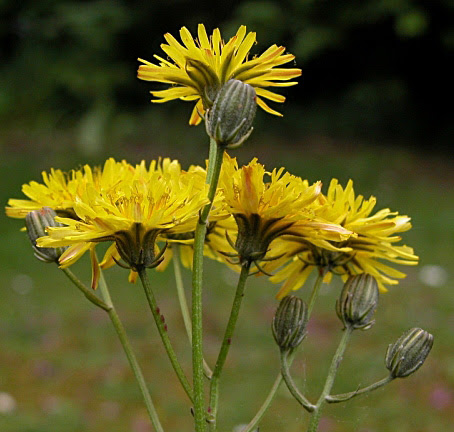
Beaked hawksbeard 'crepis vesicaria'

Gerard E Cheshire is a writer I follow avidly. His interests are the deciphering of ancient languages and medieval plant biology.  These interests bring together drawings of plants from a time well before both photography or 'scientific' illustration techniques, and a way of writing about nature that doesn't separate out daily human life experience, from nature observation and a need to embed thinking into wider cosmic narratives. There is a wonderful holistic experience to be gained from every one of the pages he studies. Cheshire is also very generous, he sends links out to his work in order to update his followers , such as myself, and every time I look to see what he is doing I am rewarded by fresh insights into how to approach something as apparently simple as drawing a plant. 

This juxtaposition below is typical of Cheshire. 

A photograph of the root of beaked hawksbeard, compared with its drawing from Manuscript MS408

On the left we have the reality of the photographic image, but the drawing takes us into much deeper realms. My first thoughts on seeing a field full of beaked hawksbeards this morning when I went for my walk, was how like suns these flowers were. 

Hawksbeard

The flowers like dandelions radiate out from a centre, the evolutionary design for these flowers echoing the sun itself. You cannot escape the connection, as you walk through a field of these flowers and then look up at the sun, they are in many ways one indivisible experience of yellowness and radiance. Hold a flowerhead in your hand and it will turn your skin yellow as it radiates reflective light. 

Cheshire then reminds us that the drawing of the root is done in such a way that we are imaginatively intertwined with four braids of Persephone's golden hair and that these represent earth, air, fire and water. Empedocles the philosopher invented the idea of the four elements in his text, 'The Doctrine of the Four Roots'; thus linking in imaginative terms, the base from which everything emerges to plant roots. The world itself, like a plant, grows. What a wonderful idea. Persephone of course had to spend half the year underground, the myth of her abduction and return to the surface representing her functions as the embodiment of spring and the personification of vegetation. 
If we then look at the way the flowers have been drawn we see another wonderful complexity visualised.
The sun rising over the flower bud

When you see a beaked hawksbeard, it may or may not be in full flower. Sometimes it will take the form of a seed-head or an as yet unopened bud. A photograph will like the one at the top of this post perhaps be able to show us a couple of states at once. However the artist in this case has drawn a rising sun, emerging from behind the seed pod/flower bud. The flower will be a sun when it has emerged, and like the sun it will disappear during winter, only to emerge again next summer. What a wonderful image. 

The full page depicting beaked hawksbeard

In the image above the leaves begin to move across the page as if their form is morphing between plant leaf and insect life and the text that accompanies the drawing is itself of great interest, and the deciphering of texts like this is another of 
Cheshire's skills. 
From this plant can be derived, doses of ichor, the wisest medicine, and it can be beneficial to midwives and child bearing women, the sun's rays as caught in the plants flower, bringing benefits of health and happiness. 

The text also operates as a poem, and as a cross between medical information, cosmic connections and everyday need. Please remember, this is also just one page, from one manuscript and Gerard E Cheshire continues to find these old manuscripts and translate them and publish his findings. I think in his quiet academic way, he is offering us something marvellous. 

Beaked hawksbeard 'crepis vesicaria'

See also: