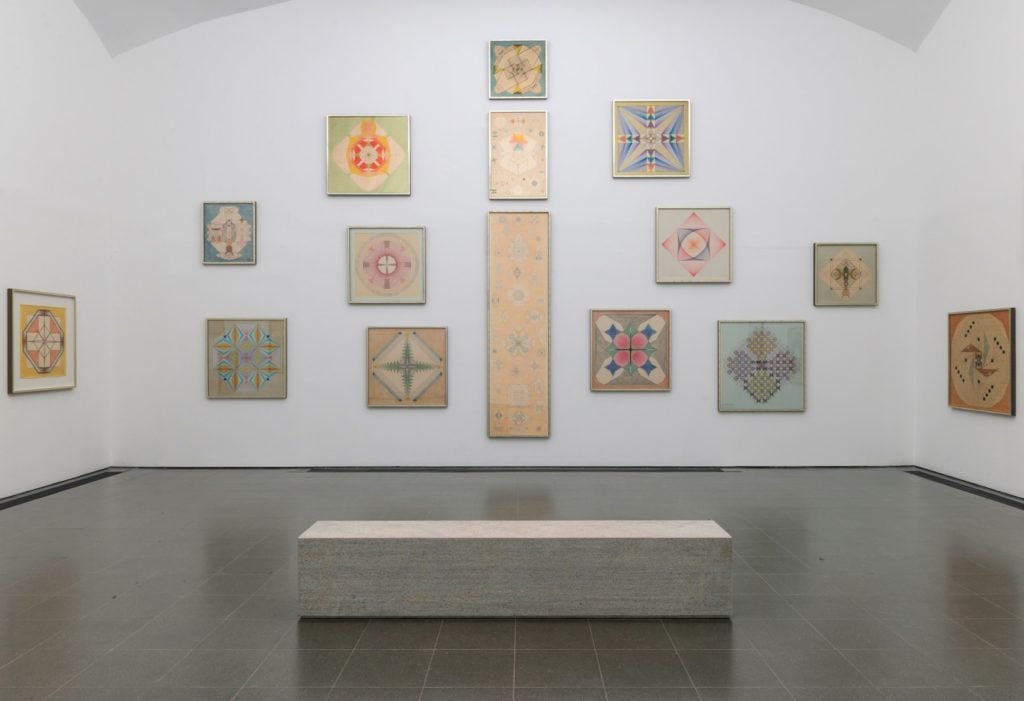
Walter Russell was an impressionist style painter, but his most important contribution to visual imagery and its ability to carry ideas was in the development of a range of diagrammatic descriptions of mystic energy forces. These diagrams have recently come back into fashion, probably because of a rise in interest of artists such as Hilma of Klint.
Hilma of Klint
Both Walter Russell and Hilma of Klint were in their own ways influenced by Theosophy and they were drawn to an exploration of alternative ways of envisioning the world that were attempts to uncover the underlying spiritual and metaphysical aspects of reality. At the time they were regarded initially as 'interesting' but very quickly dismissed as odd balls but we must not forget that many artists at the time were involved in theosophy including Kandinsky and Mondrian. Perhaps artists like Walter Russell and Hilma of Klint asked too many difficult questions of the art dealers and art audience of the time, because they were not just making images, they were producing diagrams for action, their art was part of a much larger ideal, one that would have involved participants in massive social change. In times of upheaval like the one we are in now we often need to look for an alternative understanding of reality. The one we have seems to be failing, in particular truth seems to be something for people to make up as they go along and this has caused many of us to distrust 'the powers that be' and we therefore perhaps need to forge another vision that seems more spiritually up-lifting. However to do this artists need to think of their practice as being not an isolated reflection on our times, but as a way of working that is integral to the forging of new ways to think. Our current undermined social systems and belief structures, need new foundations if we are to move onwards and become able to deal with huge issues such as global warming and the failure of our democratic processes. At the end of the 19th century theosophy seemed to offer an answer to a series of failing belief systems, and several artists at the time saw in its belief system an opportunity to rethink their practices, both as artists and as social thinkers. However it was to be Dada and Surrealism that carried the anti-rationalist flag into the centre of twentieth century art practices, and as Rosalind Krauss stated, it soon became “embarrassing to mention art and spirit in the same sentence". However Massimiliano Gioni’s 2013 Venice Biennale, entitled 'The Encyclopedic Palace' was a turning point in critical reception amongst the art community. As you entered the first pavilion in the Arsenale you were confronted with Marino Auriti's museum of imaginary knowledge, a three dimensional diagram that echoed the structure of memory theatres. We were being informed that it was ok to once again be in touch with that other side of creativity, the one we never talk about, but which we often draw upon when feeling spiritually exhausted. Since that time several artists have emerged from obscurity who put spirituality at the centre of their practices, such as Marjorie Cameron a follower of Thelema, a spiritual practice developed by Aleister Crowley, Agnes Pelton, Georgiana Houghton, who's 'spirit drawings' were shown at the Courtauld and Emma Kunz who's work was shown at the Serpentine Gallery recently. The exhibition 'Language of the birds' at New York University’s 80WSE Gallery, was an exploration of art inspired by Kabbalah, alchemy, hermeticism, and Tarot and Grisha Bruskin's work (someone I have been looking at and been influenced by for some time) is now becoming much more well known.
Grisha Bruskin
In Bruskin's work we find a conjunction between the structures of soviet Russian society and the imagery of Jewish mysticism and he has in the past set out his ideas in diagrammatic form.
However it is probably in the diagrams of Rudolf Steiner that we see the most powerful influence of the spiritualist/socialist mind on contemporary art.
Rudolf Steiner diagrams
Steiner developed a system of thinking that he called anthroposophy and he aimed to regain traction in the the spiritual world by mirroring the information obtained by science when investigating the physical world. This split between the world of the social (spiritual) and that of science, would be raised yet again in the work of both Joseph Beuys and Bruno Latour.
Beuys was deeply influenced by Steiner's diagrams, in particular those produced during his blackboard lectures. In fact a Beuys diagram at first sight looks very like one of Steiner's.
Joseph Beuys diagrams
Bruno Latour has developed a system of thinking that is an "anthropology of science". It explores the dualistic distinction that modernity has made between nature and society. Pre-modern peoples argues Latour, made no such division and a tidy nature/culture dualism was in fact never possible. He cites a particular moment in time as the beginning of this separation, the argument between Hobbes and Boyle as to what constitutes evidence. Hobbes is someone that saw evidence as something that comes from the masses of people that experience the world, evidence being something that emerges from social discourse, while Boyle points to another type of evidence, that which was embedded within a scientific experiment, such as in his case the proof of the existence of a vacuum by experiment. The tacit practice of the air pump and the dexterity it required is witnessed not by texts or languages but by silent things such as air pumps and Hobbes could not accept that this type of evidence could outweigh the voices of many people.
It was Beuys as an artist that made us aware that being an artist was more akin to being a shaman type figure, one that operated as a catalyst between people and the various ways that they came to understand the world. He was very interested in systems and saw his work as interventions that might change what were becoming ossified systems that pervaded Western society. As well as looking back to Steiner he looked as Eastern philosophies and religions as signs of alternative approaches to living and he began to integrate various aspects of his life into a larger diagram that was continually evolving. For instance he might focus on money and how it could be both used to lever change and at the same time be subject to a rethinking, whereby as a capitalist form of support for commercial exchange it was becoming redundant. This particular tendency within the various strands of contemporary practice has been brought together in the net exhibition, Diagrams of Power which showcases a range of artists working in this territory at the moment. However what seems to be missing is the touch of the esoteric, we need to remember that Thomas Edison was fascinated with the occult and that he initially invented the telephone to talk to the dead. The existence of an invisible, non-material realm is still with us but we now call it 'dark matter', these unknown territories will hopefully always be with us, they are the gaps in our knowledge that allow us as artists to do the things we do, without having to always justify ourselves in the court of rationality.
Emma Kunz Visionary Drawings: Serpentine Galleries
Coda:
I have looked at this area of work myself at times, in particular now that I'm part of the group, 'Life hacks for a limited future', I have developed a diagram for the group to help envisage the various stages of ageing.
The stages of ageing
The idea was to create a diagram with an image embedded within it, in this case a scarab beetle was the rough guide to the overall shape. In Egyptian times it was a symbol of immortality, resurrection, transformation and protection, so seemed a good model on which to base a diagram that was designed to get older people to think about facing up to death. Because this is an age of the mobile phone I then had to redesign my diagram to fit a phone screen, a note to self about the fact that technology moves on.
Louise Despont is perhaps the artist who is working most powerfully in this area at the moment. She uses stencils to create large scale 'spiritual diagrams' often using old ledger paper as a surface to work on.
Louise Despont
Another addition:
My old friend Terry Hammill on seeing this post sent me a story about when in 1971 he was in the USA and came across the work of Soleri, who had published a wonderful book called ‘Arcology: the city in the image of man’. Paolo Soleri had published his ‘Arcology' book just two years before in 1969 and his spiritual ideas are very similar to the ones introduced above, the difference being that Soleri was an architect and was determined to erect real buildings that would reflect his cosmological ideas.
Paolo Soleri: Diagrams from Arcology: the city in the image of man
I haven’t put up many posts on graffiti and yet as an art form it is probably the closest to pure drawing. I wonder if its my age or a certain unconscious bias that has kept me away from reflecting on an area of art making that surrounds me and where I can walk out and see good examples of it within seconds of emerging from the house. I did a few years ago put a book together about the streets texts of Chapeltown where I live, ‘Wits Breath Edion’, https://www.blurb.co.uk/books/2308745-wits-breath-edion and its still available on-line but I have not been alert to the latest developments of a movement that continues to be very powerful globally. However I need to remind myself of the issues involved because I have just been given an MA level graffiti artist to supervise, and so as I go through the process of preparation by reacquainting myself with some of the key background issues thought it would also be an opportunity to develop a blog post outlining what I think are the key issues surrounding graffiti art form practices.
You could define graffiti as an art form of the proletariat, being an old left wing socialist I have always thought of it as a way of making marks on a property canvas; by this I mean that walls or the surfaces on which graffiti is made, are usually owned by someone and yet the images made on them are usually produced by those who own little or nothing. This I do understand is an old trope or stereotype and as I pointed out just the other week, stereotypes are dangerous so perhaps I’d better broaden my definition.
A Marxist reading of graffiti would highlight how it works in terms of stages in the redistribution of property. In this case the use-value of a wall or other surface is becoming appropriated by the graffitist and the surface’s owner is losing control over one of the meanings of his or her property. However many current graffiti artists are using their style for commercial gain, the spray paints they use are expensive and the culture from within which they operate is much more complex than that attacked by certain urban revolutionaries. For instance a Banksy image stencilled on a wall can increase its value considerably and yet at the same time he is very critical of certain capitalist values and his work is often considered a left-wing critique of the establishment.
In 2001 IBM employed graffiti advertising by spray-painting images on pavements.
Ogilvy and Mather: IBM Linux ad
The ad agency Ogilvy and Mather were using graffiti images to bring attention to IBM’s launch of a new Linux based e-server by linking in the idea of graffiti to the counter-cultural roots of Linux as open-source, community-driven software. This awareness of commercial possibilities was a product of capitalist appropriation and for some time before this there had been a gradual drift of street art into gallery spaces, the most notorious perhaps been the parallel careers of Jean Michel Basquiat and Keith Haring.
Bansky comments on Basquiat
Basquiat's work was highly political, it questioned everyday racism and the fluid nature of identity and Haring supported rallies against apartheid and the campaign for nuclear disarmament as well as being an early AIDS awareness advocate. Both artists emerged from the New York graffiti scene, hence their left wing credentials and were taken on board by fine art galleries. It has been argued therefore that their early left wing stances were appropriated and neutered by being turned into commercial products. It is this argument that now lies central to the ambiguous nature of more recent writing about graffiti, is it truly a style of the streets or is it yet another platform for wannabe gallery artists? I don't have an opinion on this and think it's too complicated an issue to unpick as I don't know enough about the current situation, however anyone thinking of developing a graffiti practice does I think have to at least be aware of the issues.
Advertising directed at your counter culture
When Sony decided to use graffiti type images on the streets of American cities, of urban kids playing with the PSP handheld device as if it were a street culture icon, there was an immediate backlash from the graffiti community. However the line had now been blurred and a number of graffiti artists, including Mike Giant, Pursue, Rime, and Noah have used their street credentials to support new careers in the design of skateboards, T shirts and other urban wear including shoe design.
'Become a walking art installation with the Dr. Martens X Jean-Michel Basquiat collection. Iconic silhouettes are adorned with Basquiat illustrations to take your look to new levels' Text pasted from Doc Martin's website.
Doctor Martin's in the case above suggesting that by buying their boots decorated in imagery derived from Basquiat's paintings, the wearer can become a walking art installation. What this image also suggests is how much humans need imagery in order to brand themselves as belonging to certain 'urban tribes'. In this case the wearer can suggest an interest in creativity, urban style, black street culture as well as suggesting an edginess due to the fact that everyone knows that Basquiat was a drug addict and that he died young like so many teen icons.
Haring seemed to understand the very ancient roots of graffiti, and as soon as you see his imagery painted directly onto his body, you get a sense of how 'tribal' some graffiti is.
Keith Haring
A performer at the Ayres rock Tjungu Festival
Body decoration in many cultures including our own is usually part of a 'total art' or gesamtkunstwerk, which is an approach to using imagery, music, dance etc., all together, as a way of communicating what it is to be a human embedded into a particular culture at a particular time. Think of someone today going to the tattoo studio, hanging out on the street, wearing certain clothes, then moving on to a music scene to listen to a certain type of structured sound. It should all hang together for them and be part of the way they develop an identity.
High Viz street culture festival Birmingham
The idea of 'street culture' is now so embedded into contemporary consciousness that cities like Birmingham are now bringing together comic book, dance, skateboarding and graffiti as annual festivals celebrating the contribution of street life and culture to the city.
Of course when this happens some will decry the artists as selling out, whilst others will bemoan the fact that the city is allowing graffiti and urban culture to become acceptable. All of these ideas are also mixed in with issues surrounding the fact that cities are multicultural and that they are melting pots of culture clashes, high art coming up against hip-hop, poetry against tagging, oil paint against the spray can. You are either excited by the potential of new hybrid art forms emerging from this chaotic mix or are worried that what you have always understood as culture is being eroded by something that you never even considered as art. What you cant do if you live in a city is ignore it.
From a personal point of view I think that people will always want to celebrate their identity and that if you begin to elevate one way of doing this over another you begin the process of selecting out the culture of the elite or powerful. A healthy culture is not a fixed culture, it is one that is open to change and is confident enough to reflect that the only things that are constants in life are growth, death and energy transfer.
Basquiat and Haring were followed into the gallery by many other graffiti artists, and as they transfer across and become more acceptable their work becomes appropriated by academia. In my own institution Sweet Toof has been a visiting lecturer and his work it has now being argued is a modern continuation of the 'vanitas' tradition, his teeth standing in for the full skull image that was used to remind us of the fact that death is always with us.
Sweet Toof
I opened this post with an image of Blu's work, one that if you click on it becomes an animation. I have been following Blu's practice for a few years now and his work attracts me for a number of reasons. First of all he reminds me that all drawing is in some ways a performance. He will be acting out the drama of these animations in such a way that they extend over several days, as he makes drawings, paints them out and remakes, over and over again as they make their way over buildings and along streets, each drawing being a clearly thought through follow on from the one before. Of course he needs a supportive team of people filming his drawings as they unfold, and the team becomes part of the street performance. He is also very inventive, and the invention begins with the environment within which he is working, as William Kentridge said about his own animation drawing, "there is always discovery in the making". In this case the drawing begins with outlining a single brick in a wall. Once the work is done we are left with a cleaned off surface, each drawing being wiped out as a new one replaces it. This means that the work is ephemeral, something that is enacted as street drama, but not left so that it becomes dated or inappropriate because the moment or issues it reflects upon has now gone.
PHLEGM
More locally to Yorkshire PHLEGM, who is based in Sheffield, has been making images that I think work very well in an urban setting. He uses images drawn in black over a white silhouette. This is a very canny way of making his drawings stand out against a variety of different backgrounds.
If you want to get an idea of how the New York graffiti scene changed over a period of time when some of its members became art stars, perhaps the film KENNY SCHARF: WHEN WORLDS COLLIDE, is the best introduction. It was made over 11 years and features interviews and rare archival footage with Kenny Scharf, Andy Warhol, Jean-Michel Basquiat, Keith Haring, Ed Ruscha, Dennis Hopper, Yoko Ono, Kaws, Marilyn Minter, and Jeffrey Deitch.
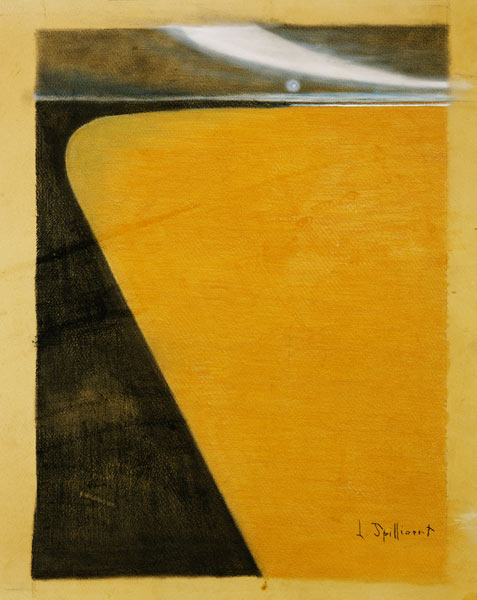
Léon Spilliaert's work is on exhibition at the Royal Academy until the 20th of September. This is an artist few of you will be aware of because it is only recently that critical opinion has shifted in his direction and work that was considered very inferior Ensor type imagery, is now celebrated as work that captured a certain type of mental anguish that existed at the time. Perhaps it's due to our own day's preoccupation with the mental pressures of being locked down and being constantly made aware of the invisible dangers of virus attacks, that has made critics re-visit Spilliaert's images and now see them as important.
Again we have a story of a once thought of poor or unimportant artist's work, being elevated into the parthenon of great art. On the one hand we all benefit by now being able to see his work, but on the other hand it makes me very cynical, as it is hard to resist thinking about the capitalist machinery behind all this reappraisal. Who will benefit from the sudden rise in auction prices and will any of the many struggling artists throughout the world gain anything from his travel from obscurity to fame, beyond a feeling of "well perhaps maybe"...?
The work is though interesting and it reminded me of Munch more than Ensor. The moody threat that lies behind certain types of image abstraction was I thought very potent. As we select out or abstract things from the world in order to envisage it, we are left with the things that reflect our own proclivities, in this case Spilliaert was obviously always aware of the threat that lies in dark pools of shadow, a half seen thing or a sinuous shape. All of which are things that we can flesh out through drawing and it is a certain type of reductionist drawing that lies at the root of his image making.
The image above of a bed covered in a white sheet could be a simple study in tone, but of course the white shape can also become a ghost like figure, we read the empty space as absence, and we are presented with a sparse composition that makes us think that someone has just died.
Spilliaert drew a lot when a child and we still have his sketchbooks.
Sketchbooks always help us to see how an artist thinks and in Spilliaert's early work you can see a certain morbid fascination coming through very early on; perhaps he was a sickly child.
For myself, I am mainly interested in the way that he can animate inanimate objects by drawing them in such a way that there is a certain ambiguity about their representation.
The pair of gloves above could be anything from jellyfish to old people, they morph between one form and another, which I can see from Spilliaert's point of view made them slightly sinister; however I like the humour and playful possibilities suggested in the way these gloves are always on the edge of dissolving and becoming something else. I mentioned Flann O'Brien's 'The Third Policeman' recently as an alternative type of drawing theory and this is another image that I think fits into O'Brien's comedic model.
The very idea of thinking of drawing as a language is problematic. We have long been accustomed to believing that the things that we take as being central to being a human being must also be central to the understanding of everything else. It has been argued by many that language is what makes human beings special and that the way that animals communicate is biological, or inborn. Human language it is further argued is symbolic, using a set number of sounds (phonemes) and characters, which allows ideas to be recorded and preserved. Animal communication it is argued is not symbolic, so it cannot preserve ideas of the past. Is that it then? This definition presumes that language is to do with phonemes and alphabets and that it is the use of symbols that singles humans out as being different. But what if a nest was a language event? Tailorbirds get their name from the way their nest is constructed. The edges of a large leaf are pierced and sewn together with plant fibre or spider's web to make a cradle in which the actual grass nest is built. Male weaver birds weave nests and use them as a form of display to lure prospective females, their efforts being both a protection for eggs and young chicks, as well as being part of a sex ritual. So we are happy about the fact that birds make things that operate as both protection and as sexual display, but we don't recognise their activities as including a language? So how do they communicate? Is not the nest structure something that is complex and robust enough to preserve an idea long enough for others of its species to consider its shape and construction in order to made decisions about future life paths?
A tailor bird builds a nest
An act of communication is the transferring of information from one thing to another thing. Every communication involves (at least) a sender, a message and a recipient, or a starting point, a movement between and an end point. Communication includes the medium used to communicate and the location of the communication. So lets think about bees.
The Roman poet Virgil had this to say about them, "Some, too, the wardship of the gates befalls, who watch in turn for showers and cloudy skies." An interesting piece of communication on Virgil's part because he is telling us that he has in some way been communicating with bees and that they in turn have been communicating with atmospheric conditions. The bees need to know when it is about to rain because they risk injury if they are caught flying in a rainstorm. Their navigation senses rely heavily on the sun and a rainstorm would in effect make it impossible for them to find their way around.
Diagram of a bee's waggle dance
So there is a causal link between an inanimate thing, (atmospheric conditions) an insect, other insects and a human being. We know that bees communicate partly through the medium of dance and one way to think of that is as a living, moving diagram, a sort of mime or body language as us humans would translate it. In order to fly you need excellent sensitivity to changes in temperature, air pressure and wind direction, all attributes that could also be used to predict the imminent approach of rain.
I have been trying to learn more about Indian aesthetics and the more I research into the history of what is a very complex and fascinating aesthetic system, I become more and more aware of its roots in human body language, especially dance and eating. At the centre of Indian aesthetics is 'rasa', one understanding of which is the enjoyment of flavours that arise from selected ingredients and their preparation. The 'Natya Shastra of Bharata' is a complex drama and dance manual written about 2,000 years ago and it includes 108 codified units of movement, including hand movements or 'mudras'which in turn have been preserved by being carved into sculptures now to be found in ancient temples. These hand movements could be read as a living diagram.
Chin or Vitarka Mudra
The thumb touches the index finger, the meeting of the powerful grasping thumb with the sensitive index finger is meant to evoke mindfulness.
Abhaya Mudra
The open hand, palm presented upright and frontally to others, is a gesture of fearlessness of reassurance and safety, a gesture which dispels fear.
Namaskara Mudra
The pressing of both palms together, a sign of joining and togetherness communicates reverence or a polite form of greeting.
Bhumisparsha Mudra
All the fingers of the right hand extend downwards to touch the ground. This gesture communicates grounded enlightenment. Originally in Buddhist traditions the earth pressing mudra is often found accompanied by the left hand held flat in the lap in the dhyana mudra of meditation.
So going back to my original question, 'is drawing a language' I suppose I was really asking a another question, are all forms of communication languages? Is any effect by one thing on another a type of communication? Perhaps its simply a matter of focus. As communication includes the medium used to communicate with and the location of the communication, if we focus on this, we get very quickly to Marshall McLuhan's concept of 'the medium is the message'. He proposed that a communication medium itself, not the messages it carries, should be the primary focus of study. In the case of hand gestures the medium is located in the human body, so we would need to return to a close observation as to how the body moves and how we begin to develop meaning from an observation of the body in movement. This I suppose also suggests that a question such as 'is drawing a language?' is really redundant and that what is much more interesting is how is communication made between any two things and what sort of communication is it?
The secretion of fungal volatile organic compounds (VOCs) are used by fungi as a mechanism to protect themselves from enemies or to manipulate their surroundings. They can operate as a means of communication, but these chemical signals are also able to specifically manipulate the recipient. VOCs can reprogram the root architecture of symbiotic partner plants or increase plant growth, they can also enhance plant resistance against pathogens by activating phytohormone dependent signalling pathways. In this instance it is quite clear that the communication process is also shaping and changing the recipient of the communication. A fungi is changing and manipulating the life of a plant. Chemical change is central to how I work as a human being, and a lot of the chemicals I put into my body are derived from the plants that I eat. So I could argue that my drawings, which are the result of my own predilections, which in turn are chemically led and are in turn heavily influenced by the food that I have been eating and that this in turn has been shaped by a fungal volatile organic compound, are also the result of chemical changes within a complex electro-chemical organism. If my drawings are the result of chemical changes that are the product of this chain of consequences, it could be argued that it is the mushroom that draws.
Beatrix Potter: A snail and its young
This image of a giant snail creature communicating with a man about the relative sizes of fish they had in their respective imaginations caught, is a result of a chemical memory, one that has carried within it an image for some time of the drawing by Beatrix Potter further above. For whatever reason I had to get it out of my system by redrawing it, but Potter would not have had me in mind as the recipient of her 'message' when she drew this image and would herself have been more effected by an encounter at one time or another with a snail. You as someone looking at both images have already begun to manufacture a chemical memory of the experience and you may or may not pass it on. The image below was part of my own chemical chain response to a process not unlike Chinese whispers.
McLuhan, M (1964, 2001) Understanding Media: The Extensions of Man London: Routledge
Schwartz, S. L. (2004) Rasa: Performing the divine in IndiaColumbia University Press
Werner, S., Polle, A. & Brinkmann, N. Below ground communication: impacts of volatile organic compounds (VOCs) from soil fungi on other soil-inhabiting organisms.Appl Microbiol Biotechnol100,8651–8665 (2016). https://doi.org/10.1007/s00253-016-7792-1