Thursday, 12 May 2022

Tim Ingold's 'Lines'

Lines: a brief history

A while ago when reporting on a lecture I went to given by Tim Ingold, I suggested that his two books on line were an essential read. ‘Lines: A Brief History’ and ‘The Life of Lines’ both open out our thinking about drawing into the theatre of life itself and help those of us that draw to invest our drawings with a wide range of possible meanings. I also stated at the time that I would provide a summary of the two books and give an indication of possible ways to use them.

Ingold, T. (2016) Lines a Brief History London: Routledge

In 'Lines a Brief History' Ingold points out that a wide range of human activities including walking, weaving, observing, storytelling, singing, drawing and writing all need to proceed in linear directions and that embedded into the very language that we talk about these things are line metaphors. For instance in order to tell a story we move events from A to B, we stretch out our sentences into lines of text. As we walk we create lines, both physically, (Richard Long makes lines by walking through grass, but so do we all.) as well as metaphorically. The old idea of the Wyrd for instance uses the image of an invisible line that is connected to you from birth, (a sort of ghost of the umbilical cord), as you move through life this line entangles itself around all the people and things you interact with, eventually weaving a cloth that is literally the tapestry of your life. In this book Tim Ingold imagines a world in which everything is interwoven or interconnected by lines and lays the foundations for a completely new discipline: the anthropological archaeology of the line.

Ingold is very much a polymath and uses a wide range of sources to illustrate his points, including archaeology, classical studies, art history, linguistics, psychology, musicology, philosophy and drawing.

Ingold's book is a great help when writing artist's positioning statements. He uses visual metaphors to demonstrate that you can take a concept and use it across many different disciplines to illuminate the way that human beings think, and reminds us that thinking itself begins with embodied experiences. For instance the idea of the 'Wyrd' begins in the actual experience of one human being being linked to another by a 'line' or umbilical cord. He points out that one of the earliest uses of vegetable fibres was to twist them together to create lines, lines that we call threads, strings or ropes. As we began to use these lines of thread, the various uses we put them to allowed us to think about different things. This is an extended mind theory which suggests that we use the stuff of the world to develop ideas or trains of thought. Threads allow us to weave ideas together, strings to tie them together and rope to scale up and over them. For instance lets say we are fishing using a line and rod, we might develop all sorts of ideas that begin with the idea of a connection between one thing and another. A line physically connects two things together, but the way it does varies. Alfred Gell introduced us to the ‘spring-hook fishing trap’ from Guyana. It consists of a fishing line linked to a bent tree branch, which is held in place by an easily displaced notch, one that the fish in effect 'trips' as it pulls on the line. When the fish bites down on the bait, its mouth is caught on the hook and in its struggle to get away it un-notches the held down branch, which springs upright, its violent release throwing the fish up into the air, leaving it dangling. In Guyana it is known as ‘the trap that turns fish into fruit’. One minute the fish is swimming and whoosh! The next minute it is hanging like fruit from a tree. As a metaphor for the harsh often sudden confrontation of death within life it is very powerful, just as easily read by Western European art audiences as fishermen from Guyana. Alfred Gell is another anthropologist which I presume is why he is also read extensively by artists. Anthropologists watch how a society thinks and as outside observers often without a good knowledge of that society's verbal language, they will often see how things are used by a society to think with, much easier than that society itself. I.e. they are in a very good position to observe the extended mind at work and the extended mind theory is as far as I'm concerned essential to an understanding of how art works. What you make allows your audience to 'see' an idea, not just to think about a concept in the head, but to physically know it. Most of Ingold's references rely on the extended mind theory and for someone making physical objects that have ideas embedded within them, his insights can be a real help, especially when trying to find the right words with which to explain how something you have made relates to life's experiences. 

The Life of Lines

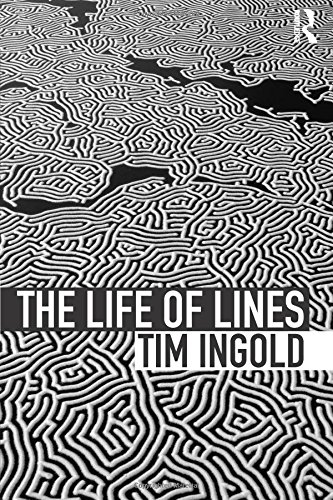
Ingold, T. (2015) The life of lines London: Routledge

In 'The Life of Lines' Ingold takes us on a journey through movement, knots, weather, atmosphere and surfaces, eventually coming to what for myself was a very important conclusion: "to human is a verb." In order to live, every being must put out a line, and in life these lines tangle with one another. This book is a study of the life of these lines and how they can be variously entangled. Following on from Lines: A Brief History, the book includes meditations on life, ground, weather, walking, imagination and what it means to be human.

The first section argues that our world of life is woven from knots, and not built from blocks. He shows how the principles of knotting and weaving underwrite both the way things join with one another, in walls, buildings and bodies, and the composition of the ground and the knowledge we find there. (Think of the way plant roots entangle themselves into and with the soil)

In the second section, Ingold argues that to study living lines, (you could just say moving through life leaves traces and that these can be read as lines), we must also study the weather. He asks what is common to walking, weaving, observing, singing, storytelling and writing, and decides that the answer is atmosphere, or particular types of weather. He then develops a meteorology that seeks the common denominator of breath, time, mood, sound, memory, colour and the sky. This section opens out an awareness of our emotional attachment to experience. For instance a 'pathetic fallacy' is often used to describe something non human using a human emotion. The weather in particular can be given human emotions to reflect mood. John Ruskin introduced the term and explained it with an analysis of a poem:

They rowed her in across the rolling foam—
The cruel, crawling foam...

Ruskin points out that "the foam is not cruel, neither does it crawl. The state of mind which attributes to it these characters of a living creature is one in which reason is unhinged by grief." He goes on to state; "Now, so long as we see that the feeling is true, we pardon, or are even pleased by, the confessed fallacy of sight, which it induces: we are pleased, for instance, with those lines ... above quoted, not because they fallaciously describe foam, but because they faithfully describe sorrow". (From Modern Painters)
In some ways Ingold's text could be critiqued in a similar way, it works at its best when the
analogies he uses ring true.

In the third section Ingold takes lines into human social life. He shows that for life to have meaning, the things we do must be framed within the interconnectedness of the lives we build. In continually answering to one another, these lives enact a principle of correspondence that is fundamentally social, the knotting together of our experiences as our life lines become entangled together being a process and a doing, rather than a thing that can be isolated out of the totality of the experience.

Again I found Ingold very useful, especially in the way he articulates the problems that emerge from a world dominated by scientific objectivity and social isolation. His reminder that nouns separate one thing from another being something that has had a particularly deep impact on my thought. 

If you are writing a positioning statement perhaps Tim Ingold is at his most useful when you want to humanise what you are doing. He has a way of writing that might not be scientifically verifiable, but which comes across as a heartfelt desire for everyday life to be the focus and centre out of which all meaning is made. He is after all an anthropologist and that's what they do, study human lives. 

This is Tim Ingold on walking, in this case on walking a city's pavements. 
“I have but one further observation to make in this regard, which brings me back to the subject of paving. It is simply that boots impress no tracks on a paved surface. People, as they walk the streets, leave no trace of their movements, no record of their having passed by. It is as if they had never been. There is, then, the same detach-ment, of persons from the ground, that runs as I have shown like a leitmotif through the recent history of western societies. It appears that people, in their daily lives, merely skim the surface of a world that has been previously mapped out and constructed for them to occupy, rather than contributing through their movements to its ongoing formation.” (From 'Being Alive') 

Ingold by implication, also reminds us that by wearing shoes we no longer touch the world. It is only on those rare occasions such as on sunny days on the beach, that we take off our shoes and socks and feel the ground beneath us with our feet. As he puts it, the situation reflects that in our society we have seen the 'elevation of head over heels'. In respect to this he then finally reminds us that in Japanese there exists the concept of 'kawada', (little hill) which represents a human being's fundamental orientation towards the ground and he warns us not to forget that we come from the ground and will return to it. 

See also:

Tim Ingold: On not knowing and paying attention

Tim Ingold's keynote speech for the art and materiality conference 

I swear I saw this 

In praise of verbs

To use or not to use theory

The exhibition 'lines a brief history'

The straight line


Friday, 6 May 2022

Why interoception?

Days of coughing brings back pains in my ribs that I haven't had since breaking them some years ago

Nighttime itch
Lying in bed and unable to do much exercise causes the body/mind to return to an awareness of its own surface irritations and the need to scratch an itch

Interoception is defined as the sense of the internal state of the body. (Khalsa & Lapidus, 2016, p. 2) This can be both conscious and non-conscious. I have been looking at how to visualise our internal awareness for a while now and the more I do so the more I believe it is central to our grasp of what it is to be in the world. I have finally gone down with Covid and this is the first day since being taken to my bed that I have been able to type anything. My last post on visualising energy flow was put up just as I was starting to feel ill, then I have had three days when my own energy levels were virtually it felt, non-existent. As I start to rest and have more energy, I'm fully alive to the fact that without all that energy flow I have been thinking about, I can do nothing. My awareness of the importance of energy levels feels a bit like an affirmation for what I have been exploring recently, so as I emerge from brain fog, and attempt the re-insertion of my own body back into the flow of experience, I'm going to attempt to clarify for myself and hopefully for any one still interested, what I'm doing and how an artist like myself can even begin to think that what they are doing is any form of research. 

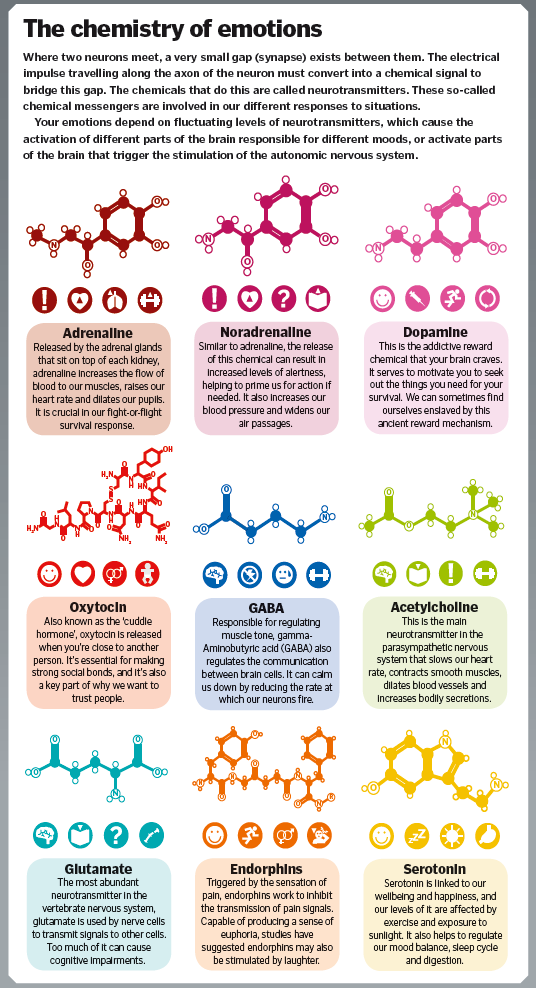
So a few bits of information that I think are central. The relationship between the mind and the body is now understood to be one of a symbiosis between them. (Fogel, (2013), Varela, Thompson and Rosch (2017), Merleau-Ponty, (1969). For instance our body secretes hormones that change our psychological state in response to physical events. In a fight or flight situation, adrenaline is released so that the heart pumps faster and limbs can move quicker. However any stressful situation does the same, so prolonged periods of stress can lead to over compensation by the body, eventually extra releases of various hormones, (basically chemicals, because hormones are our body's chemical messengers), will cause problems and both the body and mind will suffer because of that. If we look at a few more of these chemicals, we can begin see how and why they are so important. The wrong levels of estrogen can increase the risk of certain cancers, lead to depression, weight gain, difficulty sleeping, headaches, low sex drive, anxiety, and menstrual problems. In particular too little estrogen can cause weakened bones (osteoporosis), menstrual problems, loss of fertility and mood disorders. Testosterone can effect sex drive, fat distribution, muscle strength, bone mass, and red blood cell production in both men and women. Insulin converts glucose (sugar) in the things we eat so that our bodies can use the stored energy, if this is not working properly our energy levels become uncontrollable and one symptom of that is diabetes. If you know someone who suffers from this you will be very aware of how this effects mood swings. Cortisol is a type of steroid hormone and is produced by the adrenal glands. It has many responsibilities that keep you healthy and energetic. Cortisol is responsible for helping regulate metabolism, regulating blood pressure, acting as an anti-inflammatory, and even forming memories. Cortisol is secreted during higher levels of stress; if secreted for extended periods it can cause hypertension, anxiety, sleep loss, and autoimmune problems. Too little cortisol is associated with low blood pressure, weakness, and fatigue. Your thyroid gland's hormones regulate metabolism. An imbalance can cause problems with weight management and energy levels. As you can see from this very basic introduction hormones are central to both how our body works and how our mind operates; lack of drive, fatigue, depression, over anxiety and memory loss are just as much a response to hormone production as weight gain, speed of response, the development of cancers, weak bones and our general health or not as the case may be. 

There are direct feedback loops between our heart and our stomach and our brain. These facilitate deeply embedded types of information processing that our logical, language driven part of the brain often ignores, but which in reality are often far more right about the state of the world. For instance people with aphasia; a loss in language ability resulting from brain damage, appear to have a significant advantage in spotting liars, particular when untruths are given away by changes in body language. You know it in your guts and in your heart. 

As interoception is so important to the day to day regulation of our body and mind, it would therefore seem to myself that as an artist I need to embed my processes of visualisation into an awareness of this fact. 

The central issue in terms of visualisation is metaphor. What can work and how to establish a communicable language? For instance growth hormone triggers are produced in the hypothalamus (these are also hormones). which stimulate the pituitary gland to produce and release growth hormone into the bloodstream, which in turn floods out into the body to control metabolism and growth. In my mind I see various coloured waters, each one carrying tiny bits of chemical information that I represent as grains of undissolved pigment and the capturing of colour blending as one mixture begins to intermix with another. 

Like so: 


or


or

Fluids interacting

The suggestion I am trying to make, is that the movement of fluids carrying various pigmented substances can represent the fact that everything that is being depicted is in constant flow, both inside, (hormones, blood etc.) and outside, (the constant perceptual flow). 

Rodin

If you get a chance to see Rodin's watercolours, many of these have a surface that sits between representation and re-creation. On the one hand a figure in movement is suggested by a pencil line and yet at the same time a spreading, pooling sequence of watercolour marks feels as if it is trying to recreate the situation as a material flow. The eye/mind tik-toks between one reading and another and as it does so, the movement originally perceived by Rodin re-enters my own perception of the image. An image can hold within itself competing and various readings, this very ambiguity allowing it to be more capable of communicating some types of experiences than words. 

A flow of energies between inner and outer embodied worlds

Which brings me back to the other issue that I have been trying to deal with, the problem with verbal language. Language it seems to me is a very controlling way of understanding the world. It sort of fixes it or glues it down. Of course words are brilliant at carrying ideas, without them I wouldn't be able to think about things in the way I do, but words do have a way of turning the solid physicality of experience into something both chimerical and at the same time fixed down by the very words used to describe it. I'll try and explain what I think the problem is. Once something is named it seems to take on a life of its own. Look at countries. The Earth is a physical continuity with no edges or boundaries, but once you put a name to a particular area you can draw a boundary around it and as that area is defined by a name such as England, France, Saudi Arabia or the Ukraine, it begins to evolve a definition of itself separate from all the other bits of the world. In point of fact there is no such thing as a solid object called England, only an idea of one. For the brain, a memory is as real as a perception, an idea as potent as a feeling. A written language can be used to differentiate these things and as it does the separation seems to reinforce meanings that were initially only chimerical but which in terms of how humans make decisions is now central, our need for flight or fight now triggered as much by ideas as perceptions. In fact every perception is in some respects a memory idea, and we know that some people have from their own experience developed world views that blur the distinction between ideologies, facts, fictions and memory. Some studies have demonstrated that language loss improves our ability to spot lying*, which suggests that language is not so much about truth but about conviction or the telling of believable stories. The thing is that these believable stories are told with and about words, as well as without words and not about words but they are acted upon as if they are a reality. The situation is that in many ways words are shaping what we think of as reality. In the world of particle physics it is understood that when you measure a particle the apparatus of measurement is in some way shaping what can be observed of the particle. The reality of the situation being a joint state or compound 'apparatus + particle' system, which is not separable because its parts are not independent of one another. The apparatus of measurement produces an entanglement between the measuring and the measured and language I would suggest operates as a type of very sophisticated apparatus that is also shaping what can be observed. Part of its shaping is the construction of nouns to identify separate things and in doing this the world is atomised into small separate bits and these can of course be owned or categorised or listed. 
In novels there are often stories within stories. In Vasily Grossman's great novel of war and ideological tyranny, 'Life and Fate', Viktor Pavlovich Shtrum is a physicist who when he goes to work can be inspired by a wonderful idea, such as of the universe being an entangled unity. He enthuses over the fact that the new physics rejects the concept of individual entities and acknowledges only aggregates. Grossman puts it like this, "But space - measured by metal rods and rulers - and time - measured by the most accurate of watches - had suddenly begun to bend, to stretch and to flatten. Their stability had turned out not to be the foundation-stone of science, but the walls and bars of its prison." However Viktor also realises that the reality of the life he leads will lead to "doubt, suffering and lack of belief". In his day to day experience the tyranny of words that emanate from the communist party and its various committees, can be like nails hammered down into meaning. Throughout the book people are shown to be capable of the most heinous crimes, their language twisting and reshaping reality to fit whatever power happens to be in place at any one time, only a rare few being able to hold fast to a position of moral certainty within a corrupt world of war and terror. 

The interconnectedness of the perceptual flow that we are immersed into is a key concept in Buddhism: “When there is this, that comes to be; with the arising of this, that arises. When there is not this, that does not come to be; with the cessation of this, that ceases” (Ñāṇamoli and Bodhi 1995, p. 655) The belief that everything is interconnected can obviously be expressed in words, but the problem is that the sentence, "Everything is interconnected" has the same conceptual force or truth weight as the one that states, "The concept of global warming was created by and for the Chinese in order to make U.S. manufacturing non-competitive." This quote from Donald Trump, epitomises the issue, he operates as if words have their own reality and anything he disagrees with is 'fake news'. Trump has at least made us realise how slippery words are and how we can become trapped by them. Before the written word verbal language simply floated out into the air and what was said was quickly gone, only retaining a sense of permanence via stories that were passed on orally. It was also clear that the stories were just stories, storytelling being an art that ensured important concepts were passed on, legends were created and elaborated over many years of retelling, what would over time become powerful myths. But once written down, words become fixed, and once fixed they start to sit outside of the flow of life. Words as you can see, tend to generate more words, they don't let you go, you keep writing more and more of them, trying to control what it is you are trying to say, but in reality being controlled by the apparatus called writing. Each letter a nail, each noun a rivet and every sentence a straightjacket. 

The body and its immersion in energy fields

I began this post by detailing the effects hormones have on our emotional state. The apparatus that produces them being our bodies. During war or other highly fraught times, stresses are so high that hormone secretion goes through the roof, and the balance between decision making fuelled by good judgement or by instinct begins to break down. Just as I'm arguing language shapes the world, the body shapes the world too. In making images I'm arguing for an area of thinking outside of verbal language to be considered as a way of decoding experience. Interoception begins in the body and as Merleau-Ponty explained in relation to what he called the “flesh of the world” awareness arises as an event, an event where perception and meaning are born, not as a relationship between a constituting subject and a constituted object but as an intertwining or ensemble of being. The image below is my attempt to diagram this situation, adding into the mix the issue of time. For many peoples, past, present and future are events that occur within a simultaneity, just as the body cant be separated out from the mind, or from its environment, the past cant be separated from the present or the future, all are entangled. I have therefore decided to design an enamel badge to represent this, something very small, but which I believe can be used to represent all of the words not just written in this post, but in this blog. 


I hope I have been able to argue a case for the mind's ability to think using clay and ink and paper as well as other materials, and that by thinking in that way outside of the written word, ideas that are less polemic can be opened out, ways of thinking more open to hybridity and constant metamorphosis can perhaps take centre stage, rather than arguments as to what is right and what is wrong. Hopefully thinking with objects and materials concerns us less with constructions of difference and is more about raising awareness of the connections between things.

Finally and forgive the rambling, as I slip in and out of consciousness I'm also reading and the novel, you may already have guessed that has filled most of my Covid time, has been Vasily Grossman's 'Life and Fate'. Throughout the book there are characters arguing, old Mensheviks and Bolsheviks still bringing up differences, even when the German army sits on people's doorsteps; there are the scars left of Stalin's repressive slaughtering of millions of fellow Russians who didn't follow the party line, a reminder of the Holocaust and how a policy of extermination could be 'logically' embarked upon by a society of believers and what seemed to be the worst thing in my half dreaming state, this Jewish Ukrainian writer, who lived through it all, at times seemed to be writing about the Ukraine now. Radio Four reports of mass graves being dug in Ukraine merging with Grossman's stories of people having to dig mass graves for jews and gipsies. The need to burn disinterred bodies in order to destroy evidence of mass slaughter was systematically developed during the later part of WW2 and tales of the collecting of contemporary evidence of supposed genocide now flows into a nightmare state of unease, slaughterhouse images and worry about the evil nature of human beings and their failure to learn. The book asks a question of each and every one of us, "How would I act in similar circumstances?" I was also reminded of an old image of mine from many years ago now. I was walking through a council estate, and came across a group of people standing round watching a group of lads kicking someone. Something had kicked off, but what it was I never knew, but just like at school when boys got into a fight, by magic a small crowd had formed, not to intervene but to watch. I was deeply disturbed, because I realised my own 'me too' moment. I had quickly walked on, I hadn't been brave enough to step in, I was intimidated by the collective, afraid of the consequences of making people aware that I might think differently . It was much easier for me to make an image about the situation after the event than to step in and try and stop it. Society brings us into close physical proximity but fails to bind us together. Our internal worry as to how others might judge us, it appears to me, becomes more powerful in relation to our subjective decision making, than how we judge ourselves. Wondering what other people say or think about us has probably been the reason why many potentially great ideas have never made their way into the full light of day, but far more worrying is that the same internal fear has also allowed the most awful and distressful crimes to be committed on others, because no one stepped in, no one opened their mouth to say no, until it was too late and the situation became irreversible. 

Watching the wheel turn (1990)

*Ref: 

Khalsa, S. S., & Lapidus, R. C. (2016). Can Interoception Improve the Pragmatic Search for Biomarkers in Psychiatry? Frontiers in psychiatry, 7, 121. From: <https://www.frontiersin.org/articles/10.3389/fpsyt.2016.00121/full> accessed on 06. 05. 2022

Massachusetts General Hospital. "Study Shows Language Loss May Improve Ability To Spot Lying." ScienceDaily. ScienceDaily, 15 May 2000. From <www.sciencedaily.com/releases/2000/05/000512082608.htm> accessed on 06. 05. 2022

Fogel, A., 2013. Body sense: The science and practice of embodied self-awareness (Norton series on interpersonal neurobiology). London: ww norton & company.

Freund, P.E., 1988. Bringing society into the body. Theory and society, 17(6), pp.839-864.

Merleau-Ponty, M (1969)The Visible and the invisible New York: Northwestern University Press

Grossman, V. (2006) Life and Fate London: Vintage

Ñāṇamoli and Bodhi (1995) The middle length discourses of the Buddha, a translation of the Majjhima Nikāya. Boston: Wisdom Publications.

Varela, F.J., Thompson, E. and Rosch, E., (2017) The embodied mind, revised edition: Cognitive science and human experience. New York: MIT press.

See also:

Using pigments suspended in water

Visualising energy flow

Hybridity and permeability 

Paul Klee and Markov Blankets 

Texture and perception

Sunday, 1 May 2022

Visualising energy flow

A Tibetan visualisation of the energy 'spine' passing through the body

When reading Gabor Maté's 'In the Realm of Hungry Ghosts' I came across a very useful description of how he developed a complex understanding of addiction. He points out that it is impossible to understand something like addiction from any one perspective and that the complexity needs to be viewed simultaneously from many different viewpoints, and that whilst examining it from one angle we need to keep the others in mind. His understanding of the subject used biological, chemical, neurological, psychological, medical, emotional, social, political, economic and spiritual positions and I would in my case like to add historical, aesthetic and material thinking. Readers of this blog will by now be used to the way it flits around and narratives break off and re-start, sometimes months or years after coming to a stop. Certain approaches come into focus for a while and then drop back and are replaced by new interests or an awareness of perhaps an individual artist that has done work that appears to offer an insight into some aspect of what I'm investigating.

I was reading Gabor Maté's 'In the Realm of Hungry Ghosts' because it appeared to offer an alternative insight into how I could approach my own developing understanding of interoception. Reading it demonstrated to me the importance of a way of thinking that begins with human beings and their individual addictive 'demons', without negative evaluation, just accepting them for what they were. However this is only the beginning of a process that then goes on to look at aspects of the society people belong to and then scientific ways of understanding the situation such as neurology are brought into play, and after that perhaps a more spiritual approach, such as Buddhism or certain types of psychology might be woven into the debate, any and all of which at one time or another might have contributed to the 'forming' of people's 'demons' or might at least help in developing an understanding of them. The fact that the situation could be looked at from biological, chemical, neurological, psychological and other points of view, also helped me to accept the complexity in my own struggle to find a way of visualising the coming-into-being of forms that suggest the conjunction of often invisible forces that sometimes have names like biology, chemistry, physics, neurology, psychology, emotion, feelings, sociology, politics, history, economics or spirituality. We know that they effect us in some way, but we can rarely see these things in action. However over time, as we explore the possibilities of how forms arrive and shape themselves alongside these various understandings, a formal garden will grow. A set of 'plants' that will hopefully be a mutually beneficial group of species, forms or ideas, which in permaculture would be called a 'guild', a small collective that would itself be a part of the larger ecosystem. As I think about these possibilities I'm reminded of two of the twelve principles of permaculture, 'Integrate Don’t Segregate' and 'Use and Value Diversity', principles that are going to become very important as I bring ecology into the understanding framework that I'm trying to construct around my thinking. 

Gabor Maté points out that hormones are central to the way we regulate our bodies and that the body / mind relationship can be illustrated by looking at their effects.

A map of Hormones and their interrelationships

How hormones effect you

Alongside the nervous system, sits the endocrine system, a complex communication system built from an interconnection of glands and body organs. While the nervous system uses neurotransmitters as its chemical signals, the endocrine system uses hormones. The pancreas, kidneys, heart, adrenal glands, gonads, thyroid, parathyroid, thymus, and even fat are all sources of hormones. The endocrine system works in a large part by acting on neurons (nerve cells) in the brain, which in turn controls the pituitary gland. The activity of the pituitary gland is however controlled by the hypothalamus which as well as being an endocrine gland, is also part of the nervous system. When exploring these things, it quickly become apparent that evolution weaves together different elements into a very complex dance, and entangled in this complexity is the mystery of energy flows, a concept that many previous civilisations have sought to work with using methods as varied as acupuncture, meditation, reflexology and various massage techniques to ease the flow of these energies if there is a perceived blockage. The pituitary gland secretes factors into the blood that act on the endocrine glands to either increase or decrease hormone production. This feedback loop involves communication from the brain to the pituitary, to an endocrine gland and back to the brain. This system is very important for the activation and control of basic behavioural activities, such as sex; emotion; responses to stress; eating, drinking, and the regulation of body functions, including growth, reproduction, energy use, and metabolism. Most importantly in relation to perception, the way the brain responds to hormones indicates that the brain is very malleable and capable of reacting directly to environmental signals and that these signals can come from both internal (interoception) and external environmental sources. (Perception)

In order for the body to operate it needs to deal with energy flow. The four forms of energy flow normally observed are thermal, chemical, electrical and mechanical. Everything we do demands energy, but it often has to be converted from one form to another in order to be useful.

A scientific view of the body's energy use

Of the different forms of energy, radiant energy, which is carried by waves is perhaps the most important to us. When a material is heated or cooled, this changes the internal energy of the particles that it is made up of. Two changes may happen to the particles within the material: either chemical bonds between the particles may form, break or stretch, causing a change in the chemical potential store of energy in the material, or the material heating up or cooling down as the particles within it gain or lose speed, causes there to be a change in the thermal store of energy within the material.
It is these changes in the internal energy of particles that cause atoms to emit energy in the form of electromagnetic radiation which includes visible light, ultraviolet (UV) radiation, infrared (IR) radiation, microwaves, radio waves, gamma rays, and X-rays. Electromagnetic radiation from the sun, particularly light, is vital to our survival because existing biogeochemical cycles and virtually all other processes on earth are driven by them.

Chemical energy is the energy stored in molecules and chemical compounds, and is found in things such as food, wood, coal, petroleum and other fuels, all of which store energy that has been converted into chemicals from the sun's radiant energy. Chemical energy in the form of the glucose in our food is turned into mechanical energy which is used in making movements such as running or lifting heavy objects. The muscles serve as a type of transducer; a device that converts energy from one form to another, such as a microphone which converts sound waves (mechanical wave energy) into audio signals (electrical energy). In this case muscle contraction is the method that transforms chemical to mechanical energy. When the chemical bonds are broken, either by combustion or other chemical reactions, the stored chemical energy is released in the form of heat or light. For example, muscle cells contain glycogen. When the muscle does work the glycogen is broken down into glucose. When the chemical energy in the glucose is transferred to the muscle fibers some of the energy goes into the surroundings as heat, which is why you get hot when you run.

Mechanical energy puts something in motion. The mechanical energy of a system is the sum of its kinetic and potential energy and we are using energy up all the time. However by being aware of energy use we can also become more aware of energy-harvesting. We can use mechanical technology to capture energy and convert it into electricity, such as by using a wind turbine but we can also use piezo-electrical materials which produce electricity when they are put under pressure, i.e. when someone steps on them or drives over them, for example, one of the best-known uses of the technique was in a club in Rotterdam, which installed an energy-generating dance floor, where the dancers movements created their own light show.

Electrical energy is produced when unbalanced forces between electrons and protons in atoms create moving electrons called electric currents. Our cells can conduct electrical currents, electricity being required for the nervous system to send signals throughout the body and to the brain, signals that make it possible for us to move, think and feel. The elements in our bodies, like sodium, potassium, calcium, and magnesium, have a specific electrical charge. Almost all of our cells can use these charged elements, called ions, to generate electricity. The contents of the cell are protected from the outside environment by a cell membrane. This cell membrane is made up of lipids that create a barrier that only certain substances can cross to reach the cell interior. Not only does the cell membrane function as a barrier to molecules, it also acts as a way for the cell to generate electrical currents. Resting cells are negatively charged on the inside, while the outside environment is more positively charged. This is due to a slight imbalance between positive and negative ions inside and outside the cell. Cells can achieve this charge separation by allowing charged ions to flow in and out through the membrane. The flow of charges across the cell membrane is what generates electrical currents within the body. Thermal energy or Heat energy is related to the motion or vibration of molecules in a substance. When a thermal system changes, heat flows in or out of the system. Heat energy flows from hot bodies to cold ones. Heat flow, like work, is an energy transfer. When heat flows into a substance it may increase the kinetic energy of the particles and thus elevate its temperature. Heat flow may also change the arrangement of the particles making up a substance by increasing their potential energy.

Nuclear Energy is energy that comes from the binding of the protons and neutrons that make up the nucleus of the atoms. It can be released from atoms in two different ways: nuclear fusion or nuclear fission. In nuclear fusion, energy is released when atoms are combined or fused together. This is how the sun produces radiant energy and as we have seen it is radiant energy that drives the Earth's existing biogeochemical cycles.

Sapta Chakra: correspondences between subtle energy and Tibetan psycho-physiology

However alongside these more scientific ways of thinking about energy flows there are other older forms of thinking. For instance the chakra system also refers to the energy centres we have in our bodies. There are seven major chakras, each in a specific location along our spines.
The root chakra, or Muladhara, is located at the base of your spine. It provides a base or foundation for life. It grounds us and makes us able to withstand challenges and develop a sense of security and stability.
The sacral chakra, or Svadhisthana, is located just below the belly button and is responsible for sexual and creative energy. It’s also linked to our emotions as well as the emotions of others.
The solar plexus chakra, or Manipura, is located in the stomach area. It’s responsible for confidence and self-esteem, as well as helping us feel in control of our lives.
The heart chakra, or Anahata, is located near the heart, in the centre of the chest. It effects our ability to love and show compassion.
The throat chakra, or Vishuddha, has to do with our ability to communicate verbally.
The third eye chakra, or Ajna, is located between your eyes and is responsible for intuition and the imagination.
The crown chakra, or Sahasrara, is located at the top of your head. Your Sahasrara represents your spiritual connection to yourself, others, and the universe and plays a part in your life’s purpose.
A chakra imbalance or blockage it is believed may affect the parts of your body in close proximity to that chakra, including your organs, bones, joints, and tissues near that area and psychologically, imbalances in the chakras may cause an emotional imbalance, which may lead to increased anger, sadness, fear, or indecisiveness. Personal habits such as poor physical alignment or posture, eating unhealthy food, or self-destructive behaviour may cause a chakra to be imbalanced and prolonged imbalance may lead to physical disease and illness, musculoskeletal issues, and mental health challenges like depression or anxiety.

It is interesting to put the two systems alongside each other and to see how many overlaps there are. Many physical ailments are connected to emotional issues, and it is easy to see why, as hormone release is directly linked to feelings and feelings can lead to beliefs. Therefore if you believe in something like the chakra system, it may well be that working with it, you have as much right to expect better health as someone using the national health system. 

For myself as an artist trying to represent interoception and its effects on perception these issues provide yet another area for consideration and they allow me to think more about the layering or interweaving of images based on observation with those directed by intuition or feeling tone, alongside those images that emerge from a wider awareness of other cultures, history, science and mythology. 

Some people believe that human life exists simultaneously in two parallel dimensions, the physical body and the subtle body. The physical body being the mass of the material self, the subtle body consisting of our psychological, emotional and energetic body. These two bodies are always interacting and mutually affecting one another. My earlier work using votives did seem to support this, belief and feeling, seeming to sometimes work when scientific evaluation didn't. 


Meditation is also used to release blocked energy. Also, known as shakti energy, Kundalini energy is the divine feminine creative force. It usually lies latent at the base of the spine like a coiled serpent. When you awaken your kundalini, you allow this energy to travel up through your spine, through your chakras and up and out your crown chakra where it connects to universal lifeforce energy. This usually shows up as expanded consciousness or expanded awareness and perception. The image above is an attempt to visualise these various energy flows and once again it is very instructive for myself to look at these types of images and see how they relate to ones I have myself already produced when trying to visualise interoception. 

Body passing through space as it thinks it thinks


Images drawn to illustrate how interoception overlaps with perception

From the Tibetan Art of Healing

The more I look at these issues the more I am attracted to the drawings done to illustrate the Tibetan Art of Healing a heavy couple of tomes that the Leeds Arts University library has just purchased, so I shall be spending a few hours perusing them over the next few days. In my earlier post on lines as symbols of invisible forces, I pointed out that Henri Bergson had written extensively on what he termed an 'élan vital’, a similar concept to that referred to as a "vital force" by the pre-Christian Stoic philosopher Posidonius, who stated that the energy emanated by the sun, then spread out into all living creatures on the Earth's surface. More recent scientific explanations that point to the sun's radiant energy being converted into chemical energy by photosynthesis, simply confirming a hypothesis made over 2,000 years ago. More recently the philosopher Deleuze used Bergson's idea to describe an internal force, or substance in which the distinction between organic and inorganic matter disappears. (Ansell-Pearson, 2012, p.21) This removal of the difference between inorganic and organic life being for myself necessary as it supports my decision to use animism as a way of developing a more holistic understanding of the world and specifically in this case it helps me to think about how energy can flow between organic and inorganic entities. As an artist my personal understanding of these things doesn't have to stand up to scientific rational argument, it does though have to feel right. As I edge around these issues I am of course also drawing and as I do another type of understanding emerges, this time one embedded in materials play and the emergence of images that evolve out of that play.


Various approaches and attempts to visualise relationships between the interior life of a body and an awareness of its external form as an idea

Ref.

Ansell-Pearson, K. (2012) Germinal Life London: Routledge
Bergson, H. (2019) Creative Evolution London: Grey Rabbit Publishing
Maté, G. (2018) In the Realm of Hungry Ghosts London: Vermilion


See also:


Tuesday, 26 April 2022

The preparatory sketch

Some artists think it old fashioned, but it was and in many cases I believe still is, an essential tool in an artist's repertoire. The preparatory sketch allows you to think around an idea and it provides an important breathing space for the development of visual concepts that sits between the processes of initial observation and those of composition. Edward Hopper is a classic case in point. If we want to see Hopper's ideas germinating we go and look at his preparatory sketches.  In this instance, an observational drawing of a man from the back, sitting down at a bar begins an idea. We are sucked into the internal world of this lone figure and Hopper realises the potential that this small drawing has for something much larger, something that has a lot to say about the condition of human beings within a large urban metropolis. 

Observational sketches

The small observational sketches above are simple visual notes, the sort of thing any of us might make, often scribbled in a note pad while having a cup of coffee, but this image in particular gets through to Hopper and he draws it again. 

Edward Hopper sketch for the figure in the centre of Nighthawks

Hopper returns to his initial small drawings and redraws the man's back view, this time giving it more weight, solidifying the form and sitting it more firmly in a space. There is something about this figure, it begins to suck us in, as we look at it, it is facing in the same direction as us, towards the wall, but is focused on something we cant see. The hat begins to have more meaning, it is solidly on the head, but at the same time the circle of its rim indicates a rotational space that begins to revolve around the figure. 


The centre of the composition

Hopper realises that this figure has a powerful presence, one that has enough gravitas around which he can build a composition. In the drawing above you can see clearly how he is beginning to imagine an image where this figure sits in the centre, and that hat now begins to have another type of importance, not just as a compositional device but as a psychological one. It further anonymises the figure of the man, casting a shadow over him and sending him even further into himself, in effect making this man even more lonely. Once the man is established as a focal or anchor point, Hopper is able to think about how various rectangles can be made to articulate themselves around him. Finally in the actual painting the rectangle around this man will become as dark as the man himself. 


The man's interior darkness eventually pervades the entire composition, but earlier on in the development of the image his body stands out against the light. As other figures are firmed up they begin to establish relationships, a man and woman are clearly connected and they engage with the late night employee's gaze. It's a cold, rather unfocused relationship, but at least it is one that collects them together as a small group of three, the forth figure is acknowledged by no one, totally withdrawn into himself. 

The composition is almost firmed up

The final painting: Nighthawks 1942

Nighthawks was painted in 1942, a time of war in Europe, which is perhaps why I was reminded of it. In the final painting the rectangle that surrounds the central figure of the lone man has got darker, so dark in fact his figure is almost lost in its blackness. The other figures are at least lit by the glow of artificial light, even if it is a harsh cold pale lemon yellow one. 
Hopper has revealed the deep loneliness that people can feel, especially in a huge city full of millions of people. His thinking process as you can see is very formal, but he is using compositional processes that clearly reflect a deep understanding of the relationship between shape, position, colour, tonal value and their psychological impact. 
The process Hopper uses begins with a tiny sketch, perhaps done in a similar situation to the final image, perhaps a drawing done in the full light of day, but once he has spotted potential in the image, you can see him building his composition piece by piece, thinking it through, but still making changes even as he paints the final image. That darkening of the rectangle of light that surrounds his lonely figure of a man, being a final painterly decision that turns this image into a dark masterpiece, one that has lodged itself firmly into my brain ever since I first saw it in the 1960s. Now, 80 years after it was painted, in a time of post-covid and worries about war in Europe, it seems to me that Hopper's image has a particular relevance, reminding us of how easy it is to slip into isolated despair, even when surrounded by other people and it perhaps reminds us therefore to be more open to others, and to offer companionship when we feel we can. 

Hopper carried in his pocket a slightly altered quotation from Goethe. Art is..."the reproduction of the world that surrounds me by means of the world that is in me." My own interpretation of this being that our inner feeling tone creates a sensibility by which we filter out a particular view of the world and that is what I am looking for when I'm exploring the possibilities inherent in trying to depict our interoceptual understanding of ourselves. 

The original quote from Goethe states: 'The beginning and end of all literary activity is the reproduction of the world that surrounds me by means of the world that is in me, all things being grasped, related, re-created, molded, and reconstructed in a personal form and original manner.'

Reference: O'Doherty, Brian (1982) American Masters: The Voice and the Myth New York: Random House, p. 14.

See also: