Showing posts with label Tim Ingold. Show all posts

Thursday, 12 May 2022

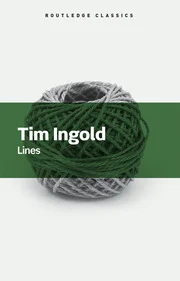
Tim Ingold's 'Lines'

Lines: a brief history

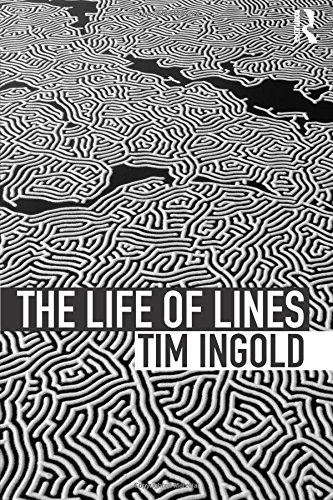
A while ago when reporting on a lecture I went to given by Tim Ingold, I suggested that his two books on line were an essential read. ‘Lines: A Brief History’ and ‘The Life of Lines’ both open out our thinking about drawing into the theatre of life itself and help those of us that draw to invest our drawings with a wide range of possible meanings. I also stated at the time that I would provide a summary of the two books and give an indication of possible ways to use them.

Ingold, T. (2016) Lines a Brief History London: Routledge

In 'Lines a Brief History' Ingold points out that a wide range of human activities including walking, weaving, observing, storytelling, singing, drawing and writing all need to proceed in linear directions and that embedded into the very language that we talk about these things are line metaphors. For instance in order to tell a story we move events from A to B, we stretch out our sentences into lines of text. As we walk we create lines, both physically, (Richard Long makes lines by walking through grass, but so do we all.) as well as metaphorically. The old idea of the Wyrd for instance uses the image of an invisible line that is connected to you from birth, (a sort of ghost of the umbilical cord), as you move through life this line entangles itself around all the people and things you interact with, eventually weaving a cloth that is literally the tapestry of your life. In this book Tim Ingold imagines a world in which everything is interwoven or interconnected by lines and lays the foundations for a completely new discipline: the anthropological archaeology of the line.

Ingold is very much a polymath and uses a wide range of sources to illustrate his points, including archaeology, classical studies, art history, linguistics, psychology, musicology, philosophy and drawing.

Ingold's book is a great help when writing artist's positioning statements. He uses visual metaphors to demonstrate that you can take a concept and use it across many different disciplines to illuminate the way that human beings think, and reminds us that thinking itself begins with embodied experiences. For instance the idea of the 'Wyrd' begins in the actual experience of one human being being linked to another by a 'line' or umbilical cord. He points out that one of the earliest uses of vegetable fibres was to twist them together to create lines, lines that we call threads, strings or ropes. As we began to use these lines of thread, the various uses we put them to allowed us to think about different things. This is an extended mind theory which suggests that we use the stuff of the world to develop ideas or trains of thought. Threads allow us to weave ideas together, strings to tie them together and rope to scale up and over them. For instance lets say we are fishing using a line and rod, we might develop all sorts of ideas that begin with the idea of a connection between one thing and another. A line physically connects two things together, but the way it does varies. Alfred Gell introduced us to the ‘spring-hook fishing trap’ from Guyana. It consists of a fishing line linked to a bent tree branch, which is held in place by an easily displaced notch, one that the fish in effect 'trips' as it pulls on the line. When the fish bites down on the bait, its mouth is caught on the hook and in its struggle to get away it un-notches the held down branch, which springs upright, its violent release throwing the fish up into the air, leaving it dangling. In Guyana it is known as ‘the trap that turns fish into fruit’. One minute the fish is swimming and whoosh! The next minute it is hanging like fruit from a tree. As a metaphor for the harsh often sudden confrontation of death within life it is very powerful, just as easily read by Western European art audiences as fishermen from Guyana. Alfred Gell is another anthropologist which I presume is why he is also read extensively by artists. Anthropologists watch how a society thinks and as outside observers often without a good knowledge of that society's verbal language, they will often see how things are used by a society to think with, much easier than that society itself. I.e. they are in a very good position to observe the extended mind at work and the extended mind theory is as far as I'm concerned essential to an understanding of how art works. What you make allows your audience to 'see' an idea, not just to think about a concept in the head, but to physically know it. Most of Ingold's references rely on the extended mind theory and for someone making physical objects that have ideas embedded within them, his insights can be a real help, especially when trying to find the right words with which to explain how something you have made relates to life's experiences. 

The Life of Lines

Ingold, T. (2015) The life of lines London: Routledge

In 'The Life of Lines' Ingold takes us on a journey through movement, knots, weather, atmosphere and surfaces, eventually coming to what for myself was a very important conclusion: "to human is a verb." In order to live, every being must put out a line, and in life these lines tangle with one another. This book is a study of the life of these lines and how they can be variously entangled. Following on from Lines: A Brief History, the book includes meditations on life, ground, weather, walking, imagination and what it means to be human.

The first section argues that our world of life is woven from knots, and not built from blocks. He shows how the principles of knotting and weaving underwrite both the way things join with one another, in walls, buildings and bodies, and the composition of the ground and the knowledge we find there. (Think of the way plant roots entangle themselves into and with the soil)

In the second section, Ingold argues that to study living lines, (you could just say moving through life leaves traces and that these can be read as lines), we must also study the weather. He asks what is common to walking, weaving, observing, singing, storytelling and writing, and decides that the answer is atmosphere, or particular types of weather. He then develops a meteorology that seeks the common denominator of breath, time, mood, sound, memory, colour and the sky. This section opens out an awareness of our emotional attachment to experience. For instance a 'pathetic fallacy' is often used to describe something non human using a human emotion. The weather in particular can be given human emotions to reflect mood. John Ruskin introduced the term and explained it with an analysis of a poem:

They rowed her in across the rolling foam—
The cruel, crawling foam...

Ruskin points out that "the foam is not cruel, neither does it crawl. The state of mind which attributes to it these characters of a living creature is one in which reason is unhinged by grief." He goes on to state; "Now, so long as we see that the feeling is true, we pardon, or are even pleased by, the confessed fallacy of sight, which it induces: we are pleased, for instance, with those lines ... above quoted, not because they fallaciously describe foam, but because they faithfully describe sorrow". (From Modern Painters)
In some ways Ingold's text could be critiqued in a similar way, it works at its best when the
analogies he uses ring true.

In the third section Ingold takes lines into human social life. He shows that for life to have meaning, the things we do must be framed within the interconnectedness of the lives we build. In continually answering to one another, these lives enact a principle of correspondence that is fundamentally social, the knotting together of our experiences as our life lines become entangled together being a process and a doing, rather than a thing that can be isolated out of the totality of the experience.

Again I found Ingold very useful, especially in the way he articulates the problems that emerge from a world dominated by scientific objectivity and social isolation. His reminder that nouns separate one thing from another being something that has had a particularly deep impact on my thought. 

If you are writing a positioning statement perhaps Tim Ingold is at his most useful when you want to humanise what you are doing. He has a way of writing that might not be scientifically verifiable, but which comes across as a heartfelt desire for everyday life to be the focus and centre out of which all meaning is made. He is after all an anthropologist and that's what they do, study human lives. 

This is Tim Ingold on walking, in this case on walking a city's pavements. 
“I have but one further observation to make in this regard, which brings me back to the subject of paving. It is simply that boots impress no tracks on a paved surface. People, as they walk the streets, leave no trace of their movements, no record of their having passed by. It is as if they had never been. There is, then, the same detach-ment, of persons from the ground, that runs as I have shown like a leitmotif through the recent history of western societies. It appears that people, in their daily lives, merely skim the surface of a world that has been previously mapped out and constructed for them to occupy, rather than contributing through their movements to its ongoing formation.” (From 'Being Alive') 

Ingold by implication, also reminds us that by wearing shoes we no longer touch the world. It is only on those rare occasions such as on sunny days on the beach, that we take off our shoes and socks and feel the ground beneath us with our feet. As he puts it, the situation reflects that in our society we have seen the 'elevation of head over heels'. In respect to this he then finally reminds us that in Japanese there exists the concept of 'kawada', (little hill) which represents a human being's fundamental orientation towards the ground and he warns us not to forget that we come from the ground and will return to it. 

See also:

Tim Ingold: On not knowing and paying attention

Tim Ingold's keynote speech for the art and materiality conference 

I swear I saw this 

In praise of verbs

To use or not to use theory

The exhibition 'lines a brief history'

The straight line


Thursday, 8 April 2021

Animism and drawing lines: a reflection on an exhibition

To be a good artist is to be an animist. Well sometimes it feels that way. To be an artist you are supposed to be more self-aware, but there is a problem with being self-aware, it creates a sensation of isolation, that you are somehow detached from things, and the result of this is everywhere to see, a myopic view of the world that has resulted in a lack of empathy with not just all those things that are not human beings but with any human being who is not like how I think I am. Not being so self centred would entail being more aware of others, such as people who aren't me, as well as animals, plants, rocks, plastic bottles, water and gravity. Being less self conscious might also mean that I might eventually become "lonesome no more" as Kurt Vonnegut would put it, open to building friendships with stones, beetles and even other people who are not like me.

The dividing line between sentient life and lifeless 'matter' is not a clear one; the covid virus for example, is an infective agent that is a nucleic acid molecule in a protein coat that is able to multiply only within the living cells of a host. If self multiplication is a definition of life, a virus is a questionable life-form, having no powers of its own to duplicate itself. This particular formulation of matter has evolved to multiply itself by latching onto organic life. The important issue here being that if there is no clear dividing line between life and not-life, our membership of the world of things which is traditionally focused on organic life forms, now opens out to include all those inorganic things that exist in the world. Our understanding of things as being separate entities is also being questioned, (the virus cant exist on its own and neither can we) and we may eventually need to re-conceptualise ourselves and other things as interconnected events rather than as separate objects. This is possible because we have the imaginative capacity, the self being an idea, just as much as entanglement is an idea or time or events. 

David Abram would argue that the imagination is an attribute of the senses themselves and that it is not a separate mental faculty. He states that what we call the imagination is "the way the senses themselves have of throwing themselves beyond what is immediately given, in order to make tentative contact with the other sides of things that we do not sense directly, with the hidden or invisible aspects of the sensible". In the same way that a virus has evolved to extend itself by developing an ability to latch onto bacteria, the senses have evolved in order to 'predict' the future. Events are constantly unfolding and everything in one way or another takes part in that tentative contact with other things, things that are really events.  It is also salutary to remember that because of the complexity of interactions that the agents behind events are often hidden or invisible and our concern to always understand why or how things are as they are, is another aspect of our isolationist thinking, which leads to a belief that there are single identifiable causes behind everything. 

Animism is a belief in an idea of interacting events rather than individually separated things. This shift in conceptual framework allows for a different type of awareness, whereby everything is experienced as not just being connected but in constant metamorphosis and flux. 

We create personal relationships with pets, cuddly toys and all sorts of other objects, such as a lucky penny or memento from a holiday, because of these relationships, things become communicative subjects rather than inert objects. These approaches to the world begin to dissolve the idea that our environment consists of a physical world distinct from the world of people.

Nurit Bird-David states, "Animism is a "relational epistemology" rather than a failure of primitive reasoning. That is, self-identity among animists is based on their relationships with others, rather than any distinctive features of the "self". Instead of focusing on the essentialised, modernist self (the "individual"), persons are viewed as bundles of social relationships ("dividuals"), some of which include "superpersons" (i.e. non-humans)." (https://en.wikipedia.org/wiki/Animism#Postmodern_anthropology) 

Tim Ingold is another contemporary theorist who argues that animists do not see themselves as separate from their environment. Ingold has written two books on lines, whereby he states that the line is a powerful metaphoric device that can be used to explain how entangled and interconnected everything is. So finally we get back to drawing, I wonder if the idea of things as communicative subjects rather than inert objects, can be applied to a reading of art objects, especially those art objects that have traditionally been regarded as 'special' things that have an 'aura' and that reside at the centre of Modernism? Let's see. 

Léon Ferrari, Caminos
Centre Pompidou, Musée national d’art moderne, Paris

The drawing above by Léon Ferrari was exhibited in the exhibition 'Lines a Brief History' at the Musée national d’art moderne, Paris back in 2013. The exhibition was constructed around responses to Tim Ingold's writings, in particular his statement that, 'a study of men and things is a study of the lines of which they are made.' The exhibition had several overlapping sections, each one described as set out below in text copied directly from the Centre Pompidou website.

A taxonomy of lines

Artists have elaborated numerous taxonomies of the line, which is a major component of artistic creation. In the 1920s, for example, teachers at the Bauhaus classified types of line according to objective criteria. Whether the strictly geometrical straight line or a free-flowing meander, lines are always a powerful means of expression. The pure line is a constant in Minimal and Conceptual art. For proponents of action painting, influenced by Far Eastern philosophies, the line is a seismograph of the body in motion. Ramrod straight or swirling, single or multiple, the line in its many guises is inextricably linked to its means of production.

A page from Paul Klee's notebooks, which was exhibited in the taxonomy of lines section

Each section of the exhibition had within it artists that I hadn't encountered, which is perhaps one of the most interesting things about exhibitions put together by foreign curators. So I decided to look at the work of those artists that were totally new to me. The taxonomy of lines section included Karel Malich, Stanislav Kalibal, Francois Morellet and Lee Ufan, none of which I had come across before. 

Karel Malich

As well as drawings, Malich worked in 3D, his wire drawings in space being very like extensions of drawings done on paper. He also worked in pastel, his very simple but intense abstract images being similar in feeling tone to 17th Century Rajasthan Tantric paintings. 


Stanislav Kalibal

Like Malich, Stanislav Kalibal was Czechoslovakian, his explorations of geometry reminded me of Kenneth Martin who taught occasionally at Newport when I was a student, however it was his trap drawings I was most interested in, I found a deep metaphorical connection with them and a link to other ideas I have held in the past about geometry being a trap


Francois Morellet 

Francois Morellet was another European abstractionist I wasn't aware of. I found his more recent installations such as the red and blue wallpapered one above an interesting take on an area that is usually dominated by black and white and very restricted colour values and a way into thinking about the phenomenological reading of art.  


Lee Ufan

Lee Ufan was at one point a member of the 'School of Things' group. He was a leading theorist and practitioner of a group that rejected Western notions of representation and emphasised material, perception, and the interrelationships between space and matter, creating works from raw, natural, and industrial materials with little manipulation. 
For more on the related South Korean art group see: Dansaekhwa 

The long poem of walking

In The Practice of Everyday Life (1980), the philosopher and historian Michel de Certeau describes walking, and its interaction with events and encounters along the way, as a “long poem”. This section considers how the line and the movement that makes it are one. Lines that “walk” across a sheet of paper or a reel of film leave a trace of their passage. Both trajectory and process, a drawing emerges from the progression of lines across the page. It is the continuous, physical movement of a line that forms a pattern in the back and forth motion of the hand; that traces the meanders we follow with our eye, or suspends and recomposes a trail to suggest an act in which the traveller and the line he makes are one and the same.


Julije Knifer

Knifer based his imagery from 1960 onward, on the use of just a single motif: the meander. With this, he created sculptures, reliefs, collages, large-format indoor and outdoor murals, artist's books, and diaries. The result is a virtually monolithic body of work, an approach I personally find impossible to contemplate, but which I know many art dealers and galleries like because it is very clear as to what you are getting and it links the artist to a very particular format, which can then be 'branded' and marketed as 'unique'. 


Klaus Rinke 

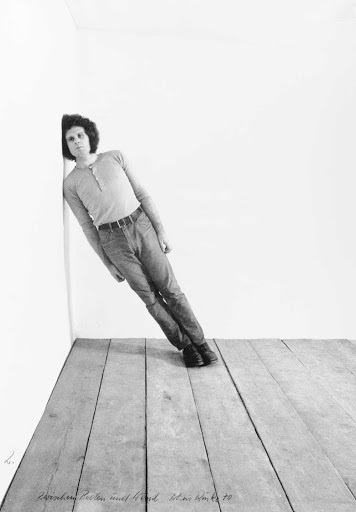
Klaus Rinke was an artist that I found more interesting, he reminded me of Vito Acconci or Bruce Nauman, his playful performance pieces also rather like Erwin Wurm's 'One Minute Sculptures', his  work reminded me of the playfulness of art, or what is often called 'serious play'.   


Léon Ferrari: Cidade

However it was Léon Ferrari that I found to be the most interesting artist in this section. These images were of plans for what he called an 'architecture of madness', spaces filled with anonymous characters behaving chaotically, representing the absurdity of modern city life and investigating the complex relationship between madness and order. 

Tracing boundaries, narrating experience

Like medieval maps that recorded the encounters travellers were likely to make, the different stages in the journey and how long it would take to walk between them, the works in this section are all “describers of itineraries.” (Michel de Certeau) As alternatives to abstract, conventional maps, these pencilled cartographies inscribe an experience or a journey. They record motion, flow and changes of direction. Their lines are the floating traces of a moving, subjective geography; illustrations of a territory lived first-hand. Through these interplays of lines, “a migrational, or metaphorical, city thus slips into the clear text of the planned and readable city.” (Michel de Certeau) The works can spring from poetic, political, exploratory, militant or subversive motivations.


Al Taylor

I have now broken my self imposed rule and have put up some images of Al Taylor's work. I have shown his work in one of my previous blog posts  but he's always worth another look as I find him much more playful and often funny, as he works around the edge of seriousness. I suspect he has as the curators put it, 'subversive motivations' and I warm to that.
 
Till Roeskens

Till Roeskens is another artist well worth investigating, his video drawings  or video mappings depict people caught in a situation that becomes more absurd every day. As people try to live a normal life in a refugee camp, it takes courage, craftiness and humour to survive. We are projected via his video into refugees' intimate experiences, while we follow the maps they draw to represent the complexity of the environment they experience.


Shusaku Arakawa: Diagrams for the imagination

Arakawa was an architect with a practice designed to prevent the inhabitants of his buildings from dying. His diagrammatic drawings are part of a body of work that is both strange and fascinating, his architectural designs based on ways to constantly keep the inhabitants thinking and 'on their guard' so that they never relax; relaxation being for Arakawa a weakness that would only result in an early death. Perhaps his drawings reminded me of Benjamin Brett's drawings of the shape of consciousness, for whatever reason, I was intrigued. 

Space/measure

Geometry – literally “to measure the land” – is a branch of mathematics applied to a territory that is surveyed, contained, occupied and ultimately possessed by a line stretched between two points. The artists in this section envisage different ways of delimiting or redefining space; not in an authoritative way but using pencil, materials sourced in situ, or their own movements. Space, be it the space on a page, in nature, or inside the studio, is defined here on the scale of the artist’s body, trajectories and movement, and no longer by a fixed boundary. The body becomes a yardstick with which to measure the environment, highlighting the relative nature of accepted standards and offering scientificpoetic alternatives to the metric system.


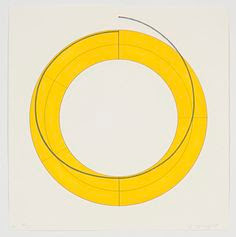
Robert Mangold

Robert Mangold has several related themes that run through his work. The fragment in relation to the whole (how, for example, can a pie slice-shaped painting be read both as a section of an invisible circle and a form complete unto itself?); formal stability in relation to formal abnormality, and how does a surface assert its materiality while also suggesting transparency? All of these issues use geometry as a method of enquiry and the line as a device to visually slice through surfaces. 

Ghostly lines

From the curve of a branch to the contours of land carved by erosion; from the wind-sculpted ripples of dunes to the furrows man leaves in the earth, this section demonstrates the omnipresence of lines in nature. From the École de Paris to Minimalism, artists have represented this aspect of nature in landscapes reduced to abstraction. Ravines, geological movement and sinuous hillsides are stripped to their essence, to their vital force. In the 1960s, artists began to leave the studio and invent new forms on the scale of nature. Some inscribed lines on the landscape, using photography to record the invisible or reversible traces of their solitary path. Others saw themselves as demiurges, adding ephemeral lines to those of nature itself.


Toni Grand

Toni Grand's sculpture is often made of organic lines made in surprisingly 'inorganic' ways. Sometimes using natural materials, even eels, these materials can be cast into fibreglass or resin, the results being neither one thing or another, his 'lines' suggestive of natural forms, but hinting of artifice. 


Vera Molnar

Vera Molnar’s computer-generated works used programming as a means to reflect upon the autographicity of the handmade trace in drawing and painting.

Writing

Whether handwritten or printed, writing is entirely composed of lines, of upstrokes and downstrokes which, combined into text, produce more lines that run across the page. These two facets of writing are a rich source of inspiration for the artists presented here. Letters and numbers, some barely legible, take over the page, the canvas, even a wall, replacing their primary function to communicate meaning with the aesthetic of a purely visual language. Other works, when not inventing languages, replace characters with abstract signs or endlessly repeated minimalist motifs, still conserving the alignment of text or musical notation.


Pierrette Bloch

Pierrette Bloch's work explores the abstract rhythms of mark making, each mark behaves like a sign, as in a written language, each mark being part of a field of marks that collectively can be read as asemic writing. 

Lifelines

Like plants criss-crossed with nervures and cavities, the human body is made up of innumerable lines, beginning with the internal network of veins and arteries. The palm of the hand maps out our existence with lines whose meaning the fortune-teller has traditionally deciphered. This final section sets out correspondences between microcosm and macrocosm. They are reflected in the format of works which exaggerate a detail of the body, or in contrast propose a diminutive mapping of the individual. While life expectancy can be read in the lines of the hand, our fragile existence, on reaching its term, hangs by a thread: the ultimate metaphor of the line.

John Coplans

John Coplans' photographs highlight skin lines, his own body being at the time of taking the photographs of a similar age to my own, so I recognise the way that skin thins and forms age lines. I'm reflecting on an artist I already knew, so I break my self set rule again, but I had forgotten his work and now I'm making work about my own body and how I feel about it, his work has relevance to me in a way that it didn't before. 

Hopefully by picking out artists that I hadn't come across before, the exercise was also useful to other people reading this post as an introduction to some artists that they hadn't come across before either. However I was also thinking about how a belief in animism could lead to an idea of thinking about the artworks in an exhibition as interacting events rather than individually separated things, and how these artworks could be seen as communicative subjects rather than objects waiting to be commented upon. I would like to think of each encounter with an artwork as being like a conversation; Coplans showing me his body as a sort of provocation, and myself replying that only after reaching a similar age am I ready to fully engage and entangle myself in his message, whilst Till Roeskens pulls me into the daily life of a refugee camp, a life that as I'm sucked into it, I realise I can never actually know, but can imagine now in far more detail than I ever did before. As in all communication, part of the reception of the work is dependent upon previous knowledge and proclivities; however all of these pieces, even the ones that I didn't find much empathy with, affected me in one way or another, and as they did they became enmeshed in my mind with all my other experiences and so they become like threads that are wound around me. As I write this post and you read it, these threads are wound around you as well, you now becoming entangled into my messy world, a world that includes stones and plants and insects as well as wind and rain and computers, atoms and quarks and electro-magnetic forces, as well as other people and ducks.

See also:

Asemic writing

Drawing and communication theory

Stitched, dashed or dotted lines

Tim Ingold

Saturday, 4 July 2020

Why it matters

A lumpen form

Whether I'm using clay, chalks or ink, there is a constant plastic morphing of shapes that as I work with them can emerge sometimes as frog-like forms, sometimes as images of rocks or landscape and sometimes as humans or plants. Why should something as fluid and unpredictable as this matter? 

Anthropomorphic map of Chapeltown

Polity Books have begun to commission a series of texts designed as arguments for the continuing relevance of various academic disciplines. Tim Ingold was given the task of developing the argument for anthropology. His argument, set out in 
Anthropology; 'Why it matters' included this short sentence, "Difference is the glue that binds us all." I found this really interesting and after reading the book, I decided to set out an argument for why I continue to pursue my own discipline, and although I haven't the time or space to devote to a full and complete articulation of my position; (Ingold sets out his argument in well over a hundred pages), I will attempt in this much shorter format to set out my own position as to why art matters, in particular, as to why it matters now and why it is central to understanding how difference is something that can gradually disappear when drawing and making things.  

The most important issue for myself is the relationship between art and the world. I believe that art does not set out to critique social issues or to answer problems, it is not about knowledge gathering or illustrating an idea. It is therefore a very poor academic discipline, as it cannot be measured easily and if asked what questions it answers or what issues it solves, many artists may well say that it does not ask questions or give answers. But as the issues and problems that face us today are so huge and pressing, does this mean that art is useless? Art is for me something much more about being embedded into life, rather than standing outside of it. It is about experiencing the world and the things that make up the world, both its processes and its physicality. It is also about using the stuff of the world to reflect on the world. It therefore deals with material possibilities. My personal approach is that as stuff comes into contact with my hands and my sight and the rest of my body's experiential bundle, it can be engaged with and as change happens its implications can be followed until something emerges. The world not being the subject of some sort of objective study but something I am immersed in. As I try to swim in it, my movements create eddies in the water, these eddies can be just splashes if I'm not in tune with the water or they can be beautiful swirls if my actions flow with the fluid I'm in. In making drawings or ceramics I try to attune myself to both the materials I am working with and the various processes and activities that I am entangled with, these other things being what we call politics, gardening, reading, having relationships with other people, feeling ill or smelling cut grass. It could be argued that everything matters, but sometimes I need to make images of things to let their 'mattering' make sense to me, I also need to filter what matters, if not I would be overwhelmed with so much information that I wouldn't be able to function. I do believe making art is about making some sort of sense, but not because it explains things, its a sort of sense that relates to how the experience of living has something about it that can be seen through the imagination. It is as if the intuitive coming into being of an image as it arrives out of a material, helps crystallise certain types of observations, not those of scientific measuring or reasoning, but those that are more about love and kindness, of empathy, of paying attention to something and how it interconnects with other things. Old ideas such as 'harmony' and 'interrelatedness' still seem important, if only because in order to achieve these things you have to look and listen and acknowledge other forms besides your own. 

Several of the drawing projects I have been involved with over the last few years have begun with conversations, I have either been drawing in the street and someone has come up to me and decided to tell me about their lives and what it is like to be them, or conversations have just happened randomly. As I get older conversations change, the things that I talked about with others in my teens were very different to the things I talk to people about now, not more interesting or deeper, just different, because as I interact with the flow of conversation today my bones ache and my feeling tone is that of someone in their 70th year and not their 17th. But above all I try to listen. Back in the studio I go on to continue my part of a conversation through imaginative drawing or making. This is not about being the analytical artist standing back from the world and being objective about it, it is about flowing with the implications of the conversation, and as images arrive using these as extensions of that conversation. Not just with people but with the materials that I have also joined in with in opening out possibilities. By making the conversations more visible, I also get to become part of a wider ongoing conversation, one that occurs on social media as much as a result of people seeing the work in exhibitions. Images thus become part of a flow of both verbal and visual conversations, but the images work slightly differently to the words, they allow others time to digest them and they take on new meanings as they are translated into digital forms. However the meaning is more to do with what is articulated at the various points of contact, rather than something directed or shaped, its a meaning that flows into forms in a similar way that molten metal flows into a mould. 

A glowing sun/virus illuminates a dark sea

There is something about care that is important here, valuing others lives is part of an attempt to value the earth itself and this means that I also have to take other viewpoints seriously, whether this be of people or non humans, which is part of a duty of care that is a hard thing to follow sometimes. 

Taking others seriously is something I found that the art world was very poor at doing when I first arrived in art college in the late 1960s. Art it seemed to me then was much more about learning to operate within a series of positions that were acceptable to certain gatekeepers within the profession. It was certainly not about developing conversations I had previously had with the people I knew before I entered the art world, especially the world I came from in the English Black Country. My teachers from that time would despair of me if they saw the work I did now, their position would be that artists deal with the type of questions that other artists find interesting, the proper subject of the discipline of art being an interrogation of the discipline. There is a long tradition of art writing going back to Lessing and including Greenberg and Dickie that discusses what can and what cant be the subject of art. It was Tom Wolfe's 'The Painted Word' that helped me to eventually articulate my own stance in relation to what I found was an arrogant and stultifying approach to art, one that was a celebration of a certain type of elitism and in England in particular, it was something to do with class. Working class people worked with their hands, therefore the crafting of things could never be as important as the planning and intellectual positioning of ideas, which were the sorts of things middle and upper class people did. It took me a long time to accept that my hands thought in their own way, and that they could have a deep conversation with a material, a conversation that was an enfolding of possibilities, rather than an intellectually understood position. The one was about an ongoing, constantly readjusted dance of relationships, the other was more an observed 'frozen' thing, an isolated object. This was why, I began to realise, that all those wonderful objects that you could look at in glass cases in the British Museum, were somehow 'dead'. They had been plucked out of their event, cut off from the doing that they were involved with. I was often told that the making of art was a thing done in isolation, it would be received within a process of a 'disinterested interest'. But the art I looked at that appealed to me always seemed to be about an approach to the world that suggested an engagement with it. Not to solve anything or to unpick the details of social ills, but to help open out an awareness of what is there. Goya does not solve anyone's problems but he makes me aware of the continuing vanity of people, the stupidity that we can all descend into and the violence human beings can inflict on each other. He is aware that reason sleeps when anger and self interest take over, is tuned into the dark side as well as the funny side of awareness. He is also attuned to ink and paper, as well as paint and its ability to be transformed into the forms he sees and the forms he imagines, the one flowing into the other. 

One thing that we need to remember about art is that it is made by people, people immersed into the world and when I look at art I cant do that without feeling or thinking about how it was first of all engaged with that world and then of how it continues to be entangled into it. This is why older art is still useful now, it changes in how it engages us because nothing stands still, but it continues to engage, because the basic things that have been central to the content of artwork remain the same. 

I have gradually come to realise that art making is something 'stitched into the fabric of the world' as Tim Ingold put it when thinking about anthropology. Our perception of the world is in fact the world's perception of itself, an idea that Ingold took from Merleau-Ponty and which when I read it, I understood as being central to how I could think about how I was working as an artist and as how as an individual being I am in the world. As I do things I interact with the world around me, it is shaping me and I am in my small way shaping tiny bits of it. We mould ourselves together, I am cast from the environment I find myself born into, but as I move through it, I begin to dance with it and hold certain parts of it closer to me than others and as I do so we grow together. Out of this experience and forming an integral part of it comes art. It is a dynamic process, one that is always seeking harmony with the environment it finds itself emerging from. 

The world of degree level art education, within which I work, has seen the rise of the need for lecturers to undertake PhDs. I have never been against the reading of theoretical texts, and in fact have often celebrated their existence and encouraged others to read them, because what they represent are other voices, other conversations as to what the world could be about. But I have always believed that these voices should not to be elevated above those of poets, farmers, street cleaners, wood workers, nurses and overhead crane fitters. All of the people you meet, either in person or via something they have written or visually imagined, are like currents that swirl around us as we swim, sometimes a current will be so strong that it almost pulls you underwater, at other times the existence of a barely perceptible undertow might almost go unnoticed, but will still be a forceful shaper of the direction you will end up going in. My personal observation has been that a PhD prioritises academic learning and the research question above instinct and a haptic understanding and in doing so analytic and objective decision making are elevated as leading to new knowledge, which is in turn valued above any wisdom gained from material thinking, intuition or hand learning. Wisdom it seemed to me could only be arrived at if it had a common purpose, and a common purpose could only be arrived at by working alongside and in collaboration with people and things. For instance if I really want to know what the landscape is like between my house where I live and the place where I work, what I ought to do is try walking from one place to the other with no shoes on. This is a very different approach to knowledge. A collection of facts is something that is too easily commodified and linked to outputs and some sort of measured impact. I have perhaps tended to rely overly on ostensive definitions of what things are, i.e. I prefer pointing to things to show how or what is happening. Wisdom is something that operates in and between people and the world, knowledge is something you can save up, like capital. It can define power relationships and elucidate difference. Knowledge leads to either or situations, which identify difference and if I know you are different from me, I may well treat you differently. This simple fact lies behind so many of the world's problems. We are not things that can be separated one from another, we are entanglements of events, parts of which are always being entangled with other events. If I could see myself and others as an ongoing event whereby we all have parts to play, I would be more inclined to help facilitate the action that is going on between things and people, rather than to create blockages, by working to disadvantage certain players. The event of a fruit ripening on a tree, encompasses many things in its becoming, from sunlight streaming down onto the Earth over many months, to a developing soil complexity and microclimate, that includes minerals, fungi and insects. There is an ever shifting and shaping combination that enables the tree's roots to embrace nourishment, and these events are intertwined with human events such as picking and eating and digesting. For the tree event I also become a distribution system, facilitating seeds to move as far from the tree as possible, so that they can survive outside of its own shade, and for myself I gain nourishment and the energy resources to amongst many other things, type this text. On the other hand, I can use words to differentiate one thing from another; I am a human being and that thing over there is a tree. If I use the two separate nouns in this way, a proposition is developed; it states that humans and trees are very different things, rather than interconnected parts of a process. This writing is art too, which is why hopefully as the words are read, an idea emerges about noticing things. It would be argued by an OOO philosopher however that the nouns are important and what is more useful to think about is the points of contact between things and how change is made at those points of interaction. Whichever way round I think of it, it is interaction and change that results. 

No matter how hard I try I always see everything through very human eyes. Everyday I take a few moments to spend time looking into the pond in the garden. It is that time of the year that the tadpoles are about to get legs and set off out into the world. There is a frog in the pond that always hides behind a particular stone and I always look to see if it is still there and worry when I don't see it. I cant but help think about the frog through my own human form and when I do I picture the frog in my drawing mind as human. As a child I read many a story where frogs were really people, or where they acted as if they were human. I also realise that still thinking like a child is a stupid thing to do, however I am of a very stupid cast of mind, so as our paths cross, I record my thoughts about this in a way that only makes sense to me, by making a drawing, a drawing that suggests that the frog is human, like myself. If this is an argument for my own discipline, then it seems to fall apart at its very inception, but in the conundrum of being illogical and subject to sometimes childlike innocence, perhaps we will find the very thing we are looking for, as it is not about profit or reasoned argument or hubris, it is simply about re-inserting ourselves back into the world, and if this means a process of stupid re-connection then so be it, if it means I think kindly about the life of a frog for five more minutes than I would have done before, if my day to day activity includes a frog in its event cycle, perhaps that's a good start. 

A flower morphs into a frog

So what is it that makes my discipline one that is useful and still of importance to the world? Perhaps it's the fact that it can take seriously a child-like point of view, that it can stand outside of academic structures, that it allows for an enmeshing between people and materials, that it facilitates a flow of change and that it is more about process than final objects. Perhaps it is also because it has a huge mythic weight on its back, one that includes all those very expensive works of art in museums and bank vaults, perhaps its to do with the fact that it is supposed to represent some sort of truth, or just that it is forever morphing and shifting its form, so that it becomes something that can be used by each society as it finds it needs something to help it understand itself. 

Bird form emerges from watery environment

My present cast of mind could also due to the fact that I have been asked to consider undertaking a PhD. Something I have been avoiding for several years has suddenly come to sit right in my centre of vision and I have to make a decision as to whether or not to undertake something that all of my colleagues have done or are in the process of doing. Therefore my earlier statement, that 'the PhD prioritises academic learning and the research question above instinct and a haptic understanding and in doing so analytic and objective decision making are elevated as leading to new knowledge, which is in turn valued above any wisdom gained from material thinking, intuition or hand learning', needs a bit more interrogation, does it always have to be so? If not how can a body of doings be constructed that allows for the serendipity of unexpected interconnections that I like to make as I write this blog, in fact, is this blog a form that could lead into a PhD? 

A long time ago I drew a diagram that attempted to show how art was always changing and that it was never a fixed entity. Perhaps it's time to revisit it and to think about what it could be again. 

Diagram of the evolution of the word 'art' I made for a GIDE conference 

Art as an idea is in constant change, if it wasn't it would have little baring on reality because reality is an ever changing experience. The only people that want art to be some sort of set of eternal values I would suggest are those that have an investment in an idea of such values. 

See also: