Showing posts with label line. Show all posts

Monday, 16 February 2026

The Vertical

I put up a post on horizontality a while ago and as I'm seeking some sort of balance in my reflections, think it's about time to explore the vertical. 

From: Felix Moscheles’s 1896 book, 'In Bohemia with Du Maurier'

When you begin a course in objective drawing, one of the first things you will be asked to do will be to practice measurement and one of the main elements of that will be to establish a vertical against which you can check both angles and relative sizes. Basically in order to establish measurement you need to compare a known element to an unknown one. One of the most common “known” elements is one that exists due to gravity. 

A drawer establishes a vertical by using a plumb line

A plumb line is one of the oldest measuring devices, one that has been used to establish verticality from time immemorial. It is also used to check relationships.

Checking the relationships between the corner of a sculpture's base and the carved head

As you can see from the image above, by using a plumb line we can easily check what lies directly above the vertical line established by the corner of the sculpture's base. We can also begin to assess by eye angles that relate to our vertical, such as the angle of the chin, of an eye or a cheek bone. By assessing a measure of length in relation to the plumb line, usually the artist's thumb slid up and down a pencil, you can also begin to establish size constancy. 

Using your thumb and end of a pencil to find a unit of length.

In the image above you can see how the plumb line establishes a vertical and how in relation to that you can find a unit of measurement; often in the case of life drawing using the head as a unit. This is of course 'sight size', so if you want your drawing to be bigger, you multiply the measured unit by the percentage larger you need it to be, leading to what is usually called proportional or scaled drawing

From: Charles Blanc’s 1867 book, Grammaire des arts du dessin.

Charles Blanc in his 'Grammaire des arts du dessin' uses an illustration that depicts a human being standing on top of a semicircle that represents the sphere of the world.  A vertical line runs through both the standing human and the world and this in turn represents a plumb line, which visualises how everything standing on the Earth relates to its centre of gravity. By using this line Blanc shows how the human figure and any other form, can be drawn as if firmly standing on the ground. Any deviation from this vertical creates some form of movement or emotional exchange beyond the establishment of uprightness. 

From: Grammaire des arts du dessin.

We have already looked at Humbert de Superville's work, a man who had his own three line scheme for expression; 'expansive, horizontal, and convergent', a scheme that he believed affected fundamental emotions. This 'off the vertical' scheme, was taken up by Charles Blanc and used to explain why it was so important to establish verticality as a measure against which all other angles could be compared. Therefore quite early on we have a relation between the vertical as a support for measurement, but also as a comparator in terms of emotional register. The vertical in the visual arts representing an upright character, one associated with resilience, growth, inner strength and quiet confidence. Vertical lines conveying a sense of nobility, spirituality and stability. They can also communicate a feeling of loftiness and spirituality, as vertical lines may suggest a relationship with the sky and other untouchable cosmic entities, such as the sun, moon and stars. Extended perpendicular lines suggesting an idea that goes beyond human measure.

If however you want to specify the establishment of a vertical line without any emotional or spiritual implications, you can do this by referring to it as a Unicode Character. U+FF5C represents the Fullwidth Vertical Line. 

Unicode Character “|” (U+FF5C) The Fullwidth Vertical Line

Unicode stands for ‘Universal Character Encoding’ and is a global standard for representing text characters in binary form. It enables consistent storage, exchange and processing of text across different digital systems and platforms. Unicode was created with the aim of serving as a unified standard for representing all writing systems and characters developed by humans.

But if we look at heraldry the primary name for a single, wide, vertical stripe located in the centre of a shield is a pale. A palet or pallet, being a thinner version of the pale. The pale may occupy one third of the width of the shield. It has two diminutives, the palet, which is half as wide as a pale and the endorse which is by some said to be one eighth of its breadth, by others one fourth. However, being upright and red, it also signifies courage. 

A Pale

If considering the cross of the crucifixion, the 'stipe' is the vertical beam or upright post driven into the ground. A vertical view of the crucifixion refers to both the physical, upright orientation of the cross (crux immissa or crux commissa) on which Jesus was executed, as well as the theological, vertical relationship it represents between God and humanity. This theological, vertical relationship represents the direct, personal connection between God and humanity. Often symbolised by the vertical beam of the cross, it represents the reconciliation of sinners to God through Jesus Christ, facilitating a "God-ward" orientation of worship, prayer, and obedience. 

Michelangelo: Crucifixion

In Michelangelo's drawing the outstretched arms of Christ metaphorically fly him into that other world that sits above the humans that support him; humans, who Christ will in turn support as he makes his way to God's side. The vertical of the cross extends out of the ground at the base of the drawing and into infinity at the top. As it is cut off, the implication is that it continues out into the cosmos, invisibly extending far beyond the physical edge of the paper it is drawn upon. 

The vertical of the cross is perhaps one of the most spiritual metaphors associated with verticality, but it is not the only one. The vertical, invisible line that extends through the body as an energy channel in Eastern spiritual traditions is most commonly known as the Sushumna Nadi in Hinduism and Yogic philosophy. In Chinese Taoist alchemy and Qigong, this central axis is often referred to as the Central Meridian (Zhong Mai) or the Taiji Pole.

The Sushumna Nadi

In Hinduism the 'Nadi' are astral channels, made up of astral matter that carry Pranic currents and the Sushumna Nadi is the most important one. It is a three in one symbol; the sustainer of the universe, the path of the universe and the path of salvation. It joins the back of the anus, via the spinal column, to the Brahmarandhra of the head and is invisible and subtle. In everyday life we feel this as we breath in and stand more upright, letting the top of our head becoming attached to an invisible thread that helps us maintain that upright vertical stance. This is again something I've become much more aware of as I continue with my research into visualising interoception. 

The Chinese arts of health, maintain that an upright posture for the cultivation and circulation of energy is vital. The Taiji Pole, is said to run directly through the centre of the body from the top of our head from the (Bai Hui) Spirits Door energy point (Qi Xue) down to the (Hui Yin) Meeting Yin energy point which is located between our anus and testicles. It is an energetic line on which are found the three elixir energy centres ( Dan Tians) of the upper Dan Tian, which is located in the head, the middle Dan Tian located in the chest and the lower Dan Tian located in the abdomen. The Taiji Pole also has three major energy channels that connect to it; 1: The Govenor channel (Du Mai) which travels up the back from the tail bone to the roof of the mouth and is considered a Yang channel. 2: The Conception channel, that travels from the tip of the tongue down the front of the body to the (Hui Yin) energy point between the legs is considered a Yin channel. 3: The most important energy channel that is also connected to the Taiji Pole is known as the Thrusting channel (Zhong Mai) which travels directly between both the Governor and Conception channels. In medical Qigong practice, a priority is regulating these two channels in order to balance Yin and Yang in the body.

Taiji Pole


Our backbones are also a protection for our nerves. Each vertebra has a hole in the centre, so when they stack on top of each other they form a hollow tube that holds and protects the entire spinal cord and its nerve roots. The spinal cord itself is a large collection of nerve tissue that carries messages from our brains to the rest of our body. Working in a spinal injuries centre, has highlighted for myself how important this is and the complexity of the body's wiring is such that doctors are still not quite sure as to what the effects will be of any spinal column breakages.  As we can see from the acupuncture charts above, each point along the spine is linked to a different effect. For instance CV10 
is linked to issues with the lower stomach, such as stagnation, bloating, distention, weak digestion, diarrhea, undigested food in the stool, vomiting as well as rumbling or gurgling noises made by the movement of fluid and gas in the intestines.

We are it seems both physically wired and mentally wired. Energies flow between parts of the body in ways that at times are confusing, but perhaps only because we don't quite yet understand the full complexity of their interrelationship. 

Like trees we have evolved to stand tall. Trees maintain their verticality by constructing a scaffolding of trunks, limbs and branches that enable them to rise from the ground into the upper atmosphere. This makes them free of competition from ground covering plants and shrubs. 
In landscapes humans and trees are often the verticals against which the horizontality of the landscape is measured. In fact you can structure a landscape around a vertical and horizontal axis.


The differences between forests and woods, agricultural land, park landscapes, reed-beds and marshlands are recorded using height, openness and density of vegetation. All vegetation aspires to reach upwards and turns towards the sun. Whether a grass stalk or a fir tree, plants have evolved a vertical structure, designed to be able to bend with the wind and at the same time achieve maximum height by building rows of semi-rigid cells upon rows semi-rigid cells in the form of complex matrices.

It is gravity that rules this world. However, although it was the first force to be described mathematically (by Isaac Newton in 1687), we still do not know how it really works; the best modern description apparently being the general theory of relativity. We know what it does, but not what it is. The mystery of gravity is that it is an attractive force, but while the other forces such as electro-magnetism, can be both positive and negative and cancel each other out, gravity is only attractive, with no way to repel it, except it would seem to me metaphorically. Every time we stand up, we fight against gravity, we are in effect by living, a type of anti-gravity force. 

Georgia O'Keefe wrote the following to her husband Alfred Stieglitz in 1929: 

"There is much life in me...I realised I would die if I it could not move towards something...it makes me feel I am growing very tall and straight inside...and very still."

The flat landscape of New Mexico had given her a new life, one that she sensed verticality, as she measured herself against her surroundings. 

Reference:


O'Keefe, G. and Stieglitz, A. (2011) My far away one: Selected letters of Georgia O'Keefe and Alfred Stieglitz New York: Yale 

See also:

Saturday, 15 November 2025

A linear enjambement

Rosemarie McGoldrick: 'Animalcules IV' (2025)

An enjambement in verse is the continuation of a sentence without a pause beyond the end of a line. For instance the poem "The Red Wheelbarrow" by William Carlos Williams, is constructed in such a way that everything depends upon a continuation of the first line, therefore the first line ends without punctuation, so that the thought continues into the next line; thus creating a sense of flow.

William Carlos Williams
XXII from Spring and All (1923)

The Red Wheelbarrow

so much depends
upon

a red wheel
barrow

glazed with rain
water

beside the white
chickens.

The Red Wheelbarrow is a short haiku like poem that makes us aware of how objects work upon our personal sense of a visual poetry.

The line that continues is also something that can be purely visual. Rosemarie McGoldrick has an exhibition of her work on at the Centre for Recent Drawing at the moment and she uses a sense of enjambement in her drawn images depicting microscopic forms of imagined plankton and geometric krill. She is another example of an artist trying to visualise the invisible and I was particularly interested in her work because of the idea of enjambement. When I was looking at  permeable boundaries, such as the ones that surround an amoeba, I was trying to visualise how the body of the amoeba was open and flexible, becoming at times part of the surrounding environment and at other times seeming to reassert itself, switching from one state to another. I saw in McGoldrick's images a possibility of a type of visual language using a linear enjambement, that could allow me to redraw microscopic and human sized forms in such a way that they were interconnected much more clearly into their environment and to each other. It also fitted very well with my earlier thoughts about lines as symbols of invisible forces. 


Two stages of relationships between bacteria, feelings, their human hosts and other things

Lines of relationship are constantly shifting and when trying to visualise an embodied complex of interoceptual feelings, some areas are just blank. In the image above the black blobs were drawn as indicators of unknowns that still have complex relationships between all the other aspects of a being situated in an environment. One issue I have also had to think about in these type of images is how power is depicted. I have been looking towards the depiction of what is sometimes called a 'flat ontology' or sets of equal relationships between things. However I'm also aware that as soon as we focus on something it has more power in our minds over other things, that then move into the background as we shift our attention away from them. For instance in the image above the form moving into the frame from the left hand side is weightier than the more complex form situated in the middle of the image. The connections between are though drawn as if they are of equal weight. Perhaps my thoughts can be clarified by referring to another image that uses similar lines to depict a relationship. 

Mesmerism

The invisible power of mesmerism is represented in the image above as another example of a male exerting power over a female. However I'm more interested in the lines of force being rather like the strings attached to a puppet. 

Although the hand of the puppeteer is usually thought of as a means of control and the strings the means by which that control is asserted, you can see it as being a relationship that goes both ways, the puppet in effect also directs the puppeteer. Connections go both ways. 

It is however Jorinde Voigt's use of lines to express relationships that I reference in my own drawings, as her images are reflections upon the transience of experience and the impossibility of actually recording it. In her drawings I see a glimpse of Cézanne's struggle to draw how he saw;
 as in Cézanne, there is a beauty in Voigt's work that emerges in relation to her seeking to pinpoint life's ever changing patterns. 

Jorinde Voigt

The drawings that were on display at this year's Turner Prize exhibition by Nnena Kalu were also a type of linear enjambement. In her case the drawings were all repeated, the continuation of the sentence beyond the end of a line, being accomplished by picking up a swirling linear thought  and doubling it. Her drawings seem very much about her own energy, about her body's movement and a celebration of it. Although related in form to some of Voigt's drawings, Kalu's feel less of an emotional dilemma, more a celebration of her existence than a struggle to affirm it.

Nnena Kalu

Nnena Kalu's doubling reminded me of Robert Rauschenberg's Factum 1 and 2.

Robert Rauschenberg: Factum 1 and 2: 1957

Factum 1 and Factum 2 are nearly identical, both using the same mixed-media techniques, of collage and paint on canvas. Rauschenberg's doubling, is this case is more a commentary on art's originality and uniqueness, paint never dripping in exactly the same way, every abstract expression being an original feeling. However the style of collage next to free paint marks, makes each 'combine' out to be a 'unique' Rauschenberg. Nnena Kalu's drawings are similar in that they are not exact copies, but close enough to at first sight be seen as identical doubles.
Rauschenberg's approach being more cerebral, whilst I feel Kalu has found her way more instinctively. All of these attempts to meditate on the nature of the creative act involve in one way or another the continuation of a communication beyond an initial setting out of what is to be communicated. They are like hair extensions, attached to the starting point, but going much further, becoming something new in the process.  

See also

Lines as symbols of invisible forces

Thursday, 8 April 2021

Animism and drawing lines: a reflection on an exhibition

To be a good artist is to be an animist. Well sometimes it feels that way. To be an artist you are supposed to be more self-aware, but there is a problem with being self-aware, it creates a sensation of isolation, that you are somehow detached from things, and the result of this is everywhere to see, a myopic view of the world that has resulted in a lack of empathy with not just all those things that are not human beings but with any human being who is not like how I think I am. Not being so self centred would entail being more aware of others, such as people who aren't me, as well as animals, plants, rocks, plastic bottles, water and gravity. Being less self conscious might also mean that I might eventually become "lonesome no more" as Kurt Vonnegut would put it, open to building friendships with stones, beetles and even other people who are not like me.

The dividing line between sentient life and lifeless 'matter' is not a clear one; the covid virus for example, is an infective agent that is a nucleic acid molecule in a protein coat that is able to multiply only within the living cells of a host. If self multiplication is a definition of life, a virus is a questionable life-form, having no powers of its own to duplicate itself. This particular formulation of matter has evolved to multiply itself by latching onto organic life. The important issue here being that if there is no clear dividing line between life and not-life, our membership of the world of things which is traditionally focused on organic life forms, now opens out to include all those inorganic things that exist in the world. Our understanding of things as being separate entities is also being questioned, (the virus cant exist on its own and neither can we) and we may eventually need to re-conceptualise ourselves and other things as interconnected events rather than as separate objects. This is possible because we have the imaginative capacity, the self being an idea, just as much as entanglement is an idea or time or events. 

David Abram would argue that the imagination is an attribute of the senses themselves and that it is not a separate mental faculty. He states that what we call the imagination is "the way the senses themselves have of throwing themselves beyond what is immediately given, in order to make tentative contact with the other sides of things that we do not sense directly, with the hidden or invisible aspects of the sensible". In the same way that a virus has evolved to extend itself by developing an ability to latch onto bacteria, the senses have evolved in order to 'predict' the future. Events are constantly unfolding and everything in one way or another takes part in that tentative contact with other things, things that are really events.  It is also salutary to remember that because of the complexity of interactions that the agents behind events are often hidden or invisible and our concern to always understand why or how things are as they are, is another aspect of our isolationist thinking, which leads to a belief that there are single identifiable causes behind everything. 

Animism is a belief in an idea of interacting events rather than individually separated things. This shift in conceptual framework allows for a different type of awareness, whereby everything is experienced as not just being connected but in constant metamorphosis and flux. 

We create personal relationships with pets, cuddly toys and all sorts of other objects, such as a lucky penny or memento from a holiday, because of these relationships, things become communicative subjects rather than inert objects. These approaches to the world begin to dissolve the idea that our environment consists of a physical world distinct from the world of people.

Nurit Bird-David states, "Animism is a "relational epistemology" rather than a failure of primitive reasoning. That is, self-identity among animists is based on their relationships with others, rather than any distinctive features of the "self". Instead of focusing on the essentialised, modernist self (the "individual"), persons are viewed as bundles of social relationships ("dividuals"), some of which include "superpersons" (i.e. non-humans)." (https://en.wikipedia.org/wiki/Animism#Postmodern_anthropology) 

Tim Ingold is another contemporary theorist who argues that animists do not see themselves as separate from their environment. Ingold has written two books on lines, whereby he states that the line is a powerful metaphoric device that can be used to explain how entangled and interconnected everything is. So finally we get back to drawing, I wonder if the idea of things as communicative subjects rather than inert objects, can be applied to a reading of art objects, especially those art objects that have traditionally been regarded as 'special' things that have an 'aura' and that reside at the centre of Modernism? Let's see. 

Léon Ferrari, Caminos
Centre Pompidou, Musée national d’art moderne, Paris

The drawing above by Léon Ferrari was exhibited in the exhibition 'Lines a Brief History' at the Musée national d’art moderne, Paris back in 2013. The exhibition was constructed around responses to Tim Ingold's writings, in particular his statement that, 'a study of men and things is a study of the lines of which they are made.' The exhibition had several overlapping sections, each one described as set out below in text copied directly from the Centre Pompidou website.

A taxonomy of lines

Artists have elaborated numerous taxonomies of the line, which is a major component of artistic creation. In the 1920s, for example, teachers at the Bauhaus classified types of line according to objective criteria. Whether the strictly geometrical straight line or a free-flowing meander, lines are always a powerful means of expression. The pure line is a constant in Minimal and Conceptual art. For proponents of action painting, influenced by Far Eastern philosophies, the line is a seismograph of the body in motion. Ramrod straight or swirling, single or multiple, the line in its many guises is inextricably linked to its means of production.

A page from Paul Klee's notebooks, which was exhibited in the taxonomy of lines section

Each section of the exhibition had within it artists that I hadn't encountered, which is perhaps one of the most interesting things about exhibitions put together by foreign curators. So I decided to look at the work of those artists that were totally new to me. The taxonomy of lines section included Karel Malich, Stanislav Kalibal, Francois Morellet and Lee Ufan, none of which I had come across before. 

Karel Malich

As well as drawings, Malich worked in 3D, his wire drawings in space being very like extensions of drawings done on paper. He also worked in pastel, his very simple but intense abstract images being similar in feeling tone to 17th Century Rajasthan Tantric paintings. 


Stanislav Kalibal

Like Malich, Stanislav Kalibal was Czechoslovakian, his explorations of geometry reminded me of Kenneth Martin who taught occasionally at Newport when I was a student, however it was his trap drawings I was most interested in, I found a deep metaphorical connection with them and a link to other ideas I have held in the past about geometry being a trap


Francois Morellet 

Francois Morellet was another European abstractionist I wasn't aware of. I found his more recent installations such as the red and blue wallpapered one above an interesting take on an area that is usually dominated by black and white and very restricted colour values and a way into thinking about the phenomenological reading of art.  


Lee Ufan

Lee Ufan was at one point a member of the 'School of Things' group. He was a leading theorist and practitioner of a group that rejected Western notions of representation and emphasised material, perception, and the interrelationships between space and matter, creating works from raw, natural, and industrial materials with little manipulation. 
For more on the related South Korean art group see: Dansaekhwa 

The long poem of walking

In The Practice of Everyday Life (1980), the philosopher and historian Michel de Certeau describes walking, and its interaction with events and encounters along the way, as a “long poem”. This section considers how the line and the movement that makes it are one. Lines that “walk” across a sheet of paper or a reel of film leave a trace of their passage. Both trajectory and process, a drawing emerges from the progression of lines across the page. It is the continuous, physical movement of a line that forms a pattern in the back and forth motion of the hand; that traces the meanders we follow with our eye, or suspends and recomposes a trail to suggest an act in which the traveller and the line he makes are one and the same.


Julije Knifer

Knifer based his imagery from 1960 onward, on the use of just a single motif: the meander. With this, he created sculptures, reliefs, collages, large-format indoor and outdoor murals, artist's books, and diaries. The result is a virtually monolithic body of work, an approach I personally find impossible to contemplate, but which I know many art dealers and galleries like because it is very clear as to what you are getting and it links the artist to a very particular format, which can then be 'branded' and marketed as 'unique'. 


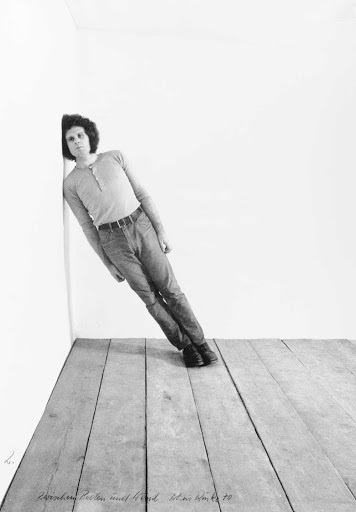
Klaus Rinke 

Klaus Rinke was an artist that I found more interesting, he reminded me of Vito Acconci or Bruce Nauman, his playful performance pieces also rather like Erwin Wurm's 'One Minute Sculptures', his  work reminded me of the playfulness of art, or what is often called 'serious play'.   


Léon Ferrari: Cidade

However it was Léon Ferrari that I found to be the most interesting artist in this section. These images were of plans for what he called an 'architecture of madness', spaces filled with anonymous characters behaving chaotically, representing the absurdity of modern city life and investigating the complex relationship between madness and order. 

Tracing boundaries, narrating experience

Like medieval maps that recorded the encounters travellers were likely to make, the different stages in the journey and how long it would take to walk between them, the works in this section are all “describers of itineraries.” (Michel de Certeau) As alternatives to abstract, conventional maps, these pencilled cartographies inscribe an experience or a journey. They record motion, flow and changes of direction. Their lines are the floating traces of a moving, subjective geography; illustrations of a territory lived first-hand. Through these interplays of lines, “a migrational, or metaphorical, city thus slips into the clear text of the planned and readable city.” (Michel de Certeau) The works can spring from poetic, political, exploratory, militant or subversive motivations.


Al Taylor

I have now broken my self imposed rule and have put up some images of Al Taylor's work. I have shown his work in one of my previous blog posts  but he's always worth another look as I find him much more playful and often funny, as he works around the edge of seriousness. I suspect he has as the curators put it, 'subversive motivations' and I warm to that.
 
Till Roeskens

Till Roeskens is another artist well worth investigating, his video drawings  or video mappings depict people caught in a situation that becomes more absurd every day. As people try to live a normal life in a refugee camp, it takes courage, craftiness and humour to survive. We are projected via his video into refugees' intimate experiences, while we follow the maps they draw to represent the complexity of the environment they experience.


Shusaku Arakawa: Diagrams for the imagination

Arakawa was an architect with a practice designed to prevent the inhabitants of his buildings from dying. His diagrammatic drawings are part of a body of work that is both strange and fascinating, his architectural designs based on ways to constantly keep the inhabitants thinking and 'on their guard' so that they never relax; relaxation being for Arakawa a weakness that would only result in an early death. Perhaps his drawings reminded me of Benjamin Brett's drawings of the shape of consciousness, for whatever reason, I was intrigued. 

Space/measure

Geometry – literally “to measure the land” – is a branch of mathematics applied to a territory that is surveyed, contained, occupied and ultimately possessed by a line stretched between two points. The artists in this section envisage different ways of delimiting or redefining space; not in an authoritative way but using pencil, materials sourced in situ, or their own movements. Space, be it the space on a page, in nature, or inside the studio, is defined here on the scale of the artist’s body, trajectories and movement, and no longer by a fixed boundary. The body becomes a yardstick with which to measure the environment, highlighting the relative nature of accepted standards and offering scientificpoetic alternatives to the metric system.


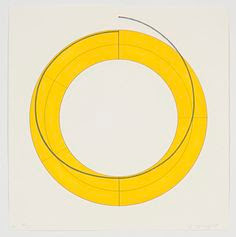
Robert Mangold

Robert Mangold has several related themes that run through his work. The fragment in relation to the whole (how, for example, can a pie slice-shaped painting be read both as a section of an invisible circle and a form complete unto itself?); formal stability in relation to formal abnormality, and how does a surface assert its materiality while also suggesting transparency? All of these issues use geometry as a method of enquiry and the line as a device to visually slice through surfaces. 

Ghostly lines

From the curve of a branch to the contours of land carved by erosion; from the wind-sculpted ripples of dunes to the furrows man leaves in the earth, this section demonstrates the omnipresence of lines in nature. From the École de Paris to Minimalism, artists have represented this aspect of nature in landscapes reduced to abstraction. Ravines, geological movement and sinuous hillsides are stripped to their essence, to their vital force. In the 1960s, artists began to leave the studio and invent new forms on the scale of nature. Some inscribed lines on the landscape, using photography to record the invisible or reversible traces of their solitary path. Others saw themselves as demiurges, adding ephemeral lines to those of nature itself.


Toni Grand

Toni Grand's sculpture is often made of organic lines made in surprisingly 'inorganic' ways. Sometimes using natural materials, even eels, these materials can be cast into fibreglass or resin, the results being neither one thing or another, his 'lines' suggestive of natural forms, but hinting of artifice. 


Vera Molnar

Vera Molnar’s computer-generated works used programming as a means to reflect upon the autographicity of the handmade trace in drawing and painting.

Writing

Whether handwritten or printed, writing is entirely composed of lines, of upstrokes and downstrokes which, combined into text, produce more lines that run across the page. These two facets of writing are a rich source of inspiration for the artists presented here. Letters and numbers, some barely legible, take over the page, the canvas, even a wall, replacing their primary function to communicate meaning with the aesthetic of a purely visual language. Other works, when not inventing languages, replace characters with abstract signs or endlessly repeated minimalist motifs, still conserving the alignment of text or musical notation.


Pierrette Bloch

Pierrette Bloch's work explores the abstract rhythms of mark making, each mark behaves like a sign, as in a written language, each mark being part of a field of marks that collectively can be read as asemic writing. 
Lifelines

Like plants criss-crossed with nervures and cavities, the human body is made up of innumerable lines, beginning with the internal network of veins and arteries. The palm of the hand maps out our existence with lines whose meaning the fortune-teller has traditionally deciphered. This final section sets out correspondences between microcosm and macrocosm. They are reflected in the format of works which exaggerate a detail of the body, or in contrast propose a diminutive mapping of the individual. While life expectancy can be read in the lines of the hand, our fragile existence, on reaching its term, hangs by a thread: the ultimate metaphor of the line.

John Coplans

John Coplans' photographs highlight skin lines, his own body being at the time of taking the photographs of a similar age to my own, so I recognise the way that skin thins and forms age lines. I'm reflecting on an artist I already knew, so I break my self set rule again, but I had forgotten his work and now I'm making work about my own body and how I feel about it, his work has relevance to me in a way that it didn't before. 

Hopefully by picking out artists that I hadn't come across before, the exercise was also useful to other people reading this post as an introduction to some artists that they hadn't come across before either. However I was also thinking about how a belief in animism could lead to an idea of thinking about the artworks in an exhibition as interacting events rather than individually separated things, and how these artworks could be seen as communicative subjects rather than objects waiting to be commented upon. I would like to think of each encounter with an artwork as being like a conversation; Coplans showing me his body as a sort of provocation, and myself replying that only after reaching a similar age am I ready to fully engage and entangle myself in his message, whilst Till Roeskens pulls me into the daily life of a refugee camp, a life that as I'm sucked into it, I realise I can never actually know, but can imagine now in far more detail than I ever did before. As in all communication, part of the reception of the work is dependent upon previous knowledge and proclivities; however all of these pieces, even the ones that I didn't find much empathy with, affected me in one way or another, and as they did they became enmeshed in my mind with all my other experiences and so they become like threads that are wound around me. As I write this post and you read it, these threads are wound around you as well, you now becoming entangled into my messy world, a world that includes stones and plants and insects as well as wind and rain and computers, atoms and quarks and electro-magnetic forces, as well as other people and ducks.

See also:

Asemic writing

Drawing and communication theory

Stitched, dashed or dotted lines

Tim Ingold