Showing posts with label Fetish. Show all posts

Sunday, 1 September 2024

Magic

Title slide of the Magic in Art lecture

I am not teaching any more, but when I was, one of the lectures I gave was on magic and art. I proposed that magic was at the core of the process we now call art and that the boundary between the real and the unreal is what is played with in both the performance of magic and art. As key examples I used images from ancient Egypt, Rome, India and Greece, and suggested that often there was no distinction between art and magic. 


What I wanted to do was to question the passivity of objects and to highlight how objects affect our experience of perception and effect change in our minds and bodies. Hopefully this way of thinking would lead to the construction of a different, more animist relationship with objects. 


A few slides from the presentation

When discussing theatrical props in relation to stage magic, Robinson argues that there is a process of transformation occurring as the trick is enacted; the ‘illusory enactment’ (Robinson, 2014, p. 136). I see this as being very similar to the need for rituals in the energising of the inanimate, and the making of magical reality. When I make votives for people, I also need to develop a private ritual for when the votive is 'put into operation' or made 'live'. This might seem to be illusionary but it is as 'real' an experience as any other. This is the driving force behind ritual objects. But they must all have a point of contact with something that gives them traction or meaning. This is often called the 'Law of Similarity' or 'Sympathetic Magic'. In my own work this might be rather obtuse or hard to see, but I can track the connection, and this gives it, if only to myself, the object's spiritual energy.

For instance recent images that are like crabs, scorpions or insects, began with someone talking to me about a somatic experience of pain that felt like they were being stung on their insides. In my mind I saw the shape of this 'stinger', which was initially like a scorpion and drew an image for the person involved of a man riding a scorpion, like a horse; in effect getting on top of the pain, being in control of it. This became a print and as I thought about this 'creature' from the insides, it began to have offspring, other pain inflicting creatures, such as crabs that could pinch and snip you, or insects that could sting. We tend to believe that these sorts of creatures have no sentience, so in our minds they do not themselves feel pain, but this is probably myth too and they probably do feel pain. 

Getting on top of the pain


Visualising a somatic experience of pain that felt like being stung on the inside

By bringing humans and invertebrates together in a visual narrative, it gives honorific value to both and some sort of equality as agents, even if the scorpion was initially only an analogy in someone's mind. 

Eventually the drawings engendered solid ritualistic objects, as these seem to have more potency. Objects offer possibilities of actual 'exchange', they externalise ideas, and as they do they make them 'real'. In his paper, 'Becoming Real: The Fluidity of Objects in Magic', Fan-chen Huang explains how boundaries between the real and the imaginary become unpicked during the enactment of magic acts. He states, 'Since time immemorial, magic has been an art that, by manipulating human perception and simulating the real, alternates the passivity of objects and disturbs the stable relationship between man and things. As magic creates a real that surpasses the realm of common knowledge and becomes more real than the real, our recognition of objects undergoes a distortion.'  He goes on to state that '...objects seem to be able to deviate from their normal course of thing-for-us in magical illusions, shattering our affirmation of perception and the scientific absolute.' 

This unpicking of the 'scientific absolute' is a useful thought as far as I am concerned, as I'm always trying to find a place for my practice as an artist, and I sometimes need to work in those gaps between a logical, supposedly 'objective' view of the world and a scientific understanding of things. There still seems to myself something missing, whether this is 'spirit', the vital spark of life, Bergson's élan vital, invisible energy forces, that something or whatever it is that I can never quite touch or put my finger on, but which I intuitively feel is there. 

I was in the Ashmolean museum recently making drawings of objects that made sense to me in relation to where I am in my own work, and one vitrine related to work from an ancient Egyptian civilisation going back to the Palaeolithic period, was full of significant objects. It was as if they could still talk to me, especially as I was already making images of scorpions and the ones in the vitrine were used in magical rituals.


From sketchbook pages drawn in the Ashmolian Museum

On returning to Leeds I went back into image making and began looking for that form that was both magical and real. 

Drawing for ceramics

Of course I then had to do some research into ancient Egyptian culture and realised once again how powerfully these themes had already been dealt with, but instead of being put off, I am even more fascinated by the possibilities this approach to image making offers. 

Serket

Serket, “She Who Causes the Throat to Breathe”


In ancient Egypt images, like the one above that was used as part of a spell to protect you from stepping on a scorpion, were used to put into effect sympathetic magic. Scorpions were also often pictured without stings or claws or they had knives stuck in them, to magically render then harmless. The protective scorpion goddess Selket used to guard coffins of the dead, and in order to effect this, statuettes of scorpions were often pierced, so that they could be be mounted on poles that had been pushed into the ground. As I read about this I was reminded of the work I made for the Patching Sculpture trail in Nottingham, where I had done something similar, this time using flower forms as a memorial to those drowned in the Mediterranean sea as they tried to get to safety in Europe.


From the YSG Patching exhibition: Breaking Ground

The objects I'm thinking about are only just emerging, several are waiting to be fired, others waiting to be glazed and I've as yet to come up with the right way to position them on poles and how to do this both indoors and outdoors, but I shall get there.
In the meantime I have a couple already made.


Crab/scorpions


Magic fetishes emerging
References:


Robinson, A. (2014). All Transparent: Pepper’s Ghost, Plate Glass, and Theatrical Transformation. In M. Schweitzer & J. Zerdy (Eds.), Performing Objects and Theatrical Things (pp. 135–148). Palgrave Macmillan UK.

Lynne U. Sneddon (2015) Pain in aquatic animals Journal of Experimental Biology Volume 218 Issue 7 April p. 967–976.

See also:

The evolution of an idea A post that shows in more detail how I evolve a sculptural idea 

The iconography of the invisible 

Drawing feet

Why I'm making animist images

Magic Slideshow

Saturday, 3 August 2024

Thingamajigs

 
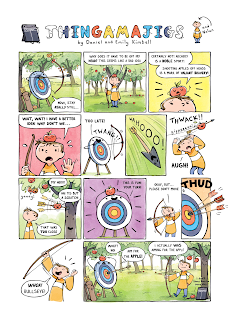
Thingamajigs, by Daniel and Emily Kimbell

The last time I was visiting my grandchildren, I came across a comic strip they were looking at called 'Thingamajigs' by Daniel and Emily Kimbell. The strip appears in 'The Phoenix' comic and in it characters are animated versions of everyday objects. 

From: 'Thingamajigs'

I was fascinated to read a comic whereby my thoughts on animist practices were being played out as children's entertainment. The use of anthropomorphism, the act of attributing human characteristics to nonhuman things, such as animals or inanimate objects, is an old one, and it has been revived for each generation in slightly different ways. 

The Thingamajigs' comic strip

In my day I first encountered human attributes in non human form in Walt Disney's 'Fantasia', which was already over 10 years old by the time I first saw it in the 1950s. 

From 'Fantasia'

In the scene above a flower becomes a swirling ballet dancer, spot-lit in the dark as if on stage. Also in Walt Disney's 'Fantasia', Micky Mouse, another product of anthropomorphism, is seen in action as the Sorcerer's Apprentice, a 20th century version of an 18th century tale. 

From: The Sorcerer's Apprentice

In the animated cartoon, Micky is seen giving life to a cleaning brush, that he then directs to carry buckets of water for him.  The film was in turn based on a poem by Goethe, written in 1797.  The poem tells the tale of an old sorcerer leaving his apprentice with cleaning chores to do. Tired of fetching water in buckets, the apprentice then enchants a broom to do the work for him, using magic that he cant really control. The apprentice soon realises he cannot stop the broom because he does not know the right spell with which to stop it. The apprentice tries to stop the broom by attacking it with an axe, but each piece chopped off then becomes a whole new broom that takes up a pail and continues fetching water, but now at twice the speed. The entire room then begins to flood, but when all seems lost, the old sorcerer returns and quickly breaks the spell. This story is in turn based on one written 2,000 years earlier by Lucian. In the story, 'Philopseudḗs', literally, 'Lover of lies', the narrator, Tychiades, visits the house of a sick and elderly friend, Eucrates, where he has an argument about the reality of the supernatural. Eucrates and several other visitors tell various tales, intended to convince him that supernatural phenomena are real. Each story in turn is either rebutted or ridiculed by Tychiades. In this Greek version, the sorcerer is an Egyptian mystic and Eucrates his companion has learnt the spell for animating the inanimate by eavesdropping, but the basic structure of the story is the same. 

This magic is concerned with the transfer or release of 'Élan vital', the vital life that Bergson argued was within all things not just the biologically active. The Animation Spell is in many fictional stories, a spell that enables sorcerers and sorceresses to bring any object to life.

Another story from my childhood whereby things were given human attributes was the fable of the North wind and the sun. This was one of Aesop's Fables, whereby persuasion triumphs over force. In the fable the sun and the wind argue over who can get the coat off a young man, the wind of course tries to blow it off, but the young man simply wraps it closer and closer around himself the harder and harder the wind blows. The sun and the wind cannot begin to argue with each other, unless we give them the power to do this, and I in turn would argue, as we do this, we release the mystical power of anthropomorphism.

The sun raises the temperature and the boy takes his coat off

We are social beings, and therefore we spend a lot of time building up connections between other people. This quality depends on trusting that others might in many ways act and think in a similar way to ourselves. But we do have to 'trust' in others, as we have no way of knowing what goes on inside other people's heads. This 'trust' can also lead to the anthropomorphising of non-humans. Just as we assume that other people are going to join in with us in the game of life, we can also have a belief that non humans might be able to operate in the same way. We give our pets internal voices, we talk to them as if we expect them to understand what we are saying. We also do this with inanimate objects; we implore our car to keep going, even though we know it can't hear us; we put trust in old tools and talk to them as if we were working with a dear friend. We attribute human-like qualities to inanimate objects, animals as well as our environments and the wider landscapes we inhabit. This can help us feel as if we are better able to understand and relate to the world around us. We are in effect always trying to socialise our experience, because being alone and unconnected to others is for a social animal a terrible thing. This way of understanding the world is something other social animals also possess. Young chimpanzees often carry around sticks and seem to play with them as if the sticks were other small chimps. This stick-carrying is a playful expression of cognitive abilities found in both chimps and humans, but in order for it to be meaningful there needs to be a capacity for imagination, or forming a mental image that is not real but which nevertheless represents reality. Anthropomorphising may be something that improves our wellbeing by creating a sense of connectedness.

The Pont des Arts that stretches over the Seine in Paris has long being used for lovers' pledges made in the form of locks. It was here that attaching padlocks became synonymous with everlasting affection. It is as if the locks can lock in or hold onto the love between people. 

So many locks were attached to the bridge that eventually their weight brought a section down

The bridge is a testimony to the power of our ability to invest human meaning into objects and place externalised thoughts into inanimate things. It is now a very common ritual for couples from all over the world to declare their undying affection for one another by placing their initials on a padlock, fastening it to something and throwing the key away.

The practice has now entered the attentions of academia and it has been thoroughly researched and its history documented. An article in the Journal of Material Culture has traced the practice to a particular source. 

'It was not until the 2000s that the structural deposition of a padlock took on widespread romantic significance. The likeliest trigger was an Italian teenage romance novel: Federico Moccia’s (2006) Ho Voglia di Te (I Want You), a sequel to Tre Metri sopra il Cielo (Three Metres above the Sky), in which characters attach a padlock to a chain on the Ponte Milvio, Rome. ‘This is “the lover’s chain”’, explains Gin, the main female character. ‘You have to put a padlock on this chain, lock it and throw the key in the Tevere.’ ‘And then?’, Step, the male protagonist, asks. ‘You never break up.’1 Step obligingly attaches a padlock and deposits the key into the Tiber. The phenomenal success of these novels and subsequent films, in Italy and Spain, led to Moccia’s (primarily teenage) fans imitating the custom, in a form of imaginative play that sparked a transition from popular culture to popular custom. By 2007, an assemblage of love-locks was fully flourishing on the Ponte Milvio, and tourists so readily adopted the practice that it became predominantly a tourist practice (Houlbrook, 2021).

From: 
Houlbrook, C. and Parker, A. (2020) Finding love: The materialities of love-locks and geocaches: The Journal of Material Culture: September: Volume 26 Issue 1

It is interesting therefore to find the same type of locks attached to contemporary Voodoo figures and African fetishes.


Mpungu figure. The Tervuren Museum

A contemporary ritual figure recently found being used in the 
Zaïre area, is locally called a mpungu, and is used by a nkanu or spirit worker to ward off evil forces. The object was collected recently from the frontier region between Lower Zaïre and Bandundu, near Angola. Padlocks accompany cloth, iron, cowries, herbs and mirrors. The figure was used to protect its owner from spells, curses or other maledictions. The padlocks and knots being symbolic barriers, barring all psychic routes to the owner and diverting or confusing the enemy. 

In both cases, whether affirmations of love or ritual protection, inanimate objects are invested with psychic agency. Proof for myself that the making of art is somehow deeply interconnected to our need to use inanimate objects as intermediaries between the everyday and an invisible spiritual world. 


Votive objects designed to deflect pain

From: Immaterial Disarray

The (im)Material Disarray exhibition gave me an opportunity to develop these ideas more fully and for the first time I was consciously trying to make objects that were animist in intent. These concerns were then developed further in the short story, 'Nest'. 

An earlier post on why I have been making animist images focused on my use of a boyhood relationship with a Sooty puppet, but I'm now concerned to find more universal forms that can have a similar agency, so have been looking at ancient religious forms, especially those associated with 'magic'. For instance, the ancient Mesopotamians performed magical rituals to purify themselves of sins committed unknowingly. One such ritual was known as the Šurpu or "Burning", in which the caster of the spell would transfer the guilt for all their misdeeds into various objects such as a strip of dates, an onion or a tuft of wool. The person would then burn the objects and thereby purify themselves of all the sins that they might have unknowingly committed. It is the transfer of sins into inanimate objects, and the fact that once externalised they can be removed, that fascinates me and helps in the shaping of the wellbeing potential of the objects I have been making.

Ritual objects based on scorpions from pre dynastic Egypt

The objects above were used to help overcome pain. Because a scorpion had a sting in the tail, it could symbolise pain. It could also be used as part of a sympathetic magic ritual. The objects I have made allude to this, but I have also upped the intensity of the colour, making it 'more painful'.  

'Thingamajigs' is a word that sits in my mind not that far away from the word 'tranculments'. Tranculments are things that we collect around us, like ornaments and the bric a brac that sort of mounts up gradually around the house, things that sit on top of furniture, that cluster around shelves and is a Black Country word from my youth, a word I got to know because we had a lot of tranculments in our house. We had horse brasses, ceramic Goss crested ware that consisted of souvenirs from seaside towns we had been to, Wade models of tiny dogs, Capodimonte figures and similar sorts of things such as framed sets of cigarette cards. 

Horse brasses

Goss Crested Ware

Wade figurines

Capodimonte

Cigarette Card

I now find these things full of psychic energy and if I come across them in junk shops they talk to me with Black Country accented whispers. I now associate these things with my long dead parents, who collected them I believed at the time, as some sort of protection from the reality of life. 

Perhaps my then intuition was not too far away from the truth. Perhaps these objects did have some sort of magical aura that blessed the house and protected those within it from harm. I spent many hours cleaning them, ritually laying them out on newspaper sheets on a Sunday morning and washing and polishing them so that they never became drab or dusty. Originally horse brasses had been used as charms or amulets to ward off evil and to bring good luck. In my parents' house they were hung on walls instead of on horses, but something of their original purpose somehow remained and worked to ward off evil, whatever that might consist of. When I was designing charms, I had these sorts of things in the back of my mind, the design below of a charm to ward off foot pain, is in effect similar to a horse brass.

Metal low relief foot charm used to ward off bunion pain
See also: 


Friday, 13 January 2023

Fuseli and the Modern Woman

An intriguing exhibition has just finished at the Courtauld's Denise Coates Exhibition Galleries. It focused on the period around the 1790s when the artist Fuseli was making private drawings of what were thought of at the time as 'modern women'. What is fascinating about the drawings is the fusion between reality and fantasy. The observed realities of what was then contemporary fashion, especially hair styles, are suffused with his elaborated fantasies and as he draws they become fetishes. These women are powerful and the drawings suggest that Fuseli had anxieties about gender, identity and sexuality at a time of acute social instability.  This was also the time of the French Revolution, a period where so many ideas that had been unquestioned for many years were being thrown up into the air and effectively ripped apart by what was going on in France. The exhibition, 'Fuseli and the Modern Woman: Fashion, Fantasy, Fetishism', presented a series of drawings I'd never seen before and it helped me to think about a range of issues in relation to image making, in particular the depiction of repressed sexual desire, how to harness difficult psychological energy and how to represent the mythic subconscious in everyday situations. 
Here are a few of the drawings that were shown


I found myself thinking about these head adornments as being similar to those developed by dinosaurs. It has been argued that some dinosaur head extensions, such as those belonging to the parasaurolophus below, were used as sexual attractors. These 18th century drawings feel as if they too represent extinct creatures; unearthed 'creepy' humanoids from an old 'B' movie.

Parasaurolophus


Stegoceras 

The woman sitting reading above is like a member of the Stegoceras family, human invention echoing nature, which is no real surprise as we are as natural as the dinosaurs. 


Triceratops 

Like the triceratops these head growths suggest aggressive defence mechanisms, these are not passive adornments, they are carried with pride. Fuseli's idea of women is a strange one, they exist for him as creatures from another world, some operating as witches or enchantresses; evil beings from midnight fantasies. Apparently his affections were rejected by his first true love, perhaps these drawings are his revenge.


Fuseli: The witch and the mandrake

The mandrake

Because it is a hallucinogenic the mandrake was thought to have magical power and that it was often found in a witch's herbal collection, whereby it was used to heighten and elicit supernatural sexual perversions. It was well known that Joan of Arc at her trial was accused of carrying a mandrake root and this was seen as clear evidence of her witchcraft. Fuseli seems to be both excited and repulsed by these associations. 

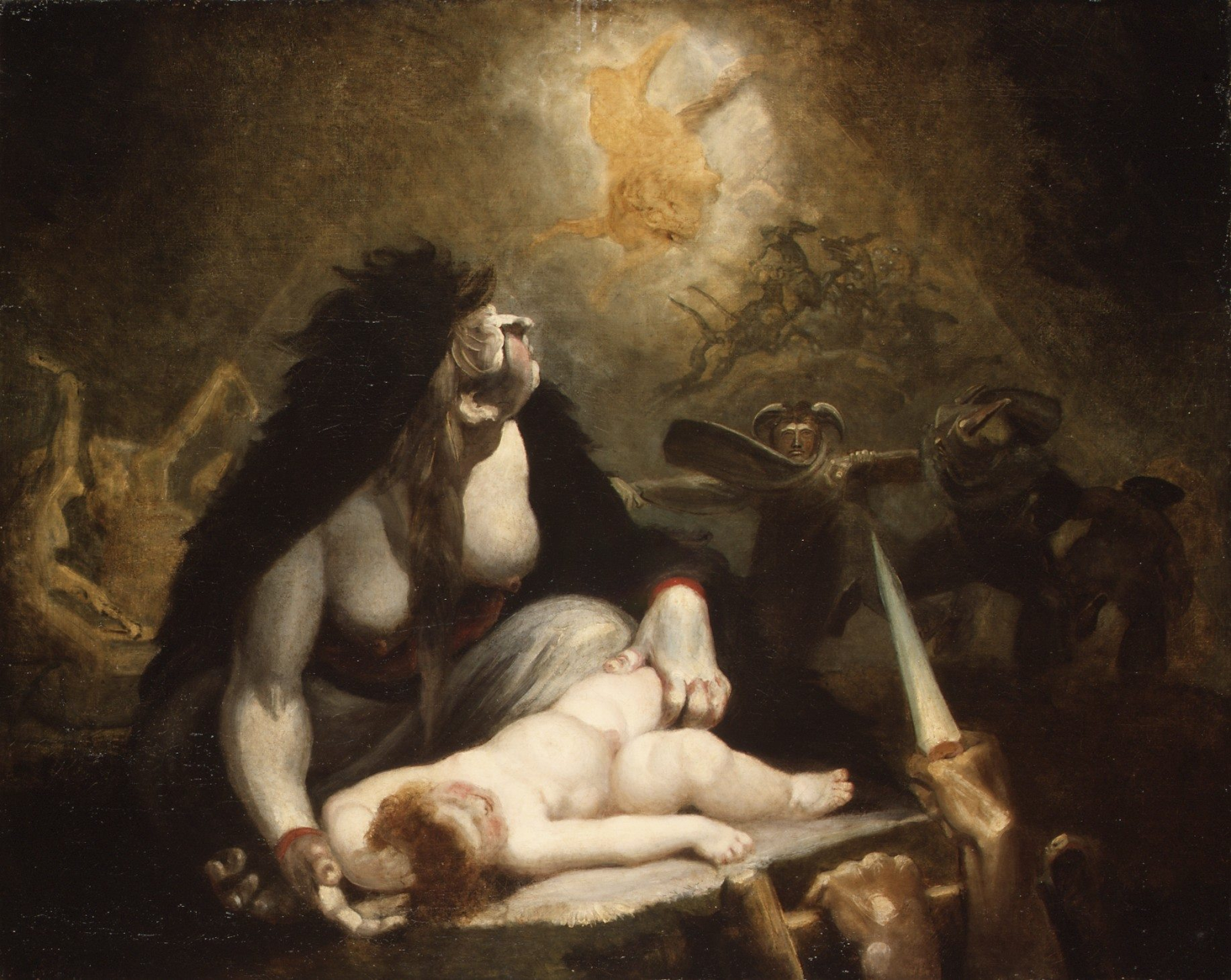
Henry Fuseli: The Night-Hag Visiting Lapland Witches 1796

In the painting above, Fuseli is illustrating Milton's text 'Paradise Lost where Milton compares the Hellhounds surrounding Sin to those who "follow the night-hag when, called, / In secret, riding through the air she comes, Lured with the smell of infant blood, to dance / With Lapland witches, while the labouring moon Eclipses at their charms." These nightmare visions were what Fuseli was famous for, his painting 'Nightmare' in particular brought him much fame and he painted several versions of it. 
Fuseli: Nightmare

You could argue that Fuseli was providing the equivalent of the Hammer Horror experience of his day. 

Publicity still: Kiss of the Vampire


Men's wigs: 18th Century

It is important to remember that men as well as women in the 18th century wore very elaborate wigs

Two high hairstyles, the right à la candor or the charm of innocence, 1778


Detail

At times Fuseli's fantasies seem to become even more overt, this particular head covering could be female genitalia. A subject dealt with much more openly by Anna Kiosse in her illustrations. 

Anna Kiosse: Women's genitalia 

Freud would have had a field day with these images. The head and the penis being something that he wrote about as being subconsciously linked. Marcus Grantham, a Freudian psychologist used Freud's ideas to develop his very questionable paper, 'The Sexual Symbolism of Hats' and when you look at wigs you can see that they could easily become part of this collective subgroup of erotic garments. Freud, in the 'Interpretation of Dreams' when writing about the sexual symbolism of hats in dreams stated, 'A woman's hat can very often be interpreted with certainty as a genital organ, and, moreover, as a man's.' So now we have a more complicated reading to consider. These complex constructions like a flowerhead, having both male and female elements. 


Diagram of a flowerhead with male (anthers and pollen) and female (ovary and ovules) aspects


The giant hairpin that is pushed through the top of this hair construction, operates as a sharp reminder of the nature of body piercing. The role of the helmet that Marcus Grantham develops in his Sexual Symbolism of Hats, now being very easy to understand. 


Piercing used to heighten religious ecstasy 

St. Sebastian: Giovanni Antonio Bazzi

Every pierced male member is in symbolic affect a martyrdom. The subconscious desires that are often associated with Saint Sebastian, revealing a psychological sexual ambiguity that lies at the heart of this narrative. 
Freudian psychology is though rather unfashionable at the moment, as Freud is regarded as yet another white, male, middle class privileged European, who analysed the world in terms of his own viewpoint. Witness Paul B. Preciado's address to the École de la Cause Freudienne’s annual conference in Paris. Preciado pointed out the discipline’s complicity with the ideologies of sex, gender and sexual difference dating back to the colonial era and of course as the speech was delivered Preciado was heckled and booed and was unable to finish what was later published as 'Can the Monster Speak?'. All of which is a rich mix of imagery and as this is art, there is no need to decide what it all means. We can though explore how all of these likenesses or connections can become the soil out of which we can grow metaphors. One of the areas we will be looking at as part of the next module will be the central role of visual metaphors in the establishment of meaning. Metaphor is not concerned with what is a right or true reading, it opens out images into alternative territories and as it does so helps us to cope with the ambiguity of life and reconciles differences. In this case looking beyond Fuseli's misogynistic views and trying to understand and find a use for his images within a more inclusive understanding of what might have been going on in his head. 
Every age has its own readings of what went on before and these drawings have become what are sometimes called, 'free floating signifiers', i.e. we can make of them what we wish. This of course gives us the freedom to visit other forgotten images of past times and opens a door to a way of making new work by revisiting old work. 

References

Beyer, J., Fend, M., Gottardo, K. (2022) Fuseli and the Modern Woman: Fashion, Fantasy, Fetishism London: Courtauld

Freud, S. (2010) The Interpretation of Dreams London: Basic Books

Grantham, M. (1949). The Sexual Symbolism of Hats. American Imago6(4), 281-295.

Knell, R. J., & Sampson, S. D. (2011). Bizarre structures in dinosaurs: species recognition or sexual selection? A response to Padian and Horner. Journal of Zoology283, 18-22.

Preciado, P (2021) Can the Monster Speak? Report to an Academy of Psychoanalysts Barcelona: Fitzcarraldo Editions

See also: