Showing posts with label image making. Show all posts

Friday, 10 November 2023

The drawings of Henri Michaux

Henri Michaux: Visage

Every now and again a particular artist re-emerges as being of vital importance to me and because of my interest in visualising the body, by combining the visualisation of inner and outer perceptual experiences, the frottages and drawings of Henri Michaux have come back into focus. I was reminded of his work by a reviewer of a paper I had submitted about my own drawings, the reviewer pointed out that Michaux had explored a similar territory many years before and that I had not referred to this. Sometimes reviewers pick up things that really make you think again and in this case I must admit I realised I had not really thought through certain aspects of what I was writing about and that the paper I had submitted did indeed need some serious revision. Probably the most serious error I had made though, was that some of the particular issues I should have picked out in the paper were ones I had written about before and I had simply left them out, my mind having a 'been there, written about that' response, forgetting that I am probably the only other person to have read what I was thinking about before, and that without some precise information about how drawing can solve certain problems, the writing didn't really make sense. 

Henri Michaux: Visage

I mentioned Michaux's work in conjunction with Unica Zurn a few months ago, but he is well worth looking at as an artist in his own right. 


Henri Michaux: images

Michaux became famous for taking mescaline but his drawings were never done under the influence of the drug, in fact he said that drawing was impossible whilst under its influence. However the visions he had of the mind working, were strong and they directly influenced his approach to image finding. His idea, of finding images in the process of making a drawing is not new, but his particular take on the idea was that he was finding out about the structure of the brain itself. This has helped myself when working to sometimes just let images become what they need to be, to allow them to emerge and in that process to look for a synergy with my own inner body language, the language of feeling tone, of stomach ache and backache, of inner excitement, of breathing in and out, of feeling fine or feeling down, all perceivable embodied moments, that can be thought of as interoception. I've also now re-written that paper, 'Drawing the embodied mind' and it is available in edition 5 of the magazine PSIAX. 

The Silence of the World: Henri Michaux

The Silence of the world is one of Michaux's hallucinatory representations of faces. A half remembered image perhaps from a book on pre-history, from a police forensic investigation file or a 1950s pulp science fiction comic. It sits between readings, half a face, a single tooth protruding, as in an old battle weary smilodon. There is something about Michaux's images that take me back into the world of the half seen, half dreamed, remembered something that sits on the edge between perception and reverie. His images enter the world of magic via an oblique direction, they find their way into our brains via the root of the fetish, and engage us as awkward strangers do. 
Perhaps above all Michaux's work reminds me that you need to tune yourself into the world of things that are 'other' than yourself, if you are ever as an artist to find those images that surprise you, that come from nowhere but somewhere. If I could tap into the logic of an apple, or think with the brain of a crystal or smell with the nose of a dog, then perhaps I would be able to draw with the eyes of a bacteria. 

Reference

Barker, G. (2021). Drawing the Embodied Mind: A Project Report on Research Into Interoception. PSIAX #5 ESTUDOS E REFLEXÕES SOBRE DESENHO E IMAGEM, 5. pp. 17-24. ISSN 1647-8045.

See also:

Tuesday, 3 October 2023

Visual onomatopoeia and image making

In a hybrid comic language, shapes and line quality can represent emotional thought

In verbal language we sometimes use words to sound like the things that they represent, such as the word sizzle, which sounds like something frying on a stove. Some words that do this connect one sort of sound with another; for instance 'psithurism', the sound of rustling leaves, is also imitative but in being derived from the Greek 'psithuros', links a natural sound to the very human act of whispering and its various associations such as slanderous talk. This is why the word 'susurrous' can be applied to both whispering or rustling; we can have both a quiet susurrous wind passing through the trees, and a susurrous whisper going around the room. The technical term for this use of words is 'onomatopoeia' which is defined as the formation of a word from a sound associated with what is named. These types of associations are useful as they remind us that languages evolve, often beginning with some sort of likeness but gradually evolving until the reason for something being called something has been lost and it is now a learnt convention. Also of course this issue reminds us of media specificity, the carrier of all these noise experiences are sound waves and the receivers are our ears and our tongues, lips and throats are used to make sounds and transmit them. Once the idea was developed that we could record  sounds made by our mouths as pictograms and other forms of writing, vision came into the frame, something carried by light waves and then received via the mechanisms of eyes; this move being it could be argued, the first trans-media idea, whereby forms initially developed in one medium, (sound) are translated into another (vision). Our present culture is however a fast changing one, and because we are constantly having to respond to new media, transmedia narratives are becoming the norm, see, we might encounter a story first of all in a written form, then perhaps as a comic, a film and then as a computer game or as a virtual reality experience. 

The image that opens this post is one that sits between the conventions of a written textual language and those of a particular visual language. (The comic book convention). The shapes are attempts to find visual equivalents to certain feelings. 'Like' in this instance is quite complex, for instance what is the image enclosed within the top righthand speech bubble meant to represent? Confusion, frustration or possibly anger? How can an image represent these things? If it is 'like' a certain feeling, for instance the depiction of icicles around the edges of a speech bubble, to suggest a cold or frosty attitude, could this be seen as a type of visual onomatopoeia?

Objects that are representations of things often partake in what I would call, visual onomatopoeia. We find certain similarities in the materials we use to make the images that echo or reflect something of the quality of the thing represented. 

A cloud made of cotton wool

A cloud made of cotton wool is an obvious example. A more subtle use of materials but still relying on an illusionistic visual link between surfaces, is the 'Bag of Aspirations' by Kalliopi Lemos, a sculpture on exhibition at the moment at the Yorkshire Sculpture Park. In this case a visual similarity between worn leather and rusting steel is used. Due to the huge size of the handbag, you need to step away from it to get an impression of it as a whole. As you do this the surface looks very leather-like, but as you get up close it becomes obvious that the surface is made of rusted metal. 

'Bag of Aspirations' by Kalliopi Lemos

The 'Bag of Aspirations' has both a texture that is implied but not real, as well as a real texture that can be touched physically. This is of course often the case with drawings. 

Tanya Wood: Unwrapped foil: pencil on paper

Tanya Wood's drawing '
Unwrapped foil' is made of graphite on paper, when looked at from a distance it has the illusion of being foil, but when you get up close and examine the surface it is possible to see that it is made of pencil marks. This illusion is so common that we forget how magical it is. But it is also metaphorical, we stand back from the world in order to 'see' it more clearly, but we go in close and examine it in order to see what it is made of.

Another approach might be to use metal-point to draw objects that have a tarnished metal finish. Brass for instance has a golden shine on application, but it quickly tarnishes and begins to adopt a somewhat greenish hue over time. You could use it to represent old bronze that also tarnishes into a green finish. Metalpoint drawings often use the nature of metal tarnishing to achieve effects and you only achieve the full effect of the drawing by leaving it to 'rust' over time. However if you want a golden shine in a metalpoint drawing, gold is still the only option, as it does not tarnish. Gold, if used selectively, like in the drawing immediately below, can suggest the opulence of a particular surface, and you can contrast its never changing gleam, with the dull reality of other forms of tarnishing material, or make a contrast with the fast changing very transient mortal fleshy surfaces of human beings, which can be represented in less honorific materials. Gold often represents itself, gold paint representing gold cloth or a golden object but it is probably more often associated with the representation of concepts of purity, concepts that go beyond the earthly material world and that aspire to heavenly things. An angel or saint's golden halo is a reminder that this individual is not of this world.

Drawing with gold leaf: Stephanie Rew

Golden halo

Velasquez 

Velasquez is a fantastic painter of surface textures, he can make oil paint look like metals or ceramics. He follows on from a tradition begun by artists such as Van Eyck, who realised very early on that you could make oil paint appear to be almost anything you wanted. As a medium it was so flexible that it could be manipulated in seemingly endless ways, as well as of course always being a real texture which revealed itself to you if you could get close enough. 

Detail of Rembrandt: Man with a golden helmet

What am I really thinking about here? I suppose its the way that cutting edge representational image making is an invented language that often works alongside and adds to a conventional one. Artists are aware of the need to keep trying out new ways to use materials to represent what they see, just as speakers need to try out new combinations of words when describing things. A good wordsmith will find ways of putting existing words together to re-think how to describe something, a good drawer or painter will not only use existing ways of making marks, but can add to the possibilities of representation by making newly minted marks out of whatever materials are available. Part of this process is a search for possible correlations between the materials being used and the things being represented. This does seem pretty obvious now I've written it down but sometimes its worth stating the obvious just to make sure everyone is on the same playing field. However the obvious often slides into the mysterious and representation and likeness can become the starting points for a type of sympathetic magic. In a poem you can put words together to achieve a 'sound' in the head that supports the idea in the poem, in such a way that the events seem inevitable. For instance in 'Oh what is that sound?' W H Auden drums up a word storm that suggests the forever onwards march of soldiers that will eventually make their way to your door.

O what is that sound which so thrills the ear
Down in the valley drumming, drumming?
Only the scarlet soldiers, dear,
The soldiers coming.

until of course...

O it's broken the lock and splintered the door,
O it's the gate where they're turning, turning;
Their boots are heavy on the floor
And their eyes are burning.

This is beyond onomatopoeia but sound is still connected via a likeness that arrives via the incessant rhythm that echoes the footfall of a marching troop of men. You can imagine a magical incantation taking on a similar form. The Sumerians were very into magic and they were the first culture to recognise how a certain set of sounds could infect behaviour within a whole language culture and they had a name for it, a ‘nam-shub’. For instance newspapers such as the Daily Mail or the Sun use phrases like 'The swarm on our streets', (The Mail) or 'Jezza's Jihadi comrades' (The Sun) to infect everyday speech in the UK. 

At the side of my bed is a book of drawings by Graham Sutherland, an artist I hadn't thought about much since I was at school, but like any art worth its salt when you look at it again after a long time it still has something to tell you. I had found an old copy of his 'Wartime Drawings' in the Leeds City Art Library. (Leeds is a wonderful city if you are interested in studying art because it has several specialist art libraries; the central library has an art library annexed to the city art gallery, the Henry Moore Centre has a library dedicated to the study of sculpture, the two main universities both have dedicated art and design sections within their libraries, and the Leeds Arts University has two specialist art and design libraries, as well as a very good collection of artists' books). 

Looking at these drawings reminded me that it is very hard to remain inventive and that artists need exposure to changing subject matter in order to evolve their visual languages. The war had forced Sutherland to expose himself to new subjects and as he faced them he was forced to up his inventive game and go beyond his previous sets of mark languages. However he was still recognisably making 'Sutherland' type marks. Because artists have particular sensibilities, some subjects are more suitable for personal language development than others and Sutherland was very careful to choose experiences that reflected his particular sensibility.

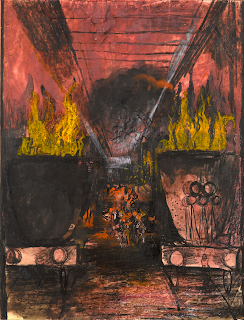
Teeming Pit: Graham Sutherland: Sometime during the period 1940/44

During the second world war, Sutherland was sent down mines and into steelworks, in order to record the way the nation's workers were as much a part of the war effort as the troops on the front line. His previous work had a very rural sensibility, he had already developed a visual language, in particular using etching's ability to render texture, to represent an idea of England as a mythic landscape that still held within itself echoes of Samuel Palmer's visionary fervour and spiritual intensity. Sutherland had been attempting to re-channel the William Blake sensibilities of ‘the Ancients’ and had tried to revisit an idea that was central to English Visionary art, but the exposure to new themes helped him to reconfigure this language, so that it could deal with the harsh realities of the 20th century. 

Graham Sutherland: Etching: Mid to late 1920s

Feeding a steel furnace: Graham Sutherland 1941

Tapping a blast furnace: Graham Sutherland 1942

What is going on here is another aspect of representation. Not only is the artist attempting to use the language of mark making to represent how the world looks, but he is attempting to at the same time represent something about how the world feels. This is of course what we normally call 'expressionism' and it has its roots in artists like Van Gogh or if we want to go further back in time, in the spiritual expressive language of El Greco or the dramatic lighting of Caravaggio used to build an audience captivating Christian drama as Catholicism began the fight back against the Protestant reformation. ElGreco in particular finds a language that is both expressive and mystical. 
El Greco

So is there a visual onomatopoeia of feeling? Is a gentle curve representative of a calm feeling tone? Is a sharply angled zig-zag representative of a more manic state of mind? In my own work trying to find ways of representing the unseen world of interoception, I have had to explore a wide range of marks and colours and have tested them out on various people, however I have yet to establish a firm foundation on which to build a dictionary of correlations between what is felt and what is represented. 

Old knees in pain

Old knees in pain (Alternative colour version)

Some people will point to the upper image as being more painful, others to the lower one. I have myself decided upon the upper image. The blues for myself suggest a cooling down of the pain, but on the other hand the brittleness of ice is suggested by the lower image and some people find this more appropriate. The complexity of representing feeling tone is complicated and I suspect never ending, which is why it is interesting.

We can also use a material to carry a message by its conjunction with what is being represented and where the material is derived from, which is a more logical process. The process involves a sort of visual etymology, whereby you choose a material because of its past associations. In the case of the drawings in watercolour below, the images are made from pigments that have been sourced from polluted rivers and the images are of children who live on the banks of the rivers that these waters flow through.

Luigi Almuena

John Carlo Vargas

Dirty watercolour: an awareness raising project

The artists Toti Cerda, John Carlo Vargas, Kean Barrameda, Fred Failano, Allan Clerigo, Van Isunza, Luigi Almuena, Renee Ysabelle Jose, and John Ed De Vera all painted watercolour images using pigments derived from filthy, polluted water collected from the almost-dead estuaries of Manila. The water was so toxic that before being used, it had to be decontaminated and the watercolorists had to protect themselves from the stench by using face masks.
When we define etymology, we are looking at the origin of a word, in this case of etymological image making we are looking at the origin of the materials used to make the images. Perhaps I'm stretching my association with visual onomatopoeia too far here, but on the other hand this blog is not about logical thinking and analysis, its more a record of a mind drifting around a subject, which is more to do with art than science or logic. 

Visual onomatopoeia also like colour, exists at different levels of saturation. The cotton wool cloud you could say bears an almost one to one, or full saturation visual correspondence with a real cloud, to the extent that you might mistake it for an actual cloud. However just as the sound of the word 'BARK' is sort of like the sound a dog makes, you would rarely mistake someone reading it out loud for an actual dog barking. If you look at the chart of architectural symbols used for materials below, you can see a degree of resemblance between these pen and ink drawings and the materials they stand for, but you would never mistake these images for the actual materials, you could say they have a low saturation of resemblance.


This degree of similarity is though very important. It allows the drawer to represent a quality in such a way that there is enough visual connection with the actual material quality, that enables you as a visual reader, to pick one thing out from another. You can then not just establish differences based on these likenesses, you can begin to learn a new language. The jaggedness of the metal image is more metal like than the granular quality of the image that represents sand. For an architect this is clearly an important way to add information about materials to a technical drawing and other architects can learn this language by using an associated key of material symbols. 

Sometimes a naturally occurring form may possess a very close visual relationship with something else. In the case of the red hot poker flower, the property it visually recreates for our eyes is one of being red hot in the form of a glowing metal poker. 

A red hot poker

To give a popular name, 'the red hot poker', to a plant, is a uniquely human thing to do. But the visual aping of one thing by another is not a purely human concern. The ophrys apifera or bee orchid, has evolved to look almost exactly like a bee. Nature has I believe, made a drawing of a bee shape over millions of years. Countless small touches or marks are made as one flower received more visits than another from a certain type of bee, until the day when one particular orchid had the perfect flower to attract a male bee and so became the template for many more to follow. This feels to me as proof that visual onomatopoeia is simply a process that is used within natural selection as part of life's survival game.

The bee orchid

Once again I begin to question the uniqueness of human invention. Perhaps given a long enough timespan, invention might be seen as no different to the testing of permutations and their usefulness by nature itself, and as part of that nature, we simply inherit this as a natural consequence of being alive. 

Our interest in these things, (or at least mine), is rooted in the simple fact that one thing can be taken for another. We react to a mistaken identity in the same way that we react to the real thing. This situation also helps create a belief, one that has been written about extensively and that can be summed up by this statement; “That which is true of a thing is probably true of its like; the degree of probability depending upon the extent and thoroughness of the resemblance.” Richard Steel Imitation, or the Mimetic Force in Nature and Human Nature . Nature 63, 513 (1901).

This principle has been applied by many cultures and belief systems, not least those cultures that still use magic as a belief system. But it has also been thought about as a driver of new ideas. Adorno stated that 'art is magic delivered from the lie of being truth', he believed that as an alternative to everything else, as perhaps a last ditch approach, art could create insights and help change the world. Magic usually regarded as illusory, is liberated by him from the lie of deception, whilst simultaneously forsaking any claim to the truth, in this way art can work in the channels of false perception, but these are channels we know work and everyone has experienced false perceptions on which they have made decisions about actions to make. In fact Donald Trump has mastered the use of this magical art and has demonstrated that you can use it to shape the beliefs of millions of people. Magic operates because of a belief that everything is connected and that any one thing can have an effect on another, as long as there is an identified connection between them. Science however breaks things down in order to understand how things work, but in doing this sometimes it loses the narrative plot, the one that makes sense to many people. Art can be like magic, in that it's objects are full of meaning by association and art objects, like magical ones, (voodoo dolls etc.) are designed to effect other people at a distance. Magic can be used to channel energy and it can operate like a force field that can effect change at a distance. This is similar to the way an image can operate as a site of both energy exchange and as an externalised mind. 

A shaman depicted in an Algerian cave painting

The mushrooms sprouting from this ancient image suggest a human/fungal hybrid fusion, the psychic resonance of which can still be felt by modern observers when they come across the image for the first time.  

The Japanese language has many psychomimes, or words that act like onomatopoeia for emotions, thought processes or states of mind. It's use of sound symbolic or mimetic words, known in linguistics as ideophones, is much higher than in English, therefore I would suggest that as a people they are more aware of these issues. For instance, at all levels of Japanese society there appears to be a pronounced need to collectively gather into clubs or organised groups. Japanese schools host various clubs or “bukatsudo”. Participation is voluntary, not compulsory, however, most students belong to either a sports or culture focused club. Belonging to these clubs are seen as training for the companies students will eventually join when they enter the adult world and company loyalty is highly prized in the Japanese workforce. This loyalty extends to brands, all of which helps to construct social solidarity. Brands have visual identities and these are used to help build this type of loyalty.
This is though not something unique to Japanese culture, Steven Dubin states that 'social solidarity and group identity are not givens; at particular times they must be intentionally cultivated and concretely enacted'. He argues that 'visual onomatopoeia communicat
es through a close equivalence between a subject and its representation'. He goes on to show that it frames experience in a way that allows a group to see a form to which they may belong, something that perhaps before they had only 'vaguely conceptualized'. Group identity is not a given; it has to be intentionally cultivated and visual onomatopoeia can be used to collect large numbers of individuals together using group insignias, emblems, or other significant symbols. Thereby he argues visual onomatopoeia operates as both 'act and artifact'. It can also be a force that is used to build up false perceptions, or controlled perceptions, so that a group mentality can be forged by lies as much as truths.
The cap badge of Dudley Grammar School 1962

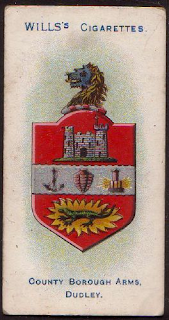
I can see how this works, and one of my earliest exposures to a series of images that were designed to foster a group identity was when I was at school. As a schoolboy I was taken through the various images that made up my cap badge, which were there to remind myself and all the other boys of how we collectively belonged both to the school and to the place we were born into. The representation of Dudley castle keep was a reminder of how the castle dominates the town and how it sits in the shadow of its history. The anchor and miner's Davy lamp signified the history of local industries, the anchor representing the iron and steel industry and the miner's lamp the limestone, coal and iron mines that honeycombed the ground underneath Dudley, and between them is a representation of a trilobite, a fossil animal commonly found in the limestone quarries and locally known as the "Dudley Bug" or "Dudley Locust". The salamander in flames is the traditional emblem of the smith or smith's forge. In European folk traditions, the salamander was regarded as invulnerable to fire and born from the flames; Leonardo stating that the salamander has... "no digestive organs, and gets no food but from the fire, in which it constantly renews its scaly skin". He goes on to state, "The salamander, which renews its scaly skin in the fire, (is known) for virtue." The lion's head is derived from the crest of the Earl of Dudley and the Earl of Dudley's steelworks was where I would begin my working career, initially as an apprentice overhead crane fitter. All of these images were woven into stories that were used to instil within us a pride in our backgrounds and to develop a sort of tribal loyalty. We were 'forged' from the flames of a Black Country furnace, we were cast like pig iron into shapes like anchors, and their chains, solid and dependable people. We emerged out of the ground, our bones were of limestone, coal and iron ore, we were the bedrock on which the industrial revolution was built and our history could be traced back as far as the time of the Silurian seas. 

It is easier to see what the individual elements of the Dudley arms are in this old cigarette card

I would argue that the  Algerian cave painting of a shaman is a direct ancestor of the image on my school cap and that hats in particular have been used as objects that can carry externalised ideas about tribal identity across many cultures and over vast periods of time. 

A while ago I was in the Ashmolean museum in Oxford and made a drawing of a hat or headpiece that took the form of an octopus/bear. Perhaps because of the way it was formally divided into segments I was also reminded of my school cap. A North American indigenous shaman artist had made a hat designed to channel both a bear and an octopus, their respective attributes no doubt at some point enshrined into stories that were designed to get the collective identity of a particular tribe clearly established. Perhaps the strength of the bear on land was to be coupled with the prowess of the octopus in water. 

Notebook page

Donald Trump has always been an instinctive user of these types of signs and symbols and he has created his Trump brand loyalty using a variety of images. For instance to become a member of the Trump tribe you need to get your official Trump card. The eagle with outstretched wings is a typical shamanistic image, tribe members being encouraged to think of themselves as being honest and true and that they follow a man who expresses majesty, strength, courage, wisdom, power and who stands for freedom. The image of the eagle is cleverly drawn, on the one hand the outstretched wings have been used as symbols of freedom, transcendence and purity, and on the other hand, the tips are drawn in such a way that they also subtly suggest fire.

The wingtip and fire

In Christianity, fire can be symbolic of religious zeal and martyrdom. In Egypt it represents a sense of superiority and control. Many cultures view fire as a symbol of wisdom and knowledge. All of these very positive and powerful aspects are suggested by the image used and they represent a hangover from much earlier animist practices, whereby we 'see' things more clearly when looked at through the eyes of something that isn't us. This doesn't mean that everyone understands these associations consciously, but they are there for stories to be wrapped around them, especially when there is a need to develop a narrative that people can belong to. A drawn image again becomes central to how symbols are used to help foster a sense of group belonging. The visual onomatopoeia here being both the flap of an eagle's wings and the flickering flame that burns up everything before it. 

See also:
Translation: Drawing between languages
Drawings as aesthetic transducers
Mimesis
The triangle
Up close and far away
Drawing to an end

Friday, 1 September 2023

Drawing and healing traditions


Wong-Baker faces are meant to be a very clear and useful guide for patients who are having trouble communicating levels of pain to their doctor or other relevant medical professionals. As they are drawings they are supposed to cut through verbal and written language problems and can be used by a wide range of ages and people of different cultural backgrounds. However I suspect they are as ridden with problems as any other supposedly 'objective' language and that what we regard as a fixed set of expressions are still prone to a wide range of interpretations by others. These faces are another example of atomisation, or a need to reduce complex reality to easily understood components. 

Another attempt to visualise pain is the Schmidt pain index,  which has four levels of pain and is targeted at insect bites.


From the Schmidt Pain Index

I have been trying to use drawing to visualise interoceptive experiences for the past three years and although some of the drawings seem to be communicative of basic feelings such as a pain in a particular place, I have been finding that it is very hard to reach a consensus of opinion in regards to more nuanced feelings. However this is perhaps a challenge rather than a disappointment, as it is obvious that we all inhabit very different internal imaginative worlds and therefore one person's image of pain is another person's image of excitement. 

The longer I work in this area the more I become aware of parallel developments in relation to visualised body images in other professions, in particular in psychotherapy. Psychotherapists use the term 'guided imagery' when referring to a situation whereby a patient is helped to recall images from long-term or short term memory. They also work with patients to create imagery from fantasy or to make them from a fusion between imagination and memory. Guided imagery is defined as 'the assisted simulation or re-creation of perceptual experience across sensory modalities'. (I.e. this is not restricted to vision alone)

The use of imagery has been central to world wide rehabilitation traditions and is a critical component of many healing experiences. When we investigate the roles played by the placebo, suggestion or faith in a recovery from illness, it is clear that as well as using modern medicine and its procedures, people often use both positive thoughts and particular imagery that can carry those thoughts, in order to help themselves recover from both mental and physical problems. Those that do, often recover much faster than those that don't. (Robson, 2022) My own work has resulted in a range of imagery that is mainly the product of self analysis, however I am very aware that when I have conducted workshops with other people the nature of the images produced keeps changing. 

In his article, 'Raising Pain Tolerance Using Guided Imagery', David Bresler points out that mental images are formed long before we learn to understand and use words. He states that they 'lie at the core of who we think we are, and what we believe the world is like', His article also raises awareness of how belief systems as a whole can be shaped by our mental images and that therefore they play a very powerful role in our ability to tolerate pain or heal ourselves when ill. He defines a mental image as 'a thought with sensory qualities' and then introduces various types of guided imagery as ways to put into effect an 'active imagination' whereby elements of the unconscious are invited to appear as images that can communicate with the conscious mind. He states that:

'if people can derive not only symptomatic relief, but actual physiologic healing in response     to treatments that primarily work through beliefs and attitudes about an imagined reality, then learning how to better mobilise and amplify this phenomenon in a purposeful, conscious way becomes an important, if not critical, area of investigation for modern medicine'. (Bresler, 2010)

Bresler points out that the body responds to imagery in the same way as any other external experience and in particular the autonomic nervous system easily understands and responds to the language of imagery. Therefore if you imagine you are very ill, or that your pain is hard to bear, you are very likely to find that you become very ill and that your pain will be hard to bear. 

It is Bresler's statement that 'elements of the unconscious are invited to appear as images that can communicate with the conscious mind', that really resonates with myself. This could be something stated by a Surrealist artist back in the 1930s and as I strongly believe that Surrealism is still and always has been, one of our most powerful visual thinking devices, is a central plank of my personal artistic manifesto. 

There is of course a dark side to this, the harsh reality is that the most common way that people develop imagery is by worrying. What we worry about is never happening in the real world, only in our imagination. In my case I have plantar fasciitis in my left foot and heel and I have to get on and do things like write this blog to distract myself from worrying about it and thinking that it will go on forever. The reality is that this is a temporary problem, but I can make it worse by worrying about it. As Bresler puts it, 'people in pain worry all the time. They worry that their pain will never end and that they will remain helplessly immobilised by something they cannot control and cannot endure. As a result, they usually have little difficulty describing an image of their pain at its very worst. Bresler quotes patients as describing their pain as being like, “a swarm of fire ants are chewing on the nerve”, or “a gigantic elephant is sitting on my chest.” If you worry about something its image becomes in effect sharper and more real, and then it can become a major focus of your life experience. In this case we need to beware of self-fulfilling prophecies, for images have the power to create their own reality in the body.  Bresler goes on to state, that if a person has developed really clear images of pain, these images can have profound physiological effects on them that can increase their experience of suffering and interfere with their body’s natural pain relieving abilities. So I have to be careful not to fall into this trap and to find ways of using images to guide myself and others away from wallowing in pain, and to instead provide the imaginative waters that will allow them to swim away from it. 

Getting rid of these images can be a powerful healing tool and this is where my experience of working with votives can make a difference. By making images of people's pain or problem and then ritually removing these pains by either breaking them, burying them, burning them or doing something focused on externalising the feeling that was put into the image, you are in effect also helping them resolve and perhaps remove their association with the 'real' pain or problem. For instance in one case someone I was working with imagined their cancer as a 'little man' that resided inside them, this 'person' was clinging on, and needed to be told to go. 

The 'little man'

Once visualised as an actual drawn and in this case a printed image, its reality was such that it began to overpower the previous mental image they had. The ritual process of tearing it in half and throwing the pieces away, helping to release the grip that a mental image had had on themselves and their own well being. If this area of visual thinking is to be of help to the wider disciplines of medicine and psychotherapy, then it will have to be capable of incorporating these sometimes quite difficult to visualise images that can arise from people's imaginative view of their inner feelings. This is a recognition that the subconscious workings of each person's own healing processes need to be supported and recognised if they are to access and utilise the insights, resources, and solutions that arise from their own interoceptive awareness.

If we are to develop a shared ‘visual’ vocabulary for symptoms and sensations of pain and other interoceptive sensations, we need to stockpile these various representations in order to see if there is indeed a common language or if there is not, to see if this image bank does at least help release the potential of others to visualise their interoceptive experiences. If so, because visual representations have the ability to communicate a wide array of feeling tones or intuited things more efficiently than verbal languages, especially in a situation where medical professionals are linguistically challenged, such as dealing with patients who have no or limited English; images can generate insights that otherwise might be missed and they may also develop possibilities for visually augmenting written information.

When making a more detailed analysis of the images produced, the fact that drawings are stable artefacts that can be returned to and examined in detail, means that we can use them to avoid the problems of image decay that is associated with any mental maintenance of an image in someone's head. 

This issue also relates to the fact that in workshops I have found that people are at their most inventive and sensitive during the first hour or so and that after that their awareness levels drop and very few new visual ideas emerge.  However the time spent in the later half of a workshop can instead be profitably spent adjusting the various images made during the first half of a session and exploring the various visual languages used, and most importantly to test out their communicative possibilities. 

However it is also important to remember that the use of this process in alleviating pain or helping people improve their existing condition, is often associated with using these images to externalise inner feelings and to in doing this help in the removal of these 'bad' feelings or thoughts. 

The drawings and objects made can help enormously in guided image meditation, giving people time to inspect the imagery, and to then move on to a transformation stage whereby they take control of the imagery in some way. 

Once generated and maintained, a mental image and associated drawing can be reflected on interpreted and its understanding transformed and a shift in perspective made. 

With the assistance of a guided imagery practitioner or in this case an artist, a participant can be helped to transform, modify, or alter the imagery, in such a way as to either substitute images that provoke negative feelings, or that reaffirm disability, for those that elicit positive emotion, or to even get rid of the negative imagery by doing something to it, such as breaking it or throwing it away. I.e. they begin to rewrite their own internal stories whilst keeping the essence of what their stories are about. These processes are similar to imagery restructuring or imagery re-scripting, (Holmes et al, 2007), all of which are about people taking control of their own journey. 

Through this process, people can hopefully change their relationship with the images that have been in the past indicative of the distressing, painful, or debilitative nature of a condition, and in taking control of the image making process or sharing it with someone else, develop their capacity for self determination and the ability to cope with life.

Helping people to use their own imagination in this interactive way maintains a focus on the depth of emotional feelings that are central to therapeutic growth. Working with another person that takes them seriously is a wonderful affirmation of them as individuals and by opening doors for them into how visual imagery can carry important information, it can also become a process that leads to the development of a new interest in art itself. 

These approaches acknowledge many other drawing and healing traditions, some of them being disciplines that are thousands of year old. 

Payne, Levine and Crane-Godreau, (2015) point out that somatic experiencing as an aspect of interoception, is a concept that is embedded into ancient embodied wisdom traditions and their more recent offshoots. Listing Yoga, T’ai Chi and Qigong, as well as the Alexander Technique and the Feldenkrais method. When drawing and making we use our bodies to externalise our thoughts and perhaps central to the awareness that we have of the relationship between the body and the mind, is the way we breathe. This connection with breathing can take us back to the traditions of the Ayurveda, considered by many scholars to be the oldest healing science. Ayurvedic healing traditions originated in India more than 5,000 years ago and recognised that mental and physical health come together and that their interrelationship is based on the need for regulated energy flow. This awareness of the deep interconnectivity of all these ideas takes my mind back to older posts, and I don't want to duplicate what I was thinking about then, but I do want to highlight ideas about the use of drawing or image making to externalise thought and how in that externalisation hopefully we are able to have some sort of control over things that might otherwise stay hidden and undermine us from within. 

However drawing and image making is not at its best when trying to illustrate a concept developed via academic research. The research can inform the background out of which an image may emerge but if the image is to be alive to its own emergence into being, it has to feed off whatever it is becoming and that means unpredictability and a certain amount of chaos is always embedded into the process. My own 'medical diagrams' tend to be records of conversations, such as the one immediately below which was made in conversation with someone who was dealing with tinnitus. 

Once the initial conversations have settled down and been assimilated into a visual language, final images become free floating and emerge as a product of their own internal necessity. The further away in time they are from the initial making process, the more I forget what they were initially a response to, and the more they become things in their own right. They operate as a type of animist extension of a thought, a thought that materialised itself and then went its own way. 


Various images that arrived out of a process of visualising interoceptual experiences

Bresler, D. (2010) Raising Pain Tolerance Using Guided ImageryThe Behavioural Medicine Report Dec 4th Available at: https://www.bmedreport.com/archives/18655

De Vignemont, F. (2010). Body schema and body image—Pros and cons. Neuropsychologia, 48(3), 669-680.

Holmes, E. A., Arntz, A., and Smucker, M. R., (2007) Imagery rescripting in cognitive behaviour therapy: Images, treatment techniques and outcomes. Journal of Behaviour Therapy and Experimental Psychiatry, Vol. 38, No. 4, pp. 297–305.

Kosslyn S.M., Ganis G., Thompson W.L. Neural foundations of imagery. Nature Reviews Neuroscience. Vol. 2, No. 9, 2001, pp. 635–642.

Payne, P., Levine, P.A. and Crane-Godreau, M.A., 2015. Somatic experiencing: using interoception and proprioception as core elements of trauma therapy. Frontiers in psychology6, p.93.

Pearson D.G. Mental imagery and creative thought. Proceedings of the British Academy. Vol. 147, 2007; pp. 187–212.

Robson, D. (2022) The Expectation Effect London: Cannongate

See also:

Minjeong An