Showing posts with label metamorphosis. Show all posts

Thursday, 12 September 2024

What it is to be human?

Lavinia Fontana, “Portrait of Antonietta Gonzalez” (c. 1595), oil on canvas

A hereditary condition known as generalised hypertrichosis terminalis, leads to a covering of fur over most of the body. If a human being has this, it usually triggers a reaction in others that suggests that in some way the person has regressed into being an animal. It is though of no harm to the person that has it and in certain cases, can be a help, as the extra hair still does the job that it was genetically evolved to do in the first place, which is mainly to keep an animal warm and to protect sensitive skin from the sun's rays.

Hair is something most of us have and only in rare cases is someone totally hairless. Like all hairy animals our hair takes certain directions over the body.

Human: Hair direction: Front and back
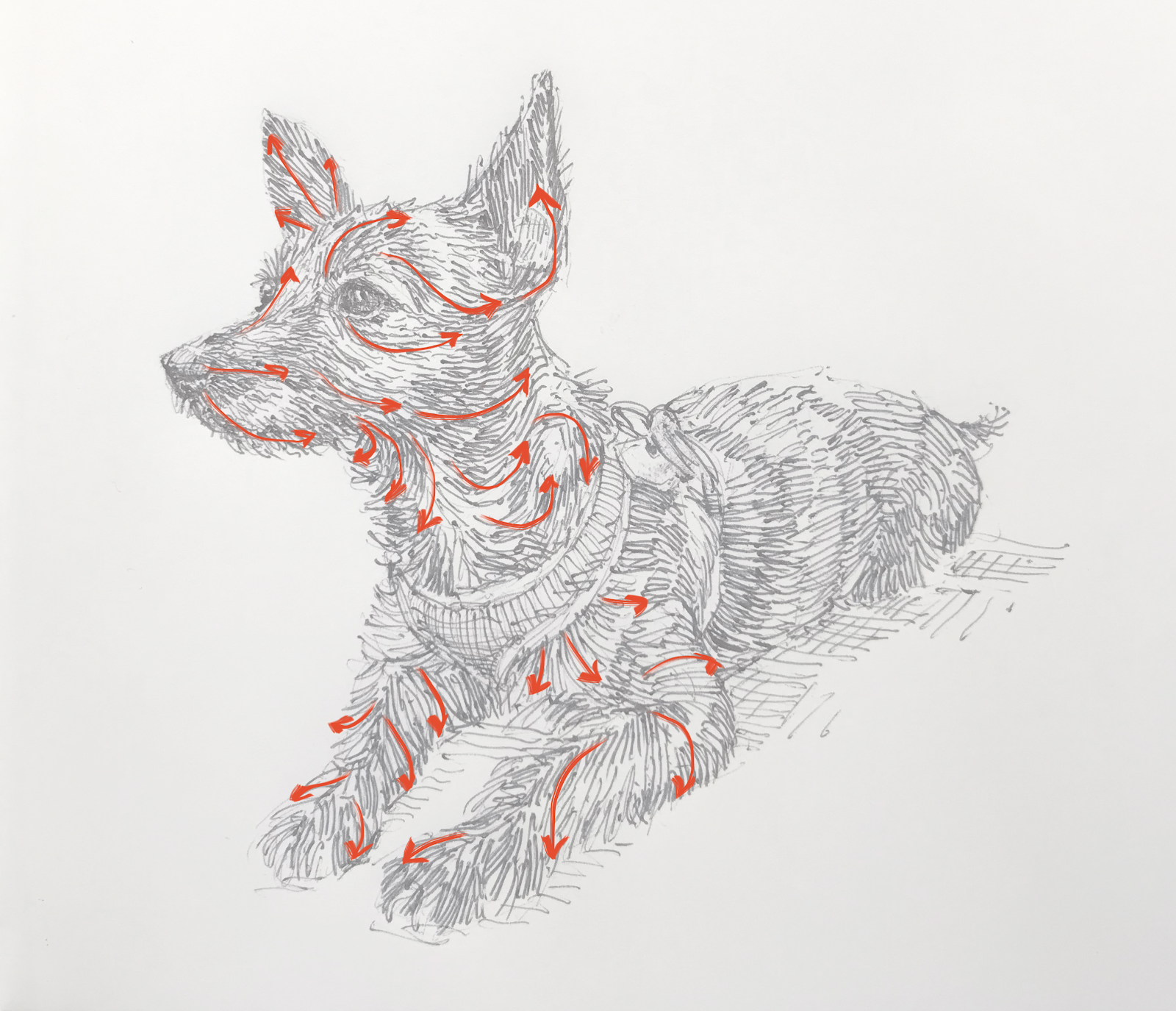
Dog: Hair direction

The fact that other hairy animals also have directional hair, is something we rarely think of as a common denominator but it is for my drawing self, interesting to think about hair direction as an example of visual energy moving around the body.

The visualisation of imagined interoceptual awareness of fur sensations

Thinking about commonality can also be an entry into animist thinking; for instance you might try to imagine what it would be like to live within a fur clad body. Body hair also provides tactile sensory input by transferring hair movement and vibration via the hair's shaft to sensory nerves within the skin. Therefore we can like other animals, extend our sense of touch beyond the surface of the skin, into the space surrounding us, by using hair to detect air currents, the presence of insects or the close proximity of objects. However the resultant perceptual stimulus and/or interoceptual feelings engendered, are rarely picked out as being important to us. But for many animals this group of senses is vital and being more aware of how they operate, might enable us to have more empathy with other creatures.
The hairs of the skin not only function to prevent heat loss but also have important sensory functions. Recent work has now established that each hair of the skin has one or more of three types of mechanoreceptor ending. Each of these three mechanoreceptor types can detect distinctive information about skin touch, which is relayed to specific brain locations in a somatotopic fashion. (Somatotopy is the precise mapping of body parts to specific areas of the brain.) My interest in interoception, has meant that I have also tried to imaginatively visualise the feeling in the body/brain of a passage of air over hairy skin and how that in itself can become another body part. Feelings, I strongly believe, can be concretised as images. The flowing, twisting sensations in the orange/black image above being my imaginative immersion into what it might feel like to be a sensing hirsute animal. 
Our intellectual history reflects the constructing of an ever widening distance between ourselves and our animal nature, something that we have recently had to question. The more we mentally separated ourselves from nature, the less we were concerned with having any sort of empathy with the natural world. Now that we are more aware of an 'embodied' mind, the recognition that the mind is in fact shaped by the body and is inseparable from it, the more we are also becoming aware that the body is itself shaped by and inseparable from the environment it inhabits. The mental separation of ourselves from nature, has historically led to a using of the world's resources, as if we had no moral responsibility for them. We were able to 'other' not only animals but any humans who did not look like or act like 'us' and as we did so, we also used these other humans as if they were animals or chattel. In the past we set up all sorts of intellectual constructs to help with this, to justify our ability to use anything to further our own ends.

Slave traders were enabled by church leaders who perversely interpreted the Bible in such a way that slavery could be understood as guiding other humans out of the darkness of their mistaken ways and into Christian salvation. The separation was such that other humans were even stuffed and displayed in a similar way to animals. Until recently for 40 pesetas you could still buy a postcard of a stuffed human.
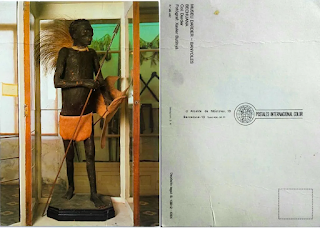
I wonder how the taxidermist thought of the task at hand when asked to work on preserving this 'specimen'? How did those theories of "scientific racism", such as the classification of people according to intellectual inferiority or superiority on the basis of skull measurements, affect the way that the taxidermist approached this task? Or perhaps the task was made easier because the taxidermist was Christian and he believed that his subject was a son of Ham? This idea had persisted for several hundred years, back in the 16th century, Gomes Eanes de Zurara, wrote that Africans were enslaved “because of the curse which, after the Deluge, Noah laid upon [Ham]… that his race should be subject to all the other races of the world”.

The Bible also of course had other things to say about this;

'And God said, Let us make man in our image, after our likeness: and let him have dominion over the fish of the sea, and over the fowl of the air, and over the cattle, and over all the earth, and over every creeping thing that creepeth upon the earth.

And God said, Behold, I have given you every herb bearing seed, which is upon the face of all the earth, and every tree, in the which is the fruit of a tree yielding seed; to you it shall be for meat.

Genesis 26 to 29

So we look like God, but who is the we? We are God faced. But what if God looked more like Fedor Adrianovich Jeftichew? What if the directional pattern of our hair was actually a sign from God? As an atheist my question is why is my hair directional, and what does this tell me about myself? It tells me that evolution is always ongoing and that humans are what they are for a brief period of time, the genetics of life ensuring there is always a better fitted form to the various life niches that are always opening out and that perhaps in the future we will need more hair to protect us from the sun's rays, and if so, future people might be very hairy.

The condition hypertrichosis terminalis is a genetic one and can be therefore passed on. 300 years after the time of Antonietta Gonzalez, Fedor Adrianovich Jeftichew was born with the same condition. Like Antonietta Gonzalez before him, he is nearly always presented in images clothed in the best raiments of the time. No one tries for instance to make him get down on all fours and show his naked body. The clash between smart clothing and an abnormally hairy face, seeming to tell us more about the nature of one of the processes of civilisation. We, the normal people, dress in a certain way, a way that signals we are 'normal'. Outward appearance, grooming, it is suggested, reflecting something about the state of the inner mind.


“Jo-Jo the Dog-Faced Boy”

Perhaps we need a distorted mirror to work out what we really look like, or what we naturally look like. In the late 19th century Fedor Adrianovich Jeftichew toured the sideshows of Europe with his father, the ‘Wild Man from the Kostroma Forest’ and was then at the age of 16 taken to the USA by P. T. Barnum, where he toured under the name of “Jo-Jo the Dog-Faced Boy”. He was told to make dog noises for the various audiences who came to see him, even though he could in fact speak three languages, and was like his father simply a man who had hypertrichosis, but also like his father he would have to live life as an outsider.

From: https://mybillie.com/

Hair is also gendered, men can easily become hirsute but women, when they have hair, are often expected to shave. Billie, a New York-based subscription service sells “razors built for womankind” and they have initiated 'Project Body Hair', which is 'A CELEBRATION OF FEMALE BODY HAIR…WHEREVER IT IS OR ISN’T.' On their website they state, "For the past 100 years, women’s razor brands haven’t acknowledged female body hair. Commercials show women "shaving" perfectly smooth, airbrushed legs. Strange, huh? But everyone has short stubble, long strands, or something in between. What you do with yours is up to you - grow it, get rid of it, or comb it. It's your hair, after all." A clear recognition that cultural norms are yet again shifting. Perhaps its becoming ok for a woman to be hairy. The popularity of werewolf teen movies, suggests that within popular culture the werewolf look is becoming socially acceptable.

Werewolf Girl by Terminotaur

As I looked into what was going on in terms of contemporary culture, I discovered that there was now such a thing as a 'furry artist', defined as 'a person who creates artistic works with the furry fandom in mind as the target audience, or who creates anthropomorphic art of interest to the fandom.' I was not really as aware as I should have been of how culture was changing. It is now totally acceptable to dress up as a dog and go out in public.

A typical image taken from a furry fandom website

A shaman is supposed to have the ability to speak with animals, and some of them have a belief that they can shapeshift into animal forms by using hallucinogens or a combination of dancing, drumming, and singing and I can see a role for a similar figure within contemporary culture. Clare Milledge in her doctorate thesis points out that the role of both the artist and shaman has 'always been to stand between two worlds: that of the visible and the invisible.' and that we 'entrust the artist to go forth into the realm of the invisible and return with a gift: the invisible transformed into the visible'.
As I try to chase down a role for an artist within our present society, there are aspects of shamanism that do seem to ring true, but perhaps acting more like an artist working as a mediator between things rather than as a priest showing the way. Mediation requires high levels of empathy, a thought which takes me back to that portrait of Antonietta Gonzalez.

The fact that Lavinia Fontana was a woman artist at a time when the profession was seen as male only, must have influenced the way that the Portrait of Antonietta Gonzalez was thought about. Both were women outsiders, both could demonstrate abilities equal to the men that surrounded them, but as the men had set out the patriarchal rules of the game, neither of them would ever really be accepted as equals. Antonietta Gonzalez is depicted as someone, who is indeed a someone. There is a recognition of a thinking mind in her direct stare and presentation of a written text that states something important about her. In many ways Lavinia Fontana's image is much more modern than the image of the Werewolf Girl. Antonietta Gonzalez is presented to us as a complex human being, one that like all of us is conflicted and has to survive the fact that other people don't know what is going on in your mind, no matter how hard you try to explain yourself. It is amazing when you realise that someone else has a real empathy with yourself, and I suspect those two women had seen something in each other that really chimed. Looking at a preparatory sketch, helps us to see that the empathy with the subject was not just a one off accident, as there is a similar feeling of total acceptance of Antonietta Gonzalez as a young woman and a clear recognition of the human being behind the hair,

Lavinia Fontana: Preparatory sketch for the Portrait of Antonietta Gonzalez 1594-95 Red and black pencil, brown ink on paper, The Morgan Library and Museum, New York

So how we can build on empathy as a way into being more at one with the world? I have recently been talking to someone about 'modes' of behaviour. Certain people look for particular patterns in life and others see different ones and both act accordingly. Some people realise this and accept the difference, whilst others think that their own mode is the right one and judge other people by how far they fail to operate in a similar mode to themselves. This causes a lot of confusion. Open this out and its easy to see how hard it is to have empathy with a dog or a bat or a tree or a mountain, all entities that we have to coexist alongside, but unless we really work hard, we may well fail to work in harmony with the world that we coexist with.


Trying to visualise my way into this set of thoughts, I made a drawing of myself wearing the white coat of the scientist, (its actually the white coat of the ceramicist, but who's to know?) and then added hair. Over the years I've had to come to terms with going bald, so it was a fascinating reversal. I'm nowhere as skilled as Lavinia Fontana in this sort of image making, but it was an interesting thing to do none the less. Fur is for most mammals not just a heat regulator, it is also a complex mass of sensors that attunes an animal to a constant awareness of its own speed of movement through space, the proximity of other objects that disturb the air around them, as well as changes in the weather. Hair helps attune animals to the world.


Feet and hands are still feet and hands when hairy

The popular press occasionally dips its toes into this area and when it does it often focuses on the cultural myth of the werewolf. Hypertrichosis terminalis is often called the 'werewolf syndrome'. Very quickly interest will turn to Jo-Jo the Dog-Faced Boy, and a historical reminder of his career will be given. I was fascinated to see in one article an illustration of a poster advertising the appearance of Jo-Jo and his father at the Middlesex Music hall in England. They were however identified as Kostroma People from the forests of central Russia, a far more interesting description than P. T. Barnam's redefinition. 'Kostroma People' suggests that in Middlesex at least Fedor Adrianovich Jeftichew and his father were regarded as 'people' and not animals.


Another notorious figure with generalised hypertrichosis terminalis who had to endure the sideshow culture of the 19th century was Julia Pastrana. At the time she was billed as “the ugliest woman in the world,” or “the bear woman.” She was described as the link between mankind and the orangutang and was therefore also known as “the ape woman.”


Julia Pastrana

Victorian 'scientists' claimed that Julia Pastrana was a half-human, half ape hybrid. She was always advertised as half-animal, with many people regarding her as a type of ape. In reality she spoke several languages and by all accounts was an intelligent woman with refined tastes.

Julia Pastrana: The bearded lady, embalmed. Wood engraving

The cruel culture of spectacle was often all those who physically didn’t conform to an arbitrary ideal of beauty could expect. Julia Pastrana is on her death in childbirth, finally mounted and embalmed and put into a display that also included her dead baby, who had inherited the gene that carried generalised hypertrichosis terminalis. Which is why it is so fascinating to find that Lavinia Fontana's “Portrait of Antonietta Gonzalez” is painted without a hint of the sideshow. On the contrary, Antonietta appears inquisitive, happy, self-assured and gazes back, standing her ground, asking us, who are we to question her?

What it is to be human is constantly being redefined, but my personal definition is one that doesn't privilege human beings above other beings, we are just something that is conscious of being and in being so, we are aware of being alive.

References
Agramunt, J., Parke, B., Mena, S., Ubels, V., Jimenez, F., Williams, G., Rhodes, A.D., Limbu, S., Hexter, M., Knight, L. and Hashemi, P., (2023) Mechanical stimulation of human hair follicle outer root sheath cultures activates adjacent sensory neurons. Science Advances, 9(43).

Garland-Thomson, R., 2017. Julia Pastrana, the “extraordinary lady”. Alter, 11(1), pp.35-49.

Milledge, C. (2012) The Artist-Shaman and the" Gift of Sight: Sydney College of the Arts: PhD thesis Accessed from: http://hdl.handle.net/2123/9452

See also:

Why draw animals

Invisible worlds

What is a portrait

Seeing as drawing: Drawing as seeing

Saturday, 23 July 2022

Venice Biennale 2022: Part two


Candice Lin

Because I am fascinated by the way materials carry ideas, I spent quite some time looking at the work of Candice Lin. She was using all sorts of materials and media; tea, fungi, dead bats, ceramics, video, electro-plating, plants, silkworms, mud, paintings and of course drawings. At first the work looks as if it has been done by a mad scientist, perhaps a crazy anthropologist or pre-Darwinian biologist. But then you realise that this is about looking at colonial histories, histories that are embedded in the various disciplines and materials she is using. I particularly found the table-top pieces interesting, she was able to hold together paintings, living things, plants, ceramics and found objects by connecting them with stories. The tables set out stages of transformation: mud from a swamp in Saint Malo, the first Asian settlement in the United States, had been fired into ceramics; starch had been boiled and moulded into bioplastic, stories of craft, labour, ritual, botany, global trade, were all looked at from a perspective that reminded us that our present society has pushed out to the margins so many alternative ways of working and being. We need a bit of magic in our lives and Lin was seeking to put it there. As for whether or not this is drawing, I would still include it in the extended umbrella of contemporary drawing practice, as these objects are all threaded together, as Tim Ingold would say, by lines of thought.


Candice Lin

There were no clear divisions between Lin's pieces, one seemed to bleed into another. Her ceramic figures operated as plant pots as well as being God like totems, nothing being fixed and operating more like verbs than nouns. For instance the electro-plating was being done as you looked at the work, therefore it was still becoming rather than being finished. For all these reasons I think I remembered Lin's work more than any other. However I am trying to deal with very similar issues, especially the idea that all is constantly in flux and after reading David `Bohm's 'Wholeness and the implicit order', I am even more convinced that this is a good direction to take. He had this to say about what he called 'undivided wholeness in flowing movement'...
"there is a universal flux that cannot be defined explicitly but which can be known only implicitly,... in this flow, mind and matter are not separate substances. Rather they are different aspects of one whole and unbroken movement." (1995, p. 11)
Lin taught me not to be worried by work that might at first feel totally chaotic or unformed, so I'm much less of a completer finisher now and more of an anything might go sort of artist. 

Image (c) Vincent James

Image (c) Vincent James

These two images of my work from a recent exhibition were of sculptural objects meant to be unsettled and between things; insides on the outside, plants too big for their landscapes, no coherent use of materials, scales confused etc. So what might have been wrong a while ago becomes for me at least, the right thing to do now. I have to keep reminding myself that if all is flux, I need to constantly re-invent myself and my metaphors too. 

See also:

Venice Biennale part one

Sunday, 23 August 2020

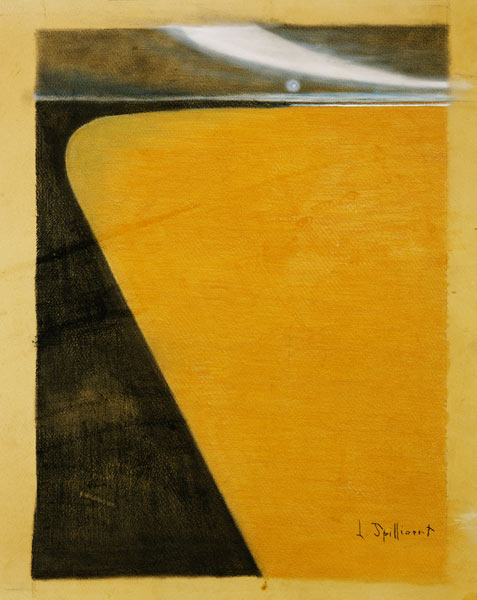
Léon Spilliaert at the Royal Academy

Léon Spilliaert's work is on exhibition at the Royal Academy until the 20th of September. This is an artist few of you will be aware of because it is only recently that critical opinion has shifted in his direction and work that was considered very inferior Ensor type imagery, is now celebrated as work that captured a certain type of mental anguish that existed at the time. Perhaps it's due to our own day's preoccupation with the mental pressures of being locked down and being constantly made aware of the invisible dangers of virus attacks, that has made critics re-visit Spilliaert's images and now see them as important.

Again we have a story of a once thought of poor or unimportant artist's work, being elevated into the parthenon of great art. On the one hand we all benefit by now being able to see his work, but on the other hand it makes me very cynical, as it is hard to resist thinking about the capitalist machinery behind all this reappraisal. Who will benefit from the sudden rise in auction prices and will any of the many struggling artists throughout the world gain anything from his travel from obscurity to fame, beyond a feeling of "well perhaps maybe"...?

The work is though interesting and it reminded me of Munch more than Ensor. The moody threat that lies behind certain types of image abstraction was I thought very potent. As we select out or abstract things from the world in order to envisage it, we are left with the things that reflect our own proclivities, in this case Spilliaert was obviously always aware of the threat that lies in dark pools of shadow, a half seen thing or a sinuous shape. All of which are things that we can flesh out through drawing and it is a certain type of reductionist drawing that lies at the root of his image making.


The image above of a bed covered in a white sheet could be a simple study in tone, but of course the white shape can also become a ghost like figure, we read the empty space as absence, and we are presented with a sparse composition that makes us think that someone has just died.

Spilliaert drew a lot when a child and we still have his sketchbooks.
Sketchbooks always help us to see how an artist thinks and in Spilliaert's early work you can see a certain morbid fascination coming through very early on; perhaps he was a sickly child.

For myself, I am mainly interested in the way that he can animate inanimate objects by drawing them in such a way that there is a certain ambiguity about their representation. 


The pair of gloves above could be anything from jellyfish to old people, they morph between one form and another, which I can see from Spilliaert's point of view made them slightly sinister; however I like the humour and playful possibilities suggested in the way these gloves are always on the edge of dissolving and becoming something else. I mentioned Flann O'Brien's 'The Third Policeman' recently as an alternative type of drawing theory and this is another image that I think fits into O'Brien's comedic model.

See also:


The Royal Academy details of the exhibition


Sunday, 19 August 2018

The continuing influence of Surrealism

Max Ernst: A classic Surrealist production

In his long poem Les Chants de Maldoror, Lautréamont described a young boy as "beautiful as the chance meeting on a dissecting-table of a sewing-machine and an umbrella". This idea, that the bringing together of previously unrelated things, would force the reader to become aware of a much wider aesthetic, and begin to appreciate a vision of life that was far wider and more inclusive than that previously accepted, was at the centre of Surrealist thinking. This was why Lautréamont was venerated by Breton and was seen as a Surrealist precursor. The universe however does this all the time. The random chaos that is the day to day reality of existence, ensures that unfamiliar juxtapositions are being made constantly, some adhere together, some are repelled from each other, some result in mutual annihilation and others in a new formal metamorphosis. 
In the past, dream states were exemplified as places where we might experience the fluidity of identity, where a human being could also be an animal, inhabit a landscape or live as a tree. Animist beliefs and roles such as that of the shaman were central to this type of understanding of the world, one that slipped in and out of rationality, as easily and as naturally as we now fall asleep; it was part of an everyday reality. Our dreams are no longer seen as an essential part of our lived experience, the shaman is no longer a valued member of society; but as an artist that works with often unexpected connections, I believe that perhaps the shaman has a role that will become more and more important as society becomes to rely on data rather than human instinct in order to make decisions. The deeper point about the chance meeting of seemingly totally unrelated objects is that any juxtaposition was in the past recognised as being important, chance was more often thought of as fate. The stars and their relative positions that just happen to be seen as they are from one particular point in space occupied by one particular species, have been given a vast network of meanings because of apparent relationships. Human imagination will feed on any juxtapositions and will look for meanings in them. The humans that have created a vast information lattice based on seeing stars from the point of view of the third planet out from a particular sun, are linked together by their ability to create poetic narratives, narratives that are central to their specific way of being. As other things bump into the picture of nowness that is always changing, new narratives will of course be constructed about them, but not all these narratives will be useful or interesting. In the sandbox of becoming some forms become memorable, some will change the way we think, but many will simply arise and disappear again without impinging on the consciousness of anyone else besides the dreamer in the sandbox. It is however that arising narrative, that story of possibility that allows us as a species to project ourselves out from a closed off inner world, into one that allows others to join in and share the narratives we create and in sharing in some way to bring what was a dream or a fabulation, into some form of reality. 
This is a very old thing as far as humans are concerned. In order to organise communal living some form of communication is central to the task. The first humans would have had to seek some sort of accommodation with the world and as they did that they would have had to communicate with each other as well as other non-human things that they found in the reality that they had to negotiate with. 


An Ávila area Shaman

The Runa, (A South American Indian tribe from the Ávila area), have a wonderful story about fixing a thatched roof and trapping a jaguar. They are still animist in their mind sets and because of this can address other creatures as if they were part of an extended family, no different to other humans, except other animals' separate points of view are perhaps clearer. This is how Eduardo Kohn introduces the story in his book, 'How Forests Think'. 
A man is standing on top of the straw roof of his hut and he intends to mend the many holes in the thatch, however this is a very difficult job because although he could see all the places where the holes were from inside his hut because the sun would shine through each and every hole, now he is on the roof he can't spot where they are. He needs help and the only creature in sight is a roaming jaguar. "Son-in-law" he calls, immediately informing the jaguar that they are related and therefore the big cat must have certain obligations to the man, "help me fix this roof by going into the hut and poking a stick through every hole you can see that the sun shines through." From inside the house there is a very different view point from someone on the outside, but when a stick is poked through to identify the holes the two viewpoints are aligned, no matter how different they are as individuals. Both inside and outside views converge each time as the stick breaks through and in the convergence a new 'higher' vision is achieved that will allow or facilitate a task to be completed. 
In the story there is a further twist, once the jaguar has been enticed to go inside the hut, he can of course be simply trapped by the man on the roof leaning over and shutting the door. The hut now becoming a trap. The jaguar is in one time frame a family member that has obligations, and yet the jaguar is still a jaguar, a dangerous beast that had just that last week attacked and killed two of the man's dogs. In a shamanistic world human identity can slip in and out of other creatures and things, there is no sharp defining difference that we like to think there is in our own identity centred culture. However I'm not sure our way of thinking of ourselves as individuals is as clear cut as we think it is. When I have for instance scraped the side of the car in a badly judged parking manoeuvre, I bodily felt that scrape as if I had grazed by own knee. The car had become an extension of my body. When I make a drawing, I feel the transfer of my mind to another thing very strongly. Above all when I'm working with others I find all sorts of ways to enter their point of view in order to get something done. When carrying a heavy object between two people we constantly shift our grip to accommodate changes in the other person's carrying position. An immediate empathy has to be built up or we will drop whatever it is we are carrying. The two become one in order to achieve a greater thing. Kohn says this is 'being alive to a living logic in moments of its emergence'. (2013, p. 98) Two things need to come together in order for a greater understanding to develop. This is very like depth perception when looking. Because we have two separate eyes we have two separate views of reality, by comparing them we can judge depth. It is in bringing things together that new viewpoints are discovered. 


Dali: The Great Masturbator 

Dali was very adept at recognising the power of an image that lay between two states, his liquid forms lending themselves to a constant metamorphosis and a coming into being that chimed perfectly with Surrealist doctrine. 


I have previously cited collage as one of the most important working methods to ever be introduced into art making. It is also one of the most recent and was a central weapon in the Surrealist armory. Collage relies on the fact that in a society like ours there is a great deal of waste, and the two disciplines of college and montage are it could be argued; poetic waste collectors. Assemblage or combines are also common terms to describe artworks that essentially operate by bringing together fragments of the world into new wholes and because our world is constantly seeking what is seen as new or novel, there is also a constant flow into the rubbish bins of society, things that are obsolescent and out of date. 'Who wants yesterday's papers' went that old pop song refrain, nobody, except the artist who is going to use them for collage. 

Cornell: A parrot for Juan Gris

The tribes of the Ávila are very aware of the importance of combining two or more viewpoints in order to achieve a higher understanding.  If we begin to look at collage techniques as simply another way of looking at bringing together two different points of view in order to develop a more sophisticated or 'higher' vision, collage can be regarded as a technique that helps to facilitate a much older 'shamanistic' or 'animist' way of immersing oneself back into the world. However this is not just about chance, it is more about looking for something that triggers meaning, even if this is only an idea of a possible meaning. As one image arrives in relation to another, we can as artists begin to edit these relationships and only let out into the world those that surprise or elicit a 'smile in the mind'. But we should never forget that 'fixing the roof' is a very practical thing and that the bringing together of different viewpoints is also known as triangulation and in triangulation we have not just a way of developing a better idea of something but a way of setting out a proof to others that can be verified. The 'surreal' world that many deride as fanciful could then be seen as simply a model for how the way we  build up communication with others works. By 'others' I'm intimating here that it is as important to think about how what we do affects everything else as well as how it might change our relationship with other humans. 

A less well known line from Les Chants de Maldoror is one concerning Lautréamont’s dream of being a hog. 

‘I dreamt I had entered the body of a hog, that I could not easily get out again, and that I was wallowing in the filthiest slime. Was it a kind of reward? My dearest wish had been granted, I no longer belonged to mankind’.
Maldoror, Part IV, Chapter 6


I spotted a figurine of a pig reading in a junk shop and for a while it became a character in some drawings I was making. I'm always interested when I see echoes of ways of thinking that cross cultures and times. In our current western culture these figures are now seen as kitsch and of little worth, but when we look at them historically they seem to sit in a much more important position. It could be that we are reading these small figures in the wrong way and that their ubiquitous presence is actually a sign of their continuing significance.

VarahaThe third avatar of Lord Vishnu 

The term avatar has often been used to refer to a soul that has been freed from delusion and is sent back into day to day existence to help others. Examples include Jesus Christ, Buddha, and Krishna. An avatar exists to give us hope that we can all achieve a state of consciousness far beyond what we feel is possible in our everyday experience of the world. However a more recent use of the word is in the computer generated world of virtual reality, in this we can have our own avatars that operate as separate entities from ourselves. The idea is a shell, one that we can can inhabit in several ways and hopefully it is an idea that will allow us to construct a future space for holistic communication between ourselves and others.
Pokémon sprites that can be used as avatars
Pokémon sprite Granbull: Human\bulldog hybrid

The Minotaur as depicted on early Greek pottery

Picasso: From the Vollard suite of etchings

The idea of human / animal hybrids allows us to consider what it might be to slip in and out of our own skins into another creature's.  

Patricia Piccinini 

The Chapman Brothers playing the Surrealist game of Exquisite Corpse.

'Consequences' or 'Exquisite Corpse' games are ways to artificially generate imagery by bringing together unexpected conjunctions. These games nearly always throw up interesting things, however the deeper issue of 'fate' or something underlying the apparent random nature of a chaos driven universe is what we have to look at if we are to use these games as part of a communication system. 

The dream of being something or someone else is something we all do at one time or another and it is only when we are not ourselves that we can really understand what it might be to communicate with others. Empathy is perhaps the key to being both an interesting artist and a properly integrated human being. By working with processes that bring together different things it may be possible to develop a semiotic dynamics that exceeds the human, and in the slippage of the idea of 'self' into other things, perhaps we might be able to more easily comprehend what it is to have been something that did not exist before there was a someone. 


A dusty bin money box

A now long gone TV game show has echoes of itself sitting in the junk shops of our minds, even an old dustbin has potential as a carrier of an idea of an alternative vision of ourselves, one that allows us to see ourselves as being able to have potential relationships with many things, both organic and inorganic. 

Potential reading:

The work of Surrealism has often seemed to me to be a sort of contemporary shamanic idea. Artists try to reconnect with the animate spirits that connect us to the other things of this world and which cement us into the processes of being that at times we can feel totally separated from. Benyshek's writings are a very good introduction to this ancient tradition and its continuing relevance. 

Denita M BenyshekShamanhood and Art: Traditional and Contemporary Arts, Artists, and Shamans