Showing posts with label Drawing from photographs. Show all posts

Wednesday, 7 October 2015

Cinematic Drawing in a Digital Age

There has always been an ambivalent relationship between lens based imagery and the drawn, in particular because of the relationship between drawing and the camera obscura. 


We tend to forget that most of the early camera obscuras were room sized, thus making the experience of watching the images seen very similar to that of watching a film. Except of course that the world was upside down, as of course it is for all of us all of the time, our brains simply inverting the image that falls on the back of our own eyes. 
Animated film is also historically closely linked to processes of drawing, most of us will have made a small flicker book at one time or another by making tiny drawings on the corners of an old novel's pages, thumbing them through to create a short animation. William Kentridge revisits these first principles of animation to produce an extensive and powerful body of drawing led work. He features strongly in the Tate cinematic drawing article but he is also a very good explainer of his own processes. In this video he talks about animation as transformation, and he explains his working processes. He is very good at positioning his practice and in this video he explains the relationships that he feels link drawing with theatre and film and how a cross fertilisation between different mediums can be a wonderful way of enriching and opening out possibilities for practice.

A very different artist that uses animated drawings to develop ideas is Jack Fried. He uses stop motion techniques with collage. He makes initial drawings in such a way that they can be easily cut up or sections painted out and replaced. 
Look at this animated drawing "Brain Lapse" to get an idea of how the technique works. 
He uses ink, gouache, white-out and coffee to get the particular effects he wants. (It's interesting how many artists find some sort of domestic products to supplement their art materials, some using bleach to draw with, others tea to stain or clothes dyes to get particular  colours). 
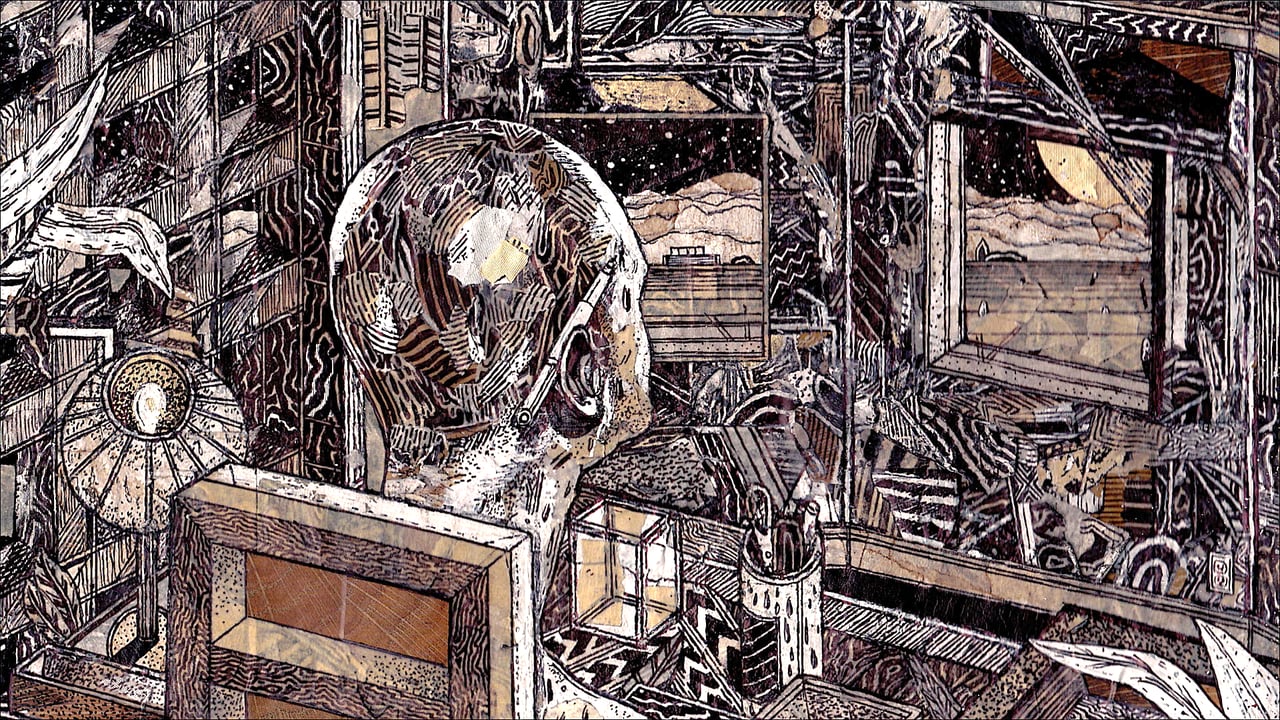
Jack Fried

Jake Fried began his artistic career as a painter, but as he went through the process of layering and modifying images, he realized what truly interested him was the way the images metamorphosed in the course of making a painting and he changed track to become an animator and in the process began to focus on drawing rather than painterly effects. He modifies and shoots the images over and over again to create these fast changing animations that are all about how images can evolve. 


Tacita Dean "The Roaring Forties: Seven Boards in Seven Days' 

However some artists think of their drawings as frames from films that might never be made. This is how Tacita Dean conceived her large chalk drawings "The Roaring Forties: Seven Boards in Seven Days'. (See the Cinematic Drawing in a Digital Age article), conversely Robert Longo has long been interested in making large charcoal drawings of the opening credits of existing movies. 
Robert Longo, Study of Bruce, 2013

The relationship between film and drawing is fascinating. Storyboard artists visualise the film often before any shooting is done, not only in the old days did it save film, but drawing was the only way for set designers to be told what to build and for camera operators to get an idea of how to prepare for any particular shot. So it could be argued that a film is actually a chemical and now digital realisation of a series of drawings. However film is also an immersive experience and its scale has influenced a whole generation of artists, not least the Abstract Expressionists, who made their large scale canvasses in response to the way cinema's huge scale could draw its audiences in. 
David Lynch was an artist who went into film making, look at his early attempts, they are really someone trying to animate a painting. This article on Lynch opens the issues out. See his early short films here.
It's hard to unravel the relationships between painting, drawing and film because they are so intertwined, and what is happening in so many current practices is that artists simply accept that there is a connection between the two and don't worry about it. 

Finally, I don't think it was an accident that Karolina Glusiec won the Jerwood drawing prize in 2012 with her animated film Velocity. I would suggest that more and more people are tuned to animation because of their expose to so much of it during childhood. It's language is clear and deeply learnt because of all those hours sat in front of the TV. If artists can appropriate that, they have a very powerful tool. 

From Velocity: Karolina Glusiec

See also


Also have a look at this pop video, which uses a great range of low tech animation techniques. 

Another music video showing how to be inventive with old animation techniques. 

There is a very good article on William Kentridge's latest show: here. 

Look at Michal Rovner's work, where she uses a variety of surfaces to project on here.

Even mainstream cartoons can be sometimes made using low tech. See


Thursday, 23 April 2015

Jasper Johns: An old man drawing

I've been looking at some recent work by Jasper Johns entitled 'Regrets' which consists of a group of two paintings, 10 drawings, and two prints created over a year and a half and exhibited for the first time last year at MOMA. 
Johns is now well into his 80s and was of course a powerful influence on both Pop Art and Conceptual Art during the 1960s. I have already pointed to his importance to the art world in an earlier post, but I'm also personally very interested in what he is now doing as an older artist, (perhaps because I'm of an age to have felt Johns' original influence in the 1960s), I'm fascinated to see that he is still working and still able to generate images that can hold my attention. 
For someone new to Johns' art perhaps one of the most important things to grasp is that he is essentially a process artist. However I thought that in this series of works the image he is processing is particularly poignant. 
Johns had been looking through a series of images that came from the reconstruction of Frances Bacon's studio in Dublin. One image was of a photograph of Lucien Freud that Bacon had had taken when he was thinking of making Freud's portrait. The photograph was crumpled, ripped and torn, a whole section missing from the bottom half. 


As you can see from the photograph above Bacon must have spent some time with it investigating possibilities for a painting. On seeing this image Johns decided that it was worth investigating. What it was that captured his attention he doesn’t say so one can only conjecture. I suspect what resonated was that Freud had recently died, and was of a similar age to Johns. They never, as far as I know, met, but both were regarded as international masters of contemporary painting. Freud holds his head as if agonising over something, and of course this being an image found in Frances Bacon’s studio, (another ‘master’ of contemporary art) this anguish or introspection must have been something Bacon was interested in as a possibility for one of his very expressive paintings. Johns of course is known for his personal reserve, for not showing any emotion in his work and for being a more ‘cerebral’ artist. Perhaps Johns saw this image as a type of ‘vanitas’ (Vanitas themes in painting and the overlapping motif of the Memento mori, were meant to remind viewers of the transience of life, the futility of pleasure, and the certainty of death), being of the age he is and aware that both Bacon and Freud are now dead, perhaps reminding Johns of his own coming demise. Whatever caused Johns to select this image, what he does next is perhaps of more interest for those of you interested in his process.
The first thing Johns does is to simply draw what he sees. 


As you can see from the drawing everything has taken on an equal importance, the torn out section and the creases are just as important as the photographic image. For Johns how to work from photographs has been a long running problem, and this way of working allows him to 'see' the photograph as an object and he has asserted in the past that he is always seeking to ensure that his paintings are objects and not windows on the world. 
I think he may even have traced the initial image directly from the catalogue page he found it on. This would have allowed him to easily make his next step.


He has mirrored the first image and made a new image by filling in both halves of the new image differently. One side he has crayoned in using primary and secondary colours and on the other side he has filled in the shapes with a grey wash. Because the edges of folds and crumples are just as important as images, the overall image itself is now becoming much harder to read and a new unexpected image has arrived due to the mirroring process. Over what was simply a torn out shape, has now appeared a 'skull'. The torn out shape now becoming a vest like body. Johns has used skulls in his work before, so he would have been quick to recognise the image when it arrived. 

It's interesting that in this print from the 1970s, Johns has put a cross through his signature. 

Once he has realised that the image on mirroring contains another (discovered)  image he sets off to make the composition more interesting. 

He crops the left side of the image so that the bi-lateral symmetry is removed, (there is an image stage before this but I haven't had the time to scan it in, I will at some point) he then begins to explore ways of working over the surface so that the mark takes precedence over the image. 

You should just about be able to see the 'vest' shape near the centre.

Detail of the drawing above. 

Johns then proceeds to explore possibilities of surface excitement by working in ink on plastic film. This means that he is able to work within the outlines he has constructed for himself, but unable to control the flow of the ink, because on plastic it flows uncontrollably and makes blobs and thickens and thins unpredictably. 

Detail

Johns then makes several of these drawings in ink. (If you want to try working in this way the print room down in Vernon Street stocks rolls of 'true grain' which is transparent plastic sheet used for making photographic exposures for silk screens, and I would suggest that Johns came across this method of working when doing exactly that, preparing to make a silk screen by painting ink on plastic sheet). 


Sometimes the image is coming through more clearly than at others, the 'mood' changing as black becomes more dominant or soft greys spread throughout. 

Finally Johns takes the image into print. Using etching processes to further explore the possibilities. 

'Regrets' Etching

Etching detail, from the central 'vest' shape, showing use of soft ground technique, whereby a textured surface is pushed into the soft wax ground and the resultant removal of wax allowing acid to eat out the metal to create a similar texture. 

Once in print Johns can really easily make variations, as you can see from this wall of images the basic design now hosts a wide variety of tonal and textual developments. 

While his work in drawing is developing possibilities for the image he is also painting. These two images below being the result. 

Regrets 1 Jasper Johns

Regrets 2 Jasper Johns

The final paintings have moved a long way from the original photographic image. Whether or not you are interested to them as images, the process is still a useful one and one that above all allows Johns as an artist to discover images as he works. What so many artists find hard is setting off to make a new image, if you try and get one straight from your head, it will nearly always be a cliché, therefore Johns, like so many artists uses a process that allows him to discover what it is that he is doing as he does it. 


Wednesday, 22 October 2014

Drawing from photographs

Drawing from photographs is something I find very difficult. The problem for me is that I end up copying rather than selecting, and therefore I always draw directly from the world, something I find far easier as the process is very selective and it's me doing the selection. However the relationship between the camera and art is a long one, starting with the invention of the camera obscura and continuing into the present as artists seek to explore how a world of instant imagery and mobile phone selfies can be reflected upon by the slower processes of painting and drawing. Check out the book, 'A Brush with the Real: Figurative Painting Today' by Valli and Dessanay, which unpicks a lot of these issues. 

David Hockney has explored the history of pre-film camera art in his book ‘Secret Knowledge: Rediscovering the lost techniques of the Old Masters’, it’s a really good read and his viewpoint is from that of the artist rather than the art historian which is always refreshing.
A Hockney drawing from ‘Secret Knowledge’

So how are artists dealing with the camera? There are vast amounts of ‘copyists’ out there and if you Google Photorealism you will find a raft of not just past practitioners, (apparently you have to have had exhibitions before 1970 to be a real Photorealist) but a host of artists still painstakingly copying from photographs. It’s skillful and hard work, but where does the art come in?
I shall try and unpick a few issues around this and at the same time introduce a few artists that I think are well worth looking at in relation to contemporary drawing.
Kevin Cosgrove is an artist that I think uses photographs in a very personal way. His interest in a particular subject matter is very powerful. He draws and paints places of work. Old fashioned work, places of oil and metal and grind. Those small workshops that used to at one time be everywhere but are now becoming few and far between, as manufacturing is outsourced and people start to forget that things can always be repaired. Perhaps the car mechanic is the most familiar figure in this world; I get glimpses of their dark workshops when I have to leave the car for its annual MOT. Cosgrave obviously loves the feel and texture of those workshops and he takes photographs of these places to work from. However when he selects from the photographs he selects aspects that he will heighten through a touch soaked in a metaphorical dark oil. Read this review of his work.
The drawing below is charcoal on paper 108 x 150 cm, large enough to get stuck in with a big soft lump of charcoal, the dark patches below the workbench creating those mysterious dark spaces we all remember from childhood. Those dark spaces where the bogyman lives. He feels for the surfaces and textures of old paint cans and tools, their worked surfaces further worked in his drawing. Although the drawing is done from a photograph, he re-shapes what is there, gives additional emphasis and thus transcends the image and makes it his own.

Kevin Cosgrove

Paul Chiappes works in a very different way, but his is also in his own way re-creating rather than just copying photographs. This time the scale issue is reversed, he works on images that are even smaller that the original photographs. His subject matter of old school photographs, images from long ago parties etc. is suffused with nostalgia and it is only when you realise the scale that we get the hook into the work. Scale makes us move around. We have to stand back from some images, their large size forcing us back until we are in a position to see them as totalities rather than as a surface of marks. On the other hand tiny images force us to examine them very closely, like those paintings reproduced on postage stamps. Chiappes’s marks can only be seen when you look at his images from about 4 inches away. They suggest an obsession and intense involvement with the images, but one totally different in quality to Cosgrave’s.


Paul Chiappes

Clive Head makes paintings and drawings from places that he visits over and over again. He takes photographs and makes small drawings on the spot. This is how he describes his working process, “Before taking photographs I make lots of little drawings and sketches as well. The initial construction of the painting is drawing and I always draw on tracing paper, which is very resilient if you keep rubbing it out. Although I make a tiny drawing at the beginning that drawing has probably gone through 30-40 different stages before the final version of the painting. The small drawing will give me an idea of the format for the painting.”
He then goes on to draw out his images large scale ready for painting. Personally I like his drawings more than his paintings, the final finished images being perhaps too finished for me, all the hard won processes and thoughts are eventually hidden beneath the paint, the final finish of which I’m not sure about. Even so his working methods are interesting and hard won, so I cant really criticise the man.
Clive Head

Head is particularly good at drawing curved space, which is something I've been interested in for a long time and as I also make large drawings I am very aware of how much physical effort they take. The lesson that all of these artists teach is that you need to have a clear idea about what makes an image if you are going to move beyond the photographic copy. 

Of course our very own Richard Baker makes images from photographic sources and you can find a book on his drawings in the college library. The print below, an etching, was printed at Workshop Press. 


Richard Baker

See also: