Drawing can lead us into many strange territories, one of which is 'witness description composite drawing'. In the United States artists are employed by police departments, usually in the forensic evidence department. For instance witness description composite drawing is what the artist Harvey Pratt has spent most of the last 50 years working on. He has worked as a forensic artist for various police forces, whilst also being recognised as an accomplished master Native American Indian artist. In fact it was this dual role that first attracted me to his work.
The term 'composite art' was originally used when facial features (eyes, noses, lips, hair, facial shapes) were compiled to complete a total composite of a face. This procedure was to be used by a witness who was guided through a process of how to match these various facial features in order to form an image of a suspect. Witness description composite drawings were basically the same technique but were drawn free hand and based on an interview of a witness or victim to determine what someone might look like. These drawings are regarded as investigative aids and they are used to help narrow down suspect lists. Witness description drawing can be used not only to identify suspects but also identify tattoos, vehicles and other items that a witness might describe during an interview.
Below are examples of witness description composite drawings made by Harvey Pratt beside photos of the subject later identified.
Considered one of the leading forensic artists in the United States, Harvey Pratt spent over 50 years in law enforcement, completing thousands of witness description drawings and hundreds of soft tissue reconstructions. You could say that Harvey Pratt had an interesting portfolio, being a Cheyenne and Arapaho tribal member and also being recognised as an accomplished master Native American Indian artist. Both these aspects of his working life as an artist involved making portraits of people, some being one step removed both emotionally and in terms of experience and others made to celebrate his ethnic origins and feeling of belonging to a tribal culture.
Harvey Pratt: Drawing of a Native American
I'm sure some of you will be worried by the fact that someone like Harvey should be introduced under the umbrella of a fine art drawing blog, but one of the issues I am trying to open out is where are the boundaries between fine art, illustration and other occupations whereby similar skills are used? All of these people are called artists and the art world is prone to snobbery, so it is always worthwhile stepping back to explore how broad the church of the artist really is, and as we do so perhaps we also have to ask questions as to how does an artist contribute to society?
A very similar profession to witness description drawing is of course courtroom drawing. In the UK photographs are not allowed to be taken whilst a trial is in progress. A courtroom sketch is defined as an 'artistic depiction' of the proceedings in a court of law and of course this means that news media have to rely on sketch artists for illustrations of the proceedings, which is probably the main way that the general public get to see hand drawn portraits of people.
Priscilla Coleman: Naomi Campbell and Piers Morgan for ITN
In the UK, a courtroom illustrator is an incredibly niche trade, and a dying one. At the moment here are four professional courtroom sketch artists: Priscilla Coleman, Siân Frances, Julia Quenzler and Elizabeth Cook. However new laws were passed in January 2020 allowing cameras into the country’s Crown Courts, including the Old Bailey, to broadcast the sentencing remarks on high-profile criminal cases, which means that court artists are only needed for the less 'interesting' aspects of a court case. Drawing in court, or making an image of any kind, be that a photograph, doodle or otherwise, is illegal in British courts. So courtroom artists not only have to be skilled portraitists but they also have to have excellent memories for faces and places. To make their images, they take written notes during the case, before moving outside to the press room to draw their images as fast as possible, both to ensure accuracy and to enable their clients, (newspapers and broadcast media) to get images in time for various deadlines.
Priscilla Coleman: Artist's notes from courtroom observations
I like to think about the notes taken by these artists as drawings in their own right. They are part of the process of remembrance and are used as triggers to ensure images are brought back as accurately as possible.
The courtroom artist is a skilled compiler of facial images and they are making notes knowing they are going to construct an image of a face within a few minutes of making their notes. They understand how heads are constructed and have training and years of experience. Compare this to a crime witness's memory of a person that is recalled perhaps several days later or even more, that then has to be translated or communicated to an artist who then has to render the image. When I looked at communication theory I pointed out that Shannon and Weaver wanted to make sure that communication systems worked well. The model they came up with allows us to easily see where problems in a communication system could go wrong.
In particular the information source needs to be working in such a way that it is decipherable by the information destination. So in this case we have someone who was probably very stressed at the time of the experience, having to recall the facial features of someone they may only have glanced at for a few seconds. Not only that, they will have had no training in the recognition and identification of facial features and no specialist language to help them either. You should try this yourself, give a verbal description of someone to another student and ask them to make a portrait from that description. The receiver also needs to be good enough to understand or not distort the message coming through. In this case either the police artist uses their experience based on previous encounters or they use the composite model. The skills of the drawer and the ability of the drawer to put this information into an effective shape for transmission are again vital. You very quickly begin to realise how amazing it is that any communication is made at all. But, and this is the real problematic issue, what both people in this communication system have in common is a set of preconceptions, stereotypes and ideas about what people look like and this is perhaps what they are really communicating. If we look at Vaught's Practical Character Reader's honest face, as seen at the top of this post, we see perhaps one end of a stereotype scale that the crime victim and police artist are measuring their ideas against. For instance in many experiments in relation to emotions instigated by facial type, people respond that they trust and find honesty in faces that are more symmetrical. Symmetry is at the core of a police artist's working system. Below is a verbatim account given by a working police artist of how they set out to do their work, the ruled pad is what they use as a starting point for every drawing.
A police artist's ruled drawing pad
"I start the drawing by having the witness go through the FBI’s Facial Identification Catalog feature by feature. I always start by having the witness look through the FIC for the shapes of the suspect’s head, or face. This is very important because the shape of the head is one of the three main components to getting close to the suspect’s actual look. I stress it’s importance. I set my drawing up on my paper before every composite. This is also important because it keeps all the drawings to a certain scale and helps with symmetry".
"I then move on to the suspect’s eyes. I rush the witness just a little bit so they don’t make themselves crazy looking at all the different eyes. I explain the importance of choosing only the closest set of eyes. I let the witness know features can be changed, or fine-tuned, when the line drawing is completed. I make sure the witness understands they should concentrate but not get frustrated by all the choices".
"Once they choose a set of eyes, I sketch in the eyes and eye brows of the eyes they chose. I don’t want to nit-pick them on features. Eyebrows don’t normally make or break a likeness so, if they remember specifics I will note it, if not I skip the eyebrow section".
"I use a regular 2B pencil because it is harder than my finishing pencil, erases easier, and draws lighter. I have the witness start looking at noses while I sketch the eyes. I draw the nose while I have the witness looking for a mouth".
"I draw the mouth while the witness looks through the chins. I draw the chin and sides of the face, after referring back to the shape of the face. I always draw the top of the head with just the forehead. I always put generic ears on, unless they were a feature the witness remembered specifically".
"I get the witness to find the hairstyle somewhere in the book. Once the line drawing is completed I have the witness look it over. I make changes by erasing with the kneadable eraser and re-sketching until the drawing is as close to the suspect as the witness can remember. I have the witness rate the line drawing on a scale of one to ten, "ten" being a portrait (really close), and "one" being no where near close. Now, with the line drawing as close to the suspect as the witness can remember, I add skin tone and shading".
"I use a 9b woodless pencil because it is soft, goes on dark, and smudges easily. I get good contrast between lights and darks. Shading takes practice. Achieving a good skin tone is important because it will make the composite believable. After, the composite has skin tone it should appear closer in the rating scale, or at least no change".
In the example above it is interesting to see how the artist leads the crime victim through a series of decision making choices, ones that must influence the final outcome.
What the artist is doing is very closely modelled on the 'Photo-fit' kit.
The Photo-FIT kit for police forces was derived from the work of Jacques Penry. In the video clip below you can see him at work. The video is a timely reminder of how social convention was often thought of as being fact and that old beliefs in physiognomy, or the practice of assessing a person's character or personality from their outer appearance persisted for many years after they were shown to be false.
Jacques Penry describes his system
Physiognomy as a 'science' was developed by Johann Caspar Lavater (1741-1801), his four volumes of 'Physiognomic Fragments' were popular throughout Western Europe, and they began to influence how people literally pictured themselves. In Central Europe, there was an obsession with silhouette pictures, usually created by cutting a person’s profile out of black cardboard. Lavater advocated the use of this system because it made face profiles easily measurable.
Lavater’s apparatus for making silhouettes
The 'proof' that you were an upstanding citizen could then after your portrait had been made, be framed and put on your wall.
Portrait by Robert Friend
Certain artists, such as Robert Friend, developed the silhouette portrait as a specialism and just as all the other elements in the images he made are indicators of class and status, the profile itself would have been slightly adjusted to ensure that the person depicted had the right sort of facial shape.
Our continued need to control how we look in relation to how facial features are read within society means that for instance, because selfies distort the face many people are undergoing plastic surgery on their noses in order to make them smaller. Mobile phone photographs misrepresent looks, because from the distance of an arms length, most lenses will make the nose appear bigger in proportion to the rest of the face. People who are not photographers don't realise that camera lenses are not the same as normal eyesight. However the selfie becomes the 'reality' and is measured by social convention and that is itself determined by very old ideas that are still rooted in concepts that came from physiognomy.
There is something weird about all these depictions of people. They are either abject in the sense that measured 'people' are completely without pride or dignity; or they are about lack of self worth. Julia Kristeva in 'the Powers of Horror' states that the abject refers to the human reaction to a threatened breakdown in meaning caused by the loss of the distinction between subject and object or between self and other. These images of faces seem to encompass all of these definitions and yet at the same time they reach out into a western European past that shows a continuing need to measure and determine ourselves through measurement. According to Foucault, knowledge is only possible within a vast system of power relationships that allow that knowledge to come to be. I.e. society allows these strange readings to continue and be used as if they are 'knowledge' because some powerful people find it useful.
In 1902 Vaught's 'Practical Character Reader' was published. It's hard to believe that this is a Twentieth Century publication, as it seems almost Medieval in its reasoning.
It is interesting to compare and contrast the total humbug of Vaught's 'Practical Character Reader' above with the images below as set out by a contemporary company advertising its skills in plastic surgery.
These images are meant to demonstrate how rhinoplasty can improve your facial harmony
A repose frontal mask
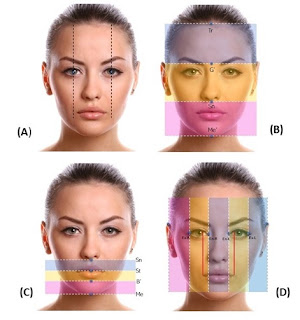
Some experts on facial harmony use a measuring system based on the golden ratio, the one above does that. You are asked to overlay the Repose Frontal Mask (also called the RF Mask or Repose Expression Frontal View Mask) over a photograph of your own face to help you apply makeup, to aid in evaluating your face for facial surgery, or simply to see how much your face conforms to the measurements of the Golden Ratio.
It is not a far remove from stating that broad headed humans and animals are vicious or people with convex curves to their noses are deceitful, to stating that a broad nose or one with a convex curve is un-harmonious. As we will see when we come to the main anthropometric points for facial harmonisation, the faces that 'scientists' use to take the measurements from, fit a very narrow stereotype, and by extension when we begin to look at equity in facial recognition technologies, we find that these technologies were once again invented by people who see white faces as the norm and the further away from that norm we get the less accurate is the technology. No matter how far measurement is taken in order to develop objectivity, it would seem to be obvious that we cant escape bias and subjectivity in our reading of faces. If so it is probably much better just to accept that and spend more time exposing ourselves to other people's ideas of beauty and character, so that at least we come to realise that what we think is only a point of view and that that old cliche 'beauty is in the eye of the beholder' has more going for it than we tend to think.
Measurement and faces is a long running concern. Durer's 'Four Books of Human Proportions' ('Vier Bücher von Menschlicher Proportionen), is another attempt to set out to give mathematical precision to the visualisation of faces.
Durer, like the forensic police artist, was attempting to develop a system that could capture the almost indefinable essence of what it is to be an individual.
Our current obsession with faces and the selfie, as already suggested, leads us into plastic surgery, an area where facial measurement is an obsession, such an obsession that it has led to a specific discipline, 'faciometrics'. Faciometrics consists of making direct measurements from predefined anthropometric points. In order to do this a facial ruler is used and measurements linked to standardised references for quantitative analysis. The relationship between these measurements then guides facial interpretation. A Practical Guide for Orofacial Harmonisation, states that 'with these normative parameters, we can guide harmonisation procedures and recover facial proportions, making facial features more similar to the reference.' 'In this way, we will achieve more individualised planning that will be a more assertive approach in the proposed treatment.' See: https://www.mathewsopenaccess.com/full-text/faciometrics-a-practical-guide-for-orofacial-harmonization
Beauty Setup ruler (A) Caliper (B)
The table below sets out the main anthropometric points for facial harmonisation.
Points
Initials
Description
Trichion
Tr
A point at on the hairline in the midline of the forehead
Glabella
G´
Most prominent midpoint between eyebrows
Endocanthion
En
Inner commissure of palpebral fissure (left and right)
Exocanthion
Ex
Outer commissure of palpebral fissure (left and right)
Pupil
P
The black circle in the center of the iris.
Nasion
N´
The midline point of the nasal root and nasofrontal region.
Pronasale
Prn
Most prominent midpoint of nasal tip
Nasal Alare
Al
Most lateral point of alar contour (left and right)
Zyghion
Zy
The point of the most lateral soft tissue overlying the zygomatic arch (left and right).
Subnasale
Sn
Midpoint of columellar base at junction of upper lip
A´
A´
The point on the midline of greater concavity in the facial contour of the upper lip, between the subnasale point and the upper lip.
Crista
Philtri
Cph
The point at each elevated margin of the philtrum just above the vermilion line
Labiale superius
Ls
The midpoint of the vermilion line of the upper lip
Stomion
St
Midpoint of the labial fissure between gently closed lips
Cheilion
Ch
Lateral extent of labial commissure (left and right)
Labialeinferius
Li
The midpoint of the lower vermilion line
Gonion
Go
The most lateral point on the mandibular angle (gonial angle). Its location is close to that of the bony gonion. (left and right)
B’
B´
The point on the midline with greater concavity on the facial contour of the lower lip, located between the lower lip and the soft chin. It is the deepest point of the mentolabial fold.
Pogonion
Pg′
The most anterior midpoint of the chin.
Mento
Me′
The lowest point on the midline of the soft tissue of the chin. This is the lowest point in the measurement of facial height.
Within a few moments we have moved from the abject to a set of concerns that are all about beauty. Durer was looking for harmonic proportion, and so is the plastic surgeon. The drawings done by the police forensic artists are an attempt to gain control of what is unknown, an attempt to find the criminal face, a project I would have thought doomed by subjectivity. But so are the standards of beauty we see set out in the supporting information for those dealing with faciometrics. These images, usually of white women, are yet another problematic concept. The unconscious bias in our actions and beliefs, is not in fact unconscious, its pretty easy to see that the models these facial features are based on are of a certain type and the type reflects the dominant characteristics of the people who control the technology.
Drawing as both witness and control shows us that what we would normally see as activities outside of fine art drawing as a discipline, are in fact areas that highlight issues for any artist doing something as apparently straightforward as making an image of someone's face. As soon as I begin to draw I'm reminded of those hours of practice as a student, always being told to measure the situation again, always been pushed towards an idea of accuracy. Strangely the more you were able to grasp things like perspective and get what you were drawing 'right' the more you were asked to now push past superficial 'likeness' and to now look for the action of perception, the traces of head movement that you initially had tried to iron out but which now became vital to the 'life' of the looking and its capture in the drawing.
Drawing of a face using eye tracking technology
What we are actually doing when we look at a face is several things at once. Initially checking fight or flight impulses, which will be done almost before you can begin to think about what you are doing, and then checking out a whole host of other bits of incoming information, status and class, usefulness, sexual interest, kinship, interest in me, similarity and difference, etc. etc. and as we do this we scan, trying to pick up changes in eye shape, frowning, smile lines etc etc so that we can establish a proper relationship with this encountered other, one we can build upon even further when we both open our mouths. But look at how different the static measured drawings are to the drawings measured by eye tracking technology. It is now much harder to tell what sort of person we are looking at because we are concerned with action and a series of events and not an isolated moment.
I have recently been exploring portraiture myself, an area of art practice that is full of clichés and a perceived need for 'likenesses' and one that on the whole I have always suggested students steer well clear of, but people persist in making them, so rather than avoid the problem, I've decided to tackle it head on. The first issue of course being 'likeness'. Likeness nearly always comes up when in conversation with someone from outside of the art business. "It looks just like a photograph" being many people's judgement call when it comes to likeness and of course the best way for an image to be "just like a photograph" is to work from one. This personally seems a redundant exercise so I never use photographs. Likeness is also measured against a normally seen static image, so I never ask my sitters to keep still, I just respond to the interaction of an exchanged conversation and as materials come into play I let the materials interact with myself and what I am experiencing. The images therefore become records of time spent with someone, rather than depictions of them. This feels much more honest and about people or encounters rather than renderings and copies. I want to avoid ways of working that tend to get people looking at themselves as if seen in a mirror, and checking for likeness. I want people to begin looking at the images as if they were new things, new figures formed from paint and ink and pens and brushes, things that talk their own language and which you have to look at very carefully if you want to listen to what they are saying.
Visual language would have started like most languages by human beings
communicating by using ideas of 'likeness'. There is a category of definitions
which are called, 'ostensive'; denoting a way of defining by direct
demonstration, e.g. pointing. I'm sure that after watching young children
learn, pointing to things to show the children they were like something
else must have been a big part of visual language development.
Because our bodies are the things we know best, I would also suggest
they were the basic initial measure. You can think in terms of body schemas,
for instance, an upright vertical body suggesting maturity, health and strength.
This could be represented by a 'right' angle, a line standing upright
vertically, can therefore also be seen as strong, healthy, in balance and
'right'. A body that is ill lies down, and in the case of dying achieves a
horizontal. As we get older we are less 'up-right', if we trip or fall we are
taken off the vertical and into the lower angles. Therefore lines approaching
the horizontal can be seen as representing being 'off-balance', ill or
approaching death.
I would suggest that the same is true of the quality of line. In full
maturity and good health we move smoothly and with confidence, when very young
our movements are jerky and unformed, and when ill or approaching death we have
shaky hands and feeble far less confident body movements. So if we make lines
that are smooth and confident we should be able to point to them and say look
these lines are like a mature strong confident person. A line made with shaky
marks, with a hesitancy could again be compared with a human being in a similar
state. It is very easy to see how a certain emotional register could therefore
be applied to the reading of drawn lines. (My earlier post on drawing
with Bezier curves relates to this, the
authority of lines drawn using vector graphic software, perhaps related to
lines drawn with a very confident and steady hand).
John Bellany: Self portrait on surviving an operation
The drawing above was done by John Bellany immediately on waking from an
operation in hospital, it's shaky lines echoing the physical and mental state
of the artist.
The attempt to codify the various elements that make up visual languages has a long on-going tradition. One that
is though very questionable once it begins to step outside of basic body
schemas. For instance if you look at the work of Eugen Peter Schwiedland
(1863-1936), an Austrian born graphologist who lived in Vienna; he
invented the Graphometer, a device like a protractor that shows how the slant
of your handwriting indicates your personality. It relies on a similar reasoning
to the one I have just introduced, but his readings are very subjective.
Look at direction 1: Schwiedland suggests that it represents
'insensibility' that the upright represents a cold reserved
nature, however as you can deduce from my suggestion that we read angle
from awareness of our own bodies, an upright style of writing could also
suggest strength of character and someone in the prime of life, a
balanced character in tune with life. One aspect of body angle I am very
aware of is that I put my body at an angle in order for me to be able to run
fast, I could therefore argue that direction 3 relates to someone who
is impatient and who wants to get on quickly. Graphology has of course
been discounted as a science because of this subjectivity, but even so
amongst graphologists the relationship between personality and angle and slope
of line would have become a shared common language and
would have been a 'true' language because it was a shared series of
conventions that could be understood in the same way by other members of the
community of language users.
The concept of directly relating angle to emotion was developed to a
fine art during the 19th century and reached such a level of sophistication
that 'aesthetic protractors' were made to help artists determine their
compositional structures. Charles Henry had argued that colour could be
used to express certain emotions and that this emotive effect could be
heightened when combined with the angle and direction of a line. He was very
influential on artists such as Seurat, who developed some of his compositional
ideas on Henry's work. (Again we have a reference to artists wanting to
underpin their work with mathematical 'rightness')
The one part of the body we spend a lot of time looking at is other people's
faces. We do this because it is via the face that a large amount of meaning is
communicated between us and a large part of this meaning is emotional. Any
comic book artist knows that in order to tell the reader what is happening
emotionally a facial close-up can do the job.
Awareness of facial expression extends and deepens the body schema and
19th century scientists were hard at work trying to formalise facial
expressions as languages to be used by artists. In particular the artist
Humbert de Superville wrote an essay designed to explain how gestures and facial
configurations could be categorised.
We use the term 'Physiognomy,' when describing the 'science' of the
assessment of a person's character or personality from his or her face. Compare
this before and after image.
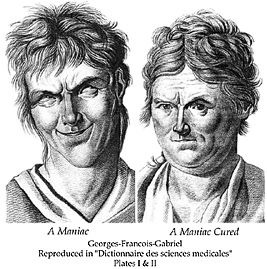
The maniac head is tilted, hair disturbed, everything is more angular,
and when 'cured' eyes are level, the mouth is a firm, almost straight line and
we feel that all is in balance. Perhaps the most powerful body of work on the subject belongs to the artist Messerschmidt, who developed a series of sculpted busts designed to illustrate the range of human emotions.
Messerschmidt
Lithograph by Toma depicting Messerschmidt’s “Character Heads” (1839)
Basic emotional features and how to draw them
were often set out in 'how to' books on drawing.
Superman artist Curt Swan produced model drawings that were used to show
other Superman artists how to draw Superman’s face in various emotional states.
Notice how no matter how agitated Superman is supposed to be his facial
appearance never approaches the formal disturbance of Gabriel's maniac further
above, but perhaps the most important issue for me is that because the line
drawing quality never changes, non of the expressions feel 'authentic'.
Superman comes across as a hollow cypher, he is about physical action rather
than emotional range. Compare Kent Williams' drawings of Batman, even though
Batman's face is always hidden by a mask, Williams manages to communicate the
character's internal emotional conflict by his use of line quality and dramatic
dark/light contrast.
The problem with physiognomy, is that as a species we are very good at
deceit . Because we know what works, we can simulate expressions, we know
how to use the knowing smile and can shed crocodile tears. You could argue that
the best test of whether or not someone understands a language is how good
they are at using it to lie. It is common knowledge that many comedians are deep down,
seriously distressed people, and by being able to 'put your face on' many of us can then 'face
the day'.
It is not a far stretch of the imagination to argue that Kandinsky must
have seen de Superville's diagrams when preparing his book 'From Point to Line to Plane'.
Henry stated that you could utilise a small degree of sadness in an
image by using the correct angle ratio, he also believed that his laws of
'dynamogony' held true in all the arts and that the arts were all related in
how they communicated emotion. This brings me to another way to think about
visual language, and how it could be translated; that of synesthesia, and
Kandinsky is the key figure here as he was a synesthete.
Read:
Cezanne and Modernism: The Poetics of Painting By Joyce
Medina p. 72 for text on Henry and his aesthetic protractor
You will find a image of an aesthetic protector in Seurat and the
science of painting by William Innes Homer