Thursday, 24 April 2025

The poetry of the body

Gaston Bachelard's 'The Poetry of Space' was at one time an essential text to read. It gave artists a rationale that they could use to value the poetic (i.e. non scientific) way that they shaped lived experiences and his text demonstrated how emotional responses to spaces like attics, cellars or even drawers, could be communicated through a more poetic understanding.  

What I'm looking for is a companion volume, 'The Poetry of the Body'. Something that like a dérive, eventually finds purpose in wondering about. My unsettled mind, as it flitters around and alights on stuff and then dips into things, never quite settles. I cant seem to drill down and deeply focus on one thing or another, each of my posts skips around an idea, but never quite settles down and I'm looking for some sort of confirmation that this is ok, this is normal.

I was watching a butterfly in the garden yesterday. It seemed to be randomly drifting around, following the shifting air currents as a light breeze passed through the hedge. Then it settled on an old stuffed textile. The cloth was now a pale yellow, a ghost of its former self, but it  offered a moment of warmth to the butterfly, that then spread out its brown spotted wings as a gift to the world. As it bathed in the sun, the surface it had happened upon became something else, a spot for sunbathing. It was a sunbathing spot that hosted a sunbathing moment, like all the billions of moments that butterflies of this sort had had in their pasts and futures. A moment that I now thought was what that old thrown out stuffed cloth had been made for. It was already degrading, it had the grime of nature already woven into its texture, touches of green were now growing through its tight matrix of fibres and this moment, was perhaps the moment of its transformation, woven back into the matrix it had emerged from. 

The speckled wood

 A moment of inconsequence, but it felt more real to me than the many systems of thinking and categories of connections that I had been wrestling with over the last few years. 

I sitt in a plastic red chair, writing about something I felt yesterday. As I lean forward to write, I'm aware my shirt lifts away from my lower back and I feel the cold air that this lets move across my skin. The chair exerts pressure to my upper thighs and I can rock slightly from one side to the other to make myself more aware of this. I cough occasionally, I am getting over a nasty viral infection that I have had to struggle against over the last two weeks. I wonder how many more I will succumb to in the future, before one takes a hold that I cant shift. I have an itch that I cant really get at as it sits between my shoulder blades, but I don't mind, it helps make me aware of that part of my body and it guides me to an ache that sits across the top of my shoulders. My attention, like that of the butterfly's, flits around and then I forget these body sensations because something else takes my attention. The flow of awareness, the impact of constantly occurring qualia on my perceptual screen, is like a mist that I walk through and as things appear to solidify themselves as they emerge out of this mist, I tend to mostly let them fade back again, unless it feels as if they hold some sort of importance. 

For a brief moment this morning I saw something come into focus as I was looking at the work of Flora Joan, who is an acupuncturist and artist. She is part of 'The Nature of the Points' a group based in Amsterdam who have been thinking and acting within a territory that straddles visualisation and healing.

Tongue and diagnostics: Flora Joan

Tongue reflexology

The tongue can be used as a diagnostic tool and it can be used to assess the flow of Qi (energy) in the body. I was interested in Flora Joan's illustration because she was bringing together elements from both inside and outside traditional Chinese medicine, in particular her own focus on a return to nature. Looking at the range of activities that take place under the umbrella of 'The Nature of the Points', also helped me develop my own thoughts on how useful my work on the visualisation of interoception was and I could see a clear link between the work they do and what I'm attempting. 


Visualisations of subjective models of the body's interior

I have cardiac arrhythmia and certain medical and music scholars have speculated that Beethoven may also have had the same condition. In his musical scores he sometime uses asymmetrical rhythmical patterns and changes in tempo, that could possibly mirror the effects of an irregular heartbeat. This aspect of his work has also been linked to a correlation between the known times when it is argued he would have experienced stress or a very high emotional connection with what he was engaging with. It is impossible to prove this of course, but it is another of those possibilities or what ifs, that help me frame up what I'm thinking about in relation to emotion and its communication. 

An invisible hand about to close on the chest

Sometimes I dream about my inner body being squeezed and then realise its my heart trying to tell me something. Out of dreams, sometimes emerge images that sit between the conscious and the unconscious mind, they can be an alternative poetry of the body. 

I think of Beethoven is a giant of poetry, particularly in the way his music's expressive power and ability to evoke emotions, goes right down to my body's core. I 'feel' his emotional intensity, as a type of 'sound poetry', something that I intuitively feel ought to be possible as 'visual poetry' as well. 

The externalisation of an idea of a headache

I have attempted to visualise inner sensations in a variety of ways and after running several workshops with people looking at how others can visualise interoceptual experiences, am now very aware of the necessary time it takes for people to confront the difficulties that face them when attempting to learn a new or developing language. Often you need to show a 
cliché in order to open a pathway towards an alternative.

Headache

Sometimes I have to rely on existing conventions and deal with clichés, as in the image of a headache I came up with above. This was an image arrived at by consensus but which I now feel could go on the side of a packet of Anadin. Which in itself might be a good thing, but I have never thought of my work as graphic design for pharmaceutical companies. 


An image of sinusitis intuitively feels to me that it is much more interesting.

Headache: Sinusitis

This is a more personalised image, one made as a consequence of a conversation, so it is an actual 'portrait' of two people's interoceptual experience, rather than a generic visual idea. Perhaps this is where the value of the work lies and that by tapping into individual experiences and trying to make them visible; am I finally making some sort of embodied visual poetry?

See also:

Wednesday, 16 April 2025

The Influence of the Tarot

Votive cards

I have had made several decks of cards based both on my personal image bank and in response to collaborative conversations with other people, and in the back of my mind when I have done so, I had images of the tarot card decks that I have come across at various times in my life. In particular, I was when a young man, captivated by the writing of Italo Calvino and his novel 'The Castle of Crossed Destinies', whereby the Tarot embeds itself into life. As the novel unfolds we see how meaning is created by symbolic interpretation. This approach to story telling triggered for myself a lifelong awareness of possible symbolic meanings that might be found in the images that at various times have welled up from my sub-conscious. Calvino also stimulated a life long interest in Jung and his idea of archetypes. 

Calvino's story is centred on a meeting of travellers who are inexplicably unable to speak after passing through a forest. The characters in the novel can only tell of their adventures using tarot cards, the narrator acting as a tarot card 'reader'. By juxtaposing word and image Calvino asks questions as to what drives the stories we inhabit. The author–narrator–character–reader relationship is constantly questioned and we are drawn into the story both as a reader and as an author. 

The Tarot as laid out by Calvino

In recognition of the importance of the Tarot in relation to a more mystical reading of recent art history, the Warburg Institute has put on an exhibition of tarot cards; 'Tarot - Origins & Afterlives', and it is on until 30th April. 

The Tarot, Mixed media by J.B. Alliette (Etteilla). c1788

I have always been interested in how narratives can be developed by sequencing, and I have sometimes used the tarot card idea as a way to make up storyboards. In our western society we tend to read text from left to right, and from top to bottom, so we lay out tarot cards the same way. But tarot readings laid out in this way have a far more interesting narrative consequence, because once the cards have been laid out, new readings can then be undertaken, dependent upon the way patterns can be found. Diagonal, vertical and horizontal readings can be undertaken, or clusters of formal relationships, such as rectangles of four or the cards that form a border around all the others, or every other card. Geometry and sequence is used to carry threads of ideas. The visual nature of the tarot breaks the linear conventions associated with a written story and questions whether or not a narrative always has to have a beginning, middle and an end. 

I have returned to the card deck as a generator of narrative connections several times, each time however I have tried to set up a slightly different approach. 

The Western World was my first attempt to develop the idea. I came up with 50 images and each one had a poetic text written to accompany it which was to go on the back of each card. You can get the idea by clicking on the Western World link. I was at the time trying to respond to the Gulf War and the then US president George Bush had been getting 'wanted' posters made of the main villains such as Saddam Hussein. It struck me that he was probably someone who in his youth had like myself played at 'Cowboys and Indians'. Perhaps, I thought, this was a myth now inhabiting his head, which was shaping decisions being made by what was then, the most powerful man in the world. By numbering the cards I gave them an initial sequential narrative, but as you laid them out, I was hoping new stories might be found as someone began to find patterns and as they did they could turn the cards over to read the poems underneath. 


Eventually I put the cards together in both a poster and book formats, thus freezing the narrative into a particular order. 

Two cards from the Western World series: 46 and 47

Back of card 46

I have since persisted in making other attempts to work in this area. The first set to be printed as cards, and with a specially designed box was a group of 52 'story cards'. These were cards with images on them that I was at the time using to create narratives. 


Story cards

This was a simple idea and it seemed to go down well, as people bought quite a few sets and I also used them to create mini exhibitions. They were even used as part of my role at the College of Art, other staff being encouraged to shuffle them and lay out cards in order for narratives to be triggered. These cards were the same size as playing cards and then a couple of years later I decided to make a set that were much more like Taro cards. This new set, again of 52, was the same size as a traditional Taro deck and had suits. 


The card backs were simply white 0s on black and the edges had permutations of - marks set into them, which meant that when you laid them out after shuffling, that certain visual configurations were suggested if you attempted to connect the - marks. Immediately users began to use these marks as a weighting system, so the branching vein/tree image, with 6 - marks, would be read as of highest value. People had to decide for themselves what each of the suits meant and I was always fascinated as to what they came up with. You can still access these cards via my website. I haven't updated it for several years but it still operates. See.

Then whilst I was working with votives I was commissioned to design a set of cards that would help older men begin to open up about their various illnesses. These were designed, printed and then distributed to various men's community centres across Leeds and after an initially quite good response, the project was shelved because of covid. 

Votive cards as they appear on the website

You can still shuffle the cards if you go to the website and I have several packs left, people occasionally asking me for a pack when they come across the project, which is archived here. 

A couple of years ago I was asked to join in a collaborative project that was designed to celebrate the 56 Group, a Welsh based artists' organisation, that I had first come across when I was a student in Newport. I was paired with the artist Tiff Oben and we came up with the idea of a set of tea cards. We would send  texts as catalysts to each other and we used them to develop 25 cards each, for a final set of 50. I think it was Tiff that came up with the idea, as she had a relative that had a set of old tea cards framed on a wall. I was of course very happy to develop another card set, as well as to work in collaboration, which I always find forces me to be inventive. I was at the same time beginning to work on images driven by my interest in interoception, so the two projects began to overlap and I saw Tiff's prompts as being similar to the discussions held by participants in my interoception workshops. 

For instance, at one point Tiff sent this text, 'Everyday we walk over the monuments of what came before. Some we see. Others are so deeply buried we barely have an inkling of them. But all make us who we are'. I then in response came up with the foot that did the walking. My own text to accompany the image, then became a reflection of the pain I was often getting in my feet due to plantar fasciitis. I then went back and reworked the foot image in response to what I had written.
Halting Implosion: A set of 50 cards (These are my 25)

There are so many artists that have been influenced by the tarot, that it's impossible to look in any depth at the issue within the narrow confines of a blog post, suffice it to say that Surrealist artists were deeply influenced by the possibilities the tarot opened out. When she was heading up the gallery at Leeds College of Art, and what is now Leeds Arts University, the curator Dr Catriona McAra often focused her attention on women Surrealists such as Leonora Carrington. It was for myself so refreshin
g to see the work of, at the time, very underestimated Surrealists. Then at the 59th Venice Biennale, in 2022, "The Milk of Dreams, there was an exhibition showcasing many of the women Catriona had already brought to my attention, a reminder that artists might fade out of sight, but at some point they come back into focus, when society is ready for them. So perhaps I'll leave this post with two images by one of Carrington's friends Remedios Varo, who was herself deeply influenced by the tarot, as well as some of Carrington's own tarot card designs.

Remedios Varo

Remedios Varo
The Devil: Leonora Carrington

The world: Leonora Carrington

Death: Leonora Carrington

See also: 

The continuing influence of Surrealism 

Fuseli and modern women

Drawing from the old masters

Languages of paper and cardboard

A report from the 'Milk of Dreams'

Friday, 11 April 2025

Drawing the dead and the dying


Images from the time of my mother dying

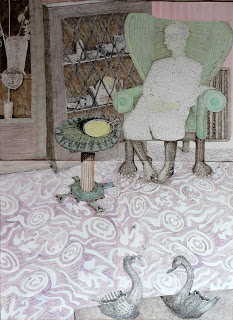
When my mother was dying I used to go down to my home town every weekend to see her and sit with her. I drew her several times and when she finally passed away I made images from the drawings as a way to come to terms with how I felt about her death. She was always surrounded by her 'tranculments', which had by then mainly been placed in glass fronted cabinets, but several, such as the swan vases or a toby jug, still adorned any spare surface, such as the top of the TV. I could find myself dizzy with the carpet pattern, often just looking for somewhere to rest my eyes, and when they rested on her, she seemed the most insubstantial thing in the room. I have a drawing of her where she literally dissolves into her chair and others where she becomes manic in her distress or lost in her bed. One drawing I made of her in bed, shows her dissolving into the pillow, whilst the bedspread becomes a repository of stories from her life. I drew all sorts of events that she had told me about, including the time when her sister Mary had trapped her foot in a rail line junction point, and how they were terrified a train would come. I tried to remember when she was happy and times when we were together, but there were many sad times too. Eventually the bedspread was covered with memories. 
When I first met Paulo Luís Almeida, he was giving a talk about his own response to a parent dying. He drew his father during the last years of his life as he succumbed to Parkinson’s disease, and Paulo spoke about the erosion of language and the disappearance of his father's world. Paulo went on to say that drawing 'incited a memorialising function of the trace'. Empathy was in his case the key issue, whilst for myself it was simply loss.

Paulo Luís Almeida: Untitled 2011

Maggie Hambling drew both her mother and her father as they were dying. 


Maggie Hambling

Hambling's drawings use a searching line that I feel attempts to give back life to the dead. Her own energy of looking is locked into these images forever, and when she has herself passed on, she will still exist in the frozen moments of her looking. 

Occasionally Foundation students used to ask me if they could get to draw dead people and the only person I knew at the time that had a way in to do this was Brian Holmes. I remember that I drew his portrait at one time, as he used to live just around the corner from where I lived in Kirkstall, however where that drawing is now I haven't a clue and he is now long dead, a reminder that every portrait ever made is in fact a memento mori. Brian was at one point commissioned by the School of Medicine of the University of Leeds to paint a mural detailing the history of Leeds Medical School and that meant he had access to their facilities, including the dissection area.

Brian Holmes: Detail of Leeds Medical School 

Brian Holmes: Foot: Etching

Brian used to go in to the anatomy area and draw bodies and could occasionally, if asked, get a student to go in with him. One of the students that asked me if he could get access was Damien Hirst, who always asserts that he was influenced by his visits to the anatomy department of Leeds Medical School and that he made anatomical drawings there. None of these drawings seem to have surfaced, but the photograph 'With dead head' has become an iconic part of his oeuvre. I'm not even sure if Brian was able to get Damien in and Damien may well have found a different way to get access, the point being that it was his association with the ever present idea of death, that to some extent signalled him out at the time as an artist of significance. 

Charles Emile Callande de Champmartin
Théodore Géricault was well known for painting and drawing the dead. In fact the image above was thought to be by him until a cleaning revealed the signature of his friend and follower Charles Emile Champmartin. Ironically the painting actually depicts Géricault himself on his deathbed. At the time, he was such an iconic trope of the tragic Romantic artist, that copies of his death mask were often found in young artists’ studios. 

Géricault: Deathmask

We all have to confront death at some time, it is a normal part of life and most cultures have embedded within them ways to come to terms with this fact. Except I feel our own, where we rarely see dead people.  Perhaps we all need to remember that we are dying, and in doing so, we might value life that much more. 

Head of the dead Christ: Durer

During the many years that Christianity formed the dominant religion of the Western World, images of the dead or dying Christ were available for everyone to see. People were constantly therefore being reminded of how death was a central fact of life. In traditional Buddhist teachings, contemplating death is an integral part of meditation. Buddha states that death is “the greatest of all teachers”; it teaches us to be humble, destroys vanity and pride and crumbles all the barriers of caste, creed and race that divide humans, for all living beings are destined to die. 

Kusôzu

Perhaps we need a return to the old Japanese Buddhist tradition of Kusôzu, whereby images were made of the sequential decay of a cadaver; not pretty but a clear message. The Roman Egyptian idea of encaustic "Fayum portraits," which were placed over the heads of mummies in coffins, is an interesting take on mortality and portraiture. These were not only realistic depictions of the deceased, the images were kept on the walls of the houses of the living and then when someone died they would be transferred to the coffin. So you would have been very aware that when the artist came to do your portrait, that its final resting place would be the same as yours. Being made in encaustic, which is an amazingly long lasting paint material, your image would like Dorian Gray stay youthful, whilst you would decay like Gray's portrait. Wilde's neat role reversal idea, in many ways highlighting our mortal condition.

A Fayum portrait

If I had to show one image that transcended the genre it would be the one below by Käthe
 Kollwitz. Kollwitz drew the workers that she met, particularly women who struggled to keep themselves alive under the most harsh conditions. In this image the woman you feel can see her own death in a not very far off future, a black ghost already sitting at her shoulder. But at the same time Kollwitz has found a deep humanity in this woman, she is a solid yet wonderfully delicate presence, on the one hand to be blown away by the trials of a hard life and yet on the other she is preserved, rock like, in all her dignity within Kollwitz's drawing. She is always in that moment that she appeared to Kollwitz, time past, present and future unravel and we are forever in the now of her being. 
 
Käthe Kollwitz

See also:

Dat

Artis

Saturday, 5 April 2025

Jonathan Richardson's self-portraits

Self portrait: Foot pain and its emotional effects

I have been making drawings and printed images of people, whereby I listen to them talk to me about their internal perceptions, (interoceptions) of pain, emotion and other inner body feelings. Essentially what I am making are a series of portraits, but images that attempt to reflect the interior world of people, rather than their external appearance. My fellow researcher at the Leeds Arts University, Dawn Woolley is focused on the photographic selfie, so it feels as if we have both interior and exterior awareness covered.
When thinking about a history that might lie behind my approach, I began by looking at expressionist portraiture, but as I dug around the subject, the more I came across the self portraits of Jonathan Richardson. 

Jonathan Richardson, Self-portrait, c. 1735

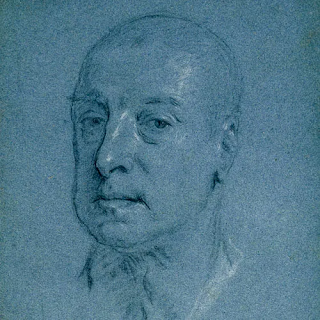
Richardson made hundreds of drawn self portraits over a period of several years. This type of serial facial analysis looked at from a present perspective, feels very modern. For instance in relation to expressionist portraits, in three of his more prolific years, Vincent van Gogh, drew and painted himself over 40 times. and as photography has become the main form of facial representation, serial portraits, such as Jo Spence's 'Brave' series, have become central to documentary practices.

Jonathan Richardson, Self-portrait, c. 1738

Richardson even went back to earlier work and made drawn copies of his self-portraits from paintings made many years earlier. Most of his self portraits are however drawn from life, using a variety of materials, including pen and ink, graphite on vellum but mainly black and white chalks on blue paper.

Jonathan Richardson Self-portrait as a poet, c. 1732

Jonathan Richardson, Self-portrait, c. 1728

During his early career as a portrait painter he defined his trade in this way, "a portrait is a sort of General History of the Life of the Person it represents, not only to Him who is acquainted with it, but to Many Others, who upon Occasion of seeing it are frequently told, of what is most Material concerning Them, or their General Character at least." However his later self-portraits, which are nearly all dated, are not a ‘General History’ of his life, they are far too particular. They represent the complexity of an inner emotional life, rather than the status or occupation of the sitter.

Jonathan Richardson Self-portrait at the age of thirty, 1735

Jonathan Richardson Self-portrait, 1736

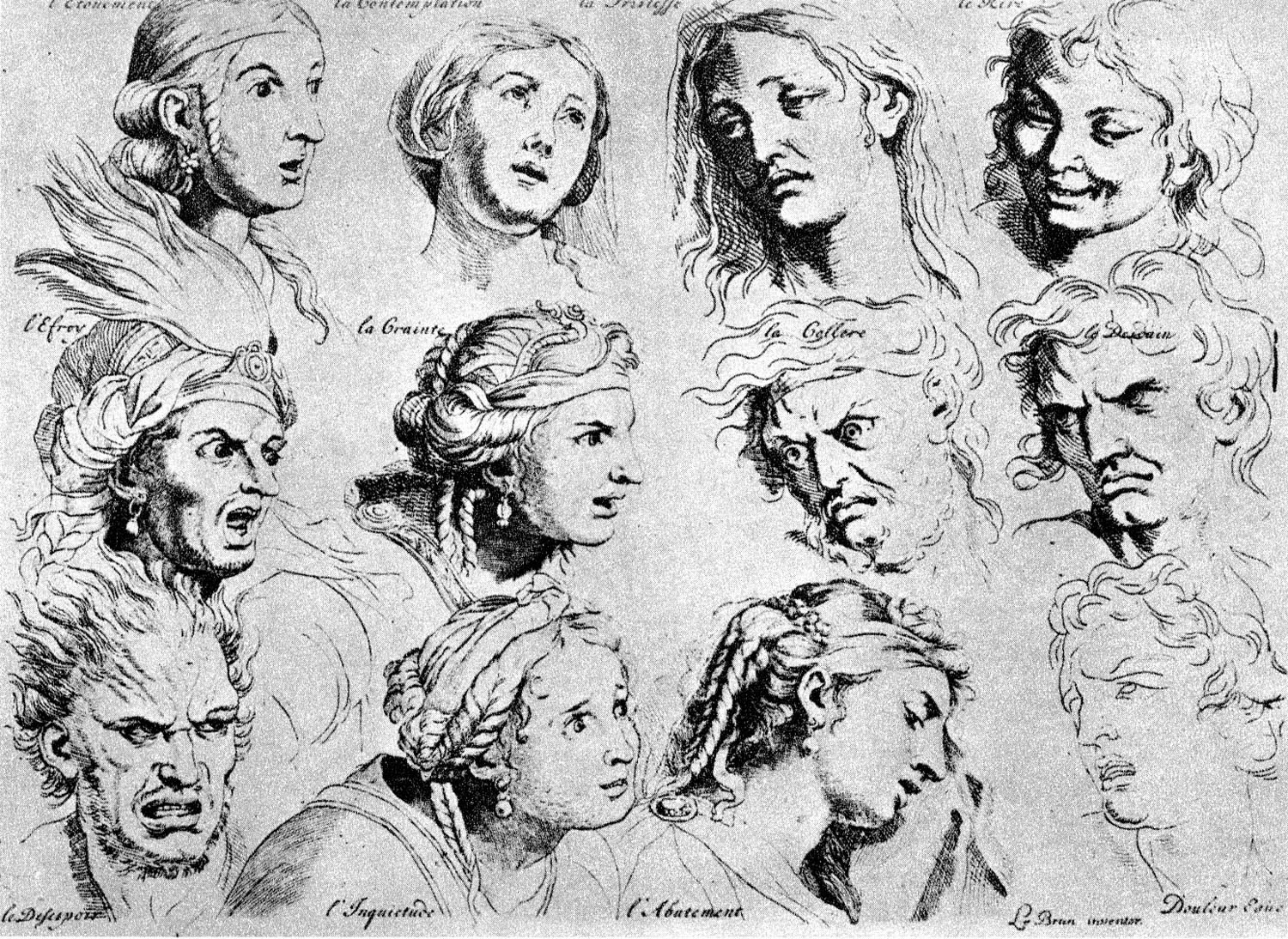
I find his portraits intriguing, especially how with slight differences in the openness of an eye, or width of a face, as well as by changing materials, he can give quite different impressions as to what he is thinking about as he gazes at himself. His images can feel very confident, or fragile, slightly sly or arrogant, quizzical or poetic but they don't feel forced or exaggerated as in Charles le Brun's  work or 
Messerschmitt portraits.

Charles le Brun: The expressions

Messerschmitt: Character Head

I first came across Jonathan Richardson in the chapter 'Searching for the self' in Susan Owens' excellent book, 'The Story of Drawing'. It is a book well worth a read if you are interested in how drawing supports the various ways that artists think about what it is that they do. We might value painting far more, but it is often an artist's drawings that reveal their thoughts and the roots of their sensibilities; the paintings or sculptures done afterwards often covering up the thinking surrounding an idea's gestation.

Richardson's portraits reminded me that you don't need to go 'over the top' when looking for expression and that it is often in small details that a telling communication is made. He also made his self portraits as he neared the end of his career, something I am also doing. It being a time to continue working if you still have the capability but the pressure to earn money or get out there to make your name is less and you can therefore reflect more on what you have done and how perhaps you can do it in a more interesting or personal way. 

See also: