Tuesday, 27 May 2025

Lynette Yiadom-Boakye at Leeds Art Gallery

It is a wonderful time to go and visit Leeds City Art Gallery at the moment, especially if you are interested in portraits. The new exhibition, 'To Improvise a Mountain: Lynette Yiadom-Boakye Curates', has been developed by the artist in collaboration with Hayward Gallery Touring, and although developed as a touring show, it sets up a series of fascinating associations and connections with work already on display in the gallery. I have seen several exhibitions containing Yiadom-Boakye's paintings of people; her imaginary compositions developed from photographs, life-drawings and found images and was curious to see how she drew as well as painted. She has also curated this exhibition, so it was a chance to see her wider interests in terms of image making, something that we sometimes forget is very important to all artists if they are to continually refresh their eyes and their minds. The focus of this blog is of course on drawing, but sometimes artists who draw and hand make images, also need to look at photography, if only to think about the differences between the two representational systems. Yiadom-Boakye's curation does that well, in particular because of her interest in Sickert, she gives us a reminder of his role in stitching together relationships between the two practices. He at times painted portraits of well-known personalities and when he did, his compositions and images were often derived from press photographs.

Sickert: King Edward the VII

Probably the most well known example of Sickert's relationship with photography is his 
portrait of King Edward the VII, the cropping being probably something he learnt from Degas. As artists began to respond to the photographic image, one of the most interesting issues was how we were reminded of how composed paintings were. One of Yiadom-Boakye's chosen artists, Lisa Brice, is I sense very aware of Sickert, but is now taking the concept of the frame and how it cuts into reality, in another direction, this time using it as a way to reconnect with images of women as framed by men in paintings. She is not like Sickert, casting a photograph into paint, but re-casting the roles of women who inhabit older painting, this time giving them a much greater agency in the image. An agency I personally recognise that can be derived from the act of smoking, the taking up of which at one time, I felt to be an anti-authoritarian snub to my father. It's interesting how easily personal history interweaves itself into the way we find meaning in our experiences. We might love our fathers, but we need to take actions that ensure we don't end up living life under their shadow and I sense that is partly what Brice is saying in these images, she loves painting's history, but needs to re-cast it as something she owns. 

Lisa Brice

Lisa Brice's other painting was I thought just as powerful and in its handling of materials, was an image I could associate with even more closely. I first saw Lisa Brice's work at the Tate and was at the time particularly drawn to this image of another smoking woman.


Lisa Brice: Parting at Dusk (2018) gouache on polyester drafting film 

The blue gouache paint streaks down the drafting film, a surface I have often worked on myself, as you use it in printmaking to hold and transfer gestural qualities when making silkscreen exposures. She translates William Rothenstein's Parting at Morning's material handling into something far more visceral, the paint standing for itself, rather than being a vehicle for representing fragility.  Brice is also making another translation, taking Rothenstein's representation and shifting its meaning, this is no longer an image of a frail white woman left by a man in the morning, it now becomes a woman of unidentifiable race, that will leave before the night, and who stands her ground, smoking defiantly. 

William Rothenstein Parting at Morning (1891, chalk, pastel and bronze paint on paper
Yiadom-Boakye is obviously interested in how painting's past can be revisited and she has chosen to exhibit one of her own responses to this. 

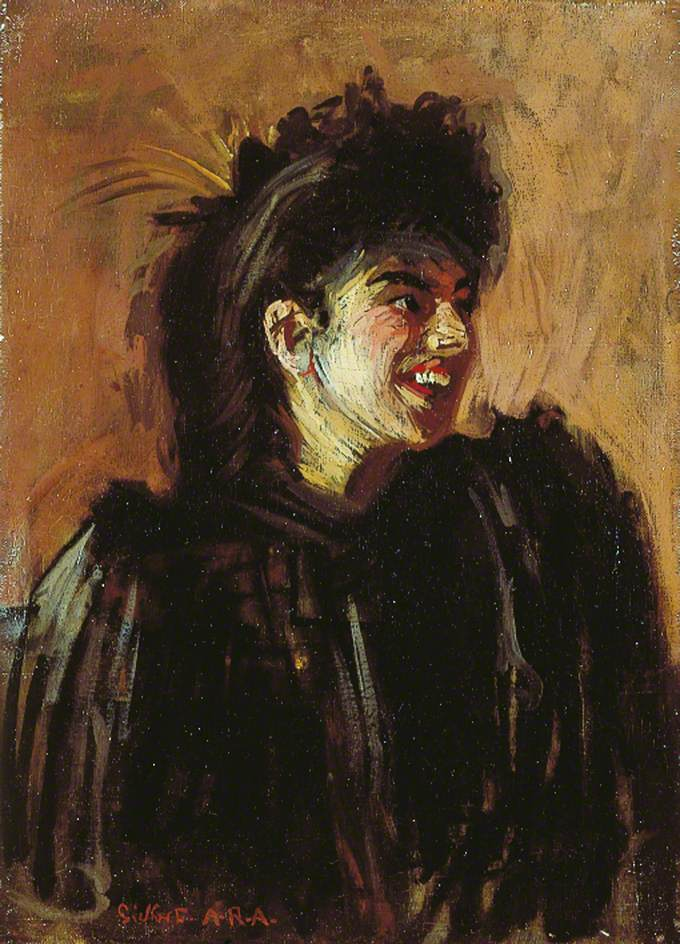
Sickert: The Blackbird of Paradise

Sickert's 'Blackbird of Paradise' painting has long been part of the Leeds Art Gallery collection and it first drew Yiadom-Boakye's attention when she was undertaking some teaching at the Leeds Metropolitan University. During a break she had gone down to the Art Gallery and found a wonderful portrait that is suggestive not only of how humans can be bird like, but how paint itself can inhabit different creatures or materials, sometimes being feathery but at other times slimy like a wet frog or dry like sandstone or an elephant's skin. It was also a study in blackness, of how one colour can be many; blue blacks, green blacks, violet blacks, transparent, impasto, gestural and solid; a reminder of how great painters give life to the paint they use, in order to give life to the subjects they depict. 


Sunbird 2 and 3

Yiadom-Boakye's imaginary portrait drawings, 'Sunbird 2' and 'Sunbird 3' are direct responses to Sickert's painting. At the core of my fascination with her work, is the fact that her portraits are imaginary. She forces us to confront what I think is a central issue in our understanding of portraiture, how much of our understanding of it is due to our obsession with what someone looks like and how much is it a reflection of how we read human beings as types. If, she suggests, an artist is to give life to her subject, she has to first of all 
give life to the materials used to depict that subject and if that is successfully accomplished, this new life, will be read and responded to as any other human being. Sometimes understood as a stereotype, or cliché and at other times as a particular individual that you can have empathy with; the reading is in the power of the beholder. 

Upstairs in the art gallery there are two other exhibitions focused on portraits. One which has been there for quite a while and a new exhibition focused on portraits of women, an exhibition that has to be shown in very low light levels due to the fragility of the various papers on which the works chosen were made. Between the three presentations there are some very interesting comparisons to be made. 

Yiadom-Boakye: Charcoal on paper

Jacob Kramer: Drawing for 'Mother'

Two similar sized drawings, both using charcoal are to be found on exhibition. One by Yiadom-Boakye is downstairs in the exhibition 'To Improvise a Mountain' and one by Jacob Kramer, is in the drawings of women exhibition upstairs. Although both drawings use similar mediums and sizes the handling is very different. It is perhaps easier to see in a detail, especially as it is very hard to photograph images behind glass. 

Yiadom-Boakye

Jacob Kramer

Yiadom-Boakye's hand is a simple solid, the charcoal is blocked in and heavily worked with a rubber. The charcoal is pushed into the paper, using it feels like a good sized block of compressed charcoal, as opposed to a willow charcoal. Kramer's is softer and more delicate. He uses willow charcoal, smoothing out his tonal changes by smudging with his fingers and making highlights with a sharpened rubber. He is feeling for the form of the hand as an extension of the expression of the face, whilst in comparison Yiadom-Boakye's hand is more generic, perhaps even more mechanical, definitely a hand designed to punch more than to express a continuation of the 'read' of the face. Both artists are seeking some sort of authentic communication, trying to express something about what it is to be part of a community that has historically for one reason or another been overlooked. As people from my own family, came as Jews to the UK in the late nineteenth century, I am very aware of the pogroms that Kramer is asking us to remember. His family lived not far from where I live in Chapeltown, which was then home to immigrant families from eastern Europe and Ireland, as it is now for people from the West Indies and other parts of the old British Commonwealth. Kramer wrote that when he was looking at his subject, he saw both its physical appearance and its spiritual manifestation. His struggle, he claimed, was to escape physical appearances and to paint the subject's spiritual form, an idea that was very much of his time, being central to expressionist thinking and deeply influenced by Theosophy. His struggle to find a form of expression that could both elevate the human spirit and remind us of a people's history, give his images a particular authenticity, that can find parallels with Yiadom-Boakye's work. She is also concerned to address a history of a people's representation, or perhaps more accurately their non-representation and in giving form to invented lives, she peoples the walls of the galleries she exhibits in with the portraits that have historically been missing.

As Yiadom-Boakye's portraits are not of any particular person, being constructions made from various source materials, they are anonymous and this opens up their interpretive possibilities.  
Many portraits over time lose their associations with particular human beings and by the time we get to see them, the name of who was depicted has long disappeared. But we are still fascinated by the image of a human being, and perhaps once a portrait is unanchored from the particularities of a name, we can much more easily inhabit the image in our imagination.

An Egyptian 'Feyum' portrait of an unknown man

Perhaps the most powerful example of this effect on myself was when first encountering 'Feyum' portraits. They appeared so lifelike, especially as I knew that they were 2,000 years old, their freshness mainly due to their being painted using wax based encaustic techniques, a reminder of the fact that in comparison most contemporary art materials will fade and deteriorate very quickly. I felt I could 'know' these people, that they were alive to me and I was able to give them life stories in my mind. This aspect of historical distancing also operates with Ottovio Leoni's 'Portrait of a Lady' on display in the upstairs gallery; although drawn in the 17th century, I felt she could have just walked into the room. The drawing very subtly draws you into her gaze, the marks constructing it changing, as we move from the gestural impressions that form the outer edges, towards the much more refined drawing of the face. We are in effect, visually sucked in.  

Ottovio Leoni: 'Portrait of a Lady'

There are so many comparisons and stories that can be made out of this conjunction of exhibitions, that I find myself drawn back into the gallery at least two or three times a week, each time a new set of relationships suggests itself; a proof to myself of how important free access to art galleries is to the wellbeing of cities. In order to 'see' an image, you often need to go back and look again and then after letting it dwell in your mind, you need to go back and look again. It is such a privilege to have somewhere you can do this, without having to pay an entrance fee. This is an issue that does affect us in Yorkshire, I now rarely go to York Art Gallery where the entrance fee is £8.50 or to the Hepworth where it it £13. We should never therefore take our local gallery for granted. 
'To Improvise a Mountain: Lynette Yiadom-Boakye Curates' is on exhibition until 5 October 2025. 

See also: 

Monday, 19 May 2025

Thinkfeel

In a post I wrote a while ago I referred to Timothy Morton's use of the term 'thinkfeel', which I took to be about 'grasping the ungraspability of a thing'. A few years later after getting involved with attempts to visualise things that are invisible, I'm even more impressed with Morton's ability to put words together in order to explain the unexplainably difficult nature of our reality. Morton told us that reality was populated by 'strange strangers', by which they (they use the 'they' pronoun) meant that the things around us, books, chairs, houses, soil, plastics, sunshine, water, trees and whatever you might encounter, are all weird. So how is the world weird? Perhaps its because we use language as a sort of screen behind which we hide from reality, we use words to single things out, 'books, chairs, houses' etc. which makes it seem as if there are nicely separate objects out there, but in reality everything is interconnected; a state that in Buddhism is termed 'dependent arising'. I have in the past when considering organic objects such as trees or humans, looked at the Markov Blanket effect, which explains how nothing living can ever in reality be an isolated fixed thing. This time, as I return to thinking about the issue, I'm more aware of animist approaches to the world, and that there is a long history of understanding everything we encounter as a fluid arrangement of energies. This both allows us to inhabit non living things mentally, (as in animist cultures as well as in the extended mind theory), and enables us to think about a life force energy, as something that gives agency to all things, not just organic forms. 

Starbucks cup

If we take a basic plastic cup, something we often use when travelling, we find that the cup is involved in a complex journey too, one that involves vast time periods and which is often interwoven with our own path through life. The primary component of plastic cups is polypropylene and the main reason you are given the cup you have been given, is its affordable price. Polypropylene is made from chains of the monomer (
a small, reactive molecule, that can be joined with other similar molecules) propylene, which is a hydrocarbon obtained from natural gas and crude oil. The monomer propylene is subjected to a polymerisation process, where it bonds with other propylene molecules to create polypropylene. One journey is back into deep history and the conversion over millions of years of organic matter into natural gas and oil. Another is into the anthropocene, our current geological age and is associated with the greenhouse gas emissions released during oil extraction, plastic processing, and consumption. We also journey into the world of material properties, where we find that polypropylene's structure provides good insulation, allowing a disposable cup to contain hot coffee without you being burnt. A journey into economics, might lead some people to believe that its use is cost-effective. It has a structure that allows for both crystalline and amorphous regions, therefore it can be strong and resilient, as well as flexible and pliant. This gives it as a material great versatility, helping to make it quite straightforward to produce, which drives costs down, because there are a lot of manufacturers who can afford and know how to use the technologies of its production; which leads to significant competition, that further drives down prices. It also has a very low density compared to other plastics and less weight means less cost in terms of transportation. We can now begin to see the cup as an aspect of a series of wider economic processes, which are themselves driven by material properties. The cup is now in my hand and I'm drinking from it, so it is now totally interwoven with my biological processes and my ecological network. I have already observed how the boundaries of biological systems, from individual cells to people, can be thought of as places where one energy meets another form of energy. These systems are also where interactions take place that help to stabilise them. This being a situation that is operating alongside our perceptual awareness of the particular biological entity we are considering. A Markov blanket concept can be used to define the boundaries of this situation in a statistical sense. I.e. instead of a solid entity you have a series of probabilities whereby something is and isn't at the same time, something that can also be thought of as an active inference scheme. As you infer something is in existence, when you look at it directly it hardens up and becomes a fixed probability, called in this case a plastic cup.

Thinkfeel meditation on a plastic cup

Timothy Morton was at one time a Buddhist and therefore would have been very aware of the concept of 'dependent arising'. This awareness has I'm sure helped them to move away from the Western ideal of humans always attempting to master the world and its objects and to have more respect for the complexity of interconnected processes. What we might feel is a disturbing and difficult compaction, is perhaps a new 'beauty'. When we confront reality it is far too complex to experience, but encounters with objects always reveal something, even though they also make you aware that other things are not available to our experience. Everything and everywhere is real in its own way, and it is constantly interacting with everything else, including you.

There are diagrams that have been drawn to help us get to grips with the Buddhist concept of dependent arising and as I'm always fascinated by how diagrams help us rethink the world, it's perhaps time to look at some. 

Dependent arising three lives model
The diagram above uses a circular format based on the Tibetan “Wheel of Life”, with twelve links on the rim of the wheel. The circular format clearly illustrates the concept of “rebirth linking” connecting kamma (action) and consciousness. It also graphically displays the central role played by unwholesome roots (kilesa) of attachment (lobha), aversion (dosa) and delusion (moha). It uses the “three lives” elaboration. Links one and two are in a “past life” whereby ignorance or false knowledge sets the conditions for formations or pre-dispositions to arise. Links three to ten are said to be in the “present-life”, commencing with the arising of consciousness and the mind-body, which in turn condition further links to “becoming” (link ten). Links eleven and twelve are “future lives” linked to re-birth, old-age, death and inevitable suffering. Woven into an understanding of the diagram is both a macrocosmic viewpoint, encompassing “physical” rebirth and life in general; and a microcosmic viewpoint emphasising “moment-to-moment” phenomena of the mind and consciousness. Both perspectives are relevant to how kamma and rebirth relate to dependent arising. Kamma is associated with the idea that all actions (no matter how big or small) have consequences. However, for Buddhists it is more specific than that, as they believe that there are skilful and unskilful actions. A skilful action is one that produces happiness, whereas an unskilful action is one that produces suffering. It is this final point that has helped me to rethink my role as an artist within all this. The concept of 'skilful' action is I believe very important as it allows 'agency' into the framework. It allows for some sort of moral compass and helps us to think about the types of agreements that could be drawn up between humans and the Earth. It would be useful to have a contract on being born into this world, that states our responsibilities to it, as well as to each other. Well that's what I 'thinkfeel' at the moment, a time when I'm unsure about so many things and which finds me trying to 'thinkfeel' my way through a fog of uncertainty, any clarity or firm intellectual framework being blown away by current world events.

I see it more like this

Circular forms are useful when thinking about stuff of this sort as they imply never ending returns, suggesting wheels that rotate through themselves but also the axes that they turn around may lead to holes into which things can fall. I once thought of the lasso as something like this, perhaps more akin to a whirlpool or spiral galaxy, which was also a thing that could be tightened up until it had closed tightly upon the object that had been lassoed.

The lasso: Another of life's circles.

I produced these Western World cards at a time when an earlier US president was engaging in a Gulf War, a war that exposed a gap between world views, that seemed at the time to be a product of lies and wishful thinking, rather than a response to reality. Give us enough rope and we will repeat our mistakes over and over again.

Spike Milligan understood how 'thinkfeel' worked, he wrote as if he knew that poetry would one day leave science behind.

There are holes in the sky
Where the rain gets in
But they're ever so small
That's why the rain is thin.

The 'thinkfeel' answer to why rain comes in very small thin drops.

See also:

Saturday, 10 May 2025

Leonard McComb

Tulips: Leonard McComb

I have just been alerted that the Artspace Gallery is hosting an exhibition of the work of Leonard McComb. He is one of those artists that I often go back to, he is a sort of lodestone that sucks me into his world, as well as being someone against which I can test myself. Nature and energy were often cited as his subject matter, but I have always put him in the category of those artists that deal in uncertain certainties.

There is something about seeing and its relationship to touch, as well as a fluctuation between mass and space, alongside something of the spirit inside the body, all compressed into the best of McComb's drawings. A spiritual radiance can sometimes be seen emanating from his drawings of flowers. it feels as if he touches the petals with his eyes, caressing them with directional marks, as he feels around the mass of their reality. Small marks, like bricks, can make solid edifices; as I put it in a former blog post on his drawings; "marks that at their inception appear to be looking for the form, but as they build up, they energise the image, eventually space and mass interpenetrate, all now vibration". He can at times capture the material condition of an object and in the same moment make it as transient as a soap bubble.

Leonard McComb at work on 'Rock and Sea , Anglesey,(Benllech)'

I remember going to see his monumental drawing of the coast entitled “Rock and Sea , Anglesey,(Benllech)”, I think it was in Sheffield, but where I saw it doesn't matter, it's a giant drawing made out of pencil, brush and ink on watercolour paper. Because of what I was doing with my own work at the time, I was reinforced in my belief that you could create monumental art by gradually working across small sized pieces of paper and constructing a final piece from the fragments and although making images of interiors, I too wanted to capture the way I was immersed in looking as an experience and his work was a fine example. It was also an answer to working and living at the time in a small terraced house. But his work also had a profound experience on me in relation to a much wider idea of art as a doorway into the spiritual.  

I'll see if I can explain, as well as try to tie in some of my thinking about the visualisation of invisible forces. When I used to work on the foundation course at Leeds, one of the reoccurring themes was the drawing and painting of a fish brought from the local fish market. It was an activity often promoted by Gavin Stuart, the oldest member of staff at that time, someone who had worked alongside Tom Hudson, Terry Frost and Alan Davie. Fish were looked at as objects of wonder, their iridescence hard to capture and their life form in death a reminder of mortality. Students would struggle to make convincing representations, but in the struggle would begin to come to terms with what it meant to confront a serious subject. 

McComb took on the same challenge, several times. Sometimes I think he missed the mark, but at others he was able to touch one of those experiences that transcend the everyday and elevate it into myth. 

Fish: Leonard McComb

In this image of a fish on a plate, the plate receives the aura of the fish and becomes an aureole, that circle of light that normally surrounds the head or body of a person represented as holy. Energy radiates out through the brush-marks, the paint being applied in such a way that it indicates the mass of the fish and some aspects of its physical presence, such as its iridescence, whilst at the same time the paint marks are open enough to suggest that it is a vibrating energy form, perhaps even a ghost of its former self. 

Flower painting

McComb at one time stated that nature's 'forms and shapes radiate from a centre’. I'm not sure that is right, but he did 'see' some sort of radiant energy surrounding the forms he was trying to represent. In the flower painting above it is the air around the stems and flowers that is energised, the glass vase begins to vibrate to its own tune, whilst each flowerhead sits still, surrounded by now revealed invisible forces. It is easy to see this in a painting because the marks are more substantial, but some of his drawn images almost dissolve back into the paper out of which they were envisioned. 

Flowers

The image of flowers above is almost impossible to see as a reproduction. Something I curmudgeonly like in a time of easy image reproduction and the dominance of the screen. In my earlier post on that feeling of an uncertain certainty, I put McComb in the company of Cezanne and David Jones, both artists that had strong convictions about the world they were experiencing, but who as they struggled to articulate their visions, found their images becoming less and less solid and more and more like dancing energy fields. 

This work is a type of vanitas, a reminder of the fragile nature of life. McComb was also a trained sculptor, and as such he would have been very aware of the materiality of thought; so to produce the flat work that he did and to position it on such a delicate fulcrum, balanced between awareness of mass and of spiritual forces, he must have in my mind also have been an animist at heart. He was able to send his mind out into the things he drew, out into the sea and the rocks, where for a while at least he would have inhabited the world he saw, so that what he was drawing was not the sea or the rocks, but his own mind as it conjoined with the spirit of the world. 

The exhibition LEONARD McCOMB, Body and Spirit Paintings and Drawings, is on 9th of May to 4th of July 2025. Michael  Richardson  Contemporary  Art, the Artspace Gallery, 84 St. Peter's Street, London N1 8JS

See also:

The Artspace Gallery
The uncertain certainty


Friday, 9 May 2025

Our death is drawn

I have been suffering from blocked ears this last week or so and it has been accompanied by sore throat and cough, you know the type of thing. The stuff you shrug off when younger but which seems to hold on for too long as you get older. I thought that I would be recovered as soon as I could get in to see a specialist ear wax removal person, but after they had tried hard for a long time they gave up and I have to go back again, after another week of olive oil in the ear treatment. Apparently I have a very narrow ear canal and the wax could not be pulled through it. However it was not a totally bad experience because they did have a tiny camera operating at the same time to see what was happening, so i did get to see down into myself from an unusual angle. I was able to then enter my head imaginatively from a new direction. I was left with earache for several days afterwards and an accompanying tinnitus like sound in my head, not unlike a roaring sea, which of course I have tried to visualise. One advantage of working on the visualisation of interoceptual experiences is that my own are just as important as other people's and I now have more empathy with those people who have tinnitus. 

As I tried to visualise the experience, I also began writing about it, to see if the one communication system could inform the other. This is a transcription taken from the notebook I keep at my bedside, alongside the visual notes I drew at the same time. 

I'm dream/thinking around 'soar', a word that sounds the same as sore and saw. I see a bubble trapped, and now several, all trying to rise up, wanting to soar up and out into the sky above me, but they are held down by the massive weight of a granular blanket that sits over the whole of one side of my head. 

The dull ache of pressure goes into a hole at the centre of my vision and then begins to spread out, I feel the soreness radiating as white light out from this dark centre. 

The soreness spreads out into the jaw, it now becomes a saw, sawing into the bone. It sits just underneath the left ear, which was the one the ear specialist had spent an hour with, trying over and over again to suck out recalcitrant wax. I imagine it massed up inside, hard and brittle, resisting the oil that tries to soften it. As the awareness shifts to the bone, it is as if there was a transfer of energy from one state to another, as if from liquid to solid or from rotary to linear movement. A spiral begins to revolve around the growing white centre of my vision, and a sound that reminds me of the whistle we had on a kettle many years ago, begins to come into my awareness, as if from a distant room in the house. 

Something is trying to get through, I feel it, rather than see it. Those bubbles are pushing to be released but they are not strong enough, things are stuck down, but something is still trying to lift them, as if the glue that holds them in place was still drying and not quite able to hold anything firmly. Things are trying to be repositioned, olive oil, is trying to have its say. 

Occasionally my other ear comes into focus. It is also blocked but has not been prodded and pocked about so much, so it sits in the background, but very solidly, a huge full stop, emerging like an iceberg from the other side of my face, but dark, not white, exacting a huge pressure and singing a gravity tune, one that is vibrating my cheekbone, as well as eating into my forehead. 

The next day, I began to work from my notes in order to visualise what I had thought /dreamt about during the night. 

I initially created a diagram so I could think about the head as a whole rather than just the ears. The diagram helped me to think about how when something goes wrong it shifts things off balance. One ear was far more blocked than the other, so it visually intruded into the hollow space of the head more than the other; in fact I can hardly hear anything in my left ear. So I decide to make an image of what it feels like, based on my initial notebook drawings. In the diagram I rotated the notebook images by 90 degrees to the left and right, so I kept the new image sided, it seemed to make more sense. 

Blocked left ear

Between the digram and this new drawing there was something missing, so I returned to making a new image, much larger this time on a A0 sheet of watercolour paper. 

Interoceptual portrait with earache 

I used the written notes as well as my initial scribbles, to develop the next image. Although using information from 'inside' it of course still adheres to a remembered body plan.  I was also reminded of an old exercise from my pre-diploma course in Wolverhampton, whereby we had to draw our faces by touch. I did like the fact that the head seemed very alive in its pain and how a very literal response to what I had written, had given the image a certain unpredictable something, that kept it in the now. 

Even a non-life-threatening illness takes us off balance, even if by just a few degrees, shifting us away from the upright vertical that is part of the bi-lateral symmetry that signifies that we are healthy and full of life. Perhaps what I'm drawing is a premonition of a future that I have to face at some point; illness being a sort of mini-death. 

Blocked ears mean you are often confusing what people are saying to you, you mishear, a phrase such as, "A breath is drawn" can be heard as "Our death is drawn". A small difference in sound, but enough of.a conceptual difference to offer up a bucket full of associations. 

To draw breath can be about giving yourself a pause, allowing for a moment that is about gathering your thoughts together before having to take action. A last breath or dying gasp, signifies the end. I was what was called in my day a 'blue baby' on arrival into this world and for a few moments there was a worry I wouldn't survive, but after some hard slaps from a nurse, apparently I began to breathe and have continued to do so ever since. It feels as if I needed reminding that breathing was going to be central to my life, I was at the time probably still dreaming of the comforts of being inside mom, and not really wanting to take on the responsibility of life. 


 I recently put up a post on drawing the dead and the dying, but I don't think I managed to say anything particularly useful, well not in terms of where I think I'm going with my own work now; so perhaps a return to the subject is needed. One of the most moving images of death that I know of is Claude Monet's painting of his wife Camille. She had been ill for some time and although her death was expected, it was still a tragic loss for him. He painted her as if she is slipping back into the life stream, dissolving back into the waters she came from.

Monet: Camille Monet on her deathbed: 1879

Seven years later another impressionist painter Marie Bracquemond, painted 'Iris in a Vase', another image of death. She made an image that is in its own way as powerful a meditation on death as Monet's. Monet tells us that death can be an individually tragic experience, and even though it is something we all have to face, when we do it is always a difficult moment. When we do face up to it, hopefully we recognise that death is actually what makes life so special, and in doing so, we embrace it. Bracquemond reminds us that everything dies and that in that moment of death, life returns back into the materials out of which it emerged. She extends our sympathy out into the wider world of vegetable life, a reminder that plants are a life-form too and that like ourselves they have to follow a cycle of living and dying. She was reworking an old vanitas tradition, but within the conceptual reframing of Impressionism, a moment of cast light, being as monumental as a cathedral, the sight of a cast petal, as weighty as a stone. 

Iris in a Vase: Marie Bracquemond: 1886

This is a bitter lesson for myself, in terms of what I am doing and how I do it. It's not so much the recording of sensations that is important, my blocked ears are in fact inconsequential; more important is the fact that I'm trying to visualise the fact that sensations flow between inner constructions and outer perceptual experiences and that this flow, will at some point need to stop and be translated into another state. One that I should be more accepting of, because at some point I too will return into the flow of materiality. In making images of what I think, I leave something behind, if only for a short while, and if those images help someone think about their life and find comfort or meaning in that thinking, then that's fine and my work will have fulfilled a purpose, even though I would have no awareness of it. 

See also

Drawing the dead and the dying

Drawing as a model for life experience

John Berger

Drawing exercises 

Why draw ears?


Saturday, 3 May 2025

Gut feeling

Queasy: From a series of images searching for how a gut feeling could be visualised

We know the term 'gut feeling' so well that perhaps we ignore it. Our feelings lie inside us and often lodge themselves into or emanate from our stomach. A stomach that is filled with bacteria, another life form that has evolved in conjunction with ourselves and that is so entwined with our bodily processes that it could be thought of as both another brain and another body, our ghost or double, that is thinking for us or alongside us, as we predict what to do next in the world.

Writers are very aware of this and we often find passages in novels that suggest that our bodies contain the source of our intuitive feelings. For instance this from Vajra Chandrasekera's myth creating novel, 'The Saint of Bright Doors':

'He feels that familiar sensation in his gut: the sickening, queasy tugging that he has always thought of as his luck, his instinct, some deep sensitivity to the world that senses where he needs to go, what he needs to do, long before he can even articulate it. When it bubbles up in him, there is always something he needs to do, even if he doesn't know it yet.' (2023, p. 26)

In an earlier post, when writing about Turner and his relationship to weather I wrote, "I believe that at the core of art's image making process is the idea that the universe is made of physical stuff and that as Seth (2021, p.20) states, 'conscious states are either identical to or somehow emerge from, particular arrangements of this physical stuff'. Artists can therefore work with material processes to create metaphors by making their own arrangements of physical stuff (paint, drawing materials, clay, stone, found objects etc.). These arrangements or physical conglomerations are like in someway, those other particular arrangements of physical stuff that are not art, those organisations of materials that we call life experience. By making these arrangements, (art) we help ourselves come to terms with the chaos of the arrangements of materials we experience as 'life'.

So yes physical stuff moved around in similar ways to other physical stuff. Echoes of larger forces perhaps? Our microbiome is spread throughout our body, and concentrated differently in the various areas that bacteria and other organisms, such as fungi, collect. It is also important to remember that microorganisms form the bedrock on which every ecosystem on Earth is founded. Without them we would have no air to breath or food to eat; without them we would not even be able to digest food, even if it became available. At a basic level, they are linked to the atoms and molecules that make up the non-animate physical world, sitting between them and 'life', holding myriads of conversations between animate and non-animate worlds through chemical and electrical exchanges. Everything is connected and the trillions of entities that live within us, connect us together, and link us to the rest of the world, just as surely as gravity holds together the mass of substances that we call the Earth, and in its own small way, how the various blobs and marks that make up or compose a drawing, come together.

So can I fuse these various bits of awareness with the visual metaphors I use in the images I make? Towards what purpose? If we can begin to see our bodies as feeling tones, as thinking entities that operate as material texts, then perhaps we can begin to see how inextricably linked we are into the Earth's bio-systems and as one steps back and looks at the situation from a cosmic distance, how we are linked in to the universe itself. Portraits of humans could be more like star systems or molecular level clusters seen via electron microscopes, all linked by interwoven energies be they electromagnetic, nuclear or gravitational.  

Stomach ache linked to constipation

The Milky Way

Granite seen under a microscope

Self portrait as a material text

References:

Chandrasekera, V. (2023) The Saint of Bright Doors Oxford: Solaris

Gershon, M. D., & Margolis, K. G. (2021). The gut, its microbiome, and the brain: connections and communications. The Journal of clinical investigation131(18), e143768. https://doi.org/10.1172/JCI143768

Seth, A., (2021) Being you: A new science of consciousness. London: Penguin.

See also:

Up close and far away: The macro and the micro
Drawing texture
Drawing and quantum theory
Powers of 10
Macro and micro: Embodied networks

Wednesday, 30 April 2025

Body Auras

 
“General Perspective View of the Human Aura.” Auguste Jean Baptiste Marques (1896)

My ongoing research into the visualisation of interoception has on several occasions led me to consider the historical role of 'the aura' in the visual realisation of the body's invisible forces. The aura or as Walter John Kilner termed it 'the Human Atmosphere' in his book of the same name, is associated with an idea of energy fields that move through the body. It is an idea that has been used many times and across several cultures, and I suspect it will come into its own again, once we begin to have a clearer idea of how the quantum world interfaces with what we think of as 'normal' space time reality.

The nearest phenomenological experience I suspect I ever encounter in relation to auras is when I get a migraine. An initial shift at the edge of my vision begins to splinter into the colours of the spectrum, and then gradually the world I look at begins to bend and fragment, the experience being not unlike looking at the world through a cut glass vase. I sense that if I could see myself from outside my body, my head would be surrounded with a faceted glow. I have had these migraines for many years and when I get them I just accept them and watch. They are a useful reminder of how much the world is a construction of my perceptual system and I try to hold on to the sensation of moving through what becomes a very fragmented world, even though I am intellectually aware that nothing outside of myself has actually changed.


I have made my experiences of migraines in both clay and in two dimensions.

Sol Invictus: Roman

I found this image of a Roman Sol Invictus recently and I felt that perhaps its maker had also experienced migraines. I liked the fact that the eyes were shut, suggesting a concentration on internal energies, that were then escaping through the head. A glow around the head is a visual idea that in religion is usually called a halo and I think that because of the prevalence of so many halo type glows that emerge from Holy Ghosts, Jesus and the Saints, that a heavily Christianised society such as that in 19th Century Britain, would have been well prepared for an idea of invisible auras, so it is no surprise to see texts such as '
The Chakras' by Leadbeater, whereby he illustrates chakra forms as if they are circular auras, or 'Man and His Bodies' by Annie Besant, which has a chapter on 'the human aura'.

The crown chakra: Leadbeater

Some neurophysiologists have though apparently suggested that the ability to see a glowing aura surrounding a person is the product of synesthesia. Aura, or emotionally mediated synaesthesia is described by people with that particular synesthesia, as a condition whereby they see projected around other people colours, which depend on some sort of emotional condition that belongs to the perceiver. This condition can also be seen in relation to objects that people have an emotional relationship with. The important issue here is that the 'aura' is therefore a projection that is dependent on the perceiver. Could it be therefore, that it was a person with emotionally mediated synaesthesia, that first came up with the idea of an aura?

Emotionally mediated synaesthesia aura

Ramachandran, Miller, Livingstone and Brang (2012) have investigated this issue and have attempted to give scientific credibility to what has often been regarded as folklore. They based their paper on a 23-year-old man diagnosed with Asperger's, who began to consistently experience colours around individuals from the age of 10. His colours were based on identity and emotional connection. They also investigated the subject's claim that emotions evoked highly specific colours, allowing him, despite his Asperger's, to introspect on emotions and recognise them in others. It was this aspect that particularly interested myself, as it appeared to relate to my interest in how emotion could be visualised.

Ramachandran, Miller, Livingstone and Brang: A colour taxonomy of emotions

Ramachandran, Miller, Livingstone and Brang (2012), have developed a diagram to explain their subject's taxonomy of emotions. They had noticed that the subject’s colour for pride was a shade of blue and the colour for aggression was pinkish–red. As the colour for arrogance was purple, they presumed this was due to an understanding of a mixing of blue and red (pigments, not light), the combination of pride and aggression in what could be called an emotion–space being arrogance. This observation, if further verified would indicate that the subject’s colour associations are not random and are the results of a taxonomy of emotions subjectively understood by the subject. Ramachandran, Miller, Livingstone and Brang went on to map several of the subject’s emotion–colour associations in a colour space, which resulted in a colour taxonomy of emotions; which reminded me of Robert Plutchik's wheel of emotions and so I set out to compare the two.
Robert Plutchik: Wheel of emotions 


There were only five words that were the same, (see linked in red) and of these there was not enough congruity to establish anything meaningful. For instance for the person with emotionally mediated synaesthesia, joy is red and for Plutchik it is yellow. Disgust for one is sort of orange and for the other purple. Love sits between green and yellow for Plutchik but is red/purple for the synesthete and fear is green for one and red for the other. It was interesting though to see how when people pick emotive words how hard it is to hit on the same words. Another possibility was I suppose to cluster the words, putting nervousness for example next to apprehension, at least they were both in green.
I had earlier played around with Plutchik's idea and had placed colours around his cone of emotions, as I did like the fact that different saturations and tonalities could be linked to degrees of emotional intensity.
Plutchik's cone of emotions: Anger, annoyance and rage

The idea of colour intensity and an aura type effect has often been used in the past when artists were having to find ways of visualising a closeness to divinity. In Medieval art full-figure auras, are called aureoles or mandorlas if more almond shaped. They are used to indicate a divine nature or at times figures under divine protection. Mandorla were often painted in several concentric patterns of colour that grew darker as they came close to the centre. This was a reflection of the church's use of apophatic theology, whereby as holiness increases, there is no way to depict its brightness, except by darkness.

Christ within a green mandorla 

The aura type image we associate with Christianity is something that is found in earlier art forms as well as other religions, also to signify divine presence.

The mandorla is made from two overlapping circles

Circles are perfect forms and two perfections overlapping create the almond shape of the mandorla. Known as the vesica piscis, (bladder of a fish), this shape is a type of 'lens'. which is itself a mathematical shape formed by the intersection of two disks with the same radius, intersecting in such a way that the centre of each disk lies on the perimeter of the other.

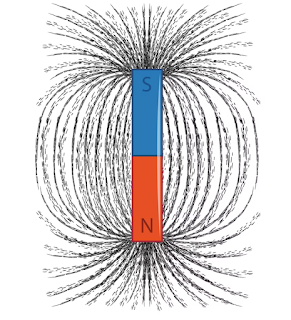
Whilst religious iconography picked up on the visual power of aura type images to represent invisible mystic or divine powers, our bodies can also be thought to hold within them other types of invisible energies; energies that could perhaps be visualised in similar ways. For instance, the heart's rhythmic contractions create a strong magnetic field that can be detected outside the body using magnetometers and it has been observed that this field can be modulated by emotions. As someone with atrial fibrillation, I'm very aware of how when my heart speeds up in response to an emotional dilemma, my interoceptual awareness of it changes and I can 'feel/see' these energies moving through my body.

Iron filings reveal a magnetic field

The shape of a magnetic field

Magnetic field distribution (left) and corresponding body surface potential distribution (right), generated by a current dipole activated at the apex of the right ventricle, with the a magnetic catheter technique. (From Fenici, Brisinda and Meloni, 2005)

As can be seen from the image above, computer aided technology can produce maps of the body's electromagnetic fields, that allow you to compare images belonging to
electrocardiogram fields of the heart, to those of magnetocardiogram fields. In order to do this, the heart, can be thought of as an electric dipole, (the separation of the positive and negative electric charges found in any electromagnetic system that produces an electric field). This field extends in all directions, and can be measured at the body surface.


Putting electrodes at two different points which each have a different electric field strength will produce a potential difference. If you connect electrodes to two different points at the body surface, you should be able to measure the potential difference generated by the cardiac electric field, and then plot its changes over time. This is how the electrocardiogram works.

Dermatomes of the Upper and Lower Limbs
Dermatomes are areas of skin on your body that rely on specific nerve connections to your spine. In this way, dermatomes are much like a map. Upper limb dermatomes run longitudinally, while lower limb dermatomes exhibit a more spiral pattern. This difference arises from the unique way the limbs bud and rotate during embryonic development. This supports Whitehead's idea that there is a plan that is laid down during our body's initial development and that this informs how underlying electromagnetic connections will eventually work. I'm working in a hospital spinal injuries unit at the moment and am beginning to see several people who are suffering from nerve pain. For instance, a condition called radiculopathy occurs when a spinal nerve is compressed or irritated, often due to a herniated disc. This can result in pain, sensory loss, or motor weakness in the corresponding dermatome. Electrodiagnostic testing can now be used to support the diagnosis of this condition; a diagnostic tool that is a more recent development of the technologies associated with the electrocardiogram.
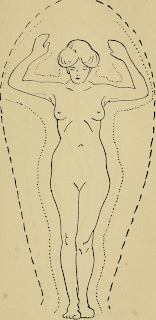
The electrocardiogram was invented by Dutch physiologist Willem Einthoven in 1902 to record the heart's electrical activity. The success of this idea caused other researchers to look for similar outcomes; one of whom was Walter John Kilner (1847–1920) who was a medical electrician at St Thomas Hospital, London, in charge of electrotherapy.  In 1911 Kilner published the "Human Atmosphere" or aura, proposing not just the aura's existence and nature but also its possible use in medical diagnosis and prognosis.

Kilner's illustration of a healthy woman with "a very fine aura", from The Human Atmosphere

The human energy field he argued, was an indicator of both health and mood, thus tying together both physical and emotional health. Kilner's work often seems similar to that of other slightly later researchers in this area, who tap more into electromagnetic ideas to be able to measure the body's energy fields, but Kilner, unlike Willem Einthoven, had no understanding of electromagnetic measurement. He would I suspect have loved to have seen electrocardiography at work. He therefore attempted to invent devices to be used by the naked eye, that could enable people to observe "auric" activity. When we look back on his work, we can of course see how he was able to fool himself by setting out to make something that enabled him to 'see' what he strongly believed in. We all know how much an expectation can influence what we see and I suspect sadly, he was more susceptible than most to the expectation effect.

It is not so much whether or not there can be any scientific proof of auras, what I'm looking for is how we are predisposed to think visually about them and what they represent. In my work looking at the visualisation of interoception, what I often find myself doing is sitting with someone whilst they describe to me an inner feeling, be this pain, emotion or another sensation and the ground out of which the conversation emerges, must not be that dissimilar to the landscape out of which thinkers such as Kilner emerged. I listened recently to a podcast devoted to synaesthesia and one of the people talking about their experiences had emotionally mediated synaesthesia, which meant that she saw colours surrounding people and these colours changed, often due to her emotional connection with the person seen. As she went on to describe, what was for her an everyday experience, I began thinking about how perhaps it was those of us who literally see differently, that help us as a species come to see or visualise those things that most people cant see, such as emotions. For instance we mainly have a three colour visualisation system called trichromacy, but evidence exists that there are people who have four distinct colour perception channels or tetrachromacy. Apparently it’s more common in women than in men and it has been suggested that nearly 12 percent of women may have this fourth colour perception channel. Is this why it is often suggested that women are more 'psychic' than men? 

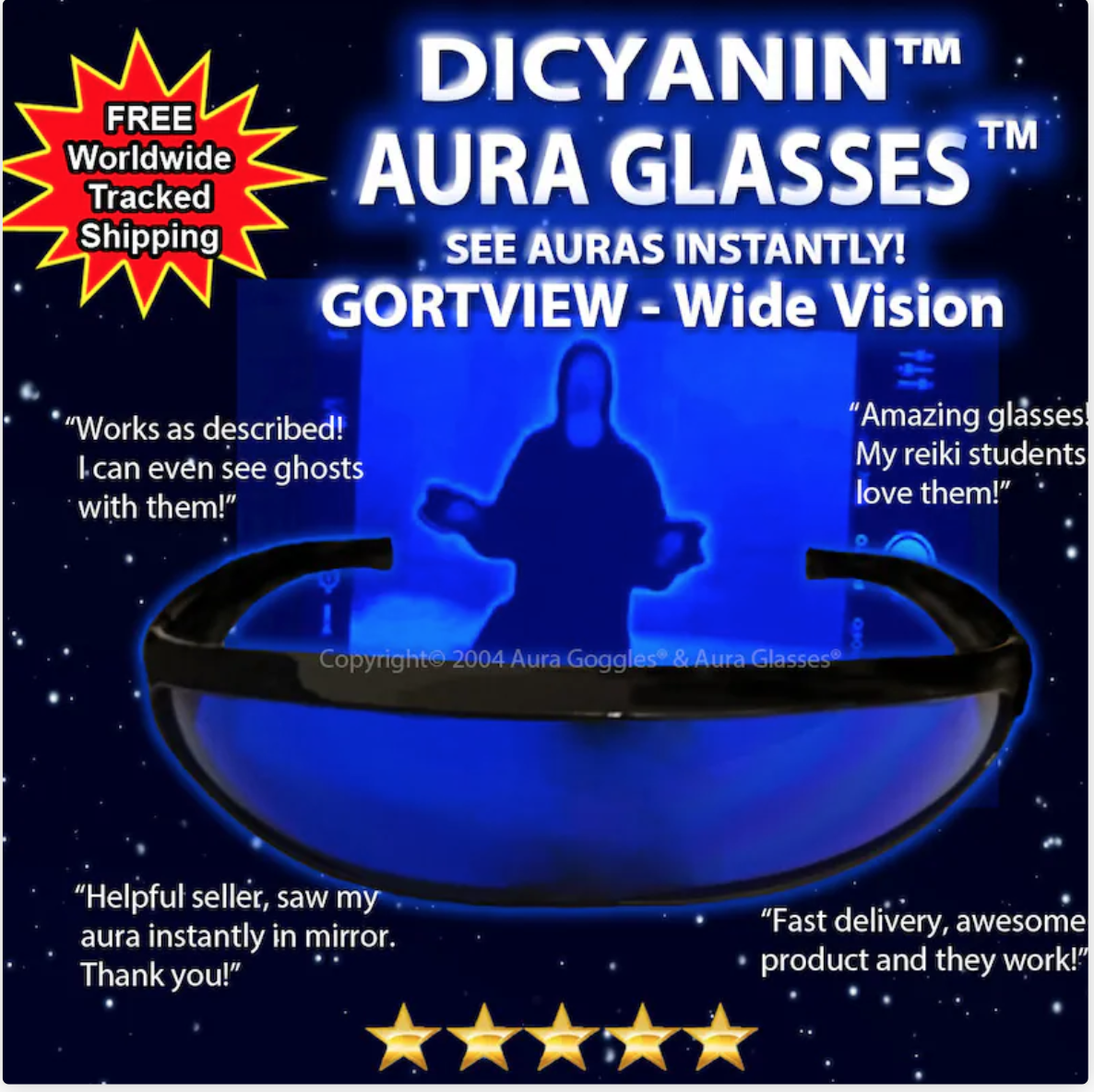
However, back to Kilner. He created what came to be called 'Kilner screens'; which were treated with variously coloured liquid dyes. These screens it was argued allowed us to see outside the visual light spectrum, and what could be seen were the result of seeing 'N-rays'. 'X-rays' immediately come to mind here. In his book we read that his screen allows us to perceive various auric formations, such as the 'Etheric Double', the 'Inner Aura' and the 'Outer Aura', which were formations that extended several inches from patients' naked bodies. His screens were more popularly known as Kilner goggles and are in my mind very closely associated with 'x-ray specs'.
The aura seen via Kilner goggles

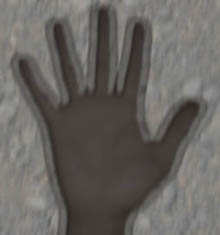
In reality of course x-ray specs merely create an optical illusion; no real X-rays are involved, but once again we have a device to create images of the body that many were willing to think, might  offer an alternative vision. 

A hand seen using x-ray specs


Kilner goggles are still being produced, but unlike x-ray specs which you can buy for £4 to £5 they cost £45 to £75 and come with lots of convincing blurb. I looked up the words put in to aid search engines to find the aura glasses above, they were, Dicyanin, Style, Ghost, Hunting, Paranormal, Tool, Detector, Metaphysical, Chakras, Energy, Prana, Occult, Wicca, Crystal, Meditation, Weird, Psychic, Reiki, Healing, Glasses, EVP, Emf, Kirlian, Orgone. Interestingly there seems to be a conspiracy theory surrounding the banning of the chemical dicyanin and manufacturers of these goggles are always keen to state that they use a synthetic replacement chemical. All fascinating stuff that points to a real want to believe in something. You can probably do it yourself without any special equipment. Just put your hand against a white wall and stare at it for a while, gradually a 'halo' will begin to emerge around the fingers. This 'halo' will depend on the actual colours in your hand, for instance if your hand is pinkish, you will begin to see colours that are optical opposites, greenish/blueish. This is colour fatigue and as most of the adverts for the aura goggles suggest you stare at the edges of bodies for some time until the aura appears, I think it is this phenomena that has triggered the idea of the aura.

Stare at this green head for 5 minutes (the time you are asked to stare at a body to see an aura)

There is an 'auratic' history and we use a certain set of words, including in particular, rays, waves and fields when talking about invisible energy or radiation. Such as magnetic fields, radio waves, microwaves, X-rays, and gamma rays. The idea of 'x-rays' is still a powerful concept, one that in particular shows how invisible rays can penetrate solid forms and reveal 'what lies beneath'. 
An x-ray that suggests a skin like aura surrounding the bones

Röntgen discovered x-rays in 1895, and in visualisations of invisible rays they have remained the 'mystic master' of ray type form ever since. The other related form is the field, such as an electric field. 

An electric field

Various researchers have then used these forms to develop concepts about how invisible energies lie beneath surface appearances. For instance Harold Saxton Burr, a researcher into bio-electrics, contended that the electro-dynamic fields of all living things, mould and control each organism's development, health, and mood. He named these L-Fields and used them to explain cellular differentiation and how and why living organisms were able to retain the forms that they do. Burr compared his L-field idea to the entelechy of Hans Driech and the morphogenetic fields proposed by Hans Spemann and Paul Weiss.

However there are far more prosaic forms of invisible energies passing through the body.

A young man holding his hand to his heart, emanating insensible perspiration.” Colour stipple engraving by J. Pass, after Ebenezer Sibly (1794)

The engraving above is really about sweat. The "insensible perspiration that issues from the pores of the body, which can only be discerned by means of a lens and that ascends through the bed-clothes like a mist when we are asleep", is I'm pretty sure, sweat. But we are all very aware of what happens when we have a fever and it is another invisible something passing through the body that we need to reckon with. 

Magnification of sweat glands

The more I have worked with interoceptual feelings, the more I realise emotions, physical pain, bodily functions, intuitions, illnesses, memories and a host of other things are all mixed up and tied together by the fact they all inhabit the same very complicated physical body. It is no surprise then to find that the various thinkers who were looking at auras, had tried to fit in to their theories other ideas that were floating around at the time. For instance in his book 'The Human Aura', Auguste Marques connects the concept of 'thought forms' to the aura and he suggests that images and colours penetrate the aura in response to emotional changes in the mind of the person who's aura we are studying. These thought forms are illustrated in his book and for Marques have very particular meanings. 

From: The Human Aura: Thought Forms

Marques uses Blavatsky's definition of an aura; 'A subtle invisible essence or fluid, that emanates from human and animal bodies and even things; it is a psychic effluvium, partaking of both the mind and the body, as it is the electro-vital and at the same time an electro-mental aura, called in Theosophy the akasic or magnetic.' Several types of aura are defined by him, including what he calls 'Tatwic' coloured bands. These relate to the senses, 'Akasha' to sound and in the form of dotted spheres, ellipses or egg-forms; 'Vayu', to touch, and in the form of circles; 'Tejas', to sight, and the form of triangles; 'Apas', to taste, and in the form of the crescent or lotus flower and 'Prithivi' to smell, and in the form of squares or quadrangles. These forms combine at a microscopic level to form auric bands. 


So you can imagine colour added into the mix and the fact that these are constantly changing in response to our breathing patterns. I am of course drawn to compare these images with magnetic and electric fields and so I took a sample line and put it through a few transformations in order to arrive at an auratic form.

Head with Tatwic auratic form

One way of describing a human being is that it is an electrodynamic organism attuned to the cosmos. This statement represents the fact that we are at a deep level organised by electric and electromagnetic fields. Alfred North Whitehead stated that, "an electron within a living body is different from an electron outside it, by reason of the plan of the body." This body plan he maintained represented both mental and physical attributes of a unified experience and that it was able to modify the motion of subatomic particles within it. Some years later the physiologist Harold Saxton Burr wrote The Blueprint for Immortality first published in 1972, which on its cover blurb stated, “This is a breakthrough book – the first comprehensive account ever published of one of the most important scientific discoveries of this century. It reveals that all living things – from men to mice, from trees to seeds – are moulded and controlled by ‘electrodynamic fields’, which can be measured and mapped with standard modern volt-meters. It goes on the state, “Since measurements of L-field voltages can reveal physical and mental conditions, doctors will be able to use them to diagnose illnesses before the usual symptoms develop and so will have a better chance of successful treatment.” An almost exact description of how Kilner's work was supposed to be used and also my thoughts when thinking about what interoceptual images might be useful for.

Pain felt when in a wheelchair

Pain relieved using a centrally jointed bed

Once again an idea seems impelled into being by a psychological need and I sense that Burr's book might be as much to do with art as science. However time to end another ramble, especially as I have just discovered after writing most of this post that there already exists a book, 'Picturing Aura' by Jeremy Stolow, that seems to cover most of the ground I've been thinking about. 

Coda

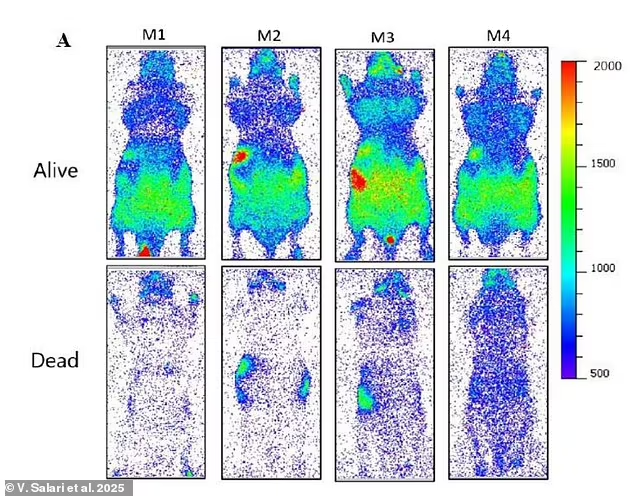
Not long after putting up this post I found an article with the headline; 'All living things emit an eerie glow that is snuffed out upon death'. It stated, 'All living things, including humans, constantly emit a ghostly glow – and it appears to vanish almost as soon as we die. Monitoring this signal could one day help track forest health or even detect diseases in people'. This glow is thought to be the result of ultraweak photon emission. One of the article's authors Dr Daniel Oblak, went on to state that, 'Mitochondria and other energy-producing machinery in our cells involve molecules gaining and losing energy, in turn emitting the equivalent of a few photons a second per square centimetre of skin tissue, which are known as 'biophotons'. (Salari, et al. 2025)

The full explanation was; 'One thing that all living creatures have in common is that they need to create energy to stay alive. In the cells of every organism, there are structures called mitochondria where sugars are 'burned' with oxygen in a process called 'oxidative metabolism'. During these reactions, molecules gain and lose energy, letting off a few photons...Because the light emitted by living cells is so faint, it is hard to distinguish from other natural sources of light, such as the radiation emitted by warm objects. However, using specialised cameras able to detect individual photons, Dr Oblak and his colleagues have now isolated this light and shown what happens to it after an animal dies'.

Mice were placed in dark, temperature-controlled boxes where digital cameras produced two images with an hour-long exposure. One was taken while the mouse was alive, and the other after it had died.

Using cameras that can detect individual photons, researchers took long-exposure photographs of mice before and after their death (pictured)

While living, the mice produce extremely faint light through a process called ultraweak photon emissions. After the mouse is dead, this light is no longer produced, and the glow vanishes.

Ultraweak photon emissions are produced when mitochondria in our cells create energy through a series of chemical reactions. As a by-product, a small number of photons are produced

Plants that were injured or treated with chemicals glowed more brightly in those regions. This suggests ultra-weak photon emissions could be used in medical diagnostics to look for damaged tissues in people.

Perhaps those individuals that have more rods or cones than is normal, (in effect mutants with tetrachromacy); can detect these photons and this could be yet another explanation for the aura concept. 

References


Fenici, R. Brisinda, D. and Meloni, A.M. (2005) Clinical application of magnetocardiography. Expert review of molecular diagnostics5(3), pp.291-313.

Kilner, W.J., (1911) The Human atmosphere, or, The aura made visible by the aid of chemical screens. Rebman Company. Available at: https://wellcomecollection.org/works/t94es3zc/items

Ramachandran, V.S., Miller, L., Livingstone, M.S. and Brang, D., (2012) Colored halos around faces and emotion-evoked colors: a new form of synesthesiaNeurocase18(4), pp.352-358.

Renbourn, E.T., (1960) The natural history of insensible perspiration: a forgotten doctrine of health and diseaseMedical History4(2), pp.135-152.

Salari, V. Seshan, V. Frankle, L. England, D. Simon, C. and Oblak, D. (2025) Imaging Ultraweak Photon Emission from Living and Dead Mice and from Plants under Stress The Journal of Physical Chemistry Letters 16 (17), 4354-4362 DOI: 10.1021/acs.jpclett.4c03546

Stolow, J. (2025) Picturing Aura London: MIT Press

See also:


Drawing the corona virus

Diagrams: Visualising the invisible

Visualising energy flow

Interoceptual textures and surface flow

Para-scientific visions and Rayonism

The iconography of the invisible

Lines as symbols of invisible forces

Measuring emotions and colour