Showing posts with label iconography. Show all posts

Saturday, 11 October 2025

From making votives to visualising Interoception

Image from a visualising interoception workshop

Stress influences the way we perceive pain. Our worry associated with pain, especially if the pain is long lasting, can make it worse. There is a feedback loop that will eventually lead to anxiety and depression and it is this feedback loop that I am hoping to break when I work with people who have experienced severe pain. 

Making votives alerted me to the fact that rituals and objects associated with them could be used to take away the pain or distress associated with a difficult experience. A votive materialises a thought, it congeals around a feeling and gives it literal weight. Once objectified, the votive releases the feeling from the person and can pass it on, become a holder for it or become a channel for the intervention of a higher power. The psychology of the situation involves the release of the trauma from the person who is suffering and 'takes their mind off it', as one of the people I was working with put it. 

Votive made for someone with chronic lung problems

Making votives led me to have to devise rituals for their use. However I didn't take that aspect of the work seriously, until by chance I met John Fox and Sue Gill, of Welfare State International and when John Fox saw what I was doing he wondered if I could extend the votive idea into rituals for funerals, something he and Sue Gill had been doing for some time. I was somewhat in awe of them, as I knew of the amazing work they had done over the years and was honoured to feel that John thought what I was doing interesting. Their 'Dead Good Guides' are designed to work in real situations and to show how art can be seamlessly integrated into the lives of everyone. I never did get to show him what I came up with, because he died not long after our meeting, but he had impelled me to move my work on and to really think about how and why my work should be more available and accessible to everyone, not just people from the art world. Not long after meeting John I had to attend a funeral of someone who had been cremated and it was obvious that people didn't really know what to do with the ashes. So my first venture into the territory was to think about rituals and associated objects, that might help people come to terms with the problem of how to dispose of someone's ashes.

Sketchbook page used to communicate the idea


Votives made to hold a body's ashes after cremation

The shell-like objects above are made very simply using pinched clay, which is then fired. Although I made these, the idea is that they should either be made well beforehand by someone before they die, or in response to a post funeral need, by a close relative or friend. Making small objects like these with your hands is an easy thing to do and the process solidifies imprints of every maker's fingertips into each object. Designed so that they can be easily pushed into the earth like a seed pod, they are closed with sealing wax or modelling wax to keep the ashes in. You can also make these seed or shell like shapes in the form of a necklace. One aspect of a pre-ritual workshop is to get the people involved to agree how these objects will be used. The more religious will perhaps want to use them like traditional votives, whereby a candle is lit and prayers said. If so these ash containers can be made into candle holders or have a wick inserted into their hollow insides. Mourners may want to add specific elements that remind them of the person who they wish to celebrate; before they release their relative or friend back into the earth or waters they came from. The more that people get involved the better. 

The ritual of letting go: Skimming votives off into the water

Ceramic votive in the form of a skimming stone filled with ash and sealed.

Another form these ritual objects can take, is that of skimming stones. Again made out of fired clay, two shallow concave forms are put together to make a 'skimming stone'. A hole is left in one side which allows ashes to be inserted and once that has been done, again wax is used to seal the hole, before the final ritual skimming of the ashes out into a lake, river or sea. 

From a sketchbook page used to communicate the idea

The work with votives always involves a drawing led conversation and that conversation leads to the visualisation of a desire or need. This is very emotional. The study of interoception grew out of this work and it has made me very aware that emotions are built within the body, that they are physiological responses to both interior and exterior change. When trying to visualise somatic awareness, I have begun gradually to build up a language of forms that have emerged from both workshops and one-to-one drawing conversations; conversations that are centred on the correspondent agreeing that it is possible to develop an image of their feelings, in a not too dissimilar way to how a police artist would sit with an observer of a crime and work with them to construct an identikit image of the perpetrator. Is it more like this...or like this...? The good thing about this approach is that the person involved doesn't need to know anything about art, they just need to make basic yes/no decisions. 

Which of these two drawings is more like the feeling you are trying to describe?

We often start with a simple comparison drawing such as the one above. Then rough drawings are made as the patient begins to open out about what they feel and we begin to sort out what is possible. 


Initial drawings done during a first meeting

Where is the feeling located?

Then we move on to where is it located in the body. Once I think I have enough information, I take the drawings back to the studio and then work them up. They are then scanned and turned into digital images and printed off. I bring these back to the hospital a week later and these images then become what is critiqued by the patient and ideas as to colour and its effect are developed. 

Annotated images developed with two different patients

As conversations move on I often get to visualise concepts such as how pain moves through the body. Typically this is described by participants as being like a zigzag of lightening. In the case of the image below I was asked to imagine a field of lightening that was also like a spider's web.

An idea worked up as a digital print

The final stages often require several changes, especially as colour is such an emotive aspect of visual language. At this stage images are digitally developed using Photoshop, which allows changes to be kept, because sometimes the patient wants me to take the image back to an earlier stage and it is so much easier to change colours. The digital version also allows me to print off copies for the patient to keep and they can be shown to other interested people.  

Image with annotations as reminders of the story behind it

The final image

Although I hadn't consciously tried to predict the visual shape of the final outcome, in several cases I realised that because we were dealing with the visualisation of normally hidden feelings, that this was not that dissimilar to visualising hidden energies. Patients would talk about the release of an electric charge within their body, or waves of emotion, descriptions that reminded me of the way that earlier researchers had described what they were discovering when they attempted to visualise invisible energies, such as the Odic force.*

In my own work, whereby I tried to visualise personal somatic experiences, such as a difficulty I had breathing due to covid19, I had also sensed that I needed to visualise a certain flow of energy, in this case how it was compacted and then released due to a blockage. 

The moment of a breath breaking into the lungs from a previously closed throat

My academic research has over the last few years looked into earlier attempts to visualise hidden or invisible forces. Initially I looked at visualisations that were the products of quasi-religious thinkers associated with Theosophy, partly because I knew that their work had influenced artists such as Kandinsky and Klee. However I gradually found more scientific thinkers and as I looked into their theories, I began to feel that there was a real need for a belief system that could explain why we feel as if there is something mystical about the universe. 

When researching older areas of esoteric thinking, that have now being debunked by science, such as geometrical psychology, Rayonism and other para-scientific theories, I began to see certain common beliefs, that might not have stood the test of time, but which do reflect an intuitive set of feelings that point to some sort of vibrational understanding of our reality. 

Visualisation of Chakras: From Leadbeater

The idea of chakras, the concept of body auras or the captured energy fields as seen in the work of Dr. Hippolyte Baraduc and the shapes of thought forms, are all attempts to visualise the invisible energies that flow through our bodies. Both colour and sound are vibrational energies and there are many examples of how sound can calm the soul and although the research surrounding colour theory is far less clear in terms of how effective colour can be in creating or changing mood, I have no doubt that colour's vibrational energy does effect emotional change. However after working with a wide range of people, I now realise that colour response is very personal and that it is not something that effects everyone's emotions in the same way.  But that doesn't mean I cant use it, in fact because it is so personal, it opens a door for idiosyncratic visual responses to deep inter-personal communication and one-to-one conversations, which is where most of my work is initiated. I don't though normally have to agree with someone else if my imagery is communicating. Outside of the work in the hospital, I am free to take the imagery wherever I feel it needs to go. The construction of meaningful to myself colour communications has become an essential aspect of my recent work and although colour is hard to pin down, so are emotions and the more I go on to work in this area, the more I feel that it is in the struggle to find an authentic colour voice for a feeling, that I will find a something that allows me to communicate whatever it is that I need to communicate. 

This image emerged from conversations about poor circulation in a leg

In my drawing conversations with people I often hear that they feel anxious, a state of mind that in Chinese culture is sometimes understood as a type of inner body chaos, or the blowing of 'internal winds' and sometimes their descriptions of the internal state of their bodies are less like a medical anatomy diagram and more like an immersion into a strange landscape or contact with alien energies. In Chinese medicine, our bodies are regarded as elements of and inseparable from, the natural world. We are an embodiment of the Earth and the Universe, the patterns of internal change that occur in our bodies, resonate with the external forms of landscape. All are manifestations of the universal Qi, the “substratum of the cosmos,” the essential quality of being, that I personally think of as another type of underlying vibration. 

An animation of an inner body form 

Each of these understandings allows me to develop imagery. By working with a range of overlapping viewpoints I can cross fertilise ideas and allow myself the luxury of imaginative play, whereby I 'freeform' with the visual elements that I have surrounded myself with in the studio and play with various interconnections as they reveal themselves.

The more I work with others, the better prepared I am to set up workshops designed to help people develop their personal interoceptual visual language. These workshops have often involved communicating the things learnt during my one-to-one drawing conversation sessions. I work with people in pairs, helping them to respond to each other's growing awareness of a chosen interoceptual feeling. People often chose a painful experience to try to visualise, but someone in a group will quickly realise that it could be a pleasurable feeling or a very different feeling, such as one that gives you goose bumps, that could be explored. I always encourage this as my research is about the benefits of a wider awareness of interoception than just pain. Craig, in his article 'How do you feel?', a paper that he went on to develop as an excellent book with the same title, points to an awareness of interoception being central to our feelings of being alive and that it is essential to our development of a subjective image of our sentient selves across time. He demonstrates how important interoceptual feelings are and shows how they are inseparable from the way the body knows itself and that emotions are inextricably linked to everything from muscle tone, to a need to go to the toilet. I'm writing this post from a hotel bedroom in Gothenburg in Sweden, having just spent the last three days at a conference devoted to the current medical understanding of issues related to spinal injuries. I sat and drew during several presentations and as the conference went on, I found myself coming to another visual conclusion about the inner body, one more to do with dendritic shaped fibrous growth at the scale of microscopic neurons. I think this was because I had been reading Craig's book and he looks at the evolutionary history of our nervous systems. He welds together ideas about both physical and mental feelings being transmitted to the brain; in such a way that I have an image in my mind of an emotive feeling being no different to a feeling of coldness, when it comes to an electrical signal, carried by neurons and stimulating the brain to make a decision about an action. I also began drawing mice and monkeys, perhaps to make sure I did not forget how grateful we should be to their contributions to spinal injury research. When I draw a monkey, it is a substitution for myself, an image that reminds me I am an animal also. I do realise that without the research that is done we would not be able to further our knowledge but I hope that when animals are used great care is taken to treat them with respect and to minimalise their discomfort and pain. 

Notebook page

In their book, 'Your Brain on Art', Magsamen and Ross use the term 'neuroarts', which is defined as 'the study of how the arts and aesthetic experiences measurably change the body, brain, and behaviour.' When highlighting art's effect on pain awareness and how it can shape it, they state in relation to people interacting with an art form, (2025, p. 37), 'The physical pain may still exist, but how they emotionally relate to that pain has changed'. It is the visualisation of both a change in emotional relationship and an awareness that the physical nature of our insides is intertwined with these emotional changes, that I hope to continue to develop my art practice out of. It takes me into the unknown, which is where as an artist I need to be, but not only that it gives me an audience that perhaps for the first time begin to see that shapes and forms might actually carry information and communicate it in ways that they had never previously noticed. 

However I'm also still probing around at that old problem, of how in making an image do you represent a feeling of being alive? In German there is a term 'zitterbewegung', a sense of vibrating, oscillating energies, that is often associated with quantum mechanics, a term I quite like as it deals with things we cant see, but which need to happen if the things we can see are to behave in ways that result in the world appearing to be as it does. The hidden processes that go on inside our bodies are for myself similar, if they go wrong, the outward appearance of the external body is also changed, another tied together set of happenings. 

The making of an animation based on a feeling of the body as a landscape, is one approach I am taking to the visualisation of inner and outer somatic interrelationships, hoping that after watching it, someone might be able to put their own inner body feelings into action and thus begin their own journey to externalise feelings. As well as exploring how some existing interoceptual visualisations of inner body forms could be animated, I've been looking at Faraday wave phenomena, another aspect of vibrational energy depiction, that I've intuitively linked to a personal understanding of the work of Dr. Hippolyte Baraduc. 

Dr. Hippolyte Baraduc: Iconography obtained without light, electricity or photographic apparatus, due to the right hand of Dr. M. Adam

Dr. Hippolyte Baraduc and Dr. M. Adam, must have at one point in time conjoined to produce the image above. Their activities were I'm sure serious and purposeful and I would like to think that they felt that they had seen something special related to the invisible nature of our existence. They may even have found a way to visualise dark matter, not that it matters, what does matter for myself is the never ending journey of enquiry that as a species we continue to go on, each generation trying in its own way to find ways to visualise those things that we cant see, but which underpin everything that we do.   

The old lungs in action

Recent attempts to make images based on a feeling have been made in response to my own asthma. That harsh rasping feel of lungs struggling is one I know well, but to make an image of it is challenging. This time I have tried to think more about spatial aspects and have looked at stretch, perspective and our sense of vertigo when we are too high up and looking down. I never quite get it right, but each time I try something emerges and as it does it adds to the iconography of inner body speculation. 

• The Odic force was a hypothetical energy or life force, proposed in the 19th century by Baron Carl von Reichenbach. Named after the Norse god Odin, it was believed to be a pervasive energy that permeated all living things and could be influenced by other invisible forces such as magnetism, electricity and sunlight.

References

Craig, A. How do you feel? Interoception: the sense of the physiological condition of the body. Nat Rev Neurosci 3, 655–666 (2002). https://doi.org/10.1038/nrn894

Craig, A. (2014) How Do You Feel?: An Interoceptive Moment with Your Neurobiological Self London: Princeton University Press

Magsamen, S. and Ross, I. (2025) Your Brain on Art: How the arts transform us Edinburgh: Canongate
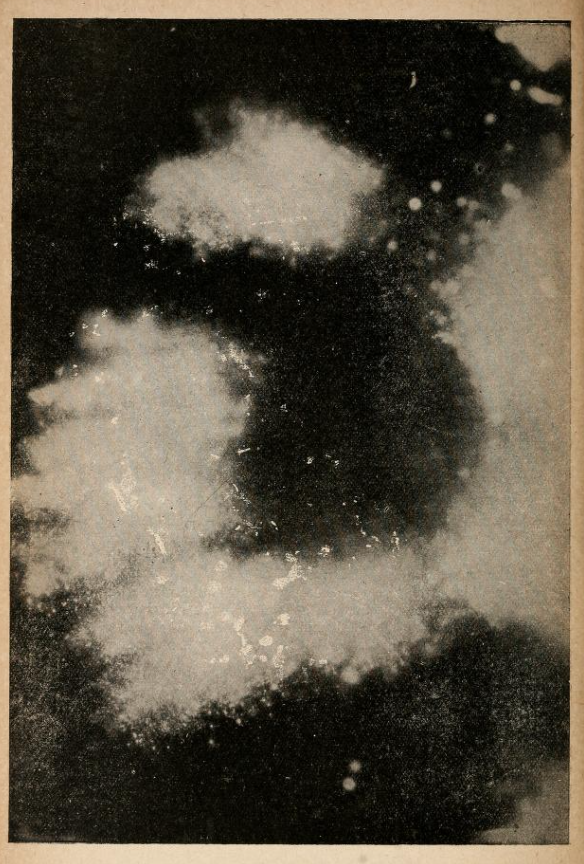
Baraduc, H. (1913) The Human Soul: Its Movements, Its Lights, and the Iconography of the Fluidic Invisible Paris: Librairie Internationale de la Pensée Nouvelle*

* In his book 'The Human Soul' Baraduc describes something he calls the 'fluidic invisible' or 'Odic liquid'.  We in effect swim in an invisible sea named by Baraduc, 'Somod'. The link above is hopefully still live and you will find images of his exposed photographic plates at the end of the book.

Friday, 30 September 2022

The Iconography of the Invisible

Dr. Hippolyte Baraduc: 'Iconography of a hand obtained by bringing the hand near the sensitive side of a plate fastened to the pole of a Wimhurst machine. One can remark the formation of electro-vital particles coming from an odic cloud showing the thumb and the fingers as well as small life-animules, white points.'

I've been exploring different ways to visualise the invisible, something that I believe re-occurs over and over again throughout human history. There are lots of other individuals who have had similar obsessions and I have in particular begun to seek out 19th century thinkers who were operating at a time when science was struggling to come up with answers to certain problems. Dr. Hippolyte Baraduc had some very interesting theories about what he called 'iconography', and what others in associated circles at the time also called ‘etheric doubles’, ‘subtle bodies’, ‘astral bodies’ or ‘bodies of light’. But first of all you might be a little concerned that I'm advocating looking at another theory that has long been disproved and consigned to the bin of outdated thinking. In my own conceptual framework the idea of proof is not so important, I'm much more interested in the poetry of an idea, so one way for me to understand old science is as speculative fiction that was at one point taken to be a real possibility, or in my terms a poetic idea. The other issue for myself is some form of congruence between what someone might have been thinking and my own ideas, in this case I'm very interested in how to visualise invisible energies and sensations that emanate from within the body and I intuitively felt that Baraduc must have had similar concerns. He is also very much of his own time, I have commented in the past on the influence of Besant and Leadbeater's 'Thought Forms' as well as Benjamin Brett's 'Geometrical Psychology' and in my last post on Edwin Babbitt all of whom I have used to help me in the paradoxical formulation of a way to draw the visual poetry of invisible energies. The image below is termed by Baraduc a 'graphy', which suggests that he understood these images as types of drawings. 

Graphy of the cosmic Od. The experiment was undertaken to show the possibility of the passage of the cosmic Od, of the vital force of the world, across the glass.

Dr. Hippolyte Baraduc published 'The Human Soul: Its Movements, Its Lights, and the Iconography of the Fluidic Invisible', in French in 1896. Similar in concept I suspect to Bergson's 'Elan Vital' a concept that Bergson introduced in his book 'Creative Evolution' in 1907. Baraduc describes what he calls 'Odic liquid', a fluid like force that both “saturates the organism of living beings and constitutes our fluidic body”. It also exists as a type of sea that surrounds everything. We in effect swim in this invisible sea, which is composed of a substance called 'Somod'. This invisible fluid somehow holds within it or can act as a vehicle to carry, 'thought radiation'. This radiation, like x-rays could he decided, be captured as images using a chemically infused plate. Baraduc called this process 'iconography' which is rather confusing as we normally think of iconography as an area of research that studies the signs and symbols found in religious art works. He was I presume thinking that 'iconography' sounded very like 'photography' which was also a chemical process that captured in this case visible radiation using a chemically infused plate. His chemically infused plates captured invisible energy, the electro-vital currents of a subject's 'internal light', something we might think of as the soul. 

The resultant images are in fact very hard to read because they are so vague, but I still find them interesting and perhaps because of their very vagueness they remain open to poetic re-interpretation. 

Each iconograph illustrated in his book is given a detailed explanation, as you can see from the image above. However the first image in his book is slightly different, it is entitled, “The Od attracted by the state of the soul of a child lamenting over a recently killed pheasant”. I love a good title, as it opens doors for an image and helps me to see why we so often need to use image and text together, the one reinforcing the other or causing us to become conflicted because they appear to contradict each other, both it would seem to me, important possibilities as we attempt to make effective and yet also poetic communication. Because it is so hard to see, it takes a while to get an idea of what is going on, or to work out what Baraduc thought was happening. 

'The Od attracted by the state of the soul of a child lamenting over a recently killed pheasant'

It is a very poor image but if you stare hard you might be able to see faint lines radiating out from the figure, as if streaks of light have continued past the boy from the window, an apparition that has been described by others as a ghostly wing . Basically it looks very like an old over exposed photograph to me but Baraduc had other ideas. For him it was, as Jed Rasula puts it in his book 'History of a Shiver: The Sublime Impudence of Modernism', a personal seance. 

The votive image above that I made a few years ago was designed to operate in a similar way; when the glass bowl was picked up, light shining through it created a pure light image on adjacent surfaces, an affect that I hoped at the time helped heighten a sense of the occult. Jed Rasula would say of this type of situation that, 'Every transaction with a text, a musical score, a painting, or a sculpture, is a personal seance.' He was pointing to the fact that whenever you look at an artwork, we become aware of another life somehow encrypted within its forms, as if there is a code, rather like computer code, that lies beneath the image and which suffuses it with some sort of personality. The 'personal seance' aspect is the resurrection in the mind of the artwork's viewer, of an image of the maker behind the object; it is as if a ghost of its maker stands behind every art object. Jed Rasula's The 'History of a Shiver', is a book arguing that early modernism and seances were both developments of a similar and connected need for society to re-find its roots in religion; hence Kandinsky and other artists' interest in madam Blavatsky and the Theosophical Society. 

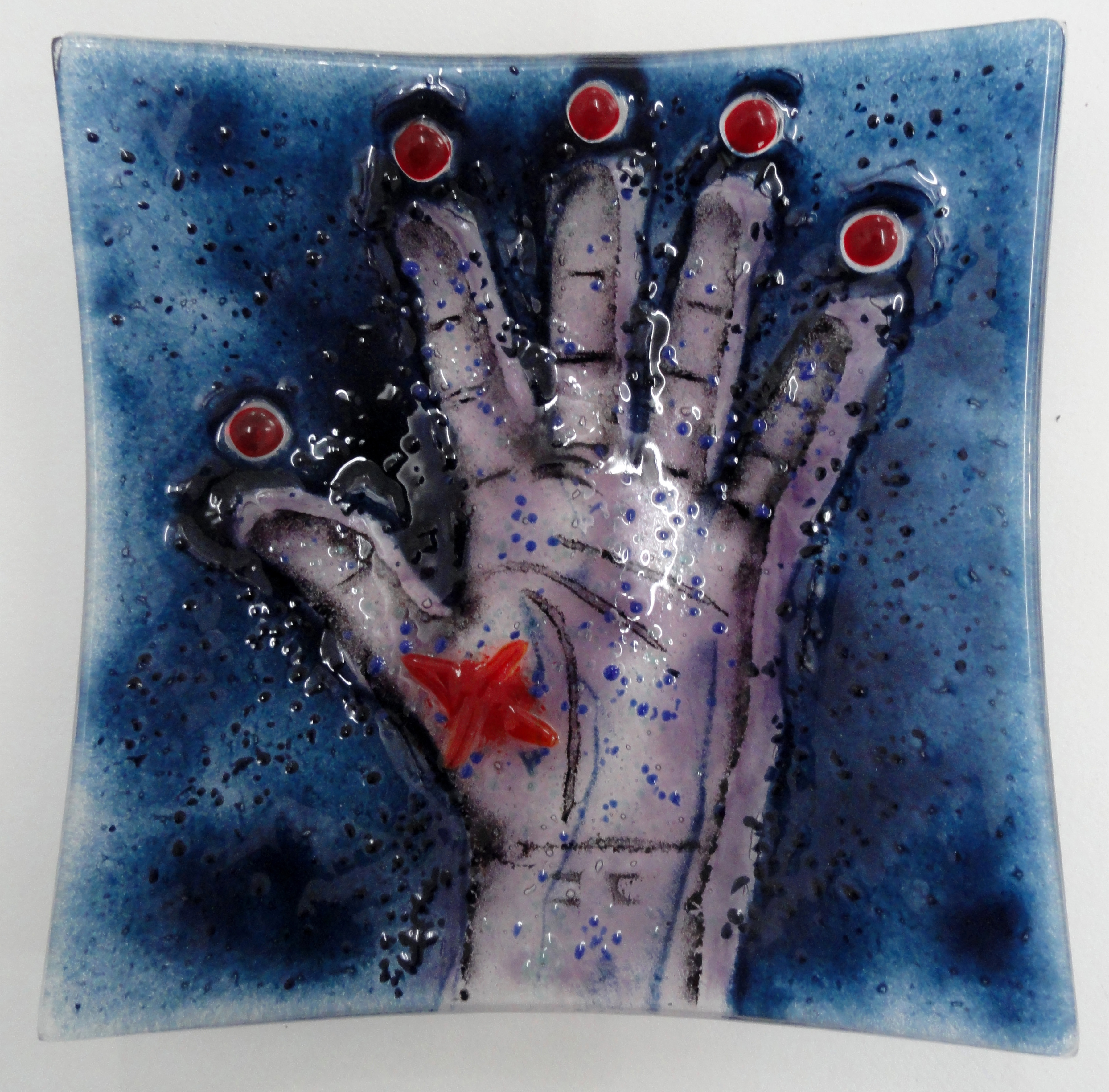
I'm very aware of this alternative history of modern art and personally believe it is time to revisit its roots again, perhaps because it is now so far distant it can also be just odd. For instance the hand of an over-electrified person, suggests a particularly manic individual, who may have clutched in their other hand a bare wire. My own attempt above in making a votive form was to suggest a connection with invisible forces, perhaps more spiritual than electrical but I could see a parallel concern. 

'Pure electography of the hand by Iodko's method. The hand of an over-electrified person, placed on a plate gives a very remarkable impression of the electrified cutaneous surface. One can here easily note the difference between electrography and iconography, where the vital waves are produced by themselves and are graphed by themselves without electricity.'

Votive bowl in the form of a fused glass image of a hand

It is perhaps the fusion of image and text that makes Baraduc's work so interesting. The text explains the images in a very believable straightforward way. 'Figuration of the fluidic shower' is however for myself no longer a scientific fact, it becomes a line from a fantasy graphic novel, or a title for one of my own images. I shall try it as a title to one of the images I recently produced when working on ideas for a permaculture aware art practice and the need to become far more embedded into the world and life cycles of plants.

Figuration of the fluidic shower

The fact that the 'signature of the life-animules and the black volative odic shower come from the ants giving up their vitality,' was for myself a doorway back into the world of the animist, and if so we could collapse time, Baraduc is in effect believing things little differently to a shaman working out of a cave 30,000 years ago. 
These old books are things to mine as if you are an archeologist digging up a trench of ancient artefacts. You have no idea of what they really were but you very quickly begin to make up uses for them in your mind. In this case you could argue that what is missing from these explanations is the fact that Baraduc was a follower of Baron Karl von Reichenbach, who proposed something called the Odic force as an invisible energy, something like electromagnetic radiation, but more of that in another post. 


Images taken directly from pages of 'The Human Soul: Its Movements, Its Lights, and the Iconography of the Fluidic Invisible'

'Photograph taken by me in July 1895, in the country. The gamekeeper Crepet is giving to 300 young partridges some ant eggs, which he is taking from a sack. The small birds are covered over by the entire black part of the negative, whilst a quantity of small life animules are freeing themselves from the eggs or from the ants. Is it the emanation of the gamekeeper, or that of the partridges? I took two photos whilst the gamekeeper was throwing handfuls of dust and of eggs. Both are identical. I took two other photos when he was giving them cooked chicken eggs mixed with bread crumbs. In these there is nothing special, the photograph is sharp. It may be concluded from this, that the signature of the life-animules and the black volative odic shower come from the ants giving up their vitality.'

Text to read:

Rasula, T. (2016) History of a Shiver: The Sublime Impudence of Modernism Oxford: OUP.

See also:


How to understand the virus Drawing the invisible enemy