Showing posts with label watercolour. Show all posts

Thursday, 26 August 2021

RIP Dame Elizabeth Blackadder

Elizabeth Blackadder

Dame Elizabeth Blackadder has died. She was one of those very underrated artists that simply do things very well. Blackadder's work celebrated her love of flowers, cats and everyday things, as well as investigating the way forms could pattern their way across a surface. She was a very sensitive user of watercolour, allowing it to be what it needed to be, whilst at the same time being able to pick out the salient details and particular aspects of plant life, that would ensure that whatever she was recreating still retained a life of its own.


Elizabeth Blackadder

As an artist she would not talk about why she did the things she did other than to say she liked stuff, but if you follow her work you can see that she has a sharp visual intelligence that enables her to make compositional images appear as if they are simply 'there' or 'right'. Composition was her forte, and she loved the work of Piero Della Francesca, somehow translating his mathematical grasp of composition into a much more informal methodology, one that totally suited her everyday subject matter.

I shall miss her, even in the days when I was making purely conceptual pieces, I remember seeing her work and gazing at it in relief, it didn't need anything to be taken on board to be understood beyond, 'I looked at this and it was wonderful'.

See also:

Drawing plants

Beuys and Cotman

A drawing of beaked hawks beard

Why draw animals 

Wednesday, 16 May 2018

Drawing in Colour 4: Beryl Hammill


Sometimes when you know someone you don't really notice what they are doing. Beryl Hammill was one of those people that it seemed like I knew, they were always working and when I saw their work I was always impressed but perhaps what I didn't do was really think about what they were doing. Now she is no longer with us and her weaving has stopped and I realise that what she represented was something very important, something that so easily gets forgotten and that is the lifelong preoccupation with what it is to see something. 
For Beryl what it was to see something was also fused together with how to capture the seeing, how to hold it or trap it within the fibres of her weaving. She represented the paradox of art, what is experienced as a series of infinitely short moments, is communicated through hard fought and laboriously constructed image making. In her case the last few years of her life were often spent gazing, no not gazing, staring at the sea, watching how waves break, how colour refracts as the sea bulges, how the spray of breaking waters, reflects colours as well as creates tiny rainbows of broken white light as each water droplet curves through space, dropping and finally recombining with a newer parent wave. She looked for the various rhythms of movement and how they could be combined, the powerful swells of a huge beast like movement, played off against the fast chatter of small breakers as they roll over the edges of the land, rolling pebbles before them and trailing white patterns behind. She was watching for how blues and greens change with depth, how yellow sunlight fuses with seaweed shot moments of unexpected colour as it waves within waves as the sea flows over the rocks that it breaks upon.  


Sometimes the drawn marks would be annotated by short bursts of writing, reminding us that writing is so very like drawing, the calligraphy of her hand contained in the shaping of letters as much as in the shaping of wavelets.


There are other moments of observation to be found in her sketchbooks, usually made when her attention wandered from the re-creation of moving water, such as the drawing above, made as she responded to a jumble of sea birds as they cluttered across the beach. These drawings have a lot of humour in them, in particular I love the way that she has found in her quick marks a bird snail.


She filled many notebooks with her studies, each drawing an attempt to create a mark set that would echo what she had seen. Colours combine in a drawing to recreate both texture and rhythm, the white of the paper a space analogous to the expanse of open water before her, the marks breaking spaces as waves break through the rolling body of sea as it nears its edge. The fact that she was drawing on the coast of Australia, looking out at a body of water that stretched from where she was to Antartica somehow makes the edge between the sea and the land that bit more special. The sea has met an unexpected barrier to its forever swell of forward momentum, it has to break from its customary pattern and find outlets for its energy in waves and foam and breakers, in those wonderful waves that tunnel over surfers as they cut into the moving edges of the waves. And there sat Beryl, for hours on end staring those waves down, looking into their heart and trying to decide what made them tick. What made the waves and what made the images that she saw, were two makings, one in the physical world and the other in the mind, that would combine in a third, the drawings made. The mind can only catch so much of the perceived wave  the hand can only catch so much of the necessary movement needed to stroke the brush in a manner like the wave, the mind and the hand now woven together with the sea, until something is captured that is held balanced on a moment, a frozen perception that is right for being preserved. 


Beryl would take these drawings back to Yorkshire and would construct from them a template for weaving, and in doing so would set about the long slow process of making crafted images that could capture in the grids of their making the colour, the rhythm and the shapes of seeing that she had seen on that edge between the sea and the land. 
The last time I saw one of Beryl's weavings it was left three quarters finished, its edges composed of partly woven hand dyed threads, their lengths as they separated from the body of the tapestry still wrapped around their spindles. The open edge of unfinished business, somehow right and proper, because seeing is never done, we will never see through to the reality behind things, because if we did there would be no place to go, nowhere else to travel, because we would know it all. But the struggle to remember what we have seen, the weaving of memories of moments of recognition into the tight weave of a tapestry, is still myth like in its potency. The Wyrd in European myth, was made of an invisible thread that followed everyone from the moment they were born. Your daily movements in effect weave your own tapestry.  Atropos of the Fates would eventually cut the thread and whatever pattern your life had made was now fixed, and now that Beryl's drawings and tapestries are also finished, it is perhaps time to reflect on a life well lived and a pattern well woven.  


Cezanne is an artist people go back to when they want refreshing. His lifelong struggle to show what it was to look at a landscape, or a bowl of fruit, is something that as artists we all wish we could emulate because he was able to cut through all the ideas and concepts and stories and take us back to the simple process of opening our eyes to see and in Beryl's straightforward Yorkshire way she has also left us with another legacy of looking. 

Coda


Before posting I decided to check with Beryl's husband Terry to see if what I had to say about her work was accurate. He suggested a few additions.

Her favourite location for 'staring' was at the bottom left hand corner of Australia, facing west across the Indian Ocean and into the setting sun. This was important to her for the way light shone through the breaking waves - and how the waves themselves circle the globe endlessly, not really meeting land until they meet the tip of south west Australia, a place where surfers meet to experience some of the biggest waves on the planet. Looking to the left and way south is the Southern Ocean and the 'roaring forties' where the sea changes colour to an icy green and grey, a hint of distant Antartica. 


Terry also pointed out that Beryl was a student at Leeds College of Art where she learned how to weave during the early sixties when Harry Thubron was there. We tend to think of the radical days of Leeds as being to do with new visual languages and the introduction of modern fabrication methods into the art school and forget that craft skills such as weaving were still being taught. 


Beryl Hammill: Woven wave detail

Hand dyed threads of remembered sea colours beginning to be woven into one of her tapestries 


Drawing in Colour part 2


Saturday, 20 June 2015

Eric Ravilious At Dulwich


The Westbury Horse

I went to see the Eric Ravilious exhibition at Dulwich yesterday. Besides being a chance to catch up with a few Rembrandt portraits that I hadn’t seen for years, this was an opportunity to see a lot of Ravilious all in one place. It might look at first sight that this is an old fashioned, should have been forgotten, very conservative English watercolour artist. What you might ask, has his work to offer someone working today? After all he died during the Second World War, 8 years before I was born.
There is though something quietly powerful about his work. He has a very strong sense of design and organisation, this coupled with a sharp grasp of how perspective can be almost hallucinatory and a way of making marks in watercolour that shifts between the fluidity of a stain and the dynamic vibration of graduated mark making. His colour is refined and sensitive to atmospheric changes, in particular he can suffuse an image with light, which he controls with an often dry-brush technique, coupled with a scratching out process that he uses to bring back the white of the underlying paper.


He constructs his brush strokes very subtlety, combining changes in direction with graduations of colour. In particular his grasp of atmospheric perspective is coupled with a clear design sense, that allows him to use elements such as this post above, to frame his view of the Long Man of Wilmington. 


Ravilious uses perspective to create emotive spaces from interiors as well as landscapes. His use of pattern in the bedroom above creating a strong sense of claustrophobia, the sprung ironwork of the bed-heads, inhabiting the space as a substitute for the missing figures that would have inhabited this space. He is aware of the potential of pattern to be a powerful emotive force, thus being able to avoid the accusation of being a 'decorative' image maker, whilst being able to carry off the use of pattern to unify his images. This is a difficult tightrope to walk and it's his use of perspective that allows him to solve this conundrum. The interplay between structure, space and decoration is kept in balance, in this way the images stay 'alive' the eyes switching between the strong stabilising verticals, spacial mark making and rhythmic pattern. 


His grasp of underlying geometric form is perhaps at it clearest when he deals with engineering. The huge ship propeller sitting on a rail carriage in the image above is beautifully realised, the mark making following the propeller's curvature, taking the eyes into and around the space, the perspective rectangle of the carriage stabilising the torque of the propeller. At the same time the 'realism' is of course a construction, one that is so intense and stripped down that the image feels almost dreamlike. In writing this is sometimes called 'magic realism', images having an almost hallucinatory intensity. 

This exhibition was really useful for myself. Ravilious' work reminding me of how important it is to reconcile the various elements that make up a drawing. In particular I was reminded that drawing can work very powerfully on that edge between movement and vibration (gestural direction and mark making) and stillness, (structure and composition). By holding all these things within a simultaneity that our eyes 'see' all at once, drawing can be used to reflect on a deep inter-relationship between structure, pattern and process that in turn reflects a further  recognition of "autopoiesis". Autopoiesis is a system capable of reproducing and maintaining itself, such as an eco-system or a human being. Any life form depends on its survival by being able to reproduce and maintain itself and this means that its physical structure must be synthesised with its 'pattern' or shape and it has to be integrated into a process that links it successfully into its environment. 

In my mind I was left thinking about how Ravilious' marks weave themselves together in a similar way to what we could call the 'web of life'. His visual patterning integrating with muscular structures, his process being one of the sympathetic and embedded observer, whose perceptions were ordered in a manner that reflected a fully empathetic human being. 

The Ravilious exhibition is open until August: see


Wednesday, 25 February 2015

Barthélémy Toguo

Every now and again I like to pick out a particular artist that I think is doing something exciting in drawing at the moment. Barthélémy Toguo is working in that gap between drawing and installation which seems to be an area of practice that is really taking off at the moment. He is also working within a global context, within that expanded field that we were made more aware of because of the 'Magicians of the Earth' exhibition. See posts Magicians of the Earth one and two.  

Often making images of an architectural scale, he works on rolls of watercolour paper. 

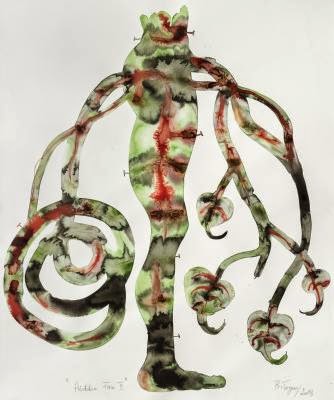
Barthélémy Toguo is an artists from Mbalmayo, in Cameroon and as well as making drawings he is involved in performance, installation, sculpture, painting and printmaking. In particular his ink and watercolour drawings are often the starting point for explorations in the way the body can be mutated and developed as a narrative for the psychic exploration of global identity confusion and collision. He lives and works in both Europe and Africa, often exhibiting in the USA. Very aware of his own culture, he is also responsive to the cultures that he moves between and amongst as he makes and shows work within a global context.


By using watercolours and inks as wet stains, he is able to suggest the mutability of forms and their propensity for suggestion and deformation. He also likes to work directly onto the walls of galleries and often shows his framed drawings within specially constructed installations. This allows him to bring together several aspects of his practice into the same environment, layering imagery and being able to suggest a multiplicity of meanings.

He often works directly onto the gallery wall, constructing imagery that is designed to work against his 'framed' or exhibited work.


The relationship between thought forms and reality shifts and mutates, his stains flowing with images as they arrive within their own becoming. 

See also:

Venice biennale