Showing posts with label Weaving. Show all posts

Wednesday, 16 May 2018

Drawing in Colour 4: Beryl Hammill


Sometimes when you know someone you don't really notice what they are doing. Beryl Hammill was one of those people that it seemed like I knew, they were always working and when I saw their work I was always impressed but perhaps what I didn't do was really think about what they were doing. Now she is no longer with us and her weaving has stopped and I realise that what she represented was something very important, something that so easily gets forgotten and that is the lifelong preoccupation with what it is to see something. 
For Beryl what it was to see something was also fused together with how to capture the seeing, how to hold it or trap it within the fibres of her weaving. She represented the paradox of art, what is experienced as a series of infinitely short moments, is communicated through hard fought and laboriously constructed image making. In her case the last few years of her life were often spent gazing, no not gazing, staring at the sea, watching how waves break, how colour refracts as the sea bulges, how the spray of breaking waters, reflects colours as well as creates tiny rainbows of broken white light as each water droplet curves through space, dropping and finally recombining with a newer parent wave. She looked for the various rhythms of movement and how they could be combined, the powerful swells of a huge beast like movement, played off against the fast chatter of small breakers as they roll over the edges of the land, rolling pebbles before them and trailing white patterns behind. She was watching for how blues and greens change with depth, how yellow sunlight fuses with seaweed shot moments of unexpected colour as it waves within waves as the sea flows over the rocks that it breaks upon.  


Sometimes the drawn marks would be annotated by short bursts of writing, reminding us that writing is so very like drawing, the calligraphy of her hand contained in the shaping of letters as much as in the shaping of wavelets.


There are other moments of observation to be found in her sketchbooks, usually made when her attention wandered from the re-creation of moving water, such as the drawing above, made as she responded to a jumble of sea birds as they cluttered across the beach. These drawings have a lot of humour in them, in particular I love the way that she has found in her quick marks a bird snail.


She filled many notebooks with her studies, each drawing an attempt to create a mark set that would echo what she had seen. Colours combine in a drawing to recreate both texture and rhythm, the white of the paper a space analogous to the expanse of open water before her, the marks breaking spaces as waves break through the rolling body of sea as it nears its edge. The fact that she was drawing on the coast of Australia, looking out at a body of water that stretched from where she was to Antartica somehow makes the edge between the sea and the land that bit more special. The sea has met an unexpected barrier to its forever swell of forward momentum, it has to break from its customary pattern and find outlets for its energy in waves and foam and breakers, in those wonderful waves that tunnel over surfers as they cut into the moving edges of the waves. And there sat Beryl, for hours on end staring those waves down, looking into their heart and trying to decide what made them tick. What made the waves and what made the images that she saw, were two makings, one in the physical world and the other in the mind, that would combine in a third, the drawings made. The mind can only catch so much of the perceived wave  the hand can only catch so much of the necessary movement needed to stroke the brush in a manner like the wave, the mind and the hand now woven together with the sea, until something is captured that is held balanced on a moment, a frozen perception that is right for being preserved. 


Beryl would take these drawings back to Yorkshire and would construct from them a template for weaving, and in doing so would set about the long slow process of making crafted images that could capture in the grids of their making the colour, the rhythm and the shapes of seeing that she had seen on that edge between the sea and the land. 
The last time I saw one of Beryl's weavings it was left three quarters finished, its edges composed of partly woven hand dyed threads, their lengths as they separated from the body of the tapestry still wrapped around their spindles. The open edge of unfinished business, somehow right and proper, because seeing is never done, we will never see through to the reality behind things, because if we did there would be no place to go, nowhere else to travel, because we would know it all. But the struggle to remember what we have seen, the weaving of memories of moments of recognition into the tight weave of a tapestry, is still myth like in its potency. The Wyrd in European myth, was made of an invisible thread that followed everyone from the moment they were born. Your daily movements in effect weave your own tapestry.  Atropos of the Fates would eventually cut the thread and whatever pattern your life had made was now fixed, and now that Beryl's drawings and tapestries are also finished, it is perhaps time to reflect on a life well lived and a pattern well woven.  


Cezanne is an artist people go back to when they want refreshing. His lifelong struggle to show what it was to look at a landscape, or a bowl of fruit, is something that as artists we all wish we could emulate because he was able to cut through all the ideas and concepts and stories and take us back to the simple process of opening our eyes to see and in Beryl's straightforward Yorkshire way she has also left us with another legacy of looking. 

Coda


Before posting I decided to check with Beryl's husband Terry to see if what I had to say about her work was accurate. He suggested a few additions.

Her favourite location for 'staring' was at the bottom left hand corner of Australia, facing west across the Indian Ocean and into the setting sun. This was important to her for the way light shone through the breaking waves - and how the waves themselves circle the globe endlessly, not really meeting land until they meet the tip of south west Australia, a place where surfers meet to experience some of the biggest waves on the planet. Looking to the left and way south is the Southern Ocean and the 'roaring forties' where the sea changes colour to an icy green and grey, a hint of distant Antartica. 


Terry also pointed out that Beryl was a student at Leeds College of Art where she learned how to weave during the early sixties when Harry Thubron was there. We tend to think of the radical days of Leeds as being to do with new visual languages and the introduction of modern fabrication methods into the art school and forget that craft skills such as weaving were still being taught. 


Beryl Hammill: Woven wave detail

Hand dyed threads of remembered sea colours beginning to be woven into one of her tapestries 


Drawing in Colour part 2


Wednesday, 17 January 2018

Patternings, ties, entanglements and knots

A cat's cradle

Drawings can sometimes be thought of as living diagrams that demonstrate how things are connected. A cat's cradle can be used to tell stories. A verbal story and the forms made by the moving fingers and loop of string are woven together as one new form, symbiotically connected not just to each other but to the audience that is watching and listening. 
This is how an old Alaskan children's tale was told.


Begin by looping the string over both thumbs and spread your hands apart.

A woman sat weaving one day and as she did so, she began to hear a buzzing noise. It went like this…bbbuuzzzzzz

Twist your left hand to make the string wrap around the back of the hand.

The woman looked up and saw nothing, she looked to the left and to the right and saw nothing, so she went back to her weaving, in and out, in and out.

Swivel your right hand so that the string is not twisted, but do not have it wrapped around the back as you did with the left hand.

The buzzing noise now grew louder…BBBBBUUUUZZZZZZZ and the woman looked around again, she looked up and she looked to the left and to the right but she could see nothing, so she went back to her weaving.

Bring your right little finger over to left hand and use it to hook both strands of string running between your left thumb and your index finger. Pull right your hand back and make the string taut.

The woman carried on with her weaving; in and out, backwards and forwards, in and out, backwards and forwards, and she began to hum a sound of her weaving, in and out…hum, hum…up and around…hum, hum…

Bend your left hand toward your body and use your left little finger to hook both strands of string in the middle of your right palm. Your hands will not be able to move far apart at this point.

Suddenly the buzzing grew very loud. The woman looked down at her weaving and was surprised to see a giant mosquito right in the middle of it.

Use your right thumb and index finger to grab string wrapped around back of left hand. Lift it over all 4 fingers on left hand and let go. (Don't let go of string wrapped on your left little finger!) Now spread your hands apart quickly.

The mosquito was now flying around the woman’s head, it began to buzz even louder. It flew down and buzzed into her ears and under her chin. It flew past her eyes and the tip of her nose. It buzzed in her hair and flew down past her cheek, it was driving her crazy!

Move your arms up and down and wiggle your thumbs and little fingers to make the mosquito fly.

"I am going to catch that mosquito," said the woman. She waited and waited until the mosquito flew right in front of her. Then she clapped her hands over it, and when she did the mosquito went quiet and all was silence.

Hold your hands together for a while, and then when you open your hands, relax your little fingers so that the string will slide off of them. Do this quickly and spread your hands apart to show that the mosquito has gone.


 The New Hebrides (Vanuatu) sand drawing tradition is similar in many ways. 


New Hebrides (Vanuatu) sand drawing

Vanuatu sand drawings are made up of geometric patterns and just as in the Alaskan story, as the drawings are constructed stories are told, in this case the stories might involve mythology, history, kinship, old song cycles and even farming techniques. The ritual of the drawing is also an art of memory, for instance a story about the rotation of vegetables when planting, to ensure their continuing health and to curtail the spread of plant diseases, is embedded into a pattern that both visualises how to move the planting and provides a calendar in the mind for when to do this. Some stories are about everyday events, but in their telling the ritual of patterning begins to transform the everyday into the mythic. Consider a story about a husband and wife who have had an argument and who are now not talking to each other. In a pattern they can be shown as separate, their journey lines far away from each other. The husband goes off into the bush and catches two chickens. He brings the chickens home tied to either end of a long pole. The symmetry of the two chickens and their hanging from the pole, is again embedded within a growing pattern. The man approaches his wife and entreats her to cook both of the chickens, knowing full well that she only has one oven. In the pattern the lifeline of the man and of the woman begin to be drawn together around the single point of the oven. The wife begins to explain to her husband why she can’t cook both chickens and in doing so they once more begin to talk together, the man using the chickens as a peace offering and the sand drawing now weaving their lifelines back together.
When I was a young boy Rolf Harris was often on the TV. He would have a large canvas set up and would gradually paint a scene, usually a picture that had something to do with an Australian aboriginal story. He would always make the image in such a way that you could never see what the picture was going to be until the last minute when he completed the story. He would constantly ask, "Can you tell what it is yet?". Now of course discredited because of indecent assault charges, his early career left a lasting impression of how an image and a story could be woven together.  


Rolf Harris painting and telling a story

‘How the kangaroo got her pouch’ was one story told by Harris, this is an old story he would have taken from an aboriginal dreamtime tale.  The Dreamtime is oral, visual, acoustic, the land itself, the creatures that inhabit it, the customs of the tribes and all that happens in both dreams and waking, everything locked together as a whole, in something that is called the Dreaming. Harris took elements from this culture and like a colonial invader stealing artefacts, presented his stories to a far off alien culture, to children wanting to be entertained and distracted. But in doing so he sowed a seed, and however tenuously linked a thread of the Dreamtime to my own imagined landscapes. 

String figures rely on likeness to work. Look at how the Navajo story below comes alive as you see the heads of the two coyotes facing each other, their tails caught around forefingers and their legs around thumbs. As Harris would say, "Can you tell what it is yet?". 


Navajo string figures: Coyotes running opposite ways

The complexity of possible connections that could be made is huge, Lillian Hsu's print below being an example of what happens when your strings get tangled and your stories get confused. 

Lillian Hsu String drawing


Perhaps Hsu's print is more like life though, the way we are directed to look at knots as topographical thinking tools, is very attractive, but often unrealistic. Knots though are an important element in this story, so although for the moment I don't want to open up another strand, I will leave a couple of images as a reminder that at some point I shall develop a post on them. 


Knots

Compare the clarity of the knotted forms above to the work of the Japanese artist Chiharu Shiota. Her installation 'The Key in the Hand' was a wonderful experience to walk into, when you entered you became totally lost in a mazy haze of thousands of red threads, and when you got closer to the centre of the installation you realised all these threads were connected to a boat, as if it was caught in a spider's web. 

Chiharu Shiota 'The Key in the Hand' 


Chiharu Shiota 'Uncertain journey' 


Shiota's 'Uncertain journey', a more recent installation is less immersive but still provides a very good illustration of how intricately connected things are. 


When I worked at the steelworks, we used to use chalk lines to mark out where large sheets of metal needed to be cut. A taut string covered in chalk, is a much easier thing to make than a straight edged ruler, you need no other technology than an ability to pull a string between two attached points and be able to use a piece of chalk or some ground up chalk dust to coat the string with powder. I suspect most of Euclid's geometric proofs were drawn in this way.  His definition of a straight line being the shortest distance between two points, would have been so much easier to arrive at if he was pulling a string taut. 


Snapping a chalk line


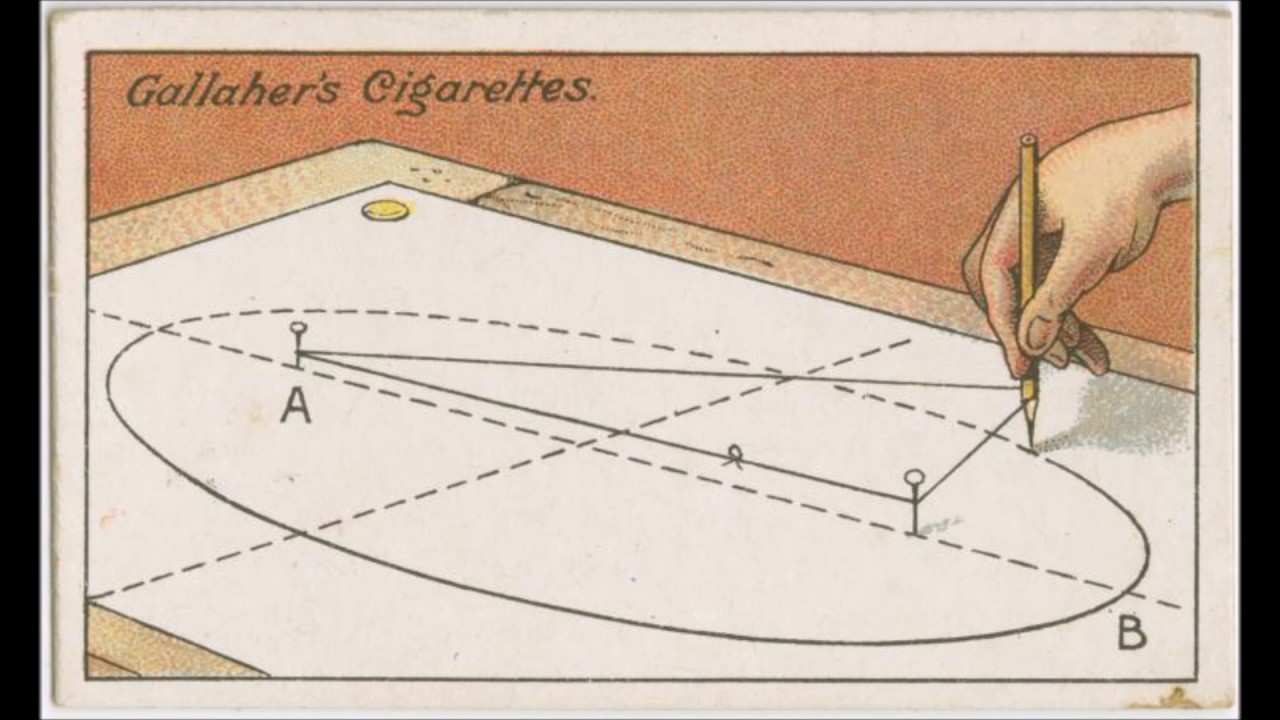
String is deeply embedded into geometric thinking when it is in its most practical form. The image on the cigarette card below is a crude demonstration of how to draw a curve from two fixed points and as a boy I well remember practicing drawing circles and especially ellipses, using a couple of drawing pins, a pencil and some string. I strongly suspect that all early geometry began with the making of string structures and if so, the stories and tales associated with cat's cradle type string structures would have been still hanging around and not separated out as a different type of thinking. Things would have been much more interconnected.  


An early Islamic diagram by Al-Biruni of the phases of the moon. 

If you look at the ancient diagram above you can almost see the 'stringing' and the text that sits alongside the drawn lines could represent the story. Modern science is little different, the image below being almost a cliched sign for scientific thinking, a type of thinking that requires a close interrelationship between mathematics and geometry. All it needs is the story around which all that abstract thinking is developed. 


When Daina Taimina developed a physical way of modelling hyperbolic space, she used crochet. What was interesting about her work was that she realised that we need to touch things in order to really grasp what they actually are. Her understanding of geometry was developed using crochet so that it was much easier to understand how a line, generated by a fold, could operate in hyperbolic space. You can watch her talking about how this came about in this video. Drawing, as in geometry is vital to this understanding, but in this case it becomes clear that without the type of drawing we associate with drawing threads, she would not have been able to develop the idea. 


I was again reminded of the myth of Theseus, in particular the part where Ariadne gives Theseus a ball of thread to unroll as he penetrates the labyrinth so that he will be able to find his way back out again. It is as if the thread allows him to drop down deep into his subconscious and return enlightened after defeating the minotaur. Taimina uses her thread to reveal the mysteries of hyperbolic space in a similar way. Daedalus the architect of the labyrinth, is often regarded as a prototype of the scientist inventor, the complexity of his thinking being something others could not fathom. However the implications of complex mathematics that we associate with scientific thinking can sometimes be clearly demonstrated by visualising processes, the key one being of course drawing. This PDF is downloadable and sets out the relationship between the mathematics of hyperbolic spaces and how these can be visualised using crochet.

The changing curvature of surfaces is something as artists we all have to deal with when drawing objects. See this earlier post. The mathematics of Gaussian curvature is a way of thinking about gravity affected spaces and the way that these are visualised relies heavily on the experience of artists visualising 3D form. 
The saddle: An example of negative Gaussian curvature


Various possibilities of Gaussian curvature

You can see from the illustrations above why the idea of crochet was so useful when trying to make sense of these types of spaces. Crochet can also be thought of as a type of net and a net is a flexible grid; so I seem to have come full circle again, perhaps time to end this post and snip this thread and start a new one.

Uccello


See also: