Tuesday, 13 February 2024

Measuring emotions and colour

I have for a while now been looking at interoception and the importance of 'feeling' or emotional experiences. However as I look into the Citrasutras, which are important writings on Indian aesthetics, I realise that once again, western aesthetic theory is way behind the times and that emotional value has been central to the way that painting has been thought about for hundreds of years on the Indian sub-continent.
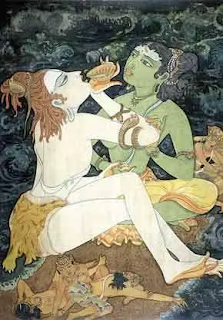
Shri S Rajam

The six limbs (shad-anga) of traditional Indian painting , as given in the Chitrasütra are the following:
Sädrusya (similarity); Pramäna (proportion); Rüpabhedä (differentiations or typologies of form);
Vvarnika-bhanga (colour differentiation); Bhäva (emotional disposition) and Lävanya yojanam (gracefulness in composition) .

In Indian art nothing is unconnected. The laws of painting (Chitra) are not understood without an understanding of the laws of image-making (Shilpa); and these are linked to knowledge of the techniques of dancing (Nrtya); that are difficult to understand without a thorough knowledge of the laws of instrumental music (vadya), and the laws of instrumental music cannot be learnt without a deep knowledge of the art of vocal music (gana). Therefore the position of figures in a painting may derive emotional disposition of their limbs from a dance form, but the emotional colour may come from an understanding of 'Rasa'. 

In Indian art theory, 'Rasa' is the quality of emotional fulfilment that a work of art produces through the personalities that are depicted in a painting, their expression and their surroundings. Rasa is a Sanskrit word that denotes the quality of emotional fulfilment that a work of art brings about. The nine types of rasa are therefore centred on emotional content, ‘Shringaram’ depicts love, attractiveness and erotic feelings. The colour green being central to this but as the erotic levels rise it becomes blue/black. ‘Hasyam’ relates to laughter, mirth and the comic; the colour white is key. ‘Raudram’: Fury, anger, warlike feelings, expressed using red and typical images include skulls and bones, weapons, and wide, circular eyes. ‘Kāruṇyam’: Compassion, tragedy, touching or moving scenes, the colour key being dove-coloured (grey-white). ‘Bībhatasam’: Disgust, aversion, abhorrent, shocking or odious, using the colour key blue. ‘Bhayānakam’: Horror, terror, fear, the terrible. Colour: black ‘Vīram’: Bold, fearless, stout hearted a heroic sensibility. Colour: wheatish brown (yellow, ochre) ‘Adbhutam’: Wonder, amazement, wonderful, wondrous. Colour: yellow ‘Śāntam’: Peace, tranquillity or a quiescent mood. Colour: perpetual white (silvery, the colour of the moon and of jasmine)

Shri S Rajam

These decisions as to colour will have been derived from experience, but experiences rooted in the times and places out of which the theories evolved. Therefore there may well be some strange, (to contemporary western eyes) types of effect. I would presume sometimes visual effects might have to be re-invented for the 21st century. However red images of skulls and bones and weapons, alongside wide, circular eyes still evoke anger and warlike feelings. Quality of colour is also vital, a mid blue is perhaps a soothing colour, or is used to evoke the sky but a very particular blue can mean something specific; therefore when dealing with the depiction of emotions the blue that for instance is meant to carry a feeling of disgust, will have to be a carefully chosen one. 

Delineation, shading, ornamentation and colouring are all essential aspects of a painting, however in Indian aesthetics the rekha, which are the lines that articulate the forms, are its real substance. Western aesthetics would also include the texture or feel of application and it is fascinating to think about how for instance the expressive brush marks and colours of a Van Gogh could be embraced within this type of tradition. 

What were most valued were effects best captured by the least number of lines. Simplicity of expression symbolised the maturity of the artist, who would look to capture an idea using a minimum number of lines when composing the main figures. The Ajanta cave paintings are an early form of painting using free flowing lines to delineate figures. Their proportion and disposition of body parts are used to communicate delicate inner feelings; together with use of the shading of different parts of the body to produce three dimensional effects in order to 'ground' the figures in an imaginary space. Colour is then used both as a contrast and to create magical or other worldly feelings. 

From the Ajanta caves

The emotions that revolve around love and heartache are particularly powerful and most of us will at one time or another have to deal with a situation when feelings totally dominate the embodied mind. Heartache is literally a pain that stretches across the chest. The giddiness of romantic love is a real lightheadedness. But the colours whereby we try to represent these things are often both mixed up and hard to assess. A feeling of euphoria can be quickly followed by one of loss. A sense of the warmth of love, can be butted up closely to one of a fear of loneliness. The erotic feelings that penetrate down into our loins, may in some instances be visualised by a harmonic movement of colour, but whether or not that is from a green to a blue, will again be dependent on quality. What sort of green, what sort of blue and what sort of colour field do these colours move through and in what sorts of shapes and forms? 

The term 'measuring emotions' is very much a paradox. When in the middle of an emotional storm, the very last thing we are capable of doing is measuring anything. But we can try to recreate the experience in an art object. As a form of externalised mind, an image can be used to play out various ways to represent what was felt, as well as what is still being felt, especially if the situation that is being represented is still ongoing. 

Emotions are like the currents that pass through the sea, some flowing strongly and others far less so, but all mixed up beneath the surface and usually invisible; until you actually dive in and are tossed about by the sea's reality. 

The psychologist Robert Plutchik was fascinated by the complexities of emotion. In particular he understood that they often came into our awareness via feelings of difference. He therefore posited 8 primary bipolar emotions: joy versus sadness; anger versus fear; trust versus disgust; and surprise versus anticipation. His model links the idea of an emotional circle and a colour wheel, which allows us to think of emotions being mixed with one another rather like paint colours, to express the complexity of the various ways we experience them.

Robert Plutchik: Wheel of emotions

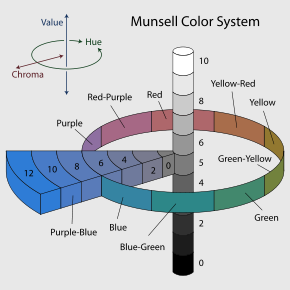
Notice how the colours in the centre have the most saturation. Plutchik thought of his model as a three dimensional one and because of this, I am tempted to explore the complex grades of colour represented by Munsell's colour sphere and to then impose these subtle saturations on to Plutchik's cone. By doing this, much more refined emotional colour mixes ought to be possible. 


Plutchik's cone of emotions

The image above of Plutchik's cone of emotions is in my mind far too dependent on a 'natural' colour wheel, but it can be played with. 

Pensive acceptance?

Love or anger?

As soon as you give particular colour qualities to Plutchik's cone, questions arise as to what these colour qualities express. However the more particular the colour range becomes, the more they point towards 'real' emotional feelings. 

From a recent series of paintings whereby Sooty undertakes the heavy emotional lifting

The fact that I'm writing about emotion from a point of emotional distance, and that my images are doing the 'emotional heavy lifting' might be due to a failure to address actual emotional relationships. Henry Moore used to always avoid trying to find underlying meanings in his work, as he was worried that he might shine light on the dark unconscious pools whereby his images arose, and in doing so what was there would dissolve like photographic images do when a light is turned on in the darkroom and he would never be able to find those images again. There is always something to resolve and though it is impossible to unpick the entanglement of everything that causes what to happen, happen; the important thing is to move on and as you do to learn a little more about why you might do the things you do. 

An alternative way of categorising feelings

Reference

The Theory of Indian Painting: the Citrasutras, their Uses and Interpretations by Isabella Nardi

See also:

Tone and emotional value

Colour and control

On naming colour

Visualising energy flow

Sanskrit Indian aesthetics

Indian aesthetics within a western tradition 

Sunday, 4 February 2024

The Lamed Vavniks


The lamed vavniks or lamed vodniks are 36 people, who unknown to each other are saving the world.


The legend of the lamed-vavniks has Talmudic origins. Lamedvavnik; a Yiddish term, is derived from the Hebrew word for thirty: 'lamed' and the Hebrew word for six: 'vav'. They combine to make thirty-six, the number of righteous individuals without whom the world would not exist. 


In this time of terrible atrocities I decided that we needed to be reminded of the possibility of ordinary people doing good. Therefore I am presenting thirty-six portraits of ordinary people. Ordinary in that they have no honorific status, such as being an aristocrat, media star or sports celebrity, but of course they are also 'special' in being individual human beings, each one having the potential to save the world. Some of these portraits were made of the same person at different times, a fact that at first I wondered about, but then I realised that each time I see them they are different and the potential they have to change the world, itself changes as they do on a daily basis. 


These people are collected together simply because I have come into contact with them, I am the connection and as a self imposed condition of that connection, I made an image based on how I felt about them at the time, an image also suffused with my feelings about the issues they raised when I was in conversation with them. It is the ordinary people of this world, who keep it sane and who help it to occasionally achieve peace, and without them our world would be a much darker place. The Lamed Vavniks are always 'ordinary'. 


The original story of the Lamed Vavniks is a Jewish one and all 36 of them were men. In these days of equality, I have decided to not discriminate and am suggesting that these righteous people are just as likely to be women as men. 


In portraits the language of painterly and drawn expression can be at odds with the distribution of individual features. These images are fusions of a play with pigmented materials and responses to the flickering moments of awareness we sometimes call perception. I think this is a good thing. It reflects that fact that we are all composites and hybrids, mixes of all the influences we have received over the years, as well as being carriers of the genes of thousands of those who went before us. A decision to stop moving the pigments around is something that comes intuitively and so is a fixing of facial features as they emerge from the morass of paint and ink and other substances. Likeness, in terms of verisimilitude is not important, but accuracy of feeling tone is. 


As these faces emerge from the possibilities that the materials of their making engender, they merge into and out of a dance of pigment, water, paper, moving brushes and pens. Their story is as much a granular tale of ink and watercolour, as it is of sadness, joy, age, youth, sex or attitude. 


These images as they are read through the various lenses and filters through which each of us gaze, are seen by some as candidates for sainthood, and by others as criminal types. 


They are all potential Lamed Vavniks, their actions may be what save the world. One small gesture, made by any one of these people, like the butterfly disturbing the air in its flight, may eventually become the thing that makes the difference, the tipping point that prevented disaster.


We should never know these people, they must remain anonymous. This is their power, by being potentially anybody they are everybody and everyone must pull their weight if we are to save this world from the ravages of consumerism and myopic individualism. 


So these people are the possible Lamed Vavniks. Is one you? Is one that woman you saw yesterday waiting for a bus? Is your uncle one? Is it that person being interviewed by the news reporter? Is it the anonymous soldier in the background of an old photograph? We are all guilty, all conflicted and responsible for the damage our kind inflict upon the Earth. Whether it is 36, 36,000 or 36,000,000 people, does not really matter. Just one might be enough, just one act, one thing done that triggers another act, starts another process and in so doing leads towards a brighter future, rather than an ending. 


I'm sitting in a house in Glasgow, surrounded by the work of a painter who I used to know really well. Her portraits surround me and I wonder if I knew the people she drew. I probably did as we worked in the same city and the art community is not a very big one. Her drawings are very personal and are like many artists more touched with the mannerisms of her hand than the individuality of the sitter. No matter how hard I try, the same happens when I make drawings in response to the presence of other humans. I try to channel something unique about the person I meet, but when looked at later, each time all I see is myself. Perhaps that is the real secret of the Lamed Vavniks. They are all possible versions of ourselves. We may be good, we may be bad, we may be bold, we may be shy, we may be whatever version of ourselves we see in the eyes of others. Sometimes I feel constructed as I speak, my voice an echo of others, my body language changing as I mimic the movements of someone I respect. Sometimes I'm unconsciously mirroring the shape of a friend and at others I'm consciously blocking the movements of a person I distrust. My boundaries keep shifting, I am a permeable membrane, a hybrid form, parts of myself carried by others, just as I carry others within myself. 


Who are we? If we are Lamed Vavniks we would never know, unknownness is a condition of their existence. It is the actions taken by people who do those actions not for profit or individual gain but for the fact that they are simply 'right' actions; that lead to these people becoming Lamed Vavniks. But they don't even know they are undertaking 'right' actions; their lives unfold as possibilities, their agency in the shaping of their lives being somehow suffused with grace, a grace that emerges from the habitual character of lives created by the gift of grace from God and there but for the grace of God, go I. I'm now confusing a Christian term with a Jewish myth, perhaps a natural consequence of my upbringing. We are all possible Lamed Vavniks, which is why we should never judge the actions of others too harshly, as we may find we at the same time condemn ourselves. 


I contradict myself with these portraits, as I do with each and every portrait I make. On the one hand I try to say that human beings are not special, that they are just a part of the endless complexity we know as what is out there, or nature, or the world. But, no matter how hard I try to be aware of everything else as being just as important, I still find myself making images of the very thing that I try to suggest should not really need any more images being made of. 


So name them ink or brush or pigment. Name them sticks and stones and bones and paper, but never John or Mary, Kevin or Jean, or even Sally or Michael or Jim. Avoid Ahmad, Fatima and Amir, never use Ezra, Leah or Aaron, and stay away from Imani, Kwame, or Omari. Fang, Jing and Yan are to be avoided, just as Mehmet, Osman and Emre. The unknown soldier has no name, and in this case no number either. These are the Lamed Vavniks and in their anonymous actions they save us all. 

See also:


Monday, 29 January 2024

What can art do?

I'm back worrying about what my work is useful for? Is art ever of any use? This is something I have had to wrestle with for well over 50 years now, and I think it's time to set out once again what types of answer have kept me going. I've also just been reemployed by the institution I have worked with for the last 48 years, as a research fellow. This will mean trying to show how my work as an artist is useful and that it has some sort of impact on society. Therefore the clearer I am about what is going on the better. I am very aware that many of the people that look at this blog are fine art students and that the question, "What use is this?" is one that often rears its head, so hopefully my personal thoughts will be useful and that they might help others come up with some sort of answer to the question, 'What can art do?'

I have for many years been an avid reader of the work of the American philosopher John Dewey. His book, 'Art as Experience' is probably the one that has had the most impact on myself as an art practitioner and teacher. The most important lesson I learnt from his writings was that art can be transformative. Not only can it be used to change behaviour at an individual level but that it can be used for social change. This is however a big ask and there are many people out there who would dispute this and argue that art can only reflect what goes on in society or that it is an hermetically closed activity that is always concerned with itself and its own rules; Art being about art, about aesthetics and the art world. 

However I believe that art can effect change, both emotional and cognitive and that art can promote first of all an awareness and then a critical evaluation of unfamiliar feelings, or different ways of thinking about the world around us. Altered perceptions can eventually lead to social change.

John Dewey pointed out that art is not about the objects made but that it is about the experience it offers. Therefore every individual is potentially an artist by way of their capacity to participate in this experience. I.e. it is collaborative.  This collaboration involves participation which itself leads to transformative change because participants experience differences in how it is possible to think, feel or behave.  Art is therefore both psychological and social, transforming not only individual intra-personal processes, but also interpersonal relationships. (Dewey, 1934)

This gives what I would call a psychological purpose to the art I make. This in turn I would hope leads to some sort of introspection on the part of people who engage with it and beyond that, that the engagement itself helps them towards new ways of thinking about other people and things. 

So how does it work?

I have recently been using an image of a glove puppet Sooty to carry a variety of ideas about the world and how I / we might think about our engagement with it. The idea was a very personal one, as it was distilled out of my own memories of being a boy and back in the 1950s been given a Sooty puppet to play with. As an adult who has been a professional practicing artist for over 50 years, I now feel capable of being able to return to experiences from the past and reframe them as constructions for thought and the development of feelings, hopefully in a way that facilitates the engagement of others. I also have to believe that in making these images, as others engage with them, the contact can lead to changes in people's cognitive awareness and the way they use feelings to understand the world. The objects I make facilitating what I have called in the past, externalised minds. It being easier to think or feel in response to a something externally perceived, than to have to compose everything, all your understandings of concepts and feelings, inside your own head. 


Sooty starts various narratives that others can complete in their own minds

At the centre of this approach to art making has been a growing awareness of animism as a way of coming to terms with the world that surrounds me. I want to talk with the rain as it falls on me, to listen to the land as I walk over it, to feel the stories of materials as I work with them, to be a bird or a cloud or a plant, or a stream and as I do/am these things, to let myself dissolve back into the world I emerge from. Animism is the belief that objects, places, and creatures all possess some sort of spiritual essence, therefore everything; animals, plants, rocks, rivers, weather systems as well as objects made by humans, such as knives and forks and spoons, as well as sculptures and drawings, are all animated and alive. This belief allows us to make contact with other things in a very different way; we can have conversations, make connections and engage with things in ways that don't have to be about separateness or difference. It sits as an idea alongside a belief in the Gaia hypothesis, that proposes that all the Earth's organic organisms and their inorganic surroundings are closely integrated to form a single and self-regulating complex system. As such the maintaining of the conditions for life on the planet, is dependent on an awareness and a set of actions that reflect this interconnectedness. 

Raising awareness is the first step in transformative art practice, these blog posts are part of that strategy, if only one person goes away after reading these words and decides that they want to make a change, then the work has had some sort of impact. 

These are not new ideas and I see myself as part of a global need to redefine what the artist does. For instance the shamanist tradition continues with work such as Pitsiulaq Qimirpik's, “Bart & Lisa Flowers”, this sculpture made of soapstone and antler bone, mixes a use of traditional mediums with images taken from the Simpson's, an iconic animation that has helped shape contemporary TV culture. He has this to say about his work, “Sculptures are in the shamanistic tradition. A lot of the visuals are about transformation, the body shifting into a different body, and the spectacle of transformation.” 

Pitsiulaq Qimirpik “Bart & Lisa Flowers” (2023)

Animism presupposes that bodies can shift and morph into different bodies, spiritual essences can be found in everything, this opens out possibilities for wonder, and gives an opportunity for us all to re-engage with the process of loving the world, instead of mining it for its resources. 

References

Preminger, S., 2012. Transformative art: art as means for long-term neurocognitive change. Frontiers in human neuroscience, 6, p.96.
Vail, J. and Hollands, R., 2013. Creative democracy and the arts: The participatory democracy of the Amber Collective. Cultural Sociology, 7(3), pp.352-367.
Goldblatt, P., 2006. How John Dewey's theories underpin art and art education. Education and culture, pp.17-34.
Dewey, J. 1934. Art as experience. New York: Minton, Balch, and Company.
Brooke, S.L. and Myers, C.E. eds., 2015. Therapists Creating a Cultural Tapestry: Using the Creative Therapies Across Cultures. Charles C Thomas Publisher.
LeBaron, M. and Sarra, J. eds., 2018. Changing Our Worlds: Arts as Transformative Practice (Vol. 12). AFRICAN SUN MeDIA.

See also: