Showing posts with label art and life. Show all posts

Thursday, 13 May 2021

Vanessa Baird, Tracy Emin and Munch

Vanessa Baird: The cherry blossom in my neighbour’s garden - Oh it looks really nice, 2019


Vanessa Baird

Vanessa Baird is an artist who has directly confronted her own life as a source of imagery.  As a drawer she is prolific and uses whatever is around her as inspiration, often revealing magical fairytales existing deep down in a daily existence that could easily dissolve into despair. She lives in Norway, but I think she may have also lived in Scotland as her mother is an artist who made her reputation there. In fact her mother appears in her images; a women now well into her 90s who needs looking after, at the same time that Baird's teenage children are also seeking her attention. The continuous distractions of her home life are not the only things she has to contend with, she has a long term illness herself. Somehow in the middle of it all, she keeps making drawings and as she does the chaos of domesticity begins to morph these drawings into something else, something that looks as if it was frightened into being by the ghost of Edvard Munch. 
Munch's work is back on exhibition in England in the Tracy Emin / Edvard Munch exhibition 'The Loneliness of the Soul' at the Royal Academy, which is on until August 1st. 

Tracy Emin

Munch
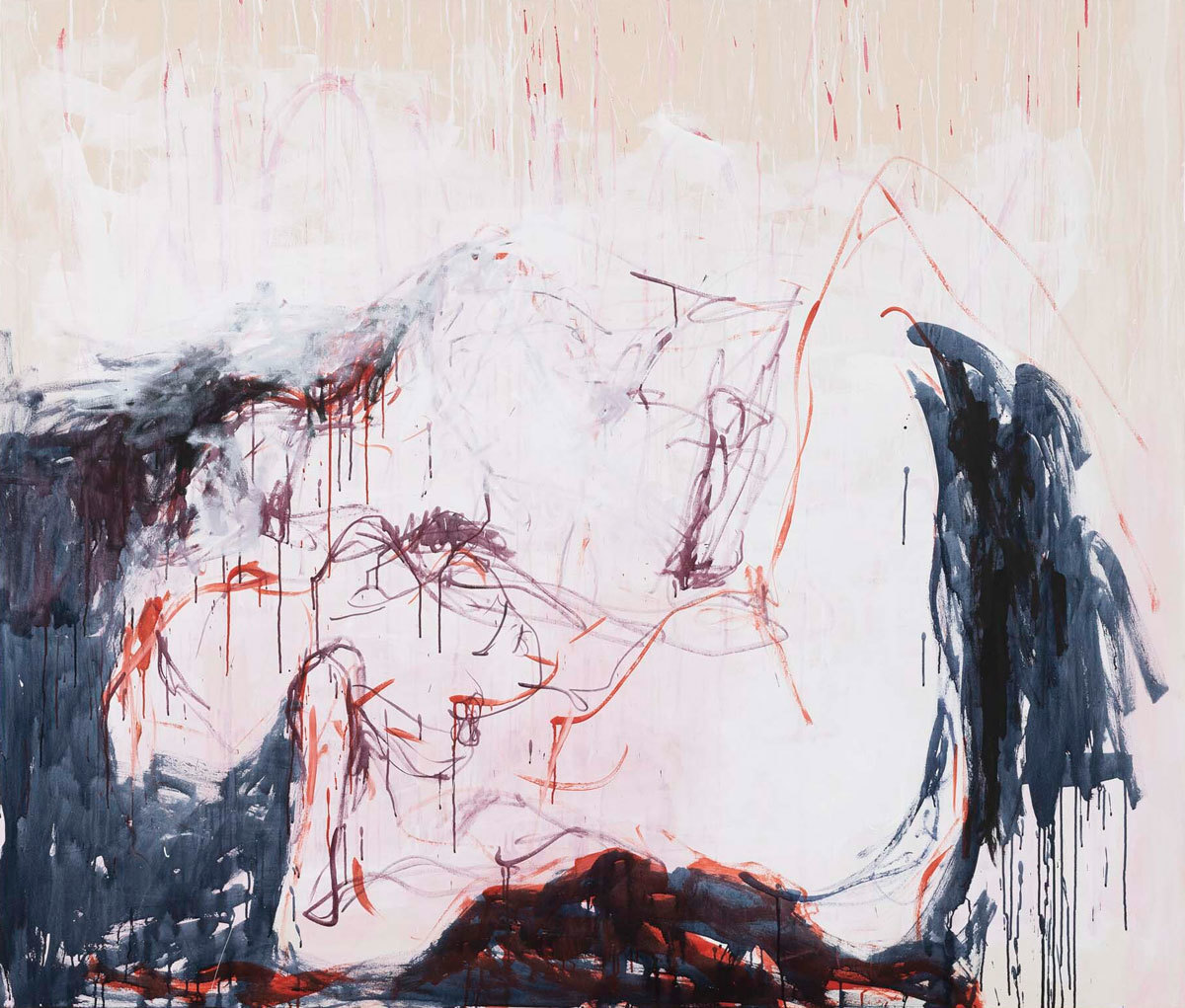
Emin

Emin

Munch

Munch

Tracy Emin

Both Baird and Emin look back to Munch as an artist that was able to communicate personal tragedy and existential despair using a personal language of nervous markmaking, shallow spaces and acidic colour, a language that can be adapted in several ways, as a comparison between Baird and Emin reveals. 
The other issue of course is the change in society that has taken place since Munch's time. Although he did not die until 1944, Munch had developed his particular approach to image making by the end of the 19th century. Women did not have the right to vote in England until 1918 and although a man could make a career out of a very personal private view of the world, women's views were still on the whole ignored by a male dominated society. The fact that the Royal Academy is hosting such an import survey of Emin's work, reflects how far we have come as a society. 
However the reason I have paired Emin with Baird is to also make a point about art and care. As well as art being used to express the angst of individuals and their ability to make their solitary way in society, it can also tell stories of home life and its messiness and the fact that women are often left literally holding the baby or being the family carer. I have been thinking a lot about the role of art lately and its ability to communicate how people feel and how it can make visible the invisible stuff that we hold inside ourselves and have decided that an idea of 'care' is central to my approach. Without empathy we could not begin to think about how to communicate with other people.

Old men's knees

An old school friend of mine has just had a knee replacement and my own knees are beginning to give out too, so I became interested in whether or not I could visually communicate this. He had sent me a photograph of his recent operation and had written to me about how painful his recovery had been. In order to make an image out of his and my own experience, the visual lineage of expressionist language going back to Munch and all those artists associated with Expressionism, seemed the most appropriate. You might feel that its all a bit old hat in the days of video art and performance, but that search for an image to communicate something is still, it would seem to me, a valid thing to do. I'm also worried about novelty, pictorial form shouldn't have built in obsolescence, the Egyptians used the same visual language over and over again for thousands of years. Marks, colours, shapes and textures can arrive in an infinite variety of combinations, but only certain images seem to stick in your mind, but when they do, they stick like glue. I decided I liked my image of old men's knees. Most of us will get these before we die, its part of the process of entropy, and even if the image only works as a note of sympathy for an old friend, he may well be comforted by the fact that I was thinking about him. 

See also:


Thursday, 30 July 2020

The etymological root of Art

I have used the diagram below before, but have no apologies for showing it again, because I think it is important at a time like this to stress the deep and long history of ideas. It could be that when these times are looked back on, they will be seen as significant moments in a return to a kinder more 'mythic' relationship with the world, rather than the present capitalist one that sees the planet as a resource to be mined. 

The Proto-Indo-European root of the word 'art' was the morpheme rt. It was associated with a dynamic process of universal creation. There are other derived ‘rt’ words such as right, rhetoric, worth, rite and ritual. Rt was associated with ‘creation’ and ‘of beauty’ but also moral and aesthetic correctness.  It was concerned with what was 'right'. It also referred to first or original things, so therefore it was associated with creation and what was created. What was beautiful  was also linked with repetitive order and ideas of moral and aesthetic correctness.
I'm suggesting that the prehistoric morpheme 'rt' is still resonant and useful for us to think about in relation to an ongoing search for what is 'right' and what it is that we should be doing as artists. 
The oldest word derived from 'rt' that is still in use in relation to the original meaning is 'rta' a word in Sanskrit that represents the ‘cosmic order of things’. The Sanskrit language is considered to be the most faithful to the Proto-Indo-European root. The word 'rta' is from the oldest portion of the Rg Veda, which is the oldest known writing that still directly relates to the original Indo-Aryan language. 'Rta' as a concept combines both the 'cosmic order of things' as a physical order of the universe and as a moral ordering of the universe. Therefore 'Rta' is a pivot between the physical and the intellectual, between matter and spirit. It has been argued that this looking for 'rightness' is the oldest idea known to humans. 
It would seem that in western Europe we have spent an inordinate amount of time considering the elements of (a)rt that are to do with making and skill and thinking about beauty as things separate from nature but not enough time thinking about the dynamic processes that lie behind how things fit together and the possibilities of using (a)rt as part of a ritual designed to re-attune ourselves to the ever unfolding act of creation and being joined in with and embedded into nature. 
I first came across Rt or Rta in relation to the concept of a dynamic process by which the whole cosmos continues to be created, in the writings of Robert Persig, he introduces the idea in 'Lila: an inquiry into morals'. In his  'Zen and the art of motorcycle maintenance' I found an empathetic writer who seemed to really understand the importance of making things by hand.  'The physical order of the universe is also the moral order. Rta is both'. (Persig,1992, p444)

Understanding 'Rta' as a root out of which our concept of art gradually developed can help in the establishing of personal and societal well-being. For example, when making artwork we often have ethical dilemmas, but if you see art as part of the ever unfolding interconnectedness of life, decisions regarding environmental conservation informed by an awareness of Rta, would emphasise this. Something that has helped myself in the establishment of an ethical framework within which to practice. Any initiatives whereby you place your work within a social context can draw upon the concept of Rta to ensure that your work helped in the development of any community's internal harmonic structure and ability to recognise contact points with the world that surrounds it. Instead of trying to hold on to how it has always been, a community might be helped to embrace the fact that the universe is an ever unfolding event and that accepting change is a strength rather than a weakness. 

N. b. A 'morpheme' is the smallest bit of a language to make sense, a morphological unit of a language is one that cannot be further divided. 
Coda
Since writing this post there has been considerable interest in what I was thinking about. Follow the link below to see how one person's research has taken the idea on further.
See also:

Wednesday, 1 April 2020

The search for the real

I have been thinking about Hans Hoffman recently.  A second hand copy of his 'Search for the real and other essays' was going cheap and for a moment I thought about buying, but decided no, because it brought back too many memories. 


Hans Hoffman

Plato said that art imitates life and that the reality of life itself is something we can never actually perceive, all we actually experience is something akin to shadows cast by the light of a fire on the walls of a cave. He stated that there existed a world of true perfect forms, and that they lay behind what we experience as everyday reality. A work of art is therefore according to Plato, a copy of a degenerate copy of a perfect form. It is therefore even more of an illusion than ordinary experience.

This stinging rebuke has been problematic for many generations of artists and over the course of time, various artists at different times, have set out to disprove him. Hoffman was one of them.

Hans Hoffman was very influential on the teaching of drawing and painting when I began my own teaching career. The preservation of 'life' in an image was deemed vital to a painting or drawing's success and there were various approaches to this, mostly it seemed at the time to do with 'formal' principles and how they could be used to generate this life force. Hoffman had this to say; "The creative process lies not in imitating, but in paralleling nature; translating the impulse received from nature into the medium of expression, thus vitalising this medium. The picture should be alive, the statue should be alive and every work of art should be alive." 


A drawing done in one of Hoffman's classes

The key to 'reading' a drawing of this sort was to watch both sides of a line. As you did your eyes/ brain would 'tick-tock', into surrounding space and back into the mass of the form. Mass and space perception being made by the visual events that made up the image. The crime was to shade it all in. 


The 'finishing' of a drawing, as above, was seen as killing it off and making it lifeless. It was in Plato's terms an imitation, and as such could never live up to the reality of the model. You can see the leg and the back are rendered 'realistically', but the experience of the perception of the figure, was lost in the attempt to render the figure as something separate from the experience. Hoffman's teaching was of its time and an essential element in the understanding of how abstract expressionism could be applied to direct perceptual experience. It is 2020 now and not the early 1970s when I first experienced Hoffman's influence on art education, a time when it was already somewhat dated. I don't need to draw in the way Hoffman suggests, but I still carry the lesson in my head, experience is about relationships and how they constantly change, about events, not separate things. 

Over the last few years I've thought a lot about what a big mistake it is to categorise difference. Art is of course part of life, but so are humans part of nature. The old nature / culture divide is in fact an illusion. We can't separate ourselves out from nature because we are nature. We can't separate art out from nature, in exactly the same way we can't separate a bird's song or a bird's nest from nature. The song and the nest are inseparable from the nature of the bird. What is perhaps more interesting is the dialogue the bird is having with bits of stick, old feathers and some dog hairs. This is the bird's reality, and we could spend more time trying to empathise with it. 

Words as nouns associate themselves with things. A dog, a man, a stone, a tree, and because of this we have a tendency to think that there are such things as dogs, men, stones and trees. However what we are really thinking about are sets of categories as set up by words. Going back to Plato, his 'ideal' I would argue was a problem with nouns. He thought there was an ideal 'horse', but this was, I would argue, because words work like that, every noun is in fact an 'ideal'. We learn that the word 'horse' stands for lots of different creatures that can be dappled, black, white, small, aged, wild or domesticated. However they are also events that take place between plants, landscapes and ecological systems; events that can also combine with the events that humans take part in. But nouns separate one thing from another and this makes us think all things are separate from each other. 

I am English, you are Dutch. I am male, you are female. I am white you are black. I am a Remainer, you are a Brexiteer. And so it goes. I am also over 50% bacteria, a living repository for a hosted colony that I need to keep replenished by engaging in a close association with my environment. 

Reality is another word, to search for it suggests that it can be picked out as separate from everything else. If there were no words we would simply live in the now and die in it and be reconstituted in it; one event, morphing into another, into another. 

Think of these words as links not things, as events in chains that join events, that sit alongside all those smells and tastes and sounds and inner body feelings, entering and exiting the event of you today and not as proofs or understandings or worst of all, as any form of 'reality'. 


Between one thing and another

See also:

Object orientated ontology and drawing
A line of disjuncture
Illusion
Mathematics and rightness Includes a reflection on the Jacob Kramer red spot, meant to 'tick-tock' between squareness and circularity. 

Sunday, 9 February 2020

Drawing and politics: Part four

Mounira al Solh

I was reminded of how important a political stance is to many artists by Kelly Chorpening's  presentation at the drawing symposium in Bristol. I was particularly interested in Mounira al Solh's series of portraits on yellow legal pad paper, that record those who have been displaced or exiled from the Middle East and other regions, but who are now living in Lebanon, Germany, Greece, many of whom are making the transition from refugee status or temporary migrant to permanent resident. Al Solh has continued this series, collaborating with local Gateshead women who have moved to the North East and has been collecting their stories from personal conversations and encounters.

These are women’s stories of separation, loss, hope and resilience and in order to both capture them and display them Al Solh has been making a large decorative tent that has been developed collaboratively with women embroiderers from Afghanistan, Iran, Lebanon, Turkey, the Netherlands and South Africa. Made with hand-stitched and machined embroidery on organic henna-tinted hemp, the work is based on an Iranian ceremonial tent from the Qajar era in Iran, currently in the collection of the Cleveland Museum of Art in Ohio. The tent is richly embellished with embroidered floral patterns and birds, and the outside panels are decorated by Arabic words which describe notions of sadness and happiness. The tent also contains a sound piece recounting the words of the women she meets, mixed with Iranian songs of sadness and nostalgia.

Electric Peacock: Mounira al Solh

However when I began to look at Mounira al Solh's other work such as her Electric Peacock drawing, I was also reminded of how the poetic and the political can be woven together and in that weaving something else emerges, something that can transcend the political. 

The private and the political merge into each other in the wonderful coloured gouache drawings of Charlotte Saloman. I love her book 'Life? or Theatre?', it is one of those testaments to life that when you come across them reinforce your own commitment to keep trying to make images that may at sometime make sense to others. 


Charlotte Saloman

Whilst in hiding from the Nazis in France between late 1940 and early 1942, Salomon painted a series of approximately 200 images reflecting on her life.  She combined images, texts and musical references, but most of all she was simply 'honest' and straightforward, never self pitying and always life affirming. To look through her work always brings me to tears. Perhaps because my grandmother was of Polish Jewish descent I am prone to be more emotionally engaged with her work, but even so, I can't not recommend her work highly enough. Whether you are seeking to explore the potential of developing personal narratives around your own life, or whether you are simply looking for an artist that has combined text and image in such a way that they become fused, or looking for an artist that transcends the political, whilst still being political, Charlotte Saloman is someone to look at in detail. In 1943, she was killed at the age of 26, after been arrested and deported to Auschwitz; she was five months pregnant at the time. 


Charlotte Saloman: Life? or Theatre?'

It is important to remember that art has sometimes been produced under the most difficult of circumstances, circumstances that at the time must have meant that there was little or no concept of being able to show work to an audience.  But work was made, work that has  affected and still affects other people's lives. 

See also: 


Thursday, 27 June 2019

Non western aesthetics: Japan (Part one)


Muqi Fachang: Six Persimmons
One of the main reasons I have been drawn towards a study of non-western aesthetics is because of the dangers now threatening us as a species, in particular climate change and global warming. I believe that because of these threats we need to change entire sets of behavior patterns. In the West we have tended to separate art out from the rest of what we do and in doing so apply certain aesthetic ideas into very elite areas of human experience, which leads to a situation whereby most people dismiss art as totally irrelevant to their lives. For instance the long Greenberg influenced debate surrounding the specificity of painting as an art form, or Danto’s writings on the specific nature of art as something defined and bounded by the art world itself. When faced with the reality of existence and how precious life is these sorts of art bound definitions seem irrelevant. This is why I have in a recent post celebrated the writings of John Dewey, a philosopher who did value the way art could reflect real life experience and why in earlier posts I have looked at object orientated ontology as a way of using philosophy to help see how everything is both connected and relatable.


I have touched upon the issue of non-western aesthetics a couple of times recently, looking at both Indian and Chinese approaches to aesthetic form, but this time I would like to dig a little deeper and open out ideas that might help us to think of how to apply aesthetics to much wider areas of our experience. This is because I believe that aesthetics is fundamentally about what we care about and if we don't care about the wider world, we won't have it to care about for much longer. Aesthetics has a much greater relevance within Japanese culture than is accorded to aesthetics in the West, therefore it is perhaps useful to explore how this situation arose.
In her fascinating book, ‘Bonds of Civility’ Eiko Ikegami describes how the people of Japan incorporated aesthetic awareness into the very social fabric of their daily lives. Japanese people becoming both producers and makers of aesthetically significant productions. Ikegami points out that identity, culture and meaning are emergent properties and that by focusing on aesthetic issues people within a very structured and hierarchical society could develop meaningful relationships with the world and their place in it without coming into direct conflict with those that sought to hold on to power. In our own society we also have many disenfranchised people who feel that they have no meaningful relationship with the world. Our current art practices are not designed to help with this and in many ways totally ignore or turn away from the problem. If you walk through the local streets where I live in Leeds you immediately sense that something is wrong, litter and rubbish is tossed everywhere and very little effort is put into the aesthetics of day to day communication between people. If people's lives don’t matter why should they bother? But their lives do matter, and so does the life of the planet. If people don’t value their local environment, they definitely won’t value the rest of the Earth outside of that locality.

 In Japan the aesthetic sensibility must have taken a thousand years to fully develop. Capitalism as an idea has also taken a long time to become part and parcel of people’s everyday lives in the west. But the urgency of the environmental situation might speed the different processes that stimulate change and we might still be able to reframe the way that our society sees itself.
The Japanese aesthetic tradition stems from two religious beliefs. The oldest being Shinto, whereby there is a deep awareness of nature as an energy generating phenomenon, this is reflected in a celebration of the divine nature of trees, rocks, objects, places, animals and people, all of which are seen as being interconnected and sharing the world's resources between themselves.  Buddhism in its Japanese form arrived later but there was a similar aspect to Shinto in that there was no human/God divide as there is in Christianity, both Buddhism and Shintoism seek to open people out to what is already there and to help them to achieve some sort of oneness or peace with the world. In the Buddhist tradition, all things are considered as illusions, they are simply points in time on a journey whereby they are evolving from or dissolving into nothingness. Everything has potential to be something else. Nature is seen therefore as a dynamic force and one that humans need to attune to, rather than try to shape. Both these traditions seek to maintain some sort of balance with nature,  making humans aware that they are not separate from nature. The Anthropocene understood in this context is a product of natural forces; because we cannot step outside of nature if we are ourselves part of nature. Any effect on the planet we might have as a species, is something that is caused by nature and nature it could be argued, will therefore have a solution. Imagine a particularly strange bird that needed to build ever more larger and complex nests, as it did so it began to decorate them with glittery things that seemed to add some sort of extra value to these ever growing larger nests, until one day everyone began to realise all of the Earth’s resources were being used up in their nest making. We are like these birds, unaware of anything else but the need to build our nests but at some point these birds will either die out or change their habits. 

Muqi Fachang's 'Six Persimmons' is a meditation on a movement between nothingness and being, it captures the moment of seeing the differences and yet similarities between a family of objects. A moment caught by a few spins of the hand/wrist and a flick of the fingers, enough to embed the human into the persimmons' action. It is in this holding on to a few moments of looking that we can see the bigger picture. Life is indeed wonderful, the simple yet complex pattern of relationships we find in a simple group of objects, echoing the patterns we find all around us. We are just too busy to notice them. This is why aesthetics are so important. They ask us to look and to see the beauty in the looking.


Gibbons Reaching for the Moon, Ito Jakuchu

At other times a visual image can become an entry into a meditative experience. 'Gibbons reaching for the moon' being both an image that highlights human hubris and folly as well as offering a space for further meditation on the nature of life itself. (I have looked at a similar Zen drawing in the past and have opened out its meaning in more detail here) 

It has been argued by Donald Richie that, 'if aesthetics in the West is mainly concerned with theories of art, that of Japan has always been concerned with theories of taste. What is beautiful depends not upon imagination (as Addison thought) nor qualities proper in the object (as Hume said) nor in its paradoxes (as Kant maintained) but rather on a social consensus'. (Richie in 'A Tractate on Japanese Aesthetics') In relation to this argument, I believe that we as a society need to recognise the fact that our aesthetic social consensus is basically broken and unfit for purpose and I further believe that it is going to be part of the job of artists to help build a new one. 

If we can spend more time appreciating the world around us, we might not be so quick to destroy it. This awareness is something that should unite the arts and sciences. When you look at a field of growing wild flowers, it is not only beautiful to look at and challenging to draw, but the hidden dynamics of soil structure, the below ground fungal biochemical systems, the plant/insect communication networks, the various interconnected life cycles, can all be understood and more importantly seen as an extension of our own eco-system. Scientific research and sensitive observation leads to an interconnected awareness, which can be something that we tune ourselves into and in this tuning we will find ourselves and the field and all the things of that field to be beautiful. 

The posts put up in this blog are part of my own self education, they are also a response to what I strongly believe is the moral duty of an artist/educator. The making of art cannot take place in a vacuum and if you look at any society that has used art forms, be these multi-media ones or very specific ones such as dance or decorative pottery, you will find that the indigenous art form was something that helped that society develop bonds with both its members and with the world outside of the social group. Whether this is the Australian Aboriginal 'Dreamtime' or a Finnish shaman's singing in of animal spirits, a Japanese tea ceremony or Michelangelo's Sistine Chapel ceiling. So as you communicate what it is you are trying to do, try to ensure that what you are doing is of benefit, ask others whether it helps them in some way, check on whether or not what you are doing hinders or helps our relationship with the planet. I'm not suggesting all artists should become eco-warriors but I am suggesting that artists need to think about their role in society and what they are communicating. If Shakespeare hadn't bothered to think about how well his work communicated to others he would never have had any of his plays staged. It is not easy and it is also a road lined with traps. The role of the artist is often confused and mythologised by the media, sensationalism often offered up instead of communication. Sometimes artists can get carried away with their own importance. Consider the case of Christoph Büchel and his moving of what is in effect a mass grave from its resting place at the bottom of the sea to the Venice Arsenale.


A visitor to the Venice Biennale takes a selfie of himself with the sunken migrant ship in the background
The cost of raising the ship and transporting it was over £30,000,000. Two fully equipped field hospitals with staffing could have been put into operation to serve one of the world's huge refugee camps for that type of money. Büchel states that he is raising awareness of the plight of migrants, but in effect what he has done is to set up a publicity stunt that ensures that the one name we remember is that of Christoph Büchel. It is work like this that makes me believe that our aesthetic social consensus is basically broken and that what we call the art world is by that very definition also not fit for purpose. Art doesn't need its own world, it should be part of all our worlds. 

If you go to Venice as well as attending to the Biennale you could visit the church of San Zaccaria. Inside the church is Bellini's 'Virgin and Child'. In response to the painting's position Bellini has painted two marble pillars that operate as a frame in order to echo the painting's positioning alongside real marble pillars, these pictorial devices of framing ensuring that we understand that this image is separate from life and is designed to meditate upon both life and its connection to the world of the spirit. If you visit the church at the right time of the day a sunbeam will brightly illuminate the face of the angel, and then slowly but surely this light beam will move across the painting giving 'divine' illumination as it does so. Both the architect and Bellini must have been aware that this would happen. If you go to Newgrange in Ireland, you will find that its alignment captures a sunbeam from the rising sun during the time of the winter solstice, this is something that is of cosmic significance. 


Bellini: Virgin and Child

As I walk to work in the morning I often draw, it helps me look at things and slows me down. When I draw trees I often notice that they collect moss on one side, and that there are more spiders on the other side. The sun is a powerful shaper of life and where we are in relation to it is fundamental to our awareness of what we are and where we fit in; as important for the moss and the spiders as it is for ourselves. The artist Roger Ackling devoted his entire working life to this idea and his austere approach owed much to his awareness of Japanese aesthetics. His small meditations, whereby he focused the rays of the sun so that he could burn simple lines on a washed up piece of wood, were small acts of thoughtfulness that anyone could aspire to. As simple as choosing to not eat red meat, or to re-use a plastic container, not all gestures have to be grand ones, but if we are to live a more aesthetic life, it will be these small gestures that signify that life and art are becoming unified. 


References

Ikegami, E (2005) Bonds of Civility Cambridge University Press: Cambridge


Richie, D. (2007) A Tractate on Japanese Aesthetics Stone Bridge Press: Berkeley

Carlson, A. and S. Lintott (eds) (2008), Nature, Aesthetics and Environmentalism: From Beauty to Duty. New York: Columbia University Press.

See also:

More reflections on tone and emotional value and why the tilt of the Earth is vital to our understanding of these things.  I.e. the influence of the sun on drawing


More on Japanese aesthetics 

Thursday, 1 November 2018

Sustainability

Dear Climate: General Assembly, 2018

On a recent Tuesday evening we went to see a music, sculpture and performance work at the Howard Assembly Rooms in Leeds. The Matter of the Soul' by Kat Austen was something I had been looking forward to because it was a complex piece that was bringing together a range of practices in order to make a statement about climate change and global warming, issues that I'm very aware haven't been dealt with as much as they ought to have been by the arts community. However I was very disappointed in the final production, the various elements failed to fit together and I found the sound languages used incomprehensible and supporting visual imagery badly done. This was a real shame, and as far as I was concerned a wasted opportunity. At least the ambition was there and perhaps that was more important than anything else.
We only have a few years left to prevent global warming becoming an unstoppable planetary disaster. As artists we cannot escape this, we have responsibilities not just to each other but to ourselves. Recent posts have suggested that we should be reframing our approach to everything we do when faced with this situation, but I have not yet really addressed something that is rather like the elephant in the room. It's so big we don't talk about it, it is the biggest thing in the room by far, but we are so scared of what it represents that we will busy ourselves with all sorts of distractions, rather than look at it directly.

There are of course artists dealing with these issues, but due to the complexity of the issues involved these are more often than not artists working in collaboration.  For instance, Livin Studio, an Austrian artist duo composed of Katharina Unger and Julia Kasinger, developed Fungi Mutarium. Fungi Mutarium is a prototype that grows edible fungal biomass, mainly the mycelium, as a novel food product.  Agar, a seaweed based gelatin substitute acts, mixed with starch and sugar, as a nutrient base for the fungi. The fungi digests the plastic and gradually overgrows the whole substrate. 


Livin Studio use drawing to highlight communication issues.

The Canadian duo FICTILIS, composed of Timothy Furstnau and Andrea Steves, have developed 'True cost market' a shop that confronts and tells its customers the real cost of its products and 'Wastewater Walk' which is a series of walks following the paths of human waste from toilet to treatment facilities in various locations. The walks are a playful way to promote awareness of the hidden infrastructure, environmental inefficiencies, social inequities, and psychological repercussions of modern sanitation systems, and to tie this awareness to shared, lived experience in the physical landscape. Different versions of the walk have included mapping exercises, water tables staffed by local water organisations, performances at stops along the route, and audio tours. 


A map of nuclear sites from a FICTILIS research file looking at protest

Both these art groups are non traditional in approach, and they see problem solving as a thing they are happy to undertake, which is normally the province of designers; they are not involved with making art objects as such, they are more interested in an awareness raising process. You could argue therefore that this is bad art, but when there is the need for something to be done, I believe this doesn't matter that much and that gradually as more and more artists begin to work in this area, ways to make powerful, emotive statements will become more and more possible, because an audience will have been developed that can understand and respond to the types of work possible in this area.

A wide range of approaches are being taken by artists to these issues and an exhibition such as 'Indicators: Artists on Climate Change' at the Storm King Art Centre, is a useful place to start if you are wondering what sort of approaches have already been made to this issue. 


Adam Lowe and Jerry Brotton

I've looked in the past at how useful both model making and maps can be when trying to visualise things, but of course these technologies can be brought together. Adam Lowe and Jerry Brotton of Factum Arte, in their work Terra Forming: Engineering the Sublime, make relief models of maps of Earth and flood them. These models are designed to provoke discussions about climate change, the artwork encompassing the associated debates and symposiums that Factum Arte are developing. This way of working, whereby the physical artwork is just a small part of an overarching series of events, talks, marches, internet campaigns etc. etc. is becoming more the norm, as artists realise that the situation is urgent. 


A strength that comes from involving art in this context is that it is not constrained by standard scientific methods and can more easily involve not just artists and scientists, but also citizens and many different types of change agents. As such, the arts can also challenge things that tend to be taken for granted, in an engaging and creative way. This can lead to new ways of perceiving, understanding and acting upon climate change.


The diagram above represents the number of art projects that have been recorded as dealing in some way with raising awareness around sustainability and climate change. As you can see these have now peaked but together they help others gain momentum in their various approaches. Each and every action, no matter how small, helps.

References

Sacha Kagan: Art and Sustainability: Connecting Patterns for a Culture of Complexity

Soil City A good place to start if like me you think soil is vitally important to a sustainable future.

Invisible Dust Lots of links to both artists and scientists   

Creative Carbon Scotland Lots of supportive information on what you can do

Centre for contemporary art and the natural world Exploring new understandings of our place within nature.

Deveron Projects A place to see how a single town has embraced art and climate change awareness

Arts Catalyst A commissioning body that specialises in arts and the environment

Green Art Lab Alliance A place to see what's going on.


Related posts:

The 12 principles of permaculture as an art manifesto

The pencil and sustainability