Showing posts with label eco-art. Show all posts

Monday, 28 March 2022

ARTocracy, Social Sculpture and Sustainability

ARTocracy

If as artists we are to embrace sustainability we will have to re-examine the practices that we call art. This isn't something new and I have looked in the past at how the word 'art' has changed its meaning over time. The stem 'rt' from the old Indo-European language root meant, 'the dynamic process by which the whole cosmos is being created.' A powerful idea that suggests 'rt' and its successor 'art' are much more to do with being involved with unfolding events than making objects, a concept that celebrates the interconnectedness of everything, rather than something just about painting and drawing. Perhaps our society needs to think again about the way art is used or perhaps we need to revisit a much older tradition. Art under capitalism has become about the exchange value of objects, unfortunately the news media now concentrates on the amount of money that an art work achieves at auction and rarely on how art might be used to add value to society. In 2017 the Wall Street Journal reported that the painting 'Salvator Mundi' by De Vinci had been bought for $450 million by Saudi Culture Minister Prince Badr bin Abdullah. A figure so huge that it is almost impossible to begin thinking about what this means. In a time of war, migration of displaced peoples, global warming and planetary wide instability, somehow the putting of so much money into an art investment seems not just futile but criminal, a sign that something has gone wrong with our idea of value. 

So it is perhaps time to look at alternatives, of ways of approaching art in such a way that its relevance to our collective understanding or feeling about the world goes beyond whether or not a drawing or painting is suitable to be shown on a gallery wall. 

In connection with my earlier posts on sustainability and the linking in of artists associated with eco-awareness, I'd therefore like to add another strand of practice, and in doing so perhaps open out alternative models that some of you might find useful or at least thought provoking.

The term ARTocracy, a sort of 'how to do it' brand name, was first used by Nuno Sacramento and Claudia Zeiske in their 2010 book of the same title. The book systematically shows how creativity could be applied through a sensitive interconnecting of people, context, processes and outputs, all of which it is argued will need to work together if we are to develop more sustainable communities. 

The book is about the organisation of collaborative projects and it is designed to raise awareness as to how projects get off the ground. It provides practical guidance about funding, communication strategies, education and the making of art in community contexts, and in particular it looks at the balance between artistic quality and social consequence. I thought this was interesting because these issues go deep. For instance I remember being told very early on in my career that I was to avoid being didactic. I.e. that I should not intend to teach or give moral instruction through my artwork, if I did my art teacher told me, it would not just be detrimental to its aesthetic value, it could actually stop it being considered as art. Years later I was to meet Joseph Beuys and the first thing he said to me was that he was a teacher and that his artwork was designed to educate and provide a moral framework for others. Beuys used the term 'Social Sculpture' for his work, a term he used to describe an expanded concept of art, in particular to advocate art's potential to transform society. The fact that Beuys was co-founder of the German Green Party, illustrates how deeply he wanted to integrate politics and social awareness into his practice. In 1982, which was the year he was in Leeds; for documenta 7 he proposed to plant 7000 oaks, each one paired with a basalt stone. The 7000 stones were piled up on the lawn in front of the Museum Fridericianum in Kassel with the idea that the pile would shrink every time a tree was planted. The project, seen locally as a gesture towards green urban renewal, took five years to complete and it eventually spread to other cities around the world. If you stand outside the Henry Moore Centre in Leeds and look slightly to your left for an oak tree, you will see one of those Beuys oaks still standing next to its basalt stone. 

I thought it useful to begin with ARTocracy simply because it is subtitled; 'Art, Informal Space and Social consequence: A Handbook for socially engaged practice', and we all need to start somewhere and this is a handbook. The first premise it establishes is that the town is the venue. I.e. the place you live is going to be where you develop an audience, find participants, seek content and be a place to both make and present or exhibit work. Your art practice is in effect embedded into the society and particular locality in which you find yourself. This is a very different approach to the idea of the artist as outsider, or cool observer of reality. It also questions the role of the artist as individualist or 'genius', looking at the artist's role as cultural activist, rather than artistic producer, exploring how an artist can energise people and local communities, rather than provide images for contemplation. Art processes it is suggested can be employed to untangle and overcome real-life challenges, defuse conflict, solve problems and open up new possibilities. Sometimes though its good enough just to help people see what's there. 

You can read all about it by downloading a pdf from Deveron Arts Projects.

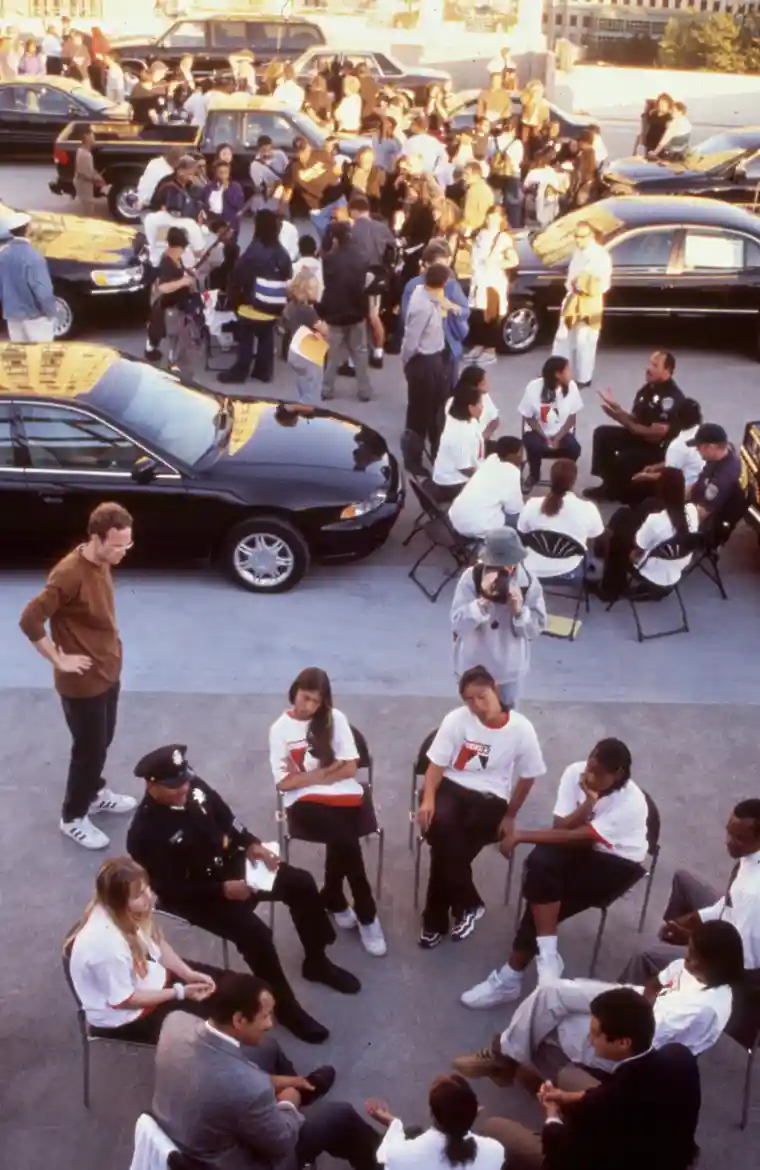
Socially engaged art practice is collaborative and participatory and how you involve people in the work is central to the process. You can involve people and communities in debate, collective action and social interaction. The term 'new genre public art' is another way of thinking about it, a description that was coined by Suzanne Lacy, who wanted to find a way of making public sculpture that wasn't putting up statues of high achievers onto pedestals, as she wanted to show how 'ordinary people' could participate in collective decision making. 
City conversations: Suzanne Lacy

What Kind of City? is the title of many of Suzanne Lacy's conversations, she has visited Leeds in the past, and this question was the title of her presentation at the art gallery. 
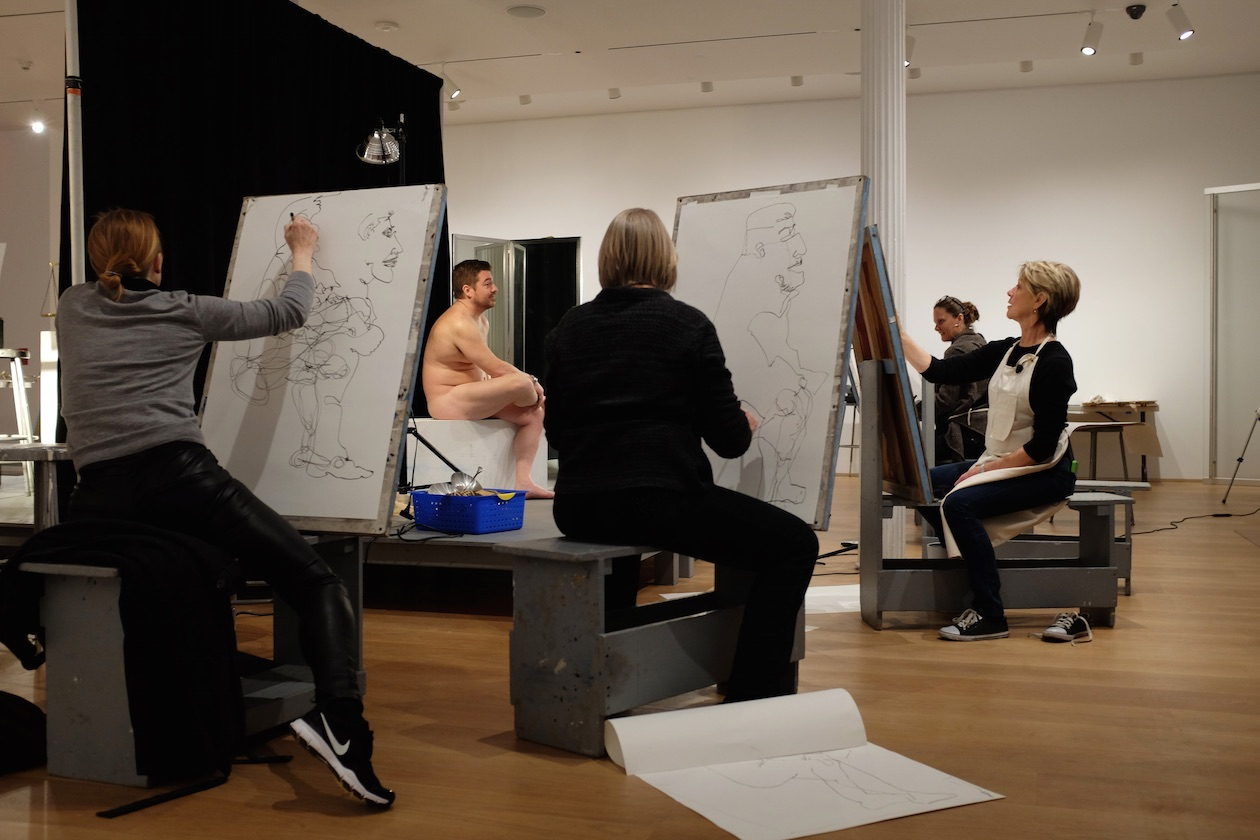
Lacy has also engaged directly with drawing in her work. She undertook a collaborative project with the artist Andrea Bowers called appropriately enough; 'Drawing Lessons'. This was a nine-day installation at The Drawing Centre, New York, during which artist Andrea Bowers attempted to teach Lacy to draw. Each day for nine days, Bowers offered Lacy lessons, which were also open to the public.  Working together under the scrutiny of the audience, Bowers and Lacy explored the questions, in work and conversation, that they engage with in their individual practices. This really interested me, because I am convinced of the power of conversations as being central to social integration and sensitive action. The project served as a platform for extended conversations with curators, union organisers, people who attended from the area and other artists who draw or do performances.  The conversations reflected on feminism, performance art, drawing, and socio-political issues of concern to the artists. For example: what are the roles and problems of representation in public art practice? How do artists reconcile activist and field-based practices with the necessities of production for the gallery and museum? What is the relationship between first and second generation Feminism? What is the role of venue, object, and style in the identification and evaluation of art? 
Suzanne Lacy and Andrea Bowers 'Drawing Lessons'

The pulling down of the Colston Statue in Bristol last year, raised many issues about the role of both artists and public statues. If the making of statues is problematic, then what can artists do when they work in public? One project I remember in particular that helped me to think about the possibilities for making art-work in this area was, 'Where The Heart Is' by Graham Fagan. As part of his work with the community of Royston in Glasgow, he discovered that the one thing most people enjoyed or could appreciate was gardening and in particular many people liked roses. Fagan purchased a new rose that had no name, originally known only by a code, JC30518/A. It was named through a consultative process across the entire area of Royston. A pupil from St Roch's Primary School eventually selecting the winning name. Cuttings of the rose were then given to any local people that wanted one and its lovely pink blossom and fragrant scent was the following year to be seen throughout the area. 

Graham Fagan: 'Where The Heart Is' 

Graham Fagan: Local children's images of the rose

Fagan's work was part of a much larger project. It is interesting to look at how it all fitted together and at how many approaches to community development were used. Check the overall project out at the link below.

So what's this got to do with drawing you may be asking? I have written about how drawing can be used to facilitate conversations in several ways. For instance as a way of developing stories around and for a community. See: 

Barker, Garry (2017) Drawing as a tool for shaping community experience into collective allegory. In: Collective and Collaborative Drawing in Contemporary Practice. Cambridge Scholars Publishing, pp. 192-215. lau.repository.guildhe.ac.uk/17315. My contribution to the book on Collaborative Drawing in Contemporary Practice, is mainly centred on how drawing can be used as a focus for conversation and how different types of drawing facilitate different types of conversations. For instance, I'm currently drawing ideas for a permaculture garden, but the real issue is that this activity will facilitate conversations and these will explore whether or not permaculture ideas can be used within wider contexts of sustainability, in particular whether or not perception and interoception can themselves be shaped or inflected by a permaculture awareness. I'm also developing a paper for an architectural magazine that brings together permaculture with perception and looks at how permaculture principles such as 'Observe and Interact' or  'Integrate Don’t Segregate' can be applied to the way we think about architecture.

Marjan van Aubel

But of course there are other approaches to thinking about how to operate sustainably as an artist. I'm always interested in how ideas can be visualised and made real. This is what so much of drawing has always been about. The problem is that we categorise things in such a way that some ideas are seen as design and others as art. If we take away the distinction, we simply have people visualising ideas. Marjan van Aubel is a wonderful example of how to do just that, in this case her ideas use light fittings in a not dissimilar way to how nature itself harvests the energy of the sun via photosynthesis. She demonstrates that there are alternatives to existing paradigms and exciting new ways of thinking about solar energy that reflect how energy is collected and used by biological entities other than ourselves. 

Olafur Eliasson: Sketch for 'Beauty'

A lot of eco ideas seem to emerge from Scandinavia, perhaps this is because the winters are so cold, and you therefore need to think carefully about how you will survive them. 'Beauty' is a typical work of Olafur Eliasson. You walk into a dark room and a fine mist is falling illuminated by a single light bulb. As you walk around the room from some angles you can see a rainbow. You also see a hose pipe that the water falls from, you see the things creating the rainbow at the same time as the rainbow. You are having an experience, and are conscious of having the experience. As you are made self-aware you go out into the world with that awareness and will hopefully make future decisions more thoughtfully. 

Beauty

Eliasson is interested in the connection between an experience that might take place in a gallery and the way it might affect your behaviour when you leave that gallery. 
Olafur Eliasson is an artist who also uses design skills to solve projects, which again highlights the artificial divide between the two disciplines. His team at Studio Olafur Eliasson consists of craftsmen and specialised technicians, architects, archivists, art historians, web and graphic designers, film-makers, cooks, and administrators. Eliasson and the studio also work with structural engineers and other specialists and collaborate worldwide with cultural practitioners, policymakers, and scientists. His climate change activism has inspired many and his approach suggests that as an artist you can both make things and be engaged in community activism. He is able to make art from the poetics of a situation, as well as from an understanding of the ecological condition of it, as well as from the constraints of physical materials and the possibilities that they offer. 


Thomas Hirschhorn: Too Too - Much Much

Thomas Hirschhorn is another artist that has responded to the problem of how to avoid the 'statue' issue, he uses everyday and found materials such as plastic sheeting, cardboard, aluminium, packing tape and magazine images to create environments for change. The process of making remains clearly visible and becomes a metaphor for the individual and collective struggle to establish local democracy or to build a space within which people could debate ideas. People are implicated in Hirschhorn's work, viewers are obliged to reflect upon that which they may have hitherto been able to ignore in their daily lives, by having to take part in conversations, often with others who they would not normally meet or engage with. Hirschhorn's practice facilitating conversations, as much as making metaphors for change. 

If I was going to cite one example of social sculpture that sparked my imagination it would be the work of Pedro Reyes, who for the artwork 'Palas por Pistolas' (2008) collected 1,527 weapons from residents of Cuiliacán in Western Mexico, which were exchanged for electronics. The artist then melted the weapons down into shovels, which were then used to plant 1,527 trees. This is real alchemy, the transformation of guns into shovels a beautiful metaphor as well as a real intervention. Reyes is also interested in drawing as a way to communicate ideas, the work 'Collective Hat' is a very funny as well as conceptually interesting work. 

Pedro Reyes: Collective Hat: pleated palm collective activity

Reyes puts it like this:

Wittengstein stated that if we were to imagine a book which contained only the truth it would have to be entirely composed with jokes. I think in jokes you are led to the truth so quickly that the only way to handle the shock is laughing. Not all jokes produce laughing, there are also slow-smiling jokes, visual puzzles and graphic puns, some jokes are diagrams.

You may remember this one...


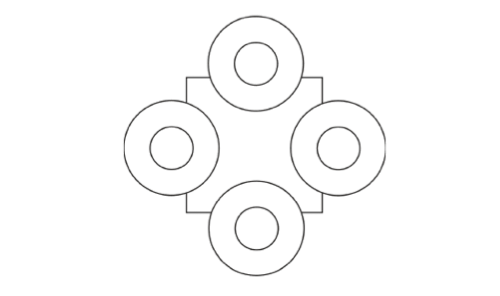
...a Mexican riding a bicycle. They are often a child's game but in fact very abstract and concrete depictions of social or spatial situations, like this one...four Mexicans sharing a table:


The design process in architecture is concerned with drawing the object, but we often lack tools to draw the social interplay. How do you map individual actors? How do you represent collective entities? This figure below for instance...


I drew this diagram of a collective sombrero and it became the blueprint for a sculpture. It was one of my early participatory sculptures. I took it to different plazas in Mexico city and asked people to wear it. What happens is very curious, for me it represents a paradox of democracy, the huddle has to deliberate endlessly where to go, and they have to walk very slowly not to stumble.

Pedro Reyes

'Collective Hat' reminded me of Lucy Orta's work. In the piece below for COP 26 Orta states, 'the ripple and the chain of solidarity clearly manifested our interdependence', and I can see clearly what she is trying to visualise, the fact that we are as in Reyes work all connected in some way. I do though personally respond more to Reyes because he realises that it is also funny, our situation so stupid, that we need to collectively laugh at ourselves before perhaps we decide to make some changes. 

Lucy Orta

See also:

The Royston Road Project

Reflections on The Colston Statue

Sustainability Resources

Cheap materials

Sustainability 1

Sustainability 2

Drawing and the 12 Principles of Permaculture

Pollution, art and making pigments

Drawing and politics

Object orientated ontology

Art eco awareness and OOO


Saturday, 11 September 2021

Art, Eco-awareness and OOO


Olafur Eliasson: Ice Watch 2015

Timothy Morton has written a very interesting book on the relationship between object orientated ontology and eco-awareness. In his book 'All Art is Ecological' he suggests that one of the biggest problems facing artists when dealing with global warming and its consequences is that it is such a big issue that rather than confront it, we are tempted to simply ignore it.

Morton worked with Olafur Eliasson during the 'Ice Watch' project.  Eliasson worked with a geologist in order to understand the implications of ice melt in the Artic and in order to raise awareness of the problems associated with rapidly melting ice sheets, he then transported12 glacial ice blocks from Greenland to the centre of Paris. At the same time the 2015 UN Climate Change Conference was being held in Paris and the ice blocks were arranged in a circle to symbolise how little time was left for action. Rather than a diatribe against the inaction of global leaders, Eliasson's work was a poetic spectacle, that allowed people on the streets of Paris to touch and engage with 25,000 years of frozen water. All the data, news, and scientific papers in many ways went over people's heads, but the poetry of frozen ice blocks suddenly appearing on the streets was much more affective in raising media attention about the problem and helping people to find an image around which to develop their own thoughts about it. This was six years ago now and a new summit is about to start, many people believing that far too little has been done since then, but that doesn't mean we should all just give up and ignore the issue. 

Eliasson works in a space between design and fine art, which it is what I have in the past referred to as 'disegno'. An old term, but one that allows for a practice that uses drawing as a problem solving or planning tool and which if you go back to its original use during the Renaissance, allowed for a practice that could include painting, sculpture and architecture, which were the main visual arts of the day, and which in my mind now includes video, film and computer based technologies. The point being that behind the use of any technology there will be a thinking process and drawing, in its many guises is still a powerful thinking tool. This definition is useful to me and hopefully to others who believe that fine art practice should be be able to respond to societal change and be able to reflect on big issues such as sustainability, gender assignment, post-colonialism and eco-awareness. 

Timothy Morton was asked by Eliasson to help shape the various texts emerging from his intervention and as Morton was already known for his use of object orientated ontology (OOO) as a philosophical framework or lens through which to see what was happening, it was also understood that a particular non-human centric response might be developed. The world seen from the point of view of the ice, from the pavement, from the pigeons flying past and from various insects interacting with a change in Parisian temperature and moisture, was just as or even more important than the responses of people to an encounter they had not previously expected to have.   

Eliasson presented his work in the form of a lecture to the assembled climate change dignitaries and at the end of his presentation, he cited a passage from Lynn Margulis’s book Symbiotic Planet.

"We need honesty. We need to be freed from our species-specific arrogance. No evidence exists that we are “chosen,” the unique species for which all others were made. Nor are we the most important one because we are so numerous, powerful and dangerous. Our tenacious illusion of special dispensation belies our true status as upright mammalian weeds". 
Lynn Margulis

Lynn Margulis points out in 'Symbiotic Planet' that human beings are no more than large moving carriers designed by bacteria for bacteria, and that most of evolution can be regarded as a process led by and carried on by bacteria. The more, she points out, that we are aware of this, the more we might see ourselves as in a symbiotic relationship with nature and be more prepared to give up our search for control over nature and accept that control over nature is a dangerous illusion.

Eliasson demonstrates the need for collaborative working, he also shows us that an artist can work in a variety of ways. The artwork he points out needs to have a life of its own, one that touches on a magical thing like 'beauty' in all its strangeness and awe. He is also aware that art on its own needs to be supported by other means and ways of getting an idea across, so he also gives talks and lectures, which themselves he points out, need to be delivered more as poetry than as factual documentation and protest. 

Morton explains the way art works in a way that reminds us of much older forms. He reminds us that Plato thought art was inherently disturbing and 'demonic'. (P. 67) 
(All quotes in this section taken from Timothy Morton (2021) All Art is Ecological London: Penguin) 
An artwork Morton states, 'does something to you'. By this he means that art reminds us that non human things can also have agency. If we can be affected by a carving or coloured marks on a surface, then we should equally be affected by an animal or a rock. Communication is not, suggests Morton, all about human to human exchange, it is about the interconnected network of everything communicating to everything else. As Morton also points out, (P. 63) "A plastic bag isn't just for humans. It's for seagulls to choke on" as well. 

Morton uses the term 'thinkfeel', which is about 'grasping the ungraspability of a thing'. He refuses to separate out 'beauty' from 'usefulness', because it is 'wild, spectral, haunting, irreducible, uncanny and causal.' He scraps the art v craft v design distinctions, seeing them as political, and reminds us that we have to choose what we care for. 'You have to 'design your street knowing that, at some point, frogs are going to be crossing over it... At some other point a glint of light will reflect off a small puddle of water, blinding a driver and killing a pedestrian.' The universe we are reminded, was never going to be formatted by human desires. Because of this art should include those things we cant control, and 'must include ugliness and disgust, and haunting weirdness and a sense of unreality, as much as of reality. (P. 80). Once we start embracing difference not as a rigid separation but as uncanny affinity, ... we see that humans are more like non-humans, and non-humans are more like humans than we think'. (P. 81)

Morton reminds us that we are frightened of been regarded as objects. He turns this around and suggests that if only we could simply accept that we are just like all the other things in this universe, simply an 'object', then we would begin to finally accept our proper place in the scheme of things. Equality, he suggests, begins in recognising the purchase things have on us and how we are inseparable from our complex interconnectedness with other things. If we cant treat other people with equality, this may reflect the fact that we are too myopic to see that small on-coming bacteria filled puddle of water, that will be the end us. 

Boat drawing: Olafur Eliasson in collaboration with Elias Hjörleifsson, 1998. 

Although mainly remembered in England for his weather project tenure in the Tate Turbine Hall, Eliasson has for many years used drawing as a way to reflect upon his awareness of the world and our human place within it. This boat drawing (above) was the result of a coordinated approach to drawing that Eliasson produced in consultation with his father, Elias Hjörleifsson, who was an artist as well as a sailor. Hjörleifsson, working from instructions supplied by his son, created the drawings on the boat where he worked. He dipped a ball of about 3 cm diameter into black ink and allowed it to roll across a sheet of paper, following the motions of the boat for a time jointly agreed on by him and Eliasson. According to Eliasson, these works had cosmic attributes, as they illustrated the varied and unpredictable movement of the ocean but they also for Eliasson contained traces of the everyday, since they were created by his father Hjörleifsson during the course of a normal work day.

As a model for how to produce work that responds to our current changing world, Eliasson's practice is very interesting as it begins to break down distinctions between art and design. I strongly believe that art and its uses and as well as its definition are all being questioned at this time, and that that is a good thing, even though it might also be slightly unnerving. 

Olafur Eliasson: The weather project: Tate Modern

References:

Timothy Morton (2021) All Art is Ecological London: Penguin Green Ideas

Lynn Margulis (1999) Symbiotic Planet New York: Basic Books 

See also:


Wednesday, 16 September 2020

Sustainability Resources

Ruth Wallen

As students return to the university and to education institutions throughout the world, how will all these places take on board what has happened recently? I'm of course very aware of the dangers of Covid19 and the worries that students have about moving into working in studios even with social distancing, but the virus is only one of a complex series of issues that we need to keep aware of if as artists we are going to respond to one of the most threatening situations humans have ever faced. 

I realise it's hard to prioritise but my own feeling is that the most important thing we need to be looking at is the environment. As a species we are in danger of eliminating ourselves by destroying the very spaces we live in. Global warming is already causing massive environmental damage, from the forest fires of the Western USA to the huge glacier melts of Greenland. Globally our wildlife species are rapidly dying out, and here in the UK alone more than two-fifths of our wildlife have seen significant declines in recent decades, insects in particular have been decimated by the use of chemicals on our farming land. The problem is very much to do with the fact that humans have seen the world as a series of resources to mine, rather than a system within which we are an integral part. 

Covid19 is itself a result of our using animals as food and keeping them in such conditions that the chance of interspecies viral transmission is heightened. We need to change our ways or we will become extinct too. The first responsibility of all educators is to help with the process of growing self awareness and at the root of so many of our problems, be it 'Black Lives Matter', global warming, deforestation, pandemics or the lack of spiritual wellbeing that seems to have resulted in the fact that so many of us suffer from depression, is a feeling of unconnectedness and a sense that what we are doing doesn't matter. When we encounter other people or anything else that is not us, we think of these things as 'aliens' and different. Because they are 'not us', we will often abuse that person or thing or treat them as objects that can simply be used and discarded at will; but in reality we are deeply interconnected to everything. 

If we can begin, step by step to rebuild a sense of that interconnectedness with everything, we can I believe gradually heal both ourselves and the world, but we have to start somewhere. Therefore this, my first post of the academic year, is simply devoted to setting out some connections to resources that I think are interesting. Some are connections to individual artists that are working with sustainability issues and others to organisations that I think have information that could be useful. I hope you will find at least one starting point that might help you develop a way forward during what are both exciting and distressing times. 

Some of you may want to use these thoughts as a way of redirecting your art practice so that it responds to these issues and others may decide to keep your art practice separate from concerns that derive from the development of your individual moral and social responsibility. Whether or not to make art about these issues is not that important, what is important is that as human beings we all take a good look at ourselves and try to take some responsibility for rebuilding what we have broken. As Suzanna Clarke put it when speaking about her recent novel, 'Piranesi', "...the divide is between people who see the world for what they can use it for, and the idea that the world is important because it is not human, it's something we might be part of a community with, rather than just a resource".  

(Guardian Review interview, Sat. 12th Sept 2020)


Art21 looks at the work of Mary Mattingly   


Resources:

Soil City A good place to start if like me you think soil is vitally important to a sustainable future.


Invisible Dust Lots of links to both artists and scientists   


Creative Carbon Scotland Lots of supportive information on what you can do


Centre for contemporary art and the natural world Exploring new understandings of our place within nature.


Deveron Projects A place to see how a single town has embraced art and climate change awareness


Arts Catalyst A commissioning body that specialises in arts and the environment


Adam Lowe and Jerry Brotton, Factum Arte, Terra Forming: Engineering the Sublime


FICTILIS, Timothy Furstnau and Andrea Steves, the 'True cost market'


CLUI (Center for Land Use Interpretation)


Livin Studio, Katharina Unger and Julia Kasinger, 


Green Arts web


Individual artists: Olafur Eliasson,  Mandy Barker, Kim Abeles, Jeff Hong, Lillian Ball, Subhankar Banerjee, Iain Baxter&, Bobbe Besold, Cape Farewell, Mary Ellen Carroll (Precipice Alliance), Brian Collier, Xavier Cortada, Gayle Crites, Agnes Denes, Steven Deo, Rebecca DiDomenico, Future Farmers (Amy Franceschini and Michael Swaine), Bill Gilbert, Isabella Gonzales, Green Fabrication (via Rick Sommerfeld, University of Colorado, College of Architecture and Planning), Newton Harrison & Helen Mayer Harrison, Judit Hersko, Lynne Hull, Pierre Huyghe, Basia Irland, Patricia Johanson, Chris Jordan, Marguerite Kahrl, Janet Koenig & Greg Sholette, Eve Andrée Laramée, Learning Site (Cecilia Wendt and Rikke Luther), Ellen Levy, Iñigo Manglano-Ovalle, Patrick Marold, Natasha Mayers, Jane McMahan, Mary Miss, Joan Myers, Beverly Naidus, Chrissie Orr, Melanie Walker & George Peters, Andrea Polli, Marjetica Potrc, Aviva Rahmani, Rapid Response, Buster Simpson, Joel Sternfeld, Mierle Laderman Ukeles, Ruth Wallen, Sherry Wiggins, The Yes Men, Azikiwe `Mohammed  Ha Schult and Shai Zakai. 


Books

Suzi Gablik: The Reenchantment of Art

Sacha Kagan: Art and Sustainability: Connecting Patterns for a Culture of Complexity

Mike Berners-Lee: There Is No Planet B: A Handbook for the Make or Break Years 

Mike Berners-Lee: How Bad are Bananas?: The Carbon Footprint of Everything

Anna Lowenhaupt Tsing, Nils Bubandt, Elaine Gan: Arts of Living on a Damaged Planet: Ghosts and Monsters of the Anthropocene

Lovelock, J. (2016) Gaia Oxford: OUP

Donna Haraway: Staying with the Trouble

Barad, K (2007) Meeting the Universe Halfway: Quantum Physics and the Entanglement of Matter and Meaning New York: Duke University Press 

Bennett, J (2010) Vibrant Matter: A political ecology of things New York: Duke University Press

Bogost, I. (2012). Alien Phenomenology. Ann Arbor, MI: Open Humanities Press

Harman, G. (2011). The Quadruple Object. United Kingdom: Zero Books

Latour, B (2017) Facing Gaia London: Polity Press
Latour, B. (1999) Pandora’s Hope Cambridge, Mass: Harvard Press

Morton, T. (2013) Hyperobjects: Philosophy and Ecology after the End of the World. Minneapolis: University of Minnesota Press


Other posts related to sustainability

Cheap materials

Sustainability 1

Sustainability 2

Drawing and the 12 Principles of Permaculture 

Pollution, art and making pigments

Drawing and politics

Object orientated ontology 

Art eco awareness and OOO

Charcoal and sustainability

Paper and sustainability

Social sculpture and sustainability