Showing posts with label ecological art. Show all posts

Tuesday, 5 April 2022

Charcoal and sustainability


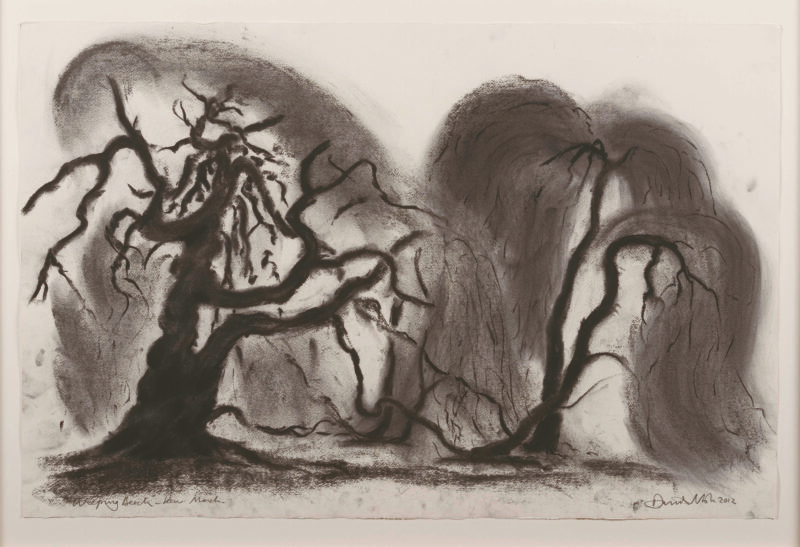
David Nash: drawings using his own made charcoal

There is a previous detailed post on charcoal and how it can be made. However issues of sustainability in relation to charcoal production were not picked out and as sustainability is so important, I have decided to re-visit my posts on various art materials and to develop eco-narratives around them. 

First of all there are considerations in manufacture if you are not making your own charcoal. Watch this video on how a specialist charcoal supplier makes charcoal ready for art supply shops and similar outlets. On the one hand it's very good to hear that they source their willow locally and that they work in relation to a specific location so don't have to have raw material shipped in and that they have managed to keep their workers in employment over a long period of time, which suggests that they are good employers. On the negative side they have to transport their charcoal to all the various art shop outlets, so their carbon footprint is probably going to be at its worst in relation to distribution rather than manufacture. Some charcoal producers state that that their artist quality charcoal is made from Natural Willow cut offs that would usually be discarded, and some like the Dorset Charcoal Company, set out in detail how they manage their charcoal production ecologically. In their case a mobile charcoal burner system allows the company to respond to the changing needs of their local woodland and they are seeking to be beneficial to local woodlands and wildlife. Visit their site to find out more about how to spot charcoal made from unsustainable tropical wood sources. However, no matter how good their carbon footprint, there will always be distribution costs, which is why you might consider making your own at home. 

Most charcoal is actually made as fuel for fires. This is still a vital source of heat for cooking in Africa and there are both good and bad practices going on. Sustainable charcoal production requires owners of natural woodland to maintain forest cover over time, rather than converting it to other land uses, such as large scale agriculture. However sustainable production is more likely to be achieved in woodlands with secure tenure with formalised management and harvesting plans designed to maintain the broad ecosystem functions of the forest or woodland. For instance in Niger and Senegal the adoption of formalised, community-based wood fuel production has resulted in an increase in the diversity and health of the forest stock (de Miranda et al., 2010). However in other areas of Africa unsustainable harvesting, has contributed to widespread forest degradation and deforestation, particularly in the vicinity of concentrated markets, such as large urban areas (Chidumayo and Gumbo, 2013).  A very brief look at charcoal production in its wider context quickly raises issues about localised and global production and the maintenance of interconnected forest or woodland ecosystems. These issues are of course related to the production of charcoal for burning, but the maintenance of healthy woodlands and forests is of significance to everyone, and whether charcoal production is for fire or for drawing, it can either be done sensitively and in co-operation with an understanding of the local eco-system, or not.  

If you are to use charcoal and want to make a point about why you are making it yourself, you could indicate how you are thinking about sustainable resources in a wider context. You might  consider issues such where willow is grown in relation to where you are? How should you harvest it if you want to ensure it is not depleted? Perhaps you might research what other wood is available to you locally and in what form does it come, (old bits of furniture, wood picked out of skips, branches and twigs from local trees etc.). Test local trees for types of charcoal, some will make for a reddish brown mark, others darker browns or light blacks and some will be scratchy and break into tiny pieces and others very soft.  If you are making a charcoal oven, could this be part of the idea? Could you set up a sustainable charcoal production facility? Perhaps making charcoal of various sorts for the local arts community. In doing so you could help others become more self-reliant and make them more aware of how charcoal is made. Could you oversee your charcoal production as part of a local interconnected woodland ecosystem? It is important to think about this, because over 90% of all charcoal consumed in this country comes from overseas, predominantly the endangered tropical rainforest and mangrove habitats of South America, West Africa and South East Asia. In addition to the damage caused by unsustainable forestry practices in these regions, is the negative environmental impact arising from the consumption of fossil fuels transporting charcoal so far around the world.


David Nash

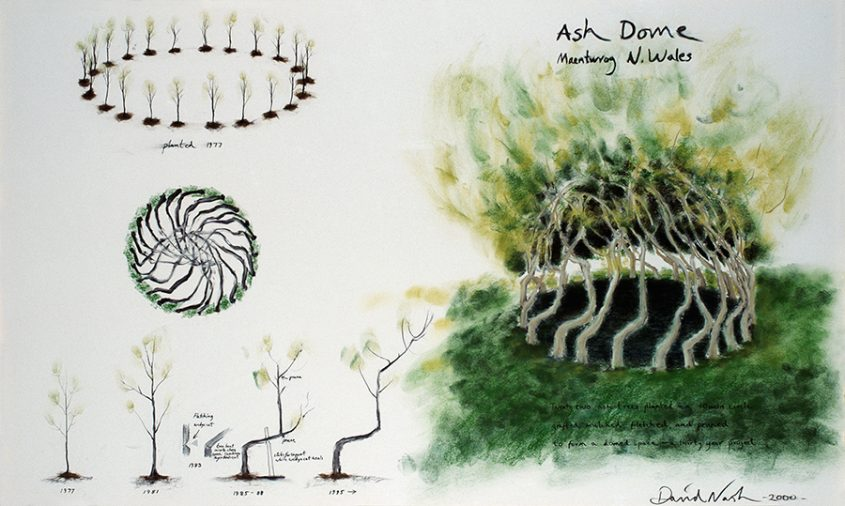
One artist in particular has deeply explored the relationship between ecology and charcoal, and that is David Nash, who is also exhibiting at the Yorkshire Sculpture Park at the moment. Using fallen trees, Nash has made sculptures and charcoal drawings that explore environments and ecosystems as points of intersection between nature and art. As he says, “trees take just enough and give back more”. Drawing is central and constant in Nash’s practice. It is an alternative way of learning about and understanding his subject, of finding form for ideas and recording and responding to perceptions of his environment. He uses hand made smoky willow charcoal to create intense blacks, these he will soften or accompany with softer warmer colours made from ash or oak; bold swathes of colour are achieved by using pure pigment dug out from the ground, mixed with burnt wood and ashes and wiped onto his drawings with bare hands. He uses local streams in which to dissolve ground down homemade charcoal alongside various natural pigments, which then become his inks, his ideas are often driven by the particular qualities of certain trees and their environments. His drawing Ash Dome (2007) was created using ash charcoal and earth taken from the surrounding ground, and he uses diagrammatic drawing to demonstrate  the aesthetic associations and familial links between various aspects of his ecologically tuned ideas.

Ash Dome: david Nash

Working directly with fallen twigs and other 'pick-up' elements of a natural habitat might be even more ecologically friendly. For instance every stick can be a drawing implement. When you make marks with sticks you will find them expressive and they will help you achieve a much wider range of line quality.  If you have no ink to dip the sticks into, just collect local soil, add water and draw using dirt. You can if you have more time extract colour from leaves. This video will show you how. Then when you draw both applicator and pigment will have a conceptual relationship.

How to extract colour from leaves

The German artist Nils-Udo works directly with fallen leaves and branches to create site-specific works. From delicately arranged petals scattered on the surface of a pond, to huge nests formed from twigs, leaves, and wildflowers, like Nash he tries to use what he finds in an environment such as a woodland or park, heightening our awareness by making interventions designed to make us wonder. His artist statement reads: “By installing plantings or by integrating them into more complex installations, the work is literally implanted into nature. As a part of nature, the work lives and passes away in the rhythm of the seasons.”

Nils-Udo

A charcoal burner's mound

The form of the nest like work above is heavily influenced both by birds' building activities and by the size of charcoal burner's mounds. 

Nils-Udo: Project proposal for a motorway service area

Nils-Udo's drawings are proposals for interventions often in urban spaces, whereby planting is used to soften the impact of the harsh edges of places like motorway services stations. The question though is of course is he just hiding or making more acceptable something that we should be confronting, such as the still too high levels of car use and associated carbon emissions? 

Once you have made a charcoal drawing or a drawing using soil, it may need to be fixed. Van Gogh used to use a skimmed milk spray to fix his charcoal drawings and Spectrafix Degas Pastel Fixative, also uses milk-protein. I try not to advertise brands, but in this case it is ecologically far more sustainable than toxic fixatives that operate like hair sprays. Most of us at one time or another will have used hair spray to fix a charcoal drawing, but remember the clear liquid spray is made of polymers that cause it to create a film over what you spray it on, be that hair or your charcoal drawing or an insect. Don't forget, hairspray was originally created to kill insects back in the 1940s, it was one of many chemicals developed after World War Two, that relied on advances in toxic chemical production because during that war there had been research into chemical warfare, just in case the other side decided to use poisonous chemicals to attack unprotected populations. Instead of people it was then decided to use these chemicals on the natural world; Rachel Carson's book 'Silent Spring' highlighted the issues surrounding the following unrestricted developments in using chemicals like DDT to control insects, pointing out that in the end those chemicals did indeed and still do, poison humans too. Spectrafix, not only avoids toxic chemicals it also facilitates layering, as it can be used to both fix and restore the friction you need to rework or refresh markmaking on an overworked surface, so that additional layers of charcoal can be applied.

When considering sustainability there are always more questions than answers, but if we don't consider these, we might at some point wake up to a dying planet. 

Of course paper is also a material that is often made in unsustainable ways. I will be putting up a post on the issues specifically related to paper and sustainability in the near future, but in the meantime there are several other issues to think about in relation to paper, and you can read about those at some of the links set out below. 

References

Chidumayo, E. N., and Gumbo, D. J. (2013). The environmental impacts of charcoal production in tropical ecosystems of the world: a synthesis. Energy Sustain. Dev. 17, 86–94. doi: 10.1016/j.esd.2012.07.004

De Miranda, R. C., Sepp, C., Ceccon, E., Mann, S., and Singh, B. (2010). Sustainable Production of Commercial Woodfuel: Lessons and Guidance from Two Strategies. Washington, DC: The World Bank.

See also:

Paper and sustainability 

Charcoal

The pencil and sustainability 

Sustainability resources 

Drawing on the principles of Permaculture

Making your own drawing tools

Andy Goldsworthy

On line books on paper


Saturday, 11 September 2021

Art, Eco-awareness and OOO


Olafur Eliasson: Ice Watch 2015

Timothy Morton has written a very interesting book on the relationship between object orientated ontology and eco-awareness. In his book 'All Art is Ecological' he suggests that one of the biggest problems facing artists when dealing with global warming and its consequences is that it is such a big issue that rather than confront it, we are tempted to simply ignore it.

Morton worked with Olafur Eliasson during the 'Ice Watch' project.  Eliasson worked with a geologist in order to understand the implications of ice melt in the Artic and in order to raise awareness of the problems associated with rapidly melting ice sheets, he then transported12 glacial ice blocks from Greenland to the centre of Paris. At the same time the 2015 UN Climate Change Conference was being held in Paris and the ice blocks were arranged in a circle to symbolise how little time was left for action. Rather than a diatribe against the inaction of global leaders, Eliasson's work was a poetic spectacle, that allowed people on the streets of Paris to touch and engage with 25,000 years of frozen water. All the data, news, and scientific papers in many ways went over people's heads, but the poetry of frozen ice blocks suddenly appearing on the streets was much more affective in raising media attention about the problem and helping people to find an image around which to develop their own thoughts about it. This was six years ago now and a new summit is about to start, many people believing that far too little has been done since then, but that doesn't mean we should all just give up and ignore the issue. 

Eliasson works in a space between design and fine art, which it is what I have in the past referred to as 'disegno'. An old term, but one that allows for a practice that uses drawing as a problem solving or planning tool and which if you go back to its original use during the Renaissance, allowed for a practice that could include painting, sculpture and architecture, which were the main visual arts of the day, and which in my mind now includes video, film and computer based technologies. The point being that behind the use of any technology there will be a thinking process and drawing, in its many guises is still a powerful thinking tool. This definition is useful to me and hopefully to others who believe that fine art practice should be be able to respond to societal change and be able to reflect on big issues such as sustainability, gender assignment, post-colonialism and eco-awareness. 

Timothy Morton was asked by Eliasson to help shape the various texts emerging from his intervention and as Morton was already known for his use of object orientated ontology (OOO) as a philosophical framework or lens through which to see what was happening, it was also understood that a particular non-human centric response might be developed. The world seen from the point of view of the ice, from the pavement, from the pigeons flying past and from various insects interacting with a change in Parisian temperature and moisture, was just as or even more important than the responses of people to an encounter they had not previously expected to have.   

Eliasson presented his work in the form of a lecture to the assembled climate change dignitaries and at the end of his presentation, he cited a passage from Lynn Margulis’s book Symbiotic Planet.

"We need honesty. We need to be freed from our species-specific arrogance. No evidence exists that we are “chosen,” the unique species for which all others were made. Nor are we the most important one because we are so numerous, powerful and dangerous. Our tenacious illusion of special dispensation belies our true status as upright mammalian weeds". 
Lynn Margulis

Lynn Margulis points out in 'Symbiotic Planet' that human beings are no more than large moving carriers designed by bacteria for bacteria, and that most of evolution can be regarded as a process led by and carried on by bacteria. The more, she points out, that we are aware of this, the more we might see ourselves as in a symbiotic relationship with nature and be more prepared to give up our search for control over nature and accept that control over nature is a dangerous illusion.

Eliasson demonstrates the need for collaborative working, he also shows us that an artist can work in a variety of ways. The artwork he points out needs to have a life of its own, one that touches on a magical thing like 'beauty' in all its strangeness and awe. He is also aware that art on its own needs to be supported by other means and ways of getting an idea across, so he also gives talks and lectures, which themselves he points out, need to be delivered more as poetry than as factual documentation and protest. 

Morton explains the way art works in a way that reminds us of much older forms. He reminds us that Plato thought art was inherently disturbing and 'demonic'. (P. 67) 
(All quotes in this section taken from Timothy Morton (2021) All Art is Ecological London: Penguin) 
An artwork Morton states, 'does something to you'. By this he means that art reminds us that non human things can also have agency. If we can be affected by a carving or coloured marks on a surface, then we should equally be affected by an animal or a rock. Communication is not, suggests Morton, all about human to human exchange, it is about the interconnected network of everything communicating to everything else. As Morton also points out, (P. 63) "A plastic bag isn't just for humans. It's for seagulls to choke on" as well. 

Morton uses the term 'thinkfeel', which is about 'grasping the ungraspability of a thing'. He refuses to separate out 'beauty' from 'usefulness', because it is 'wild, spectral, haunting, irreducible, uncanny and causal.' He scraps the art v craft v design distinctions, seeing them as political, and reminds us that we have to choose what we care for. 'You have to 'design your street knowing that, at some point, frogs are going to be crossing over it... At some other point a glint of light will reflect off a small puddle of water, blinding a driver and killing a pedestrian.' The universe we are reminded, was never going to be formatted by human desires. Because of this art should include those things we cant control, and 'must include ugliness and disgust, and haunting weirdness and a sense of unreality, as much as of reality. (P. 80). Once we start embracing difference not as a rigid separation but as uncanny affinity, ... we see that humans are more like non-humans, and non-humans are more like humans than we think'. (P. 81)

Morton reminds us that we are frightened of been regarded as objects. He turns this around and suggests that if only we could simply accept that we are just like all the other things in this universe, simply an 'object', then we would begin to finally accept our proper place in the scheme of things. Equality, he suggests, begins in recognising the purchase things have on us and how we are inseparable from our complex interconnectedness with other things. If we cant treat other people with equality, this may reflect the fact that we are too myopic to see that small on-coming bacteria filled puddle of water, that will be the end us. 

Boat drawing: Olafur Eliasson in collaboration with Elias Hjörleifsson, 1998. 

Although mainly remembered in England for his weather project tenure in the Tate Turbine Hall, Eliasson has for many years used drawing as a way to reflect upon his awareness of the world and our human place within it. This boat drawing (above) was the result of a coordinated approach to drawing that Eliasson produced in consultation with his father, Elias Hjörleifsson, who was an artist as well as a sailor. Hjörleifsson, working from instructions supplied by his son, created the drawings on the boat where he worked. He dipped a ball of about 3 cm diameter into black ink and allowed it to roll across a sheet of paper, following the motions of the boat for a time jointly agreed on by him and Eliasson. According to Eliasson, these works had cosmic attributes, as they illustrated the varied and unpredictable movement of the ocean but they also for Eliasson contained traces of the everyday, since they were created by his father Hjörleifsson during the course of a normal work day.

As a model for how to produce work that responds to our current changing world, Eliasson's practice is very interesting as it begins to break down distinctions between art and design. I strongly believe that art and its uses and as well as its definition are all being questioned at this time, and that that is a good thing, even though it might also be slightly unnerving. 

Olafur Eliasson: The weather project: Tate Modern

References:

Timothy Morton (2021) All Art is Ecological London: Penguin Green Ideas

Lynn Margulis (1999) Symbiotic Planet New York: Basic Books 

See also: