Showing posts with label cartoons. Show all posts

Saturday, 8 August 2020

The portrait as stereotype

We are taught very early on to avoid stereotyping when making images of people because in image making stereotyping is associated with some of the most painful periods of human history. Because of my own awareness of family history and of how jews were portrayed during the nazi regime in Germany, I can clearly see that stereotyping is associated with removing individuality from people and treating them as if they have no individual human consciousness or feelings. This makes it so much easier to then take the next step, which is to treat people as if they are soulless objects, things that exist only to be done to. Stereotyping was a key element of the nazi process of trying to eliminate jews and others.  So why put up a post on the portrait as stereotype? 

The people that are visually stereotyped tend to be those that are 'invisible' or oppressed or simply belong to a set of people that can be categorised as 'other', or people not like me. In this category you do sometimes get stereotypes of powerful people, however the point about the stereotype is that these are faceless portraits, and its a lot easier to brand the disempowered with things we would like to not associate with. Stereotyping is a line that is easily crossed and one to be treated very carefully if you are going to go anywhere near it. When the powerful are stereotyped, somehow they seem less abject, we often see bankers stereotyped as suit wearers carrying large bags of money, or surrounded by symbols of wealth, yes their individuality is taken away but aspects of their power remain. 


The pin striped suit stereotype can be enough to stand in for great wealth and privilege, but interestingly there are no human facial features being shown in these cartoons, unlike the recent image below of a jewish banker based on a cartoon by Ben Garrison. I thought that these images were done with and a thing of the past but I was wrong, and the evil money grabbing jew as a stereotype still exists and is part and parcel of some right wing rhetorics. Notice how different this image is to the ones of the bankers, the body posture suggests weakness, rather than the more statuesque deportment of the cat\men above. This post is hopefully a warning about how easily these things come back into play. Poor Ben Garrison has no control over what people can do with his images and the PhotoShopped version of his original reminds me of another evil circulating around the internet; doctored imagery. CGI can undermine our notions of what is true and what is fiction. 

Ben Garrison's work above has been targeted by right wingers and they have even invented a fake right wing biography for him

The only time I have ever seen the stereotype used in such a way that it doesn't lead to dehumanisation is when it is deliberately used by those who have been stereotyped to raise awareness of the very stereotyping that they face. 
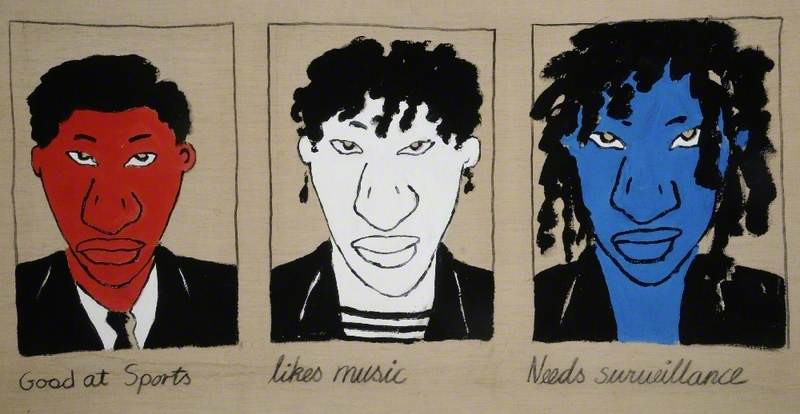
School Report: Tam Joseph

Tam Joseph's 'School Report' reminds us of how male black youths are stereotyped by society, however his drawings have just enough of a personality to them to avoid that demeaning characteristic of features exaggeration that Oscar Arredondo points to when he demonstrates the insults inherent in images of stereotypical Indian figures. "Chief Wahoo," the bucktoothed mascot of the Cleveland baseball team is transformed by him into a series of stereotypes of people of other cultures or religions. As Arredondo points out, none of them would be tolerated in contemporary America, except the image of Wahoo himself. Sadly Arredondo has missed some of the work which is promoted by certain extreme groups. Perhaps he should have stated, "none of them ought to be tolerated in our contemporary society".
The 8 portraits above from Oscar Arredondo's exhibition, "A Mile in My Moccasins," are cruel, simplistic, anachronistic and vulgar, but as part of an awareness raising campaign about the fact that Native Americans do not deserve to be denigrated as cartoon mascots, it has worked and the Cleveland baseball team has now dropped its use of the old mascot. However I think the work is still problematic as not only does it remind us of how easily stereotypes can be developed, it also reminds us of how hard it is to then remove them from our mental image banks. 

Toyin Ojih Odutola

Toyin Ojih Odutola has responded in a very different way to being stereotyped. She read that in 1910 a German archeologist on discovering anatomically correct bronze sculptures in Nigeria, decided that Greeks from Atlantis must have made them, as he couldn't get his head around the 
fact that Benin bronzes could have an aesthetic superficially similar to certain European traditions. Africa and its many peoples was seen as a stereotype at the time and in many ways that stereotype still exists. She therefore in response to the German archeologist's crazy invention, decided to create her own world, one where black women are powerful. At one point in her life Odutola had moved to Alabama and it was when living there she had been forced to question why she had become to be seen as a black stereotype that was aberrant in some people's eyes, and because she enjoyed drawing she turned to this as a way of dealing with these problems of 'otherness'. She also makes portraits, but she states, they are composites of multiple people and she says she is very fortunate in "having really badass beautiful people" around her to draw, but her 'composites' go beyond the stereotype and become people; people that in the Barbican exhibition, were made by drawing on black paper. 


Toyin Ojih Odutola: Lonely Chambers (T.O.), 2011, pen ink and marker drawing on paper

Hardeep Pandhal is another artist that has explored stereotyping; in particular people from the Indian sub-continent. In his work Sikh painting traditions meet the English graphic traditions of the Beano and Viz and as they do, a cartoon image of a Sikh emerges and is used by Pandhal to question how the points of entry into culture operate, especially for those born and bought up in England, but who also live within a sub-culture that still retains many of the cultural traditions of a previous time and place. 
Hardeep Pandhal

Cartoonists deal with stereotypes on a daily basis, this allows them to achieve a direct communication with their audience, but this also comes with dangers. Some of these dangers are intellectually problematic in that any stereotype misdirects its audience and allows us to think that a situation or individual is simplistic or without human warmth, but some are mortally threatening, as to poke fun and to undermine by using a cartoon like image can cause deep offence. Cabu, Charb, Tignous and Wolinski all worked for Charlie Hebdo a satirical magazine that attacked many targets in the name of humour and who caused deep offence in the Muslim community by both the stereotypical portrayal of arabs and muslims as well as of course irreverently making cartoon images of God. The anger caused by their work of course led to their deaths. You might argue that these are not fine artists, but in France the dividing line between cartoonists and artists isn't as fixed as it is in England, all are seen as image makers. 
Honoré Daumier was imprisoned for six months in 1832 for his depiction of King Louis Philippe as Gargantua and Daumier as an artist has at times been compared to Goya and although some would argue to the contrary, I see all these images as attempts to illuminate the human condition, some might be better than others, but surely that is the case with all art and if we always shy away from confronting political issues, we will never achieve that better world which I'm sure we would all like to help bring to fruition. The line between cartooning, stereotyping and politics can be a very difficult one to control, where does it demean or undermine the humanity of those portrayed and where does it illuminate a power imbalance or injustice? Just because it is a difficult path to follow doesn't however mean that as an area of work it should be avoided, just that I would urge caution and suggest that you test out any work made in this territory with a few other people before going public. 

'Toyin Ojih Odutola: A Countervailing Theory' is at the Barbican Centre's Curve Gallery from August 11th until the 24th Jan 2021.

See also:


Wednesday, 23 October 2019

Philip Guston and alien phenomenology


Steve Bell: Boris Johnson

In times of political turmoil artists often turn to the absurd to communicate their obvious dismay as to what is happening around them. Steve Bell has seen Boris Johnson as an arse, and back in the 1970s Philip Guston saw Richard Nixon as a prick and ballsack. For Guston in particular his use of caricature was part of an ongoing transformation of his work as he moved from being an abstract expressionist to being an artist that dealt with harsh uncompromising imagery, imagery that was as much a reflection of popular culture, as an awareness that if as an artist you had to match up to one of the greats of the past, Goya was as powerful as Velasquez. 


Untitled (1971), Philip Guston

Untitled (Poor Richard) (1971), Philip Guston. 


Philip Guston: Richard Nixon
From the Richard Nixon series 1971-74

The Richard Nixon drawings helped Guston to develop an approach to drawing that highlighted the raw absurd nature of life. He was also able to use the processes of caricature that he used to reinvent Nixon as an image, on other not always human objects, such as sticking plasters, shoes and coats. A severe distortion of human forms, could also be applied to non-human forms, giving to each subject a new 'reality' or 'attention' that ensured that these objects were no longer just 'background' details to a human drama but significant 'players' in their own right. 


Philip Guston 1980

The smoke from the cigarette is just as powerful as the fingers, which are as weighty in this image as sticking plasters or an ear or an eye. A coat and some shoes stand for an absent human and in doing so they are just as important in terms of image hierarchy as a human subject. This is where Guston's importance lies. He is able to transcend the human centred preoccupation of the cartoonist's imagery and in applying these conventions to non-human forms, is able to show us our own closed circuit of anthropomorphism, to be what it is, a problematic navel gazing, that has led to the dangers of climate change and species destruction. 
Philip Guston

A dismembered head, a green bottle, a light bulb, all inhabit the same space and all have a presence in this image that suggests that as actants (Bruno Latour's term) they all have equal possibilities, each one open to speculative narratives that may or may not entangle the others in their narrative gravity. These images of Guston's are perfect illustrations of what Ian Bogost calls Alien Phenomenology, a philosophy in which nothing exists any more or less than anything else, in which humans are elements but not the sole or even primary elements of philosophical interest. A position that has at times been called a flat ontology. 

This post is one of a series that begins to collect together ideas related to object orientated ontology, agential realism, speculative materialism, and other ways to give more weight to things that sit outside human centred disciplines. Gradually these posts will be used to put together a hopefully coherent philosophy of drawing as material thinking. 

In essence, other things have as much impact about what goes on as we do. We cannot but be entangled in the influence fields of other things in order to be part of the events that happen in our local timeframe. We have though in the past tended to not recognise the role that all these other actants have and we have instead prioritised the human (and often just one sort of human; white, male, middle class European) to the exclusion of everything else.  

See also:


Key texts

Barad, K (2007) Meeting the Universe Halfway: Quantum Physics and the Entanglement of Matter and Meaning New York: Duke University Press 
Bennett, J (2010) Vibrant Matter: A political ecology of things New York: Duke University Press
Bogost, I. (2012). Alien Phenomenology. Ann Arbor, MI: Open Humanities Press
Bryant, L, R. (2011) The democracy of objects Ann Arbor, MI: Open Humanities Press
Harman, G. (2011). The Quadruple Object. United Kingdom: Zero Books
Latour, B (2017) Facing Gaia London: Polity Press
Latour, B. (1999) Pandora’s Hope Cambridge, Mass: Harvard Press
Morton, T. (2013) Hyperobjects: Philosophy and Ecology after the End of the World. Minneapolis: University of Minnesota Press


Sunday, 10 March 2019

Glen Baxter at Leeds Arts University


On exhibition at the moment in Leeds Arts University's Vernon Street building is the work of Glen Baxter. Baxter is an alumni of the University and he gave a very funny talk in conjunction with the opening of his exhibition. This ought to have been expected as his work is always humorous and designed to pull the rug from out under the feet of anyone who takes art too seriously. It is interesting to compare his work with Mark Tansey, an artist that has reached 'blue chip' status as a contemporary grand master and one that also plays games with our reading of art. Baxter is much more of a joker, he is not afraid to deal in one liners and in many ways he reveals serious issues that surround our society's relationship with contemporary art practices. In particular he questions the relationship between high and low culture and the reception of art within sub-cultures that lie outside of the 'art world'. 
I will simply leave you with a few of his cartoons, they speak for themselves. 


Find details of the exhibition 'Unhinged in Hunslet' here.  Exhibition open until 11th April.

See also:
Hardeep Pandhal: The Beano and Viz


Friday, 23 November 2018

Drawing and Politics part 2

Martin Rawson

The link between drawing and politics has for many years been via the political cartoon. In particular we have a tradition in England that includes Gilray, Rowlandson, Cruckshank and Dent and which continues with the work of Steve Bell, Ralph Steadman and Martin Rawson. In order to make a point artists have had to distort, highlight grotesque appearances and create 'surreal' situations, so that the paradoxes and confusions of politics are communicated to as wide an audience as possible. Artists such as Goya valued this tradition and drew upon it in their own work and whenever times are harsh and artists need to confront the brutal realities of life, this type of art comes back into fashion. However as has already been pointed out there are many other ways of using drawing to make a political point. 

Drawing can be thought of as a type of 'capture' or 'trapping' of a period of time. It is a very personal decision making process, that is unique to the individual making the drawing and therefore has a different type of agency to mechanically produced images; one driven by interest and cognition rather than by technological effect. The sense of touch that comes through mark making and the handmade nature of the image create the beginnings of an authentic dialogue with an event, a dialogue that is unavoidably human and in being so is therefore political and because there is so much 'touch' involved, a certain level of truth value comes through as well. Political work demands a point of view and so do drawings. As you view them drawings reveal themselves via different visual languages; these might include emotional or expressive mark making or use of tonal value, they may involve an invention of form that can be distorted to heighten an awareness of something or to achieve a link between another form that we would not have previously thought about. Selection is vital in a drawing, and because of this it works so much better than a camera, when picking out narrative threads from a situation. Above all a drawing can both record and respond to a situation at the same time, it can invent new forms at the same time as recording what is seen and because it is human made, it has a certain democratic relationship with other human beings, allowing them to enter into an interpretive dialogue with the image, something that is again much harder to do with a photograph.   


Dr Jill Gibbon is based in Leeds and in her work brings together an awareness of cutting edge killing technology with one of the oldest methods of recording events; drawings in sketchbooks. 

Dr Jill Gibbon making sketchbook notes at an arms fair

Dr Gibbon makes her drawings covertly whilst visiting arms fairs and in doing so reveals the reality of buying and selling weapons. The weapons are set out on display as if they were products in a very posh shop. I think it is interesting to see that Dr Gibbon just has to wear a smart outfit and she seems to fit in. People probably think she is making notes as to which missile she would like to buy next. Gibbon's work demonstrates that the politics of how we see is now intertwined with the politics of how we capture (and share) the images which narrate our lives. She raises these issues much more because she draws, and therefore makes it personal, than if she had surreptitiously hidden a camera in her bag and had then released photographs of these places. There are so many photographs out there that they would just be lost amongst the host of images of arms fairs already out there. Dr Gibbon's work gives us a very different experience of time, time spent wandering around these places, time spent making a series of drawings, often in concertina type sketchbooks that can be opened out to reveal a panorama of looking and wandering around. This is a politically focused dérive. 


Dr Jill Gibbon, sketchbooks

It's interesting to see the relationship between beautiful women and armaments. Men in suits strike poses and of course so many weapons of mass destruction look like enormous phalluses. It would be interesting to see how far into one of those arms exhibitions the subjects of Barbara Walker's drawings would get. 


Barbara Walker

The way drawings are presented can also be political. Barbara Walker's large drawings are often done directly on gallery walls, so on the one hand their scale gives presence and highlights a political awareness of the individuals she selects to draw, who are often members of society that are not celebrated or picked out for their achievements. On the other hand she erases the drawings at the end of the exhibition, this in many ways reinforces a political awareness that society doesn't really care about these people, and the exhibition is a sort of sideshow that does not really effect the reality of the situation. 


Barbara Walker cleaning off her drawings

I have recently been posting on art and philosophy and will be continuing to do so, but I do wander what is a quandary proper to politics as opposed to philosophy? Object Orientated Ontology as an approach to philosophy is I would suggest driven by a political need for equality, a desire to give equal rights to all those other things that human beings have tended to just use for their own pleasure and devices. Therefore a focus on the underprivileged in human society can become a doorway into looking at how society can ignore both certain types of people and the world itself. It is no coincidence that President Trump ignores the plight of refugees and the threat of global warming. 

Not all stories are the same. A story from a time when humans had a more animist relationship with the world.


A Kenyan farmer saw a spotted hyena trying to force itself into his goat enclosure. He instinctively attacked the hyena with his spear and killed it. However as the hyena cried out it woke the other villagers and the elders came over to the killing to see what was happening. 
The elders were unhappy. The farmer had acted too rashly. In those times someone would be appointed to represent the animal and he had testified that his careful examination of the hyena had revealed that the deceased was a female who was still suckling pups. He argued that given the prevailing drought and the hyena’s need to nourish her young, her behavior in attempting to scavenge food from human settlements was reasonable and that it was wrong to have killed her. The farmer had not considered the hyena’s situation and he could have simply driven her away. Eventually the elders ordered the man’s clan to pay compensation for the harm done by driving more than one hundred of their goats into the bush, where they could be eaten by hyenas and to ensure that a wider type of restorative justice was done. .
Wrongdoing was seen as a symptom of a breakdown in relationships within the wider community of nature and the elders seek to restore the damaged relationship rather than focusing on identifying and punishing the wrongdoer.

A Makonde elephant shetani

Justice and nature can be cruel, the shetani figures of East Africa are often vengeful and unpredictable spirits. Sometimes coming in hybrid anthropomorphic forms, such as this elephant/human above, they suggest that it isn't all one way traffic and that at times nature will bite back, sometimes hosted in strange and twisted forms. We have to hope that our vast pits of polluted rubbish do not breed mutant forms such as these. My feeling about shetani images is that they are nature's political art, and that the reason humans are so worried by shetani figures is that deep down we realise we are guilty and that we deserve their attacks.