Showing posts with label knots. Show all posts

Wednesday, 24 July 2024

The Borromean Knot

The Borromean Knot

I have looked at knots in the past because I like the way that they are both physical objects and powerful metaphors, they tie things together, mentally and physically. But now as I'm trying to get to grips with some alternative approaches to thinking about my own mental life, I have discovered a particular mental knot that is used to try to explain subjectivity or some of the key aspects of our mental life from a psychoanalytic point of view. 

In mathematics Borromean rings are three simple closed curves in three-dimensional space that are topologically linked and cannot be separated from each other. They break apart into unknotted and unlinked loops when any one of the three is cut or removed. I. e. the rings are held together only by the presence of all three. If any one of the rings is cut open, the entire structure falls apart. Sometimes this is represented by three overlapping circles, but this takes away the vital three dimensional nature of this idea, it doesn't work in two dimensions, so if you need to draw one you need to give the rings some form of three dimensional indicators, such as the white spaces in the drawing above, that indicate which part of the circle sits on top and which below. 

This construction was historically one of the heraldic symbols of the dukes of Borromeo, which is why it is called what it is. 

Odin's knot

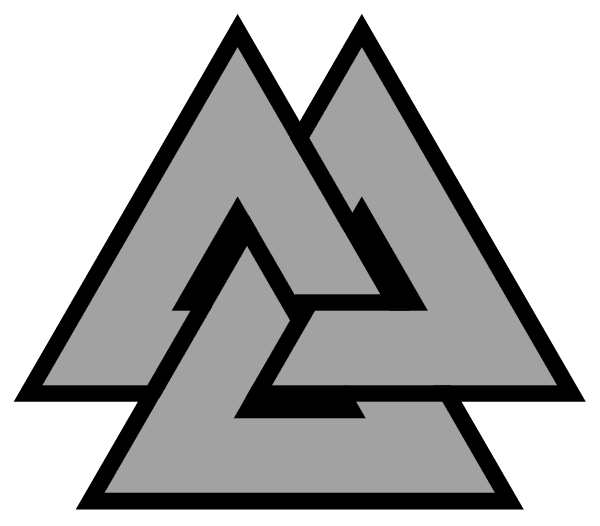
In Norse mythology, triangles are used to express the same idea, (the Valknut) and topographically it makes no difference to the concept. The knot belongs to a tradition of thinking that is centred around the use of fibres to think with. In this case 'seidr', (Old Norse seiðr, 'cord, string, snare') was a form of shamanistic magic concerned with discerning the course of fate and how to effect change, which was done by symbolically weaving new events into being. Odin's knot, like any other form of weaving, is a structure that only makes sense when it is complete, the individual threads or cords are thin and insubstantial, but when brought together as a weaving or in this case an idea, a powerful concept is realised.

However there is another version of Odin's knot, one that fuses together all three triangles as a continuous band, and this represents the fact that differences are an illusion. 

Odin's knot

Borromean Rings also represent the symbol of the Trinity in Christianity, the three interlocking rings signify the divine trinity, which represents the belief that God is of one Being made up of three distinct Persons who exist in co-equal, co-eternal communion as Father, Son and Holy Spirit.  In fact these interlocking rings can be used as symbols for many sets of interlocked triads such as past, present and future.

It is however the Borromean Knot as used by the psychoanalyst Jacques Lacan that I'm going to try and focus on, as it might help me with some sort of structural support when trying to think through the relationship between the world out there and the inner world of embodied mental processes. 

Lacan and the Borromean Knot

The three rings are first of all 'real', in that topology is about solid, three dimensional objects and their surfaces. Therefore when Lacan decides to use it as a symbol, it is a much more solid symbol than a geometric figure, such as a circle or a triangle. 

It is a symbol of an inseparable bond, so that whatever is joined together by this bond is seen as a totality, something that might have three components, but no one component can be free of the other two; if it ever is, it would actually cease to exist in the form it takes. Lacan uses the knot to illustrate his structural theory of three registers or orders of what he thinks of as the psychoanalytic experience or categories of the psyche; the Real, the Symbolic and the Imaginary. However, he chooses the Borromean Knot, not just because of its interlocking nature but because of the fact that its loops have to be 'real' or three dimensional to work, they have to be loops of chain or rope. This he states, means that rather than simply representing this structure, topology is that structure. 

The knot is not just a way of illustrating the interdependence of the three orders, it is also a structure that helps Lacan to think about what the three orders have in common. Each ring represents one of the orders, and certain elements can be located at intersections of the rings. and these can be used to focus on the relations which bind or link the three aspects of the psychoanalytic experience. He argues that if the knot is broken or unravelled in some way it results in some form of psychosis. There is though a further element in his concept, which he calls the 'sinthome', which he thought of as a fourth ring, a ring that was needed to go beyond the symbolic. I can see why he might need this, and its the problem with theory and representational systems. It's ok to have an idea and to set out a theory, but where is the lived experience, at what point can you get totally lost in the activity and in effect become it? The 'sinthome' it seems to me is not just about a need to have a fourth ring to ensure the three rings hold together, but is a reminder that there is a reality beyond symbolic meaning, and that is for myself a very useful thought. I'm often asked about my work, 'What does it mean?' and by that I gather that people want me to describe its symbolic meaning, but I tend to avoid this, as it can be like a trap, in doing so, it can seem to empty the work of meaning, rather than communicate what its trying to say. 

But Lacan's Borromean Knot has letters and the word 'meaning' inscribed into the various overlapping sections and these are where the detail in terms of his thinking is held. 

Lacan's Borromean Knot


'For Lacan, the reality of human beings is constituted by three intertangled levels: the Symbolic, the Imaginary, and the Real. This triad can be nicely illustrated by the game of chess. The rules one has to follow in order to play it are its symbolic dimension: from the purely formal symbolic standpoint, ‘knight’ is defined only by the moves this figure can make. This level is clearly different from the imaginary one, namely the way in which different pieces are shaped and characterised by their names (king, queen, knight), and it is easy to envision a game with the same rules, but with a different imaginary, in which this figure would be called ‘messenger’ or ‘runner’ or whatever. Finally, real is the entire complex set of contingent circumstances that affect the course of the game: the intelligence of the players, the unpredictable intrusions that may disconcert one player or directly cut the game short.'

(Žižek: How to Read Lacan, pp. 8–9)

Žižek returns to this issue in his book, 'Event: Philosophy in Transit' and if you put the two descriptions together you get a reasonable idea of Lacan's three registers.

'For Lacan, the Imaginary, the Symbolic and the Real are the three fundamental dimensions in which a human being dwells. The Imaginary dimension is our direct lived experience of reality, but also of our dreams and nightmares — it is the domain of appearing, of how things appear to us. The Symbolic dimension is what Lacan calls the ‘Big Other,’ the invisible order that structures our experience of reality, the complex network of rules and meanings which makes us see what we see the way we see it (and what we don’t see the way we don’t see it). The Real, however, is not simply external reality; it is rather, as Lacan put it, ‘impossible’: something which can neither be directly experienced nor symbolised — like a traumatic encounter of extreme violence which destabilises our entire universe of meaning. As such, the Real can only be discerned in its traces, effects or aftershocks.'

(Žižek 'Event: Philosophy in transit' pp. 119–20)

My personal interest is in this case the fact that for Lacan, direct lived experience of reality is fixed into the 'imaginary' register. 

Right in the centre of Lacan's annotated diagram is the letter 'a'. Small case, and standing as an abbreviation for 'autre', or in English, 'other'. Or is it what Lacan had called 'The Fragile Absolute'

Lacan states that there is a price we all must pay in order to gain access to the social world of other humans. We must undergo a process of finding limits to our natural 'jouissance'. 

'Jouissance' as used by Lacan, has been described as: 'The lost plentitude of one's material bodily drives given up by the subject in order to enter the symbolic order and access the symbolic power of the phallus, something that occurs upon the adoption of language and acceptance of the rules of the name-of-the-father'. 

I.e. There are laws to follow, the first ones of which you learn from your parents. Lacan for some reason called this process 'symbolic castration'. Which sort of makes me have a mental shiver.  You are supposed to have sacrificed an 'enjoyment' that in fact you never really had on the alter of the Symbolic (Law). You sort of 'remember' the prohibition of that enjoyment and resent your Symbolic castration for having had an intuition of something that may not even exist. As far as I can see, this works as a story, a fabrication of the mind, such as the classical Freudian tale of Oedipus, who fulfilled a prophecy that he would end up killing his father and marrying his mother, thereby bringing disaster to his city and family.. The “lost” enjoyment concentrated in the 'objet a' is an impossible enjoyment, hence it is a 'Fragile Absolute'. 

But, and this is where Lacan constructs another tale for us to think about, the lost 'jouissance', that primal something that was lost as you become subject to society and its laws, is the thing around which you construct the subjective story of yourself. This is why we are always wondering what we are and why we are. This awareness of some sort of loss, is what makes us into the desiring subjects we are. the 'a' at the centre, is the lost 'other' that causes us to desire in the first place and this is why Lacan also called it the 'object-cause of desire'. It is the only thing that belongs to all three aspects of the psychoanalytic experience. 

If we then turn to 'JA' which seems to be translated as 'autre jouissance', this it seems is a sort of pure 'jouissance' of the Real beyond any symbolic contamination. This 'escape' is somewhat problematic though as it seems to rely on a very male centred phallocentric idea, in which for some reason, this other is associated with the feminine, therefore this 'jouissance', I would argue, lies outside the ring of the Symbolic, and as far as I can understand his logic, it would then appear that not being male is a form of psychosis.  At another point he mentions a “pure difference” and a “fermenting” Nature, things that stand outside of the sacrificial lack. The important issue in terms of the diagram, is that JA sits outside of the symbolic. Here we can see the problem with words again. When naming things, nouns are either so or not so, they create binary divisions, whilst events are closer to the truth as they are open ended and they evolve. 

The section that is made by the overlap of the real and the symbolic is labelled 'Jφ' φ is the lowercase version of the Greek letter phi Φ.  In Lacan's terminology Jφ stands for 'phallic jouissance'. This means that this concept stands outside of the 'imaginary', it is outside of the domain concerning how things appear to us. Lacan at one point plays with the similar sounds in French of le nom du père (the name of the father), le non du père (the no of the father), to emphasise the legislative and prohibitive functions of the father, and this lies central to why this is a 'phallic jouissance'. The symbolic world that the father introduces the child into is a construct that we have to come to terms with, even if we resent it. Because it is not a part of the imaginary experience it is a 'castrated' enjoyment. 

Meaning is set between the symbolic and the imaginary and sits outside of the real, which is, according to Lacan, inaccessible to psychoanalysis itself. Because of the overlaps between rings, there can be various combinations between the elements. Thus, for example, there can be a symbolic or imaginary hole in the real, for instance a nightmare may leave you with a deeply traumatic aftereffect, a real object may become an icon within the symbolic. Likewise, there can be a consistence or hard core of 'meaning' within the symbolic, or a hole in the imaginary, whereby direct experience is seen as an illusion. The sliding between categories does seem to me to be more akin to how I experience being and when I try to sense my own psyche, its illusiveness and slippery nature is part of its essence, it is something you can't nail down. 

I can intuitively grasp what Lacan is saying, but I think he would have been better at setting it down as a form of poetry or a personal fable rather than as a psychoanalytic conundrum. My own day to day anxiety is I'm sure rooted in my relationship with my father, his harsh rule still impinging on my own ability to trust my instincts, as I still feel myself inwardly seeking his approval before I do anything. Something that I have battled with all my life, and that has at times seemed 'mythic', a something to externalise in order to overcome its hold.

If I had to choose my own geometric figure to represent that movement between the outer and inner worlds that I seem to inhabit it would however be the triquetra.  The triquetra is a triangular figure composed of three interlaced arcs and as you follow them round you realise they are all part of the same figure. Lacan's struggle to unpick the reality that sits outside of perception, from the world of symbols that humans use to give order to their world, is at the end of the day, as far as I can see, a failure, but an interesting one. I am constantly trying myself to find visual structures that give some sort of meaning to my experiences and I do find that those meanings are very illusive and that they have something to do with my inner psyche and my bumping into a something out there, together with the need to resolve the experience of both. 

The triquetra

The representation of three curved forms as a continuous band represents, like Odin's knot, the fact that differences are an illusion. 
Sometimes when I'm awake I think I'm asleep and sometimes when I dream I think I am awake. The topology of dreams is perhaps the next thing to explore. 

See also:

Knots

Lacan and drawing as an external self

Patterning, ties, entanglements and knots

The weaving of grids

The triangle

Saturday, 2 May 2020

Knots

Wendy Chien: detail of exhibition presentation

Wendy Chien decided to make a different knot every day for a year. In doing so she was able to explore the knot sub-group of formal possibilities; however if you were to look through the 'Ashley Book of Knots' you would soon become aware that as yet she had only just begun exploring them. Ashley took eleven years to compile the book and was able to document 3,900 different ones.  For Chien tying knots became part of a meditative daily practice and their presentation format became an important aspect of the work.

Wendy Chien: knots in a typical exhibition configuration 

Over the years I have seen knots used in a variety of ways by various art practitioners; performance artists, conceptual artists, sculptors and artists that draw have all found the humble knot at one time or another central to their practice.

The thing about knots is that they are really practical and can be used to tie lots of different things together in many different ways and for a wide variety of purposes. However because both humans and other creatures have been using them for so long, they have a complex body of mythology surrounding their use and therefore if you begin to use knots in your practice you will find that they bring with them a rich story telling heritage. 

How to knot things together

More useful knots

These drawings of knots are themselves interesting, because the artist making the drawings would have to convert an idea of a three dimensional knot into two dimensions; and you can't tie a knot in a string in two dimensions. The issue about dimensions is about topology and as someone that works between two and three dimensions I'm immediately interested. This is where knot theory comes in and more than six billion knots and links have been tabulated since the beginnings of knot theory in the 19th century. Chien's 365 knots, now seeming totally insignificant when matched against the total number of possible knots that have been identified in the field of topological form. 

Salvatore Ferragamo shoes: Marko Metzinger
Credit...

As soon as you begin thinking about them you find knots everywhere, from braided hair to shoelaces, from heraldic knots on family crests to the  knots in the illuminations decorating “The Book of Kells.” There are knots of legend, like the Gordian knot that Alexander the Great sliced open with a swing of his sword. There are knots reputed to have magical properties, such as the knots tied by Laplander shamans in handkerchiefs, which, when loosed, could raise a powerful wind. In the Inca Empire, bureaucratic information, such as tax registers, calendars and military records, was stored using knots, on devices called quipu. 

A quipu

A quipu is a particularly fascinating thing. On the one hand it operates as a positional ten-based numeric system that, instead of using written symbols, uses knots. On the other hand quipus could record a story in a similar way to a Vanuatu sand drawing or contemporary musical notation. The positioning of the knots representing important elements of a narrative that a performer would then bring to life. Echoes of similar practices are still evident locally in Yorkshire where each fishing village on the East coast would have its own 'Gansey' pullover design. Different combinations of motifs of nets, fish, ropes, herringbones, ladders, rope twists etc. were knitted into these fisherman's clothes, so that if drowned and picked up on the coast somewhere, you could identify where a man came from and elements of his life story could be extrapolated from the jumper he wore.  

I really like the idea of a book chapter on lashings and slings

The sculptor Terry Hammill exhibited a very interesting piece using an old sling last year at the West Yorkshire Printmakers Gallery. The sling, which would have been given to soldiers, comes with various illustrations that demonstrate ways of using and tying it. 

Terry Hammill: Sling

The two pages from the 'Ashley Book of Knots', show how sculptural knots are. They are the perfect synthesis between 2D and 3D, being two dimensionally linear, (most early perspective drawings were made by snapping taut chalked string lines on floors) and in three dimensions used to contain a mass, such as the elephant above, the ropes encasing of the form, also being a three dimensional representation of it, as in a cross contour drawing. 

Christo: Wrapped jerry can

Artist's as diverse as Christo and Jeanne-Claude and Tehching Hsieh have all used ropes as important signifiers in their work. Hsieh for instance tied himself to fellow artist Linda Montano with a rope for an entire year, the rope suggesting in this case, what its like being tied to someone for life, a form of stoical endurance. Whilst in Christo and Jeanne-Claude's case familiar objects and landmarks acquire a new significance as they are covered and tied down. 

Ope Lori: Alpha and Beta (2015)

Ope Lori uses the 'tug of war' metaphor to explore limits of gender and sexual difference, the rope both tying people together and operating as a way to test out dominance, every 'tug of war' enactment being in effect a theatrical power-play, whilst Dutch artist sandra de groot makes knotted, wearable macramé sculptures that reference armour and African headpieces. 

sandra de groot

We can forget that crafts such as hair braiding, macramé and knitting are all part of the extended knot tradition. Shani Crowe straddling the worlds of hair braiding and fine art. 
Shani Crowe

Knots are so ubiquitous that we forget they are there, but every time you tie your shoelaces first thing in the morning, you are engaging with their potency. Your own life line continues to wind its way out into the world and as it does so it weaves its way around people and things that you encounter, tying them all to yourself in ever complicated ways. 

Sheila Hicks: Life Lines

See also:

Drawing real and symbolic lines in space
Patterning, ties, entanglements and knots
More knots and braiding as drawing theory
The weaving of grids
Drawing as entanglement with life
A link to a paper on how knot theory can be used in textile design. This is a summery of a very interesting presentation I attended in Loughborough a few years ago.

Wednesday, 17 January 2018

Patternings, ties, entanglements and knots

A cat's cradle

Drawings can sometimes be thought of as living diagrams that demonstrate how things are connected. A cat's cradle can be used to tell stories. A verbal story and the forms made by the moving fingers and loop of string are woven together as one new form, symbiotically connected not just to each other but to the audience that is watching and listening. 
This is how an old Alaskan children's tale was told.


Begin by looping the string over both thumbs and spread your hands apart.

A woman sat weaving one day and as she did so, she began to hear a buzzing noise. It went like this…bbbuuzzzzzz

Twist your left hand to make the string wrap around the back of the hand.

The woman looked up and saw nothing, she looked to the left and to the right and saw nothing, so she went back to her weaving, in and out, in and out.

Swivel your right hand so that the string is not twisted, but do not have it wrapped around the back as you did with the left hand.

The buzzing noise now grew louder…BBBBBUUUUZZZZZZZ and the woman looked around again, she looked up and she looked to the left and to the right but she could see nothing, so she went back to her weaving.

Bring your right little finger over to left hand and use it to hook both strands of string running between your left thumb and your index finger. Pull right your hand back and make the string taut.

The woman carried on with her weaving; in and out, backwards and forwards, in and out, backwards and forwards, and she began to hum a sound of her weaving, in and out…hum, hum…up and around…hum, hum…

Bend your left hand toward your body and use your left little finger to hook both strands of string in the middle of your right palm. Your hands will not be able to move far apart at this point.

Suddenly the buzzing grew very loud. The woman looked down at her weaving and was surprised to see a giant mosquito right in the middle of it.

Use your right thumb and index finger to grab string wrapped around back of left hand. Lift it over all 4 fingers on left hand and let go. (Don't let go of string wrapped on your left little finger!) Now spread your hands apart quickly.

The mosquito was now flying around the woman’s head, it began to buzz even louder. It flew down and buzzed into her ears and under her chin. It flew past her eyes and the tip of her nose. It buzzed in her hair and flew down past her cheek, it was driving her crazy!

Move your arms up and down and wiggle your thumbs and little fingers to make the mosquito fly.

"I am going to catch that mosquito," said the woman. She waited and waited until the mosquito flew right in front of her. Then she clapped her hands over it, and when she did the mosquito went quiet and all was silence.

Hold your hands together for a while, and then when you open your hands, relax your little fingers so that the string will slide off of them. Do this quickly and spread your hands apart to show that the mosquito has gone.


 The New Hebrides (Vanuatu) sand drawing tradition is similar in many ways. 


New Hebrides (Vanuatu) sand drawing

Vanuatu sand drawings are made up of geometric patterns and just as in the Alaskan story, as the drawings are constructed stories are told, in this case the stories might involve mythology, history, kinship, old song cycles and even farming techniques. The ritual of the drawing is also an art of memory, for instance a story about the rotation of vegetables when planting, to ensure their continuing health and to curtail the spread of plant diseases, is embedded into a pattern that both visualises how to move the planting and provides a calendar in the mind for when to do this. Some stories are about everyday events, but in their telling the ritual of patterning begins to transform the everyday into the mythic. Consider a story about a husband and wife who have had an argument and who are now not talking to each other. In a pattern they can be shown as separate, their journey lines far away from each other. The husband goes off into the bush and catches two chickens. He brings the chickens home tied to either end of a long pole. The symmetry of the two chickens and their hanging from the pole, is again embedded within a growing pattern. The man approaches his wife and entreats her to cook both of the chickens, knowing full well that she only has one oven. In the pattern the lifeline of the man and of the woman begin to be drawn together around the single point of the oven. The wife begins to explain to her husband why she can’t cook both chickens and in doing so they once more begin to talk together, the man using the chickens as a peace offering and the sand drawing now weaving their lifelines back together.
When I was a young boy Rolf Harris was often on the TV. He would have a large canvas set up and would gradually paint a scene, usually a picture that had something to do with an Australian aboriginal story. He would always make the image in such a way that you could never see what the picture was going to be until the last minute when he completed the story. He would constantly ask, "Can you tell what it is yet?". Now of course discredited because of indecent assault charges, his early career left a lasting impression of how an image and a story could be woven together.  


Rolf Harris painting and telling a story

‘How the kangaroo got her pouch’ was one story told by Harris, this is an old story he would have taken from an aboriginal dreamtime tale.  The Dreamtime is oral, visual, acoustic, the land itself, the creatures that inhabit it, the customs of the tribes and all that happens in both dreams and waking, everything locked together as a whole, in something that is called the Dreaming. Harris took elements from this culture and like a colonial invader stealing artefacts, presented his stories to a far off alien culture, to children wanting to be entertained and distracted. But in doing so he sowed a seed, and however tenuously linked a thread of the Dreamtime to my own imagined landscapes. 

String figures rely on likeness to work. Look at how the Navajo story below comes alive as you see the heads of the two coyotes facing each other, their tails caught around forefingers and their legs around thumbs. As Harris would say, "Can you tell what it is yet?". 


Navajo string figures: Coyotes running opposite ways

The complexity of possible connections that could be made is huge, Lillian Hsu's print below being an example of what happens when your strings get tangled and your stories get confused. 

Lillian Hsu String drawing


Perhaps Hsu's print is more like life though, the way we are directed to look at knots as topographical thinking tools, is very attractive, but often unrealistic. Knots though are an important element in this story, so although for the moment I don't want to open up another strand, I will leave a couple of images as a reminder that at some point I shall develop a post on them. 


Knots

Compare the clarity of the knotted forms above to the work of the Japanese artist Chiharu Shiota. Her installation 'The Key in the Hand' was a wonderful experience to walk into, when you entered you became totally lost in a mazy haze of thousands of red threads, and when you got closer to the centre of the installation you realised all these threads were connected to a boat, as if it was caught in a spider's web. 

Chiharu Shiota 'The Key in the Hand' 


Chiharu Shiota 'Uncertain journey' 


Shiota's 'Uncertain journey', a more recent installation is less immersive but still provides a very good illustration of how intricately connected things are. 


When I worked at the steelworks, we used to use chalk lines to mark out where large sheets of metal needed to be cut. A taut string covered in chalk, is a much easier thing to make than a straight edged ruler, you need no other technology than an ability to pull a string between two attached points and be able to use a piece of chalk or some ground up chalk dust to coat the string with powder. I suspect most of Euclid's geometric proofs were drawn in this way.  His definition of a straight line being the shortest distance between two points, would have been so much easier to arrive at if he was pulling a string taut. 


Snapping a chalk line


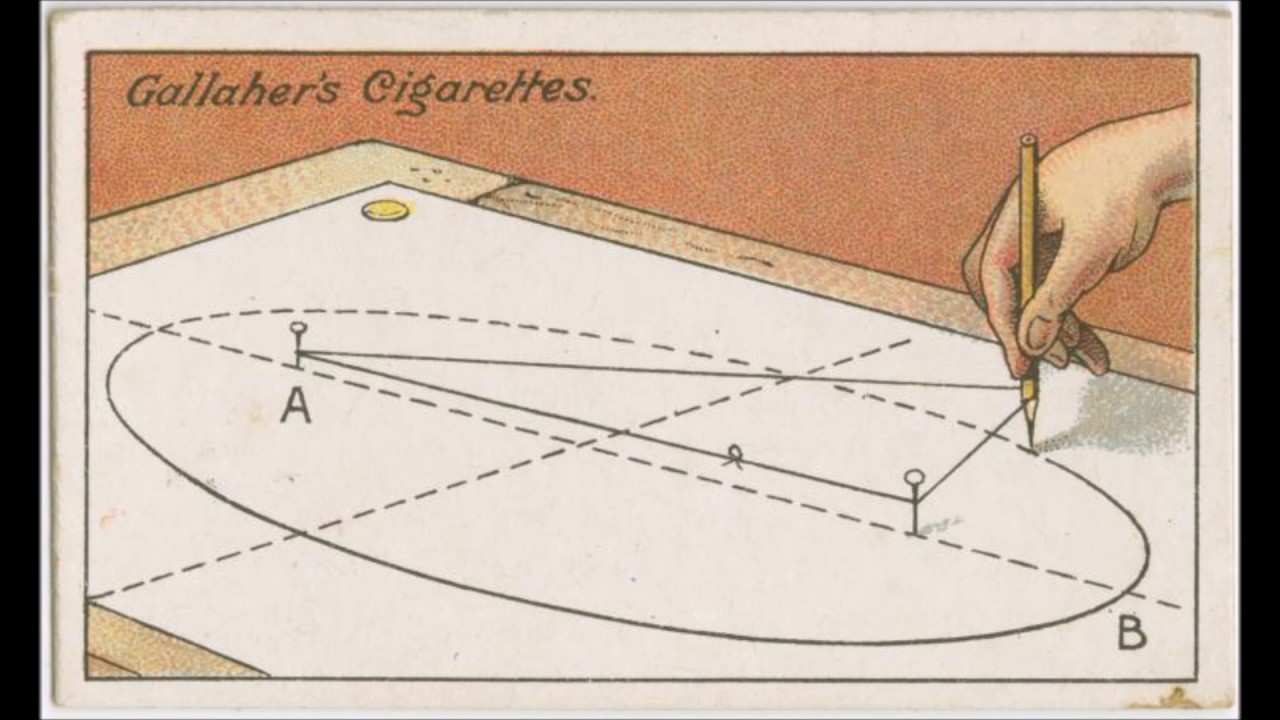
String is deeply embedded into geometric thinking when it is in its most practical form. The image on the cigarette card below is a crude demonstration of how to draw a curve from two fixed points and as a boy I well remember practicing drawing circles and especially ellipses, using a couple of drawing pins, a pencil and some string. I strongly suspect that all early geometry began with the making of string structures and if so, the stories and tales associated with cat's cradle type string structures would have been still hanging around and not separated out as a different type of thinking. Things would have been much more interconnected.  


An early Islamic diagram by Al-Biruni of the phases of the moon. 

If you look at the ancient diagram above you can almost see the 'stringing' and the text that sits alongside the drawn lines could represent the story. Modern science is little different, the image below being almost a cliched sign for scientific thinking, a type of thinking that requires a close interrelationship between mathematics and geometry. All it needs is the story around which all that abstract thinking is developed. 


When Daina Taimina developed a physical way of modelling hyperbolic space, she used crochet. What was interesting about her work was that she realised that we need to touch things in order to really grasp what they actually are. Her understanding of geometry was developed using crochet so that it was much easier to understand how a line, generated by a fold, could operate in hyperbolic space. You can watch her talking about how this came about in this video. Drawing, as in geometry is vital to this understanding, but in this case it becomes clear that without the type of drawing we associate with drawing threads, she would not have been able to develop the idea. 


I was again reminded of the myth of Theseus, in particular the part where Ariadne gives Theseus a ball of thread to unroll as he penetrates the labyrinth so that he will be able to find his way back out again. It is as if the thread allows him to drop down deep into his subconscious and return enlightened after defeating the minotaur. Taimina uses her thread to reveal the mysteries of hyperbolic space in a similar way. Daedalus the architect of the labyrinth, is often regarded as a prototype of the scientist inventor, the complexity of his thinking being something others could not fathom. However the implications of complex mathematics that we associate with scientific thinking can sometimes be clearly demonstrated by visualising processes, the key one being of course drawing. This PDF is downloadable and sets out the relationship between the mathematics of hyperbolic spaces and how these can be visualised using crochet.

The changing curvature of surfaces is something as artists we all have to deal with when drawing objects. See this earlier post. The mathematics of Gaussian curvature is a way of thinking about gravity affected spaces and the way that these are visualised relies heavily on the experience of artists visualising 3D form. 
The saddle: An example of negative Gaussian curvature


Various possibilities of Gaussian curvature

You can see from the illustrations above why the idea of crochet was so useful when trying to make sense of these types of spaces. Crochet can also be thought of as a type of net and a net is a flexible grid; so I seem to have come full circle again, perhaps time to end this post and snip this thread and start a new one.

Uccello


See also: