Showing posts with label psychology. Show all posts

Thursday, 27 August 2026

Visualising pain

Headache

Finding forms with which to visualise pain is not as easy as you might think. For one person a jagged yellow may feel exactly right as a visual translation of their headache but for someone else it doesn't work at all. Perhaps there is no universal correlation between a pain and a visual form and if not why am I working in this area? I think it's because there is some correlation, some instinctual connection between a pain and a shape, but not one that can be pinned down into a grid of references that allows us to see a throbbing pain as one form and a sharp pain as another. Perhaps it is also because the more I work with people I realise that it is not the images that I produce with them being accurate representations of pain or other somatic feelings that are the most important thing, it is rather the process of forward and backward iterations of change and adjustment in response to conversations, and the record of this that is important. During this process people become more aware of their feelings and as they do, something happens in their mental life that allows in change, something new begins to work its way into neural pathways and possibilities begin to open out. The forms discovered therefore represent 'possibilities' and are open to interpretation, rather than them being dictionary like fixed readings. The images are more about visualising the human condition of being always unsure as to how other humans receive our complex communications. We feel certain things about life and our consciousness of it but we might also feel that only our own mind is certain to exist and that we are locked inside our own subjective experiences. In philosophy this is called solipsism and is to do with the problem of other minds, the emotional realisation of this being sometimes seen as a form of existentialism. However, I'm a believer in intersubjectivity, not just amongst people but in a pan-creation intersubjectivity and believe that consciousness and meaning do not originate inside my own individual brain, but are collectively co-created across the entire relational and environmental fabric of existence. Therefore altruism is of vital importance to me, not just in terms of the value I put on the existence and welfare of others but on my awareness and value of our interconnectedness with everything else. In having conversations and responding to them through drawing, the images that evolve are for myself, a materialised realisation of these ideas.

In an earlier post on decor art, I was ruminating on the fact that surveys had found that people did not like certain shapes and colours in paintings and that perhaps spiky shapes, sharp, jagged and angular forms reminded us of aggression and pain, because they resemble thorns, teeth, or claws and these forms therefore possibly trigger primitive survival instincts and raise alertness. I also stated that harsh, bright colours, high-contrast hues and highly saturated colours demand immediate attention, as psychologically they represent warning signs, urgency, and intensity. However there would be a very different response to these forms when experienced as part of a fireworks display. How we would then emotionally react to those fireworks, would though depend on our current mental state. When we were hosting a Ukrainian couple, a boy and his mother, who had come over to England to escape the war, we had not thought about this. When a firework display began in our local Sikh temple, the boy hid under a table, the loud bangs signifying for him immediate danger. Someone suffering from PTSD may well find the experience of fireworks frightening and disorientating but most people who have been introduced to fireworks within calm, family orientated situations, are able to get an uplifting mental excitement from the experience.

For myself, watching fireworks triggers a feeling of awe, which creates a space for me to enter the sublime, a state that blends wonder with a thrilling touch of terror. Unlike traditional beauty, the sublime challenges and humbles us. In the case of fireworks, the emotional state that arises, combines visual stimulation from bright, dynamic colours with the sudden, thrilling crack of loud bangs; leading to a temporary state of euphoria and excitement. From their stunning colours to their thunderous booms, fireworks trigger reactions that are emotional and instinctive.

A certain class of fireworks that I come across, especially during large scale organised firework displays, tends to evoke a more complex series of emotions, I'm thinking here of the firework effects such as airborne chrysanthemums or peonies, forms that jellyfish like grow and fluctuate, often exploding with bangs and crackle effects, some of which begin and others end their sequence of unfolding. These forms heighten excitement by activating neural pathways associated with curiosity as well as awe. These fireworks I believe tap into an evolutionary preference for eye-catching stimuli, similar to how flowers or ripe fruit grab our attention. Watching these types of fireworks doesn’t just captivate us, it feels good. The brain releases dopamine, these vivid visuals paired with loud sounds, also helping forget everyday worries, creating a temporary state of euphoria. The intersubjectivity that I mentioned earlier is in my mind confirmed by then looking around the crowd that has gathered to watch the fireworks. I see that sense of awe in many faces and know that others are feeling something similar to myself. But not everyone has the same expression, some are excited, others calm and contemplative; some are quickly distracted, whilst others remain entranced. I wonder if this is to do with the five personality traits. Often condensed into the acronym OCEAN, these are 'Openness to Experience', a measure of creativity, curiosity, and interest in new ideas; 'Conscientiousness', a measure of self-discipline and focus on goals; 'Extraversion', a measure of how sociable you are; 'Agreeableness', a measure of kindness, warmth and your cooperative nature and 'Neuroticism', the measure of your emotional stability and how easily you experience negative feelings like stress or anxiety.

I'm rambling on, but in effect as I ramble, I'm trying to think about why similar things may evoke different feelings in different people and yet at the same time a certain amount of similar or collectively understood information is also communicated. My curiosity allows me, or predisposes me, to see associations between flowers and fireworks and also at the same time because of my research into interception, I can see a connection with the shapes of firework explosions and the sorts of forms that people have used to visualise how they experience a pain.

As soon as you begin to ask someone about a pain, you begin to realise it will be a complicated answer. For instance it may feel as if it is constantly in flux, it may be flickering in and out of consciousness or pulsing, throbbing, beating, pounding, jumping, flashing, shooting, boring, drilling, stabbing, sharp, cutting, lacerating, pinching, pressing, gnawing, cramping or crushing. It may feel as if it is tugging, pulling, hot, burning, scalding, searing, tingling, itchy, smarting, stinging, dull, sore, hurting, aching, heavy, tender, taut, rasping, splitting, tiring, exhausting, sickening, or suffocating, some of these feelings coming with more emotional associations than others. Certain feelings are very closely associated with pain, someone may be fearful, frightened, terrified, or feel the pain is punishing, gruelling, cruel, vicious, blinding, annoying, troublesome, miserable, intense, unbearable, spreading, radiating, penetrating or piercing. It may also be felt as a numb pain or as if you are being squeezed or torn. Cool, cold and freezing feelings can be experienced, alongside nagging, nauseating, agonising, dreadful and torturing pain. These feelings of pain might be brief, rhythmic, continuous, momentary, periodic, steady, transient, intermittent or constant and you may feel sad about them or angry or bored or worried or just accept them. It is in the unpicking of this complexity that the individuality of interoceptual feelings are unearthed.
Basic experiences such as throbbing, burning, stabbing, shooting, aching and itchy pains have been initially in drawing led conversations visualised by dots, lines, textures, colours, etc. in both two and three dimensions. I am also aware that others have been there before me such as Tong et al 2014 and that the forms they came up with were not dissimilar to some of the shapes and colours used by myself. Their goal of "Transforming invisible physical index data that represents chronic pain as art can provide patients with an overall visual feedback of their pain experience and how it changes over time. " (Tong et al 2014, p. 1) being much more focused on achieving a set of fixed correspondences between colours and shapes and the pain experienced, whilst I'm more concerned with visualising the complex human condition of feeling pain, one that also has an emotional landscape. At the same time I'm always careful to ensure that everyone also is aware that these are images made by an artist, and even though these images are made in response to a back and forth, critique and edit process, I am in the end the originator of the colours, forms and shapes used. As to how other humans receive our collaborative and complex visual communications, I'm not sure, but it is interesting to set them out as a comparison with the work of Tong et al., especially as by putting them on black backgrounds 
Tong et al make their forms somewhat like fireworks exploding in a dark sky. I also like Tong et als idea that their forms are like some sort of self illuminating jellyfish moving in dark waters and as I do I begin to see a family of forms begin to cluster in my visual mind. Which may be more to do with the sorts of correspondence we find in magic rather than in any scientifically verifiable activity. 

From: Tong et al 2014

Each of the images below is an attempt to visualise pain, what I think is interesting is that although these images are built up from agreements with several other people who have these pains, there is no clear correspondence between them except they were all made by myself. So are these images in reality simply my own visualisations of pain and they are not really proper collaborations? Should my idea of developing a new pain chart have to be parked? I shall see. But at the moment my worries about subjectivity are growing and I begin to wonder if all I have done is give myself opportunities to engage in image making that stretch my capacity for visual invention, rather than my making an objective visual record of a collaborate conversation. It is very hard to remove myself from the process. 


Images of people in pain

Reference

Tong, X., Gromala, D., Shaw, C. and Clarke, P., 2014, July. Transformation between Electronic Arts and Chronic Pain: Long-term Body Activity Data Visualisation and Pain Animation. In Electronic Visualisation and the Arts (EVA 2014). BCS Learning & Development.

See also:

Decor Art

Fireworks

Drawing and healing traditions

A highway code for pain

Ibrahim el Salahi pain relief drawings.


Wednesday, 22 July 2026

Decor Art

A painting from my parent's house

My step mother died last year and it took a while to sort out her affairs. However, her niece contacted me recently to tell me that everything was now in order and that a couple of items that she believed had come to her aunt from my dad needed to find a home. She had found a couple of cross stitched copies of paintings made by my mother as a distraction when she was dying with cancer and two small paintings. It was agreed that my sister would have one of the paintings and a cross stitched image that was based on a Rembrandt painting and that I would get to have the other two images. I didn't remember ever seeing the painting I received, but my sister did remember hers, as it was on the wall of one of the houses she lived in when she was a girl. I am though a lot older than her and my parents, who tended to move house every two or three years, had lived in several houses after I left Dudley.  However, the more I look at the painting, the more I become intrigued. 

The painting's signature 

The painting is signed, with a name that could be Kine, Kinn or Klien or something similar. I found out that paintings signed with the "K" last name were often painted by what were called "Decor Artists". There were many European and American painters in the mid-1900s who painted cheap, commercial oil landscapes and signed them as "Kine", "Kinn" or similar, which were sold in furniture and department stores. These mass-produced "factory paintings" were also by the late 1980s made in overseas workshops such as Dafen Village in China. Skilled but uncredited painters used their skills to quickly create and reproduce works. I also found the following statement about this type of painting.... "while many vintage decor paintings from the 1950s–1970s possess a certain charm or historical value, they generally hold little to no long-term monetary or gallery value". This use of various types of value systems of course intrigued me; historical value in this case was there, but no monetary or 'gallery' value. In the art market, gallery value is the standard retail price an artwork commands when sold through a commercial art gallery. It typically represents the base "Artist Price" doubled to cover the gallery's commission and operational expenses. As these paintings were sold in furniture stores, they were obviously thought of as 'decor', however I have seen people go into galleries and ask to look at paintings that would go with the interior decorative scheme they had implemented for their house. The use of the word 'charm' when researching qualities associated with these paintings, opened another aesthetic conundrum for me. For instance there is such a thing as 'curated nostalgia'. It draws from vintage or cottagecore* themes; such as cozy country cottages and whimsical florals. This creates a comfortable, safe and deeply familiar visual environment. The cozy feelings evoked are deeply emotional
, and I realise that these paintings are perhaps far better at communicating certain types of emotion than the work I'm supposed to be developing in relation to my research into the visualisation of interoceptual experiences. 

There is one particular artist who is celebrated for his work in this area. Thomas Kinkade, is renowned for cozy, idyllic cottage scenes. His signature style features glowing windows, sun-dappled pathways and vibrant gardens, his paintings capturing a nostalgic and for many people welcoming warmth. His paintings are celebrated for evoking deep feelings of peace and a loving home.

Thomas Kinkade

Kinkade’s paintings depict an idealised, nostalgic escape from modern anxieties. By utilising luminous painting techniques, easy to read symbolism and familiar, therefore safe imagery, his works are like a comfort blanket. The feelings expressed in these images are related to the feelings that my parents wanted to have evoked when they purchased the painting I was sent. Knowing my dad he probably bought it second hand from a salesroom somewhere, maybe part of a job lot, bought sight unseen. He liked that sort of adventure. 

But there is another approach to this type of image and that is its stereotypical nature. A stereotypical image is an oversimplified and often fixed visual representation of a particular idea or concept. If decor artists were to make images by the thousand, they needed to have a clear idea of what people wanted and therefore would need to work with stereotypes. 

I decided to look at what was offered in similar outlets today. Wilco had landscape prints,


Idyllic Country Scene 

Wilco accompany their presentation of two 'Idyllic Country Scenes' with this statement: 'Bring a peaceful countryside charm to your home with the Idyllic Country Scene Framed Art. This beautiful artwork features an assortment of serene rural landscapes, perfect for creating a calm and cosy atmosphere in any room. Set in a classic frame, it offers a timeless charm and makes a great addition to living rooms, hallways, bedrooms and even offices.'

Posterlounge the Fine Art print company is slightly up market of Wilco, it asks, "Are you inspired by atmospheric landscape prints? Countryside Cottage by Dominic Davison being a contemporary offering by them of a by now familiar theme, the difference is that Davison is a digital artist. This is how Posterlounge introduce Davison's work.
'Pure romance, a grandiose attention to detail, warm summer evenings and an idyllic holiday feeling… All these things mark British artist Dominic Davison’s digital masterpieces. The biggest source of inspiration for Dominic’s wall art is his chosen home, Buckinghamshire, featuring picturesque cottages, green meadows and quaint forests. His unmistakable style is inspired by artwork of all kinds.'
Countryside Cottage by Dominic Davison

Both companies tell us that these images are 'idyllic'. The Oxford English Dictionary informs us that "Idyllic" is often used to describe a scene, place or experience that is peaceful, charming, and picturesque and is associated with a serene, flawless, or stress-free rustic environment, it can refer to anything from a beautiful countryside landscape to a perfect, carefree childhood memory. This idea is an old one, the OED goes on to explain that...'the word "idyllic" derives from the Greek word eidyllion, meaning "little picture" or "short poem." Historically, it refers to an "idyll," which is a literary or artistic genre used to depict an idealised, peaceful vision of pastoral or rustic life.' However, this romanticised outlook, where nature is innocent and untainted, has been intentionally constructed and passed down through centuries of literature, art, and philosophy. The Roman poet Virgil’s Eclogues depicted idealised shepherds philosophising in meadows, while in reality shepherds had to deal with a harsh difficult to negotiate landscape that included wolf packs, disease and extreme poverty. During the 18th Century Marie Antoinette had a fake rustic hamlet built at Versailles, so that she could play at being a lady peasant, at the same time the real French peasants were starving. Farmers today struggle with debt, climate change and corporate takeovers, the countryside can be a very harsh environment, often far away from comforts such as local hospitals or cultural outlets such as theatres or art galleries.
It would seem that the more industrialised and urbanised we become, the more we romanticise the countryside. Hence the 
'idyllic' stereotype. 

Back in the 1990s Komar and Melamid set out to find what most people would like if a painting could be made exactly to their wishes. Intending to discover what a true "people's art" would look like, the artists began the process which resulted in America's Most Wanted and America's Least Wanted paintings, which were exhibited in New York at the Alternative Museum under the title "People's Choice."

USA Most wanted painting

France most wanted painting

Turkey most wanted painting 

They went on to conduct surveys in several other countries and as you can see from the three samples taken from their research, what people wanted was very similar in each case. Michael Govan had this to say about their project.
In a way it was a traditional idea, because a faith in numbers is fundamental to people, starting with Plato's idea of a world which is based on numbers. In ancient Greece, when sculptors wanted to create an ideal human body they measured the most beautiful men and women and then made an average measurement, and that's how they described the ideal of beauty and how the most beautiful sculpture was created. In a way, this is the same thing; in principle, it's nothing new. It's interesting: we believe in numbers, and numbers never lie. Numbers are innocent. It's absolutely true data. It doesn't say anything about personalities, but it says something more about ideals, and about how this world functions. That's really the truth, as much as we can get to the truth. Truth is a number.
-Michael Govan, Director, Dia Center for the Arts
Govan's statement was I found worrying. Faith in numbers is I find problematic, but I could see what he was getting at. I was more interested in what this group of images represented in terms of visual psychology. It has been argued that people love landscape images because of the prospect and refuge aspects of evolutionary psychology, such as the safety instinct whereby we are biologically drawn to landscapes that offer a vantage point to survey surroundings (Prospect) and sheltered areas for protection (Refuge). Images featuring lush green colours and accessible water (like lakes and rivers) are meant to be universally pleasing because they signal survival, food sources and seeing water, that even in pictures or video projections, signals safety, relief, and replenishment, and in turn it produces wakefully relaxed brain waves. This is a process also called "soft fascination", whereby water engages us in a gentle reflection that quiets the mind, allowing the brain's cognitive networks to recover from stress and anxiety. Landscapes can also serve as blank canvases for the viewer's imagination, acting as a form of visual therapy, giving the mind a space in which to mentally inhabit a space far away from daily stresses, a place that is a serene, idealised environment. It is argued (biologist E.O. Wilson,1984) that humans are evolutionarily wired to respond positively to natural, adaptive environments (like water and vegetation) and neuroaesthetics supports this by identifying the exact neural pathways that light up during experiences of beauty. It has been found that when viewing natural scenes certain particular neural pathways are indicated as being used and these same scenes when examined using stress reduction theory research, show that viewing these natural scenes immediately engages the brain’s calming, restorative responses, lowering cortisol levels and blood pressure. Therefore there is a direct connection between aesthetics and the brain's production of chemicals to control emotion. Landscape scenes that evoke the Golden Hour, use warmer tones combined with lower colour saturation, mimicking the sensations we get from experiencing early morning and evening light. The feelings invoked by those times of the day are often felt by people to be both spiritually uplifting and emotionally warming. Landscapes serve as blank canvases for the viewer's imagination. They act as a form of visual therapy, allowing the mind to mentally escape the traumas of now and transport someone away from their daily stresses into nostalgic, serene and idealised environments. I do wonder however, how much of this has been culturally manufactured. Perhaps nature and culture are in this case interwoven, but its also useful to remember that people who live in the Amazon view their environment not as a "wilderness" or an "idyll" but as a living, sacred entity.

In 1984 Roger Ulrich published a ground changing paper, 'View Through a Window May Influence Recovery from Surgery'; patients that had a view of a landscape through their window were discovered to heal more quickly that those who did not. It would appear that not only does exposure to landscape views effect people's mental state, but that it can also be beneficial to their physical health.

Wittenstein would look in these situations at 'use value'. He believed that languages act as sets of tools, "meaning" being determined by their practical use within specific social contexts. Therefore in terms of 'use value' a painting of this sort may be used to benefit someone's mental health. It could be argued that we often get mixed up when trying to think about the 'value' of an image and although the painting I have been sent has no monetary or gallery value, it may well have been used by my parents as a window into a nostalgic, idealised environment, that allowed them to escape the everyday realities of their lives in Dudley.

So what does this mean in relation to what I'm normally looking at in terms of visual imagery? Perhaps a bit of a wake up call in relation to who uses what imagery for what purpose. Most people like images of landscapes, because these images make them feel better. I sense by most people I'm talking about the majority of people who have hard lives, especially those working in towns and cities, where nature is rarely experienced as a raw elemental force, more as a breathing gap or space for leisure and an escape from work. The rich can afford to buy abstract paintings that often are not that different from Komar and Melamid's 'Least Wanted' paintings. They can afford to like difficult things.

America's Least Wanted painting

Harsh colours and spiky, abstract forms, are, Komar and Melamid found, the least wanted shapes and colours to have in a painting. Probably because of what they represent. Harsh, bright colours and spiky shapes represent danger, tension, and aggression. These visual elements trigger heightened cognitive arousal and mimic natural cues associated with threats or intense stimulation. Spiky shapes, sharp, jagged and angular forms remind us of aggression and pain, because they resemble thorns, teeth, or claws. These forms trigger primitive survival instincts and raise alertness. Harsh, bright colours, high-contrast hues and highly saturated colours demand immediate attention, as psychologically they represent warning signs, urgency, and intensity. There is also a certain amount of synesthesia at work, whereby a perceptual phenomenon stimulates one sensory or cognitive pathway and involuntarily triggers an experience in another. Such as when spiky, jagged shapes are triggered in the mind by sharp, explosive sounds. We instinctively associate jagged shapes with the twisting and fast bodily movements that are often made in response to sharp percussive noises and in turn these movements can be visualised using forms that like a frenzied dance movement, sharply zig-zag from side to side. 

Because I'm often working with people in pain, it is this area of visual form that tends to dominate the images produced. But as it seems clear from the above, these images are the least wanted in terms of 'pictures to live with'. 

So what in my case is the 'use value'?

I have tended to think of the use value of my research as raising awareness of interoceptual sensations and feelings. I have also thought of the work I do as art. Some of the images that have emerged from the process are I think powerful in their own right and when put into a gallery context are open to interpretation, just like all the other images seen in galleries. Once removed from their initial 'use value' context, they slide into a further use as imaginative images of the body, that help me to visualise ideas about the cosmic body and my thoughts about how we use images of our bodies to visualise the wider world. 

Most importantly, this post allows me to find a connection between what my parents might have thought in relation to using a visual image in their lives and what I do as an image maker. I have for too many years thought of myself as someone 'different' to my parents, but the reality is I am very similar. 

*Cottagecore is a lifestyle and design aesthetic that romanticises rural, simple living and harmony with nature.

References:

Ross, A., (1995) Poll stars: Komar & Melamid's" The people's choice". Artforum.

Ulrich, R.S., (1984) View through a window may influence recovery from surgery. science, 224(4647), pp.420-421.
 
Wittenstein, L. (2012) Tractatus Logico Philosophicus. London: Simon and Schuster.

See also:


Thursday, 18 September 2025

Interoceptual portraits

I have been taking the work on interoception into another area, that of portraiture. I have for many years been fascinated by Oscar Wilde's 'The Picture of Dorian Gray' a late nineteenth century Gothic novel, whereby the deeds perpetrated by an evil man, are reflected in the changes made to the features of a hidden portrait, rather than to the face of the man who perpetrated the deeds. At that time there was much interest in physiognomy, the art of judging character from facial characteristics and in response to this, Wilde developed an idea based on a sort of reverse engineering, whereby you can measure the depth of depravity that someone is sinking into by watching their face transform over the years. If only this were true. I can still remember the first time I saw the Ivan Albright painting he made for the film 'The Picture of Dorian Gray'. In the 1945 Albert Lewin directed film, the first part had included two colour inserts of a painting made of the youthful handsome Dorian Gray (in reality painted by Henrique Medina) and then later in the film you had two frightening technicolour reveals of Albright's degenerate image of what in reality Gray had become.  Albright's painting would haunt me from then on. 

Dorian Gray by Henrique Medina 1944

Ivan Albright Picture of Dorian Gray: 1944

I thought I saw glimpses of Albright's insight into the human condition in Francis Bacon's work and I was reminded of this when an artist I had been working with in conjunction with an Italian artist to develop ideas for interoceptual portraits, sent me a Simon Shama quote; ‘What Bacon liked about George Dyer was not the assembly of features… what he liked was the inside of him and the way that pressed against the outside, the whole slithery jumble of a person’.

Francis Bacon: Study for a portrait of George Dyer

The phrase, "The whole slithery jumble of a person". struck home, and when it came to my own recent self-portrait, I found myself dealing with disintegrating forms alongside a colour struggle using complementary opposites, both ideas being used to build a psychological idea of an inner duality.

Interoceptual Self portrait

The two artists I have been working with have just sent me some objects through the post, which was a way of getting some sort of physical contact into a situation whereby we have been trying to make images of each other via computer screens. There is something much more authentic about touch and even though we are all three separated by many miles, the few objects that I can hold in the hand and pick up to look at, close those geographical distances right down to the surface of my fingers. Our portraits of each other have been developing over the years. But this time we sent objects and images to act as some sort of catalyst or stimulus to the making. As always these things are as much self-portraits as portraits of others, but the process of an image's arrival is always intriguing. In the case of the image I made responding to the objects in one parcel, I first of all glued down a shirt pattern that was enclosed and then I responded to the same artist's mono-print of a skull. As I was working between several things in the studio, I on purpose didn't think deeply about what I was making, I just kept doing stuff. As Johns put it, "do something and then do something else", or something like that. I.e. keep responding and making things happen and only later go back and see if anything works or not. 

Portrait of myself made whilst thinking of making a portrait of another English artist

Portrait of myself made whilst thinking of making a portrait of an Italian artist 

There is as you can hopefully see in the image above, a strange form emerging from the head of the figure. It is like a shell and has a red rose like form sitting over what would in a more conventional portrait be the brow. It is the product of one of our exchanges, but as always there is very little logic in my image development process. One of the things I was sent from Italy was a small nest like object, it was made of fabric, wrapped in rusty wire and other metal pieces and in its centre was a plaster form, its shape like a pebble brain. My artist corespondent had made a metaphor for her brain. I had sent to her a pair of ceramic legs that I had modelled on an idea of the hut of the Baba Yaga, which is always in illustrated books depicted as a hut carried on giant chicken legs. Without the legs the hut would just be a hut, but with them it became something fabulous. I had sent these legs to both my artist collaborators because I wanted them to think about using the legs to make something of their own fabulous, in the old sense of the word, as something magical, mythical or relating to a fable. When I looked at the nest I realised I needed to put it on similar legs, as I did it became alive and it took over my image making process. It had invoked some form of sympathetic magic.


Portraits of an artist's brain as a mythical creature

Part of my research into the raising of awareness of interoceptual feelings has been to look at the work of illustrators who have been working to visualise its importance. A really good example was the illustrative work of Abby VanMuijen and after looking it, I decided that she had already done some excellent work that focused on the core issues involved and decided therefore that I didn't need to retread the same path, but would continue to push for some sort of visual synthesis between my own more idiosyncratic language and the diagrams of emotional range and pain awareness that I had also been looking at. I was particularly interested in the fact that she kept the same image as an underpinning form and changed the colour to fit the emotional movement.

Abby VanMuijen

I therefore decided to try a similar approach; initially taking my interoceptual self portrait and changing the colour palette to see if I could demonstrate an emotional shift, but combining emotions to see if it was possible to communicate that ever morphing sense of life's instability and constant change.

Surprise and disapproval 

Anger and remorse

Acceptance and sadness

Interoceptual self portraits with colour changes suggesting mood swings

The initial image has a much more nuanced colour range, colours push against each other, my experience being that our emotional range shifts and moves in a complex manner. If like Abby VanMuijen I push the colour range into the primaries, emotion changes but it is simplified, therefore I have decided to look at complex mixes. 

Robert Plutchik, the colour wheel of emotions

I'm gradually bringing my ideas together but as always I'm not quite sure what I'm doing, mainly feeling for something rather that following a logical path. I have looked at 
Robert Plutchik's work for a while now and although I can see all sorts of problems with it, it does open a door for me, so why not I thought step through it? 

See also:

Wednesday, 24 July 2024

The Borromean Knot

The Borromean Knot

I have looked at knots in the past because I like the way that they are both physical objects and powerful metaphors, they tie things together, mentally and physically. But now as I'm trying to get to grips with some alternative approaches to thinking about my own mental life, I have discovered a particular mental knot that is used to try to explain subjectivity or some of the key aspects of our mental life from a psychoanalytic point of view. 

In mathematics Borromean rings are three simple closed curves in three-dimensional space that are topologically linked and cannot be separated from each other. They break apart into unknotted and unlinked loops when any one of the three is cut or removed. I. e. the rings are held together only by the presence of all three. If any one of the rings is cut open, the entire structure falls apart. Sometimes this is represented by three overlapping circles, but this takes away the vital three dimensional nature of this idea, it doesn't work in two dimensions, so if you need to draw one you need to give the rings some form of three dimensional indicators, such as the white spaces in the drawing above, that indicate which part of the circle sits on top and which below. 

This construction was historically one of the heraldic symbols of the dukes of Borromeo, which is why it is called what it is. 

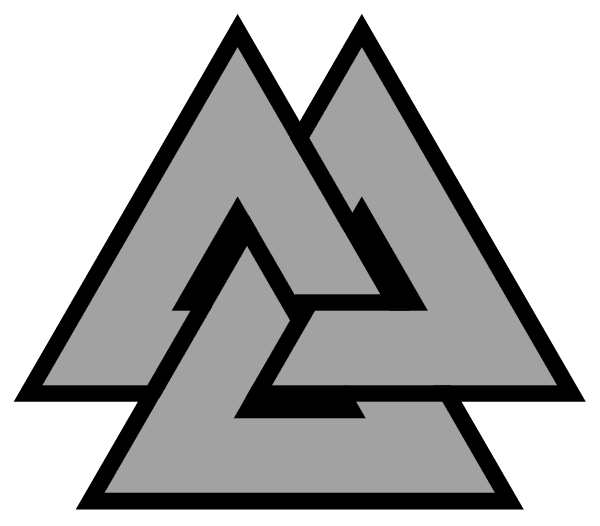
Odin's knot

In Norse mythology, triangles are used to express the same idea, (the Valknut) and topographically it makes no difference to the concept. The knot belongs to a tradition of thinking that is centred around the use of fibres to think with. In this case 'seidr', (Old Norse seiðr, 'cord, string, snare') was a form of shamanistic magic concerned with discerning the course of fate and how to effect change, which was done by symbolically weaving new events into being. Odin's knot, like any other form of weaving, is a structure that only makes sense when it is complete, the individual threads or cords are thin and insubstantial, but when brought together as a weaving or in this case an idea, a powerful concept is realised.

However there is another version of Odin's knot, one that fuses together all three triangles as a continuous band, and this represents the fact that differences are an illusion. 

Odin's knot

Borromean Rings also represent the symbol of the Trinity in Christianity, the three interlocking rings signify the divine trinity, which represents the belief that God is of one Being made up of three distinct Persons who exist in co-equal, co-eternal communion as Father, Son and Holy Spirit.  In fact these interlocking rings can be used as symbols for many sets of interlocked triads such as past, present and future.

It is however the Borromean Knot as used by the psychoanalyst Jacques Lacan that I'm going to try and focus on, as it might help me with some sort of structural support when trying to think through the relationship between the world out there and the inner world of embodied mental processes. 

Lacan and the Borromean Knot

The three rings are first of all 'real', in that topology is about solid, three dimensional objects and their surfaces. Therefore when Lacan decides to use it as a symbol, it is a much more solid symbol than a geometric figure, such as a circle or a triangle. 

It is a symbol of an inseparable bond, so that whatever is joined together by this bond is seen as a totality, something that might have three components, but no one component can be free of the other two; if it ever is, it would actually cease to exist in the form it takes. Lacan uses the knot to illustrate his structural theory of three registers or orders of what he thinks of as the psychoanalytic experience or categories of the psyche; the Real, the Symbolic and the Imaginary. However, he chooses the Borromean Knot, not just because of its interlocking nature but because of the fact that its loops have to be 'real' or three dimensional to work, they have to be loops of chain or rope. This he states, means that rather than simply representing this structure, topology is that structure. 

The knot is not just a way of illustrating the interdependence of the three orders, it is also a structure that helps Lacan to think about what the three orders have in common. Each ring represents one of the orders, and certain elements can be located at intersections of the rings. and these can be used to focus on the relations which bind or link the three aspects of the psychoanalytic experience. He argues that if the knot is broken or unravelled in some way it results in some form of psychosis. There is though a further element in his concept, which he calls the 'sinthome', which he thought of as a fourth ring, a ring that was needed to go beyond the symbolic. I can see why he might need this, and its the problem with theory and representational systems. It's ok to have an idea and to set out a theory, but where is the lived experience, at what point can you get totally lost in the activity and in effect become it? The 'sinthome' it seems to me is not just about a need to have a fourth ring to ensure the three rings hold together, but is a reminder that there is a reality beyond symbolic meaning, and that is for myself a very useful thought. I'm often asked about my work, 'What does it mean?' and by that I gather that people want me to describe its symbolic meaning, but I tend to avoid this, as it can be like a trap, in doing so, it can seem to empty the work of meaning, rather than communicate what its trying to say. 

But Lacan's Borromean Knot has letters and the word 'meaning' inscribed into the various overlapping sections and these are where the detail in terms of his thinking is held. 

Lacan's Borromean Knot


'For Lacan, the reality of human beings is constituted by three intertangled levels: the Symbolic, the Imaginary, and the Real. This triad can be nicely illustrated by the game of chess. The rules one has to follow in order to play it are its symbolic dimension: from the purely formal symbolic standpoint, ‘knight’ is defined only by the moves this figure can make. This level is clearly different from the imaginary one, namely the way in which different pieces are shaped and characterised by their names (king, queen, knight), and it is easy to envision a game with the same rules, but with a different imaginary, in which this figure would be called ‘messenger’ or ‘runner’ or whatever. Finally, real is the entire complex set of contingent circumstances that affect the course of the game: the intelligence of the players, the unpredictable intrusions that may disconcert one player or directly cut the game short.'

(Žižek: How to Read Lacan, pp. 8–9)

Žižek returns to this issue in his book, 'Event: Philosophy in Transit' and if you put the two descriptions together you get a reasonable idea of Lacan's three registers.

'For Lacan, the Imaginary, the Symbolic and the Real are the three fundamental dimensions in which a human being dwells. The Imaginary dimension is our direct lived experience of reality, but also of our dreams and nightmares — it is the domain of appearing, of how things appear to us. The Symbolic dimension is what Lacan calls the ‘Big Other,’ the invisible order that structures our experience of reality, the complex network of rules and meanings which makes us see what we see the way we see it (and what we don’t see the way we don’t see it). The Real, however, is not simply external reality; it is rather, as Lacan put it, ‘impossible’: something which can neither be directly experienced nor symbolised — like a traumatic encounter of extreme violence which destabilises our entire universe of meaning. As such, the Real can only be discerned in its traces, effects or aftershocks.'

(Žižek 'Event: Philosophy in transit' pp. 119–20)

My personal interest is in this case the fact that for Lacan, direct lived experience of reality is fixed into the 'imaginary' register. 

Right in the centre of Lacan's annotated diagram is the letter 'a'. Small case, and standing as an abbreviation for 'autre', or in English, 'other'. Or is it what Lacan had called 'The Fragile Absolute'

Lacan states that there is a price we all must pay in order to gain access to the social world of other humans. We must undergo a process of finding limits to our natural 'jouissance'

'Jouissance' as used by Lacan, has been described as: 'The lost plentitude of one's material bodily drives given up by the subject in order to enter the symbolic order and access the symbolic power of the phallus, something that occurs upon the adoption of language and acceptance of the rules of the name-of-the-father'. 

I.e. There are laws to follow, the first ones of which you learn from your parents. Lacan for some reason called this process 'symbolic castration'. Which sort of makes me have a mental shiver You are supposed to have sacrificed an 'enjoyment' that in fact you never really had on the alter of the Symbolic (Law). You sort of 'remember' the prohibition of that enjoyment and resent your Symbolic castration for having had an intuition of something that may not even exist. As far as I can see, this works as a story, a fabrication of the mind, such as the classical Freudian tale of Oedipus, who fulfilled a prophecy that he would end up killing his father and marrying his mother, thereby bringing disaster to his city and family.. The “lost” enjoyment concentrated in the 'objet a' is an impossible enjoyment, hence it is a 'Fragile Absolute'. 

But, and this is where Lacan constructs another tale for us to think about, the lost 'jouissance', that primal something that was lost as you become subject to society and its laws, is the thing around which you construct the subjective story of yourself. This is why we are always wondering what we are and why we are. This awareness of some sort of loss, is what makes us into the desiring subjects we are. the 'a' at the centre, is the lost 'other' that causes us to desire in the first place and this is why Lacan also called it the 'object-cause of desire'. It is the only thing that belongs to all three aspects of the psychoanalytic experience. 

If we then turn to 'JA' which seems to be translated as 'autre jouissance', this it seems is a sort of pure 'jouissance' of the Real beyond any symbolic contamination. This 'escape' is somewhat problematic though as it seems to rely on a very male centred phallocentric idea, in which for some reason, this other is associated with the feminine, therefore this 'jouissance', I would argue, lies outside the ring of the Symbolic, and as far as I can understand his logic, it would then appear that not being male is a form of psychosis.  At another point he mentions a “pure difference” and a “fermenting” Nature, things that stand outside of the sacrificial lack. The important issue in terms of the diagram, is that JA sits outside of the symbolic. Here we can see the problem with words again. When naming things, nouns are either so or not so, they create binary divisions, whilst events are closer to the truth as they are open ended and they evolve. 

The section that is made by the overlap of the real and the symbolic is labelled 'Jφ' φ is the lowercase version of the Greek letter phi Φ.  In Lacan's terminology Jφ stands for 'phallic jouissance'. This means that this concept stands outside of the 'imaginary', it is outside of the domain concerning how things appear to us. Lacan at one point plays with the similar sounds in French of le nom du père (the name of the father), le non du père (the no of the father), to emphasise the legislative and prohibitive functions of the father, and this lies central to why this is a 'phallic jouissance'. The symbolic world that the father introduces the child into is a construct that we have to come to terms with, even if we resent it. Because it is not a part of the imaginary experience it is a 'castrated' enjoyment. 

Meaning is set between the symbolic and the imaginary and sits outside of the real, which is, according to Lacan, inaccessible to psychoanalysis itself. Because of the overlaps between rings, there can be various combinations between the elements. Thus, for example, there can be a symbolic or imaginary hole in the real, for instance a nightmare may leave you with a deeply traumatic aftereffect, a real object may become an icon within the symbolic. Likewise, there can be a consistence or hard core of 'meaning' within the symbolic, or a hole in the imaginary, whereby direct experience is seen as an illusion. The sliding between categories does seem to me to be more akin to how I experience being and when I try to sense my own psyche, its illusiveness and slippery nature is part of its essence, it is something you can't nail down. 

I can intuitively grasp what Lacan is saying, but I think he would have been better at setting it down as a form of poetry or a personal fable rather than as a psychoanalytic conundrum. My own day to day anxiety is I'm sure rooted in my relationship with my father, his harsh rule still impinging on my own ability to trust my instincts, as I still feel myself inwardly seeking his approval before I do anything. Something that I have battled with all my life, and that has at times seemed 'mythic', a something to externalise in order to overcome its hold.

If I had to choose my own geometric figure to represent that movement between the outer and inner worlds that I seem to inhabit it would however be the triquetra.  The triquetra is a triangular figure composed of three interlaced arcs and as you follow them round you realise they are all part of the same figure. Lacan's struggle to unpick the reality that sits outside of perception, from the world of symbols that humans use to give order to their world, is at the end of the day, as far as I can see, a failure, but an interesting one. I am constantly trying myself to find visual structures that give some sort of meaning to my experiences and I do find that those meanings are very illusive and that they have something to do with my inner psyche and my bumping into a something out there, together with the need to resolve the experience of both. 

The triquetra

The representation of three curved forms as a continuous band represents, like Odin's knot, the fact that differences are an illusion. 
Sometimes when I'm awake I think I'm asleep and sometimes when I dream I think I am awake. The topology of dreams is perhaps the next thing to explore. 

See also:

Knots

Lacan and drawing as an external self

Patterning, ties, entanglements and knots

The weaving of grids

The triangle