Sunday, 22 March 2015

Drawing Now MOMA


Catalogue Cover: Drawing Now

Drawing Now was an exhibition held at the Museum of Modern Art in New York in 1976. It proposed that for the first time drawing had begun to be seen as a practice in its own right. In order to articulate this idea Bernice Rose wrote what was to be a very influential catalogue essay. She stated that there were four artists that at the time seemed pivotal to what was happening both within drawing and within art itself. Cy Twomby, Joseph Beuys, Robert Rauschenberg and Jasper Johns were seen as central to her thinking. 

Cy Twomby

Cy Twomby

Cy Twomby was cited because what he represented was a link to Abstract Expressionism and the idea of the artist’s mark. Twomby had redefined the artist’s gesture as a style or symbolic mark. In his hands it was no longer a hard fought gesture, it was a sign of coolness. It was a mark designed to sum up the artist’s signature mark. It was as if he has boiled up all those books on graphology, seasoned them with ‘la patte’ or the artist’s mark and ate the whole brew as nourishing soup. His trademark was indeed a trademark, he had branded surrealist automatic drawing as a style instead of a process. 

Masson

Masson: 1926 Automatic Drawing
(Masson often 'dribbled' paint over his surfaces in order to tap into his unconscious or uncontrolled brain, he is a key link between European Modernism and Abstract Expressionism)

This was important because what Pop Art made people aware of was how signs were becoming more important than things, and one thing art had was its own signs, one very important one being the gestural mark. This mark was often coupled with an idea of the artist’s signature style, in particular within Abstract Expressionist circles, the paint mark could be the totality of the artwork. Pollock’s dribble was what set him apart from Rothko’s stains or De Kooning’s brushwork.
In drawing this goes back a long way. You could argue that it was drawing that that kept the idea of the individual hand signature alive. Back in the Renaissance drawing was seen as an intellectual activity associated with the diagram, with planning, with analysis and close observation, but at the same time it was also seen as a record of individuality, the area where an artist left his (and it was nearly always at that time ‘his’) private thoughts, where purpose originated and ideas were seen to gestate. Only in drawing was the artist working with the individual signature of the hand and collections of artists’ drawings were made not just for the purpose of copying them but as repositories of a singular individual’s thoughts. Painting was usually done by the team; a master’s cartoons being covered up as the paint was applied. Composition was far more important than gesture, the organization of a perspective more important than local colour. Even though this would change as Romanticism began to cultivate and celebrate the idea of the individual genius, drawing as preparatory work for painting and sculpture tended to be how it was thought of right up until the middle of the 20th century. However during this period what did happen was that drawings were becoming more and more appreciated as things in their own right. In particular the more a society valued the inner workings of the mind, the more an ‘unfinished’ thought or scribble might be valued as it could reveal to us how an idea came into being. Drawing was therefore both an arena for conceptual thinking and a way for an artist’s individuality to come through in the way they made marks or scribbled notes. (Think of the way that Leonardo’s sketchbooks have become revered).
Twomby was just one aspect of this old tradition re-forged into a contemporary notion. Joseph Beuys fitted another need. He was tapping into an older shamanic tradition. His drawings were seen as communal rituals, his blackboard drawings, diagrams of social possibility, performed in front of an audience, his more self consciously gestural drawings often using particular materials like fat or wax to carry messages of transformation through ritual engagement. 
Joseph Beuys

Joseph Beuys

Joseph Beuys: Blackboard

Beuys' work was another older ‘sign’ of art, art as a spiritual and sociological glue, an activity around which people could find meaning for the life they were living. Beuys drawings could be records of performance as much as notations of thinking, many of his small drawings felt like scientific notations as materials and annotations were put together in some sort of spiritual equation. The individuality of the artist’s signature in Beuys’ case now extending into the artist himself as trademark. His felt hat and jacket being an inseparable part of the artist’s ‘look’.

The other two artists that were signaled out as ‘leaders’ in the new drawing movement were Robert Rauschenberg and Jasper Johns. Both these artists had been seen as pivotal in moving beyond the emotional entrapment of Abstract Expressionism and both these artists were to be seen as artists that understood that we were now living in a complex world of signs and it would be the way we thought about this that would revolutionise the way we would think about art.

Rauschenberg had for a while been using 'real world' objects and images in his 'combines'. He was looking for a drawing process that would allow him to do the same thing and he came up with 'solvent transfer'. If you put a strong solvent, such as acetone, (nail varnish remover) or lighter fluid onto a printed image it will begin to re-disolve the ink. If you dampen good strong drawing paper in such a solvent and place printed images face down onto the paper you can work over the backs of these images with pencils and crayons, so that their pressure transfers the images. What Rauschenberg also realised was that a mark passing through an image could both transfer part of the image and yet still be a mark in its own right. He had in effect worked out how to keep the gestural mark of Abstract Expressionism whilst allowing himself to incorporate photographic imagery from the media soaked world he was living in. The gesture could therefore also operate as a sign that photographic media was now so ubiquitous it even permeated the artist's handmade mark.


Rauschenberg: Solvent transfer drawings. 

If you look at the drawing above, you can see that Rauschenberg's hand gestures pass through the images of the olympic wrestlers, his 'scribble' in effect capturing their image.  Representation was thus allowed back into drawing. This way of working also relates directly to collage, and it has often been argued that collage techniques were the only totally new concepts to enter the drawing canon during the twentieth century. (Rose unpicks this in her catalogue essay) Greenberg's prohibitions had to be engaged with somehow and once figurative imagery was allowed back into the frame, there would be a whole host of people trying to make sense of this new/old world, not least the Pop artists.

Jasper Johns was another artist who had allowed figurative imagery to 'slip-back' into his work. But this time in a more conceptually 'knowing' way. A painting of a target is still a target, a painting of a flag or a number is still a flag or a number. The image operating in a sort of no man's land between art and reality. Johns was again interested in signs, art signs were part of a post-Duchampian game and Johns was a clever player.

Johns: 0 through 9

Johns: Numbers

Jasper Johns: Flag

Johns: Passage

The gestural marks that would go into making an image such as a flag could be read as Abstract Expressionist gestures, but this time the gestures are 'frozen' into their zones of stripes or stars. In a similar way he used graphite wash to heighten awareness of the material quality of the marks in 'Numbers'. In his paintings the use of encaustic would in effect 'freeze' his painterly marks. All was now a game, a game about surface, (Passage consists of his own hand print and mark formally arcing through and disturbing the field of existing marks), a game about how we use symbolic language, (is an American flag still a flag if it is no longer red, white and blue? or a game about reality status and mimicry. 

You can get the original MOMA catalogue text here.

This exhibition, together with another Rose curated exhibition a few years later, Contemporary Drawing: Allegories of Modernism in 1992 also at MOMA, was seminal in that it began to define how drawing could now be written about, and written about separately from painting and sculpture. 
For those of you planning for COP3 you will need to think through how you can articulate your own drawing practice. The catalogue essay might be a useful read as it will introduce you to several strands of contemporary thinking about fine art drawing practice. 

Remember if you are thinking about putting ideas together for COP3 you can always use this blog to help navigate what is complex territory, and of course if you have questions you can always use the comments boxes. 

See also:


Wednesday, 18 March 2015

Eye tracking drawing technology

Graham Fink has an exhibition at Riflemaker at the moment that relies on using eye tracking software, in particular he has acquired a Tobii 'eye-tracker'. See: 

The technology works by shining infra-red light directly into the eyes. The reflections are recorded by a camera through multi-algorithms and filters which allow eye movement to immediately be translated to a screen. 


This type of software is becoming more available as developments in aids for people who have lost their limbs or body functions becomes more sophisticated. 


As you can see from looking at the two drawings above the images are very close in appearance to those drawings done in exercises when you are asked to keep drawing whilst looking at the subject and making your hand follow what you are seeing without looking at the paper. If you have not done this, you should try it. It's interesting that the gallery celebrates this as a unique thing, when for many artists working in this way is basic bread and butter stuff. The only thing that has changed is that computer software and a printer have replaced the brain and hand. 

It is interesting to compare these computer drawings to other images. 

Giacometti

As a sculptor Giacometti feels for the face in space. His eye movements being tracked by his pen as he searches for what is there in front of him. 


Claude Heath

 Claude Heath is actually feeling for the form. The white dot on top of the 'head' being the point where his feeling starts from. 

"When you follow the movements of a football across a flat TV screen you sometimes have the sensation that the ball is going in a certain direction when it turns out to have a different arc altogether and ends up at the feet of a different player than you had first thought. Its true movements are hidden by the flatness of the screen until it arrives at some particular part of the pitch. This same kind of sensation sometimes happens while drawing, when you attempt to compress the sight and touch of a solid object onto various parts of a flat surface". 
Claude Heath 

Claude Heath has been fascinated for a long time with how we see and how a drawing can trace a memory or record of the process. 

Thinking about looking has of course been central to drawing practice for hundreds of years from Durer's investigations of drawing technology to Cezanne's preoccupation with trying to record those "petit sensations". As someone who draws every day it has always been a central concern of my own and I often return to this activity in order to refresh my own drawing language with a dose of perceptual reality. 
Durer
Cezanne

See also:

Sunday, 15 March 2015

Cross Contour Drawing

Whenever you have to deal with mass in a drawing, cross contour lines are a potential approach. Sculptors in particular have to deal with mass and therefore have often developed a cross contour approach to drawing. Working in this way, is not about developing a cross contour style, (always beware of stylisation) it’s about recognising when and where to place marks so that they indicate the mass that they relate to. Time spent making this sort of drawing helps to develop the eye’s ability to recognize change in surface direction and aids your hand’s ability to respond to these changes by both developing control and getting used to inventing marks to suggest surface texture and mass at the same time
Moore: Shelter

Moore: Study for sculpture: Family Group

Moore: Etching: Elephant Skull

Henry Moore used cross contours throughout his life and was very sensitive to their use in a variety of ways. In the etched drawing of an elephant skull above, you can see how his lines trace over the surface of the bone and in doing so pull your vision in and out of areas of light and dark. In this case Moore is allowing the lines he makes to do two things at once. He masses lines together to create dark holes and then allows cross contour lines to ‘escape’ from the dark and travel over surfaces. Compare this drawing with his earlier ‘shelter’ drawing. Again we see the use of cross contour lines, this time combined with wax resist and ink lines that trace over the form. His studies for sculptural groups of figures are particularly sensitive to the use of contours, the heavy mass of stone being suggested by crayon and the changing of direction of surfaces suggested by the contour lines as they make their way over three dimensional forms. The 'stone' texture is suggested by the use of a grey wash, this also being used to describe the play of light over the mass, however in this case the contour lines are still clearly seen, as the wax rejects the wash and the lines stand out in white.
Cross contour lines are drawn lines that travel across the form. They may be horizontal or vertical, or both, often when describing more complex forms, cross-contours are drawn at varying angles, sometimes changing direction as they develop to suggested planar change. When I was a student a classic exercise was to imagine an ant making its way over an object you were looking at. You then had to draw the traces of its imaginary movement as if its feet left a line of marks. The trick to this was not only hard looking and thinking, but to imagine an unpredictability of movement, as if the ant had a mind of its own and kept changing direction. This exercise made you ‘feel’ across a surface and you got used to adjusting the direction of marks so that they ‘sat’ in the space convincingly.


Map contours work in a similar way, (see above) as they gather together they suggest a sharp drop or steep incline, as they spread out they suggest a tilting plane or gentle slope. 

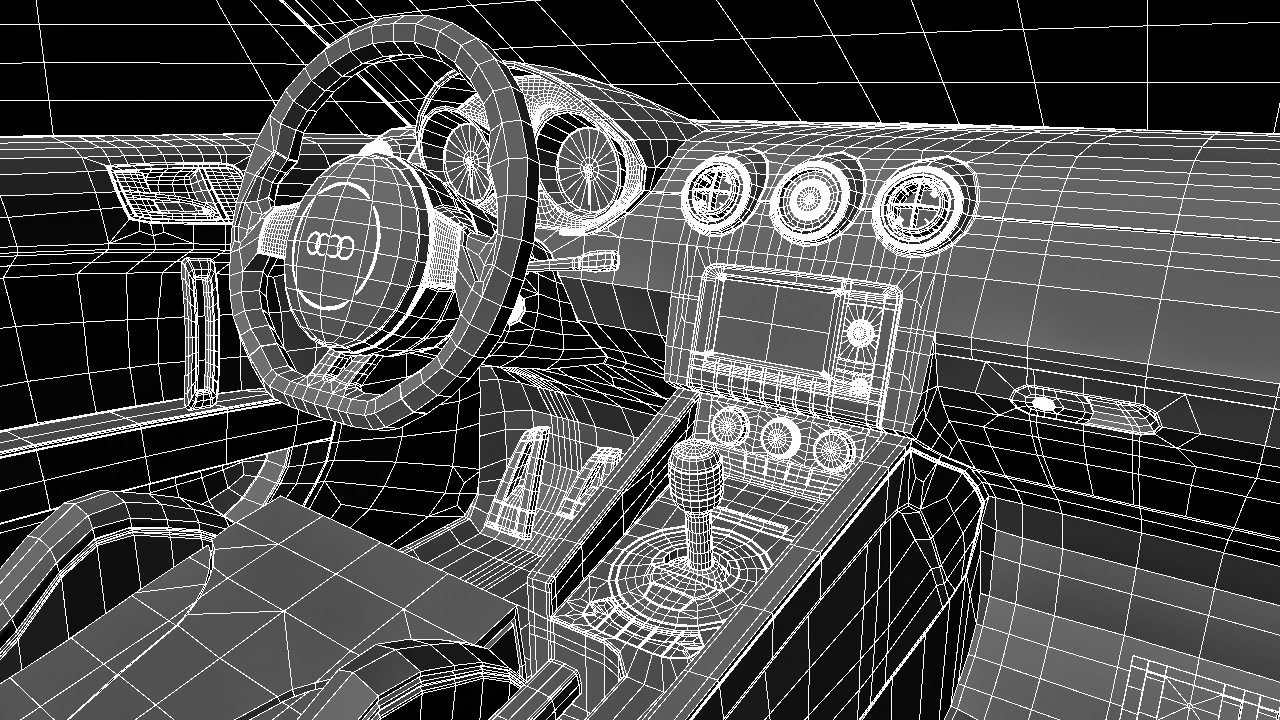
In mathematics geometric contour lines are often used to visually describe complex three-dimensional forms, such as rotating surfaces. See above. This type of geometric thinking having a history that goes back to the Renaissance and Uccello’s wonderful drawing of a vase.

Uccello
Present day computer realisations that use wire frame modelling continue this long tradition.
You can find examples of cross contour lines in the work of many artists both historical and contemporary.
Durer

In this drawing of a man’s head by Durer, you can see a particularly subtle use of lines following the surface of the skull. Lines are drawn in white as well as black, this allows the artist to suggest two things at once. A line can follow the direction of the surface, thus indicating the physical mass or ‘haptic’ nature of the subject and at the same time can indicate the way light plays over the form. This allows the artist to place the subject in a convincing space. Mass and space are therefore synergistically combined in this sort of drawing.

Victor Newsome’s drawing ‘four views of a figure’ uses cross contour lines within a very technical approach. His figures look like they have emerged from an engineering drawing, suggesting that as humans we are at the end of the day simply living machines.  This woman in a bath is one of a series of drawings that Newsome made, the study of a head (below) gives a clear idea of how he used perspective contour lines to simplify form. (He is also another former ex-student of LCA) 

Victor Newsome

Victor Newsome

The study of ears by Newsome above is currently on display in the Ferens Art Gallery in Hull. 

I've used cross contour drawing myself many times and usually to give weight to an idea. For instance this idea of a head like form with a hole through it would not be convincing if it hadn't been drawn using a method that gave it formal weight.

Hole in the head
Hans Bellmer

Hans Bellmer's, Bastille Corset, uses brick-like structures to suggest both the soft shapes  of a corset and the structural presence of a brick wall. Bridget Riley uses the same visual effect to create spatial movement in her early black and white canvases. 

Bridget Riley

Although always spoken about as if being entirely about 'optical' effect, Riley's early work, I would suggest, relies upon a strong awareness of the relationship between touch and sight. In some ways the disorientation you feel in front of her 'Op-art" paintings is a very physical one, that derives from our brain's search for a solid on which to pin the illusion. 

Perhaps the most important issue about cross contour drawing is that it brings together sight and touch. You are drawing as if you are feeling over a surface and it is well known that children need to feel objects in order to begin to picture what they might be, touch reinforcing what is seen. It has therefore been argued that touch comes before sight in our world of organised perceptions. 


As Margaret Atwood wrote: “Touch comes before sight, before speech. It is the first language and the last, and it always tells the truth.”


Atwood points to a key element of meaning, authenticity is vital to our awareness. There is something about 'trust' here. Touch is more 'honest', we believe in it, therefore by working in a way that brings us back to an awareness of touch, we can build a feeling of 'truth' into the image. The solidity we perceive in front of a Henry Moore drawing also means that we 'trust' that these forms are 'authentic', the lines that trace their mass telling us that these images have weight and therefore a certain 'gravity'.


Related Posts 


Solidified drawing: 3D printing