Showing posts with label Communication theory. Show all posts

Monday, 16 March 2026

Drawing on conversations

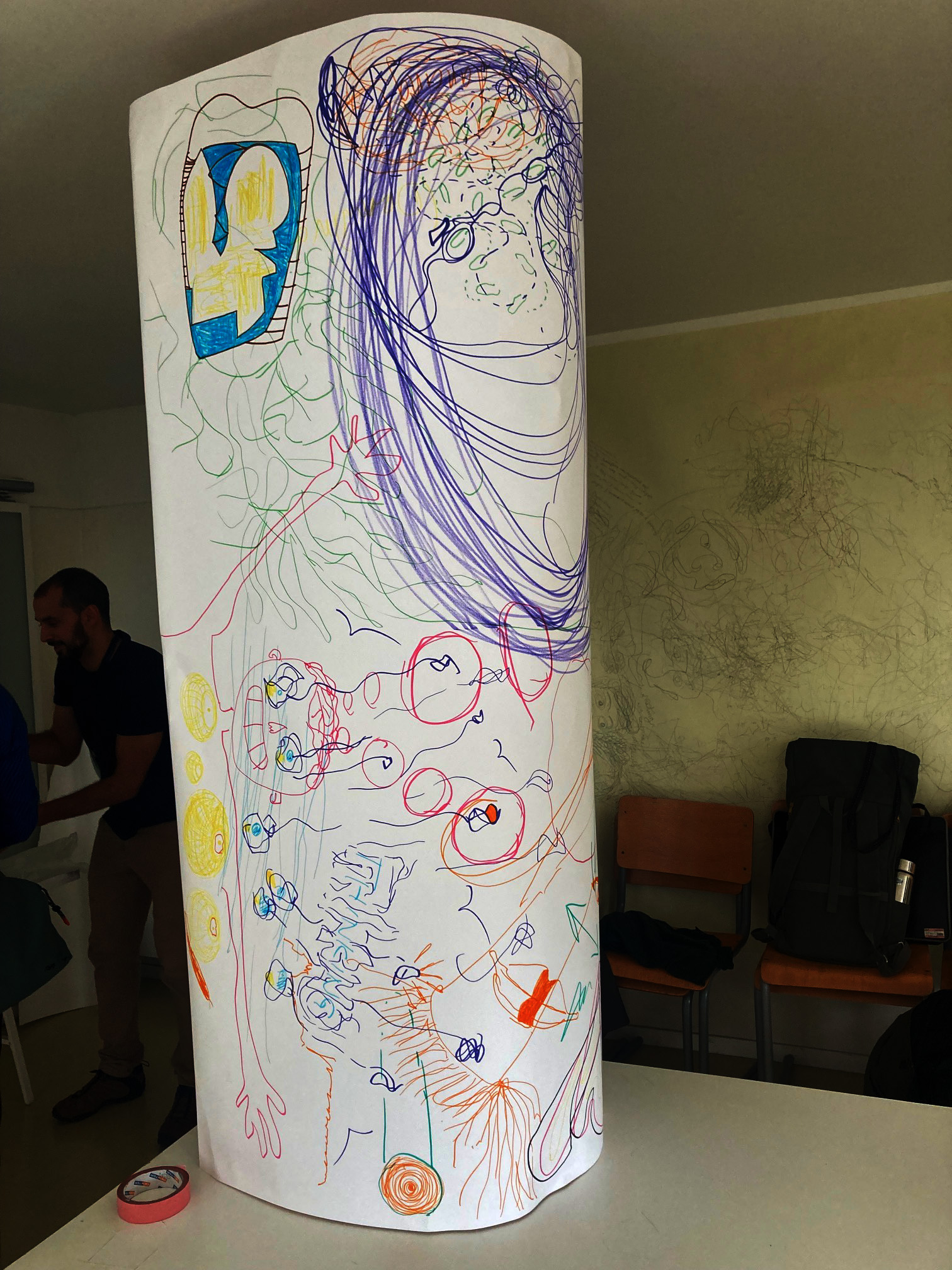
A visual conversation about a pain that felt like an insect or scorpion sting

The images above are from a range of drawings done in response to a conversation with someone about a pain they had, which at one point they described as being similar to being stung by an insect or scorpion. Some of the drawings were done during the time of the conversation, reminders of what had been said. Others were drawn up after the conversation was over and then taken back into a further conversation, whereby the first conversation was reflected upon and the more 'worked up' drawings were shown to the other conversationalist.  This was part of an iterative process, designed to eventually get to a point whereby the other person was able to say, "Yes it felt like that," or "I imagined the situation to look like that". This process is hopefully helping someone see what was initially invisible but felt, it was experienced but the experiencer had as yet no visual shape for it. 

A large part of my practice is devoted to listening to people in conversation. Over the years these conversations have varied, from stories about the terrible journeys people might have made to get to Leeds from often war torn areas of the world, via the drama of world politics, to more recent ones about ageing bodies or the trauma of injury. Sometimes we forget that the glue that ties us all together is made out of the grain of conversations.
Conversations are complex things and although informal, they instigate the interactive exchange of thoughts, ideas and feelings between people. Conversation is vital to the way our species socialises, comes to an agreed understanding and maintains connections between individuals and groups.

Conversations are though not always what we think they are; only part of the content of a conversational exchange derives from the actual words said. The tone of voice can be extremely influential, as can facial expressions, women may understand things differently from men, people of one generation may have a world view totally different to another, someone from another culture may have preconceptions that you don't and many other psychological and physiological factors may interfere with clear communication. Even so, without someone being prepared to listen as carefully as possible and someone else being prepared to try hard to explain themselves or their understanding of a situation, we would never be able to come to any form of coauthored agreement on the nature of our existence.

These blog posts are a type of conversation, but they are very one sided. My views are put down, but nobody is probing them, no questions are asked as to what I mean, (well not immediately, I do get questions by e mail or verbally when I meet people) and whatever I think at the time is frozen in place. If you compare this to a real time conversation you will see a huge difference. When we’re in one to one conversation, our brains literally sync up. This is something called "neural coupling" or "neural entrainment". It is when the electrical impulses in two brains become synchronised. When you talk and another person listens. you gradually find yourselves “on the same wavelength”. This is why a conversation can be transformative. But you have to leave yourself open to what the other person is saying. For instance it can be too easy to dismiss a conflicting belief or to agree with something that fits your opinion. It is in the back and forth of conversation that meaning is made.

There is something called the 'Johari Window' that was proposed by psychologists Joseph Luft and Harrington Ingham in 1955, as a way to visualise conversational and other relationships.

The Johari Window

The Johari Window is a rectangle that has within it four areas representing different aspects of self knowledge or self awareness. The Open Area is where we find the common or shared knowledge about our lives and our feelings about the world. The Blind Spot is where others know things about you and the world you inhabit, but which you don’t yet know about. The Hidden Area, is what is hidden within yourself in terms of knowledge and perspectives known only to you. Your intensions for instance, might be very different to your actions, we all have things we would like to keep private. The Unknown Area, which is what is unknown to both you and others, is the area represented in black in the diagram and in reality it would have to be of a cosmic scale, as we can only know what we experience and we can only experience that tiny, fleeting moment given to us by a conscious life, everything else that has ever existed is unknown to us. Even so, it is within that moment that conversations take place and as they do the open area can grow and become fertile ground for the development of new thought. 

But in conversations with people that you have only just met you need to build some sort of trust, especially if they are going to open up to you in any meaningful way. Therefore you need to listen closely to them, then when they finish talking, it is useful to summarise their side of the conversation. You can then ask questions about what they said, all of which makes it clear to the other person that you are listening carefully to them.

The conversations that form part of my art/research practice are usually drawing led. This means that my summaries of what is being said are quickly drawn sketches. These sketches form a kernel around which a particular understanding will grow, one that I might in some ways know more about than the other person, simply because drawing is my language of choice. However we both engage with the process of critiquing what is being drawn. The part of the conversation that is centred on, "it's more like this drawing than that one", or "this line should be darker or thinner", being where an exchange takes place that gradually builds an image in my head and in the head of the person telling me a story about themselves. Hopefully this image is new to both of us, it is something discovered through the conversational process. For myself, this helps me in terms of my own validation of a working practice, as it reinforces my belief in the importance of interactive exchanges with others in order to develop ideas. It places socialisation at the centre of my practice and most importantly I have to develop an agreed understanding of a visual language, something which I feel is often lacking when I see artwork placed within a context where non-art trained people have to encounter it. 

Even so when I show the work done outside of the conversation from which it emerged, other people who were not party to the conversation, often find it a challenge to understand what is being communicated. I have had to accept that there is no such thing as a universal language and that instead I now believe that languages are constantly evolved by some sort of social interaction, always being re-negotiated and changed in response to new experiences. 

In order to get a better theoretical grasp of what it is to develop ideas and knowledge through conversations, I have looked at the work of Gordon Pask. His  major contribution to communication research was the development of Conversation Theory.  This grew out of his work with cybernetics and his analysis of the dynamic process whereby both people and machines learn about each other. He first came to my notice because of the 1968 exhibition Cybernetic Serendipity which included his robotic courtship model, whereby biomorphic shapes moved in relation to each other, responding to a program that the audience could interact with.  


Gordon Pask: Display for Cybernetic Serendipity 


Pask believed that the more we learn about how we learn from interactions with others, the more tolerant we would become and society would be a much better thing. If only listening and sharing had become the norm, instead the role models we now have are much more about bullying and getting your own way and his early computer learning models have fostered an AI that seems to be linked to the worst of human nature, rather than Pask's idea that learning should always be beneficial and generative.  Even so it might be useful to go through Pask's major ideas and see how useful they might me, especially when it comes to evaluating a practice like my own, that relies on conversation as a methodology. 


Gordon Pask's model of conversation in the form of a diagram


The five major elements of conversation in the diagram above are:

  • Context: when and where it happens: the conversational content must suit the situation and be something agreed or at least accessed by both participants. 
  • Language: people's interests are related to their sub-group pre-occupations, such as particular words that only those involved in that sub-group would know. Language is not just about understanding English or Chinese, it’s also about tone and intention and having shared values, as well as a recognition that in my case drawing is a language too; all of which need to be dealt with in a conversation if we are to continue to…
  • Exchange: the back-and-forth of messages that we usually think of as conversation
  • Agreement: what we understand from each other and believe together, even if we agree to disagree about everything, at least we have understood that we have different points of view.
  • Transaction or action: what happens afterward as a direct result of the conversation.
In an earlier post on communication theory I pointed out that the central weakness of a transmission theory of communication is that it is not concerned with the production of meaning itself, which is a socially mediated process. This is why there are several constitutive theories, because meaning production is complicated. In particular how can we say something novel or different to one another? We need the capacity for new messages to be generated and the resultant understanding confirmed or denied. The best method I know that can deal with this is 'conversation'. In conversation we can learn new concepts, share and evolve knowledge, and confirm agreement. Diagrams can both be used to describe how this works and to reinforce the idea that drawing is a language.

Conversation for Agreement
As a result of conversation, two people believe that they agree.

Gordon Pask would suggest that conversation as a process is a bit like this:
Step one: Open a channel. When one person sends an initial message, the possibility for conversation opens. For conversation to follow, the message must establish common ground; it must be comprehensible to the other participant.

Step two: Commit to engage. The other participant must pay attention to the message and then commit to engaging with the the person that initiated the conversation. Such a commitment may amount to nothing more than continuing to pay attention. For conversation to persist, the commitment must be symmetrical and move back and forth and there must be the possibility for either side to break off from the conversation for any reason, at any time.

Step three: Construct meaning. Conversation enables the conversationists to construct meaning, including meaning that is new to one or other of the participants. This 'meaning' will though come out of a shared context, so will be to some extent socially determined. I.e. The person that opens the conversation uses it to convey what the topic of discussion is; the technical term is 'descriptive dynamics', they will often try to explain how the topic might be used to understand a new concept, (prescriptive dynamics or "what should we do next?"). The other conversationalist “takes all this in” and “puts it all together” in an attempt to reproduce the other person's meaning. In most conversations it is presumed that there is some sort of sharing, a common language is often developed, but some work is often needed for this to happen. Think of two people carrying a heavy weight, as one person shifts their grip the other person responds, until between them they have a better grip on the situation. The moving of the weight is in effect what the two of them share and without this sharing the weight would be dropped. This is the inherent coherence at the centre of the conversation concept, one that allows myself to introduce drawing as part of a conversation; it helps me 'shift my grip' and as I do so, the other person has to 'shift their grip' in order not to drop the weight. As our human nervous system has evolved especially to make sense of the messages that arrive, “meaning making”, the taking in of what both yourself and the other person are saying and putting it all together, is the most natural thing to happen.

Step four: Converge on agreement. One participant may wish to confirm their understanding of the other's ideas. To do so, they might create a different formulation of the topic(s) under discussion, to see if it holds water when reformulated. The other person then attempts to make sense of this new formulation and compares it with their original. This is an iterative process that often leads to further exchanges. When both judge that the concepts match sufficiently, they have reached “an agreement over an understanding.” It is at this point that hopefully in my work where I hold drawing conversations with people, that we stop for a while and I take the drawings done away and try to refine them, before bringing them back and resuming the conversation.

Step five: Evolve or stay. After the interaction of conversation, either one or both people may hold new beliefs, make decisions they would not have made before or develop new ways of thinking about relationships, with other things, people or themselves. On the other hand it is always possible that both people's mindsets will remain as they were.

Step six: Act or Transact. Sometimes one or both of the participants agree to perform an action as a result of the conversation that has taken place. For example, in my case I may agree to develop a series of images in response to the conversation and bring the results back in a week's time. The other person may agree to think about their situation in a new way as a result of our conversation, especially as we would have spent quite some time reflecting on their interoceptual experiences and trying to devise a language to describe them.

Conversation to Learn
Conversation is a means to convey concepts and confirm agreement.
A conversation changes one of the participants. That participant has “learned” something

In my work in the hospital it is critical to consider what can’t be talked about. Conversations may be limited in fundamental ways. For instance the conversational infrastructure may prevent certain things being talked about. If asked, “How well does the infrastructure support the conversational connection?”, I would have to respond with a few reservations. For instance a hospital ward is not private and there are constant intrusions by others wanting access to the patient. Therefore patients find it hard to be totally open about their experiences. I am also a new person in their lives so it is natural for patients to have certain reservations about opening out to myself, especially in relation to private matters.
The situation is potentially loaded with emotional dilemmas. I leave it to the clinical consultant to make the initial contact with a patient, trusting that they will only select people for the experience, that the consultant feels are emotionally robust enough to take part in conversations designed to get them to face their current situation, that of being in a spinal injury ward. Even so, I have to reflect carefully on how far to go in relation to descriptions of people's injuries, so that I don't trigger emotionally negative responses. Just as importantly the conversational participants will have different capacities for responding to the type of conversations I initiate. Each individual will contribute what they know in their own style of interaction and it can take me a while to recognise this. Even after all these considerations some drawing led conversations may go nowhere, whilst other conversations create their own energy and are generative, leading to new and unexpected knowledge but at the beginning of these conversations I never know which ones will be productive.


Conversation to Collaborate: Agreeing on goals and coordinating actions to achieve them

If the conversation is to work, it has to offer something for both participants. As a conversation develops the ongoing exchange has to identify the potential benefits in continuing the engagement. There ought to be some learning or interest stimulated, or at least some sort of delight in the situation, such as the positive experience of someone actually being prepared to listen to your story.

In this very one sided conversation I suppose it's now time to see if I can convince the reader that there is more to it than a simple break down and exploration of the stages that make up conversations and how they help in the production of meaning.

Tim Ingold has pointed to the fact that all we are is an intermingling. We are part of an ever forming universe where everything is enfolded into everything else. He argues that we live in a ‘con-crescent’ world. (Concrescent: in biology, a growing together of initially separate parts or organs). In response to this situation he further argues that when seeking the truth a conversation will be everything, not just between people but between all the possible things that you might be able to connect with. The process he states is fundamentally democratic and is concerned with conjoint actions; bodies in correspondence being engaged in democratic conversations forming communities of open-endedness. He finally argues that ‘Commoning’ or the joining with others will be the key drivers behind sustainability. The holding of conversations 
being not just about how we develop empathy for other people and learn from them, we need to develop conversations with plants, other animals, minerals, electrons, quarks and energy forces, if we are to overcome the hubris of thinking that we have any form of separation from or dominance over nature. In her book, 'Finding the Mother Tree', Suzanne Simard establishes that trees not only 'talk' to but co-operate with mycorrhizal fungi and that they are central to an interconnected eco system that at one time always included human beings. She reminds us that the indigenous humans understood this and that the Secwepemc, the first nation people who inhabit the interior of British Columbia in Canada, have a word Kw̓seltktnéws (pronounced kw-selt-kt-news), a fundamental principle that translates to "we are all related", a worldview that acknowledges that all people, animals, plants, water and soil are interconnected, requiring stewardship, respect, and reciprocity. 

I am I know repeating myself when I write about these ideas but perhaps that's a good thing, the art of rhetoric suggesting that repetition is very useful if you want to convince your audience that you strongly believe in the message you are trying to deliver. 

References:

Pask, G. (1976) Conversation Theory: Applications in Education and Epistemology London: Elsevier Science Ltd

Simard, S. (2021) Finding the mother tree: Uncovering the wisdom and intelligence of the forest London: Penguin

See also:

Drawing conversations
Drawing and communication theory
Is drawing a language?
Is drawing a language? Part 2
Is drawing a language? Part 3
Is drawing a language? Part 4
Tim Ingold democratic conversations

Saturday, 26 October 2024

Drawing across disciplines: Day 3

Day three began again with parallel sessions, I attended the four sessions presented under the umbrella of HYBRID KNOWING SPACES BETWEEN ART & SCIENCE. 

1. Felicity Clear: Drawing the atmosphere

Felicity Clear was based in Ireland and had been studying tides, winds and other elements that go towards our understanding of weather. The interrelationship between all these elements was very fluid and there were particular visual rhythms that could be discovered to underpin these relationships. In order to further her interest in this area she had signed up for scientific courses on the weather and weather systems. We were introduced to the Coriolis effect, a force that causes the deflection of circulating air due to the Earth's rotation. This major factor in weather patterns, controls the direction of winds and causes them to deflect to the right in the Northern Hemisphere and to the left in the Southern Hemisphere.

The Coriolis effect

She had become fascinated by the various ways that weather could be visualised. One particular archive she had been looking at, held the beautiful watercolour images drawn up by a French meteorologist/artist, of clouds, which were produced during the time of the first world war. Weather forecasting was at the time vital to the prediction of how poison gas would disperse, or of how troops could move. Wind direction and its speed, as well as knowing whether or not rain was due, would influence strategic command decisions as to future actions. This was also the case in relation to the British army.  I by chance also found a wonderful weather resource that could be used here. The resources Felicity was uncovering, combined observational visualisation techniques with data visualisation, in effect fusing art and science into one discipline. 


She had even constructed her own weather observation station, in order to look at how the measurements could be both collected and visualised. 

I was very taken by a simple way to measure degrees along a horizon line. You simply use your extended arm's clenched fist as a sextant, and you can use it to measure the height of the moon, star, or planet above the horizon. A clenched fist, when held at yours arm's full extension will roughly measure off 10-degrees; you can therefore use your fist to make a reasonable guesstimate of degrees either horizontally or vertically.

All the various ways to visualise weather data rely on the concept that you need to simplify a complex phenomena, in order to be able to measure it. Which is interesting, in that it presupposes that in the process of simplification, there are no important changes. In fact approaches to measurement can be read as a media specificity issue, because as you measure you are actually shaping what is being measured. Felicity then pointed out that the interesting issue here was that art could be used to render visible that which was not normally visible. This phrase had now been used several times by various speakers, including myself when I introduced the purpose of my workshop and I wondered if as we began to sum up what we had discovered during the conference, whether this aspect of drawing, as a tool for revealing the invisible forces that surround us, would be foregrounded. 

She then went on to show how her own work used this type of data and its representation. 

Wind speed and direction data on a stick plot

For instance she had used charcoal to plot wind speed and direction using a stick plot, similar to the one above. The charcoal of course adding a soft sensibility as it was worked, something that begins to change the plotting into something that reflects the hand in action, rather than a machine measuring data. Long lengths of tracing paper had been drawn on to visualise certain flows of weather movement and these drawings were then hung in a space that had air movements that made the drawings slightly quiver whilst they were being exhibited. 

Felicity Clear: Exhibition view

In another exhibition elastic tape was used to extend drawings out into the space within which they were being exhibited, so that the work began to move between diagrammatic form and 3D installations. She began adding imaginary marks to drawings that also included observational data, fusing the two ways of being into one totality. Folding, flow and contour were now all becoming central to the way she was thinking about moving the work forward, the imaginary and the measured were now fused together in one understanding, something that seemed to echo what had happened in the world of quantum mechanics, whereby it was well understood that observation itself could affect results. The old divide between scientific objectivity and artistic subjectivity being something that drawing seems to be able to step right across. What had begun as a movement towards a more scientific way of thinking about visualising the weather, was now moving into a poetic phase. 

2. Lúcia Antunes: Scientific illustration: A learning journey through drawing 


Lúcia Antunes: Scientific illustrations of a bat

Lúcia is a scientific illustrator and communication designer and this fusion of professions was vital. Her work could not exist without the full collaboration of scientists and other specialists and she described it as, 'the visual representation of science' and that she was always concerned with helping to explain.  It was pointed out that Pedro Salgado had raised the profile of scientific illustration in Portugal and that he, like all other important scientific illustrators was involved in establishing the conventions of visual communication within the discipline. These were needed in order to maintain a uniformity of presentation and a mutual understanding. For instance the orientation of subjects or way to display anatomical parts are often standardised, or the use of an outline for clarification purposes even though there isn’t a line around an actual subject, or the removal of certain anatomical parts for simplification, or to make the shading of drawings concurrent with an imaginary principal light source placed at the upper left corner. These principles, (some of which I have remembered from when I was having to do some work in a related area), can though from my experience, also become a straightjacket and I was interested to hear that she felt my workshop session had been of value, as it highlighted both the need for focus groups in order to test out communication, and the fact that working together with others can be a way to re-inject visual invention into the process. 
This did raise an issue for me in terms of ownership of copyright. If an image is truly a joint development, who owns the copyright, should it be a joint ownership, or because the artist would have the final say over how the image would look, should it always be the artist? I well remember my time working as an illustrator and the client would often make sure the copyright stayed with them, even though what I finally produced for them was an original piece of visual thinking. The client's argument was both that they were paying for my work and that I was working to illustrate their concept. 
Lúcia pointed to the need for continuous testing to allow for dialogue between all parties, as well as the need to observe and not merely see. 
She produced both illustration and design work, which was for her a continuous or seamless strategy, as it allowed for knowledge exchange to lie at the centre of her practice. She was involved with a programme that was centred around literacy in science and health. Again this chimed with the work I had been doing and I thought the images she showed us were excellent examples of communication design as well as of scientific illustration. I was also interested in the fact that she used a far greater graphic freedom when designing book covers or materials for certain pamphlets. This layering of approach in relation to audiences was intriguing, especially as I was beginning to think about how I could work with a medical illustrator. At this point I began thinking about two plant leaves, sitting where the lungs are in the body, thinking that the image could be used as an illustration of how closely linked plants and people are in terms of their genetic code and their respective needs to breathe. 
Lúcia finally reminded us of how the processes involved in visual communication allowed us to pass on knowledge in a structured way, and she asked us a question; how do we search for knowledge using visual communication tools? 
I was left reflecting on the fact that so many of us working in the visual field are siloed. Fine artists rarely working with graphic designers to clarify their ideas, communication designers always working to communicate various clients needs, but rarely being commissioned to use their skills to help other artists. Having worked as an industrial interior designer, illustrator, printmaker, sculptor and as a drawing led fine artist, I am happy to use skills developed in my various areas of previous work, but I think we could all become far more strategic in the way our various visualisation skills could be harnessed and how we could perhaps work more in collaboration. Perhaps if we were simply called visualisation specialists and that we were seen as visual problem solving professionals, then our skills might be appreciated more by other professions. What Lúcia's work demonstrates is that she has the skills to on the one hand clarify for science professionals what they are looking at and at the same time have the skills to develop a communication strategy to enable general principles to be understood by non science audiences. I'm sure she also has the skills to open out the poetic possibilities of the situation as well. 

3. Maria Strecht Almeida: Abel Salazar's explorations of the Golgi area in mammalian cells, or when staining and drawing converge

We were introduced to the work of Abel Salazar, a man who stated, "The one who only knows about Medicine, does not even know about Medicine." Which sort of summed up his approach to the integration of art and science. Stain technology was used by Salazar as a method to help understand both structure and function of cellular life. Maria's presentation was again visually very interesting and my notes are perhaps more visually informative than textually clear. 


The small drawing above from my notebook was an attempt to note down the structure of the Golgi area, it was actually presented as an image more like the one immediately below. 
I was fascinated by this image, which was why I had made a drawn note of it, and have since looked into it again, as it reminded me of Ruyler's diagrams in his book 'The Genesis of Living Forms'. The folding of the Alps was compared with the folding of flat metal sheet, which was in turn compared to the folding of cells during the process of embryogenesis. This appeared to be another example of this process.

Excerpts from my notebook

Salazar used tannin and iron solutions to dye cells, in particular we were shown how he had used the technique to draw the organelle, a sub-cellular structure that has one or more specific jobs to perform in the cell, much like an organ does in the body. Tannin and iron solutions are chemical compositions not unlike oak gall ink, which I have made myself in the past and it also uses iron together with a tannin solution. Tannin and iron can be used together to create a range of colours, from brown to slate to light black, it provides a structure for the iron to bond to. Maria reminded us that artistic colour mixing and scientific staining are parallel worlds, something that I have touched upon myself in the occasional blog post. 

Maria showed us a very neat diagram, (in the image directly above), that showed a circular form divided into 4. It demonstrated a movement from a photographic representation, bottom right to a drawn clarification. As you moved around the circle, the next three images after the photograph, each represented a further layer of clarification, and they were all drawings. The clockwise moving arrow I drew represents a move towards greater and greater abstraction. She talked about the power of images to convince us of reality and that a move away from the image as product (ownership) to the image as process (understanding) was required. 
This presentation reminded me of the gradual development of the media's public image of the corona virus and of how important a sequencing of images was to the understanding of process. 

4. Mariana Sousa: Understanding the inside to draw the outside: The history of artistic anatomy in Lisbon

Mariana explained that there has been a long partnership between the Medical-Surgical School and the Royal Academy of Fine Arts in Lisbon. Students from both schools came together in the Anatomical Theatre of Lisbon for the observation, study, and copying of the human cadaver. From this collaboration arose the University of Lisbon's collection of anatomical drawings, dating from the first half of the 20th century.

An image from the collection

As we looked at anatomical drawings I was reminded that the flow of muscles over bones, was similar in structure to the flow of water over rocks, or air around solid objects. The revealing of the inside of the body is of course sometimes associated with flaying and I couldn't get that image of a flayed man holding his own skin out of my head.

This image wasn't shown

We were reminded of the need for the body to be prepared for dissection and that there was a need for the drawing of the expressive nature of the body as well as its internal structure. (In this case I was reminded of the work of Messerschmidt.) 
There is a painting by Carlos Bonvalot entitled 'The Master' (1914), The painting depicts an Anatomy lesson taught by Professor Henrique de Vilhena, at the Faculty of Medicine of the University of Lisbon. His presence ensured the traditional training in anatomy continued for many years but on his retirement, there was no one to replace him. 

Finally we were left with a sort of question, Mariana stated that there had been a "removal of harmful elements from the collection," and I wanted to know what this meant. Bad drawings? Incorrect drawing? Drawings with pornographic potential? Perhaps a more intriguing question than its possible answer. 

After a coffee break we had a practice sharing session, held in my case under the overarching term, 'Drawing along'. 

Junuka Deshpande: A drawing hangs in the middle


To get to this session we walked down to the 'pink house', a short walk that took us past the huge fallen tree that occupied the space outside of the studios in which we had been working. This tree had been preserved as it had been the tree around which the building we were in had been designed. It was now host to a wonderful variety of fungi and was a spectacular and wonderful thing to have been preserved. 

Junuka's practice had developed out of work she was doing with Indian women and was a project that explored the observation of a crossroad/underpass through drawings. We were told that in India the flyover under which they were working, was a symbol for modernity. The drawings are made from the same place over 30 days. 


A sequence of Junuka's images demonstrating a move towards greater abstraction

The drawings began as very figurative reportage, but gradually they became more abstract as they began to use the materials of the site as elements in the drawings' own making. The drawings made becoming an embodied exercise. We were presented with examples of the drawings made, as well as small piles of earth, samples of rubble, sand etc. The drawings were collected together in format type, ranging from observations to material responses. We were also shown a film, which had a soundtrack composed of sounds recorded from the streets where the work was being done. This was particularly evocative. 

The last section of drawings documented examples of close observations of micro spaces and crevices and it felt as if the drawings needed to finally be placed back into the ground out of which they emerged. As Junuka was also a filmmaker, I thought there was much potential in the moving of the idea on into either a filmed installation, animation or even a more comprehensive film that documented the whole process. 

Junuka's presence was in this case essential to the reception of the work and I would have liked to have seen her 'leading' the idea, perhaps as a talking head, in a film. 


After lunch the keynote session for the day was held. 

Gemma Anderson-Tempini: Interdisciplinary methods:Artistic research and public art

Gemma presented two projects, the first was focused on the representation of biology as process (2017-21) and the second was focused on 'And she built a crooked house', which was a project that I had seen when it was shown in Leeds. 

Mitosis

The first block of research was focused on drawing the processes of life. She was looking at processes such as mitosis, protein folding and embryogenesis. In order to move her practice on from drawing substances to drawing processes she listed associated 'doing' words; tense, grow, align, bundle, burst etc. something that reminded me of Richard Serra's verb list for sculptural production. She needed to extract salient features from complexity. Again working with scientists in collaboration seemed to be very rewarding. 
She would use drawing to be able to ask the scientists in the lab questions. She decided that at one point she was devising a 3D score for mitosis. Working on graph paper helped, as well as folding the flat images out into 3D space. 
A series of drawings that expressed a move from fine granularity to course granularity had worked very well using the fine grid of graph paper. This was expressed in an almost dendritic form, thick lines made by joining graph paper squares, gradually got thinner and could be drawn using the next size down graph paper squares. 
The work was question and process led, but at the same time, allowing different processes to merge and diverge. 
She looked at the life cycle of haemoglobin, and collaborated with 4 scientists, using colour to represent different energy levels. Trying to follow the life of a haemoglobin molecule as it binds and unbinds with oxygen. These drawings were folded into cones and she saw a possibility of linking the forms with dance structures. She was drawing the processes of life. There is an excellent website that documents all of the work.

The crooked house project had evolved in a very different way, but was still related to her interests in visualising scientific thinking. 

She then stated that drawing shows what we know and what we don't know. Now that she had a body of work that proved that she could work in collaboration with scientists, she decided to get more involvement and sent her images to a particular scientist working in the area she was interested in, to see if he was interested in a collaboration. (This was a way of working I hadn't considered before and I began to wonder if I could do something similar)
He was interested and the two of them clicked and they made models together, as they tried to envision types of hyper-spaces, which were made of paper, so that sections could be slotted together. They looked at 'inverse vision'? and the liberation of form through this use of joining papers together. This process eventually brought her to consider knotting as a structural principle. 
She had thought about drawing as a form of proof, for example a 3, 4, 5 triangle must be at right angles, and she had also seen a relationship between pregnancy and string theory. (She has twins and the experience was resulting in some very interesting decisions being made in relation to her practice) The 10 dimensions of string theory got her thinking about models of space. In particular hypercubes. The forth dimension and non linear geometry have long been influences on modern art and one of the implications of looking out from the forth dimension is that you can see the insides of things, as if they are turned 'inside out', in a similar way to how a two dimensional object can be looked at by a three dimensional one. The implications are all played out in Abbott's 'Flatland', but her take on this was also one of a mother birthing twins. 
I had experienced the result of all this thinking as I live in Leeds and had visited the Victorian house in which was located her installation 'And she built a crooked house' twice. Each room unpacked various approaches to her thinking, from a seance being held on the top floor, via a mirror room that made you experience infinite reflections of yourself and piles of dirty washing, to a room for contemplation, whereby you could listen to a discussion on quantum theory, to a shadow room, whereby shadows of 3D hypercubes were projected on the walls. There was also hypercube wall paper and an exhibition of her drawings, whereby she had attempted to visualise the types of spaces she had been researching. 


The house was a wonderful experience and as you entered and left, in the garden you passed a climbing frame built using the principles of construction she had taken from the research. The house was a very excellent example of public art at its best. 

View of the climbing frame

Following the keynote and coffee, were the final workshop sessions. I attended a 'Drawing between' workshop.

Jasminka Letzas: Somatic drawing as boundary object 

This workshop was held around a large sheet of drawing paper, that had been taped onto the top surface of a set of tables, that had been pushed together in the centre of the room. As we entered the room, we were asked to stand next to the table, gradually filling spaces around all four sides, until we stood shoulder to shoulder all the way around it. 
Jasminka then introduced herself and her background working in therapy and began the session by getting us all to relax by scrunching our shoulders up towards our ears and then relaxing, then pulling ourselves up straight and shaking ourselves, making ourselves aware of feet and knees and how we were standing etc. Using a variety of basic exercises to remove the tension of the last three days. Everyone seemed to appreciate this approach, as it had been a very full-on conference, with one event after the other and little time to soak it all up. 
We were then all asked to write a short statement on the paper in front of us that represented what we were going to do next with what we had learnt. I wrote 'Have more conversations'. I was very aware that when I returned to England one of my first meetings was with a nurse and an anatomical illustrator from the Leeds Teaching Hospital and that it would be work that could emerge from this conversation that might indicate my next direction for practice. 
After doing this we responded to our text and had to draw what came into our minds. We were then asked to move around the table. When we stopped we had someone else's drawing in front of us and we were asked to take it a step further, in any way we chose. After doing this a few times the table top became a maze of drawings. 
We were then asked to respond to what we had done and eventually one section of the drawing was rolled and stood on its end, in order to emphasise its objectness.


The session reminded me of how important collaboration is and that as a group we were very supportive of each other. Jasminka's workshop was also a reminder of how important drawing is in the alleviation of stress and as an approach to mental well being. 

We finally reconvened and Paulo asked us all to think about how as a group we could move things forward. I asked if everyone's details could be circulated, perhaps with a  small biography, so that we could be reminded of all the interesting people we had met and be tempted to contact them to develop new initiatives. 

It was announced that on the Saturday there would be a final seminar to help draw out the implications of the conference, but I had to travel back to Leeds. 

We were left with some questions, that would hopefully be addressed during the next day's seminar.

Can the drawing skills acquired within practice-based research in the arts be transferable to other ways of knowledge production?

Can the visualisation strategies of STEM environments be transferable to artistic research as a field in its own right?


What drawing skills are transferable, meaning that we can apply them in different fields and sectors of society?


What is the potential for transferability or transformation of drawing research between STEM and Art and which drawing skills can enhance knowledge, insight, understanding and competencies?


We have skills in observation and visual recording, skills in the visualisation of the invisible, skills in the abstraction of complexity, skills in the communication of emotion and of the representation of objects in space, all of which can be applied to any area of knowledge as tools to both help with communication and to problem solve. I'm sure as a field these skills can be clustered together under the drawing umbrella. I look forward to the next steps to be taken. 

See also:

Day one

Day two

Where stains and traces meet

Stains and blots

Oak gall ink

Embodiment 

Drawing dialogue symposium

Tuesday, 8 June 2021

Graffiti and the Colston statue

The Statue Of Edward Colston

The statue as displayed in the current exhibition

On the 7th of June 2020 John Cassidy's statue of Edward Colston, a 17th century slave trader, was pulled down by an angry crowd and thrown into the river. The statue had already been graffitied in earlier attempts to respond to its implications, and when it was fished out of the water the damaged statue became a problem for the city. Should it be put back or not? The statue has just been put on display, but this time as part of an exhibition designed to ask questions as to its role and whether or not it should ever be re-erected. The exhibition however has come in for criticism from the right-wing media for the way the statue is presented, lying down on its back and still covered in the graffiti that had been daubed on it. 

I have looked at graffiti as a street language in an earlier post and we could have no better illustration of the division between low and high class values as in the relationship between the visual language of the statue; cast bronze and an idealised three dimensional realism, and the visual language of the graffiti; spray paint, pooling colour that collects in indentations and the traces of hand gestures rather than any attempt at representation. Colston was initially celebrated in bronze and set up on a plinth above his fellow citizens because of his philanthropy. The received narrative is that he was elevated to this position because he devoted his later life to good deeds within the city of Bristol. Elevated is a good word to use in relation to a statue like this, the bronze itself is 8ft 8 inches high and the plinth is 10ft 6 inches high, the head of Colston therefore looks down from a commanding height of over 18 feet above the ground. Around the sides of the plinth are two scenes from Colston's life and a third image of a maritime fantasy. A plaque on the south face bears the words "Erected by citizens of Bristol as a memorial of one of the most virtuous and wise sons of their city AD 1895" 

Most of the spray paint was applied to the statue before it was toppled, therefore someone must have climbed up to it in order to do this. This physical act is itself a sign of challenge, the plinth is meant to keep people at a distance, a distance that was overcome by the act of climbing. The toppling signifies the taking of resistance to what the statue represents one step further. The graffiti preparing the crowd for action, the statue already defaced, its presence reduced by the act of marking it, therefore its power was compromised and it was in effect already brought down to earth by being touched by the language of the streets. 

Colston's prestige in Bristol was not what we think it was, or have been encouraged to believe. The notion that the erection of the statue in 1895 was undertaken because of popular support for his philanthropy is hard to sustain. The £1,000 that was needed to pay for it was very hard to come by, the final amount only reached after the statue had been unveiled. The original proponent of the statue J. Arrowsmith, eventually covered the cost. Arrowsmith belonged to a group of Bristol businessmen for whom Colston represented an idea of respectability and self-made wealth.  He also represented an idea of rich paternalism which could be looked to as a bastion against the rise of socialism and private charities. The slavery on which his fortune was built was obscured for the purposes of creating a certain heroic narrative of Bristol's history and as a smokescreen behind which could be hidden the inequality that meant that Bristol, like so many cities in England at that time, was sharply divided between the haves and the have nots. 

I have been looking at the continuing importance of ritual recently and the ritual commemoration, celebration and memorialisation of Edward Colston was crucial in the communication of a 19th century concept of Colston that legitimised capitalist individualism, both morally and economically, as a political system. Colston was also used as a symbol for the right of limited but sustained private relief organised and distributed by those considered the city’s moral and economic leaders, thus cementing the authority of the rich to not only determine who had money and who didn't but that the rich were in some way given almost divine status as 'benefactors' of their poor brethren. It was around this constructed symbol that the rich merchants at the time then constructed rituals similar to those we see in the masonic tradition, rituals designed to re-affirm their powerful position within the city. The ability to depict Colston as both ‘merchant prince’ and ‘moral saint’ was thus central to the perpetuation of 19th century capitalist ideals. If you want to read the details research the work of the Bristol Radical History Group.

So we have agendas within agendas. Many of the people protesting against the toppling of the statue stated that Bristol needs to retain its history and that times and therefore values change, but no one as far as I can remember, stated that the statue was erected to serve a particular purpose, in that it was designed to become the centre piece around which certain rituals could be developed and enacted, rituals that gave 'divine' authority to a group of rich white merchants and that the statue was a political construct erected long after the actual events of Colston's life and not a celebration of Colston's philanthropy by the common people of Bristol. The problem is that history is something we can all mine in order to support our own agendas. 

It has also been quickly forgotten that soon after the toppling the artist Marc Quinn had erected a sculpture of activist Jen Reid to take the place of the slave trader's statue. Quinn had his statue secretly installed overnight on the plinth, an action that quite rightly drew the ire of virtually every political spectrum out there. Quinn had forgotten that the issue was all about power and who has the right to exercise it. By taking it upon himself to make a decision as to what sort of representation should stand on the plinth, he was exercising his own power as a well known artist, and as he is white, middle class and male, he was seen as providing yet another example of those with power, taking their power for granted. Quinn's action was paradoxically in many ways reminiscent of Arrowsmith's. Both men wanting to have statues erected that celebrated their own status, both men looking for a subject that could be read in terms that would by association celebrate themselves and their own agendas. 

The exhibition of the rescued statue can only be attended if you book a timed visit with the museum. These sessions have it appears been block booked by those that want Colston's stature resurrected where it was before. They don't like the idea of the re-presentation and intend to stop anyone else experiencing it; so much for letting the people of Bristol access their own history. Instead of standing over 18 feet high, Colston is made to lie horizontally in such a way that people can get up close and examine the statue and its graffiti. The most powerful visual signifier being the red paint that covers the statue's face, which felt to myself as if the blood of the dead had come back to haunt him. So who's history are we to celebrate? Colston's, Arrowsmith's, the unknown graffiti artist's, the people of Bristol? The conservators have reported that the statue is structurally damaged, so it would require extensive repairs if it was to be returned to its plinth. 

There is though another issue for us to consider, and that is how powerful body metaphors are. By simply taking something that was standing up and not just standing up but standing proud and re-presenting it in a lying or horizontal position the meaning has changed completely. At various times this blog has asked its readers to rethink how work is presented and it has also argued that a re-presentation can be more meaningful than the work itself. The arguments surrounding the Colston statue illustrate the point really well, we feel as if the fall of the statue and its post-fall recumbent position embodies a deep truth, that of an active youth being overtaken by old age and then death. That is the deep metaphor behind it all. One set of values are now becoming redundant and different values are taking their place. This is of course unsettling, especially if you see yourself as belonging to a group of people that still cling on to those old values. 

Read from left to right a horizontal line rises and becomes a vertical line. This basic element of visual language is related directly to our own experience. We lie down horizontally when tired or ill, we rise and stand up straight when awake and feeling confident and healthy. If we are lying down for a long time without ever attempting to raise ourselves up, it may well be that we are dead. 

Communication theory suggests that we examine who communicates what to whom, in what channel and with what effect? When undertaking any form of analysis it is also suggested that you compare and contrast a similar situation that is different enough to allow you to illustrate salient points. So I have decided to look at how John Cassidy's Colston's statue of 1895 and Duchamp's 'Fountain' from 1917 have both been used to communicate ideas. 

These objects were put on display only 22 years apart, but one was in Bristol and the other in New York. Both objects were cast, one in ceramic and the other in bronze, both objects were intended to make a point and both objects have been subjected to considerable changes in their perception over the years since their making. 

John Cassidy's work was commissioned by a group of the great and the good of Bristol, this commission was part of a long term falsification of Colston's life, which included spiritual transformations and miracles such as rumours that samples of Colston’s hair and nails had been secretly conserved and were worshipped by the Society of Merchant Venturers in the Merchant's Hall, like medieval religious relics, and the ‘miracle’ of the Dolphin that saved one of Colston’s ships in a storm by plugging a hole in the hull with it’s body. The unpalatable aspects of Colston’s history, such as his leading role as an organiser and profiteer in the slave trade and his religious and political bigotry, were ignored and whitewashed away. 

Duchamp's work is similarly surrounded by stories of falsification and begins its journey at the behest of a committee. The Society of Independent Artists was based on the Parisian Salon des Indépendants and Duchamp was a founding member. All submitted work to the society's exhibition was to be accepted and Duchamp tells a story that he submitted 'Fountain', a urinal signed R. Mutt as a test to see whether or not the rules were being adhered to. However there is another story. Glynn Thompson argues that all the evidence suggests that the urinal was the work of Baroness Elsa von Freytag-Loringhoven. The urinal it is argued by Thompson and Spalding is in fact the world’s first great feminist, anti-war work of art. The art world has persistently refused to acknowledge this, especially because so many ideas and concepts that are central to the idea of contemporary art practice are focused on a post-Duchampian narrative. 

Duchamp 'Fountain'

Both works are externalised ideas, examples of the extended mind concept. Their physicality allows us to think about ideas in ways that allow for their appropriation through ritualisation. The statue of Colstan was used by Arrowsmith and other members of Bristol's civic and business elite as a symbol of civic pride, in particular a pride in business and individual achievement and in paying for the erection of a sculpture, it also demonstrated their good taste and the passing of that taste onto the people of Bristol. The fact that it is Andre Breton that begins to develop a new narrative for 'Fountain' in the 1930s shouldn't be forgotten. Breton was a member of another elite, the European art intelligencia and his idea that 'Fountain' was one of the earliest examples of a found object, fitted in neatly to his other ideas about mundane, mass-produced objects developing new resonances when arranged in unprecedented configurations. The surreal object is a very close relative to the found object. Both suggest that meaning is something that is very tenuous and that what was once an object anchored to a particular use value, such as being something to urinate into, can by changing its context become a nightmarish vision emerging from the subconscious mind or a piece of sculpture. The object in this case representing the clever ideas of a certain group of intellectuals who were seeking to validate their own positions within a newly developed art world. 

In the same way that Colstan's role as a slave trader was forgotten, Baroness Elsa von Freytag-Loringhoven's role was forgotten too, women were not yet ready to be taken seriously as artists by the art world.

Baroness Elsa von Freytag-Loringhoven

The effect of both works was to establish a myth. One myth was the benevolence of a businessman who was a great benefactor to his city, the other a myth about art and its ideas and that the artist's 'choice' was central to art practice. Both in their own ways celebrate myths of male individuality, the idea of the lone genius entrepreneur being as applicable to businessmen as to artists.  

So once again we come back to power. People trying to maintain it, people trying to deny others the right to have it and people trying to establish their credentials as holders of power and their rights to then take actions dependent on the power they have. 

The pulling down and dunking of Colstan's statue is perhaps not that dissimilar to the 'outing' of the provenance of 'Fountain', both acts signifying a shift in dominant discourses. 

I have tried to write this entire post without mentioning 'Black Lives Matter'. Of course this is central to the argument that there needs to be a shift in dominant discourses. It is difficult to accept that a man who made his money by being a slave trader is put on a pedestal in a city that also hosts a large population of Afro-Caribbean people for whom slavery and its bleak and terrible history is central to their personal history and identity. However I have tried to work around the edges of the issue, not as if it is the elephant in the room, but in order to explore how ritualised activities can embed themselves into all our lives and especially how these rituals need objects around which to focus and develop stories. Sometimes we need to focus on the mechanisms of communication, and as we do, we find that the content of the communication begins to reassert itself. It is finally up to us as artists to make decisions as to how we use this awareness. 

A new ritual begins