Showing posts with label Performance. Show all posts

Friday, 8 December 2017

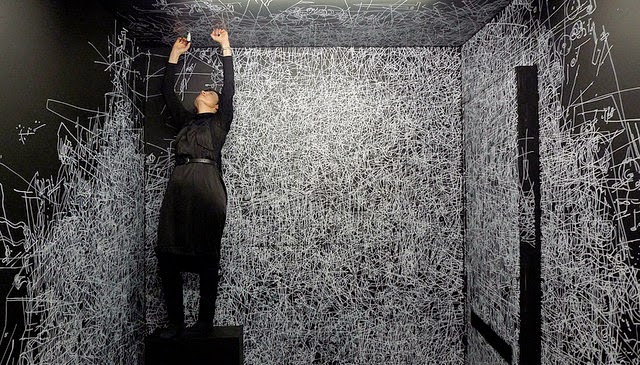
Performance drawing


Kate Groobey: Pants Down

Kate Groobey's performances where she acts as if she is an element within her own paintings, reminded me of how important performance is when making a drawing or painting. The animated video 'Pants down' being a sort of half way house between one of her paintings and one of her performances, the crude moving elements within the painting, easily produced by attaching painted cardboard cut-outs to the body and simply beginning to move them around and then stop motion filming them. She obviously also took a few stop motion shots as the paint was applied and animated them too. You could argue that she is the imp that threatens to pull the rug from under William Kentridge's more serious approach to fine art animation. Although on the one hand there is a certain crudity in her approach, I feel this is actually a very sophisticated tongue in cheek response to the heavily theorised and very male dominated idea of 'proper' painting.

William Kentridge on his animation technique

Jackson Pollock was called an Action Painter by Harold Rosenberg because according to Rosenberg the canvas was "an arena in which to act". Hans Namuth's film of Pollock at work, cements in my mind the idea of the artist in action as being what this type of work is all about. In particular as Namuth's film develops we see Pollock through a glass sheet that he begins to paint upon. As he applies the paint he is first of all seen as an integral part of the developing image, but he is then gradually 'painted out' of the picture as the skeins of dripped paint develop across the glass surface. In the early part of the film there are some images of Pollock's shadow painting, partly reminiscent of the shadow on the wall in the film 'Nosferatu' that I referred to in a recent post on the emotive use of tone. The artist in action and the marks made by the artist as a consequence of these actions become entwined together, the film becoming the vehicle that holds all the elements together. In many ways Namuth's film supplants Pollock's paintings in the mind of audiences, the images of him at work, now an integral part of the work's reception.
If we now revisit Kate Groobey's practice, we can see a direct lineage between Namuth's film and the films Groobey makes of herself embedded within her paintings. She is making work far removed from the Abstract Expressionists' very macho vibe, being able to use humour and a way of working that directly deflates the sometimes overbearing pantheon of painting.  Her feet sticking out from the bottom of the image below, tell us all we need to know about where she literally is in this work. 
Kate Groobey

Caroline Denervaud's performative drawings, are much more formal in their construction. It is as if she allows her body to be controlled by the drawing. She holds poses that seem to echo the shapes and forms required by the emerging image, her body becoming an aesthetic fit, as she responds to the demands of the drawing.


Caroline Denervaud
In an earlier post I introduced the performative work of Joan Jonas and in her case she develops more of a narrative interest as she constructs her performances.
Joan Jonas
In all of these cases the artist and the materials used become entangled in a complex work that sees the boundaries between art object and artist dissolve.

I was recently at one of Greg Burgoyne's drawing performances. He tends to use the elements we might find in the studio or even the stationary cupboard as the things he works with. Often developing a relationship with the material that suggests that he finds it hard to be in control. This is for me the most interesting aspect of the performances I've seen of his. I can engage with his struggle to smooth out paper, or the impossibility of controlling sticky tape when sticking it to your shoes as you walk. The ripping sound as his feet pull the tape from the roll, making an ever anxious soundtrack to what seems like a pointless act, or the sound of paper being torn and crumpled as it is pushed against a wall. He develops a very emotional relationship with his materials, they appear to have as much agency as he does in a performance and this is an issue I think is going to become more and more important.
So many performances have historically been about control and we now live in a different world, one with more awareness of how badly we have treated both each other as human beings and the world itself.

If you go back to the 1960s and look at performances such as Bruce Nauman's 'Walking in an Exaggerated Manner Around the Perimeter of a Square' you have the sense that the artist was fully in control. 
Bruce Nauman's 'Walking in an Exaggerated Manner Around the Perimeter of a Square'

Anastasia Faiella

If you look at an artist such as Anastasia Faiella, you feel she is demonstrating how much she is in control of her body. This might be very hard to do, like an Olympic athlete if you train hard you can master all the elements of your process. However when you get to my age you are more circumspect. I am very aware that my body doesn't do the things it used to do, that it is getting worn out, so I begin to be more sympathetic to the agency of other things in the world. I value good shoes that support my feet and ankles when I walk, I appreciate the role other things play in my life, regarding the things I now do as being more like a slow dance with constantly changing partners.  


Gilbert and George: 1970

Gilbert and George were probably the first English based artists that I was exposed to who had performance at the heart of their practice. I remember going to see their large scale drawings of themselves in a very English landscape in the early 70s, in if I remember correctly, the Hayward Gallery and the 23 charcoal-on-paper 'sculptures' that make up what they now call 'The General Jungle or Carrying on Sculpting', were back on display recently at the Lévy Gorvy gallery, a timely reminder of the first time for myself when drawing, sculpture and performance seemed to have no barriers between each other. In this particular case the drawings, (all made on lots of sheets of paper joined together), seemed to provide an arena within which G&G could act, their other work being seen on TV monitors within the same gallery spaces. Originally titled THE NATURE OF OUR LOOKING this was one of several pieces with a pastoral setting, their ideas at the time all being related to what it was to be English and in this case they were looking at an English love of idyllic rural imagery, ‘Here in the country’s heart where the grass is green’ words by the Victorian poet Norman Gale, are quoted within the sculpture/drawings. The fact that much of their work has been about the myths of Englishness, perhaps being because one of them is English and the other Italian. 
Gordons makes us drunk
The video 'Gordons makes us drunk' being a classic performance piece from this time and one that opened doors to a very powerful way of developing metaphor. Gin being seen within the English imagination as on the one hand a Hogarthian evil, as in prints such as 'Gin Lane' and on the other hand as a symbol for colonialism, the image of the English having their G&T served by a native servant being central to a certain idea of a colonial past. Gilbert and George by getting drunk on Gin became a metaphor for a period that perhaps the nation at the time wanted to forget.

All art is in some sense a performance and what we often see exhibited in relation to past performances is rather like a preserved stage set rather then the full experience. The Joseph Beuys exhibition that is currently at the Leeds city art gallery being typical of this. The vitrines within which his work is placed, being rather like the relic cases we see in Catholic Churches or objects found in a museum.


Joseph Beuys: Artist's rooms Leeds City Art Gallery

Beuys: Shaving performance

The reality of a performance is often awkward and difficult. This is part of the importance of it, performance art is not like theatre, it is not about entertainment, it is about awareness raising. The drawing issue is here one of planning, developing a concept and then enacting it. This is drawing as 'disegno'.

Marina Abramovic
The awkward feeling that the man must feel squeezing himself between two naked figures is exactly how good performance art should make you feel. The audience has to experience something memorable and life changing and in trying to achieve this, performance art perhaps holds on to its roots in shamanistic acts and our need for powerful rituals as life affirmative events.
See also:


Tuesday, 7 February 2017

DRAW TO PERFORM 4


River Lin

For those of you interested in drawing as performance the DRAW TO PERFORM 4 symposium is happening soon. This is a two day international symposium of live Drawing Performance Drawing Movement Dance

 
The full text from the Draw to Perform website below:


Brighton’s Fabrica Gallery are hosting a live two day drawing performance event that will feature artistic collaborations between leading drawing performance artists from the UK and abroad, musicians such as Paul Hartnoll (Orbital) and acclaimed contemporary dancers. The two day event, curated by Draw to Perform - an international community of drawing performance artists - will explore the exciting fusion of different art disciplines in front of live audiences, creating unique works of art. Day One will feature the live performances and Day Two is made up of bookable workshops with the performance artists, allowing art enthusiasts of every age and ability the chance to work with professional artists. (“Draw to Perform comes to Brighton for the first time. Don’t miss seeing this stirring art form that combines drawing, theatre, dance, and music into a vibrant and dynamic act” Ram Samocha, DTP founder).


Participating Artists: Yael Flexer - Flexer and Sandiland (UK), Marega Palser (UK), River Lin (France/Taiwan), Nelly Lewis (UK), Katrina Brown (UK), Paul Hartnoll (UK) and Ram Samocha (UK/Israel), Cesar Forero (Canada/Colombia) and My Johansson (UK/Sweden), Jan Rae (Australia), Fiona Geilinger (UK), Jasmin Schaitl (Austria), Echo Morgan (UK/China).


The Draw to Perform Symposium is curated by artist Ram Samocha. Samocha also heads Draw to Perform, an international community for drawing performance, which has held previous international symposiums, collaborative events and educational workshops. The first, second and third Draw to Perform Symposiums were held in London. Following the success of these events, recognition of Draw to Perform and its events has grown steadily and the community has showcased performance symposiums and workshops at Central Saint Martins (2013), Goldsmiths University (2015), and OCAD University, Toronto (2016).


Venue:

The event is open to the public and runs from the 4-5th March, 2017 11am-5pm at Fabrica, 40 Duke Street, Brighton: http://fabrica.org.uk


Tickets:

Tickets for Day One cost £15 in advance and £20 on the door. There’s no charge in Day One for under 12s.

The workshops start at £5 for children, £10 for adult, and £25 for family.

Tickets for live performances can be bought from Eventbrite: https://www.eventbrite.co.uk/e/draw-to-perform-4-day-1-live-performances-tickets-31380043555

Tickets for workshops can be bought from Eventbrite:


Contact:

For more information about Draw to Perform, please contact us:


Tel: 07896126962    Follow us on Draw to Perform Facebook page.

Friday, 16 October 2015

Drawing as abstraction and performance

Caroline Denervaud 


Caroline Denervaud has developed a really interesting practice that brings together performance, drawing and abstraction.  Richard Baker introduced me to her work and I have spent some time the last few days going through the videos she has on her web-site. She has managed to hold a very fine line between how the body can be represented and classic processes of abstraction. She also uses collage to create biomorphic forms, using a Victor Pasmore like visual language. As an artist she makes seamless links between the abstract concerns of the mid 50s and current performative work.  

Victor Pasmore


Tuesday, 5 May 2015

The Draw to Perform symposium

Kevin Townsend

Drawing as performance is a growing area within fine art practice and there is a symposium on this coming up in the near future. Those of you who have been assessed and are thinking of how to fill your time and are interested in this area, might find it rewarding to attend.

Find a review of the symposium here:

The Draw to Perform symposium is an exciting international art event that celebrates the unique discipline of live drawing performance. Curated by artist Ram Samocha, this vibrant two days event includes participation of great artists from all over the world. It is open to the public and provides a fabulous live art experience to all art lovers.

Drawing performance is a stream of performance art in which artists create their artwork in front of a live audience while communicating with the viewers. Mark making in drawing performance is often a result of powerful physical gesture and body movement connects elements of line, movement, space and time.

The first Draw to Perform symposium was held on December 2013. The initiative to gather artists working in this field stemmed from the need to promote the growing stream of live drawing performance. Draw to Perform1 started as an ambitious ‘one men’ project that turned out to be a great success resulted in a dedicated community of artists and art lovers from all over the world, all egger to turn this into an annual tradition.

The upcoming Draw to Perform2 symposium will happen at NUM3ER, South London on Sat-Sun May 16-17, 2015. This time it will focus on durational drawing performances (6 hours long); the connection between performance art and drawing and the relevance of drawing as a modern medium. The symposium will include live drawing performances, video screenings, artist’s talks and lectures by 17 international (Germany, France, Brazil, U.S.A, Australia, Israel, Finland, Taiwan) and local artists.
____________________________

Participating artists: Gerald Royston Curtis (UK), Dolanbay (Berlin), Poppy Jackson (UK), Ram Samocha (Israel), Yara Pina (Brazil), Jordan Mckenzie (UK), Bettina Fung (UK), Kevin Townsend (USA), Kellie O'Dempsey (Australia), Bertrand Flachot (France), Jennifer Wroblewski (USA), Holly Victoria Matthews (UK), Shoshanah' Ciechanowski (Israel), John Court (Finland), River Lin (Taiwan), Gosia Wlodarczak (Australia), Rachel Grant (UK).

Day 1 - Live Performances: Saturday, 16th May 2015. From 11am-5pm.
Live drawing performances by Gerald Royston Curtis (UK), Ram Samocha (Israel/UK), Bettina Fung (Hong Kong/UK), Kevin Townsend (USA), Kellie O'Dempsey (Australia), Bertrand Flachot (France), Jennifer Wroblewski (USA), Holly Matthews (UK), Shoshanah' Ciechanowski (Israel), River Lin (Taiwan), Rachel Grant (Scotland/UK), and more.

Day 2 - Discussion Day: Sunday, 17th May 2015. From 11am-5pm.
Artist’s talks by Kevin Townsend (USA), Kellie O'Dempsey (Australia), Bertrand Flachot (France), Jennifer Wroblewski (USA), River Lin (Taiwan), Rachel Grant (Scotland/UK), Jordan Mckenzie (UK), Ram Samocha (Israel/UK), and more.
Video screening by Yara Pina (Brazil), Dolanbay (Berlin), John Court (Finland), Gosia Wlodarczak (Australia), and more.
This is an ongoing event; audiences can come and go as they please.
___________
Draw to Perform - International symposium for Drawing Performance www.drawtoperform.com Saturday May 16, 2015 11am-17pm Sunday May 17, 2015 11am-17pm NUM3ER London - 3 Creekside, London SE8 4SA www.number3london.co.uk

Gosia Wlodarczak


Thursday, 5 February 2015

Robert Morris: Blind Time Drawings

Exhibition view of Blind Time Drawings (Grief) 2009

Robert Morris is a very important figure in relation to how we now think about drawing.  His Blind Time Drawings, were done over a long period between 1973 and the year 2009. The fourth series, was a group of works inspired by the writings of the philosopher Donald Davidson and because of this fact this series is often looked at more closely than the rest because it is easier to unpack in relation to the driving force behind the process. As the title of these drawings implies, they were made by the artist with his eyes covered. However the drawings are anything but haphazard, he followed a strict plan when making them, and his writings, which describe the process, are vital to an understanding of how and why he set about making them.

Morris used predetermined sets of guidelines and usually covered his hands with graphite, often mixed with oil or ink in order to have a very hands on approach to the mark-making. He would spread, smear, press and rub the marks into the paper, often whilst inside a specially constructed environment, so that it was impossible for him to see what he was doing.

Both these drawings from (Grief) 2009


You can just about see the notations at the bottom of this drawing. He would have set a time for how long this drawing would take and a set of directions, such as, '‘With eyes closed, graphite on the hands and estimating a lapsed time of 3 minutes, both hands attempt to descend the page with identical touching motions in an effort to keep to an even vertical column of touches. Time estimation error: +8 seconds.’ Which was the task of one of the first drawings of the Blind Time I works from 1973. 

In series II (1976), the artist gave verbal instructions to a thirty-year old blind-from-birth woman, known only to us by the initials A.A., who followed a similar procedure to how Morris was working. Texts near the drawings’ lower edge or on adjacent panels record the method of their making as well as the difference between the estimated and actual amount of time used. For example, “With the eyes closed the ten fingers move outward from the center making counting strokes,” is the text to accompany Blind Time I (1973), which consists of a densely layered field of short vertical marks. He added to the text a note about time, “Two thousand strokes are made in an estimated two minutes. Time estimation error: +45 seconds.”

These drawings of atmospheric graphite marks, are about process as well as product. If you look at his early work such as ‘A Box with the Sound of its Own Making (1961), you can get an idea of how he was thinking. These drawings are self-referential and are attempts to make drawings about the way drawings are made. These "Blind Time" drawings point to a disjunction between estimated and actual times, a disjunction also foregrounded through the juxtaposition of intention (as described by the texts) and result (as manifest in the drawings). This disjunction is something we all experience when involved in making drawings. Time always seems to flow more quickly when I’m lost in drawing, but I know for others it goes more slowly. The point being, that our experience of time is subjective.


From (Grief) 2009

 Morris would sometime define areas to work within, but of course he could only guess if he was able to get the marks where he had directed, his closeness or distance from the indicated areas is very easy to see as he has indicated the areas with geometric precision, thus highlighting the nature of the hand made marks. He takes us back to first principles, some of our earliest drawings are the imprints of people's hands left on cave walls and therefore often done in the dark. 

These drawings also act as records of performances, his work holding a line so to speak, between performance art and drawing. 


From: Blind Time I, 1973

From: Blind time IV (Drawing with Davidson) 

From: Blind time V (Melancholia), 1999

From: Blind time III 1985

Because of the central position that these drawings take within recent drawing theory there is a fair amount of writing available in support of the theoretical issues surrounding these drawings. Therefore they could make a useful COP3 subject. For example see

Drawing as a blind performance was just one opening into the wider world of art as theatre, another artist dealing with time in a very different way but just as influential was Laurie Anderson.

'This is the time. And this is the record of the time'. 
Laurie Anderson 'From the Air' 

From Big Science 1982

References


Morris, M (2005) Robert Morris: Blind Time Drawings, 1973-2000 Steidl Dap


Tuesday, 16 September 2014

Paper as drawing material

So how far can you push paper as a drawing material in its own right? I recently came across this image by Anant Tavkar, simply created using his fingernails working into the back of handmade paper. 

There is something magical about this image, its working process is all about touch and feel, but the image we are looking at is about hearing. Three different senses combined in the experience of one image.   To see, to hear, to touch. You can mould paper, cut it, scratch it, punch holes in it, fold it, sandpaper it, wet it, stretch it, push pins through it and whatever else you can think of to manipulate it. All these processes of course not leaving a trace of themselves beyond a change in the paper’s appearance.  We are so used to drawings that are done by working on the paper with a material that leaves a trace of its working, whether this is ink, pencil, charcoal, paint etc.  that we can often forget to explore the quality of the paper itself as a drawing material.
The problem is that this can become something that operates entirely as a craft, (i.e. being concerned solely with the skills of making) and you can become so absorbed with technique that you forget content. However just because there are potential dangers in taking work in a direction, doesn’t mean you shouldn’t go there. An interesting variation on the theme of paper as a drawing material is on show at the moment at the Carol Fletcher Gallery.  As part of its ‘Onscreen’ programme they are showing John Wood and Paul Harrison’s ‘One More Kilometre’ from 2009. A stack of paper is ‘attacked’ by a hand held belt sander. As the sander is lowered to the stack the top layers of paper are sent shooting off to one side, moving so fast that they appear to make a white moving line. See the video here


In this case the paper becomes the line, the support itself becoming the subject of the work. This is also another piece of work that lies on that boarder between drawing, performance and media, demonstrating once again that a lot of interesting work is being done along the frayed edges of disciplines.
See also: