Saturday, 14 October 2017

Beuys and Cotman at Leeds City Art Gallery

Leeds City Art Gallery has finally opened after refurbishing and the new rooms are superb. In particular the central upstairs space is bathed in natural light and is a wonderful space for showing sculpture. 
Two of the opening exhibitions are of particular interest for the drawing community, the staging of a large show of the gallery's Cotman holdings and the Joseph Beuys 'Artist's Rooms' display. 
If you have never looked at Cotman before you will be surprised at how modern he can seem. He breaks the landscape down into abstracted chunks and eliminates details and in doing so prefigures the way artist's of the 20th century would begin to select out forms from nature. However what really interested me was the display of his pencil drawings.


Cotman

The drawings were located on shelves, simply leaning against the wall, 4 or 5 to a row, still attached to their supporting card backing. A glass sheet was then fixed over the lengths of wood shelving in order to protect the drawings from the public. A very neat method of presenting a diverse range of small shapes and sizes. 


By displaying the drawings in this way it meant that I could get up really close and look at how the images were made. 


Cotman

I was immediately taken with a drawing of some weeds. I suppose it was because drawings like this are ones I have done many times, usually thinking "this will come in handy at some point", made when wandering the streets collecting visual information for some future foreground detail. Because I have drawn this type of situation myself I can also empathise with the selection of the composition. Cotman is keen to locate the plants selected in a space, a few marks indicating other grasses and plants are enough to ground his image. Looking back on the sketchbook drawing (1) below, taken from one of my old sketchbooks, my effort looks very isolated and because the sense of space is poor, the drawing lacks life. I can remember at the time not wanting to get down on my knees to sort out the visual entanglement of other plants around the base and this is probably why the drawing is lacking in attention to a specific experience. 

Sketchbook drawing 1

Sketchbook drawing 2

My sketchbook drawing (2) in retrospect seems a much better record of an experience, the few brushed in indications of other plants create a sense of space that (1) doesn't have.  
As I stood looking at these small drawings of Cotman's, I was becoming more and more aware of the embodied nature of their understanding. Because these are things I have drawn, I begin to re-enact their making in my body. Each stroke Cotman makes is meaningful to me intellectually and physically. The hand is still holding the pencil, the arm is still moving, the elbow tracing a smooth curve as it pushes and pulls the lower arm across the paper, the shoulder now aware of a change of pressure as the hand is pulled off the paper and dropped down again as a leaf is found in space next to a rising plant stalk. I'm in Cotman's body, I inhabit his mind, his hand and his eyes. I'm affected by the plants he drew, their presence still echoing through time, their effect still potent after all these years. I know this, I know I am both Cotman and the small weeds he once perceived on a day when he had his paper and drawing implements with him. We are drawn together as I re-animate the artist and the stimulus for his perceptions, the old drawing's agency is powerful, taking a strong hold of me. 
Most of the drawings in this display are in pencil. Like many artists I draw with pencil to capture ideas and images as they either come to me perceptually or via the inner workings of my imagination. In the morning before going to the art gallery I had been working on another image of an eye in the corn. 
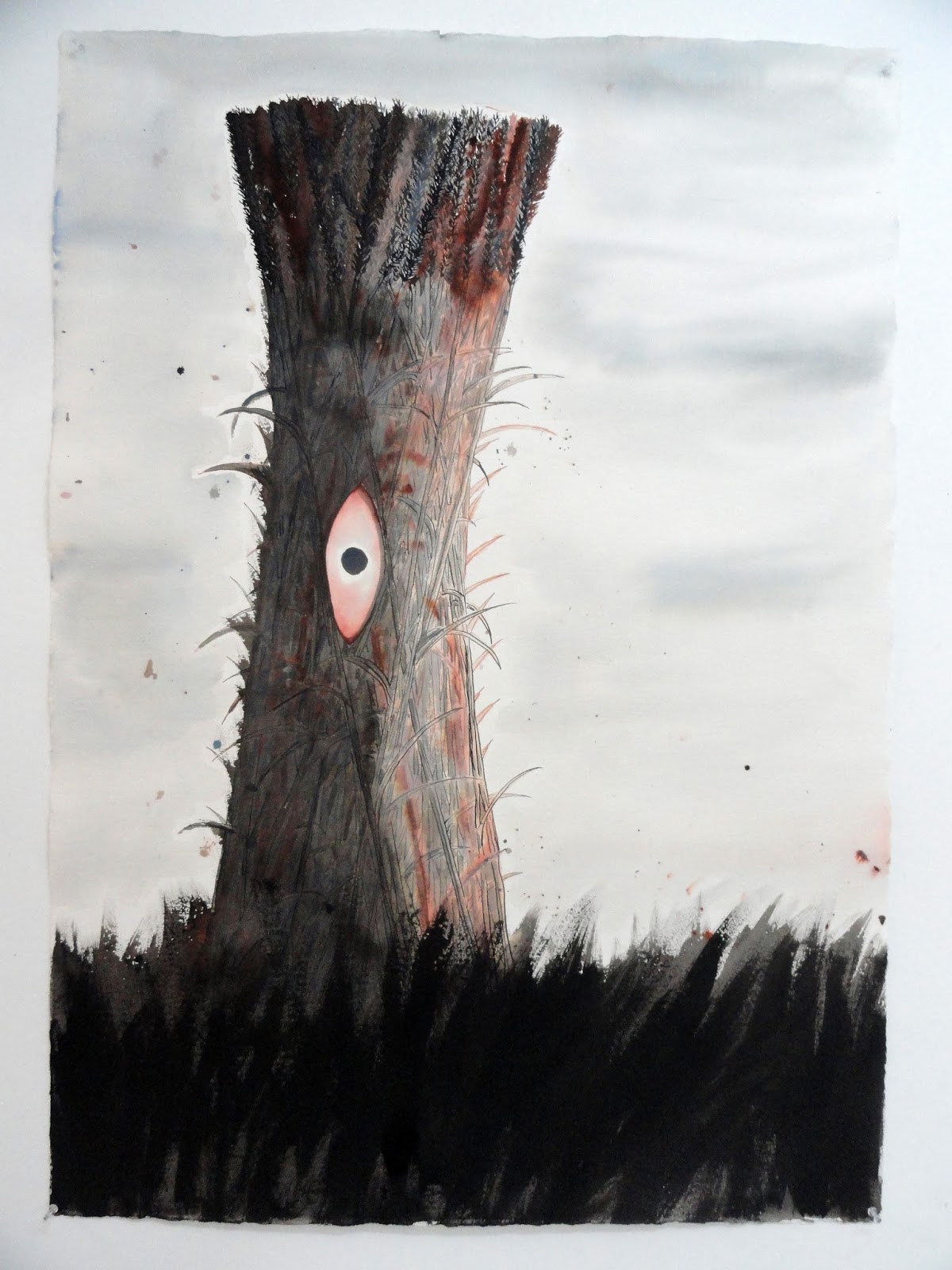
Eye in the corn

The image above would not have come to me without in the past standing next to a wheat field and drawing it. (Sketchbook drawing 3). 

Sketchbook drawing 3

The Cotman drawings are collected together in an area adjacent to a much larger gallery in which a comprehensive display of his finished watercolours is on exhibition. That connection between what you are aiming for as an artist and what you need to collect from your experiences is very important. In this case it was for myself interesting to see how he had at times been on a very similar journey. Tiny drawings of horizon lines were of particular interest for me as they made me very aware of the importance of linear rhythm, especially on that line that separates the land from the sky. 


Cotman: studies of the horizon

Again I'm both reminded of my own drawing experiences and taken over by these little scraps of information. The way that you look across a landscape is determined by how the experience is punctuated by events. Once again I am engrossed by these indications and quickly aware of how Cotman would have been engaged in the experience. For him a windmill stands out, for myself a mosque. But for both of us the edge between sky and land is a linear experience, an experience that reflects the material presence of the world and the way that it shapes us. 


Detail of Leeds horizon from a large drawing


In the main gallery devoted to Cotman's watercolours is a drawing on which he had spent a much longer time. Titled, "An effect of Parhelion seen from Hunstanton Lighthouse on July 6 1816", Cotman had obviously been deeply impressed by a powerful natural phenomenon. 


Cotman: An effect of Parhelion...

Cotman both writes about and draws an image of the event, a rare occurrence and one which is centred on light and our perception of it. Here we see his response to the 'effect' of the world, his being acted upon by world events, shaped and in turn shaping the experience. 
An effect of Parhelion... is an image we might well place as one of those belonging to the tradition of the sublime. Cotman is also an artist that uses his drawing materials in a much more expressive manner, the drawing of a road disappearing into the mist below, demonstrating that he isn't always about sharply defined areas and flat shapes.  

Cotman

On the ground floor of the art gallery there are also three rooms devoted to the work of Joseph Beuys. It may at first appear as if Beuys and Cotman are worlds apart in both sensibility and effect, but as I wondered through the galleries I began to feel that they were in fact very similar. 
Beuys: Pregnant woman with swan

Drawing is for both these artists central to their practice. Both are happy to work ideas out on scraps of paper or card and they both have an instinct for abstraction. The profile of a pregnant woman above being as much as a simplification as any of Cotman's abstracted landscapes. 

Beuys: Energy Field

Beuys' drawings are also records of performances and he often uses a particular brown coloured floor paint for his later drawings. These images feel as if they are about traces of events and so did Cotman's drawings. Both artists are offering us records of their material engagement with the world, Beuys is much more aware of this, often talking about the meaning of fat and felt and other materials, but Cotman is obviously aware himself that his ideas are being shaped by the properties of the materials he chooses to use. Both artists abstract elements out of the process of their complex entanglement with experience and the matter that shapes that experience. The consequence of these experiences is relayed to me and as an entity made of similar stuff to both artists, I am 'tuned' into the way materials are being shaped to form ideas. Beuys is though a 20th century creature, he is aware of a post quantum world, a world of relativity and the atomic bomb, so is therefore much more attuned to energy flows and the transmutation of matter. Beuys has a type of political awareness that Cotman doesn't have, but there are politics of the picturesque that Cotman would have had to deal with that we are perhaps not as aware of as we should be. 
I have on purpose spent more time writing about Cotman than Beuys, even though Beuys as an artist was much more influential on my own practice and was one of those artists that I was fortunate enough to actually meet. My point is that the act itself of drawing is such a special one in that it carries with it a material value, a physical entanglement with the world that writing never does. In those small pieces of paper I could sense the reality of experiences, in a way that the words on this screen never could. I am asking the reader to go and look at some actual 'real' drawings and to open themselves out to their own embodied world. To try and feel that invisible but palpable pencil or pen in their hand and to re-trace the time of a drawing's making. No matter how tiny and ephemeral a drawing may be it is a physical, material idea and as such is a reminder of our own and the world's material agency. 

Both these exhibitions are well worth visiting and there is of course the added bonus of being able to visit the new displays upstairs in the gallery. 

Find more information on the Leeds City art gallery here

Monday, 9 October 2017

Computer generated art and coding

Tom Betts used to work out of Leeds but moved some time ago to Brighton. During his time here he was making drawings with interactive media, specialising in generative programming techniques and computer game modifications, in particular he had made a modification of the first person shooter game Quake. At the time an old cinema space was still available in the Merrion Centre and Tom took it over so that people could play his new art games using a specially erected console.  Tom had stripped the graphics down in such a way that when you played you were bringing across the screen abstract 3D shapes, reminiscent of both forms taken from abstract art and those taken from very crude pixelated computer gameplay.

Tom Betts

Computer generated art is sometimes forgotten about, but it is a growing and continually fascinating arena of practice that overlaps the world of systems art and gaming. Coding of course is a very important element within these types of practices.  
Frederick Hammersley was one of the first artists to see the potential of computer coding as a way of generating imagery, you can see the relationship between his work and other process led work here.

Frederick Hammersley: Computer generated image 1969

In England it was probably the work of Harold Cohen that first came to the public's attention. He used a program called AARON, which drove a robotic machine that could make large drawings on sheets of paper placed on the floor.  

Harold Cohen: 1982

I have briefly touched on these issues before, in particular read the notes on the work of Corneel Cannearts. The history of this type of work is something I must admit to not being fully cognisant of. However what I can do is offer a few pointers to those of you wanting to open out your own research into the area. The work of Nam June Paik was probably what first alerted me to the importance of the electronic manipulation of imagery. Paik with technical support, developed a video synthesizer that allowed him to mix and manipulate colours and shapes from different images. He stated at the time, "This will enable us to shape the TV screen canvas as precisely as Leonardo, as freely as Picasso, as colourfully as Renoir, as profoundly as Mondrian, as violently as Pollock and as lyrically as Jasper Johns". (Edith Decker, Paik Video, S. 152.) Sometimes Paik's work can be too easily seen as simply to do with his appropriation of numerous TV sets and building them into towers or robot like sculptures. He was also deeply involved with how electronic media operated, was very interested in why electronic images were like they were, and was using theories taken from Marshall McLuhan's concept of 'the medium is the message', in order to justify his experiments. 

Artists such as John F. Simon Jr. have pointed out the similarities between concept-based and software-based art. "I see parallels between my work and works by those like Lawrence Weiner and Sol LeWitt at the end of the sixties," states Simon. "Their wall sketches especially were nothing more than a set of instructions…I believe that software and programming are a natural continuation of this concept because software is basically nothing more than a set of instructions… The ideas of some concept artists could be written as programs and could then be implemented by a computer. The art works would then simply produce themselves. Or, more simply: art does what it says. That’s the way I look at my programs." (Baumgärtel, 2001, p.103) Simon has also made the link between his work and LeWitt's in a much more direct way. See. 

John F. Simon Jr.: 'Combinations'

For those of you wanting to look at creative coding, I am told that 'Processing', and 'openFrameworks' an open source C++ toolkit are good places to begin. Raven Kwok is an Openprocessing user and he is worth looking at if you want to get an idea of much more contemporary work in this area. You can get an idea of Kwok and how he works from the clip below of Kwok introducing himself. 

Raven Kwok

Davidope is the pseudonym of animated GIF artist David Szakaly. Even someone as digitally challenged as myself has been able to make animated GIFs, so this area of working might be a place to start if you have never thought of making images for a computer screen before. Davidope has used GIFs to revisit concepts such as those investigated by Bridget Riley back in the 1960s. The issue about GIFs is that they take up very little computer memory and therefore they can be accessed on a wide range of devices; you also don't need to understand coding to begin making interesting things.

Davidope: Animated GIF

Florian Cramer has emphasised what has been called the 'defect paradigm' in many computer artist's interactions. This is probably due to the fact that artists are not necessarily good programers. He sees destruction or creative modification as the focus of works that specifically concentrate on using the graphic qualities of games as visual raw materials, such as Arcangel Constantini's "Atari Noise"

Arcangel Constantini's "Atari Noise"

Play Arcangel Constantini's "Atari Noise"

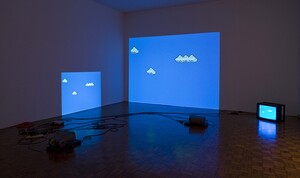
Although I understand the conceptual game being played in 'Atari Noise' and of course its relationship with mathematical variation and systems art, I personally much prefer Cory Arcangel's 'Super Mario Clouds'. Based on the Nintendo NES game; Cory Arcangel hacked the game and modified it so that all that remains of the game are the white clouds on a blue sky. Cory Arcangel had to open the cartridge, on which the game was stored, and replace the Nintendo graphics chip with a chip on which he had burned a program he had written himself. 


Cory Arcangel's 'Super Mario Clouds'

Cory Arcangel's work acknowledges the conventions of contemporary art installations and in stripping the images down to simply clouds, he creates an oblique link between the history of Modernist painting and the history of gaming. In effect performing a Greenbergian move within the conventions of computer generated art. For me this move was one that demonstrated that this area of work was now mainstream. 
Much more recently Larry Achiampong & David Blandy in 'Finding Fanon 2' which is available as a UHD video, have combined art-house cinema with machinima. It has been stated that, "their work investigates the post-colonial condition within the simulated world of Grand Theft Auto V. The result is a multi-layered narrative which raises questions about the alleged ideology-free spaces of video games". Metamakers Institute 

Larry Achiampong & David Blandy: Finding Fanon 2

The issue about Cory Arcangel or Larry Achiampong & David Blandy's work is that it is work that transcends the boundaries of computer game art, becoming simply 'art', the fact it is using computer game technologies is no longer the be all and end all issue for the work. Like Hito Stereyl they use technologies as part of the way they think about ideas. See Hito Stereyl playing with ideas associated with the technologies of video making. 

Mark Hansen and Ben Rubin: Listening Post

'Listening Post' was the first piece of computer assisted art that I thought worked as well as any other. Even though it was made way back in 2001 it still feels contemporary, therefore I would suggest it is the concept rather than the technology that carries the weight of the idea. 

See also:

The work of Rachel Ara is a good place to start if you are interested in a more feminist stance in relation to work in this field.

Machinima is not a game (an overview of contemporary practices)


Network Art: Practices and Positions edited by Tom Corby: See the chapter 'The Ludic Hack' in particular p.85 for some interesting comments on the relationship between Arcangel Constantini's "Atari Noise" and the work of Nam June Paik. 


Sunday, 8 October 2017

Large scale detailed images

Sometimes as an artist you want to get across a vast amount of detail. Perhaps you need to reflect the complexity of a situation or simply engage your audience with a type of 'Where's Wally?' mass of details. Martin Handford's 'Where's Wally? books for children rely on their success by tapping into our interest in seeking out clues from masses of detail, something that probably goes back to our need in pre-historic times to seek clues of danger or animal presence within dense forests or other difficult terrains. 


Martin Handford: Where's Wally?

In the British Museum print department there is a huge woodcut print made by Durer in 1515, of a Triumphal Arch glorifying the house of Habsburg and emperor Maximilian's military achievements. It was printed from 195 wooden blocks on 36 separate sheets of paper. The ambition and energy that must have gone into making a print of this size is staggering, as as someone who has done a lot of printmaking, I'm very aware of the complexities of organisation this must have involved. What it does do however is demonstrate that sometimes as an artist you need to tackle complexity head on and make something that has the same rich texture as the subject it is trying to deal with. The deeply embedded need we have to study detail now comes into its own and an image of this complexity, added to its subject matter, can be studied with great pleasure and intense involvement for hours at a time. This type of image stands at a far distance from a current age of fast read technology, but I do believe that we still have a need for these types of experiences, hence my reference to Martin Handford's work. Sometimes the pleasures of childhood experiences can be dismissed as unworthy when we get older, but it could be argued that as we get more 'sophisticated' we can actually lose touch with our basic instincts and one of the roles an artist can have, is to remind us of our own natures. 


Durer: Triumphal arch.

Adam Dant is a Jerwood Prize winning British artist. His work deals with the fact that he now lives in London and he seeks to reflect his concerns with living in this teaming metropolis, that has a very well known history. He obviously looks back to artists such as Hogarth for inspiration and has produced a body of work that sits on the edge between illustration and fine art. This is fine by me, but I also realise that many people will bring up the old illustration/fine art argument and argue that his work is by definition weak because of being too close to illustration. I have had to deal with this issue over and over again, because like Dant my work is figurative and deals with stories that arrive directly from my experiences of living in Leeds. I might have an argument with the way he visualises space, (I think he is at times too predictable, perhaps because he has to produce a much higher volume of work than myself and I also have this difficultly with Paul Noble's drawings), but he has ideas about the world and is trying to communicate them using visual means. His language is one of detailed pen and ink drawing and I would argue that this is just as important a language as the 'hard won' image charcoal drawings of the Borough Polytechnic School or the various systematic grid based languages of abstract modernism. 


Adam Dant

Dant looks back to a long tradition of English drawing which includes Rowlandson and Hogarth and when interviewed he always cites Peter Bruegel as the artist that he most admires. However of all the images in the Tate Gallery's collection I suspect it is George Cruikshank's 'The Worship of Bacchus' that lies closest in effect to Dant's work. 


Cruikshank's 'The Worship of Bacchus'

Cruikshank's painting is huge and like Durer's 'Triumphal arch' very difficult to read as an on screen image. Which brings me to an issue that I have had to grapple with myself. If you do make work of this sort it is almost impossible to represent it on a computer or mobile phone screen. This link is my own attempt to solve the problem and is of a recent drawing of mine that will be shown soon at the the Royal Cambrian Academy in Conwy, in 'Imagined Landscapes' an exhibition selected by the artist Clive Hicks-Jenkins. Because most people will see my work on a computer screen I also make work that is about the 'centralised image' and this type of work is so much easier to grasp on screen. (See below)


Eye of the Hayfield

An artist much more in tune with the relationship between the small screen and monumental image making is Emma Stibbon. She is exhibiting at the moment in an excellent printmaking show at the The Zillah Bell Art Gallery in Thirsk, North Yorkshire.


Night Navigation - Intaglio print by Emma Stibbon


The Original Print Show is curated by Norman Ackroyd and is on until until the 14th October. Stibbon often works at a monumental scale, (see earlier post) but instead of trying to put in masses of details and lots of events into her images, carefully selects compositions that will make an impact. I would suggest her way of working is much more appropriate to an age of mobile phones, because the images transfer to screen much easier. However like Martin Handford I still believe there is room for artists that work with masses of surface detail. It might be deeply unfashionable and not mobile friendly, but when an audience is confronted with the reality of the scale and the fact they have to work hard to see all the details, it becomes an experience and in being that, I think an image can be all the more memorable.

Ensor: The entry of Christ into Brussels 1889

This is an old idea and one often disparaged by the Modernists, who saw in these issues the worst aspects of narrative art. However all ideas are meant to be tested and certain aspects of the Modernist canon do not seem to stack up any more. The one thing I think working as a artist for nearly 50 years has taught me is that fashions change and that what was once argued as being the only way forwards, will at some point be seen as a backwards step. I will leave you with two images, Ensor's 'The entry of Christ into Brussels', an image that in many ways ought to be wrong and perhaps given the time when it was painted a backward step. But it in many ways opened the door to Expressionism and is still a painting that people will sit and look at for a long time.

Ensor: The entry of Christ into Brussels 1889

The other image is of Stanley Spenser's painting in the Sandham Memorial Chapel. Again an artist that it could be argued took no account of what was going on in the then current art world, but if you go to look at his paintings they have an ambition and authenticity that transcends fashion and when you visit them in situ, they become experiential and deeply communicative. 

Stanley Spencer: Sandham Memorial Chapel


The current exhibition of Raqib Shaw at the Whitworth in Manchester celebrates this type of approach to making images and if you are at all interested in the type of work pointed to in this post, do go along and have a look.  

Gary Lawrence won this year's Jerwood drawing prize again with another of his very detailed images. 


Gary Lawrence 

The British Museum have commissioned a film about the conservation of Durer's huge Triumphal Arch Print. 

Manabu Ikeda is another artist that has taken on long durational drawing commissions. His 'Rebirth', a 13 x 10 foot very detailed drawing responding to Japan's recovery from earthquake disaster being typical of his work. 


Manabu Ikeda
See also:

The narrative drawing tradition