Sunday, 16 July 2017

Drawing and dance

Senga Nengudi: Performance 1978

Watching the dancers performing before Tim Ingold came on to talk reminded me of how dance and drawing have become very close bedfellows over the last few years. However this is not surprising and if we go back in time or look at other cultures you will often find that the arts were totally integrated. Ellen Dissanayake in her book "Homo Aestheticus' has in particular argued that the arts are central to human evolutionary adaptation and demonstrates a close link between painting, song, dance, and drama as activities that are essential to how we build an understanding of our place in the world. This situation is totally at odds with a Western tendency to categorise and atomise, holding up the idea of specialisation that underpins certain aspects of the scientific method. This could be seen at its most trenchant during the period of Clement Greenberg's influence over Western painting during the late 1940s through to the early 1960s. Greenberg was himself reflecting on Lessing's Laocoon, each in their turn writing about the specificity of art forms and how they needed to be refined and honed in relation to their particular characteristics in order to work at their optimum. Ingold would have said, I'm sure, that what this meant was that art was following theory and theory itself is always at least one remove from reality. The work therefore becomes an illustration of theory rather than a becoming in correspondence with an experience of the world. 
As experiential beings we are essentially holistic in our being at one with the world. Therefore we ought to be able to deal with the flow between disciplines as a normal consequence of the totality of life. In everyday conversations we use our body language as much and perhaps more than our verbal language to communicate, our fingers gesture to emphasis a point with sometimes more emphasis than the inflection we put into our words. We act intuitively to respond to situations, not usually having time to break each action down depending on whether it would it be better to use voice or body.  

Dance is a time based art form, therefore video rather than still photographs is a more appropriate way to experience it. However by the very nature of web links what I might put in as links to various drawing/dance/performance events can in time be taken away, so please bear with me if you are following this post at a later date and the links have gone dead. 

Some performance drawing work that is worth exploring as an introduction to the area. 

The MOMA resource On Line is a useful introduction to this expanded field of drawing. 

Oskar Schlemmer’s Bauhaus ballets have had a long influence on the visual arts, this video is a recreation of Schlemmer’s work. 

Robert Rauschenberg's Pelican is an early performance work that is well worth researching. Rauschenberg was friends with both Merce Cunningham the choreographer and John Cage the musician, as artists they saw how they could effect each other's approach to working, each one stimulating the other and helping each other realise how they could take their particular disciplines into new directions by combining them and in doing so reinventing them. 


Anne Teresa De Keersmaeker, has walked and danced through a prepared arena of sand to make us aware of the way we move through space and in this instance used two members of her performance troupe to construct a drawing that is designed to shape the nature of dance moves when the dancers emerge onto the stage, not as a separate activity, but as an actual part of the performance.  

Neville Gabie is an artist that uses mark making as an extension of very physical performances his 'contact improvisation' techniques including working with a huge heavy lump of chalk or a bucket of whitewash. Just as dance itself can integrate everyday human activities, Gabie extends drawing into those territories that we often ignore as 'everyday' events. 

David Connearm is another artist that uses the limitations of the body to make his drawings. This is a description of his practice:
"He begins by drawing a line at the top of a sheet of paper, as straight as possible, although it inevitably records minor tremors of the artist's hand. The next line, drawn closely underneath, is an attempt to replicate this line, small imperfections and all, and will also necessarily introduce its own imperfection; and so on down the sheet. Even with this exacting method, the drawings record some degrees of variation. The way in which the paper absorbs the ink is affected by the humidity of a particular day or hour, by the slightly varying speeds at which the lines are drawn, and other uncontrollable factors. Connearn uses Rotring pens in order deliberately to minimize the expressive qualities of the lines."
From the V&A website
In this case it is the drawing as a final result that we see exhibited, but in your head you can 'see' him in action, repeating the same movements over and over again and for me this becomes a type of dance. 
David Connearn, Mappa Mundi: Drawing to the Extent of the Body


The exhibition 'The Artist is an Explorer', curated by Marina Abramovic included several artists working in a vein that overlaps drawing and performance.

Heather Hanson has developed several controlled performances that emphasise the bi-lateral symmetry of the human body. 

Tony Orrico's performances are again treading that line between dance and drawing. 

There is a long history of collaboration between choreographers and contemporary artists, and so those of you wanting to work in this area should not feel daunted by a lack of existing research. 

Revisiting MOMA's 'On Line' could be a useful place to start, especially as it was curated in such a way that there was seen to be a gradual transition between ways of thinking about a line in space and the line as network.
This is how it was described at the time:

'On Line is organised chronologically in three sections: Surface Tension, featuring the artistic drive to construct and represent movement through line within the flat picture plane; Line Extension, composed of works in which lines extend beyond flatness into real space—that is, into social space; and Confluence, presenting works in which line and background are fused, giving greater significance to the space between lines. In following the development of the meaning of line over the last one hundred years, the exhibition traces it in movement, across disciplines, and as it has been drawn out and rewoven in time and space—inevitably reflecting the interconnection and interdependency that are increasingly both shaping and emerging from a globalized society. Line, like thought, once understood as linear and progressive, has evolved into a kind of network: fluid, simultaneous, indefinite, and open.' (MOMA website)

Some of the issues in the post above have been touched upon earlier, see for example:
Is drawing a language (Part three)  

Tom Wolfe's 'The Painted Word' is an interesting critique of Greenberg and other theorists and their influence on art. 

Tuesday, 11 July 2017

On not knowing and paying attention: a talk by Tim Ingold


Last night I went to a lecture by Tim Ingold. For those of you interested in drawing theory, Tim Ingold is an essential read. His books ‘Lines: A Brief History’ and ‘The Life of Lines’ open out thinking about drawing into the theatre of life itself and allow you as a maker to invest your drawings with a wide range of possible meanings. At some point I will go through both these books and provide a summary and an indication of possible ways to use them. However for this post I’m simply going to put on record the notes I made during his talk.

On not knowing and paying attention: a talk by Tim Ingold

Because he had before the talk been working with some of the dancers from the dance centre, the evening kicked off with a performance by eight dancers, which consisted of them using contact improvisation techniques to explore how people could be linked in different ways. From massing themselves up into towers which could be climbed, to swirling lines of linked hands and running bodies, we were given an interesting physical introduction to the performative possibilities of the body in space. Performative drawing is now well established within the drawing canon and is well theorised, a typical example being this PhD thesis on Marking Time by Jane Grisewood.

Tim Ingold introduced his talk with a statement to the effect that what we used to call ‘wisdom’ has now dissolved into ‘knowledge’ and ‘knowledge’ is now becoming ‘information’. He is worried about this, as it leads to the disparagement of ‘truth’. He stated the problem is that the more you know, what you begin to encounter is your own knowledge. Rather than to seek knowledge perhaps we should be ‘attending’ to things. To be attentive is to discover things in the experience of them. He asks the question, “Do we need to know less?”

In order to know less, perhaps we need to turn towards the world, to accept it for what it is, rather than to measure it or categorise it. He reminded us of the key elements of academic practice. To collect data and from that data to develop theories of interpretation. However he pointed out that in effect theory turns its back upon the world. Theory is used to interpret data, and is he believes therefore always separate from the reality of existence.

He sees the need for all this data and theory about the need for certainty. In a world of certainty there can be demonstrable ‘joined up’ thinking. Everything is joined up, so that you can move from A to B to C to D in an ordered progression. He drew a diagram like so.

Pointing out that as we move between connected points most of the surface area of the diamond is not actually touched by the lines of connection cutting it. We in life, follow a much more winding path, not so much from A to B but a snaking path following the world as we discover it. Tim Ingold talked about taking an orthogonal direction, which I read to mean moving at right angles from a starting point, however I’m not sure he meant it to be so geometrically precise, I think the snaking line he drew on his diagram was much clearer.


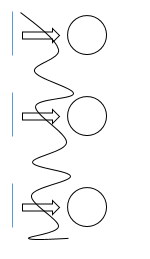
He moved on to talk about intention. My reading of this was that he was referring to intention as understood by psychologists. We tend to believe that human actions are intentional, we set out to aim for something and in doing so we get an effect. He set out a view of life as a series of aims and their targets, drawing a diagram like so:


As each aim and target is achieved we get a sum of actions, each starting with an intention, and gradually leading towards an objective.

However Ingold then points out that attention is longitudinal and that it tends to ‘go with the flow’ or follow the implications of the material you are working with. Once again he draws his snaky line over the previous diagram.


He now brought in a new metaphor to explain the difference between intention and attention. We can divide a log in two different ways, we can cut it with a saw or split it with an axe. When we cut it with a saw we cut across and through the wood grain, but when we split it with an axe we go with the wood grain, using its very nature to help split it apart. Again he draw diagrams. (I keep including the diagrams because this blog is about drawing, and I think it’s important to demonstrate how drawing helps us think).
Intention the log and saw
Attention the log and axe

When we go with a material, a decision is matured in the action itself. Decisions evolve in the course of actions. A decision is in effect a reflection of movement. For example; when walking, you intend to go, but once you set out each separate step is not an intentional act. “I am walking” becomes, “My walking walks me”. Every step is hesitant, each footstep begins with an investigation of the ground and its nature. Like making marks on a drawing, as we make a series of steps, we are not sure where each one will go, but gradually one becomes more assured as you find your way. You are though testing as you act, you need to “push the boat out into the current”, to take an existential risk in order to do anything at all. This means that you need to be open to the conditions of the world. You are in effect inside the actions you take, and it is only afterwards that you can say, “I did that”. You merge with the action itself.

In the intentional model cognition leads and the body follows. But in a model whereby we submit to the world, (the submission model), we are cast off into a world of actions, where skills mastery and vulnerability are both sides of the same coin. Lines of life, like the emerging delicate roots of a growing plant are always hesitant. Submission therefore leads but mastery follows.

This is how Ingold believes the imagination itself works. Imagination is a sort of improvisation of a way or passage through life. However as a way is seen, you need the skills to make best use of your passage. Skill sets therefore follow imagination or insight. It is important not to think of imagination as a form of mental representation, imagination goes beyond what we can represent. In fact if we can represent something we already know what it is; imagination is about what we have yet to represent.

We are asked to think about what it means when something ‘appears’ to you. It is revealed to you. You join with it in the moment of its birth, you are as much part of the revelation as what is revealed. However this situation is more likely to take place if you are in tune with the material world you inhabit. You develop ‘foresight’ when you are at one with your materials. You sense what they are capable of. Foresight in this definition being not about seeing something in the mind’s eye, but seeing something as a type of forwards anticipation, being one step ahead of your material, because you are paying attention to that material. (You can see here why Ingold is very important for people who make art, this is a very good description of what happens as a drawing or other art form evolves). Foresight is the opening up of a path, a kind of seeing into the future, which allows you to carry on. Foresight could in these terms be seen as looking towards a possibility.

However possibilities eventually become actions. Ingold draws another diagram demonstrating the relationship between submission and mastery. The steep learning curve of submission eventually reaches a point of what Ingold termed ‘inflection’ (I take this to mean change in meaning) or a tipping point, whereby an action matures and we move towards mastery. These tipping points he believes are often between sets of opposites.
Point of inflection
Submission                      Mastery


We need to educate our attention, and remind ourselves that in perception there is the constant weighting of the ‘affordances’ of perceptions. (Affordances are: ‘Action possibilities in the environment in relation to the action capabilities of an actor. Independent of the actor's experience, knowledge, culture, or ability to perceive). I.e. are our perceptions useful? If we feel they are not we often ignore them.
Ingold sets out two opposing views of what is out there.  Do our perceptions chance upon a world already laid out, or is nothing ready for us, so that we have to be astute enough to respond to what we find, and as we find it we in effect shape it.
The line we cut through existence is open ended, it is more about hopes and dreams, not plans and predictions. We are in effect 'longing for something'. This longing is what hopes and dreams are, and the problem we face is how to capture them, or make them materialise before they get lost. This is of course the artist's fear. The real skill of the artist is therefore that of the dream catcher. The pinning down of an idea, and its realisation is key. However there is always a tension between the anticipatory reach of an idea, and the drag of materials in action. The friction of material engagement is what slows an idea down, but at the same time gives it the chance of realisation. All life is caught in the tension between opposites such as submission and mastery or imagination and aspiration.
Ingold cites the word 'longing' as vital to this understanding, he believes that longing wells up in attention and leads on to a skilful manoeuvre. It is  a word that can also be in either future or past tense.
Perception is also about exposure. By willing each step into action, we are in effect pulling ourself out of the position we were in. In exposing ourselves to the world we attend it or wait for it, and in doing this we can be astonished by it. Not 'surprised'. In science, it is stated when something comes up that is unexpected, this is, 'not as previously thought'. The flipside of anticipation. Ignorance presupposes that things have to be explained to us. However what if we are not wanting to constantly anticipate things, perhaps ignorance is best. Prediction depends on concepts and categories, we use data to build theory based on concepts and categories, therefore we are surprised when our predictions are wrong, but not astonished. But those who are attentive to the world are always astonished at what they find, this is due to their vulnerable but resilient attention. This attention should mean that we are more aware of others, both other humans and the world itself, opening out an ability to correspond with others. Each responding to the other in an ongoing conversation, rather than joining up with others. 
Ingold then draws another diagram of flowing streams of things moving alongside each other. 
The issue he now highlights is the fact that responsiveness is an ethical condition. He goes on to quote from Deleuze and Guattari's 'A Thousand Plateaus', "'One ventures from home  on the thread of a tune", a line that suggests both the fragility of experience and the way we need to dance with it. 
He goes on to say that thinking unsettles thought. It reaches hesitantly towards something else. He returns to his earlier diagram about certainty and asks is this what we should be looking for? Should we be looking for understanding or what he termed, 'undercommoning', or the moment of being lost. (My understanding of 'undercommoning relates to antiauthoritarian organising groups, so I'm not sure exactly how he is using the word)
Ingold now moves on to suggest that our normal experience is actually more like that of those with autism. Autism is always experiencing the world as it is. Therefore things are always unsettling. However, most of us can from the moment of astonishment move quickly on to normalise our relationship with reality.

Going back to his earlier issue with too much knowledge and in particular scientific knowledge, he suggests that many of our problems are 'fake' problems. I.e. they are problems with existing solutions, such as jig-saw or cross-word puzzles. This he feels is rather like the difference between real and fake freedom. Fake freedom is one of imposed options, such as the recent referendum, binary choices are in many ways non choices. Real freedom is the freedom to decide on a path through life and to follow it no matter how it wavers about, or makes U turns. Freedom and necessity are one and the same thing, it is about harmonising with something to find a direction. Finally he brings us to the current state of education and suggests that it now offers an immunity from experience, rather than an exposure to it. Education offers an illusionary certainty, but richness of thinking only comes from uncertainty. Therefore, in conclusion, not knowing is not ignorance but a form of wisdom, a form of wisdom centred on paying attention to things and not being bound by theory. 

These notes were taken during the talk and were scrawled in a small notebook. I apologise for any inaccuracies or misunderstandings, they are all due to my own inability to concentrate or understand what was said. 

References:

Ingold, Tim. The Textility of Making:  Cambridge Journal of Economics. 34. 1 (2010): 91 -
102. Web. 1 January 2014.

Ingold, Tim. Toward an Ecology of Materials: Annual Review of Anthropology. 41 (2012): 427 - 42.

See also:

Notes on another Tim Ingold lecture


Thursday, 6 July 2017

More on framing

I pointed out in my last post that double sided frames can be an interesting solution when trying to change a viewer's relationship with a drawing. I think this is an interesting area to pursue, one which is essential when thinking about the interaction between the observer and the observed. The encounter with an image depends on several issues, presentation being one of the most important, as it begins to shape our reaction before we even begin to look at the image.


Dieter Roth installation view

Think about how you would encounter the Roth installation above. If you wanted to look at each image you would have to walk in between the frames and bend your knees so that you could see the images set out below. Then you would have to rotate around to look at the facing two images. Each encounter would then mean stepping back out of the space, seeing the images fanning out away from you and then you would step back in between the images to look at the next four images. However as you approach the work, the installation would work as an object that rhythmically articulated along the wall. The piece therefore having both an overall physical presence and a series of 'framed' moments that could only be experienced one at a time. You are made to be very aware of having to work hard to see this work, it is a very public encounter, with moments of intimacy in between having to step out into the gallery space to re-orientate yourself. It engages the audience in a way that could be seen as performative. Compare this experience with that of a double sided hinged frame.


John Jones framers: Hinged double sided frame

In the case of a hinged frame you encounter the object flat onto the wall, the initial experience being not dissimilar to the normal one of looking at a framed drawing. However it is subtly different. The frame is more 'object' like as it is much deeper than you would expect. The realisation that you need to do something is triggered by an awareness of the inset hinges and then of course in order to see the other side you need to open the frame as you would a book. You need to peer inside, an action quite different to walking in and around the frames as you do with the Roth piece. This is more about privacy, and intimacy, an effect heightened by the fact that the work is also window mounted, a further frame within a frame, designed to heighten a sense of  'honorific' value, or as Benjamin would put it to frame the 'aura' of the image. However because one image is seen first and then the other side is seen later, after opening up to reveal what is inside, it could also be argued that this type of frame suggests a division such as conscious and unconscious, or revealed and hidden. This type of encounter has a long history, for instance the 'Wilton Diptych' is designed to be opened like a book, you open it to reveal its precious contents. Many altarpieces were designed to be open and closed. Often with one type of image on the outside, sometimes painted in grey, so that when the screen door is opened the colour of the painting inside glows and shines out. 

'Wilton Diptych'

19th century American miniature portrait

The small intimate locket type of image such as the one above has been made for many societies over a long period of time and it is this very personal encounter that the hinged frame also suggests.  
This is quite different to a freestanding double sided frame, such as the one used to display the work of Max Pechstein below.

Max Pechstein

The putting of a frame on a plinth suggests the turning of a painting into a sculpture, it emphasises the three dimensionality of the work, the frame becoming more of an object than simply an edge between the outside world and the world of the image. However because in this case the image still lies within the frame, at the moment of image contemplation the old image / frame relationship returns. Moving between frame as object and frame as theorised by Derrida as the parergon, who at one point argued that the outside can become part of the inside in order to define itself as something defined by the inside. I.e. The frame is initially thought of as being outside the meaningful context of the image it frames. However as soon as the frame is noticed, it becomes part of the meaning of what is inside it.  The choice of frame is often defined by the type of image, so we have a constantly flipping set of relationships and readings of the situation. 
Imagine this situation. In the 1930s an artist paints a flat geometric 'Modernist' painting. His gallery has it framed in a 'Modernist' frame, a simple clean black box and the painting is bought and is exhibited for many years in a well known art gallery. In the year 2017 a new curator moves into the gallery and has all the Modernist paintings reframed in 19th century style Victorian gilt frames, knowingly re-positioning the works by making us aware that we were always 'seeing' the painting and its frame as an invisible and indivisible relationship. 
But do you always have to frame? If you look at Laercio Redondo's work below it has simply been put on small shelves and leant against the wall. Again this makes the images work more as objects, but now without the frame, the image and object begin to fuse. 


Laercio Redondo   

Hajra Waheed's work also relies for its presentation on long lines of purpose built shelves.

Hajra Waheed

Coda

Thao Nguyen Phan

Since putting up this post Thao Nguyen Phan has has an exhibition at Tate St Ives. She tells complex stories that intertwine mythology and folklore with urgent issues around industrialisation, food security and the environment. The threat posed by the destruction and excessive consumption of Earth’s resources is a recurring theme across her practice and she uses a variety of means to communicate these issues, including drawing. In this case her presentation technique means that you have to encounter the work by walking around it and leaning in awkwardly close to the wall, you can then see both sides of the framed pieces. The very difficulty involved seems to make you remember the issues raised, she is heightening our embodied memory. 

Hanging work for exhibition

If you want to open these issues out theoretically a good start would be to read 'The Parergon', by Jacques Derrida and Craig Owens in 'October', Vol. 9 (Summer, 1979), pp. 3-41 Published by: The MIT Press https://www.jstor.org/stable/778319


Monday, 26 June 2017

Sketchbooks

I've just bought an old copy of the 'Picasso's Sketchbooks' exhibition catalogue. The book has facsimiles of six complete sketchbooks and fragments of 36 others. I used to have one which I bought back in the 1980s, lent it to someone and it never returned. What I thought was interesting when returning to go through these images was how little writing he did. All his thinking is visual, each page represents a search for an alternative resolution to a visual problem, and I think there is a strong lesson to be learnt here. Sometimes students feel they have to annotate everything in their sketchbooks in order to justify their decision making. However if the mind is thinking visually, stopping to write can often hold back the visual invention as the brain is having to switch between different modes of thinking. This doesn't mean that  artists should not write, Picasso and many others have written wonderful poetry, but that artists have to be careful to not compromise one way of thinking by muddling it up with another.


Picasso

Ex LCA student Henry Moore's sketchbooks are not as wide ranging in approach as Picasso's but are similar in that they concentrate on solving visual ideas. However some sketchbooks are about finding ideas from direct observation and others about free form invention. The famous shelter or sheep sketchbooks are reflections on 3D form as much as they are records of observed events, once again we have an artist looking at the world and selecting out of it the information that supports their aesthetic vision.


Henry Moore

However many of Moore's sketchbooks are more like Picasso's, he is looking for a range of visual solutions to a problem and works images through as variations on a theme.


Henry Moore

As always there are alternative arguments and at first sight Edward Hopper's notebooks seem to suggest that he is writing to support his visual thinking, but when you read the text you realise these drawings are done after the event so to speak, they are documents of work done. The notebook as document of practice is something that has become more prevalent recently, as several artists have begun to use the document of practice as their actual practice. It is in Hopper's work I see the initial germ of this idea emerging.


Hopper

Pep Carrió

Pep Carrió

Pep Carrió’s sketchbooks are stream of consciousness records of every day of his life. He never misses a day and his sketchbooks become the artwork itself, gradually building up a mass of images that have an impact simply because of the sustained invention that has now continued for years. 

An alternative approach is that of Dieter Roth. He used the diary format to reflect on his life, interweaving selections from these diaries into his work, making almost direct translations from them and creating copybooks from them using Xerox. Each page becomes an intense interaction between word and image, he often used water soluble ink as he wrote so that when the paper was dampened ink would bleed and spread, the writing then becoming more visually akin to other types of mark making. At the same time as he made these diaries, alongside them he was collecting every piece of waste less than 1cm thick that he encountered every day in the studio, preserving it in a plastic folder and compiling these into ring binders. His everyday thoughts are collected alongside everyday detritus. A concept that I think is very interesting, artists' jottings being valued as much as the dirt and rubbish on the studio floor. This is almost in direct opposition to Picasso who values every page, signing and dating his work as he proceeds, as he obviously believed that at some point in time researchers would value his work so highly that they would want to be able to follow his thinking in sequential detail.


Roth diary pages

Roth daily collection file pages

Dieter Roth: vitrine of notebooks

Roth often used both sides of his paper, so this has given exhibitors a problem, and of course there is an interesting solution.

Dieter Roth

Double sided frames can be really useful and encourage a very different audience engagement with the work. Professional framers, such as John Jones in London, also make double sided hinged frames. However framing and how this can change an audience's engagement with the work is something else and I shall open this out a little more in the next post.

Sketchbook links of interest:


Frances Alys sketchbooks

Sketch Open

Lucy Lyons makes sketchbooks the focus for her practice 

Sketch the exhibition


My own way of using a sketchbook. Tracking the evolution of an idea. 

If you want to follow the thread about documentation the best thing to do is click this link to


Friday, 23 June 2017

Garry Barker Exhibition


The exhibition Piscean Promises is being held in the Workshop Press Gallery in Chapeltown. The gallery opens out into the street and everyone will be welcome, neighbours as well as those interested in art. 
The Gallery is at 10 Back Newton Grove, Chapeltown, Leeds, LS7 4HW.
See this link below for details as to how to get there:

The exhibition began as most of my work does by having a conversation with someone. Huge amounts of dead fish were being washed up onto the English shoreline, the person I had been talking to had seen this and it had affected them deeply. 

This was the text given out at the exhibition.

So why Piscean Promises?

It’s about the way people argue with each other, as well as the short-sightedness and myopic nature of human beings. 

But first thecomedy, a joke about fish.

A goldfish has a little castle toy inside its bowl. 
The goldfish swims around and around and around.
Here's what the goldfish thinks.
Hey, there's a castle!
etc. etc.

I don’t know of any jokes that fish have about humans; so perhaps I have to tell one for them. 
A total of almost 80% of the world's fisheries are fully- to over-exploited, depleted, or in a state of collapse. Worldwide about 90% of the stocks of large predatory fish stocks are already gone. We are losing species as well as entire ecosystems.In 1992 the once thriving Canadian cod fishing industry came to a sudden and full stop when at the start of the fishing season no cod appeared. Overfishing had caused 40.000 people to lose their livelihood and an ecosystem was now in a complete state of decay. The European Union responded by putting in controls on how to fish in EU waters. However British fishermen want to take back control. Recently hundreds of thousands of fish were washed up onto the Cornish beaches, it was horrible said holidaymakers who were put off going onto the beach. Trawlermen sometimes underestimate the size of shoals, this means that they get too many fish in their nets. If this happens, to make sure they are safe from capsizing, a vessel has no choice other than to release the bottom of the net so that the catch falls away. However fish are quite delicate and vulnerable to damage due to the high number of them caught in the net. They are incapacitated as a result of being hauled to the side of the vessel, and when released from the net they are already effectively dead. These sightings are becoming more common as nets get bigger. This sort of ‘embarrassment’ may drive behavioural change within the fishing industry a Government spokesman said. 
The vast majority of fish we eat are not farmed but essentially mined. 
There are 10 natural resources that are critical to the functioning of the U.S. military industrial complex. The extraction of these under the ground resources which form the base on which industrial societies stand, is constructed in many instances through the use or threatened use of armed violence. As a result, armed violence plays a critical role in fostering political destabilisation, environmental degradation and ecological devastation. The ability of wealthy industrial societies to extract vast quantities of natural resources from the earth and get these resources distributed to where they want them also requires complex social arrangements that are instituted, organized, shaped, directed, and controlled by specific organizations, institutions, treaties, and laws, many of which are seen as the ones we should rely on once ‘free’ of the EU regulatory framework, such as the World Bank, International Monetary Fund, and World Trade Organization. These highly coercive institutions have multiple, often violent, negative, destabilising impacts on individuals, societies, and the environment.               
Over the past 50 years, the average global temperature has increased at the fastest rate in recorded history. 
Everything is connected. 
The tragedy about humans.

Humans go around and around and around and can’t understand the fundamental contradiction between a profit-oriented economic system and long-term environmental sustainability.  They think that the natural world is totally controllable by humans, and that the world is only of value in relation to what it has to offer to humans. The joke is that they always argue that they are right. 

We treat the natural world in the way we do because we have no empathy towards it. We treat ‘others’ in a similar way. 
There is little compassion for those who brave the seas on small boats in search of a life in Britain. There is an atrophy of imagination, further eroded by a right wing press breeding an anxiety that closes minds and shuts our doors in the face of other people. We live in a time of a monstrous betrayal, a time of historical amnesia and a cosy particularly British viciousness. What a miserable, pathetic distortion of the truth is this petty fear of outsiders, what a lamentable head in the sand attitude towards the reality of late capitalism.  
There are no borders to humanity, no difference between ourselves and the rest of nature, only in the minds of the fools and bigots who build them. But still we vote them in. 
This work is allegorical, based on conversations had with many of you and others, a response to the awful dawning of a post Brexit world and a coming Conservative liaison with the DUP climate change deniers. 

Logic has failed us; these images are the product of dreams and unconscious reverie, as something tries to get out before it destroys its host from the inside. Personal associations are linked to images seen and new interpretations are begun. Truth is seen as a construction and part of the rhetoric of temporality, subjective experience being heightened by an awareness of the impossibility of communicating what is intended. Allegorical meaning is seen as an aesthetic form of understanding, rather than something made to affect a change in people’s behavior, which is something they have to do themselves. For this artist allegory is pre-eminently a kind of experience that senses the transitory nature of the world, one that gives an intimation of mortality, but it is also about transforming things into signs, these images are in effect an attempt to look for, ‘signs of the signs’ emerging.

Garry Barker 2017


Individual fish were photographed and made into cards.

The centrepiece of the exhibition was a swirling mass of ceramic fish. Each one had been made by myself and was thought about as an individual ‘portrait’ of a fish. The point being that we never think of fish as individual beings; we only think of them as a mass of undifferentiated things that we have unilaterally decided we have complete control over. Reference the recent arguments over amounts we can fish if we leave the EU. No one ever questions the rights of fish to be fished. 

The drawings ranged from those about masses of dead fish to attempts by human beings to make peace with these usually alien creatures, and in the centre of all these various approaches to come to terms with our difficult relationship with fish was a large drawing that had been done in response to stories about Brexit and immigration and how Leeds itself would be re-shaped in a time of future global warming. 


The final drawing I produced was large and complex, too complex to be photographed, so I developed a different way of recording it. click on this text to go to the image as photographed using a 360 degree rotating camera. You can guide yourself around by clicking on the arrows. 


Details

These large drawings allow me to draw together several story threads and are part of my attempt to mythologise the stories told to me. For instance the graffiti type images of stick figures, drawn as if they are images painted directly on the white cliffs of Southern England, were my response to local Leeds graffiti identifying the edges of gang territory, and applying this to England itself, the white cliffs being Albion, and for many people a sign of being able to 'take back control', i. e. not to let any foreigners in. St Michael also stands on the cliff edge waiting to spear any trespassers. However the island of England is not as beautiful as people might imagine it to be. A boat full of migrants makes its way into the inner area of the drawing and as it does various stories are played out. newly housed immigrants spill out of their accommodation in a modernist tower block, buildings have been reduced to rubble due to war and the type of hostilities we usually only associate with the Middle East. There are refugee camps in England and a wall has been built between US and THEM. The land turns over and encloses the sky and in the countryside fields are inhabited by mutant cows. 

So that people could identify with what was going on, certain details were taken directly from my own drawings of Leeds, in particular those done in the areas surrounding the place where I work and made on my daily walks way to and from the college of art. 

I had also made some prints, which gave me an opportunity to actually sell some of my work as well as to use some colour for a change. In this case the term 'fishfingers' was enough to get my mind thinking about how we wrestle with ourselves and find it hard to accept that we are in fact no different from the fish we happily eat on a Friday. We are as they say, 'what we eat'. 


Part two of this exhibition will be shown in the Leeds College of Art. 'Curator's Choice' will consist of a large glass vitrine hosting layers of ceramic fish. 

See also other posts on exhibitions and my art practice:

When the past overhauls the present Includes link to 360 degree view of exhibition
Drawing it all together
3D thinking Trying to use a 3D printer