Thursday, 22 December 2022

Thinking with articulated body parts


William Kentridge

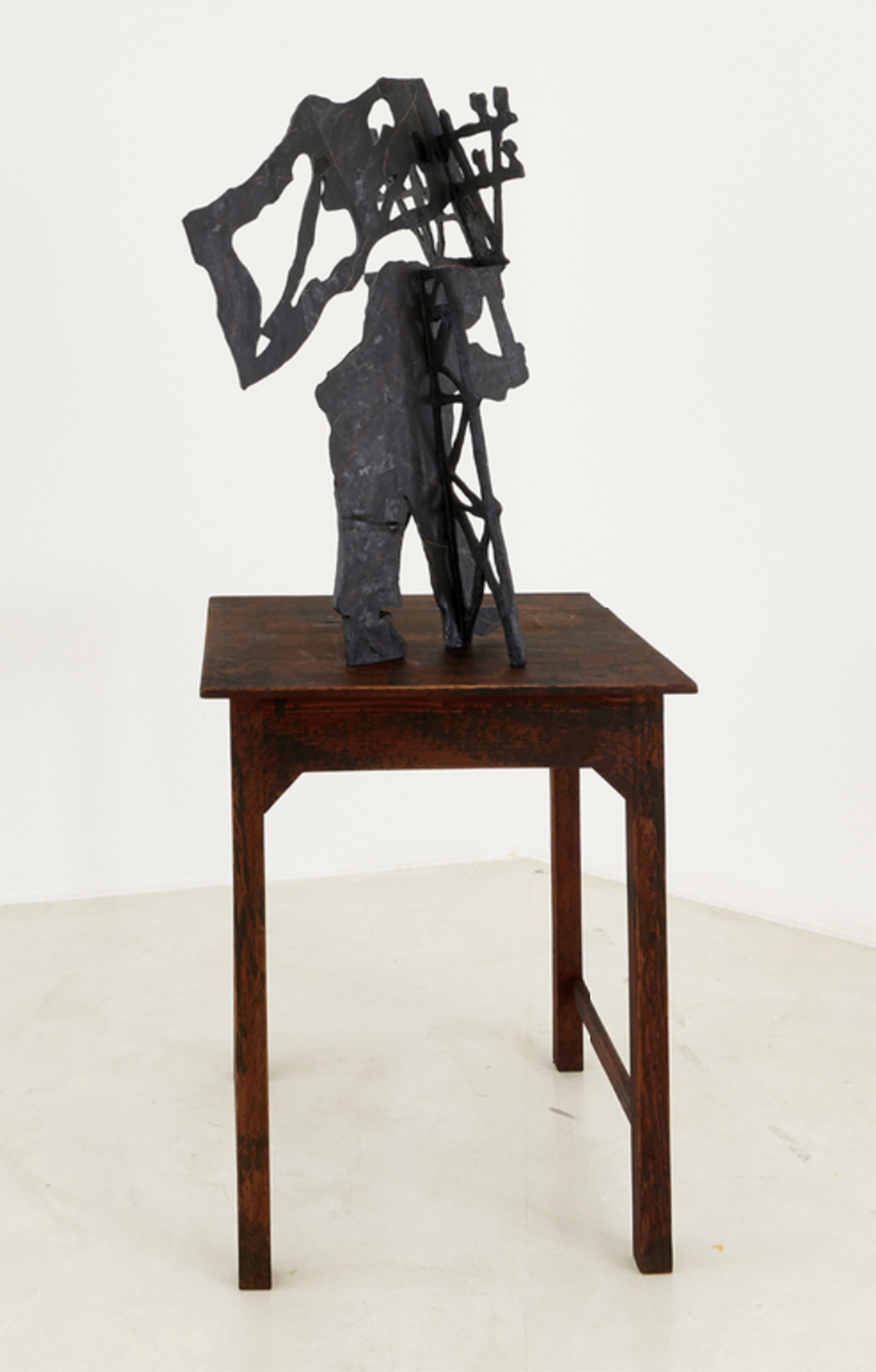
The William Kentridge exhibition that has just finished at the Royal Academy provided us with a wonderful example of an artist working across genres and being inventive in a wide variety of ways. One of the tools he uses when inventing compositions and movements for both human and animal subjects is to make cut out forms that can then be fixed to each other using simple joints. I love this articulated thinking, and have used it myself, both as something totally two dimensional and as a way to think about linking more three dimensional forms together. 

Making articulated figures is a very old way of working and Kentridge isn't the only artist who still uses this technique, Clive Hicks-Jenkins also uses it productively. 


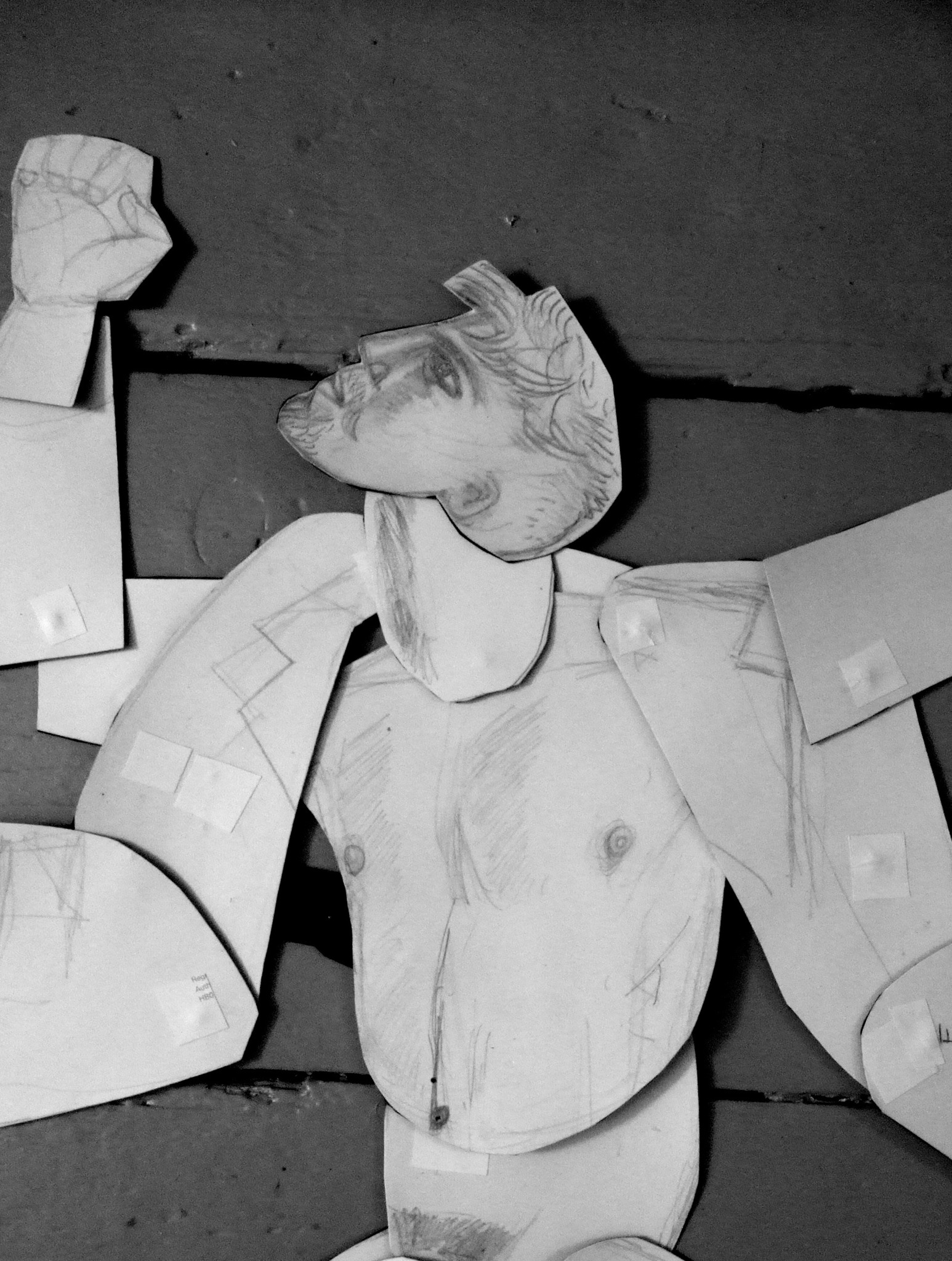
In the image above you can see the various cut out body parts and their associated clothing being assembled. This is not about cutting out complicated forms, in fact the simpler the better, you do though need to have an idea of how joints will be made and where to place them. I use split pin butterfly clips to make my own jointed figures, but have also used paper clips, wire and string. 

Split pin butterfly clips

You can of course simply stitch a joint using thread, use a small piece of twisted wire, anything that allows you to make a joint. Once you begin working like this you can be very playful, perhaps you might make a short animated film of the movement possibilities. 
Don't forget overall image effect. Because you are cutting out shapes you tend to be much simpler or bolder in your thinking; the forms that make up a figure therefore become much clearer. We all have an unfortunate tendency to get trapped into details and this really does help to avoid this. When you begin to make any drawing or textural indications within these shapes it is therefore useful to maintain a simple but clear way of visual thinking. Look at the trousers in the figure below.


The movement of cloth and associated folds in the trousers has been reduced to a few bold marks, this allows for the trouser forms to sit comfortably within the dynamic of the overall composition of arms and legs and body parts; i. e. they are integrated into the gestalt of the whole image. 


You can see this process developing as the image evolves. The simple forms of a cut out coat are integrated into the totality by another set of marks that suggest both the edges of the coat's collar and the play of shadow across creased fabric. The problem would be if you tried to give the fabric a realistic finish, it would not sit well within the simple forms of a cut out. 

Simplified drawing on head and hands and torso, kept visually separate by simply changing colour

Clive Hicks-Jenkins 

Clive states that he begins with a maquette, starting with a paper template and working his way to a fully rendered figure. Once he has the figure made he can play and try out compositional experimentation. He takes photographs and makes sketches as he makes these changes, something that as students you all need to do, so that you can visually explain the processes that lie behind your decision making. Finally for Clive a drawing takes shape, and then in his case often a painting begins. The result will often be quite different to what he had in mind when he started out, as he points out, these things take their own directions. They are what they are. However, as they begin as flat, articulated figures, something of that origin has to remain in the final work.

Clive Hicks-Jenkins 

If you look closely at Clive's articulated cut out wolf, the language of animal hair comes from the same visual language set as folds in clothing. It is simple and bold enough to sit against the cut out shapes that make up the creature. 

This way of working was sometimes used by early animators, my own favourite being Lotte Reiniger.

Lotte Reiniger.

You can see 
Lotte Reiniger's influence on William Kentridge, his own animations owing much to her sophisticated shadow play and of course all of these artists owe a debt to historical folk traditions such as Chinese and Indonesian shadow puppetry. 

Indonesian shadow puppetry

I'm very aware that several students have asked me about portraiture and this approach can be a very interesting way to break out of old habits in terms of facial depiction and composition. 
Tim Hawkinson. Emoter

I have posted on Tim Hawkinson's Emoter  a while ago and I think it is still worthwhile looking at his approach but this time in terms of portraiture. He breaks a face down into units, just as the body can itself be broken down. He uses blown up photographs of his own face to do this, so the type of simplification that drawing can produce isn't available to him, but the implications are still there. You could build a face in the same way that a body is constructed. 


Muscle structure of the face

Face mask with articulated jaw "elu" ("spirit") Nigeria, Ogoni

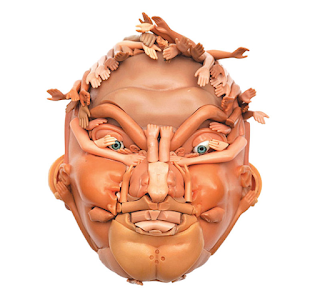
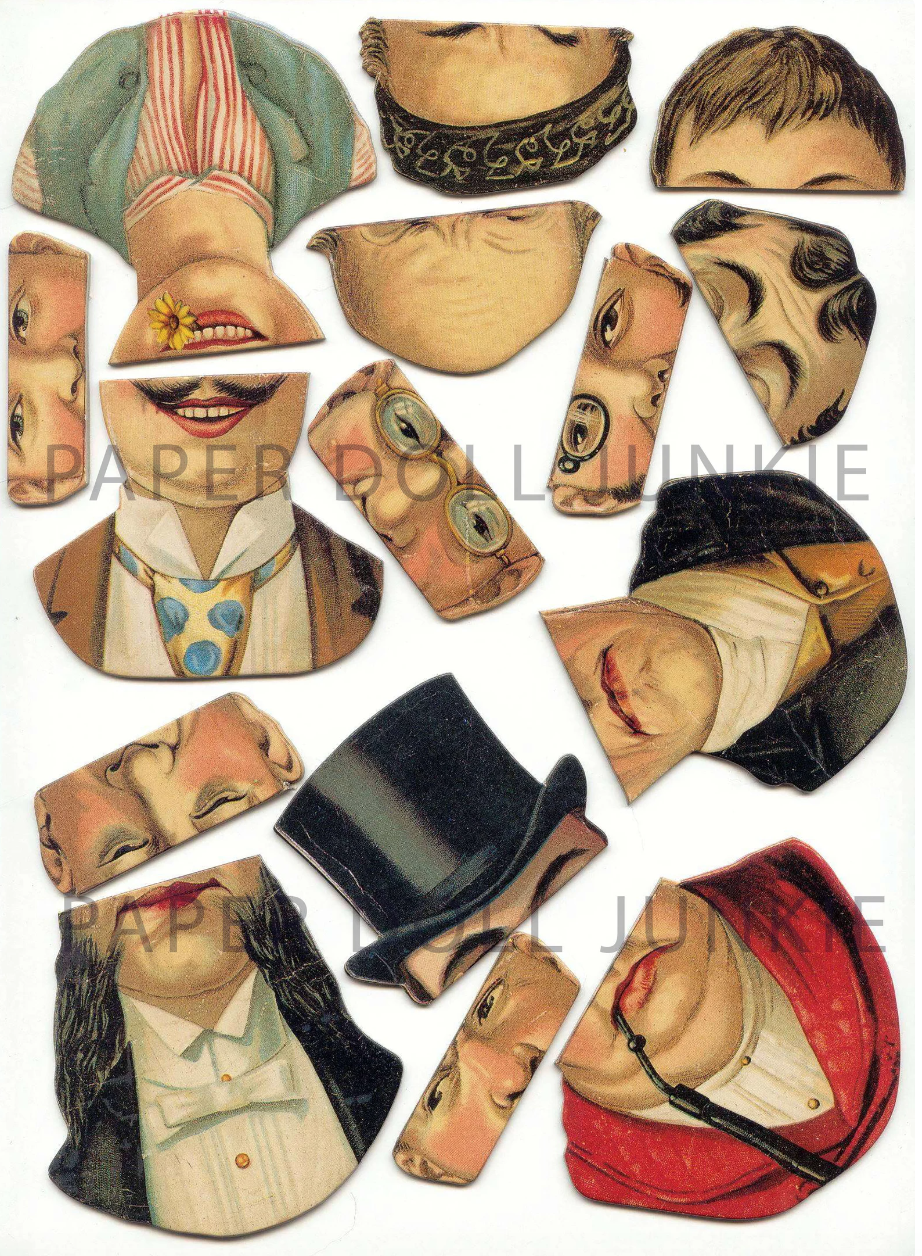
The degree of simplification you bring to this process will determine the visual look or feel of the images made. Compare the Nigerian face mask with an articulated jaw above, with a face made by Freya Jobbins from recycled dolls and the early 20th century paper toy face further below. 

Freya Jobbins

Paper toy face

The world of toys is another area of endless fascination in relation to these issues. Mr Potato Man has a wide variety of body and face parts now available to buy as extras that mean you can extend your Potato Man ideas even further. 

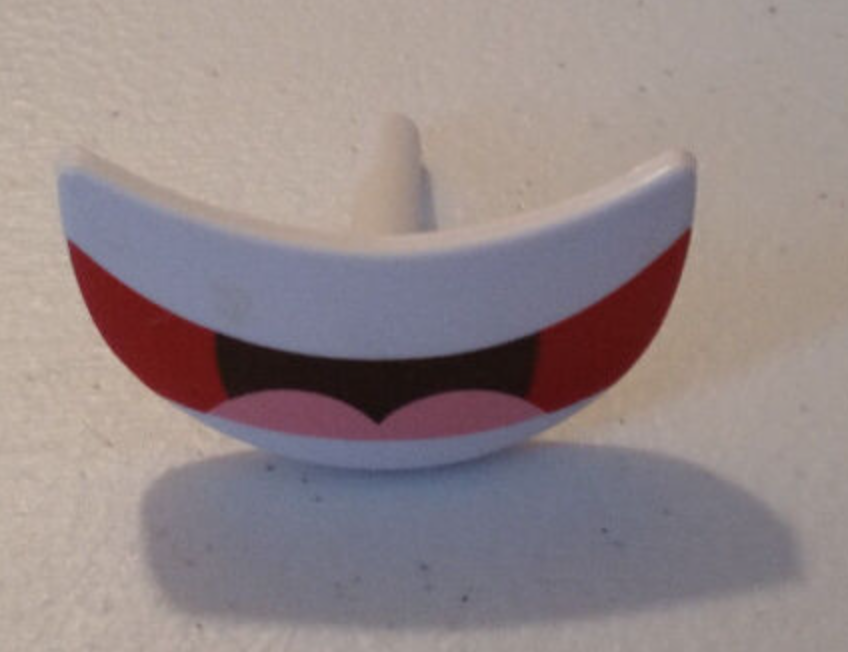
Mr Potato Man mouths

A Mr Potato Man mouth

When you look closely at the mouth forms that the plastic additions come in you may well find that they are very strange abstractions. The mouth above could be a design for an abstract painting. The more we separate a whole into parts, the more each part can become loosened from its original function. This process of atomisation is one that we are very good at, but which has also led us as a species to be able to cut up interconnected eco systems and divide the world into dis-functioning units. Every way of thinking has its effects on reality, and hopefully before we apply these conceptual models we think through their consequences. 

However it is in shadow puppetry that the most deeply mystical and spiritual of articulated images emerge. Like the cave wall that acted as a membrane between the world of the spirit and the world of the everyday, the thin sheet upon which the shadows move is another delicate membrane that sits between the world of the imagination and of reality. 

A figure from the Javanese shadow-puppet tradition of Wayang Kulit

Clive Hicks Jenkins has an excellent blog and he has given a far better explanation of the history of shadow puppets than I could ever manage, so do click on the link and read what he has to say about this wonderful art. 

Christian Boltanski 

Various contemporary artists have returned to articulated shadow puppetry, and as well as William Kentridge, Christian Boltanski and Kara Walker have made extensive use of the technique. 

Kara Walker

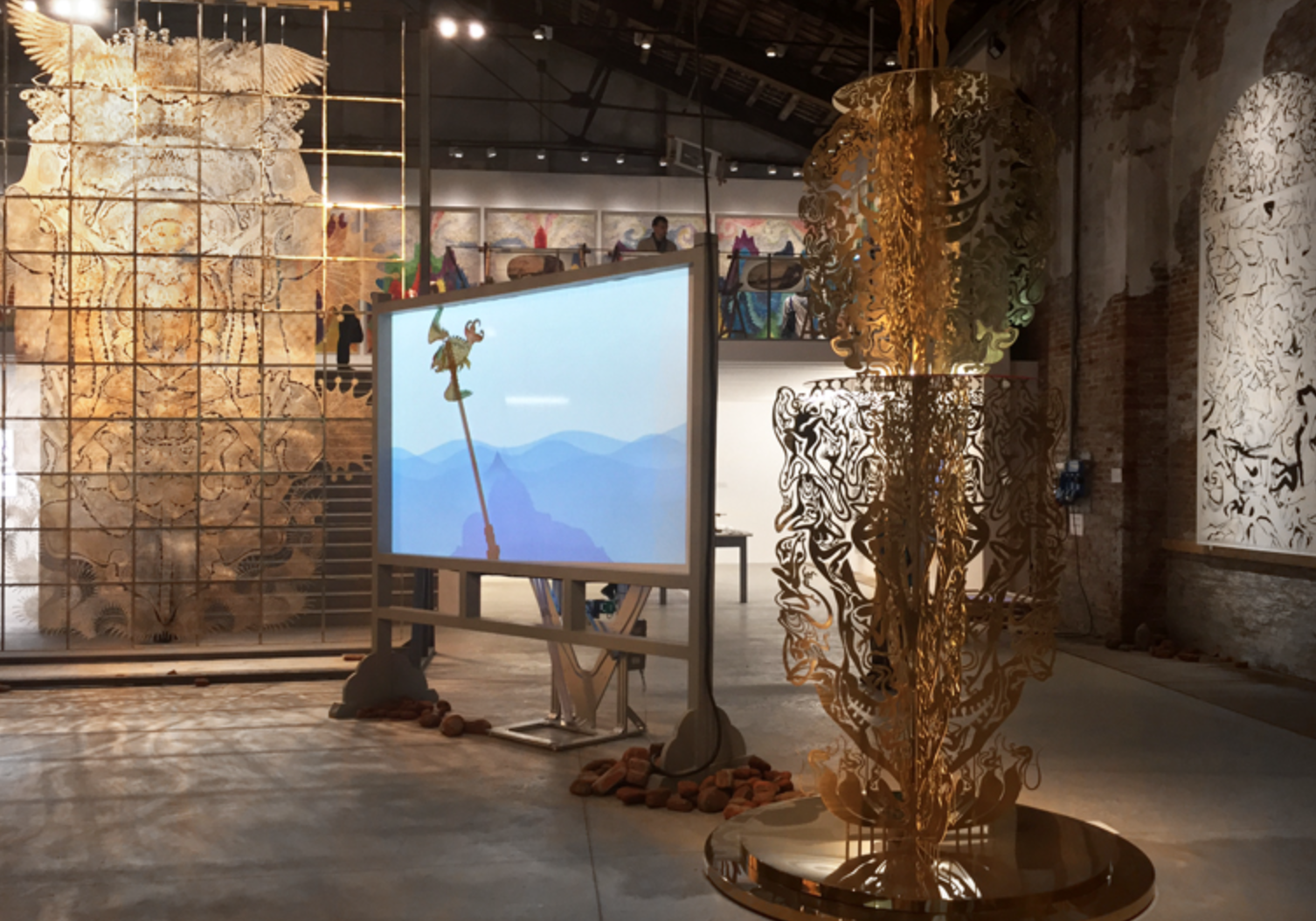
The Chinese pavilion at the 57th Venice Biennale saw the artists Wang Tianwen, Tang Nannan, and Yao Huifen working together to present ‘Removing the mountains from and filling the sea’, a shadow theatre performance. 


Wang Tianwen, Tang Nannan, Yao Huifen: Removing the mountains from and filling the sea

Wang Tianwen, Tang Nannan and Yao Huifen combined new and old technologies to make the work. Traditional skills in making the shadow puppets were combined with computer driven armatures, whilst some components were still fixed to bamboo sticks, such as the waves you can see in the image above. Their work reminds us that old and new technologies are in reality the norm. We keep using what works, whilst we invent new forms, and the one sits alongside the other. We forget that painting is an art form thousands of years old and happily go to exhibitions where it sits side by side with video projections and we have kitchens full of modern gadgets that sit alongside utensils that have changed little since Medieval times. 
It is not just artists that have thought of breaking forms down in this way. Detecting people in images is a key problem for video indexing, browsing and retrieval. The main difficulties are the large appearance variations caused by action, clothing, illumination, viewpoint and scale. Therefore the people that break down images for indexing, represent people use a 2D articulated appearance model composed of 15 part-aligned image rectangles surrounding the projections of body parts: the complete body, the head, the torso, and the left and right upper arms, forearms, hands, thighs, calves and feet. Each body part is numbered so that a numerical filing system can be applied to the images. 

From: Learning to Parse Pictures of People: Remi Ronfard: 2002

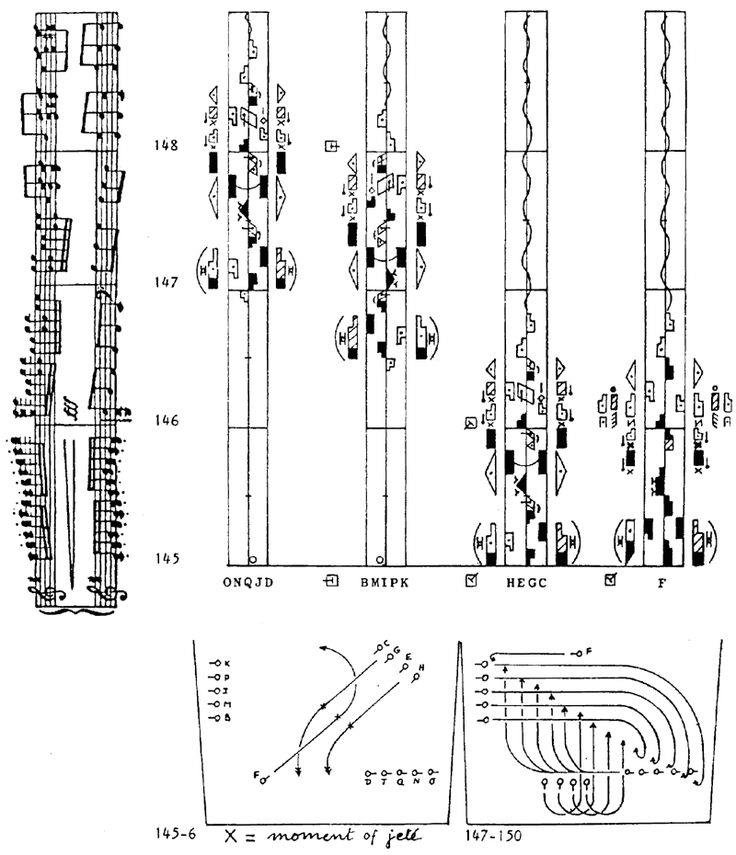
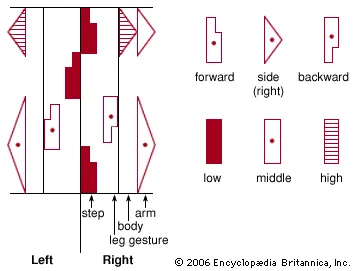
This way of visualising computer images of the body is now 20 years old and is no doubt in the scientific world of computing redundant, but it might be interesting to combine it with Laban notation. 


Laban notation

Of course once you begin looking at how to move a real body in terms of articulating it in sections you could take the idea out into performance and that could be a wonderful new beginning for the idea. What if we could extend or join certain parts?


Rebecca Horn: Finger gloves

All of these thoughts have led me towards my own attempts to work with articulated body parts in an animation.

One of several articulated figures that are going to eventually feature in an animation. 

See also:

Saturday, 17 December 2022

Drawing as theatre

Karina Smigla-Bobinski – ADA, 2010, sphere, helium, charcoal, installation view

One way you can look at certain types of drawing practices is to consider them as theatre. Theatre requires the activation of a space in such a way that an audience can experience a physically contained or constrained series of events, that are orchestrated to communicate particular ideas. In the case of Karina Smigla-Bobinski's drawing installation ADA for example, a box like room space is activated by a floating sphere with short spikes of charcoal attached to its surface. People are also allowed into this space as actants* and as they push or hit the plastic sphere it bounces around the space and 'draws' on all four walls, as well as the ceiling and floor. 

The ball is covered with 300 charcoal sticks with a spacing of 10 inches from one another.

ADA works very like a contact improvised dance performance, the audience being able to step in and out of what could be called an 'action drawing'. 

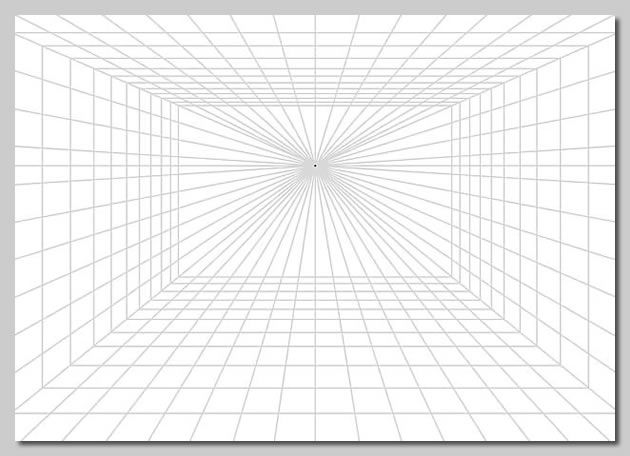
Performance is though usually associated with the theatre and the space of the theatre is often associated with perspective as a drawing mechanism. For instance perspective scenery is a scene design technique that represents three-dimensional space on a flat surface, creating an illusion of reality and an impression of distance. In effect perspective and theatre become fused into a new form, a form that like both theatre and perspective drawing creates an illusionary space for action to take place within it. This fusion was made possible by the introduction of the proscenium theatre. This involved the use of an arch, (sometimes curved and sometimes rectangular) which served as the frame within which the audience observed from a more or less unified angle the events taking place upon the stage. This 'frame' and separation of the audience from the performance, was in effect almost the same as one point perspective.  

The idea of the proscenium arch can be thought of as a social construct that divides the actors and their stage-world from the audience. In fact the seat that would be the perfect point from which to view the action, was often both the place where the person most powerful present would be seated and the spot opposite the controlling perspectival vanishing point. The curtain usually comes down just behind the proscenium arch, both hiding the stage from view when scenery is changed, but also reminding the audience of the reality that surrounds the illusion. 

The stage curtain was not introduced until the 17th century. When it was drawn back the plane it moved through was what became known as the imaginary forth wall. This was like a plane of glass through which the audience experienced the illusion of watching events happen from a distance. A situation that physically reinforced the fact that you could not intervene in what was happening, but God like, you could see what was going on, and therefore you were emotionally engaged, even though unlike the Gods you had no power to intervene. 

One point perspective

Proscenium Arch, Pantheon Theatre, London 1815

Palladio’s Teatro Olimpico in Vicenza

Because this type of stage fits the mathematical model of perspective, it also becomes very easy to use the various tricks of anamorphic perspective drawing to create further illusions. 
Palladio’s Teatro Olimpico in Vicenza exhibits an early use of anamorphic perspective, the illusion that the street is much longer than it really is, is created by a forced perspective. Forced perspective is a technique perhaps seen at its clearest in the Palazzo Spada, as created by Francesco Borromini. He designed a barrel-vaulted colonnade that looks much longer than it is by making the two sides of the colonnade converge and by reducing the height of the columns as they recede.
Palazzo Spada: colonnade: Francesco Borromini

Bramante’s Santa Maria presso San Satiro in Milan is another example of forced perspective, one that you can see easily when a photograph is taken from any point of view away from the one determined by the central vanishing point. 

Bramante: Santa Maria presso San Satiro in Milan

Bramante's perspective illusion choir viewed from the west transept.

In many ways paintings and drawings from this time could be regarded as silent theatre. Perspective created the illusion of a space constructed for action that sat behind a picture frame and the fact that theatres themselves were also now constructed using similar principles, for a while brought the two disciplines into close proximity, but there were other issues that also fused the two ideas. 

In painting there had been a long tradition of gesture as a way to indicate meaning. 
Representations of hand positions or gestures in portraits and paintings were some of the most effective ways of conveying messages. For instance the gesture of the blessing hand shapes the letters IC XC, an abbreviation for the Greek words Jesus (IHCOYC) Christ (XPICTOC) which includes the first and last letter of each word. Therefore the hand that blesses reproduces, with gestures, the Name of Jesus.
The blessing gesture

The language of gesture in Italy was firmly established and went all the way back to Roman times, when hand gestures associated with oratory were established and which were still understood in the 15th century.  


In the theatre, the Commedia Dell’Arte had flourished throughout Europe from the 16th through to the 18th century. (Our Punch and Judy is an English spinoff of this form of theatre). This was a theatre of improvisation which was undertaken within a framework of clearly established roles, with associated masks and stock situations. The professional players who specialised in these roles developed comic acting techniques that could be transported throughout Europe because they didn't rely on any one specific European language. The language used within a Commedia Dell’Arte improvisation was grammelot (nonsense and gibberish). Any audience member could follow the exaggerated physicality and the tone and pace of the voice. The languages of gesture, especially hand gestures, were vital to the construction of the required effect. Commedia Dell’Arte was a theatre style that heavily relied on physicality to build character. This acting style developed the concept of a leading body part (the body part that goes in a direction and the rest of the body follows). This incorporated the concept of centre of gravity in an actor’s body; for instance a bottom fixation could be contrasted to a posture centred on a nose. Imagine an earthy character constantly waggling a padded fat bottom always in confrontation with another character who always had their nose stuck up into the air in an attitude of constant aloofness. Add to this fast signing with the hands, especially with rude signs, as in a very vulgar version of present day British sign language and you can get an idea of the art form.

Watteau: The Italian comedians 

It is Watteau that brings the two traditions of visual art and theatre together again. I have posted about him recently because Watteau as a painter was someone who could deal with the visualisation of a society in a transitional state and I strongly believe that our society is also in a similar position. The people he depicts are set into liminal spaces and the space of the theatre is typical, as it sits between worlds. It is on the one hand 'real' as the actors and the stage are physically clearly in existence, but on the other hand it is an imaginary space, one that can be used to literally play out ideas. The relationships between people in Watteau's paintings and drawings are suggested by small gestures and body postures and you get the feeling that people's minds are suffused by a never ending series of unresolved actions and unfulfilled desires. They act out their lives but perhaps have forgotten their lines. You sense that the people in his paintings have lost direction, that they are unsure about the roles they should be playing and in compensation they turn to the Commedia Dell’Arte players who all know their roles and play them to perfection, day in, day out, to audiences across Europe. 

Deutschlands Geisteshelden: Anselm Kiefer 1988

Because of this understanding of theatre type perspectives being ones within which you can play out an idea, artists still use these one point perspective stage like spaces. Kiefer's large charcoal drawing on canvas, 'Deutschlands Geisteshelden' positions the viewer as if they are looking through a proscenium arch at a stage. Burning torches line the walls of a space that is empty except for the names of the actors scrawled above the fast receding, single point perspective floor. These actors (or actants) are German cultural heroes; Joseph Beuys, Arnold Böcklin, Adalbert Stifter, Caspar David Friedrich, Theodor Storm, and others. These are the actors of a painful history play and Kiefer sets out his image as a stage, so that he can make them perform as ghosts of their former selves. All are dead, Joseph Beuys, his mentor dying in 1986, just before Kiefer began drawing out the image. Kiefer I'm sure was well aware of the relationship between images made using one point perspective and the theatre, he is a well read artist and he cites many literary figures as past influences on German culture. The image as a stage whereby ideas are acted out continues to be a powerful idea and as more performative ways of working have emerged out of traditional drawing practices, I would suggest that the fusion of drawing and theatre is something that will become more and more the norm. 

So is Karina Smigla-Bobinski's 'ADA' part of this tradition? I would suggest it is. The large sphere is playing out the role of a performer, or actant, alongside the people that have to enter the space to move it around. Without the people, the sphere would just sit there. The resultant drawings, like in all 'draw to perform' works, are traces or recordings of the event. ADA is also in form very like the virus that has invaded our lives over the last few years, a fact that begins to give extra traction to the non-human character Smigla-Bobinski has invented. I have for some years now been interested in animism and I would argue that ADA operates within an animist framework, the sphere becomes an actant in the same way that any objects in an animist framework can become part of the interconnectedness of the life system that someone belongs to. The term 'actant' is itself a reminder that within an animist world we are all actors; landscapes, people, plants, rocks, animals and the weather and that perhaps by returning to these types of very ancient traditions, we might find that we begin to regain a much older and more productive relationship with all the things that surround us, but which we have for many years ignored because they were not other humans. 

* Actant: Is a term used in literary theory and is a way of referring to a person, creature or object playing any of a set of active roles in a narrative or event. This means that in this case the people who enter the space defined by 'ADA' are as much a part of the event as the sphere. By using this term you can suggest that both the actors and the scenery are acting out vital roles within a play. It is also a term that helps us think about how in 'object orientated ontology' humans and other things can be considered as having an equal footing on the bill of life. 

See also:


Life or theatre


Sunday, 11 December 2022

Vanessa Baird

When I went down to London to see the William Kentridge exhibition at the Royal Academy I also managed to fit in a few other exhibitions including the OSL Contemporary Gallery at No. 9 Cork Street, that was hosting a FRIEZE exhibition of the work of Vanessa Baird. I introduced her work to readers of this blog last year as an artist who has directly confronted her difficult life as a source of imagery.  She is an artist that makes drawings of the chaos of existence, everything that happens to her being grist to a visionary mill. You really feel she has no inner censor and that what you see is the totality of what she experiences and feels about what is going on around her. If I wanted to illustrate the fact that drawing can be used to respond to the full spectrum of the human condition, there couldn't be a greater contrast between my last post on the work of William Anastasi and Baird's messy, colourful, psychologically intense images; images that seem to flow out of her life and that are exhibited in such a way that they totally fill any available space. 

Vanessa Baird: I Can Get Back Down to the End of the Town and Be Back in Time for Tea

The exhibition, 'I Can Get Back Down to the End of the Town and Be Back in Time for Tea', was quite an exhausting experience, Baird’s images made in pastel and watercolour on sheets of A1 paper, were presented three images high, edge to edge, wall papering the upstairs gallery space at OSL Contemporary, so that there was no space left for anything else.  
Her storytelling comes from a wide range of references, most from her own lived experiences, as well as some from Scandinavian folklore and literature. She is also regularly commenting on contemporary political and social affairs as well as making observations on personal domestic realities. 

Vanessa Baird

She is as happy to make an image of herself unexpectedly farting whilst cleaning up broken crockery, her severely distressed mother watching on, as she is to illustrate a creature from a Scandinavian folk tale. Because so many of her drawings include images of her very ill mother, her work reminds me of a time when I had to watch my own mother dying of cancer and of the images I made 40 years ago. They are images that when I see them now I still find uncomfortable and difficult to look at, but at the time they had to be made. I would travel down to Dudley on a Friday evening after work and travel back to Leeds on Sunday evenings. At the time I wasn't driving so I used the coach, filling small sketchbooks with scribbled drawings about what was happening and then making more worked up images during the week. I drew things she told me, stories of her life and images of her dying. The chair at the side of her bed had spirals of inlaid mother of pearl set into its arms, as the weeks wore on and it was clear she wasn't going to last long, those spirals become more and more significant. Life will at some point or other throw at you the full kitchen sink of emotional and intellectual conundrums and if art is what I think it is, it will be up to dealing with any and all of these experiences. 

Constance Thelma Barker 1985

Constance Thelma Barker 1985

Slipping away

Vanessa Baird's images are much more energetic and life affirming and I was very aware that her own experience differed considerably from mine. When I was making images of my mother's slow death I had young children of my own and responsibilities, all of which heightened a sense of being unable to really deal with the emotional issues that surrounded me at the time. Experiencing the death of another is also about the coming to terms with the death of oneself. I am now much older than my mother was when she died and feel as if I still have a lot of life's experiences to process as imagery. Baird's images are however far more immersive than mine, perhaps I have always maintained a certain distance from life in order to respond to it. Perhaps as Baird gets older she will become more detached, her present life whereby she spends most of her time caring for her ageing mother, is one many people might recognise, but few would have the energy left to also make so many images about the experience. Her life experience is I would have thought a hard one, but she also reminds us that we must never forget, in the middle of sorrow there is often comedy.


Earlier in the year I went to the Kawanabe Kyōsai exhibition at the Royal Academy, and Baird's imagery brought back memories of another artist that was happy to draw and make images of everything and anything he experienced. The fart as an image is ubiquitous, something I've seen in old German woodcuts and the drawings of Hokusai, as well as an activity celebrated by comics and comediennes from Mel Brooks to Miriam Margolyes. 

Kawanabe Kyōsai: A study of the effects of flatulence 

The fart joke is probably the oldest joke. Chaucer told a classic in The Summoner’s Tale. A manipulative friar seeks a donation from an old man, who angrily says he already donates enough to the church.  The friar then gives him a sermon about the dangers of anger, before asking him again for a donation. The old man replies that he can have a donation if he agrees to divide it equally amongst the other friars at the convent. The friar agrees and so the old man asks him to put his hands together as if he is about to receive some money. The old man then turns round and drops a tremendous fart into the friar’s cupped hands. The second half of the story is then concerned with how to divide a fart evenly and the tale's final image is of twelve friars arranged  around a wagon wheel, each at the end of one of its twelve spokes. Then, when a fart is released over the centre of the wheel, it will according to Chaucer, travel evenly along each spoke and therefore the nose of each friar will receive an equal portion of a carefully divided nasty whiff. 

A fart joke from an illuminated manuscript 1344

The images that we create as human beings can be sublime and can also be crude, who is to say which are the most important to us? 


Vanessa Baird's images are stacked edge to edge

Vanessa Baird

The fact that both William Anastasi and Vanessa Baird could at one time or another have been making images whereby I found parallels with my own approaches, points to the issue of life itself and how different concerns emerge. At one point in my life it was the philosophical conundrums of art practice that fascinated me, such as what lay behind representation and at another time I felt much more deeply engaged with the drama and complexity of everyday life and how I could use images to reflect on it. My recent work on interoception, consciousness and the way our nervous system is layered has made me much more thoughtful about how emotional feelings and intellectual engagement are intertwined and that the full spectrum of life; thinking and feeling can be all dealt with by a drawing practice that like a diary records and responds to life as it changes. As I get older I also get less and less worried about what my work is about and much more interested in what emerges as I make it. The journey of the work now made, perhaps reflects the complex journey of later life, of knowing a lot of stuff but being less and less able to do the things you used to do. The one thing that is still in common with the images I was making 60 years ago, being that I still just like making images and above all finding out what the next one will be like. 

See also:

Hybrid forms Reflections on the acceptance of difference and fluidity

Tuesday, 6 December 2022

William Anastasi and conceptual drawing

William Anastasi: Pocket Drawings

In 1969 William Anastasi folded a sheet of paper into eight rectangles, making them the same size as his back trouser pocket. As he walked, he held a tiny, soft pencil against the exposed paper inside the cramped space of his pocket; the resulting marks on the unfolded sheet of paper graphed the activity. When he decided a drawing on one section was finished, he refolded the sheet, creating a new blank surface, and the process began again until all eight rectangles had been used. 
He was the first artist I ever came across to suggest that walking was good for thinking, something I still believe is true. “I love walking,” he said, “I find that walking does something to my thinking, to my mental process, that is different from sitting or lying down.” 

When I was an art student in the late 60s and early 70s undertaking my DipAD, conceptual art was a very powerful shaper of possibilities and the musician John Cage and the artists associated with his practices were vital to the milieu that these ideas were emerging from. One of the artists central to these practices was William Anastasi and I thought it would be useful to remind both myself and those of you that read this blog, how influential at the time his work was. 
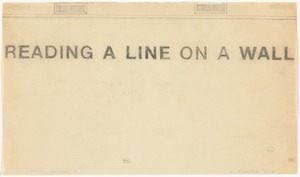
William Anastasi: Reading a Line on a wall: 1967

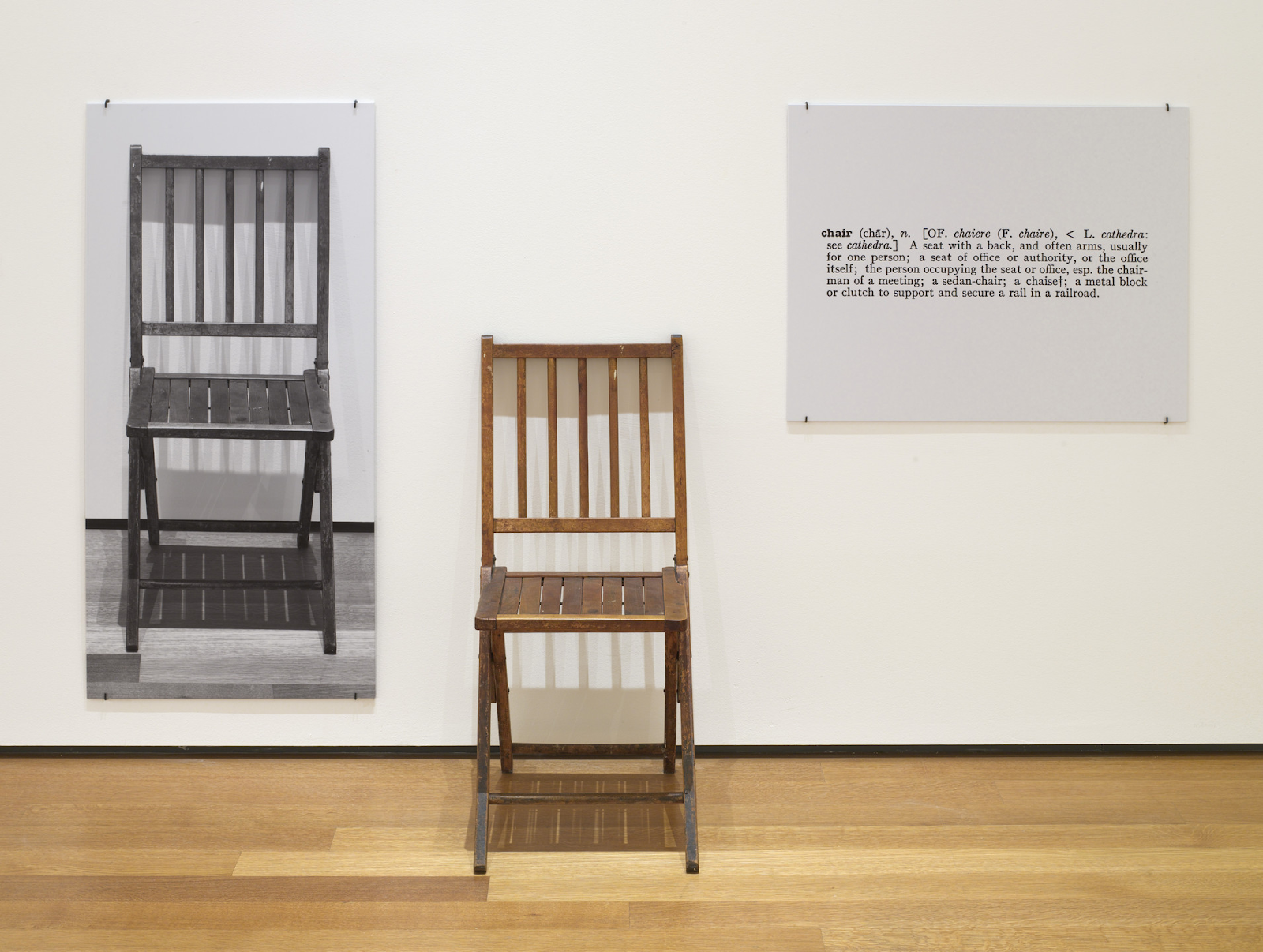
READING A LINE ON A WALL is one of those art pieces that seems almost about nothing and appears devoid of any content aside from the fact of its own legibility. However just like Joseph Kosuth's 'One and Three Chairs' of 1965, it opened up debate as to what was actually going on when we encountered an artwork. Kosuth like Anastasi belived that “art is making meaning,” and like the theorist Greenberg, he believed that most of the art of the Western canon was about artists trying to make responses to what it was to make art. For instance Gombrich's 'Art and Illusion' was a very important text at the time and it was centred on the history of the 
psychology of pictorial representation, suggesting that each new generation of artists was concerned to push the possibilities of visual representation, and that art history could be seen as an ever unfolding set of approaches to getting us to 'see'. 

Joseph Kosuth 'One and Three Chairs' 1965,

In Kosuth's case, by assembling three alternative representations of a wooden chair, he constructs a platform for exploring representational meaning or how we come to determine what things are; he asks the question, "What are the differences between a 'real' thing, its representation and its definition?" In Anastasi's case, the work's content is also about definitions, and it is also firmly in the present tense, as it refers directly to our reflective sense that during the moment when we read 'READING A LINE ON A WALL', we are reading and all distinctions between the content of the work and the activity of the beholder dissolve into a state of self-awareness, immediacy and a truth statement. It is what it is or a 'what you see is what you get' moment, a type of position that also reflects Frank Stella’s famous statement ‘What you see is what you see’, that became the mantra of Minimalism.

As a viewer you are 'asked' to reflect on the implications of reading the word 'reading', an activity fraught with intellectual pitfalls. It is easy to forget but this was a time of complex aesthetic yet conceptual but also semiotic and philosophical niceties, as unpicked very astutely by Tom Wolfe in his essay 'The painted Word'. As a student in the late 1960s I was quickly made aware of the need to 'read' a work of art as a text. Because of the still heavy influence of Clement Greenberg these 'texts' also had to be self referential, Greenberg's 'Towards a New Laocoon'* advocating a development of Lessing's position that different types of art could only carry certain types of content. For instance according to Greenberg painting could only carry messages about paint, surface and colour and that any additional 'narrative' was false and would be an additional interference. Therefore the most highly regarded paintings and sculptures of the day were those that most thoroughly manifested the essence of their own means of expression through various modes of self-referential production. These might be certain types of brushstrokes, or ways of dividing the canvas into areas of colour, or the artist leaving traces of painterly actions, (Abstract expressionism, the abstract sublime and minimalism were all movements influenced by these theories). Like many of the most conceptually rigorous works from the late 1960s, Anastasi’s drawing confronts the criteria of that narrow aesthetic paradigm in a way that is meant to demonstrate some of the flaws in the argument. For instance the sparse white wall in the drawing is an illusion of a white wall. Typical art galleries now hung art against large clean white walls, which was an idea that will soon be picked apart by Brian O'Doherty in his essay, 'Inside the White Cube, The Ideology of the Gallery Space'. What seems very non figurative is in fact a very highly figurative image, of a gallery wall, therefore a dreaded illusion. In fact it is a drawing of a particular gallery wall, the arrangement of air vents, electrical sockets and moulding corresponding precisely to one particular wall of the Virginia Dwan Gallery in New York. The physical flatness of the sheet of paper itself participates fully in the imitation of the wall that the drawing depicts, its size for size correspondence with the actual gallery wall, adding to the conundrum, especially when exhibited on an even larger gallery wall, such as those at MOMA.

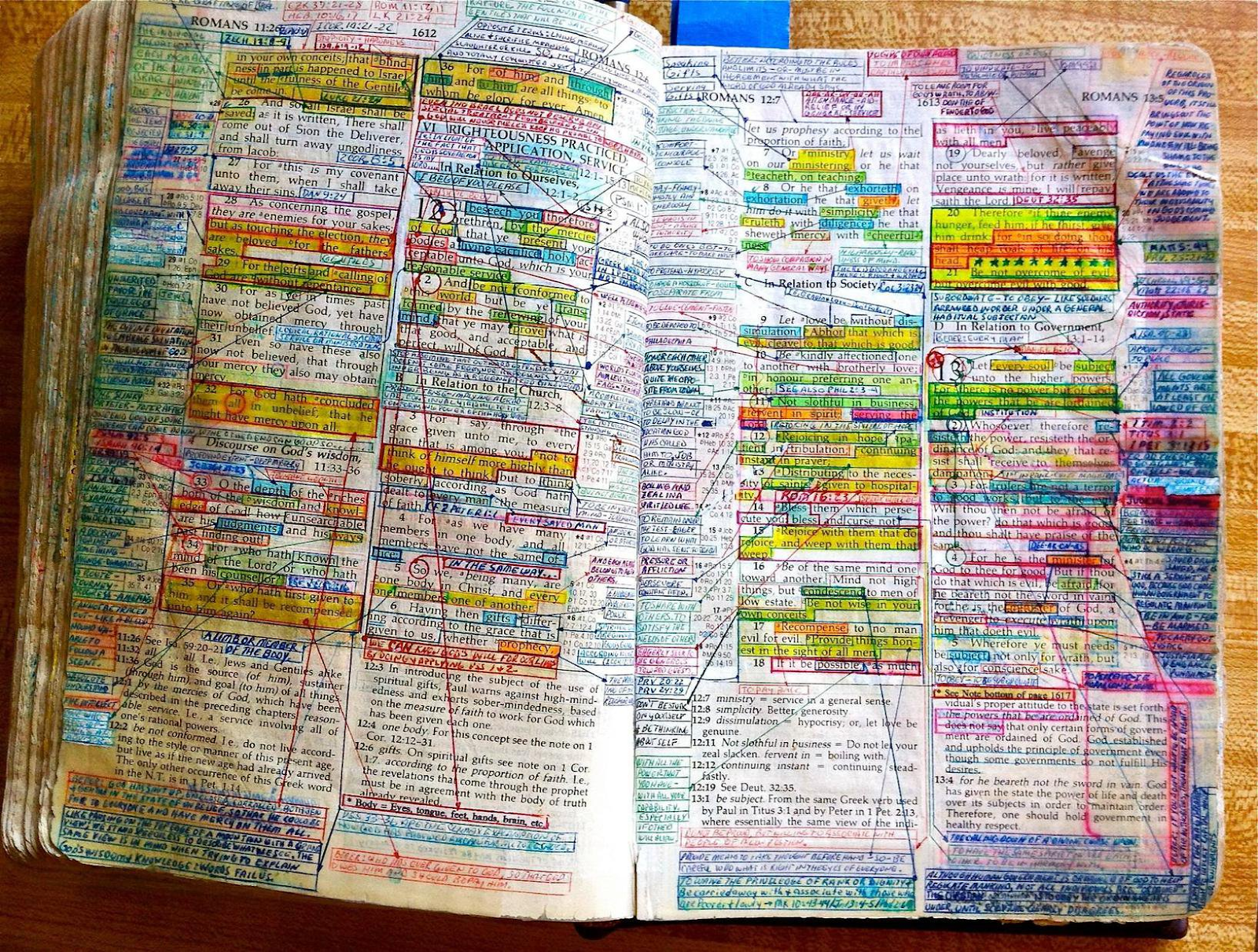
But which line are we reading? The line that suggests moulding or the line of text? The drawn line or the written line? Both lines are central to their relevant disciplines. Lines are the bedrock of both drawing and writing. However the words 'READING A LINE ON A WALL' are in upper case blocked letter forms and as such they are solid forms rather than lines, which they could have been if Anastasi had used a lower case cursive text. Upper case or capital letters suggest something important, like the capital letters surrounding Roman civic buildings, they are authoritative. As you can see by now, 'READING A LINE ON A WALL' takes a fair bit of reading and for a young lad like myself this set of readings within readings was quite liberating and it opened a door to what is known as 'hermeneutics', the branch of knowledge that deals with interpretation, especially of the Bible, where various interpretations are often found surrounding earlier texts. Layers of meaning nested with layers of meanings. 

An annotated Bible 

You can find some old Bibles with already printed 
hermeneutic annotations and when these include the individual annotations made by the Bible's owner the reflective layers begin to get more and more fascinating as you begin to realise how as human beings we strive for the 'right' interpretation. However what we only ever arrive at are interpretations, never answers. This is perhaps the central meaning if there is one to Anastasi's 'Reading a Line on a wall'. No matter how carefully a text is read, even with expert guidance it will always remain unknowable. It is easy to forget the powerful role of critics at that time in determining what was good and bad art. In a post-modern world there are as many answers to what is good or bad as there are questions, but back in a time when people still went to Sunday school and were made to read and make sense of their Bible, it didn't seem so strange that someone in 'authority' might try to lay down a definitive interpretation of art. 

Garry Barker: Handmade Bottle Rack: 1972
This type of self referential art was very popular when I was a student and I was at the time sucked into the game, making several pieces of art that 'cleverly' commented (or so I thought at the time) on the activity of art making. I was bamboozled by theory and persuaded that all good and interesting art was always to some extent a reflection on the nature of art itself, by the staff that taught me at that time, Keith Arnatt in particular. It was not until I read Tom Wolfe's text 'The Painted Word' in 1975 that I was able to get past the what had become a block on my own ability to use art to reflect on the wider issues that I had begun to see as being much more worthy of taking up my time. Gradually I began to see that art's spectrum of human awareness included everything from philosophical debates as to how many angels could be found dancing on the head of a pin, to stories about leaving the washing up until tomorrow. In fact the older I got the more I began to realise that the best and most important stories weren't even told by humans, it was just that we like to hear the sound of our own voices. The 'Handmade Bottle Rack' was very much a response to my own history at the time. I had come to art college directly from working in a steel works and I decided to make Duchamp's readymade by hand. I was trying to make a comment about the way his intellectual achievement, had negated the achievement of the 'workers', those who laboured in factories to produce objects like the bottle-rack and who's labour was usually forgotten especially by the sort of people who would use a bottle-rack. (At that time wine drinking was seen as a very middle-class thing to do, working class people drank beer). I was also making a point about the artist's labour and that 'Judd's dictum', "That anything is art as long as somebody calls it art", was another middle class attempt to take away the meaning of labour, skill and craft from those who worked with their hands. Looking back on the work, perhaps its most important aspect was the fact that I made it in such a way that all the materials could be recycled. After exhibition and it being photographed, it was taken apart, and all the materials given back to the workshop where it was made, so that next year's students could use them. If the job of an artwork was to communicate an idea, then once done, like yesterday's newspaper, it was redundant, and the idea of keeping work for posterity was I argued, a middle class idea about the creation of an elite culture and a way of supporting an evil capitalist art world economy that relied on the monetisation of curated ideas. 

As a young man I was far more 'militant' in my thinking and found a harsh conflict between what I was being taught and how I felt as someone coming from a working class background. For instance my parents loved 'tranculments', (a Black Country word for ornaments) or as I had begun to think of them, small scale domestic sculptures. They carried ideas such as memories of places visited, (souvenir porcelain miniatures carrying names of seaside towns), reminders of old traditions, (horse brasses), a love of animals, (miniature ceramic dogs) and reminders of war (polished and engraved brass shell cases), but I was quickly educated to see these things as kitsch objects. They were I was told cheesy or tacky, this was apparently not art, these were objects that appealed to popular or uncultivated tastes because they were overly sentimental, and I was being taught to see these things as ugly, without style, false, or in poor taste. But in order to fight back I had to learn the language of middle class art and of course in doing so I received the approval of my tutors, who thought my work at that time was good. I had moved over to the other side and become middle class,  my 'educated' stance was understood by other middle class people as clever and the work I did was totally incomprehensible to the rest of my family who still collected souvenirs and polished the horse brasses on weekends. 

As contemporary students you may well have similar experiences. What I found as I got older was that all these things are simply aspects of a human condition that is a reflection of how we make sense of the world around us. The problem is that at certain times you will find gatekeepers to the profession that you want to enter. Whether this is your tutor, Clement Greenberg or your local arts council officer, people will have ideas about what art is and what it is for, and you will have to form your own beliefs and set of convictions if you are to practice art on your own terms. 

* 'Towards a Newer Laocoön' by Clement Greenberg, was a very influential critical text, the title refers both to Gotthold Lessing's Laocoön: An Essay upon the Limits of Poetry and Painting, of 1766, and to Irving Babbitt's The New Laokoön: An Essay on Confusion of the Arts, of 1910. Greenberg is interested in the existence of limits or boundaries that distinguished the differences between the various arts.  According to Greenberg's argument, it is a truth value characteristic of modern art that each type of art had to define itself in terms of the limitations of its 'proper' medium, or in other words to preserve a 'truth to the materials' involved in the practice of the various art forms. 
See also:

The Painted Word by Tom Wolfe

Who's afraid of Tom Wolfe: Judith Goldman's repost to the Painted Word

Walking and drawing More reflections on the influence of Keith Arnatt but also an introduction to the work of Stanley Brouwn another late 1960s conceptual artist who drew. 

Drawing and measurement Another Keith Arnatt reflection

Drawing and philosophy

Facing a blank sheet of paper One of my own attempts to make work that reflects on similar issues

The word 'art' and its history