Friday, 11 April 2025

Drawing the dead and the dying


Images from the time of my mother dying

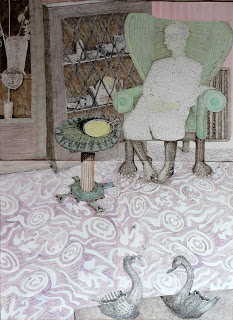
When my mother was dying I used to go down to my home town every weekend to see her and sit with her. I drew her several times and when she finally passed away I made images from the drawings as a way to come to terms with how I felt about her death. She was always surrounded by her 'tranculments', which had by then mainly been placed in glass fronted cabinets, but several, such as the swan vases or a toby jug, still adorned any spare surface, such as the top of the TV. I could find myself dizzy with the carpet pattern, often just looking for somewhere to rest my eyes, and when they rested on her, she seemed the most insubstantial thing in the room. I have a drawing of her where she literally dissolves into her chair and others where she becomes manic in her distress or lost in her bed. One drawing I made of her in bed, shows her dissolving into the pillow, whilst the bedspread becomes a repository of stories from her life. I drew all sorts of events that she had told me about, including the time when her sister Mary had trapped her foot in a rail line junction point, and how they were terrified a train would come. I tried to remember when she was happy and times when we were together, but there were many sad times too. Eventually the bedspread was covered with memories. 
When I first met Paulo Luís Almeida, he was giving a talk about his own response to a parent dying. He drew his father during the last years of his life as he succumbed to Parkinson’s disease, and Paulo spoke about the erosion of language and the disappearance of his father's world. Paulo went on to say that drawing 'incited a memorialising function of the trace'. Empathy was in his case the key issue, whilst for myself it was simply loss.

Paulo Luís Almeida: Untitled 2011

Maggie Hambling drew both her mother and her father as they were dying. 


Maggie Hambling

Hambling's drawings use a searching line that I feel attempts to give back life to the dead. Her own energy of looking is locked into these images forever, and when she has herself passed on, she will still exist in the frozen moments of her looking. 

Occasionally Foundation students used to ask me if they could get to draw dead people and the only person I knew at the time that had a way in to do this was Brian Holmes. I remember that I drew his portrait at one time, as he used to live just around the corner from where I lived in Kirkstall, however where that drawing is now I haven't a clue and he is now long dead, a reminder that every portrait ever made is in fact a memento mori. Brian was at one point commissioned by the School of Medicine of the University of Leeds to paint a mural detailing the history of Leeds Medical School and that meant he had access to their facilities, including the dissection area.

Brian Holmes: Detail of Leeds Medical School 

Brian Holmes: Foot: Etching

Brian used to go in to the anatomy area and draw bodies and could occasionally, if asked, get a student to go in with him. One of the students that asked me if he could get access was Damien Hirst, who always asserts that he was influenced by his visits to the anatomy department of Leeds Medical School and that he made anatomical drawings there. None of these drawings seem to have surfaced, but the photograph 'With dead head' has become an iconic part of his oeuvre. I'm not even sure if Brian was able to get Damien in and Damien may well have found a different way to get access, the point being that it was his association with the ever present idea of death, that to some extent signalled him out at the time as an artist of significance. 

Charles Emile Callande de Champmartin
Théodore Géricault was well known for painting and drawing the dead. In fact the image above was thought to be by him until a cleaning revealed the signature of his friend and follower Charles Emile Champmartin. Ironically the painting actually depicts Géricault himself on his deathbed. At the time, he was such an iconic trope of the tragic Romantic artist, that copies of his death mask were often found in young artists’ studios. 

Géricault: Deathmask

We all have to confront death at some time, it is a normal part of life and most cultures have embedded within them ways to come to terms with this fact. Except I feel our own, where we rarely see dead people.  Perhaps we all need to remember that we are dying, and in doing so, we might value life that much more. 

Head of the dead Christ: Durer

During the many years that Christianity formed the dominant religion of the Western World, images of the dead or dying Christ were available for everyone to see. People were constantly therefore being reminded of how death was a central fact of life. In traditional Buddhist teachings, contemplating death is an integral part of meditation. Buddha states that death is “the greatest of all teachers”; it teaches us to be humble, destroys vanity and pride and crumbles all the barriers of caste, creed and race that divide humans, for all living beings are destined to die. 

Kusôzu

Perhaps we need a return to the old Japanese Buddhist tradition of Kusôzu, whereby images were made of the sequential decay of a cadaver; not pretty but a clear message. The Roman Egyptian idea of encaustic "Fayum portraits," which were placed over the heads of mummies in coffins, is an interesting take on mortality and portraiture. These were not only realistic depictions of the deceased, the images were kept on the walls of the houses of the living and then when someone died they would be transferred to the coffin. So you would have been very aware that when the artist came to do your portrait, that its final resting place would be the same as yours. Being made in encaustic, which is an amazingly long lasting paint material, your image would like Dorian Gray stay youthful, whilst you would decay like Gray's portrait. Wilde's neat role reversal idea, in many ways highlighting our mortal condition.

A Fayum portrait

If I had to show one image that transcended the genre it would be the one below by Käthe
 Kollwitz. Kollwitz drew the workers that she met, particularly women who struggled to keep themselves alive under the most harsh conditions. In this image the woman you feel can see her own death in a not very far off future, a black ghost already sitting at her shoulder. But at the same time Kollwitz has found a deep humanity in this woman, she is a solid yet wonderfully delicate presence, on the one hand to be blown away by the trials of a hard life and yet on the other she is preserved, rock like, in all her dignity within Kollwitz's drawing. She is always in that moment that she appeared to Kollwitz, time past, present and future unravel and we are forever in the now of her being. 
 
Käthe Kollwitz

See also:

Dat

Artis

Saturday, 5 April 2025

Jonathan Richardson's self-portraits

Self portrait: Foot pain and its emotional effects

I have been making drawings and printed images of people, whereby I listen to them talk to me about their internal perceptions, (interoceptions) of pain, emotion and other inner body feelings. Essentially what I am making are a series of portraits, but images that attempt to reflect the interior world of people, rather than their external appearance. My fellow researcher at the Leeds Arts University, Dawn Woolley is focused on the photographic selfie, so it feels as if we have both interior and exterior awareness covered.
When thinking about a history that might lie behind my approach, I began by looking at expressionist portraiture, but as I dug around the subject, the more I came across the self portraits of Jonathan Richardson. 

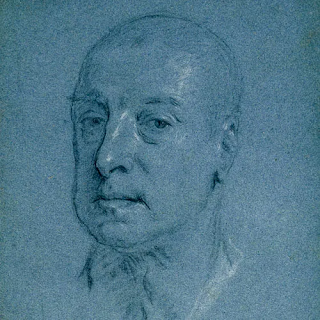
Jonathan Richardson, Self-portrait, c. 1735

Richardson made hundreds of drawn self portraits over a period of several years. This type of serial facial analysis looked at from a present perspective, feels very modern. For instance in relation to expressionist portraits, in three of his more prolific years, Vincent van Gogh, drew and painted himself over 40 times. and as photography has become the main form of facial representation, serial portraits, such as Jo Spence's 'Brave' series, have become central to documentary practices.

Jonathan Richardson, Self-portrait, c. 1738

Richardson even went back to earlier work and made drawn copies of his self-portraits from paintings made many years earlier. Most of his self portraits are however drawn from life, using a variety of materials, including pen and ink, graphite on vellum but mainly black and white chalks on blue paper.

Jonathan Richardson Self-portrait as a poet, c. 1732

Jonathan Richardson, Self-portrait, c. 1728

During his early career as a portrait painter he defined his trade in this way, "a portrait is a sort of General History of the Life of the Person it represents, not only to Him who is acquainted with it, but to Many Others, who upon Occasion of seeing it are frequently told, of what is most Material concerning Them, or their General Character at least." However his later self-portraits, which are nearly all dated, are not a ‘General History’ of his life, they are far too particular. They represent the complexity of an inner emotional life, rather than the status or occupation of the sitter.

Jonathan Richardson Self-portrait at the age of thirty, 1735

Jonathan Richardson Self-portrait, 1736

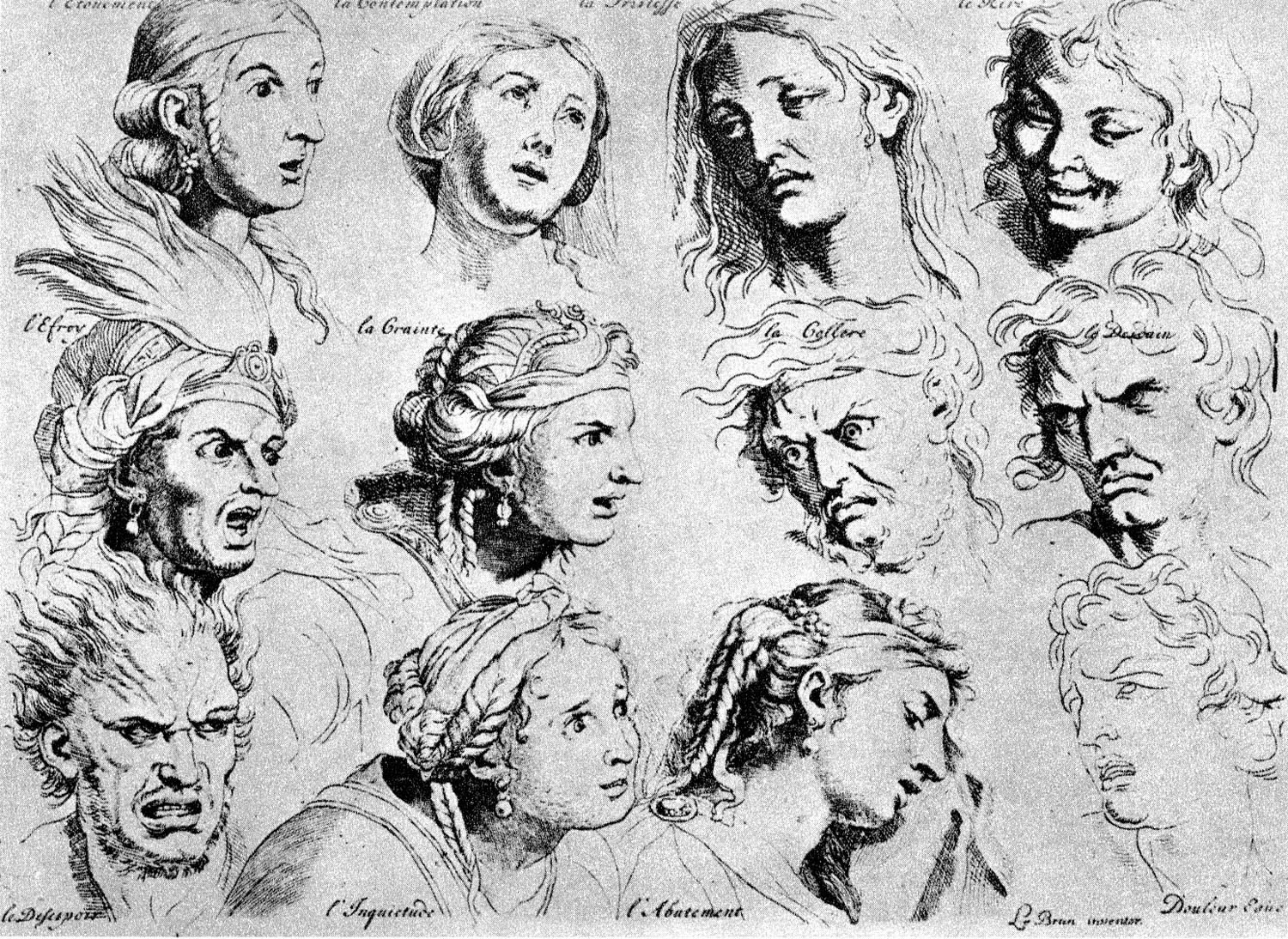
I find his portraits intriguing, especially how with slight differences in the openness of an eye, or width of a face, as well as by changing materials, he can give quite different impressions as to what he is thinking about as he gazes at himself. His images can feel very confident, or fragile, slightly sly or arrogant, quizzical or poetic but they don't feel forced or exaggerated as in Charles le Brun's  work or 
Messerschmitt portraits.

Charles le Brun: The expressions

Messerschmitt: Character Head

I first came across Jonathan Richardson in the chapter 'Searching for the self' in Susan Owens' excellent book, 'The Story of Drawing'. It is a book well worth a read if you are interested in how drawing supports the various ways that artists think about what it is that they do. We might value painting far more, but it is often an artist's drawings that reveal their thoughts and the roots of their sensibilities; the paintings or sculptures done afterwards often covering up the thinking surrounding an idea's gestation.

Richardson's portraits reminded me that you don't need to go 'over the top' when looking for expression and that it is often in small details that a telling communication is made. He also made his self portraits as he neared the end of his career, something I am also doing. It being a time to continue working if you still have the capability but the pressure to earn money or get out there to make your name is less and you can therefore reflect more on what you have done and how perhaps you can do it in a more interesting or personal way. 

See also:

Sunday, 30 March 2025

Dancing and Occult Chemistry

I'm very aware that as I make a drawing my body performs a series of movements that could be thought of as a type of dance routine. Back in the 1960s when I worked at the steelworks, we had a time and motion expert come in to analyse the various jobs that we did and in that analysis I for the first time saw the possibilities of some sort of 'work dance', one that however had military overtones.

Motion efficiency study by Frank Gilbreth, c. 1914.

Frank Gilbreth was a pioneering management consultant, who invented the use of cyclegraphs as a way to improve the efficiency of repetitive tasks. The image above could both be used as an example of how a relentlessly monitored production line could dehumanise people and as an idea for a type of choreography and its documentation. As I sit at my drawing desk, I'm sure a time-lapse image of my movements would not be that dissimilar, except for the matter of my taking a break whenever I want to.

Movement and its understanding can be both a form of control, (think army marching displays as in the Edinburgh military tattoo) and an expression of freedom.

Military geometry 

At a sub-atomic level all is movement and one of the earliest twentieth century attempts to describe the invisible structures that lie beneath perceived reality was Besant’s and Leadbeater’s 'Occult Chemistry', published in London by the Theosophical Publishing Society in 1908. I have mentioned Besant and Leadbeater in previous posts, mainly because of their interest in visualising thought forms and their book 'Occult Chemistry' subtitled, 'Clairvoyant observations on the chemical elements', is a fascinating example of how an awareness of eastern religious practices was at that time beginning to influence western approaches to visualising the unknown. 

From: Occult Chemistry

This is how they describe visualising a hydrogen atom in chapter two:

'Turning to the force side of the atom and its combinations, we observe that force pours in the heart-shaped depression at the top of the atom, and issues from the point, and is changed in character by its passage; further, force rushes through every spiral and every spirilla, and the changing shades of colour that flash out from the rapidly revolving and vibrating atom depend on the several activities of the spirals; sometimes one, sometimes another, is thrown into more energetic action, and with the change of activity from one spiral to another the colour changes.'

From Occult Chemistry: The complexities of a hydrogen atom

I was fascinated by the relationship between atomic structure and the organs of the body and tried to develop their atom image as a beating heart. Edwin Babbitt had also proposed an atom of this form in his text "Principles of Light and Colour," His model of the atom was a globular structure composed of spirals and spirillae, with three movements: rotation, orbital motion, and pulsation and I think it would have been Babbitt's idea that was used as a model for Besant and Leadbeater’s diagrams. 

Atom heart dynamo

The visualisations of Besant and Leadbeater, as well as Babbitt, in some ways resemble those eventually developed in relation to Niels Bohr’s theory of atomic structure and the related laws of quantum mechanics; initially these structures were visualised as electrons in orbit, then they became cloud-like and illustrated as fuzzy-edged three-dimensional geometries, such as vibrating spheres, misty toruses or out of focus dumbbells. I suspect that our ideas of the sub-atomic world will look like something very different in another hundred years time. 

A radium atom visualised using Bohr’s theory of atomic structure

Besant and Leadbeater stated, “The atom can scarcely be said to be a ‘thing’, though it is the material out of which all things physical are composed”. “It is" they further stated, "formed by the flow of the life-force and vanishes with its ebb.” This reflects some of our earliest human ideas of religion; ideas that arose out of the contemplation of what happens when someone or something 'stops', when movement comes to an end and things die. 

We now tend to think of the sub-atomic world as being composed of wave energies, energy and movement being conjoined. As living beings, in order to respond to experiences, we rely on the constant movement of our sensors in relation to what is out there; we experience this movement as 'life' and its expression is at its most heightened as dance. 

The passepied an old French court dance

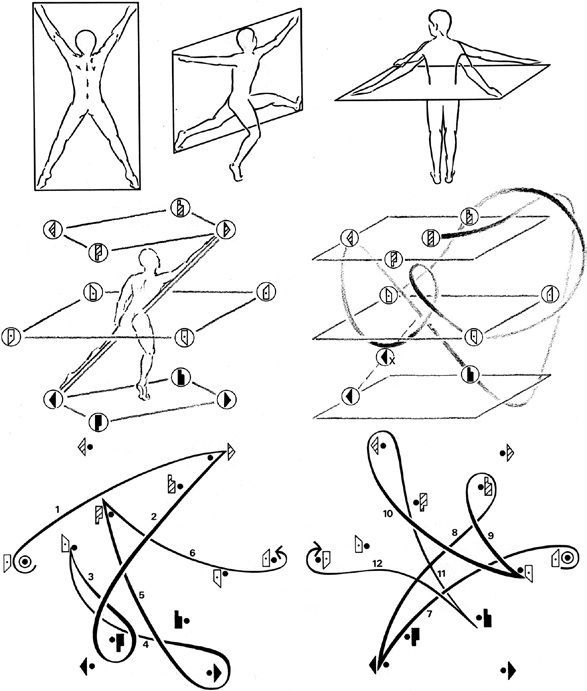
The structure of the passepied is not unlike the spiral structures that thread through the atoms as envisioned by Besant and Leadbeater. As the body moves through three dimensional spaces, it forms interlocking wave structures, that if for a moment are realised as diagrams they can be seen as similar to the visualisations produced for Occult Chemistry.


Choreography: Laban diagrams and William Forsythe's Space Trace Notation

A visualisation of the sodium atom from Occult Chemistry
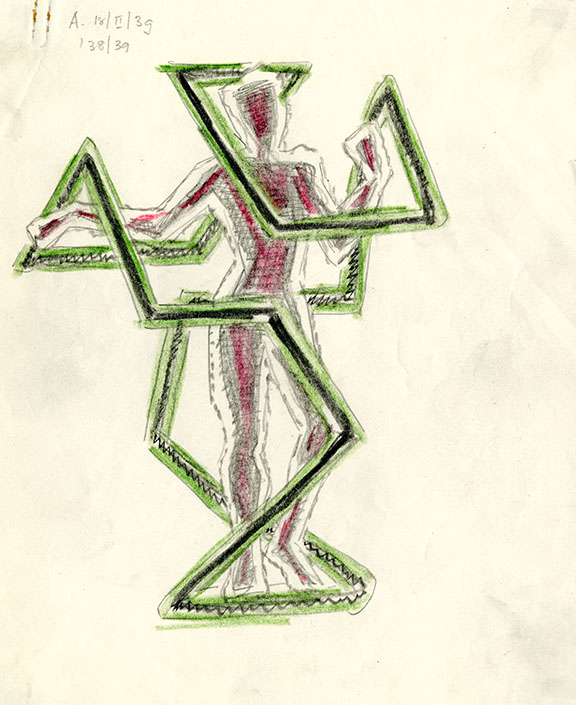

Figure in a dodecahedron

I am always looking for ways to link the various threads that arrive within my weekly musings on drawing, searching for how I can come to some sort of personal understanding about what I'm thinking about. I have recently found an article by David A. Becker which has helped me to see how certain strands could be linked together. Music, brain structure, chemistry and geometry are all fused together in his article, 'A Peculiary Cerebroid Convex Zygo-Dodecahedron is an Axiomatically Balanced "House of Blues": The Circle of Fifths to the Circle of Willis to Cadherin Cadenzas'.  He wrote this abstract for his article in the journal 'Symmetry'.

'A bilaterally symmetrical convex dodecahedron consisting of twelve quadrilateral faces is derived from the icosahedron via a process akin to Fuller’s Jitterbug Transformation. The unusual zygomorphic dodecahedron so obtained is shown to harbor a bilaterally symmetrical jazz/blues harmonic code on its twelve faces that is related to such fundamental music theoretical constructs as the Circle of Fifths and Euler’s tonnetz. Curiously, the patterning within the aforementioned zygo-dodecahedron is discernibly similar to that observed in a ventral view of the human brain. Moreover, this same pattern is arguably evident during development of the embryonic pharynx. A possible role for the featured zygo-dodecahedron in cephalogenesis is considered. Recent studies concerning type II cadherins, an important class of proteins that promote cell adhesion, have generated data that is demonstrated to conform to this zygo-dodecahedral brain model in a substantially congruous manner.' 

(Becker 2012)


I have previously commented on the way that bi-lateral symmetry has affected our relationship with the world and how we think about it, especially as someone that spends many hours drawing on bilaterally symmetrical sheets of paper. This symmetry is of course reflected in the layout of our nervous systems and in the context of brain connectivity van den Heuvel and Sporns have posited that the human brain contains a bilaterally symmetrical group of twelve major interconnected neuronal hubs that Becker (2012) has linked to our propensity to respond to particular musical rhythms. A relationship illustrated beautifully by John Coltrane's drawing of a circle of fifths that I used in a previous post, as an illustration of the relationship between rhythm and our spatial understanding.

John Coltrane. Untitled (circle of fifths), 1967

Many years ago I used to tap dance, and I recently found an old pair of my tap shoes in the basement, perhaps its time to revisit my inner body rhythms and to see if my feet have more awareness of these issues than my hands. When I began teaching I noticed some of the older staff wore brogue shoes with solid heels and when they strode out into the studio, they used the sound of their clip-clop rhythm, to both get immediate attention and in Patrick Oliver's case to teach students about the relationship between rhythm and space. What I do feel is that it is the bilaterally symmetrical body that 'knows' these things and that the head follows slowly behind. In the head's embryonic development its pharyngeal arches, pouches, and clefts, are derived from the implications of formal possibilities of the icosahedron and its cells will remember that, especially when the head twists around as the body is dancing. 

UV Map* of my bilaterally symmetrical body made using Maya

*A UV Map is a type of vertex map that stores vertical and horizontal positions on a 2D texture. The letters U (Horizontal) and V (Vertical) denote the axes of the 2D texture because X, Y and Z are used to denote the axes of the 3D space. (Vertex = graph)

I look at the map of myself above and see the possibilities of laying it over a star chart. This week I'm designing cosmic tableware and am thinking about what the tablecloth should look like and am getting close to an idea that welds together drawings of the curved time/space that is gravity and the body map. 

Space time curvature

The cheese platter has already been made in the form of a moon sitting on a sun. 


Soup bowls

Design for batik tablecloth

This is another one of my tranculment ideas. The point being that the things which we surround ourselves with in 'ordinary life' can become entries into a more mythic everyday.

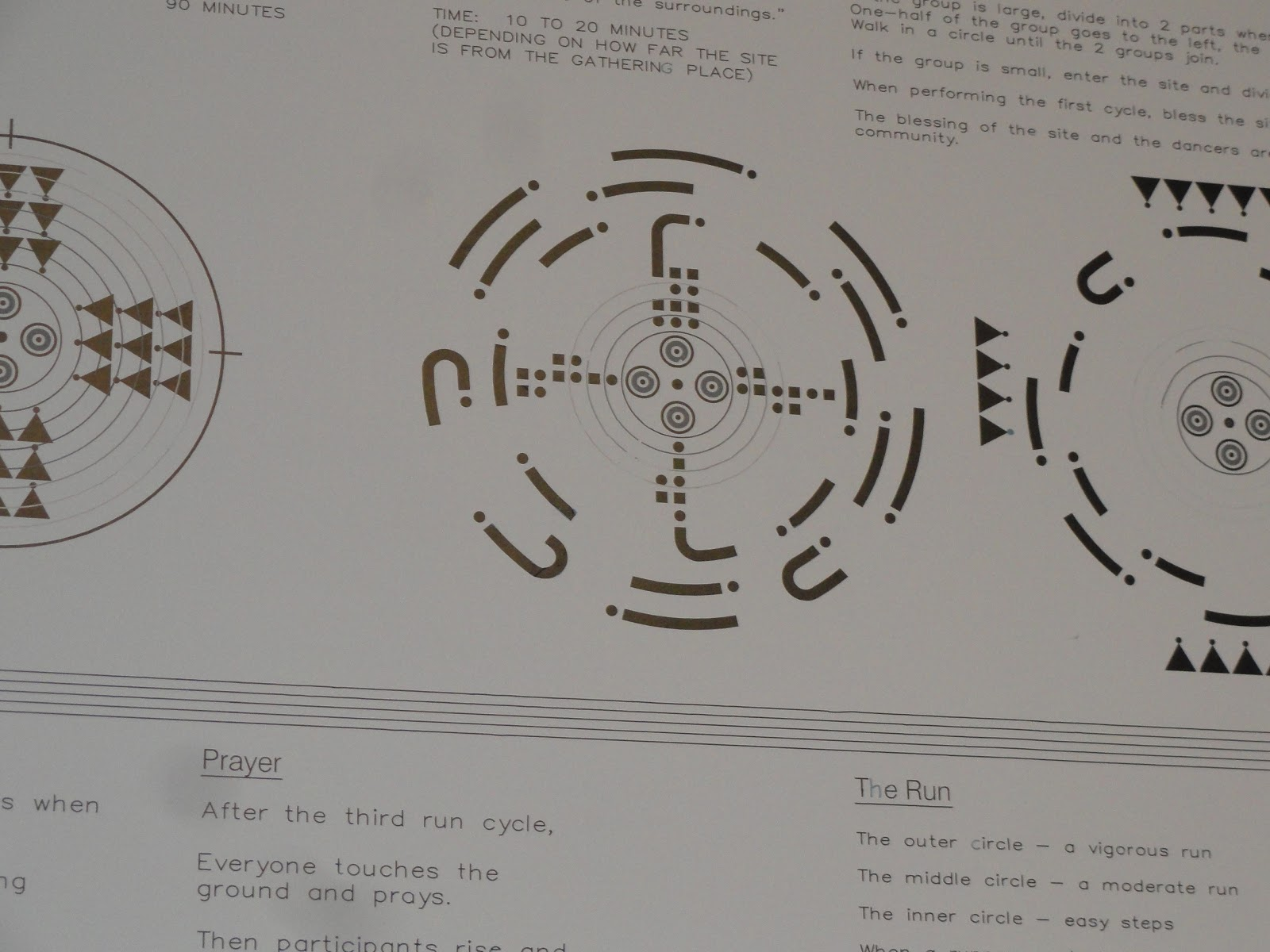
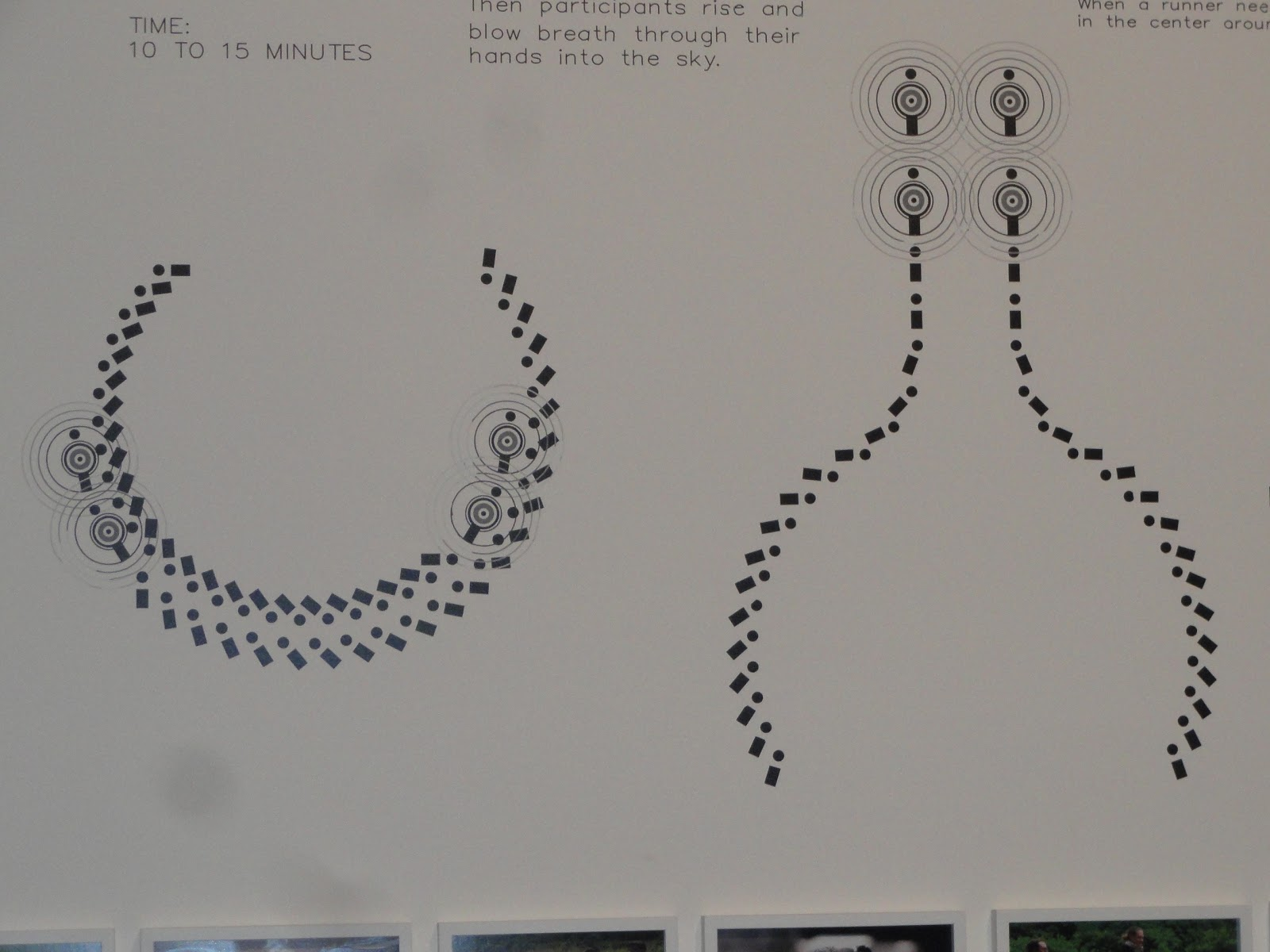
From the micro to the macro is another theme that seems to run through my ideas and as I work through this stuff in my head I remember something else. In the large wall drawing 'Planetary Dance' by Anna Halprin, she presented rituals consisting of explanatory diagrams with accompanying text. Back in 2017 at the Venice Biennale Halprin was offering us a chance to help heal the world by joining its peoples together in a healing set of dances. I took a couple of photographs of the diagrams she drew and they sort of close the circle of my thoughts today on these things and help me link up my various ramblings.


Anna Halprin

At one point in their dancing, participants had to blow breath through their hands into the sky and when they do this we are linked back to the chemistry of breath, the exchange of gases, oxygen and carbon dioxide, that takes place between the body and its environment during respiration, but that's another story.

References

Becker, D.A., (2012) A Peculiarly Cerebroid Convex Zygo-Dodecahedron is an Axiomatically Balanced “House of Blues”: The Circle of Fifths to the Circle of Willis to Cadherin CadenzasSymmetry4(4), pp.644-666.

Morrisson, M. S. (2009) Occult Chemistry and the Theosophical Aesthetics of the Subatomic World RACAR: Revue d'art canadienne34(1), pp.86-97.

van den Heuvel, M.P.; Sporns, O. (2011) Rich-Club organization of the human connectome. Journal of Neuroscience 31, 15775–15786. 

See also:

Maps made by our nervous systems

Horizontality and the body

Body cartography

The micro and the macro
Jorinde Voigt: Drawing as abstraction and notation

Monday, 24 March 2025

Stained glass: Finishing

The finished panel

As you can see from the image above the stained glass panel I have been working on for over a year has finally been finished. It's approximately A1 size and it was designed as a response to the fact that when I started the project I had plantar fasciitis, which meant I couldn't put my foot down without extreme heel pain. As I had been making votives, I decided to use the idea of Sooty as a type of voodoo fetish, interceding to bless the pain and therefore release it. It did eventually go away but not I suspect due to the intersession of Sooty. Even so it was an interesting experience and I have learnt a lot technically and have set up my workshop to be able to undertake quite a few of the glass skills used during the past year. The painting I started out with is this one below, and as always its fascinating to look at how a change in technique totally changes the meaning of what can be almost exactly the same image. 

The original painting 

My last post was about the soldering process, which left me with lots of cleaning to do, most of it due to the deposits of tallow still left on the lead. Once the tallow had been cleaned off the next step was to stabilise the panel with black putty, which  ensures that every section is held securely in place. If the panel was to be used as a window, it would also need to be made weather proof and this stage would ensure rain water would not be able to penetrate it. 

Black putty being applied to all the gaps between the lead and the glass

I had bought myself a tub of stained glass putty a while ago, so had it ready. It's much more expensive than the putty you use to secure the glass in a window and I suspect you could mix your own by staining ordinary putty black but I was in a rush to get everything finished, so had bought a ready mixed tub. There is nearly always a reason for the materials being what they are and when I have tried to go my own way, such as using ordinary soldering flux, things haven't worked. 

Stained Glass Lead Cement Putty Black 1/2 PINT (Approx: £26)


I used an old toothbrush to push the putty into the gaps between the leading and the glass. I was amazed at how much putty would be needed to go into these gaps, and it takes quite a while to work it into each section. A circular movement of the toothbrush seemed best, and as the putty began to settle into the spaces, it lifted off the glass surface. (I was initially worried that it might stick to the glass and be hard to clean off). 

The toothbrush: The black putty is very sticky, like thick runny hunny.

As the gaps become filled, the putty pulls away from the glass surface. 

I then, once all the gaps were filled on one side, with help, I turned the panel over and repeated the process. I had some whiting power left over from when I was printmaking and once the putty was in place on both sides, dusted one side with it. This is to help dry the putty and clean off the panel. Using an old scrubbing brush, I then worked my way across the panel, again using a circular motion and this removed bits of excess putty and at the same time cleaned the glass. This was then repeated on the other side.

Using an old scrubbing brush to remove whiting powder and excess putty.

The window was at last beginning to look how I wanted it to. The too shiny look of the solder had gone, the black of the putty now filling every crevice of the surface, which makes the whole panel look as if it is an old thing; something made back when stained glass was a process embedded into a deeply spiritual way of understanding the world. I was beginning to think that all the effort was at last going to pay off. 

The final part was to get the 'look' of the leading right and to do this I used black stove and grate polish. (£7)
'Stove black'

I used to help my nan polish her black iron stove and this was very like the Zebo polish that we used then. When buffed up with a soft duster or rag, you get a rich dull black, which is what I wanted. These final touches were vital as they gave the panel a very personal feel. The surface looks very hand done, the final finish looking like something that has resulted from several hours of intense one to one application. The Sooty window was meant to be a type of fetish or votive and by virtue of the many hours of work invested into its making, it has human spirit built into it.  


Developing the final patina by polishing

This final part of the process felt intuitively right, perhaps because of the link back to the time helping my nan polish that old black iron stove. 

In order to have a good flat light source behind the panel, I ordered an A1 size, LED lightbox from Amazon, and it fits very neatly, I used it to light the window in order to take the photograph at the top of this post. 

It has been a long and expensive process, I have learnt a huge amount and made a piece of work I am very satisfied with, as it extends the conceptual as well as the emotional and spiritual range that I am trying to communicate with. I have also set up my old studio in such a way that I can now cut glass and grind it into shape, I can cut lead and fit panels together, but what I cant do is paint the glass without access to a specialist kiln. My objective was to see if I could become self sustaining in relation to a craft that I really feel does enhance spiritual 'feeling'. But the reality is that it will have to be a 'supportive' skill, one I use occasionally to enhance my work, rather than as a main focus. 

See also: