I decided to take on a drawing course as a participant rather than as a tutor. You might wonder why I would need to do this, as I'm pretty busy with several projects and teaching drawing myself, but there are always things you can learn and above all it's useful to check in with yourself at times and check out whether or not you are still learning or even capable of learning.
The other issue is that like all educational experiences, it is the people that for one reason or another also find themselves wanting to undertake the same course, that you will learn most from and often that learning is oblique, not expected and offered up totally openly. I was though also interested in the 'Drawing Correspondence' course because the tutors were all highly regarded professional practitioners in the field of drawing.
There is a certain amount of trust that needs to be kept going throughout the course and so I wont be sharing other people's work, only my own, but if people want to comment or add to this reflection they can, by simply contacting me and I can add into the post or even put up another post using guest authors. If you are reading this I'm afraid the course will be over, as I agreed that I would not post during its run time and get what I had to say checked over before going public.
Before the course began the team had put together a free online event, 'The Body I Am In', which was convened by the Drawing Correspondence team and hosted online by Drawing Projects UK. There were guest presentations with speakers including: Chloe Briggs, Tania Kovats, Anita Taylor, Hélene Fromen, Nell Brookfleld and Charmaine Watkiss, the last three being invited speakers.
I didn't get round to looking at the recording of this until after I had started, so I cant say that it was the experience of looking at this that made me join up, but it was useful to be able to reflect on other people's approaches to dealing with the body in drawing. In particular I was interested in Nell Brookfield's presentation because the issue of drawing the face by touch is something I have encountered several times before and it seems to reemerge at regular intervals.
I first experienced drawing the face by touch as an exercise on my pre-diploma course when I was at Wolverhampton School of Art in the 1960s. I was intrigued at the time by the results but found that I was always making a compromise by drawing what I remembered of my face at the same time as drawing what I felt. Then during the mid 1970s I was working on a Foundation course now teaching drawing and thought I'd re-introduce the idea, but first of all I thought best to try it out myself. This time I decided to use very large sheets of paper and to begin in the middle but with feeling the back of my head and to only allow myself to get to the front once I had exhausted the back of the head's tactile information of hair and skin over bone and had begun to build a language appropriate to the sensations I was getting through my fingertips. The interesting issue was that ears therefore often came next, rather than eyes, the nose or the mouth, one ear might emerge as the hand moved left from the position where the occipital bone comes to a rounded end at the back of the skull just above where it meets the axis of the backbone but the other ear might be reached by a hand slowly exploring the top of the skull and dropping down to the back of the ear. What was particularly interesting about the ear was the amount of surface it took up. I have very large ones and had always been rather self conscious of this, but they now gave me a very difficult translation problem. If you feel the back of the ear as it emerges from the skull, you can feel the cartilage through the skin and then you rise to the top or helix and your fingers turn over across a smooth but soft lip, all of which are areas you cant see when you look in a mirror. However then your fingers begin to touch areas you have seen. This complex of tactile information meant that an ear experience might spread out over a large part of the paper surface. Gradually I would move to the front of the face, but always returning to the back or top of the head as anchor points, and what this did was release me eventually from my 'visual memory of the head'.
I then tried this out as a drawing exercise on the students but only a few were able to conceptually grasp the idea, most of them ended up with a drawing of the head from the front by touch because it took too long to conceptually disengage with memories of the head's visual perception and then re-engage with touch and the rebuilding of visual information based on that. I was also teaching an adult education course at the time and the students were older and in many ways more ambitious, however I didn't have access to large sheets of paper, so we tried out the concept on A4 sheets and it worked so much better. By starting again at the back of the head, the students constructed 'joiners', some of which stretched the head experience out and along the floor and others into large freeform circles of imagery that turned up-side down as they were pieced together. As soon as the nose, mouth, eyes visual axis was broken the images took off. This memory was I realised very important, and although I no longer have the drawings I did at that time, watching the recording made me think it was about time to engage with this type of process again.
The sessions began with an introduction Chloe Briggs, Tania Kovats and Anita Taylor presenting themselves, followed by the people who had joined the program, each of which had been asked to select a drawing to talk about.
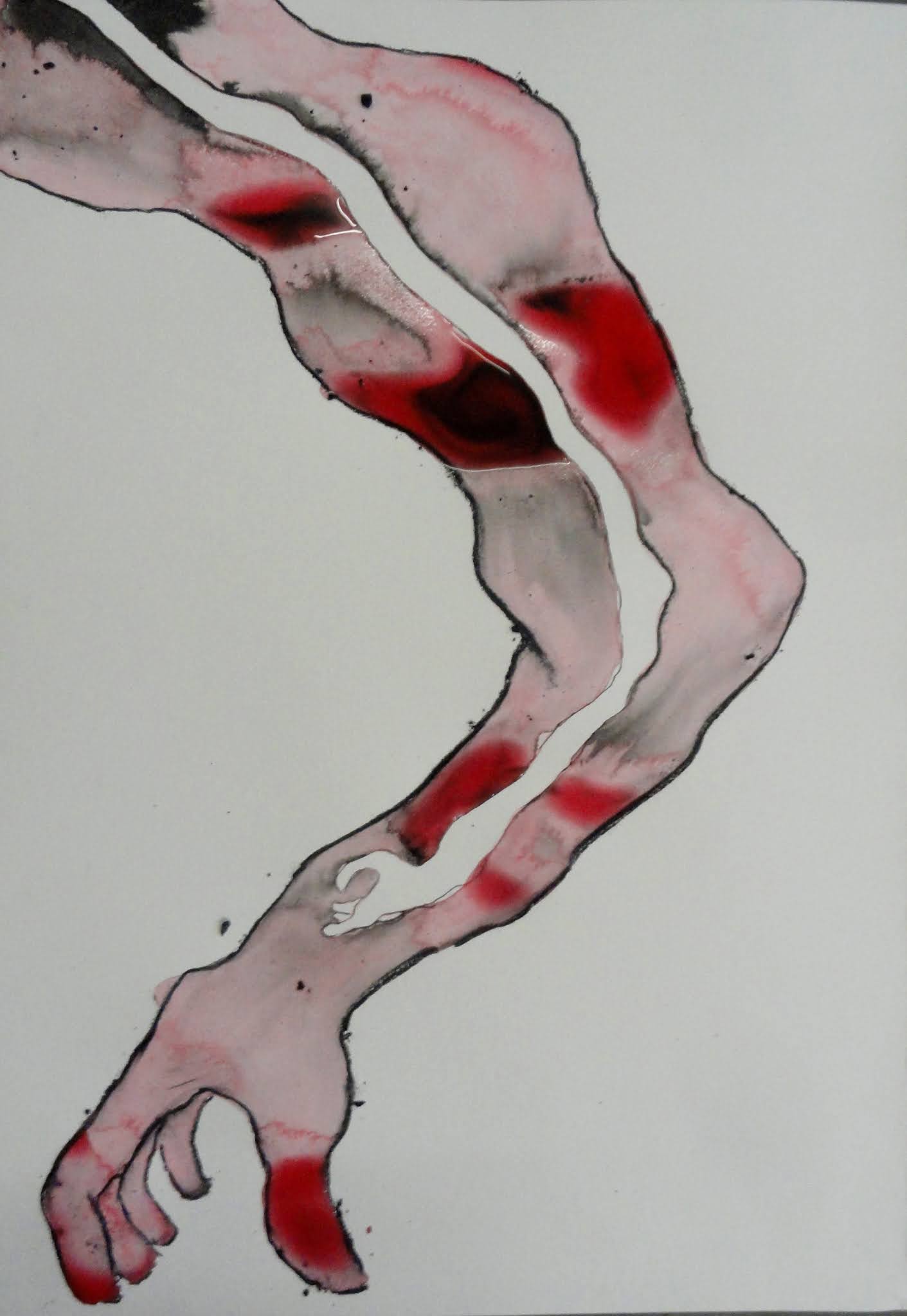
However for our first real drawing challenge we were all given a body part to draw and I was given a left arm.
These images below were of some of my attempts.


I'm always interested in what triggers an idea, and in my case it was the fact that whenever I have to identify my left from my right I feel a pain memory in my left arm. This then takes me back to my childhood and a time when I lived with my grandparents in the village of Pensnett in what is now the West Midlands. It has since been swallowed up by urban growth, but in the 1950s it was still easy to walk out into fields, but at the same time it was not far away from the Round Oak Steel works, a place where my grandad worked as a train driver, shunting metal and coal along local lines that linked the steelworks to the national rail network. My gran was adept at all sorts of country healing techniques, and when I developed a carbuncle on my left arm, a huge thing that covered the arm's bend; she applied her home made ointments and pastes and wrapped my arm in bandages. I can still see in my mind the removal of the big pad of sticky brown stuff and the feeling of relief that the carbuncle had been removed as well. She didn't just work on myself, other women in particular would come for advice and help on health matters, and usually whilst they did, my gran would make tea and when it had been drunk proceed to 'read' the leaves. I used to wait for the stories and as I listened to them, began to have a first young boy's inkling of the power of a story. I have thought about my gran many times since she died and she is still central to my thinking about how we operate in this world and how we are connected with it. She could talk to horses and had a wonderful almost symbiotic relationship with them, having grown up in a stable complex and as a girl having to sleep with horses at night, so that she could alert the grownups if a horse was becoming unwell.
The images of tiny arms and hands emerged naturally and I was interested in how they worked as metaphors for the fact that every man has a boy trapped inside him, and it is often that trapped boy and his experience of growing up, that still makes decisions for the man.
These thoughts are of course very personal, and right from the start I realised that this course was going to become a challenge in relation to who can accept their body as a publicly faced carrier of tales and who needs to hide behind it or keep their thoughts to themselves. I was also the only man on the course, something I only found out at the first session and I did wonder if my presence might inhibit others in talking about their relationship with their body.
Between the first and the second session I began to process the images, in some ways needing to step back from them, they were too 'loaded' with own life messages and needed to be universalised.
These images allowed me to bring colour back in and also forced me to think again about my processes, in this case my long years as a printmaker were very evident, breaking the drawings down into layers and adding colour to these being central to how these images were realised. The final one being a sort of reflection on late Michelangelo's crucifixion drawings and the need to find an image sitting on the edge of spirituality, but still grounded in the body, an image trying to take off, but still being tied to the ground.
Session two
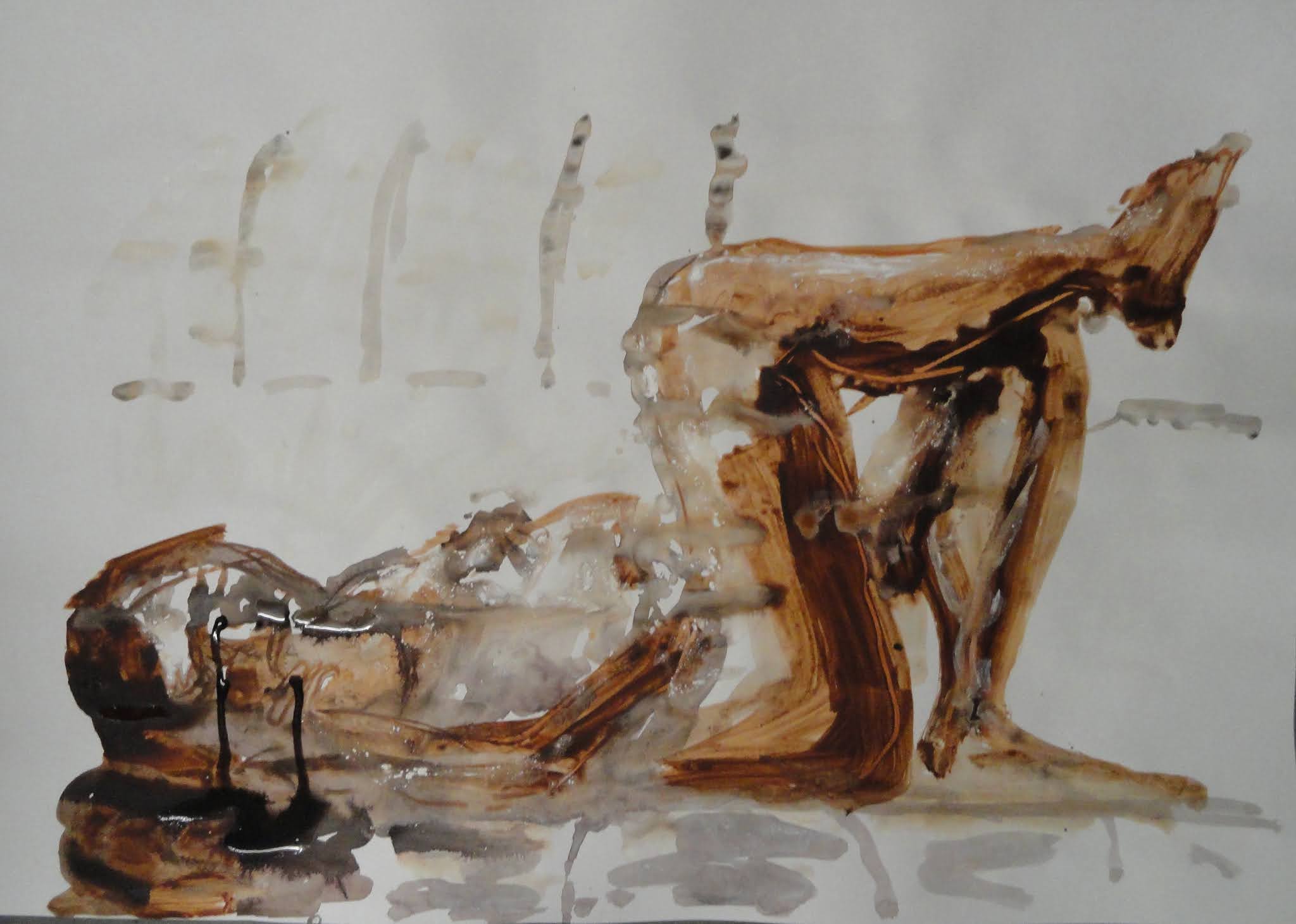
Session two was centred on online life drawing. I have in the past been very dismissive of drawing from online sources and have avoided them, but now there was an opportunity to find out whether or not anything of value could be transmitted via the screen. I had committed to this program and therefore also to a certain trust in the provider, so I was pleased to find out that it was possible to get something from the experience. The first encounter was with Lilli, a very pregnant model, who was therefore weighted down by her condition. This of course gave a certain gravity to the situation, and worked to give me a way in to creating three dimensional form within the flatness of the screen. We were given an opportunity to loosen up our own bodies by making a couple of fast responses, these I did in charcoal and decided that they were too clichéd, so decided to work with mixed media, as this would give me more opportunities for visual invention. The thing I had been most worried about in relation to screen based imagery was in fact weight. I didn't think I could get around the lack of physical presence, but the fact that Lilli was pregnant, gave me a heightened sense of the real behind the lens. In fact as I moved the materials about I began to see her melting down into the cushions she was sitting on, the soft contours of the sofa-bed, merging into Lilli's rounded body. The flesh and blood stuff that lies just beneath the skin, being what I found myself very aware of and I was reminded of my daughter's last pregnancy when things went wrong and she lost a lot of blood. This personalisation of the situation was again something I hadn't expected but which I should have, as even the process of drawing an image of a left arm had done this. I was beginning to realise the body is always a site of intense emotional investment, and that part of my response was going to be that I was now getting old and my own body is beginning to fail. This was going to be something that became even more apparent when the next situation was revealed.
Once again we were introduced to the model, this time a totally in control of her body dancer, loi. 


The situation was one whereby she would work her way around a particular set of spatial configurations, a pole was available for her to hold on to and she could control her body so well it felt that each movement was choreographed. She was in particular very aware of the camera, and was obviously working to the screen, composing her body, so that 'pictures' were being constructed in the drawer's vision, as much as the drawer selecting various movements for the drawings. I produced a lot of drawings, and again realised I was finding a way to work on screen, this time though finding what had been about liquidised gravity in the Lilli drawings, was now about tethered flight and movement, loi's body became for me very bird like, her dance one of fluttering movements, as she worked her way around the pole centred spaces. The drawings I felt were most successful integrated loi into the spaces she was moving in, but I never quite felt I was getting to a point beyond my past history, having worked with dancers and moving models several times before, but of course in the past always in the flesh. This experience of seeing someone in the box like space of the computer monitor was both easier to engage with when drawing quickly and conceptually interesting as this was cyber-space and I hadn't really come to terms with what that meant in terms of 'seeing' another human being as an electronic form.


Because I was having problems going beyond what I had done before, I began cutting into the drawings as I did them, pulling the spaces out so that the drawn gestures were making 'real' curves and in effect another body was constructed from the spaces loi's body had made. Again these drawing fell short of what I was experiencing and I decided to throw them away. As luck would have it, as I began stuffing the things into a bag to take them out to the recycle bin, they finally seemed to find themselves as images, and so began the next stage.


I realised that if I took these cutup drawings back into the 2D world of the screen, that there would be some sort of closure to the process, from 3D (loi's body) to 2D (the computer screen), to 2D (my drawings) to 3D (the paper constructions) and back again to 2D (the photographs on screen. Once liberated by the process I felt able to then work with all the images as digital files and made several large scale printable images that were designed to work with colour as a rhythmic elemental force, that could heighten for myself the pulsing power of loi's original movements.
I was finding these images very interesting but still I felt they fell short of being an experience in their own right. They were too 'easy' too decorative or not 'discovered', whatever it was about the images I needed to do something to get to a point whereby I wasn't just going to leave the process unresolved. Then just to see what would happen I began folding some of the images in half. The fold was central to the earlier process and I had thought about the fold as in Deleuze, several times before when trying to think through some of my ideas about how to draw aspects of interroception or somatic approaches to body imaging.
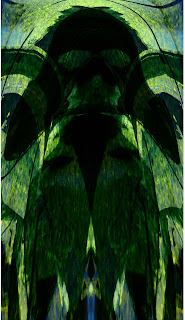
The bilateral symmetry of the folding took these images back into being human bodies again. We are of course like so many animals reliant on bilateral symmetry, constructed around a backbone and inner-tube, something that so many cultures and societies have understood when making representations of humans and their gods. Symmetry gives power and as I began embedding the movement drawings back into a centrally folded composition, I realised I had re-discovered something very important, that if energy is to be captured it needs to have its handedness balanced and symmetry does that. So I was finally left with an image I thought had power, a female power that was channelled from both Lilli and loi and one I was for a moment at least going to keep working at.
Session three
The third session was about clothes and people. We all construct our identities through the clothes we wear and rarely come across naked people unless in very particular situations, such as in a life studio or when wild water swimming or in bed. Therefore the session should have been very revealing and a way into dealing with the very personal issues that kept emerging. These are a few of the drawings I did of the other participants, we all had to model something that meant something meaningful to us, I modelled an old tie given to me by my father and attempted to tie it on screen, whilst telling the story of its father/son history.


I didn't think any of the drawings I did that evening were any good. I wasn't able to get into the other people on the program in the way I had with Lilli and loi. There was no punctum for me, not enough time to find that entry point I have always needed to find if I am to get into an image and every drawing I made was I felt superficial. It was a good exercise in terms of getting to know the other students and things were stated that were very personal, and I was now very aware that other students really were committed to revealing themselves as part of the process but somehow visually it wasn't working for me. Perhaps I don't have enough empathy, or in this case just needed to spend time trying things out, instead I was too focused on getting an image made during the very short time each person told their story about the item of clothing they had chosen to wear.
It was only later when other people remarked that my tie story was very interesting that I decided to have an attempt to get into that aspect and I then made a few images I was a bit happier with, but they were not anything beyond average, being too predictable again.
Non of the images were going to ask questions as to what the reality of the situation was, the 'cartoon' like approach didn't do anything beyond trivialise the ideas and I decided to drop the approach. It was perhaps something for a short video, but certainly not for memorable two dimensional image making.
Session Four
The forth session was much more focused on self portraiture. Anita Taylor opened the session with an introduction to her own large scale images of herself. I've seen her drawings several times before and have always responded to the way they engage the viewer perceptually. Much more interesting than drawings made from photographs, you get the sense of a visual and tactile journey over a face, that is itself like a landscape. The vigorous handling of charcoal and erasure techniques develops a 'feeling around the head' sense and tone is used not just as a modelling or emotive device, but as a way of establishing mass in space. So it seemed very appropriate that the session would be led by her and the memory of her self-portraits that set a pretty high bench mark.
After the experience of the third session I was a bit worried that I would not be able to respond effectively, but I soon got lost in the making of responses to views of myself in a mirror. In fact I had brought two large mirrors down into the studio, so that I could vary my reflection and see myself re-reflected, which meant I could see multiple images of myself. I worked on my knees, crawling backwards and forwards, pushing my reflected images back into the glass, whilst pulling information out from rapid working across sheets of hot pressed watercolour paper. Anita had suggested we work on newsprint, but I wanted the freedom to use wet materials as well as dry ones, and the smooth surface of the hot pressed 300gsm paper allowed for both sensitivity to movement as well as textural manipulation.
I began each drawing with crayola wax crayons, a sort of nod to childhood, but also with an awareness that whatever I did later would be preserved by the wax, as it would resist any water based pigments. Lines in space, rather than around features set out the initial responses, which meant I didn't feel trapped by my first responses as I did the week before. In fact I didn't try to capture a likeness at all, struggling with space and mass as something to pull out of the mirror, and not a surface. Because I was on my knees I felt like an animal, a dog looking in the mirror, puzzled by what it sees. Only in the latter stages of these drawings did I try to find any sort of likeness, and it was more a likeness of attraction than reflection. Marks are sometimes attracted to other marks, they cluster because they need each other's company and in their gradual correspondence they finally adhere into something recognisable. This is again not about a surface likeness but more a corresponding mass or intuited other, a doppelgänger or ghost of whatever reality might be out there in the mirror.
I did several of these drawings, some more worked on than others and at the end of the session felt exhausted by the physical effort of looking and trying to keep my responses to the looking as honest as possible. One of the problems if you are an experienced drawer is that you have a bag of tricks that you can always refer to if a drawing is going wrong. No not going wrong, looking thin, no not that either, aesthetically unloved perhaps. Anyway I know it when I see it and I have to stop myself making 'art marks' as a solution. I still remember my first encounter with this as a life drawing tutor. We had brought in a new tutor from another college and he was regarded as a life drawing specialist, so I was very interested to see how he would teach. As I was at that time in charge of booking life models I sort of had an excuse to drop in and see what was going on. I was puzzled at first by a certain similarity of surface being developed by the students and then realised that the new life tutor was showing students how to cover up inaccuracies or clumsy attempts at rendering mass or form by making 'interesting' marks that had the appearance of 'adjustment' but were in fact stylised markings. It was interesting to see how many people were fooled by this and several people remarked on how they thought the drawings were improving. As the tutor worked his way round the class, he would rub out some sections of each student's drawing and those same 'interesting' marks would begin to work their way into more and more 'improved' drawings. I think we all can have a tendency to do this to ourselves as well, so it's hard to blame anyone for trying to get the students' work to look more accomplished, but an honest clumsy attempt will in the end teach the drawer far more.


Only one of the drawings that was done from a sideways view in the second mirror survived, but several of the head on images felt honest enough to keep, there was something about my hand continuously interfering with and touching my face, as if looking into the mirror wasn't enough to make contact with the image; I had to feel it into place. I rarely make drawings of myself and when I have been making drawings over the last few months they have been about how I feel inside myself. Interroception and somatic responses to the body have been where I've been focused, so in many ways I had also drawn myself into a conundrum. Where does feeling tone come from? I had been looking for it intuitively inside myself, but these drawings found it by looking in a mirror.
I was very busy doing other projects that week so had no real time to reflect and so felt under prepared for the next week's session.
Session Five
Session five, entitled 'Liquid Bodies' was led by Tania Kovats and Callen McKeon, organiser of @queerlifedrawing who led as someone who was gender neutral, or moving between genders; the fluidity of current gender definitions being something that like many of us I have had to engage with quite a lot over the past year or so. My own sexuality is something I am very aware of is a product of 1950s post-war culture. I always felt as if I was out of time and place and had had many a run-in with my father as I grew up, mainly because he never felt that his son acted like a man. This was a situation only resolved when I was married and we had children, finally my father seemed to accept me as someone he could identify with. I wonder how things would have turned out for me in a time of liquid modernity?


The drawings I made were again awful. I was very tired, had been working on other things and had to move on the moment the session finished to do my permaculture course, for which I had prepared a presentation, so that was also in the back of my mind. I thought something would come through, but the looking was poor and I couldn't find a 'punctum' or entry point into the situation. I had thought the image I made of myself wrapped in a red tie and with an androgynous body a couple of weeks earlier would have helped me with the empathy issues, but no. Perhaps I needed more time to get to know someone who was obviously a very interesting person, but who I couldn't quite reach through the screen. I needed to 're-gender' my materials as well as my looking, but hadn't had enough time to get to grips with how.
We also had a session responding to breath control. As we controlled our breathing, we drew. Breathing in and out through the nose, followed by in through the nose and out through the mouth, and in through the mouth and out through the nose, and then finally to breathe in and out through the mouth.
I only made one drawing, but I was very interested in it because of all the drawings done during these sessions this was the one nearest in intent to the work I had been doing on interroception. I drew with both hands, not looking at the paper, eyes closed and feeling where I was as I changed breath type. I found the drawing interesting mainly because I realised that I was in some ways re-drawing my ribs. (I had made some drawings about ribs and breathing a little while ago, but from imagination, not as a performative trace of a physical event).
Session six
We were asked to choose three drawings to talk about as we were getting near to the end and some reflection was needed. I chose these three:
The final drawing was of two images I had been working on in relation to the interroception theme, the somatic images were now being incorporated into more recognisable figures, but their interiors were still washes of variegated liquids. These are quite big, (see the door as size check) and I was wondering whether or not to use them, as well as thinking about how I could use the whole experience as a way of taking my drawing on into unexplored territory. Of the three looking back I think the left arm has most potential, if only due to the liquid nature of its making. My bi-lateral symmetry interest is now waining and the door sized images feel over blown, but they all have something of interest, so I will jump off from where they are and see where I land.
We all had to contribute one image and a short text for a final publication that was designed to reflect our collaborative efforts and I did this twice, first of all selecting one of the tie drawings and then a self portrait. The text for the tie drawing was a bit too long, so I wrote something else and made do with that. I was beginning to get a bit irritated with myself for not being able to put more time in, but I had been teaching a lot more and was also in the middle of a permaculture course, one that also held its Zoom sessions on Tuesday nights.
The original text for one of the tie drawings has however begun to interest me again, so I shall paste it in here, as I think it does make some sort of sense, and may be something I return to.
First proposed text for 'The Body I am in' publication
As a drawing I emerged alongside much more technically competent observations and conceptually fascinating approaches to how a body becomes visible within a drawing process. You can see the remains of other thoughts sliding through the thin paper I sit on, but I'm not effected my them, I'm wrapped in my own thoughts, as I am wrapped in the memory of a tie once given to me by my father, a man deeply troubled by a son who wanted to be an artist.
Drawings can emerge unbidden and when they do they are not always appreciated. Like Freudian slips, apologies are made for them, cracks that can destabilise the bigger picture. As an embodied thought, I am aware that I will be misread many times by those who think first and feel later; but I'm used to that, my father never understood me either.
I'm drawn using an implement called a fine liner, on a sketchbook page thirteen centimetres wide and twenty-one centimetres high. The 'fine' in liner like the 'fine' in fine art, is though too pure for my liking. This is a word that came into use during the mid 13th century and was used to refer to things that were 'unblemished, refined, pure, free of impurities and of high quality'. All terms that suggest boundaries between things, ways of separating out what is good, better and best, a word evolved from the Latin 'finis', 'that which divides, a boundary, limit, border, end', a word we are used to seeing at the end of any French film, 'FIN'. The word fine in its current use, does not so much denote the quality of the art work, it points to the purity of the discipline. Hence in maths we have pure maths, and the idea of purity, as we have seen so many times, is an idea that leads to the eradication of the un-pure. You are supposed to be either male or female, or of a particular race or colour, to be of a certain religious or political persuasion. The eradication of impurities and the elimination of the heretic are both sadly implications of our fondness for a fine liner, for an implement designed for its ability to draw clear boundaries around and between things. So my emergence as an image is perhaps fortuitous, a reminder that impurity, the unsure, the mixed up, the confused and the hybrid, are what will shape the future of both bodies and drawings.

Page from a notebook
So what did I get out of it? It is always good to check in with other people that are interested in drawing. Chloe, Tania and Anita are all seasoned professionals who can offer advice and put things in such a way that it opens more doors, sometimes its really simple, such as Tania's "put your hands around the edges of the screen" to finish a session with, a simple but somehow very profound gesture. The people met on the course were all fascinating and we are planning to keep the group together and I suspect that will be the long term benefit. As to the drawings done by myself, I was quite disappointed, but when looked at in a few month's time I might have changed my mind.
The final publication made as a record of the event:
The Body I am in
See also:
Drawing exercises
More drawing exercises
Drawing and mindfulness Part one
Drawing and mindfulness: Part three: Making a drawing
Drawing and mindfulness: Part four: Material conversations
Drawing and mindfulness: Part five: Finding yourself
Self portrait drawings
Drawing hands
Flesh