The artist John Midgley died recently, an artist who devoted much of his working life to designing and painting banners for the trade union movement and in particular for the various miners' unions. His death has reminded me of a long and powerful relationship between artists and working class political organisation.
John Midgley banners made for the Durham Miners
John Midgley set up Chippenham Designs in 1970 and his company still continues to design and paint banners. His influence on the making of political statements remains and in many ways his approach to his work was I feel very similar to the way artists used to work for the church. We are so accustomed to the idea that artists work for gallery exhibitions, that sometimes it's useful to see an alternative tradition. The banner is often used to proclaim what is right; by walking the streets and carrying a sign, or putting a sign up over your place of work, (this could be a church or an art gallery, as well as a factory), you are making a powerful statement about your belief system.
The baton of political protest was picked up by various feminist movements in the 1970s and perhaps the most well known of the artists who came to prominence at that time, who also used banners, was Judy Chicago.
Judy Chicago: Drawing for a banner
Judy Chicago banners and woven banner making
Judy Chicago is very aware of the religious background out of which socialist banner making emerged and uses biblical text to make her own pronouncements. She also has some of her banners woven, an aspect of her overarching project of feminist awareness raising; in this case of society's association of women's work with craft and craft's difficult relationship with 'fine art'. A relationship that had seen a divide open up between two very different value systems; on the one hand 'men' being regarded as being 'genius' artists who belong to the avant-garde, while women being regarded as the craftspeople, who carry on traditional values.
Both John Midgley and Judy Chicago were making their statements in the 1970s, Midgley in many ways working in a tradition that was fast disappearing, and Chicago being in the vanguard of a movement that was becoming more and more powerful.
The banner continues to be an important communication vehicle, it still fulfils its historic function, church parades continuing to take place with banners carried aloft. However banners can also be still be used to raise the profile of those who find themselves marginalised or dismissed by society as being unproductive or a problem. The Harris Galley's recent exhibition, 'The Unfurlings: Banners for Hope and Change', saw a collaboration between groups of people from across the UK working with artist Ian Beesley and poet Ian McMillan to create banners that were designed to be centre pieces around which a campaign for a better understanding of dementia could be built.
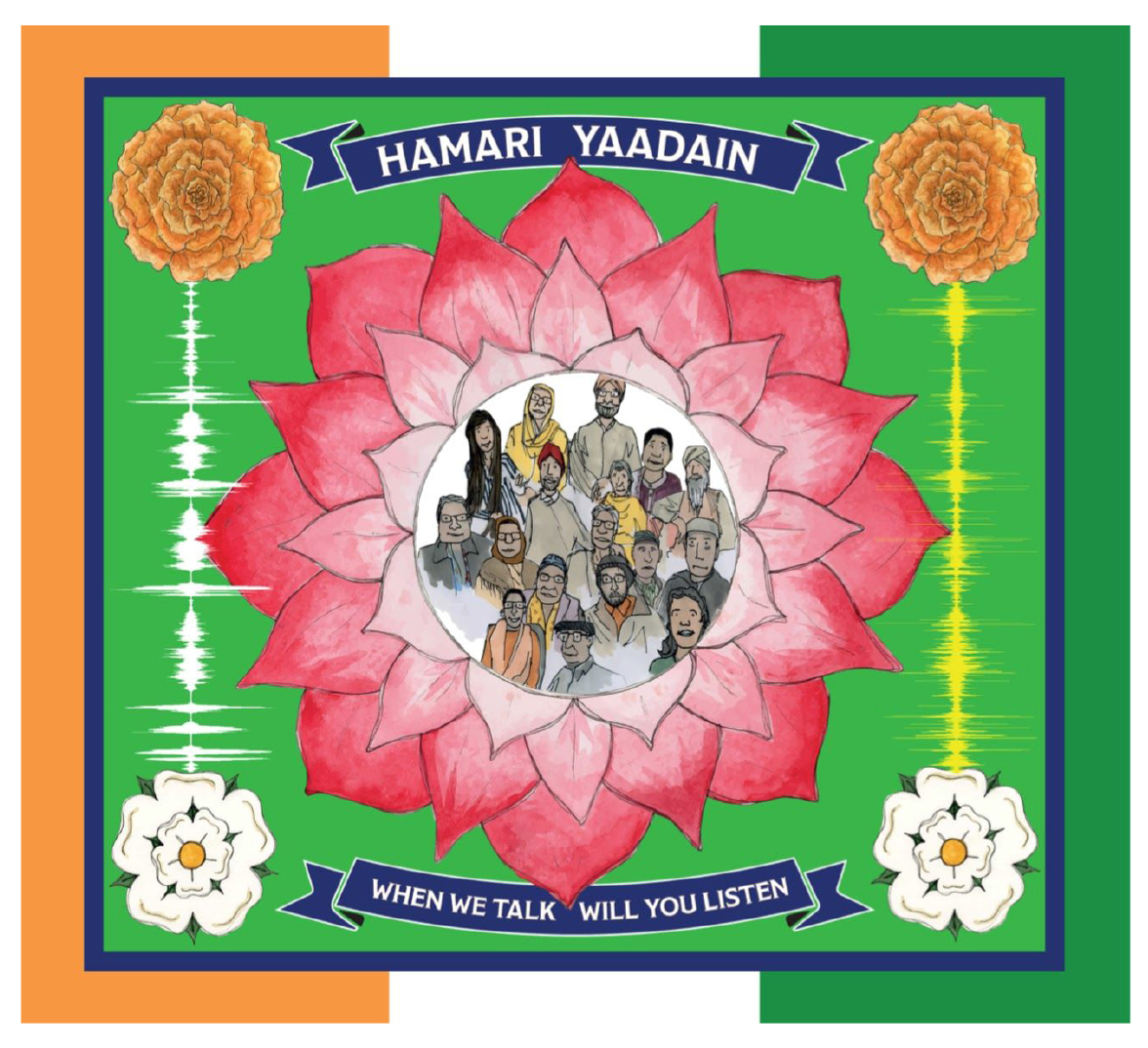
Hamari Yaadain: Banner
‘When we talk will you listen’ is an 'Unfurlings' banner created by ‘Hamari Yaadain’, a South Asian group
based in Leeds. The banner asks us to listen, and to try and understand the concerns of
people living with dementia. One of the symptoms of certain kinds of dementia can be the
disturbance of speech, and the ability to speak a second language, something that has obviously had an effect on certain immigrant communities. The design is a collaborative venture, between the artist and the Hamari Yaadain group, which is typical of community art practice, the artist having to operate more as a facilitator than as an individual creator. This role is often undervalued, but as someone who has worked for many years supporting community art and community art education, I am very aware that the artistic skills involved in facilitating this type of work are just as powerful and involve perhaps a wider set of competences than what we might call traditional gallery art practices.
Ian McMillan wrote a poem to accompany every banner, this poem was the one he wrote to support the Hamari Yaadain banner. This collaborative venture giving the project a rich complexity in its realisation. I have not posted on community art practices before, but it should not be forgotten how drawing is still central to person to person communication and ideas development. Ian Beesley as the lead artist will have had to make a variety of drawings in order to both help design the banners and to show all the other collaborators how their various ideas could be made to fit in or in some cases he would have had to make drawings to show how one idea would work better than another. Drawing is for the community artist a key tool, often being used as the glue to hold everything together.
'The Unfurlings: Banners for Hope and Change'
The banner still continues to be used to carry political messages, Cauleen Smith's 'I Cannot Be Fixed', or 'Leave me for the crows', are banners that have emerged from a practice that encompasses moving image, installation, textile, drawing, and performances that double as community gatherings.
Cauleen Smith
It is perhaps in Smith's work that we see a more contemporary approach, the banner being one aspect of a multi faceted practice that attempts to embrace the viewer within an immersive environment designed to work across a wide range of sensibilities. This is not new, think of the banners hung in a church, they would be set alongside stained glass, sculpture, incense burning, candles and music.
Cauleen Smith, Epistrophy, 2018, multichannel video, four CCTV cameras, four monitors, projection, custom wood table, stuffed raven, wood figures, bronze figures, plastic figures, books, seashells, minerals, jar of starfish, Magic 8-Ball, maneki-neko, mirror, metal trays, plaster objects, wood objects, wire object, fabric, glass vase and plants
If you want to see a banner being used as part of a multi-media environment you could look at Mel Brimfield's exhibition that is on at the Tetley in Leeds at the moment. 'From this world, to that which is to come', which is named after a quote from Pilgrim's Progress. The banner in this case being about collectivity and the need to unite in collective protection in times of stress and need.
Mel Brimfield: Installation shot: The Tetley 2021
Coda
Leeds Spinners: Banners
Since putting up this post, I have come across Leeds Spinners and the recent banner work of Emma Dolan. It was wonderful to find that this tradition was being taken on by someone local.
As always as I walked around the Arsenale I was interested in how work had been hung or presented. In particular I was looking at the way 2D work had been framed or not framed and how this was helping to shape the meaning or audience relationship with it. So my final post on Venice looks at this and then wanders off away from Venice into more general thoughts about the frame as a type of frame within a frame, or physical Venn diagram.
Jill Mulleady
When looking at the work of Jill Mulleady I was as much as anything fascinated by how she had had her images presented. I have put up the occasional post on framing and if you read my previous posts you will be aware of how irritating I can sometimes find works framed inappropriately. It is perhaps hard to see from the image of her work above, but she had had every painting she exhibited in the Venice Arsenale sunk back into the wall, so that the images were flush with the wall's surface. The wall was also painted matt black, so that the 'washed out' or watercolour feel to her paintings was emphasised.
Jill Mulleady
It's interesting to hear her talk about the narratives that she uses, she is very aware of the changes in emotional intensity between urban and rural subjects. I presume the black was for her a way of heightening the difference between the two moods she was dealing with. By sinking the images into the wall she is also able to get away from the 'objectness' of the paintings and in doing so seeks to gain a narrative unity in a similar way to how a series of wordless graphic novel images might work together. The Japanese artist Mari Katayama often uses very elaborate frames for her photographs of herself and her ongoing elaborate scenarios that reflect on her own disabilities. Katayama had both legs amputated when she was a girl and has since had to use a range of ever changing prosthetics. She photographs herself in various elaborate stagings, herself and her prosthetic legs, usually being centre stage. Investigating issues of beauty, frailty, sensuality, femininity, vulnerability and characterisations of her physicality as being less than able bodied. Katayama confronts society's obsession and anxieties about bodily appearance. Her adjusted frames work to support the ideas going on in the images. Elaborate gilt frames, (seen in the past as symbols of classical beauty) have added inserts, sometimes very obviously screwed into them, suggesting that they are somehow made less whole by the additions or in several cases lots of empty shells made into a decorative line. Shells can in some ways be thought of as cast offs, empty forms that the creature that inhabited them no longer needs. Katayama's old prosthetics are also cast off as she grows or as she changes her personal sensibilities.
Mari Katayama: Framing details
Martine Gutierrez’s photographs were initially produced for a multi-page spread in Gutierrez’s Indigenous Woman magazine – a glossy magazine with its own beauty advertisements, fashion spreads and a letter from the editor all featuring the very same model, stylist, photographer, writer, and editor. Each of the frames had been painted on so that the frame sat in the same colour range and quality of aesthetic values determined by the image. The exotic nature of the subject matter echoed by the way the frames had themselves been exoticized.
Martine Gutierrez
Framing is a form of presentation and I would suggest that hanging is a powerful alternative possibility when it comes to presenting flat images. Ricardo Garcia's huge drawings in the Venezuelan Pavilion hang as banners cutting into the space, the red lighting further creating an atmosphere tense with expectation.
Ricardo Garcia
Banners have a long history, one that evokes belonging to a membership of something or militancy, from miners' banners to those used in Nazi rallies or they can belong to folk traditions, such as the fantastic work of Jonny Meah, who made banners for the circus and travelling freak shows.
Jonny Meah
Jonny Meah
Jonny Meah always works out his images through drawing, the one below being his solution to the problem of a boy/girl. I find his work really powerful and think it would be interesting to see his work alongside that of artists that are seen as part of the high art canon. On the other hand of course the societal attitudes that he was reflecting upon when he was working have changed, what was at one time seen as freakish, is now seen as simply part of the human condition, we are far more prepared to accept difference, his work can now disturb as much as intrigue, but I still feel that if you have not come across artists like him before, it is worthwhile doing some research on how and why they operated in the way they did.
Jonny Meah
The banner can be a sophisticated tool of the establishment or something used within a people's 'folk' tradition, and artists have responded to both ends of the spectrum.
Does form follow function?
I find it slightly disconcerting that the banner format has more lately been appropriated by my local art gallery, as well as other art galleries throughout the world. The hanging banner within an architectural setting is about the making of public messages and only those powerful enough to have access to and ownership of public buildings can usually use them.
However street protest also uses a banner format, some old formats such as the miners' banners, clearly themselves imitating earlier religious conventions.
The banner tradition continues, in particular it has become associated with feminist protest movements and because of the present political climate in the UK I would suggest that the banner will be making a comeback.
Contemporary UK street protest
Mark Wallanger has made work about these public displays of protest, his 'State Britain' installation, being a faithful reproduction of Brian Haw's own one man protest placards and banners.
Mark Wallanger: State Britain: 2007
Brian Haw
The Nordic Pavilion in Venice was hosting an exhibition entitled 'Weather Report: Forecasting futures'. It was an attempt to put together a group of artists that were concerned to work in a territory that used to be called science fiction or speculative fiction, therefore when framing an idea it had to evoke a certain futurity. Ane Graff presented an image of genetically modified wheat framed in such a way that it appeared to be emerging from some sort of isolation tank. The frame in this case now becoming an extension of the idea into the surrounding architecture.
Ane Graff: Nordic Pavilion Venice
Drawing a frame around something is a basic conceptual idea. It separates one thing from another.
By drawing a line around something we separate it out, the red circle around a word is in many ways very similar to the frame around an image. In the same way that the circle separates the word from its context within the sentence, a frame separates an image from its context within the wider world. As a concept it is a very powerful one, one that in mathematics is called set theory and as a way of illustrating certain aspects of set theory we have Venn diagrams. I could argue that all frames are in essence physical Venn diagrams and they help us think about how ideas can belong to the world or be a reflection on the world.
Thinking of frames within frames reminds me of what happened to the Venezuelan Pavilion this year. You could think of each pavilion in Venice as a type of frame, in the terms of the diagrams above each pavilion would be a disjoint set, separate from each other. (In mathematics, two sets are said to be disjoint sets if they have no element in common) Within each pavilion Set (A) there would be framed individual works. These would be subsets (B) of set (A). We normally don't think of the power of the pavilion as a frame, we simply walk through the entrance to get in to see the work on show. But because of economic and political unrest in Venezuela, on the opening of this year's biennale the Venezuelan Pavilion remained closed, the doors padlocked shut. Suddenly the focus of the art world was on the locked doors, in effect the framing (the pavilion) was now operating as the main carrier of meaning.
An intersection of politics, mathematics and art is something that often occurs, if only because they are three fundamental ways for human beings to make sense of the world. They are glued together within art as metaphor. See this earlier post.
A rambling post again but hopefully within the ramble there are some points of interest. Don't forget when visiting exhibitions to look at how the work is presented, you will have to present your own work in end of year shows, outside exhibitions and to a wide range of people via on line formats. each time presentation will be an issue, so he more you look at how other people are doing it and the more you consider the contextual implications of the various approaches to it, the better choices you will make.
Sometimes though framing is simply a physical job to do, this earlier post shows one way to make a frame: Framing a large drawing. The cutting and sawing and the thinking through how all the elements fit together involve a lot of basic geometry, a discipline that would have evolved out of physical actions that demanded a certain amount of precision, like planning for a building or deciding where boundaries are. Doing, always comes before theory.
A frame can also be part of the conceptual thinking about edge; see this post.