Showing posts with label sea. Show all posts

Saturday, 10 May 2025

Leonard McComb

Tulips: Leonard McComb

I have just been alerted that the Artspace Gallery is hosting an exhibition of the work of Leonard McComb. He is one of those artists that I often go back to, he is a sort of lodestone that sucks me into his world, as well as being someone against which I can test myself. Nature and energy were often cited as his subject matter, but I have always put him in the category of those artists that deal in uncertain certainties.

There is something about seeing and its relationship to touch, as well as a fluctuation between mass and space, alongside something of the spirit inside the body, all compressed into the best of McComb's drawings. A spiritual radiance can sometimes be seen emanating from his drawings of flowers. it feels as if he touches the petals with his eyes, caressing them with directional marks, as he feels around the mass of their reality. Small marks, like bricks, can make solid edifices; as I put it in a former blog post on his drawings; "marks that at their inception appear to be looking for the form, but as they build up, they energise the image, eventually space and mass interpenetrate, all now vibration". He can at times capture the material condition of an object and in the same moment make it as transient as a soap bubble.

Leonard McComb at work on 'Rock and Sea , Anglesey,(Benllech)'

I remember going to see his monumental drawing of the coast entitled “Rock and Sea , Anglesey,(Benllech)”, I think it was in Sheffield, but where I saw it doesn't matter, it's a giant drawing made out of pencil, brush and ink on watercolour paper. Because of what I was doing with my own work at the time, I was reinforced in my belief that you could create monumental art by gradually working across small sized pieces of paper and constructing a final piece from the fragments and although making images of interiors, I too wanted to capture the way I was immersed in looking as an experience and his work was a fine example. It was also an answer to working and living at the time in a small terraced house. But his work also had a profound experience on me in relation to a much wider idea of art as a doorway into the spiritual.  

I'll see if I can explain, as well as try to tie in some of my thinking about the visualisation of invisible forces. When I used to work on the foundation course at Leeds, one of the reoccurring themes was the drawing and painting of a fish brought from the local fish market. It was an activity often promoted by Gavin Stuart, the oldest member of staff at that time, someone who had worked alongside Tom Hudson, Terry Frost and Alan Davie. Fish were looked at as objects of wonder, their iridescence hard to capture and their life form in death a reminder of mortality. Students would struggle to make convincing representations, but in the struggle would begin to come to terms with what it meant to confront a serious subject. 

McComb took on the same challenge, several times. Sometimes I think he missed the mark, but at others he was able to touch one of those experiences that transcend the everyday and elevate it into myth. 

Fish: Leonard McComb

In this image of a fish on a plate, the plate receives the aura of the fish and becomes an aureole, that circle of light that normally surrounds the head or body of a person represented as holy. Energy radiates out through the brush-marks, the paint being applied in such a way that it indicates the mass of the fish and some aspects of its physical presence, such as its iridescence, whilst at the same time the paint marks are open enough to suggest that it is a vibrating energy form, perhaps even a ghost of its former self. 

Flower painting

McComb at one time stated that nature's 'forms and shapes radiate from a centre’. I'm not sure that is right, but he did 'see' some sort of radiant energy surrounding the forms he was trying to represent. In the flower painting above it is the air around the stems and flowers that is energised, the glass vase begins to vibrate to its own tune, whilst each flowerhead sits still, surrounded by now revealed invisible forces. It is easy to see this in a painting because the marks are more substantial, but some of his drawn images almost dissolve back into the paper out of which they were envisioned. 

Flowers

The image of flowers above is almost impossible to see as a reproduction. Something I curmudgeonly like in a time of easy image reproduction and the dominance of the screen. In my earlier post on that feeling of an uncertain certainty, I put McComb in the company of Cezanne and David Jones, both artists that had strong convictions about the world they were experiencing, but who as they struggled to articulate their visions, found their images becoming less and less solid and more and more like dancing energy fields. 

This work is a type of vanitas, a reminder of the fragile nature of life. McComb was also a trained sculptor, and as such he would have been very aware of the materiality of thought; so to produce the flat work that he did and to position it on such a delicate fulcrum, balanced between awareness of mass and of spiritual forces, he must have in my mind also have been an animist at heart. He was able to send his mind out into the things he drew, out into the sea and the rocks, where for a while at least he would have inhabited the world he saw, so that what he was drawing was not the sea or the rocks, but his own mind as it conjoined with the spirit of the world. 

The exhibition LEONARD McCOMB, Body and Spirit Paintings and Drawings, is on 9th of May to 4th of July 2025. Michael  Richardson  Contemporary  Art, the Artspace Gallery, 84 St. Peter's Street, London N1 8JS

See also:

The Artspace Gallery
The uncertain certainty


Wednesday, 19 March 2025

The Oceanic

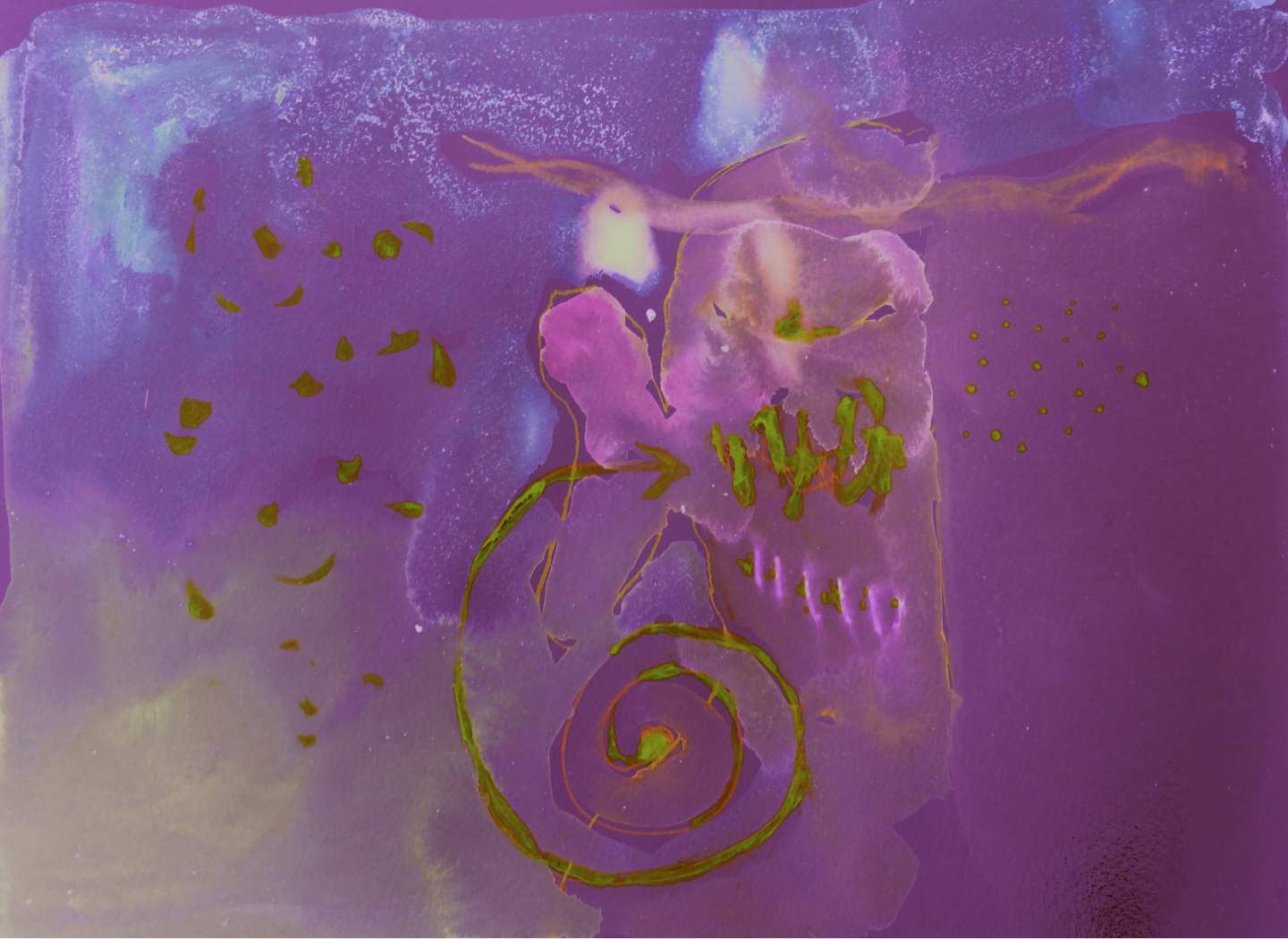
Image made in response to listening to someone's experience of tinnitus

I have for some time now been making images in response to people's interoceptual experiences. Sometimes when I do this I can find myself lost in an inner sea of the body and experience it as another universe. To be lost within people's experiences, can sometimes induce a feeling within myself not unlike that one sometimes described as 'oceanic' and when that happens the resulting images can feel cosmic. The image above was a final one made in response to a series of visits to someone trying to communicate what it feels like to hear a sound that doesn't actually exist. Sometimes this was an experience inside the body, but not always, at other times the 'sound' seemed to come from outside. The 'buzz' of sound seeming to be like the sea, a sea that existed inside as well as outside the person experiencing the noise.

I'm sure most of us have at one point or another swum out a little beyond our depths when at the seaside, or on a foreign holiday found ourselves swimming in a deep clear sea on a beautiful sunny day. These can be moments when you just close your eyes and float, letting the sea take you and as you do everything seems to be in that moment, all worries and fears for once dismissed, as you experience a oneness with the moving waters, the sea sound in your ears and the sun above. This is the feeling of the oceanic.

The 'oceanic feeling' was first used as a term by Romain Rolland. De Cruz (2022) states that Sigmund Freud in response to a letter from Rolland, attempted to explain religion as the result of certain cognitive dispositions and saw it as a 'childlike yearning for a fatherly figure'. He took Rolland's idea of “oceanic feeling” (of limitlessness and being connected with the world), as a sort of phenomenological explanation of religious experience. But what if the reality of that experience is of a deeper significance, and in being reminded of how we are totally immersed and interconnected into the world, we begin to see other moments when we are totally 'lost' in our worldly integration. Higgie, (2023, p. 73), quoting Freud, writes that he also linked oceanic states to the times 'when people fall in love and consequently feel as if they are merged with another or are in some way transfigured by the experience'. Higgie (p.74) goes on to point out how Marion Milner widens Freud's vision when she writes that an oceanic state could be experienced moments of artistic creativity, when the unconscious mind lets go of the distinction between me and not me, between seer and seen, and does things that the common sense, conscious mind cannot do.'

My occasional posts on 19th century and early 20th century mystic approaches to how to visualise invisible experiences are I'm sure linked to this feeling. The moment of creativity is something special, even if we only get lost within it momentarily, in those times we let our mind/body dissolve itself into the world via the materials of making. Higgie's book reminded me of the central importance of women to a more mystic tradition of art and it has been very useful in letting me feel connected to a range of approaches to art making that have long been there and it has also reminded me that we need, as Higgie states, 'elements of illusion to cope with reality'. (Ibid, p. 88)

Image produced in response to a conversation about tinnitus

The tinnitus image above was made directly before the one that sits at the top of this post. It is easy to see the relationship and the differences. The spiral remains a very important aspect of the feeling tone but the eye has gone, it was far too obvious and grounded the image in an exterior seeing, rather than opening it out into a more 'mystic' interior life of the invisible. The colour was too predictable and had no real sense of the un-reality of an alien sound. The notes around the edge are annotations taken from a conversation made in response to a previous drawing. I listen, I draw, I take the drawing away and then develop it further. Once satisfied that I have something worthwhile, I take it back to the person I spoke to and we begin another conversation about the relationship between the image and the experience they have had. Gradually the images are changed, a type of co-production emerging. At its best when I let go of my control, an image can arrive that seems to myself at least, literally 'wonderful'.

References.

De Cruz, H. (2022) Religion and Science The Stanford Encyclopaedia of Philosophy (Fall Edition), Edward N. Zalta & Uri Nodelman (eds.), Accessed from https://plato.stanford.edu/archives/fall2022/entries/religion-science/ 15. 1. 25

Higgie, J. (2023) The Other Side: A Journey into Women,  Art and the Spirit World London: Weidenfeld and Nicolson

Coda

It has been great to be chosen as one of the best drawing blogs out there by Feedspot: See: https://bloggers.feedspot.com/drawing_blogs/ for a link to all the ones shortlisted. 

See also:

Art therapy and perceptual research 

Drawing water

The uncertain certainty 

Freud and drawing invisible forces

Ibrahim el Salahi: Pain relief drawings

Sunday, 10 June 2018

More on water


I was in the British museum last weekend and spotted some more drawings of water. Images of water or clouds or smoke fascinate me because they are very hard to draw as you have the constant paradox of trying to make a static image of something that is in essence always in movement. 


In the image right at the top of this post the artist has changed the direction of the lines to suggest a changing series of sea types. In the foreground we have a rhythmic swelling sea, this begins to change as we move towards the shore, first of all the swelling is broken by swirling eddies and as the shore approaches the lines flatten out, suggesting that the sea calms as it nears the shore. The image immediately above, taken from another area of what was a huge print of Venice, (probably 7 to 8 feet wide and made up of lots of small prints) has a further range of sea water symbols, this time wavelet forms surround the figure of Neptune, and as we move towards the shore the sea is established by a series of straight lines with half circles breaking up areas of white in between. 

The two drawings of the sea below are from different times visiting the South Coast, one drawn during a storm a few years ago and then used for an animation (see further below) and another that was drawn when I was in West Wittering over Easter. 


The patterns that the sea makes are inspiring and craftspeople from a huge span of time periods and from all the continents have at one time or another used motifs inspired by the sea.

Wave design taken from Greek pottery

Atamoana textile with ocean wave pattern (New Zealand)

Ancient Pueblo (North America)

Roman

There is a wonderful series of paintings by Ma Yuan (ca 1160-1225). These are the earliest images that I have come across whereby an artist has attempted to freeze the complexity of moving water into images, rather than reducing images of water to a series of basic symbols, such as the Egyptian symbol for water below.

Egyptian symbol for water

All of the pattern images above have reduced the movement of water to a rhythmic formula, but Ma Yuan's Water Album: Ten Thousand Riplets on the Yangzi, demonstrates a deep awareness of both pattern and uniqueness, there is a sense that every wave creates a one off shape. Every wave is also a forming and un-forming part of a never ending rhythmic process. Ma Yuan can also invoke subtle atmosphere, his waters drift into and out of the mist as they form and reshape, his images are a reflection of water in its many guises, from rough waters to ripples, from flat lapping to sloughing through troughs and peaks.


Ma Yuan: Water Album : Ten Thousand Riplets on the Yangzi

However Ma Yuan's images are in some ways too sophisticated for a designer to use and and a Japanese artist such as Mori Yuzan fills that gap between perceptual wonder and designed clarity. 


The images above are from a book, 'Ha Bun Shu' (1919) by Mori Yuzan of wave and ripple designs. Similar work is also collected in Hamon shu (Wave patterns), a multi-volume work brought out at the beginning of the 20th century. Both these works would have acted as a kind of go-to guide for Japanese craftsmen looking to use wave and ripple patterns. You can find them on line here.
Mori Yuzan's images might not be as complex as Ma Yuan's but they are still fascinating because they have had to go through a process of clarification and simplification and if they are to work they once more have to hold that tension between rhythm and structure that communicates both structural integrity and constant movement. 

The sea is powerful and when you are in it and far from land its close proximity can be terrifying. Its constant movement, the flexing of its gargantuan water muscles make you feel as impotent as a mayfly. I have swum off boats in the Mediterranean, but only from tourist excursions and in calm weather, even so I well remember the slight nervousness I had when I realised I really was swimming in the cruel sea. More than 8,000 lives have been lost crossing the Mediterranean over the last two years, an ongoing disaster that we tend to lose sight of. The same body of water that I stand in front of and draw, has also taken the lives of thousands of poor people seeking another life in Europe. 

A short animation I made in response to the refugee crisis

The animation I made (above) tested out my ability to invent moving water, some sections are better than others and I may try and go back to this and redraw, but I found the subject a hard one to confront and constantly worry that I have not been able to deal with this subject sensitively enough. I tried to develop a soundtrack that reflected the tension and unease I had been feeling about the situation, which involved another very different form of drawing , as I had to develop a timeline and think about how to compose the distorted sounds that I developed using feedback-loops. What it must be like to be stranded on a small crowded unseaworthy boat I dread to think, but I had to try and respond somehow to the situation. The many facets of water are like moods and as moods develop they can become dangerous and difficult, the people in this animation are tiny, they may appear insignificant, but everyone on these boats, boats that so often disappear into the Mediterranean, would be someone with a complex full life, someone that if we knew them could become a friend or even part of our family.  

See also:

Drawing water
Beryl Hammill drawing water