Showing posts with label visualising the invisible. Show all posts

Sunday, 1 March 2026

Drawing Experience

'Spinal Pain 2', digital drawing.

I have had an image selected for the online 'Drawing Experience' exhibition, hosted by Loughborough University. Work submitted had to respond to the research question, 'how can lived experience be translated into drawing?'. The image selected is from my work in the spinal injuries unit and the fact it was selected means that the work communicates to others beyond the confines of the medical environment. 

This is the 'Drawing Experience' curatorial statement:

The theme Drawing Experience had its inception in the impromptu discussions about drawing that took place between Deborah Harty (Loughborough University, UK), Isabel Herrera-Gonzalez (University of Seville, Spain) and Fan Ye (Hubei Institute of Fine Arts, China), who were both Visiting Scholars at Loughborough University in 2025. Having not previously met, whilst discussing our own drawing practices and interests, sometimes through the aid of translator app, at other times through bodily gestures and emphasised expressions, we came to realise that we all had an interest in the potential of drawing to trace lived experience. The crossovers in our practices and approaches, alongside an interest in the potential of drawing to be able to bridge language barriers and highlight cultural differences, led us to begin the curatorial collaboration. We conceived the research question, how can lived experience be translated into drawing, to be investigated through the format of an open call for drawings for an online exhibition. This format enabled us to extend the discussion to others from across the globe, whose work sits within a context of drawing in the expanded field. From the call, we received a high volume of drawings in a variety of formats and media, including works on paper, moving image and performance drawings.

To evaluate the submissions, the main criterion was to what extent the work responded to the question posed in the call. For this, the curators considered the information provided in the short textual statements and the drawings themselves. These provided lively debate, as we negotiated the line between interesting drawings, personal responses and drawings we all agreed were convincing as traces of lived experience. The curators considered drawings that evidenced innovative approaches, which challenged the notional limits of drawing to consider lived experience. We particularly valued those proposals which looked for indirect ways to answer the question. Whilst acknowledging the aesthetic quality and the technical virtuosity, we prioritised the coherence between form/material and discourse. We leaned into works where the trace of lived experience felt tangible, whether through subtle textural choices, personal symbolism, or the emotional resonance of the imagery. We also selected works that felt authentic in translating intangible experiences into visual form, as this alignment between intent and execution made the theme feel alive.

In the works selected for inclusion in the exhibition, the artists pose fascinating reflections on what it means for them to translate experiences and sensations of the body into a graphic code. An interesting consequence of viewing the group as a whole, was seeing and comparing the multiplicity of different answers to the same question; all whilst using the economical means of drawing. Some resort to visual syntax to express (or, better said, 'narrate') the tacit part of their experience, as in the colours of Mahsa Makki Alamdari or Deepani Seth. Some use intense, precise forms to convey profound experiences, as in the evocative drawings of Helen Goninon or Lauren Arnott. Whilst others, such as Ellen Bell and Janice Nadeau, use sparse lines to evoke the quiet repetition of daily life. These powerfully evidence lived experience traced into drawing. The drawings do not shout, but rather linger, just like many of our most intimate memories. Others use a more figurative language to give concrete form to sensations and impressions that are abstract and difficult to verbalise (sometimes barely remembered), as perhaps in the case of Garry Barker, Camille Courier, Rachel Gadsden-Hayton & Jeremy Hawkes, or Lisanne Sloots. Some transform drawing itself into a medium or space for encounter with others, capturing dialogue and exchange in line, such as in the drawings of Mary Yacoob or Joanna Leah and Orla Bates. While others focus on the immediacy and honesty of drawing as to directly convey embodied knowledge in real time, like Ipek Yeginsu or Caroline Wright. As a whole, these works seek to confront traditional conceptions of drawing, with artists like Rachel Colley (through material experimentation), Sarah Tutt (through performative encounter), or Helen Farrell, Ella Emanuelle (through technology), expanding its limits beyond what is expected and predictable. The works in the exhibition emphasise the breadth of contemporary drawing practices evidencing the ability of drawing to be a living trace of experience.

One of the most rewarding aspects of curating this exhibition was reflecting on how cultural contexts not only shape each artist’s way of approaching the theme, their inclusion in the exhibition, enables a sharing of diverse experiences to a wide audience.  Whilst the central question remained the same, how can lived experience be translated into drawing, the responses were filtered through diverse traditions, personal histories, sensibilities and materials. These different cultural frameworks influenced the metaphors used in the drawings, some artists drawing on collective cultural symbols, while others focused on hyper-personal, yet universally relatable, moments. This reinforced the idea of drawing as a universal yet deeply individual language, one capable of bridging cultural differences while highlighting unique perspectives. This mix showed that while lived experience is personal, drawing acts as a common thread, allowing us to understand perspectives that might otherwise feel distant, simply through the language of line and form. Perhaps the best proof lays in the fact the curators all come from different cultural backgrounds and use different spoken and written languages, but we have still been able to read and understand the meanings behind each drawing.

Curating these submissions has been both humbling and inspiring, as it has reminded us of the power of drawing to make the invisible tangible, and to connect us through what cannot easily be put into words. The selection of works has highlighted how drawing can be a silent conversation between artist and viewer. During the process of selection, we were not just curating works, we were witnessing artists sharing personal experiences that words might fail to capture. The contrast between the ephemerality of experience and the potential permanence of drawing felt particularly poignant. It is a reminder that this exhibition is not just about art, not just about evidencing how lived experience be translated into drawing, it is about preserving and connecting human stories. 

Taken directly from the Drawing Experience online exhibition   

This exhibition is hosted by the Drawing Research Network, an organisation that I have always found extremely useful when trying to think through my role as both an academic and artist. The important thing about networks is that you can see how your peers are thinking and find out what is happening in terms of contemporary practice. I was particularly pleased to find that they had accepted a digital image, as my point in making it, like others that have been generated as part of this project, was that it would be seen mainly online, either on a computer screen or on a mobile. The first audience for these images being patients and medical staff who need to see them in a clean hospital environment. I am very aware when drawing competitions are announced, that at times digital imagery is regarded as less authentic than drawings made using traditional art materials, but if I am to be fully inclusive in my awareness of audiences and the appropriateness of communication media, I feel that working both analogically and digitally, is the best way forward for myself. The question, 'how can lived experience be translated into drawing?', being one that at times we all need to ask ourselves, if drawing is to remain central to our practice as artists.

Reference: 

Drawing Experience 

See also:

Garry Barker Exhibitions

Speculative Grace

From making votives to visualising interoception

Friday, 30 September 2022

The Iconography of the Invisible

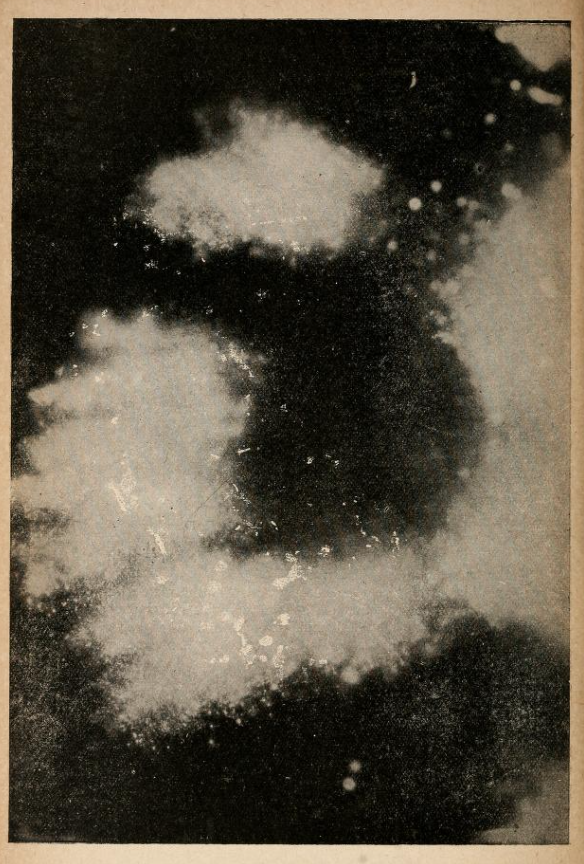
Dr. Hippolyte Baraduc: 'Iconography of a hand obtained by bringing the hand near the sensitive side of a plate fastened to the pole of a Wimhurst machine. One can remark the formation of electro-vital particles coming from an odic cloud showing the thumb and the fingers as well as small life-animules, white points.'

I've been exploring different ways to visualise the invisible, something that I believe re-occurs over and over again throughout human history. There are lots of other individuals who have had similar obsessions and I have in particular begun to seek out 19th century thinkers who were operating at a time when science was struggling to come up with answers to certain problems. Dr. Hippolyte Baraduc had some very interesting theories about what he called 'iconography', and what others in associated circles at the time also called ‘etheric doubles’, ‘subtle bodies’, ‘astral bodies’ or ‘bodies of light’. But first of all you might be a little concerned that I'm advocating looking at another theory that has long been disproved and consigned to the bin of outdated thinking. In my own conceptual framework the idea of proof is not so important, I'm much more interested in the poetry of an idea, so one way for me to understand old science is as speculative fiction that was at one point taken to be a real possibility, or in my terms a poetic idea. The other issue for myself is some form of congruence between what someone might have been thinking and my own ideas, in this case I'm very interested in how to visualise invisible energies and sensations that emanate from within the body and I intuitively felt that Baraduc must have had similar concerns. He is also very much of his own time, I have commented in the past on the influence of Besant and Leadbeater's 'Thought Forms' as well as Benjamin Brett's 'Geometrical Psychology' and in my last post on Edwin Babbitt all of whom I have used to help me in the paradoxical formulation of a way to draw the visual poetry of invisible energies. The image below is termed by Baraduc a 'graphy', which suggests that he understood these images as types of drawings. 

Graphy of the cosmic Od. The experiment was undertaken to show the possibility of the passage of the cosmic Od, of the vital force of the world, across the glass.

Dr. Hippolyte Baraduc published 'The Human Soul: Its Movements, Its Lights, and the Iconography of the Fluidic Invisible', in French in 1896. Similar in concept I suspect to Bergson's 'Elan Vital' a concept that Bergson introduced in his book 'Creative Evolution' in 1907. Baraduc describes what he calls 'Odic liquid', a fluid like force that both “saturates the organism of living beings and constitutes our fluidic body”. It also exists as a type of sea that surrounds everything. We in effect swim in this invisible sea, which is composed of a substance called 'Somod'. This invisible fluid somehow holds within it or can act as a vehicle to carry, 'thought radiation'. This radiation, like x-rays could he decided, be captured as images using a chemically infused plate. Baraduc called this process 'iconography' which is rather confusing as we normally think of iconography as an area of research that studies the signs and symbols found in religious art works. He was I presume thinking that 'iconography' sounded very like 'photography' which was also a chemical process that captured in this case visible radiation using a chemically infused plate. His chemically infused plates captured invisible energy, the electro-vital currents of a subject's 'internal light', something we might think of as the soul. 

The resultant images are in fact very hard to read because they are so vague, but I still find them interesting and perhaps because of their very vagueness they remain open to poetic re-interpretation. 

Each iconograph illustrated in his book is given a detailed explanation, as you can see from the image above. However the first image in his book is slightly different, it is entitled, “The Od attracted by the state of the soul of a child lamenting over a recently killed pheasant”. I love a good title, as it opens doors for an image and helps me to see why we so often need to use image and text together, the one reinforcing the other or causing us to become conflicted because they appear to contradict each other, both it would seem to me, important possibilities as we attempt to make effective and yet also poetic communication. Because it is so hard to see, it takes a while to get an idea of what is going on, or to work out what Baraduc thought was happening. 

'The Od attracted by the state of the soul of a child lamenting over a recently killed pheasant'

It is a very poor image but if you stare hard you might be able to see faint lines radiating out from the figure, as if streaks of light have continued past the boy from the window, an apparition that has been described by others as a ghostly wing . Basically it looks very like an old over exposed photograph to me but Baraduc had other ideas. For him it was, as Jed Rasula puts it in his book 'History of a Shiver: The Sublime Impudence of Modernism', a personal seance. 

The votive image above that I made a few years ago was designed to operate in a similar way; when the glass bowl was picked up, light shining through it created a pure light image on adjacent surfaces, an affect that I hoped at the time helped heighten a sense of the occult. Jed Rasula would say of this type of situation that, 'Every transaction with a text, a musical score, a painting, or a sculpture, is a personal seance.' He was pointing to the fact that whenever you look at an artwork, we become aware of another life somehow encrypted within its forms, as if there is a code, rather like computer code, that lies beneath the image and which suffuses it with some sort of personality. The 'personal seance' aspect is the resurrection in the mind of the artwork's viewer, of an image of the maker behind the object; it is as if a ghost of its maker stands behind every art object. Jed Rasula's The 'History of a Shiver', is a book arguing that early modernism and seances were both developments of a similar and connected need for society to re-find its roots in religion; hence Kandinsky and other artists' interest in madam Blavatsky and the Theosophical Society. 

I'm very aware of this alternative history of modern art and personally believe it is time to revisit its roots again, perhaps because it is now so far distant it can also be just odd. For instance the hand of an over-electrified person, suggests a particularly manic individual, who may have clutched in their other hand a bare wire. My own attempt above in making a votive form was to suggest a connection with invisible forces, perhaps more spiritual than electrical but I could see a parallel concern. 

'Pure electography of the hand by Iodko's method. The hand of an over-electrified person, placed on a plate gives a very remarkable impression of the electrified cutaneous surface. One can here easily note the difference between electrography and iconography, where the vital waves are produced by themselves and are graphed by themselves without electricity.'

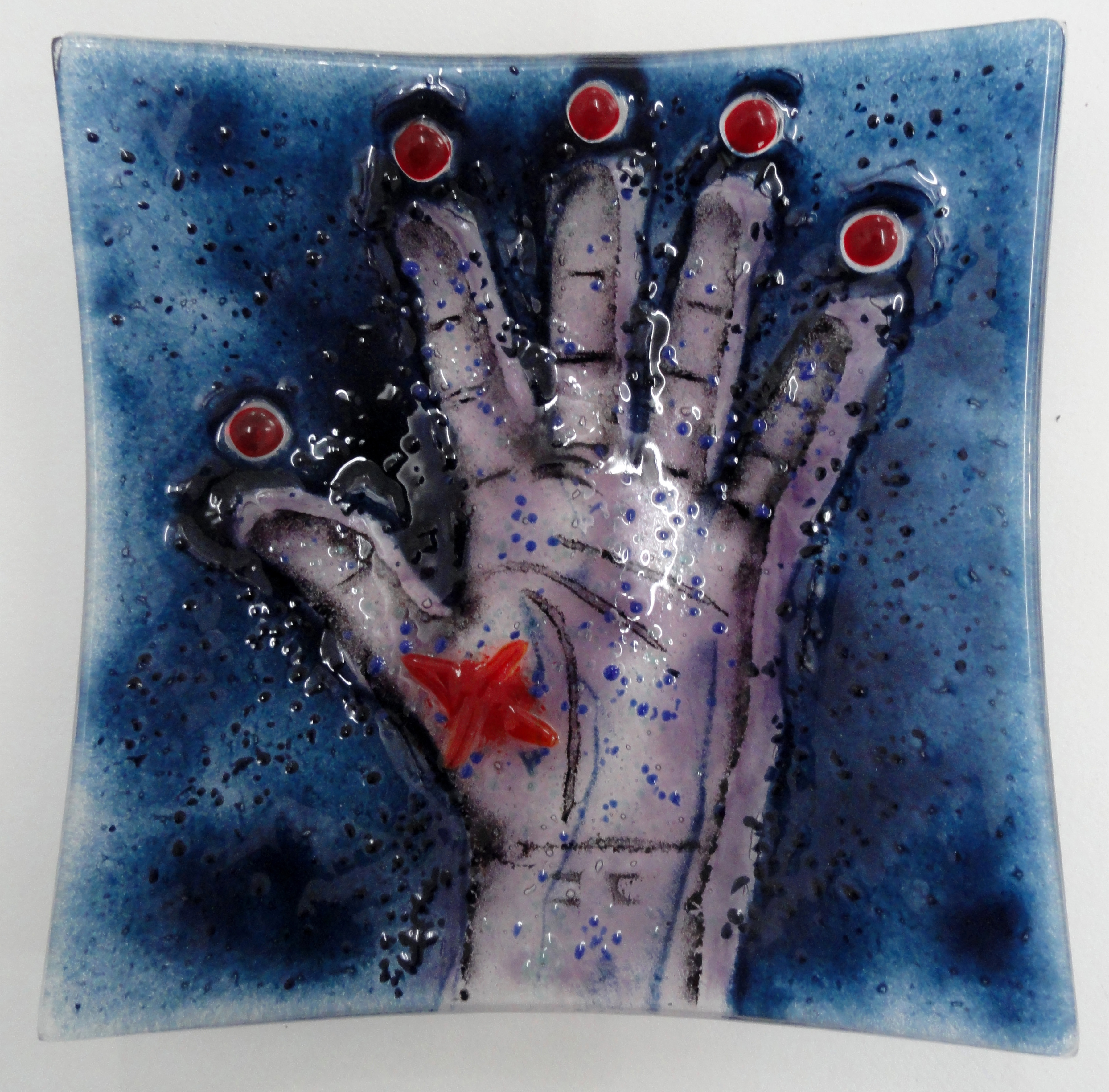
Votive bowl in the form of a fused glass image of a hand

It is perhaps the fusion of image and text that makes Baraduc's work so interesting. The text explains the images in a very believable straightforward way. 'Figuration of the fluidic shower' is however for myself no longer a scientific fact, it becomes a line from a fantasy graphic novel, or a title for one of my own images. I shall try it as a title to one of the images I recently produced when working on ideas for a permaculture aware art practice and the need to become far more embedded into the world and life cycles of plants.

Figuration of the fluidic shower

The fact that the 'signature of the life-animules and the black volative odic shower come from the ants giving up their vitality,' was for myself a doorway back into the world of the animist, and if so we could collapse time, Baraduc is in effect believing things little differently to a shaman working out of a cave 30,000 years ago. 
These old books are things to mine as if you are an archeologist digging up a trench of ancient artefacts. You have no idea of what they really were but you very quickly begin to make up uses for them in your mind. In this case you could argue that what is missing from these explanations is the fact that Baraduc was a follower of Baron Karl von Reichenbach, who proposed something called the Odic force as an invisible energy, something like electromagnetic radiation, but more of that in another post. 


Images taken directly from pages of 'The Human Soul: Its Movements, Its Lights, and the Iconography of the Fluidic Invisible'

'Photograph taken by me in July 1895, in the country. The gamekeeper Crepet is giving to 300 young partridges some ant eggs, which he is taking from a sack. The small birds are covered over by the entire black part of the negative, whilst a quantity of small life animules are freeing themselves from the eggs or from the ants. Is it the emanation of the gamekeeper, or that of the partridges? I took two photos whilst the gamekeeper was throwing handfuls of dust and of eggs. Both are identical. I took two other photos when he was giving them cooked chicken eggs mixed with bread crumbs. In these there is nothing special, the photograph is sharp. It may be concluded from this, that the signature of the life-animules and the black volative odic shower come from the ants giving up their vitality.'

Text to read:

Rasula, T. (2016) History of a Shiver: The Sublime Impudence of Modernism Oxford: OUP.

See also:


How to understand the virus Drawing the invisible enemy

Tuesday, 27 September 2022

Freud and drawing invisible forces

Dali: Freud 1939

Dali's drawing of Freud points to his almost mythic status amongst the Surrealists who believed that Freud opened the door to the unconscious and thus to a way of making images that tapped directly into dreams and a collective unconscious that not only legitimised the work that they were doing, it gave it a theoretical foundation. Dali makes Freud almost cloud like, his soft forms drift into being as if arriving from a dream. But Freud could also draw quite well himself, his accurate representations of the nervous system of the sea lamprey meticulously document  spinal nerve cells, reflecting an excellent command of traditional drawing techniques and an eye for the clarification of what are very difficult forms to observe under the microscope. 

Freud: The nervous system of the the sea lamprey

The drawings Freud made when he was a medical student were based on careful microscopic observation of physical bodies. However when he later began to explore the invisible inner workings of the mind, he would find no trace of the mind's processes existing physically, he therefore had to invent another way to represent unseen mental processes. He was very aware that visual representations communicated far more clearly what was going on beneath the skin and so it was clear to him that some form of visual representation would aid him greatly in the communication of his ideas about what was going on deep inside the mind, which at the time was presumed to sit within the brain.


However what Freud didn't take into account was that drawings are also to some extent free floating signifiers, i. e. when looked at the people doing the looking will develop their own interpretations of what they are seeing, especially when the annotations have to be translated. Perceptually a drawing operates like a view of life itself, it becomes a visual field and simply sits in the place of the view that is reality and the brain tries to interpret it as it would any other stimulus coming in. Yes the observer knows its a drawing, but it is still open to interpretation. For example, the diagrams immediately above are from a Japanese book on Freud and they all relate to the original German publication of his diagram bottom left. (Find a larger image of the English translation further above, which is a copy of the image bottom right). As his work was translated from German into Japanese and back into English there were what you might call 'Freudian slips'. For instance in English the Japanese for the German 'Das ich unt das Es' had become 'The I and the it'. Apparently the original German in the diagram bottom left, translated as 'acoust Pcpt' in the English diagram version, is "akustischen Wahrnehmungen" or acoustic perception and is sometimes translated in Japanese as in the above diagram 'A' by "耳殻'(literally the outer part of the ear) or "聴覚帽" an acoustic cap. Therefore the internalised other becomes an aural manifestation or an ear of the other in the mind, which I find perfect as a poetic representation that embeds a cranial stethoscope and a type of ventriloquism into the way the image is read. My recent work trying to visualise tinnitus has also made me very aware of how difficult it is to find the right visual analogies for invisible effects that take place in the acoustic mind. The poetics of the diagrams above open out gracefully as we move from one language of annotation to another. The words eventually become visual textures that intimate a certain way of scanning the linear forms that they accompany. Timothy Takemoto describes the situation in detail; 'The more famous picture B on the left is from the earlier "Vorlesungen zur Einführung in die Psychoanalyse" (Freud, 1916-17) (Introduction to Psychoanalysis) in which the internalised other is represented as an "uber Ich" (literally "over I") commonly translated as "super ego". Uber Ich might be taken to suggest a visual metaphor, so perhaps the new representation in "The Ego and the Id" (1925) was to qualify and make sure that the reader understand, we are talking 'Ear of the Other in Your Head.' 
As an artist looking to visualise tinnitus, the phrase 'ear of the other in your head' has begun to feel like a title for all of the images that have been produced so far. Takemoto is also speaking from what in Japan is called a Nacalian perspective. Nacal is Lacan backwards, and Nacalian refers to the fact that Lacan's theories explain Japanese behaviour quite well if they are turned upside down or back to front. This is I believe a proper way to treat most psychoanalytic theory as it releases theory back into the story ocean and allows those of us who are artists free reign to follow whichever current seems to be taking us in the direction we want to go in. 

But Freud has other diagrams. A Harvard university exhibition devoted to the origins of psychoanalysis explained how Freud used diagrams in detail: 

Emma Eckstein, one of Freud’s early patients and the first female psychoanalyst, was pivotal to Freud’s development of the “seduction theory,” which located the roots of hysteria and the neuroses in early experiences of sexual trauma. Freud used Emma’s neurosis as the example to illustrate how a childhood sexual trauma could reemerge in adulthood in the form of neurotic symptoms. The diagram, from an 1895 letter, conflates the two temporalities (past and present) and maps out the triggering elements for Eckstein’s illness. The black circles stand for conscious events, while the empty circles represent unconscious and repressed memories. As Freud wrote to Fliess the next year, memory-traces in the past were subject to rearrangement and revision in the present—a process known as nachträglichkeit or “deferred action.”

Freud's original diagram for the triggering elements for Eckstein’s illness.

Freud also made diagrams to visualise the architecture of hysteria and melancholia.

The architecture of hysteria

Melancholia

Those of us that were given Paul Klee's Pedagogical Sketchbook to read in our early years of art training will recognise a certain sort of mind at work, one that Klee illustrated beautifully. It is interesting to map off Freud's diagrams with Klee's visual interpretations, as in for instance the two images of Klee's below, one visualising the sexual reproduction of plants and the other how the heart pumps, both Freud and Klee are aware of the diagrammatic power of drawing to not just illustrate but to fundamentally recreate ideas as visual realities. 

From Klee's The Pedagogical Sketchbook

Diagram from 'On Transformations of Instinct in Anal Erotism'

Freud often wrote about the “anal personality,” who he argued had the traits of “orderliness, parsimony and obstinacy.” He stated this was most probably due to childhood faeces retention. As was explained in the Harvard University exhibition of Freud's drawings, 'The child wishes to retain the most primary gift (a faeces), resisting its loss; later, the trait is mostly manifested through a desire for cleanliness. The drawing demarcates the process of substitution among the various signifiers along two main axes, one running diagonally between faeces (Lumpf) and baby (Kind), and the other running horizontally between baby and penis'. 

Diagrams were a way for Freud to clarify his ideas, but they also gave his ideas a physical presence and therefore more gravitas and added weight to his theoretical ideas. 


His earlier work exploring neurons  

Freud's drawings could also be looked at as totally abstract images, if we compare his drawing of neurons above to a drawing by Hans Arp below, both drawings could be explained as being explorations of how basic forms could be organised. 

Hans Arp

Freud's drawings also reflect the various journeys his mind was taking at the time. Which is perhaps all we can ask of any drawings. 


Freud's freehand drawn diagram of the unconscious above can also be read as a mind roughing out an idea. Freud was very interested in how the body might be 'seen' in the mind. He stated that the brain’s fibres and cells “contain the body periphery in the same way as a poem contains the alphabet, in a complete rearrangement” and that “the body periphery is not projected onto the cortex in a simple and direct fashion ... but rather it is represented there”.  He believed that the mind represented the body abstractly and symbolically. Mental functions are dynamic and exist over time, and they involve processes that cannot be seen and cannot easily be drawn. This was why Freud gave up observational drawings and began to use diagrams. Freud's drawing above is a record of an event, which is another reason why it is so interesting. Perhaps you might try and represent other types of events that have happened in your own life. For instance how you came to realise something, or how a process of thinking that you use could be understood. These are good ways of exploring drawing as a way to understand things beyond the observational.  Events make up processes that are themselves entangled into other processes and different types of drawing can be aligned with different types of events, for instance a diagrammatic representation is different to a map of where things are, which is different to a sketch outlining what the situation might look like, but all use the potential of drawing to carry concepts. Drawings are of course normally static, compressed translations of events, and it is interesting to think of these static consolidations of dynamic processes as batteries and how drawings can release the energy of 'trapped' events to be read as types of narratives. 
At the same time that Freud was speculating on the unconscious, other people who are now forgotten were doing the same thing, one of my favourites was Edwin Babbitt, who's book 'Principles of light and colour', contains some fascinating insights into how others were trying to get to grip with visualising invisible forces. If the unconscious seems now a normal part of our everyday conceptual framework, a hundred years ago there were several other theoretical competitors around, and light itself often seemed central to their gestation. A few pages from 'The Principles of Light and Colour' should I hope be enough to whet your appetites for further investigation of concepts such as 'chromo-mentalism' and the various radiating rays that penetrate and emerge from our bodies. 

The angel of innocence and Psycho-magnetic curves emanating from the temple

Psychic lights and colours

The general form of an atom

Odic lights and flames

Babbitt introduces us to Odic lights and his diagram of the atom is an amazingly beautiful construction of pure poetic fiction believing itself to be a depiction of what lies beneath reality. Babbitt would have believed in these theories just as much as Freud believed his, and interestingly many psychologists have been trying to debunk Freud over the last few years, his theories being regarded as yet more examples of middle class white males, turning their idiosyncratic views of the world into theories that explain everything from their privileged position. 

As an artist who draws a lot I am much more interested in the power of images to hold our attention, not as proofs or understandings, but as magical encounters, doorways into ways of thinking that we would not normally have, and as such I can look at Babbitt's drawing of the general form of an atom and see hearts pumping, bees swarming and yes atoms vibrating, all entangled into the same fluid image, an image that for myself is as much about the future as the past. 

See also: