
Vija Celmins: Desert

Vija Celmins: Sea
Frances Richardson has been responding to the work of Peter Dreher. Dreher made a series of paintings called 'Tag um Tag guter Tag' that engaged him for several years, and which involved him painting the same glass over 5,000 times. This series of paintings, in English ‘Day after Day, Good Day’, was a meditation on time, painting the glass 2,500 times at night and just over 2,500 times during the day. He always painted the glass in the same position on a 25 x 20cm neutral grey ground, and from the same viewer distance and life size. You could argue that these paintings measured out the length of his days, in effect becoming his own personal clock.
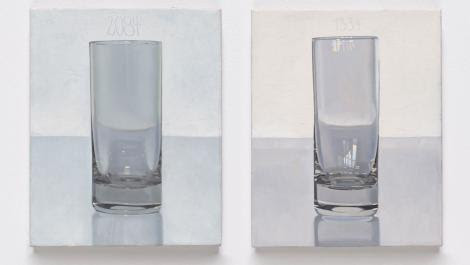


Peter Dreher: 'Tag um Tag guter Tag'
So what you may ask would another artist find interesting in these images of a glass? I think artists are always fascinated by other artists, and are driven to try to understand their obsession. But artists are particularly obsessed with artists that take on the still-life as a subject. It is as if the human/material conversation brings out something fundamental, it focuses on a material metamorphosis, in such a way that it is almost like a religious revelation. Perhaps I need to provide a little history.

Quince, Cabbage, Melon and Cucumber (c. 1602), Juan Sánchez Cotán.
Cotán’s painting of a stark, very deliberately arranged group of vegetables elevates this humble subject matter into a celestial dance. The vegetables are framed in a night sky darkness, their austere nature almost monk like; we are meant to worship in front of this image as at a vegetal altar. There is a spherical geometry that underlies this image, one that suggests celestial bodies moving across a night sky, a classical order that perhaps takes us way back to a time when vegetal Gods were worshipped and the night was a sky God's domain; a reminder that the first animal and human sacrifices were made to ensure the continuation of the yearly growth cycle.

Chardin ‘The Ray’ 1728
In Chardin’s ‘The Ray’ the tense figure of a startled kitten stands alongside a dead ray, a fish that is painted in such a way that it’s vacant and ghostly gaze, becomes a metaphorical message as powerful as Rembrandt’s 'Carcass of Beef', this is indeed 'nature morte'. This is another still life that is deliberately constructed, the architectural arrangement of both alive and dead animals, being framed in a structural triangle of inanimate and animate objects. The frozen action is locked into a space initiated by a knife that almost pierces the picture plane with its handle, but which also establishes the compositional structure, a structure held down by a black jug that gives weight and gravitas to the image.

Morandi: Natura morta 1939
Morandi’s bedroom doubled as his studio, a situation now common as covid hits our ability to travel to studios and other places of work. He stated, ‘I’m a painter of the kind of... composition that communicates a sense of tranquillity and privacy, moods which I have always valued above all’. Morandi uses very subtle rhythms to give a pulse of life to inanimate objects. He suffuses them with his own quiet life rhythm, created in this instance by the undulating heights of objects played off against subtle colour variations played as if by a colour piano and transforming a simple group of everyday objects into a meditation on time. His methodical approach also extended to the objects he used as his subject material; often painting them and then allowing dust to settle on the now slightly rougher surface, each object slowly losing its original sharpness and clarity, gradually beginning to dissolve and soften its form as dust settled.
This slowing down of perception until it becomes a meditative experience is what ties all these artists together, and is the key to what I have called an almost religious revelation.
You should try this; stare at an object, especially something mundane, something you have previously found uninteresting. Keep staring, stare at it for longer that you want to stare. Now begin to draw it, find its edges, feel the movement of its various planes and angles with your drawing materials, mark your way over its surfaces as if it is a loved one, locate it in the space it belongs to, focus on the light that envelops it until it dissolves back into the light from which it emerged, and then keep drawing. Draw until you cant see anything any more. Now stare again at what you have drawn, stare at it for too long. Take your time, look again at that object you found boring and insignificant and hold in your mind what you have seen and then meditate again on the experience. Gradually at some point in the process, hopefully there will be a moment of revelation, a realisation that you and this object are in fact entwined together in existence and that just for a little while you were joined in a harmonic relationship, one that is recorded in the materials of your extended mind. I often draw the things I'm about to eat, I regard drawing as a type of digestion, we are what we eat and what we look at.

A beetroot
Frances Richardson is a sculptor, someone I have written about before in a post on drawing as ‘thin sculpture’. She was obviously drawn to Peter Dreher’s work because of its focus on the enduring materiality of time. This is what is said about the exhibition on Karsten Schubert’s website.
‘Hunter/Gatherer brings together Frances Richardson's recent ink drawings with a selection of work by Peter Dreher. An exercise borne from the solitude of our current moment, Richardson's new works on paper gather together a group of objects each of which holds a sense of emptiness. Paired with the works are texts written by the artist’.


Frances is she says ‘full of doubt’ about this, she feels ‘representation tends to hold authority and domination over things, subjugates the object in a reduced form for the purpose of narrative or symbol; reductive nouns and images attach themselves to objects, a shortcutting of our sensory experience of the world. For me, representation was a ‘not seeing’ of things in themselves as a matter of vibration; but perhaps I need to deal with things as they seem to be the measure of us’.
I was personally fascinated by her doing things over and over. The last time I was engaged with Frances’s drawings there was a sense of labour, repetition and the pricking of countless holes, as paper became sculptural as well as becoming a drawing. As a maker she was re-making paper in her own image, partly yes trying to exert her ‘authority’ on things, but partly I suspect being controlled by paper’s very own material language.
I use a lot of ink, I use it with pens and brushes and sometimes I pool it and think of it as a metaphor for my own ageing skin, its ability to crack and seep and stain, coupled with paper’s ability to soak it up, to resist it and to pool it as the paper crinkles and bends, being in my mind a metaphor for my own materiality.
I’m therefore excited by the way Frances uses the ink to capture the surface of buckets and stone axes, or should I write 'the bucket' and 'the axe head', or is it 'a bucket' and 'an axe head', are these general or particular things? As they repeat how do they do so? I often draw the same thing, but each time it looks totally different, I can never get back into the same place, the object is always dissolving back into the world it emerges from. Frances Richardson plucks her objects out of their spaces, she holds them firmly in their Chinese ink coats, dark surfaces floating in white, each image struggling to become a mass in a space, but as she realises herself, each object is only a vibration, the thin skin of each drawing, a stretched membrane that just needs the faintest of breaths to make it vibrate again.
The work is a fine and proper salute to Peter Dreher, the hours that he spent staring at his glass, compressed into nuggets of time, each one like a hand grenade waiting for someone to pull out the pin, and when they do, like all universes that exist in a point of fluctuation, they expand to become everything that has been and will be, even an old bucket or a hand axe chipped out of flint 10,000 years ago or a drawing and another drawing and another drawing.

Still thinking 1 (Bucket 1)

Still thinking 3 (Bucket 3)

Frances Richardson: Still thinking 3 (Bucket 3)


