Before the invention of photography artists had no other option when making portraits but to work directly from another human being. This being so, a portrait was a study of mass in spacetime. A sitter would have to 'sit', i. e. would have to engage in close contact and collaboration with an artist. In fact, because as a process it took so long, sometimes substitute sitters were employed or models that sat in for kings and queens because important people were always busy. This person of high status, would then re-appear at opportune moments to have their features recorded in more detail.
However since the invention of photography, many portraits have been made by copying photographs and these are no longer studies of mass in space and time, they are about the transfer of a flat image recorded in an instant, to another surface, using much slower methods. The grid is often used to trap or capture one image and is then used to transfer it to another grid, thus ensuring that nothing has moved out of place during the transfer.
The older method was about confronting reality and re-creating it, so that as someone looked at a portrait something of the struggle to comprehend existence was revealed, the copying of photographs simply reveals the ability to invest time in a reproduction process. It is therefore about the personal interest of the copyist and little about a confrontation with another being.
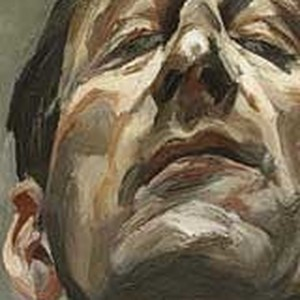
The National Gallery is hosting the exhibition 'Lucian Freud: New Perspectives' at the moment and it is on until the 22nd of January, if any of you are interested in portraiture, this is a must see exhibition. When Freud had no one else to paint he would use himself as the model and that of course involves looking into a mirror. The image that opens this post being a good example of how you can surprise yourself when catching a view of your image in a mirror leaning against a wall. This is Freud's attempt to escape the trap of the mirror/window, instead of looking out to a passive view, the mirror is made more active, it looks back and in turn Freud appears to activate the mirror through some sort of extramission vision.
Lucien Freud: Detail
It is useful to look at a detail of Freud's painting. Look at how everything is slightly off balance. The mouth tilts to the left, the chin juts out and bends very slightly off the horizontal, patches of paint find their way over an envisioned mass, you can feel his solid grasp of form as his paintbrush lays down each mark, he is in effect constructing this head as a mass or lumpen thing, even though it is a solid that is always slightly moving. In doing this he re-created an experience and for myself as an observer I have to take a much slower time to read his marks, time that is divided up by his planar aware paint patches.
This type of approach begins with a grasp of the head's mass.
Lucien Freud: Etching
It is easier to see how Freud worked if you look at one of his etchings. The process of etching means he had to clarify his marks and as you can see from the image above he feels for the mass of the head by using marks that make changes in response to planar direction. This is what makes us so certain that this individual was drawn from life and not copied from a photograph. A photograph is flat and there is no mass to grasp. These planes or surface directions are though never quite still, they overlap and interpenetrate, because no matter how still the sitter, they will always be in movement because the artist is himself having to look and it is in the looking that movement is generated. As you look to one side of the nose your gaze becomes active in assessing the planar movements towards an eye, but in order to assess these you need to drop your gaze down towards the cheek. These constantly roaming eye movements allow you to eventually stitch together a solid idea of the head. Within this complexity of looking is something we call 'accuracy' or 'likeness' and an ability to also catch this at the same time as the experience of the looking, is what makes Freud such as powerful painter.
So how can someone starting off on the journey to become a portrait painter begin the process of learning the skills of looking at a head and a grasp of the mass/space complexity of experiencing someone over a long time period? There are methods that can help wean you off photographs and make you more aware of how to record the process of looking at solid objects but these usually demand of a would be portrait painter time spent investing in the skills of three dimensional construction.
Artist's studios used to always have classical busts from which apprentices were meant to begin developing their drawing skills. The issue about drawing from sculpture is that the sculptor has already simplified the form for you. This can be a useful experience, because it helps the drawer to 'see' how forms can be drawn, the sculpture in effect clarifies the complexity of life. However classical busts are expensive and so many artists rely on purpose made 'planar heads'.
You can buy them ready made, and some have even been designed by other artists specifically for the purpose of helping artists become more aware of the planes that underpin a three dimensional grasp of the head's mass.
A planar head
An Asaro Head
The Asaro planar head was developed by the artist John Asaro, the left side of the model head is a simpler variant of the right side, this allows you to explore how a growing complexity can carry different levels of emotional effects.
Most students will begin by simply using cardboard to make a model. If you need a support to construct one over, you can buy cheap polystyrene display heads for wigs from Amazon for £1.99 and then using ideas of planar simplification you can construct your own heads to work from.
A polystyrene display head for a wig
Using a polystyrene display head to support cardboard faceting
Once you have made or otherwise acquired a planar head, then you can draw it from every angle and get used to the fact that the head consists of solid surfaces made of skin and muscle stretched over a boney skull.
From Burne Hogarth: Drawing the human head
The drawings made from planar heads are though very crude and the next step is to practice drawing from life, this may be from your own head seen in a mirror or much more usefully from other people prepared to sit for you. But try and keep in mind the understanding of planes that you now have. The drawing above is from Burne Hogarth's classical 'how to' drawing book, and you can see the influence of the planar thinking. Hogarth's book is a typical example of teaching constructive drawing where you start by creating simple shapes or abstractions to represent elements of the subject you are drawing.
It might seem a long way from a master such as Freud and a 'how to' drawing book but if you place two images side by side you can see their relationship.
Two approaches to drawing mass
The difference is that Freud's drawing is much subtler, he relies on looking and feeling for the form more than using a planar formula to establish the solidity of the head. But remember the drawing on the right is for students. The nose and mouth feel stuck on rather than being understood as gradual changes in surface direction, but I hope you can see how working in this way you begin with a firm grasp of the mass and solidity of the head. In technical terms this is the constructional method. The constructional method allows you to think in terms of shapes, tone and line; this degree of abstraction helps you overcome your brain’s pre-conceptions about what things look like. For instance when drawing a leg that is very foreshortened it is very hard to get it to look right, but if reduced to simple forms it becomes much easier. You can also get things in the right place before you add detail. This is a vital lesson, likeness in a portrait often comes at the very end not at the beginning. You can also get a clear idea of the most important areas of light and dark on the face. Instead of infinite gradients of tone, you have created planes that are facing or not facing the light source. This means you can quickly establish the key elements around which you will build a portrait and more importantly in your own mind you can picture the head's physical reality as a graspable entity and not the slippery, hard to understand flat thing that emerges from a photograph.
If however as a student you still feel that you want to work from photographs, my advice is to convert the photograph into a solid object and to then begin trying to make a portrait.
A very simple way is to begin folding the photograph. Within a few seconds you have a more three dimensional object that can even be put on a shelf.
Joseph Parra
Once folded the image can be drawn from and this will give you a process or way forward that at least will change your relationship with the photograph. Another way is to go back to your cardboard head and after taking lots of close up photographs from all around the head of the person you want to portray, to print them off at a size that works in relation to the planes of your cardboard, then to cut the photographs out and glue them carefully onto each facet of the planar head. In this way you can bring together multi-photographic viewpoints, into one solid form. This can now be drawn from, but it will also be a intriguing object in its own right.
However there is also a very traditional way of working that can be very valuable. This requires you to make an armature around which to build a clay model. Of course this takes much more time, but think of this as another opportunity to learn new skills. You will need a wooden base and an upright, so why not use the opportunity to practice making wood joints?
Once you have made a wooden base, you will need to give the clay something to stick on to.
Wire, tape and even some string and newspaper can be used to make an armature
Once you have an armature in place it needs to be measured because you will be building a head from two photographs that will need to be printed off at the same size as the 3D head you are going to make. You can draw lines across the two images to make sure they are correctly lined up, as in the image below.
Because of your experience in making a planar head, you might try laying some tracing paper over a photograph and making it more three dimensional, this will help you decide on where planes begin and end.
You will need to grid your photographs so that you can take measurements
Callipers
You will also need some callipers so that you can transfer measurements from your photographs
Look at this video on how to block out a form for making a portrait bust
In the video the sculptor uses her own head to take measurements, but you will use the two photographs, the problem being that you have to think 3D, and there is a halfway house, what you might call two and a half D.
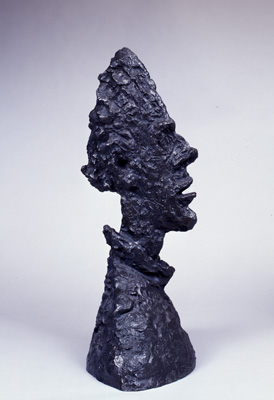
Giacometti
You can use Giacometti as a model, simply begin thin, start with making a profile out of clay, practice transferring the measurements and once you have something you are happy with extend the face out sideways by taking measurements from the frontal view. As you do this keep an awareness of the grid, its a good idea to mark it over your emerging clay head as it arrives, so that you can keep checking that everything is where it should be.
Measuring lines can be incised deeply into the clay and linked directly to measurements taken from the flat images.
Once you have a model that you are satisfied with, or dissatisfied with it can be drawn from in the same way as the Asaro Head or your cardboard version and this should give you a feel for the solidity of reality rather than the flatness of the photograph, the translation of 2D information into 3D information allowing you to have a much better grasp of mass potential in any future construction of a portrait.
This sense of three dimensional reality is often when looking at paintings first glimpsed with how the painter deals with edges between masses and spaces.
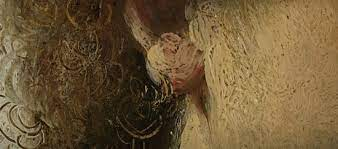
Velasquez: detail
If you look closely at Velasquez you will notice that his figures emerge out of the spaces they occupy in such a way that there is a sort of hesitant line or edge between the figure and the space it occupies. This oscillating moment is a reminder of the time spent recording what was seen, of extracting information from the nerve patterns that cross a screen of looking.
Velasquez: Queen Mariana of Austria
Even though Velasquez is intoxicated by re-creating the textures of various surfaces, he never forgets that each and every human being occupies a mass that sits dynamically in space and it is this re-creation that gives such vibrant life to his portraits, they are never static.
Rembrandt is similar, the eyes below are situated within a solid mass, the brush lays paint in directions that reveal his mind feeling its way over the forms of the face.
Rembrandt: detail
Look at how Rembrandt feels for the direction of the form with the paint
Rembrandt: Etching
Like Freud, Rembrandt uses etching as an extension of drawing. Look at how the marks of the etching caress the planes of the face. This woman is a mountain captured within a few square inches of paper, he knows her as a rock, a solid reality that is part of his awareness of his own existence. Again there are no sharp edges, a moving, roving set of eyes, will always be seeing something just past an edge. As the artist looks and records, their eyes are always looking into space and over mass. The one is always emerging from the other. The act of looking reveals an exchange of mass into space and space into mass. Science now tells us that everything consists of a never ending oscillation of energy fields. These portraits, like the quarks, neutrinos and muons beneath them, continue to dance into existence and as they do they remind us of how powerful portraiture can be and that at its best it can re-create the life essence of human experience.
Etching: Lee Newman
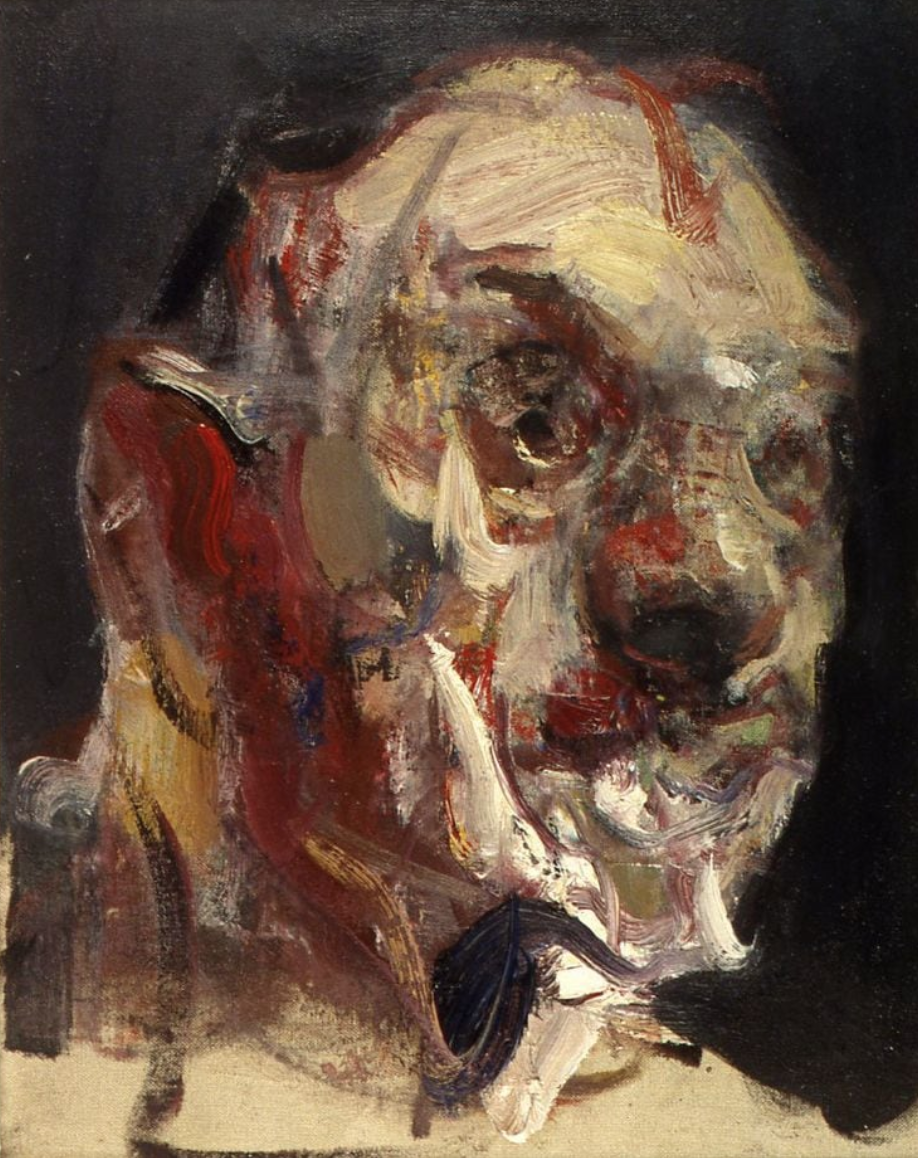
Robin Cook by Lee Newman
The contemporary artist Lee Newman is someone that clearly understands the link between observation through time and portraiture. His drawings, prints and paintings testify to a life long concern to capture life's energy and weight within the fragile thin surface of image making. His etched lines caress the face and as he moves on into painting, you really do feel that each paint stroke acknowledges the mass beneath.
Drawing is something that underpins painting and as this blog is very much focused on drawing I shall leave this rumination on how to begin thinking about portraiture here.
I would hope that as students you don't forget that skills take many hours of practice and that whichever way you decide to approach something like portraiture, only many hours of trial and error will enable you to build the necessary skills. I'm also aware that if you are a frustrated painter that you just need to begin painting, but that shouldn't stop you taking on board some of the activities that have been suggested, in fact mixing in painting alongside and onto the things you are making can lead to interesting hybrid objects that open out even more possibilities for formal investigation.
Lucien Freud: Self portrait
See also:
Drawing and philosophy This post includes links to the remaining art schools that still teach traditional methods.
I've just de-installed my work from the (im)Material Disarray exhibition in Wakefield. This was part of 'INDEX' a fringe exhibition linked to the Yorkshire Sculpture International 2019 festival. I have recently been trying to deal with conversations I have been having with people about climate change and our need to find a new relationship with materials if we are going to survive the anthropocene* and this exhibition gave me a chance to try out some of my ideas of how to respond to those conversations in public. *The current geological age, viewed as the period during which human activity has been the dominant influence on climate and the environment. I was selected for the exhibition from a proposal I had put together which included drawings of what I was thinking about, but I hadn't at the time of putting in the proposal made any of the work.
The two drawings above were done in my sketchbook whilst lying in bed in Paris recovering from a bout of sickness and diarrhoea. There was a vase of flowers in my hotel room and I began imagining what it would be like if it turned itself upside down and began to walk. I had been reading about how we don't ever think of inanimate objects as having 'agency' and these drawings were an attempt to visualise that idea but I didn't take them any further at the time. On getting back to Leeds I saw the (im)Material Disarray request for artists and as I knew the lead artist, I trusted that it would be an interesting exhibition and more importantly as the exhibition was about objects in disarray, saw it as a chance to work through some of my ideas about how to give inanimate materials agency. These are some drawings I did for the proposal.
I was thinking about hermit crabs as I made these drawings on grey paper and wrote this text as part of the application:
Recently almost everything made by human beings begins to feel as if it is in some way a dark, forbidding blight on the planet. What were until recently simple ‘man made’ objects, are suddenly not just manufactured things slowly becoming aware of their status as commodity fetishes, they are now ecological monsters of the anthropocene, lurking on the edges of our unconscious, reminding us of failed attempts of being kind to others, especially plants and minerals and those animals that are not human.
Out of the corner of your eye, what was a simple domestic object may well be a growing Lovecraftian spore, something from chthonic depths that may or may not be living to two spaces at once. What was once right and wholesome is now upside down and manic, what was once a comfortable part of our home, now dark with desires that if not held in check will ruin us all, if it hasn’t done so already.
These small creatures made from the detritus of domesticity, from cardboard, newspapers, left over rolls of tape, old toothbrushes, dead mobile phones and no longer used mugs, can clutter up the house like deformed gremlins.
This series of objects includes ceramic elements embedded hermit crab like into domestic containers that are now more like creatures than objects, a hybrid series of forms that at times seek to be like humans but constantly fail to be so, they can shuffle into corners and lurk behind other objects, or organise themselves into a pack and when they do so, in large numbers they finally reveal themselves to be waste harbingers of doom.
On acceptance I now I had to make the objects.
The first ones I made were very like the drawings I had submitted, but quite quickly the making process began to take on its own momentum. I had piled into the studio as many old bits of rubbish, ends of tapes, lengths of wire, etc etc and gradually a language of objects began to take over from a language of drawing.
I made several head type forms out of cardboard stuffed with newspapers and covered them in parcel tape. As extensions to these 'heads' began to be added, the concept became about materials trying to become human. For instance these objects needed legs to stand on and they had to find a point of balance to stop them falling over. This idea was reflected in the title for my work in the exhibition, 'Failed attempts at being human'. The work was eventually spread throughout the gallery, a series of objects placed amongst other people's work, positions chosen by the two curators, who were themselves considering how images of domesticity were being interrogated by the idea of (im)Material Disarray. In the exhibition two different conversations were woven together. The overall theme for the exhibition was a Feminist narrative centred on refusing the traditional roles of the domestic, my own contribution being more to do with waste and how it begins to have chthonic undertones and possibilities for new lifeforms to emerge. That's the interesting thing with curated exhibitions, work doesn't necessarily fit the theme exactly but in the deviation lies the fascination of other ideas seeping through and around the edges of the initial concept. Like all conversations, there is an element of unpredictability and that is partly why you engage with situations of this sort.
A few images from the exhibition
Map of SNAPARTS gallery: each artist was given a number, I was 6
I was also working in ceramics, so the processes of drawing, building ceramics and making objects with rubbish became intertwined. One method would sometimes really challenge another and in the friction between the two I sometimes found a 'voice' for the materials. For instance the 'face hugger' image above with three legs, was a result of using an old blue plastic bag filled with stuff I was going to throw away and noticing that a 'not working' ceramic left next to it suddenly seemed to become 'alive' in some way. The head eventually got in-between the bag and the ceramic but that just came through trial and error.
Sometimes I would go back to drawing trying to work out an almost realised idea that was shaping itself through working with the materials I had found but was yet to quite 'get there'. The headscarf idea eventually made it as part of a very different object, (see 3rd image below) and the drawing immediately below was made when the object was not far from completion, and it was used to help me think about a few final issues which included a black slash of tape and the elimination of a stick 'antenna' from out of the top of the head.
All sorts of objects began emerging, at one point to felt as if they had a life of their own and I didn't have to think about them anymore.
Thinking about leaning forms
Exhibition photographs
It was at this point that I began to think about needing to deal with another aspect of what I was trying to do. These 'creatures' had emerged out of a need to find responses to conversations I had been having about how wasteful our society was and how we were despoiling the planet by using up resources and being unthoughtful. Although I thought the work in the exhibition would be interesting, I wasn't sure about how it was going to carry on the conversation, therefore when I had my proposal accepted I also agreed that I would put on something more performative on the first Sunday after the exhibition's opening. For this I had decided to tell a story.
The story was developed around something I saw on one of my trips to Wakefield to get an idea of the layout of the gallery. I had spent time watching swans building a nest out of rubbish alongside the river Calder as it flowed past the Hepworth Gallery. The story became more and more elaborate as the time for the performance got closer and when I delivered it it had become a thing in its own right, something that was taking its own shape as a narrative. The performance went well and people seemed to be gripped by the story, but I realised it needed reshaping and writing again.
What is interesting about the process of developing an idea is how different aspects keep coming forward and then retreating into the background. This all started with conversations and reading, the process then became about making drawings, then ideas about inanimate materials having some form of agency were opened out through writing, then drawings again, then making and letting materials speak for themselves, back into drawing and then into a spoken narrative and now it was becoming a written out story. All these things were aspects of one idea. No one element being more important than the other, it was about a series of inter connected events rather than the making of a number of art objects.
As the story developed I started to visualise certain moments within it and so I found myself going back to drawing; drawing I suppose always being my default way of thinking. Below are some of the drawings now emerging which are directly related to the idea of a swan's nest made from rubbish mixed up with other flotsam and jetsam. The nest becomes sentient and travels from the rivers of England out into the sea, reaches the great North Atlantic gyre of plastic and eventually after meeting monsters decides to leave earth and go to the moon. It has now become a fable for children and I am working with someone else, this time someone who has worked as a writer and editor and I have decided to let the story go more and more into his mind and as I step back, I can see that it is metamorphosing into something new. This letting go is I think very important, we are a species that works collectively and the best ideas flow and shape themselves between us, at times we hold onto the baton but at other times people with different skills and ways of working need to push on and take ideas into directions you would never have thought about. These are some of the drawings done to help visualise scenes from the story as it develops.
As you can see there is as yet no real coherence in the way these images are drawn, collaged or worked up as prints, all are simply ideas coming directly out of my head and onto the page, but that is always the exciting thing, not knowing what things will look like until they arrive. I don't use my own work very often to develop posts in this blog because it is about the wider issues of drawing. But on the other hand I have also begun to realise that it is therefore hard for any of you following these posts to get a practical idea of how drawing might work as a driver for my own ideas. This exhibition is now finished, the fable is still developing and the writer I have handed it over to is working on the final chapter, so that is coming to some sort of conclusion, it will then be decided whether or not I continue working on the images as illustrations for the book. In the meantime a very different exhibition opens this evening which I have been working on in print and ceramic, reflecting on conversations I have been having about the divisive nature of current politics and in the studio I am making large drawings in preparation for an exhibition opening at the end of October, again about a very different set of themes. Drawing though underpins them all and for me that is why it is so important and why I keep putting up posts encouraging the embracing of drawing in all its aspects.
The end
As to the de-install, I separated all the objects into their various components, which were then bagged up and sent off to the recycling bin.