Before the invention of photography artists had no other option when making portraits but to work directly from another human being. This being so, a portrait was a study of mass in spacetime. A sitter would have to 'sit', i. e. would have to engage in close contact and collaboration with an artist. In fact, because as a process it took so long, sometimes substitute sitters were employed or models that sat in for kings and queens because important people were always busy. This person of high status, would then re-appear at opportune moments to have their features recorded in more detail.
However since the invention of photography, many portraits have been made by copying photographs and these are no longer studies of mass in space and time, they are about the transfer of a flat image recorded in an instant, to another surface, using much slower methods. The grid is often used to trap or capture one image and is then used to transfer it to another grid, thus ensuring that nothing has moved out of place during the transfer.
The older method was about confronting reality and re-creating it, so that as someone looked at a portrait something of the struggle to comprehend existence was revealed, the copying of photographs simply reveals the ability to invest time in a reproduction process. It is therefore about the personal interest of the copyist and little about a confrontation with another being.
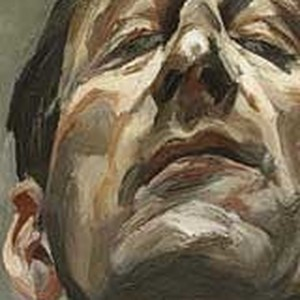
The National Gallery is hosting the exhibition 'Lucian Freud: New Perspectives' at the moment and it is on until the 22nd of January, if any of you are interested in portraiture, this is a must see exhibition. When Freud had no one else to paint he would use himself as the model and that of course involves looking into a mirror. The image that opens this post being a good example of how you can surprise yourself when catching a view of your image in a mirror leaning against a wall. This is Freud's attempt to escape the trap of the mirror/window, instead of looking out to a passive view, the mirror is made more active, it looks back and in turn Freud appears to activate the mirror through some sort of extramission vision.
Lucien Freud: Detail
It is useful to look at a detail of Freud's painting. Look at how everything is slightly off balance. The mouth tilts to the left, the chin juts out and bends very slightly off the horizontal, patches of paint find their way over an envisioned mass, you can feel his solid grasp of form as his paintbrush lays down each mark, he is in effect constructing this head as a mass or lumpen thing, even though it is a solid that is always slightly moving. In doing this he re-created an experience and for myself as an observer I have to take a much slower time to read his marks, time that is divided up by his planar aware paint patches.
This type of approach begins with a grasp of the head's mass.
Lucien Freud: Etching
It is easier to see how Freud worked if you look at one of his etchings. The process of etching means he had to clarify his marks and as you can see from the image above he feels for the mass of the head by using marks that make changes in response to planar direction. This is what makes us so certain that this individual was drawn from life and not copied from a photograph. A photograph is flat and there is no mass to grasp. These planes or surface directions are though never quite still, they overlap and interpenetrate, because no matter how still the sitter, they will always be in movement because the artist is himself having to look and it is in the looking that movement is generated. As you look to one side of the nose your gaze becomes active in assessing the planar movements towards an eye, but in order to assess these you need to drop your gaze down towards the cheek. These constantly roaming eye movements allow you to eventually stitch together a solid idea of the head. Within this complexity of looking is something we call 'accuracy' or 'likeness' and an ability to also catch this at the same time as the experience of the looking, is what makes Freud such as powerful painter.
So how can someone starting off on the journey to become a portrait painter begin the process of learning the skills of looking at a head and a grasp of the mass/space complexity of experiencing someone over a long time period? There are methods that can help wean you off photographs and make you more aware of how to record the process of looking at solid objects but these usually demand of a would be portrait painter time spent investing in the skills of three dimensional construction.
Artist's studios used to always have classical busts from which apprentices were meant to begin developing their drawing skills. The issue about drawing from sculpture is that the sculptor has already simplified the form for you. This can be a useful experience, because it helps the drawer to 'see' how forms can be drawn, the sculpture in effect clarifies the complexity of life. However classical busts are expensive and so many artists rely on purpose made 'planar heads'.
You can buy them ready made, and some have even been designed by other artists specifically for the purpose of helping artists become more aware of the planes that underpin a three dimensional grasp of the head's mass.
A planar head
An Asaro Head
The Asaro planar head was developed by the artist John Asaro, the left side of the model head is a simpler variant of the right side, this allows you to explore how a growing complexity can carry different levels of emotional effects.
Most students will begin by simply using cardboard to make a model. If you need a support to construct one over, you can buy cheap polystyrene display heads for wigs from Amazon for £1.99 and then using ideas of planar simplification you can construct your own heads to work from.
A polystyrene display head for a wig
Using a polystyrene display head to support cardboard faceting
Once you have made or otherwise acquired a planar head, then you can draw it from every angle and get used to the fact that the head consists of solid surfaces made of skin and muscle stretched over a boney skull.
From Burne Hogarth: Drawing the human head
The drawings made from planar heads are though very crude and the next step is to practice drawing from life, this may be from your own head seen in a mirror or much more usefully from other people prepared to sit for you. But try and keep in mind the understanding of planes that you now have. The drawing above is from Burne Hogarth's classical 'how to' drawing book, and you can see the influence of the planar thinking. Hogarth's book is a typical example of teaching constructive drawing where you start by creating simple shapes or abstractions to represent elements of the subject you are drawing.
It might seem a long way from a master such as Freud and a 'how to' drawing book but if you place two images side by side you can see their relationship.
Two approaches to drawing mass
The difference is that Freud's drawing is much subtler, he relies on looking and feeling for the form more than using a planar formula to establish the solidity of the head. But remember the drawing on the right is for students. The nose and mouth feel stuck on rather than being understood as gradual changes in surface direction, but I hope you can see how working in this way you begin with a firm grasp of the mass and solidity of the head. In technical terms this is the constructional method. The constructional method allows you to think in terms of shapes, tone and line; this degree of abstraction helps you overcome your brain’s pre-conceptions about what things look like. For instance when drawing a leg that is very foreshortened it is very hard to get it to look right, but if reduced to simple forms it becomes much easier. You can also get things in the right place before you add detail. This is a vital lesson, likeness in a portrait often comes at the very end not at the beginning. You can also get a clear idea of the most important areas of light and dark on the face. Instead of infinite gradients of tone, you have created planes that are facing or not facing the light source. This means you can quickly establish the key elements around which you will build a portrait and more importantly in your own mind you can picture the head's physical reality as a graspable entity and not the slippery, hard to understand flat thing that emerges from a photograph.
If however as a student you still feel that you want to work from photographs, my advice is to convert the photograph into a solid object and to then begin trying to make a portrait.
A very simple way is to begin folding the photograph. Within a few seconds you have a more three dimensional object that can even be put on a shelf.
Joseph Parra
Once folded the image can be drawn from and this will give you a process or way forward that at least will change your relationship with the photograph. Another way is to go back to your cardboard head and after taking lots of close up photographs from all around the head of the person you want to portray, to print them off at a size that works in relation to the planes of your cardboard, then to cut the photographs out and glue them carefully onto each facet of the planar head. In this way you can bring together multi-photographic viewpoints, into one solid form. This can now be drawn from, but it will also be a intriguing object in its own right.
However there is also a very traditional way of working that can be very valuable. This requires you to make an armature around which to build a clay model. Of course this takes much more time, but think of this as another opportunity to learn new skills. You will need a wooden base and an upright, so why not use the opportunity to practice making wood joints?
Once you have made a wooden base, you will need to give the clay something to stick on to.
Wire, tape and even some string and newspaper can be used to make an armature
Once you have an armature in place it needs to be measured because you will be building a head from two photographs that will need to be printed off at the same size as the 3D head you are going to make. You can draw lines across the two images to make sure they are correctly lined up, as in the image below.
Because of your experience in making a planar head, you might try laying some tracing paper over a photograph and making it more three dimensional, this will help you decide on where planes begin and end.
You will need to grid your photographs so that you can take measurements
Callipers
You will also need some callipers so that you can transfer measurements from your photographs
Look at this video on how to block out a form for making a portrait bust
In the video the sculptor uses her own head to take measurements, but you will use the two photographs, the problem being that you have to think 3D, and there is a halfway house, what you might call two and a half D.
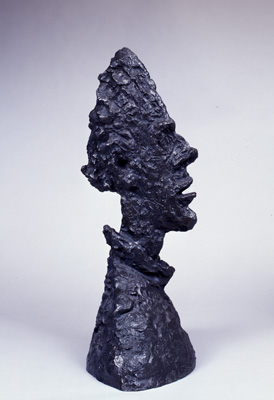
Giacometti
You can use Giacometti as a model, simply begin thin, start with making a profile out of clay, practice transferring the measurements and once you have something you are happy with extend the face out sideways by taking measurements from the frontal view. As you do this keep an awareness of the grid, its a good idea to mark it over your emerging clay head as it arrives, so that you can keep checking that everything is where it should be.
Measuring lines can be incised deeply into the clay and linked directly to measurements taken from the flat images.
Once you have a model that you are satisfied with, or dissatisfied with it can be drawn from in the same way as the Asaro Head or your cardboard version and this should give you a feel for the solidity of reality rather than the flatness of the photograph, the translation of 2D information into 3D information allowing you to have a much better grasp of mass potential in any future construction of a portrait.
This sense of three dimensional reality is often when looking at paintings first glimpsed with how the painter deals with edges between masses and spaces.
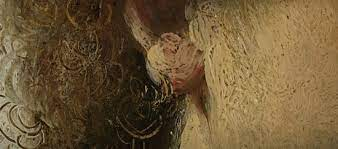
Velasquez: detail
If you look closely at Velasquez you will notice that his figures emerge out of the spaces they occupy in such a way that there is a sort of hesitant line or edge between the figure and the space it occupies. This oscillating moment is a reminder of the time spent recording what was seen, of extracting information from the nerve patterns that cross a screen of looking.
Velasquez: Queen Mariana of Austria
Even though Velasquez is intoxicated by re-creating the textures of various surfaces, he never forgets that each and every human being occupies a mass that sits dynamically in space and it is this re-creation that gives such vibrant life to his portraits, they are never static.
Rembrandt is similar, the eyes below are situated within a solid mass, the brush lays paint in directions that reveal his mind feeling its way over the forms of the face.
Rembrandt: detail
Look at how Rembrandt feels for the direction of the form with the paint
Rembrandt: Etching
Like Freud, Rembrandt uses etching as an extension of drawing. Look at how the marks of the etching caress the planes of the face. This woman is a mountain captured within a few square inches of paper, he knows her as a rock, a solid reality that is part of his awareness of his own existence. Again there are no sharp edges, a moving, roving set of eyes, will always be seeing something just past an edge. As the artist looks and records, their eyes are always looking into space and over mass. The one is always emerging from the other. The act of looking reveals an exchange of mass into space and space into mass. Science now tells us that everything consists of a never ending oscillation of energy fields. These portraits, like the quarks, neutrinos and muons beneath them, continue to dance into existence and as they do they remind us of how powerful portraiture can be and that at its best it can re-create the life essence of human experience.
Etching: Lee Newman
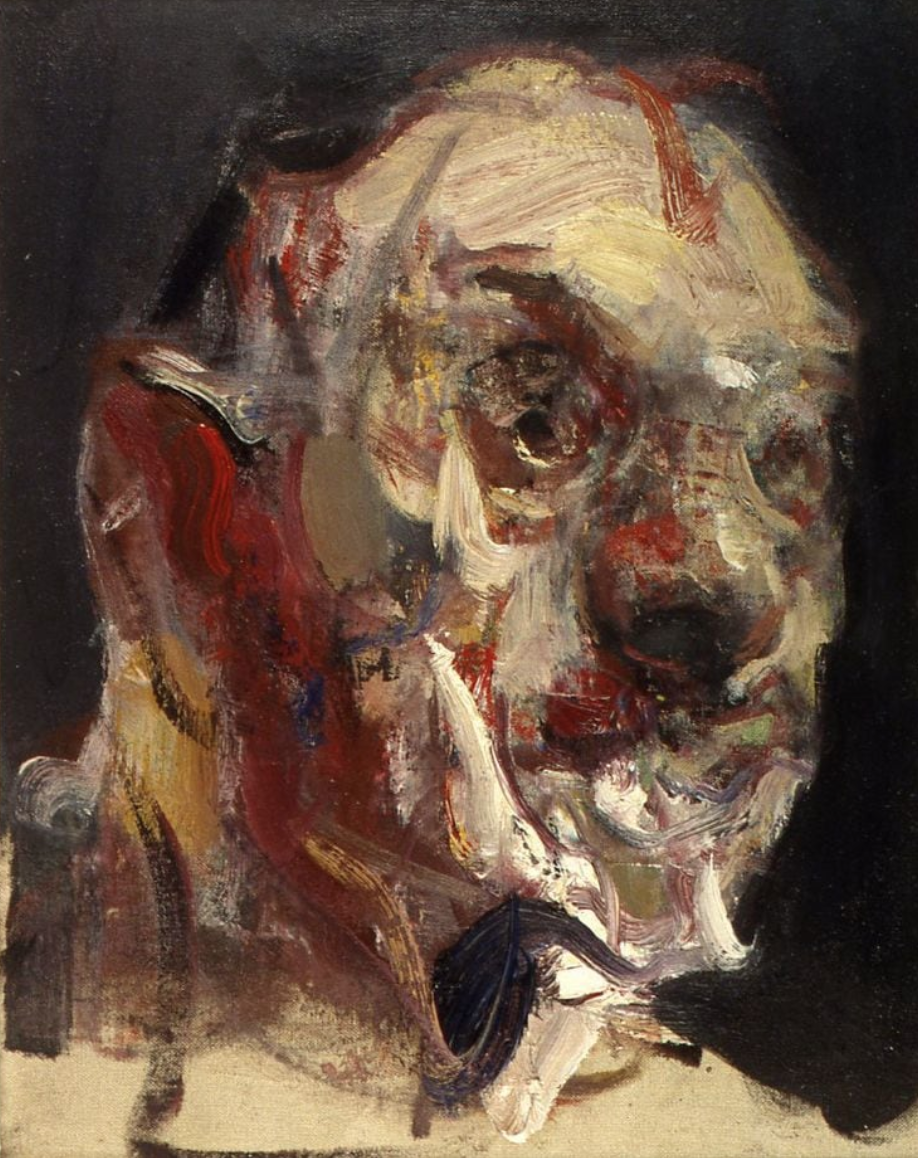
Robin Cook by Lee Newman
The contemporary artist Lee Newman is someone that clearly understands the link between observation through time and portraiture. His drawings, prints and paintings testify to a life long concern to capture life's energy and weight within the fragile thin surface of image making. His etched lines caress the face and as he moves on into painting, you really do feel that each paint stroke acknowledges the mass beneath.
Drawing is something that underpins painting and as this blog is very much focused on drawing I shall leave this rumination on how to begin thinking about portraiture here.
I would hope that as students you don't forget that skills take many hours of practice and that whichever way you decide to approach something like portraiture, only many hours of trial and error will enable you to build the necessary skills. I'm also aware that if you are a frustrated painter that you just need to begin painting, but that shouldn't stop you taking on board some of the activities that have been suggested, in fact mixing in painting alongside and onto the things you are making can lead to interesting hybrid objects that open out even more possibilities for formal investigation.
Lucien Freud: Self portrait
See also:
Drawing and philosophy This post includes links to the remaining art schools that still teach traditional methods.
I'm looking at mathematics again, so apologies for this, but in an attempt to maintain a holistic approach to aesthetic thinking, every now and again I try to dip my toes into waters I'm deeply frightened of. In this case it's the work of Michael Hansmeyer that I'd like to highlight. This is work that uses layer upon layer of flat drawings, that when cut out of card and stacked one above the other make complex three dimensional shapes that bridge the gap between sculptural form and drawing.
Hansmeyer often uses a finite subdivision rule as a way of repeatedly dividing a two-dimensional shape into smaller and smaller pieces. Subdivision rules in a sense are generalisations of regular geometric fractals, but instead of repeating exactly the same design over and over, they have slight variations in each stage, and this makes for a much richer structure while still maintaining an overall harmonisation of forms. These subdivision rules are often found in biologic entities, which is why structures using this way of constructing themselves remind you of natural forms.
A finite subdivision rule applied to a polygon
Using flat forms to construct three dimensional models
As you divide regular geometric forms and you move away from symmetry you begin to achieve a nature like complexity, a complexity that can be stabilised formally by reintroducing bi-lateral symmetry.
Two symmetrical rotations of 'time' section above
A complex made of four quadrilaterals subdivided twice.
Our lungs obey a similar principle, and the reason I've become more interested in these things is that I've been thinking more about how to envisage the things we don't normally see, such as the insides of our bodies.
Grotesque columns based on Doric forms
Hansmeyer applies these types of rules to create variations on regular patterns. In the case of his columns above, an abstracted doric column was used as the input data to the subdivision processes. The ornamentation is developed by controlled subdivision put together as a continuous flow. The complexity of each column is a result of changing focus on different aspects of the data input. For instance one section might be a response to the dimensions of the indentations that surround the capital, and the adjoining section could be a response to the change from a circular cross section to a square one.
A Doric Column capital
Once the flow of change has been established, drawings are made of each move and these are then used to drive a laser cutter.
Cutting and building a column out of cardboard sheets.
I have mentioned Michael Hansmeyer's work before, but have been returning to it, to think about its generative processes of arrival and how my own process of making variations of form relates to it. Generative mathematical form does seem to be a powerful tool and has a deep connection with the way many forms in nature are generated with slight variations, such as human beings. In order to see if there was an entry point for someone as mathematically challenged as myself I have done a little research and it would seem that 'Grasshopper' is the best software to begin with. It requires no knowledge of programming or scripting, and it can help you as an artist beginning to look at this area to build your own form generators. So if you are interested in this area, don't be put off by its apparent complexity, like most complex things, it is built from simple units. You do however need to understand what a Rhino environment is. Rhino 3D is a free form surface modeller that uses a modelling by curves technique or NURBS (Which I did look at a little while ago) The fact that it is still free to download does mean you can make a start on this without having to buy expensive software.
More recently Hansmeyer has been using these design principles to create set designs for opera. His grotto for Mozart's Magic Flute, being a particularly successful transfer of his more sculptural ideas into operatic stage design. Not long ago I put up a post on artists, such as David Hockney, using their skills to create grand dramatic and expressionist spaces, in this case a sculptural principle now becomes a shaper of environments and it also further illustrates a point that I have been making more and more recently. Visual thinkers can move between being seen as artists, biologists, architects, or stage designers, because essentially they are problem solvers. Fine art students are just as capable of solving visual problems as students from any other discipline, with the added bonus that as an artist the problems that you set for yourself are just that, self set problems, arriving out of issues and interests that you are fascinated by.
Michael Hansmeyer's set for the Magic Flute
This work is a form of digital morphogenesis, a type of generative art in which complex shape development is enabled by computation. Perhaps the most interesting issue is though that you can find the same formal principles of shape morphogenesis in biology, geology and geomorphology, which for myself raises an issue about the divide between organic and inorganic matter. The more that I am drawn to animism as a way of acknowledging the rest of the world that isn't me, the more I see similarities between the way matter morphs into form and the way life forms are shaped, it is perhaps more an issue of one taking longer than the other to become what it becomes. I am making a series of drawings that are meant to sit visually in that space between the organic and the inorganic, that are images of inner body sensations, feelings and awarenesses and I am thinking about how to explore their formal possibilities further, which is also why I'm personally becoming interested in shape morphogenesis.
There is so much disinformation around about how the corona virus spreads that I thought I'd look at how drawing can help clarify things when words don't.
Plan of a call centre that was hit by the corona virus
In the diagram, it is easy to see how people sit next to each other in this work space. Blue chairs represent those who became infected. This is what happened. One infected employee came to work on the 11th floor of a building. That floor had 216 employees. Over the period of a week, 84 of those people become infected (the blue chairs). Notice how one side of the office is primarily infected, while there are very few people infected on the other side. Being in an enclosed space, sharing the same air for a prolonged period increases your chances of exposure and infection. The estimates were that 94% of infections were from respiratory droplets / respiratory exposure, and roughly 6% from door handles, elevator buttons etc). Another 3 people on other floors of the building were infected, most likely from doors handles, elevator buttons or from being in an enclosed elevator with the infected person. See the full article here. It is easy to see how close contact and being in an enclosed space are by far the most important issues in the spread of the virus.
Plan of a restaurant hit by corona virus
A single asymptomatic carrier went to a restaurant. The infected person (A1: Yellow) sat at table 'A'. Airflow was from right to left. (Black arrows) Approximately 50% of the people at the infected person's table 'A' became sick over the next 7 days. 75% of the people on the adjacent downwind table 'B' became infected. And even 2 of the 7 people on the upwind table 'C' were infected (believed to happen by turbulent airflow). No one at tables E or F became infected, they were outside of the reach of the air flow of the main air conditioning. See the full article here.
One person on a bus manages to infect several others, again it looks as if a contained environment, whereby people share the same air, is the most likely place for you to become infected.
Diagrams seem to make things much clearer.
Drawing is also of course about images.
I have already put up a post about some of the ways that we can think about the virus as an image. However there are many more images now circulating through various media outlets, all of which are making an impact on our collective psyche. As an artist I'm interested in how deeply they will impact on our sub-conscious selves.
Invisible germs revealed
One of the most interesting issues has been the need to find graphic ways to reveal the invisible. In this image above taken from a government information poster, the prevalence of ultraviolet light images to 'prove' the existence of germs and how hand-washing removes them has influenced the design and construction of the image.
Ultraviolet light images of hand washing
However I believe the blue hand and glowing green virus on the door handle taps into a much older tradition of revealing the invisible.
Kirlian photography of human in lotus position
Kirlian photography can show an 'aura' around people, its popularity is very much to do with its other worldly suggestiveness.
Blue Vishnu
Blue representations of skin were often a way to present a figure as being other worldly, as being something normally invisible made visible. What is happening is that there is an awareness that the pandemic is a mythic event and that imagery associated with it needs to tap into deep roots if it is to deeply effect us.
Etruscan death demon
Blue Etruscan death demons already existed by the end of the fifth century BC and demons and devils in Christian iconography were often depicted as being blue or green
The Devil presenting St. Augustine with the book of Vices: Michael Pacher
St Theobald exorcises a possessed man: C14th Church of St. Thibault: France
In the detail of a wood carving above, blue represents an aspect of demonic possession and the majority of the images of the corona virus that circulate through various media outlets are coloured blue.
Visualisations of the corona virus
Drawing (in these cases visualisation using CAD technical drawing and PhotoShop manipulation) can deal with both how to understand the spread of the virus in a very logical and clear way, as well as being able to find imagery that helps us think about an invisible entity. It is colour though that adds the emotional and spiritual value.