Showing posts with label Curtis Holder. Show all posts

Sunday, 10 November 2024

Curtis Holder at Leeds City Art Gallery

Seki Lynch, coloured pencil on paper, 150 × 123 cm, 2024

An exhibition of Curtis Holder's drawings, ‘Silent Echoes, Spoken Truths' has opened at Leeds City Art Gallery. Curtis has been an artist in residence at the gallery and the exhibition documents his time in Leeds meeting and drawing people. 

On his website Curtis states about the exhibition; "The title of the exhibition reflects the deep – yet often unspoken or overlooked – past histories and emotions of people of the Global Majority in Leeds. It highlights the process of bringing their voices to light with the sharing and revealing of personal stories through dialogue and drawing. "

The sitters for him have also chosen works to accompany the exhibition they felt emotional towards or saw themselves reflected within. I was particularly interested in the exhibition because not only have I followed his work for a while, but one of his 8 sitters is a friend of Sue and myself, so I can get a sense of how as a person someone has been 'captured' by Curtis' work.

As I walked into the main exhibition space I was immediately taken by the portrait of Professor Emily Zobel Marshall. She is an expert on the trickster figure in folklore, and she has also established a Caribbean Carnival Cultures research platform, which I was fascinated by as I am a long term Chapeltown resident, the area of Leeds that hosts a West Indian carnival every summer.  
The media Curtis Holder is using is central to how these portraits communicate. His main material choice is coloured pencil on paper and sometimes acrylic gouache is used to give solidity to certain colour areas, drawing therefore being central to his visual thinking.
These drawings although made of thin eel like crayon lines, also feel as if they are woven out of fine threads. The fine lines of crayon colour spread out across the white paper and gradually they find form and as they do so they mass together and as the mass comes into being, the colour range begins to optically blend and what was a quivering network of open lines, gradually becomes a soft mass, a quivering entity that is very slightly out of focus. The process of finding the figure also means that we are given alternative possibilities, hands are in several places, a profile might be suggested and then a more frontal image pursued and pushed further towards a particular identity. Earlier or alternative suggestions are usually made in red crayon, which suggests that all of the images start that way, and indeed there is a red shift in the final colour range. The coloured pencils are kept pretty sharp, and the weight of his hand is such that he can keep that sharpness for a long time, i. e. that he is not pressing very hard, thus allowing his hand to sweep across the paper with a sensitivity to the paper grain. I was reminded of Cézanne's struggle to depict his 'petit sensations' and Curtis Holder I suspect is also fascinated by those small shifts in perception that are constantly happening.  If he is to become sensitised to the situation he is looking at, he needs to keep his crayons active, all is therefore rhythmic movement and to capture this, the hand needs to dance with the eyes. 
He is.a past winner of 'Portrait Artist of the Year' and I did ask him about some participants use of cameras and iPads, a practice that he also finds very strange, it feels on the one hand disrespectful, the artists rarely looking at their subject and on the other hand, what the artists are doing is making images of images, rather than having to deal with the reality of getting to know another human being over a period of time. Portraits should be about intimate connections and listening to the feeling tone of others, not copying a mechanical image.

Professor Emily Zobel Marshall

It's interesting to look at how Holder's approach is then realised within individual portraits. The portrait of Professor Emily Zobel Marshall is a particularly sensitive combination of the sitter's chosen stance, (hands on hips, staring out into the space she occupies, body very erect and alive with potential) and his application of drawing technique to capture this. Her hair and its interwoven relationship with Holder's approach to the seeking line, became for myself a 'punctum'. (I'm thinking here of Roland Barthes use of the word, whereby he would become attracted to a specific detail in a photograph and this would have a powerful impact on his reaction to the rest of the image.) The fine searching lines of crayon become strands of hair. There is a wonderful synergy between the massing of individual lines and the massing of hair, the one effectively becomes the other, the open energy of the mark making becomes the slightly unruly face framing hairstyle. I am what I am, says both the hair and the crayon mass that represents it. What is then fascinating is how these marks then go on to construct the face. 


Rembrandt: Margaretha de Geer 

If we look at a Rembrandt portrait, we can see how he treats facial detail, in such a way that we are given a fluidity of emotional engagement, interwoven with a fluidity of paint. Bone structure is clearly in place, but the paint flows over it, in effect therefore forever animating our relationship with the sitter, who is always coming into being, the paint never settling down and therefore remaining alive. The dark space of Rembrandt takes us into an awareness of the sitter's deep psychological inner world, while the interlacing lines of Holder's drawings emerge out of white paper and vibrate with an energy that suggests a more lively inner state, one that in the professor's case is reflected in her stance, suggestive of action, and a confrontation with the light of day, rather than an interiority moving back into the dark. 


Background detail: Professor Emily Zobel Marshall

In the space around Emily Zobel Marshall flowers are growing. These echo the ones on her dress, which have been reinforced by the use of acrylic gouache. By being liberated from the dress fabric they appear to grow out of her body, perhaps ghosts of an idea she might once have had. they are made out of the same red crayon lines that she emerges from, an earlier form that like a fossil tells us much about the past. As my gaze flits back to the face, the line of a cheek bone reasserts itself, a sign of a firm skull underneath the soft woven texture of line mass. Her dress has red flower heads painted into the line matrix, this change of media, changing the speed of read, making this fabric more of a holding frame for a body standing proud. Her lips are firm but perhaps, because of the moving lines within which they sit, they are also on the edge of a tremble, after all, the lines of dancing rhythm, like all tricksters, never do quite stand still, they never do create unyielding solids, and as they search the figure out, they perhaps also reveal something of a person's fragility as much as their solidity. 

Because I know Doctor Rommi Smith the poet, performer and writer, I wanted to see how Curtis had managed to depict such a dynamic character. 

Doctor Rommi Smith

The first thing you notice is that she has many hands. Constantly moving hands create waves of flowing energy around her. In the drawing she has three heads and all revolve around the yellow V of her shirt front, or is it a blouse? Unlike the Emily Zobel Marshall portrait, Rommi's body does not extend down to the bottom of the image, it dissolves in a swirl of marks, as if the waving hands are also breaking her image apart, wiping it away as they gesticulate her thoughts, or try to reinforce an utterance. The hands become like birds about to fly away and have their own independent lives, an idea that could only emerge from a drawing technique that uses marks that flow so fluidly over and through the spaces of the white paper. These intermeshing lines opening out the types of spaces perhaps only seen by birds as they fly through a thick set hedge. 


In the portrait of Rommi, arising out of the mazy energy of the crayons' application, there is a strong suggestion of spirituality. This is reinforced by the slightly upwards gazing head, a gaze that looks inwards as much as out. There is a tap on the chest given by the one hand framed in black, a tap that says, "Yes its me, I'm here", the central figure trying to reassure us that she is the one we need to listen to, not those others half formed in the background, not those ghosts of past selves.


In this portrait the punctum for myself was the one line that dropped down from the drawing to touch its bottom edge. A spindly line that the whole drawing is balanced on. Suddenly I became aware that underneath all Rommi's swirling energy, fierce pride and powerful intelligence, there was a thin line that somehow held it all together and that she was more fragile than I had thought. 

Rommi Smith: detail

It is Holder's technique that lends itself to these types of narrative. The flickering marks will always suggest a certain fragility, their smoke like haziness can so easily be read with some sort of spiritual implication, but therein lies the fascination of the technique and its need for careful control. The drawer has to finally establish enough coherence within the matrix of lines to convince the audience that some sort of likeness is emerging, not perhaps a fixed likeness, but one that still looks how the sitter appears. This is a likeness as a verb rather than as a noun, a capturing of moments, rather than a moment, which for myself is far more incisive than a photographic copy. It is only in conversation that we get to know someone. In my own work I prioritise conversations as a way to find out what others think and feel, and sometimes these conversations also become portraits, very different in feel and ability to the work of Curtis Holder, but they have given me enough of a similar experience to know how important the one to one experience is to the creation of a necessary empathy if a portrait is to have any real conviction. 
Alongside the room of large scale 'finished' portraits which were excellently framed and set off against a wonderful dark blue is a room devoted to Holder's small studies. This room is essential viewing if you are to get a feel for the full range of his ability. 

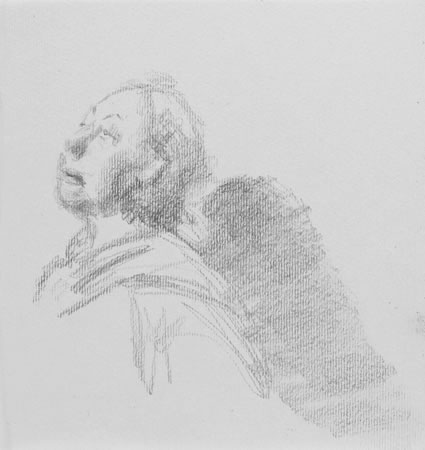
Curtis Holder: Study

I was particularly taken by a small study of a seated man. It reminded me of my old colleague Peter. He has recently had a wonderful exhibition of his photographs, some of which occupied the same space as the drawing I was looking at. Whether it was of him or not doesn't really matter, because the drawing says things about the human condition as a whole, which is why I think Curtis is such an important artist. His drawings go beyond portraiture, they signify something in their very nervous search for truth, that says things about how fragile and yet full of energy life is. The image of a seated man tells us that whoever it was sat for a while had a very particular life force, one expressed through their face, their hands and their body as much as their words. My only reservation about the display was the use of the square magnets, a device that stops holes being put into the paper, but which visually intrudes into the paper space. Such fragile and sensitive marks need to be read unimpeded by any other visual interference. On the other hand it was a brave act to not put these drawings under the cover of perspex sheets and by doing this I really appreciated the close proximity this gave to the act of their making. 

The exhibition is open from 08 November, 2024 until 13 April, 2025 and if you can get there don't miss the Stuart Croft exhibition that is on at the same time, the films are extraordinary and deeply thought provoking, this is an excellent time to visit.

See also:


Sunday, 22 January 2023

Celia Paul, Gwen John and Curtis Holder


I recently wrote a post about a small Celia Paul etching I came across in the Marlborough Gallery. I have since been looking at her drawings and amongst several very different images found the self portrait drawing above. I really find it fascinating, as it has echoes of some of the things I have been trying to do myself. The head feels as if it could be made out of mixing and flowing gases, different textural energies merge into each other, so that the head appears to drift into visibility. At the same time it is still a head, the eyes seem shut and a moment of stability occurs around the ear. As the head twists away from me, I decide something in my own mind about the internal gaze of this shut eyed figure; thinking that what it is doing is in some way asserting its own internal gaze over my own. It is powerful without having to be constructed with all the usual signs of power. Instead of making a drawing of a head as solid as a rock, by drawing it from a low viewpoint, carving it out with tonal masses or by using cross contour lines, this portrait arrives by using fumage like techniques. I have been asking myself, how do you draw energy? How do you draw a body and at the same time reflect on it as a particular set of events that emerge out of and back into the energy flow? This drawing seems to pulse with psychic energy and has a presence, so becomes for myself, a pointer, an indication of a possible direction to take.

The issue of 'presence' and what that actually is, is another of those conundrums that has been on my mind recently. What type of presence can you give to someone or something that is depicted within an image? How does it relate to the actual presence of the person or thing portrayed? Celia Paul is unfortunately sometimes known more for her relationship with Lucien Freud than for her own work, Gwen John was initially known more as a model or 'muse' in relation to the much more famous Rodin. Gradually over the years Gwen John has been seen less and less as a lover of Rodin and more and more as an important artist in her own right. This reflects a shift in society and what was at one point seen as a series of attributes of the 'feminine' and therefore not important, is now read in a very different way. The 'quiet' portraits of Gwen John, express dignity, the importance of an inner voice and calm control. The curve that the composition below is based on, is rather like a strung bow, it is taut and full of controlled energy. The 'presence' of the sitter is undoubted, but it is not the type of presence you associate with the grand portrait tradition of important people. This painting acknowledges and presents the presence of a mortal soul, one that still manages to project a distinct aura, despite a lack of bravura paint energy. In fact the energy pulse comes from the restricted palette, the greys that surround the face and hands, allowing the subtle warms of perceived skin tones, to glow with life.  

Gwen John: Chloë Boughton-Leigh: Leeds City Art Gallery

When you look at Gwen John's drawings you also see this observation of quietness. The fragility of life is glimpsed in her portraits of other women and girls, but it is not a weak fragility, it is one maintained via a steely resolve that sits beneath a quiet exterior. 

Gwen John: Study of a girl

Gwen John: Study of a child

Celia Paul has a similar tough fragility. I like the way that she stares back at you from these drawings. She knows the value of her own presence, she doesn't need to glorify her existence, it simply is. 

Celia Paul: Self portrait: 2007

Celia Paul: Self portrait: Watercolour and coloured pencils

Celia Paul's self portrait, made with watercolour and coloured pencils above, not only 'just exists' or floats into being, it seems to balefully stare out as if acknowledging her own uneasiness about being an artist. This soft almost not there presence, after a while becomes rather uncomfortable to look at; she seems to ask, "What are you looking at?" Her presence defiantly present in what is such an initially insubstantial seeming image. 

Curtis Holder was the 2020 winner of the Sky Arts Portrait Artist of the Year competition. A televised competition that I have previously criticised for being about television and not painting or drawing. Even so I think it is worth looking at some of Holder's drawings, as I believe he is an artist that has managed to come through because of real merit, his work holding up on the TV screen as well as in the flesh. In the context I'm writing about today, it is in the way he draws what I am beginning to think of as energy fields, or how to draw light as both particle and wave, that interests me. He is also drawn to Gwen John as an artist and has made a portrait of her.

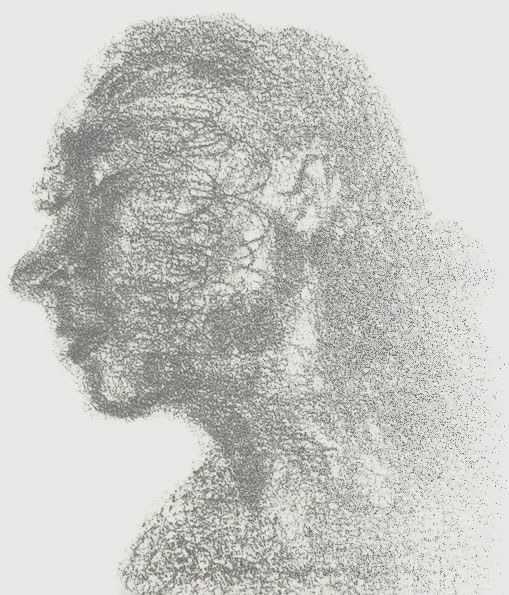
Curtis Holder: Gwen John: 2021

Holder's portrait of Gwen John is one of those images that emerges from a flickering 'rain' of lines. He must have worked from a flat image, as Gwen John is long dead, but he raises her back into being by discovering her image in these lines as they cut through the surface of his paper. I am slightly worried about the dark line that curves around an edge of hair, it feels as if it is a leftover from an earlier approach, (one you can also see outlining the shoulders) but besides that I think the drawing is an excellent approach to making a homage of an artist that has obviously had an influence on him. 


The best of Holder's drawings have a quality that allows you to hold mass and energy as two things in your mind at once, in particular I thought the way that the orange of the what I think is a self-portrait below, drifted out into the space around the figure, was an interesting device, as it added an alternative way of dealing with time. The pale residue of orange powder, (I presume it is from faint dustings of pastel, but as I haven't seen the actual drawing it could be traces of a watercolour wash) sits next to the heightened intensity of his orange pullover, in a similar way to an afterimage. Not as an optical opposite, but as a suggestion of an orange moving through space, of a former existence. 

Curtis Holder

The soft orange in the image above I also began to read as a sort of ghost, and it reminded me of another small drawing of Celia Paul's, 'Mandy with wings'. 

Celia Paul: Mandy with wings 2007

Her drawing 'Mandy with Wings' is a beautiful small reminder of how to find magic in the everyday. I suspect the wings that Mandy now has in this image were initially Mandy's shadow cast onto a wall behind her, but Paul has seen another possibility and in the tilt of the head and suggestion of a monk's habit made by a couple of lines traced over Mandy's shoulder, a delicate spiritual idea has floated into being.  

Celia Paul: Mother with clasped hands 2007

In Paul's drawing of her mother with clasped hands above, the 'punctum' for myself is the dark line that stretches from her mother's neck down to her hands. It's like a scar that cuts the figure in two. The vertical lines of the laid paper reinforce the thinness of the image and the hand clenching the other hand's fingers, suggests a nervous awareness of a situation that the eyes can barely look at. I found another drawing of Paul's mother on a scrap of torn paper, its informality suggesting that she didn't want to make too much of the situation, a note made in a moment, perhaps in such a way that she didn't disturb her mother. Perhaps I'm reading my own narrative into the drawing, as I well remember how other people used to react if I decided to draw them, it always seemed such an intrusion, so I tended to make drawings of people surreptitiously. 

Celia Paul: Mother

Celia Paul also draws using watercolour and etching. Again I found her approach fascinating. Whoever Mandy is, Celia Paul seems to be able to find the spiritual in her. In this instance, 'Mandy in Sunlight' she gives her friend a yellow halo, and the 'sunlit head' below, which I presume is also an image of Mandy, suggests even deeper spiritual awareness, closed eyes in both cases intimating the presence of someone who is deeply concerned with her inner world. 

Celia Paul: Mandy in sunlight

Celia Paul: Sun lit head

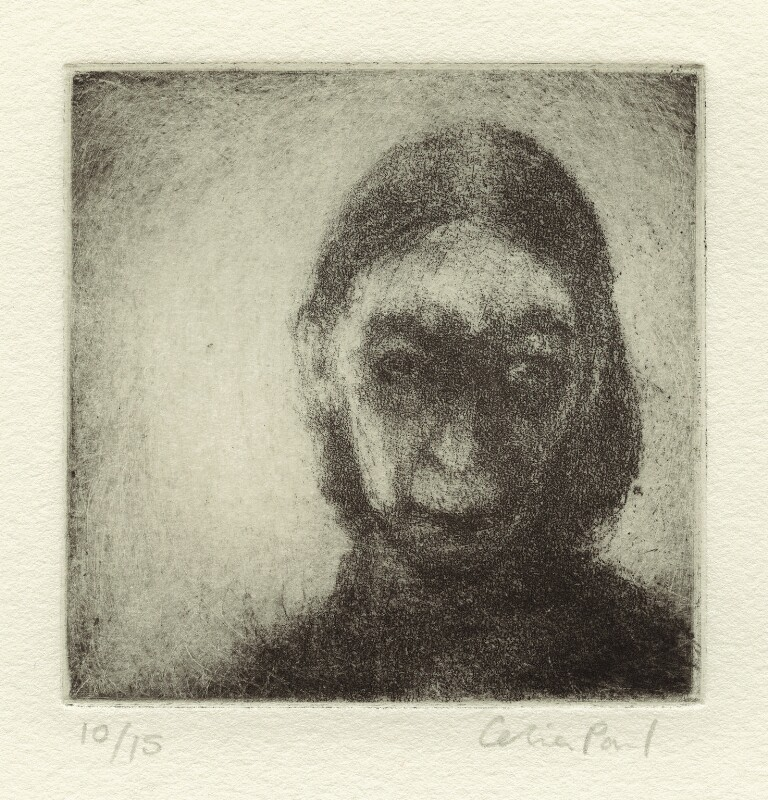
In the small etching below it is Paul that stares out at us again, her face off centre, unable to 'face' filling the frame, somehow avoiding direct face to face contact, yet at the same time able to stare you out. One eye slightly lower than the other, the image emerging like others out of a haze of marks, this time the ones that an etching plate allows you to make, especially when it is wiped by hand. 

Celia Paul: Self-portrait Etching

See also: