Showing posts with label drawing and spirituality. Show all posts

Monday, 16 February 2026

The Vertical

I put up a post on horizontality a while ago and as I'm seeking some sort of balance in my reflections, think it's about time to explore the vertical. 

From: Felix Moscheles’s 1896 book, 'In Bohemia with Du Maurier'

When you begin a course in objective drawing, one of the first things you will be asked to do will be to practice measurement and one of the main elements of that will be to establish a vertical against which you can check both angles and relative sizes. Basically in order to establish measurement you need to compare a known element to an unknown one. One of the most common “known” elements is one that exists due to gravity. 

A drawer establishes a vertical by using a plumb line

A plumb line is one of the oldest measuring devices, one that has been used to establish verticality from time immemorial. It is also used to check relationships.

Checking the relationships between the corner of a sculpture's base and the carved head

As you can see from the image above, by using a plumb line we can easily check what lies directly above the vertical line established by the corner of the sculpture's base. We can also begin to assess by eye angles that relate to our vertical, such as the angle of the chin, of an eye or a cheek bone. By assessing a measure of length in relation to the plumb line, usually the artist's thumb slid up and down a pencil, you can also begin to establish size constancy. 

Using your thumb and end of a pencil to find a unit of length.

In the image above you can see how the plumb line establishes a vertical and how in relation to that you can find a unit of measurement; often in the case of life drawing using the head as a unit. This is of course 'sight size', so if you want your drawing to be bigger, you multiply the measured unit by the percentage larger you need it to be, leading to what is usually called proportional or scaled drawing. 

From: Charles Blanc’s 1867 book, Grammaire des arts du dessin.

Charles Blanc in his 'Grammaire des arts du dessin' uses an illustration that depicts a human being standing on top of a semicircle that represents the sphere of the world.  A vertical line runs through both the standing human and the world and this in turn represents a plumb line, which visualises how everything standing on the Earth relates to its centre of gravity. By using this line Blanc shows how the human figure and any other form, can be drawn as if firmly standing on the ground. Any deviation from this vertical creates some form of movement or emotional exchange beyond the establishment of uprightness. 

From: Grammaire des arts du dessin.

We have already looked at Humbert de Superville's work, a man who had his own three line scheme for expression; 'expansive, horizontal, and convergent', a scheme that he believed affected fundamental emotions. This 'off the vertical' scheme, was taken up by Charles Blanc and used to explain why it was so important to establish verticality as a measure against which all other angles could be compared. Therefore quite early on we have a relation between the vertical as a support for measurement, but also as a comparator in terms of emotional register. The vertical in the visual arts representing an upright character, one associated with resilience, growth, inner strength and quiet confidence. Vertical lines conveying a sense of nobility, spirituality and stability. They can also communicate a feeling of loftiness and spirituality, as vertical lines may suggest a relationship with the sky and other untouchable cosmic entities, such as the sun, moon and stars. Extended perpendicular lines suggesting an idea that goes beyond human measure.

If however you want to specify the establishment of a vertical line without any emotional or spiritual implications, you can do this by referring to it as a Unicode Character. U+FF5C represents the Fullwidth Vertical Line. 

Unicode Character “|” (U+FF5C) The Fullwidth Vertical Line

Unicode stands for ‘Universal Character Encoding’ and is a global standard for representing text characters in binary form. It enables consistent storage, exchange and processing of text across different digital systems and platforms. Unicode was created with the aim of serving as a unified standard for representing all writing systems and characters developed by humans.

But if we look at heraldry the primary name for a single, wide, vertical stripe located in the centre of a shield is a pale. A palet or pallet, being a thinner version of the pale. The pale may occupy one third of the width of the shield. It has two diminutives, the palet, which is half as wide as a pale and the endorse which is by some said to be one eighth of its breadth, by others one fourth. However, being upright and red, it also signifies courage. 

A Pale

If considering the cross of the crucifixion, the 'stipe' is the vertical beam or upright post driven into the ground. A vertical view of the crucifixion refers to both the physical, upright orientation of the cross (crux immissa or crux commissa) on which Jesus was executed, as well as the theological, vertical relationship it represents between God and humanity. This theological, vertical relationship represents the direct, personal connection between God and humanity. Often symbolised by the vertical beam of the cross, it represents the reconciliation of sinners to God through Jesus Christ, facilitating a "God-ward" orientation of worship, prayer, and obedience. 

Michelangelo: Crucifixion

In Michelangelo's drawing the outstretched arms of Christ metaphorically fly him into that other world that sits above the humans that support him; humans, who Christ will in turn support as he makes his way to God's side. The vertical of the cross extends out of the ground at the base of the drawing and into infinity at the top. As it is cut off, the implication is that it continues out into the cosmos, invisibly extending far beyond the physical edge of the paper it is drawn upon. 

The vertical of the cross is perhaps one of the most spiritual metaphors associated with verticality, but it is not the only one. The vertical, invisible line that extends through the body as an energy channel in Eastern spiritual traditions is most commonly known as the Sushumna Nadi in Hinduism and Yogic philosophy. In Chinese Taoist alchemy and Qigong, this central axis is often referred to as the Central Meridian (Zhong Mai) or the Taiji Pole.

The Sushumna Nadi

In Hinduism the 'Nadi' are astral channels, made up of astral matter that carry Pranic currents and the Sushumna Nadi is the most important one. It is a three in one symbol; the sustainer of the universe, the path of the universe and the path of salvation. It joins the back of the anus, via the spinal column, to the Brahmarandhra of the head and is invisible and subtle. In everyday life we feel this as we breath in and stand more upright, letting the top of our head becoming attached to an invisible thread that helps us maintain that upright vertical stance. This is again something I've become much more aware of as I continue with my research into visualising interoception. 

The Chinese arts of health, maintain that an upright posture for the cultivation and circulation of energy is vital. The Taiji Pole, is said to run directly through the centre of the body from the top of our head from the (Bai Hui) Spirits Door energy point (Qi Xue) down to the (Hui Yin) Meeting Yin energy point which is located between our anus and testicles. It is an energetic line on which are found the three elixir energy centres ( Dan Tians) of the upper Dan Tian, which is located in the head, the middle Dan Tian located in the chest and the lower Dan Tian located in the abdomen. The Taiji Pole also has three major energy channels that connect to it; 1: The Govenor channel (Du Mai) which travels up the back from the tail bone to the roof of the mouth and is considered a Yang channel. 2: The Conception channel, that travels from the tip of the tongue down the front of the body to the (Hui Yin) energy point between the legs is considered a Yin channel. 3: The most important energy channel that is also connected to the Taiji Pole is known as the Thrusting channel (Zhong Mai) which travels directly between both the Governor and Conception channels. In medical Qigong practice, a priority is regulating these two channels in order to balance Yin and Yang in the body.

Taiji Pole


Our backbones are also a protection for our nerves. Each vertebra has a hole in the centre, so when they stack on top of each other they form a hollow tube that holds and protects the entire spinal cord and its nerve roots. The spinal cord itself is a large collection of nerve tissue that carries messages from our brains to the rest of our body. Working in a spinal injuries centre, has highlighted for myself how important this is and the complexity of the body's wiring is such that doctors are still not quite sure as to what the effects will be of any spinal column breakages.  As we can see from the acupuncture charts above, each point along the spine is linked to a different effect. For instance CV10 
is linked to issues with the lower stomach, such as stagnation, bloating, distention, weak digestion, diarrhea, undigested food in the stool, vomiting as well as rumbling or gurgling noises made by the movement of fluid and gas in the intestines.

We are it seems both physically wired and mentally wired. Energies flow between parts of the body in ways that at times are confusing, but perhaps only because we don't quite yet understand the full complexity of their interrelationship. 

Like trees we have evolved to stand tall. Trees maintain their verticality by constructing a scaffolding of trunks, limbs and branches that enable them to rise from the ground into the upper atmosphere. This makes them free of competition from ground covering plants and shrubs. 
In landscapes humans and trees are often the verticals against which the horizontality of the landscape is measured. In fact you can structure a landscape around a vertical and horizontal axis.


The differences between forests and woods, agricultural land, park landscapes, reed-beds and marshlands are recorded using height, openness and density of vegetation. All vegetation aspires to reach upwards and turns towards the sun. Whether a grass stalk or a fir tree, plants have evolved a vertical structure, designed to be able to bend with the wind and at the same time achieve maximum height by building rows of semi-rigid cells upon rows semi-rigid cells in the form of complex matrices.

It is gravity that rules this world. However, although it was the first force to be described mathematically (by Isaac Newton in 1687), we still do not know how it really works; the best modern description apparently being the general theory of relativity. We know what it does, but not what it is. The mystery of gravity is that it is an attractive force, but while the other forces such as electro-magnetism, can be both positive and negative and cancel each other out, gravity is only attractive, with no way to repel it, except it would seem to me metaphorically. Every time we stand up, we fight against gravity, we are in effect by living, a type of anti-gravity force. 

Georgia O'Keefe wrote the following to her husband Alfred Stieglitz in 1929: 

"There is much life in me...I realised I would die if I it could not move towards something...it makes me feel I am growing very tall and straight inside...and very still."

The flat landscape of New Mexico had given her a new life, one that she sensed verticality, as she measured herself against her surroundings. 

Reference:


O'Keefe, G. and Stieglitz, A. (2011) My far away one: Selected letters of Georgia O'Keefe and Alfred Stieglitz New York: Yale 

See also:

Saturday, 27 May 2023

Mythic Worlds

Jordan Belson, Brain Drawing, 1952. Ink on paper

The Drawing Centre in New York has just held an exhibition entitled 'Mythic Worlds: Works from the distant past through to the present'. I wish I had been there to see it, however they have put together an on-line catalogue, so we can get a good idea of the exhibition's content and this review is therefore based on what I could find available on line, rather than what was actually on exhibition, but we must all cut our cloth accordingly. 

Jordan Belson, Brain Drawing, 1952. Ink on paper

After reading through the catalogue and looking at the images of work on display, there were certain artists that for me, stood out as having practices that in one way or another, were helpful in understanding what I have been doing recently myself. Selfish perhaps, but when you visit exhibitions it is always useful to have a focus, or you can find yourself wondering what you are doing there and become overloaded with too much information to process. This doesn't mean you avoid new things, it's simply that you need a way into the new. I'm always keen to find artists that I have never encountered before, especially if they have been making work that seems to overlap with my own interests and Jordan Belson in particular interested me because of his attempts to fuse both scientific and mystical understandings of the universe. He developed what some people have labeled “cosmic cinema”, his animated films exploring the dynamic relationships between form, movement, colour and sound. Using basic animation techniques, mirrors, kaleidoscopes, and a variety of low-tech equipment he creates films that operate very like early types of microbial life. I'm making a new animation at the moment and by looking at Belson's work, I was reassured that the low technology approach I have been making is still viable. 

Making an old school animation

Exhibitions with a theme are often useful as they help you to think about the wider context for work and good curators find unexpected relationships between artists that you might not have thought about before. 

Jordan Belson: Samadhi (1967)

The animated film Samadhi explores the relationship between spiritual perception and scientific theory, drawing from Oriental philosophy and religion as well as Johannes Kepler’s astronomical theories and is accompanied by Belson’s ambient score. 

Jordan Belson, Brain Drawing, 1952. Ink on paper

His images reminded me that human beings are over 50 percent bacterial life and they helped me to visualise an idea that if God was of any species, it would be that of a higher form of bacterial entity. These images could therefore be seen as aspects of the religious art of microbial life forms, and now that I think about it, I would be quite happy to have people consider my own recent work in a similar way. 

Mel Chin: Tantric Dream diagram: 1991

Mel Chin: Degrees of paradise: Drawing for gallery layout

Mel Chin's 'Degrees of Paradise' was a study for a proposed State of Heaven, where an immense, floating, hand-knotted carpet, would serve as a symbolic and sacrificial sky. In 1991 we were faced with the actual destruction of the ozone layer and eventually the world's governments did act to ban ozone depleting chemicals. Chin's work was part of a global movement to raise consciousness of the need for action in relation to the use of ozone layer destroying chemicals. Looking at it from a 30 year distance, it reminded myself of the fact that art can help raise awareness of the need for action to be taken. Chin in tapping into Tantric ideas, also reminds us of the centrality of our physical bodies to a wider spiritual understanding of the interconnections between ourselves and all the other events and things that happen in this world. 
Displayed in the adjacent gallery, (see gallery layout drawing above) through a “sky” of video monitors was 'the State of Heaven', a multidimensional fractal program developed by McGill University physicists S. Lovejoy and F. Begin. Their interpretation of meteorological dynamics had advanced understanding in the fields of climatology and plate tectonics, Chin acknowledging that connectivity and collaboration with other disciplines are vital if deep communication is to be achieved. The resulting final images generated were to be given to weavers to be reinterpreted in wool, but I'm not sure whether or not this final aspect of the piece was ever completed. 

Ilka Gedő is another artist that I somehow had not looked at before. Her self-portraits are very powerful, and her image in the exhibition of a table immediately communicated the fact that she was able to draw objects and turn them into events, a rare skill, but one I'm beginning to think is essential in a time when Capitalism is beginning to loosen its grip, and if we are to collectively get it to remove its dead hands from our tiller, we will need more and more examples of how to experience the world as interconnected events and not as a collection of atomised or itemised things. I was particularly interested in her drawings and pastels of the Ganz Factory. She was able to take a momentary experience and bring to it an intense spiritual concentration and expressive power. These are drawings of industrial work, drawings that reminded myself of my time working at Round Oak Steel Works in the West Midlands. Her drawings are both realistic and at the same time, more importantly, expressive and moving. The objects that appear in these industrial spaces, just as they did for myself in the 1960s, seem to devour the human beings that are brought in to service them. 


Ilka Gedő

I have been thinking about drawings as types of batteries recently and Gedő's in particular seem to be full of that energetic potential that marks can create, especially as their collective energies flow across the surface of the paper. Her work taps into that 'uncertain certainty' that so many artists exhibit when they come to terms with both the fragility of life and its underlying dynamism. 

Ilka Gedő

Ilka Gedő: Table 1949

Hu Zhengyan was the first artist to develop colour woodblock printing and he worked in 17th century China, however it was his images devoted to the depiction of strange distorted wooden forms that had been selected for this exhibition and they intrigued me. They reminded me of traditional Japanese suiseki stones, small naturally occurring rocks which are appreciated for their aesthetic value because they look like full sized landscape forms. 


Hu Zhengyan: Woodblock prints

A suiseki stone

The idea of seeing vastness in small things is a wonderful one and is something all of us can understand, as we have had to pass through childhood to get where we are. It has always seemed to me that if you can keep that childlike wonder that you had when as a child you made models, you would have far more chance of being a good artist. I now believe that this is a type of animism, a way of sending your thoughts out to inhabit other things, but also a way for objects to hold thoughts within themselves, so that they in turn can go on to inhabit the people that then encounter them. 

This is how the drawing centre introduces the exhibition: 

Tracing commonalities, both formal and conceptual, Of Mythic Worlds draws surprising connections between artists that might otherwise go unnoticed. Rarely exhibited drawings by Morris Graves, Jack Whitten, Georgia O'Keeffe, and theorist and writer Roland Barthes are presented alongside nineteenth-century Shaker Gift Drawings, as well as major works from artists such as Mel Chin and Jordan Belson. Historical block prints from the Qing dynasty are juxtaposed with works made by contemporary artists including Cici Wu, Bernadette Van-Huy, Julia Phillips, Steffani Jemison, and Robert Bittenbender. Of Mythic Worlds also includes new work made on the occasion of the exhibition by Duane Linklater, an Omaskêko Ininiwak artist based in North Bay, Ontario.

Together, the works of these artists investigate personal belief systems, spirituality, and consciousness; explore the metaphysical and the sublime; recall myths passed down from ancient cultures; and expand our understanding of mysticism and immateriality.

The exhibition it is argued in the introduction covers a lot of ground and I suppose it is the job of the marketing people to find a comprehensive net within to present it. I wonder how if given the money and access to various collections myself or someone else might have put an exhibition together. As students you can organise exhibitions of old postcards (heck you can tell my age in thinking people may still collect these) or cut out images printed off from your computer and organise them on a wall, it's always an interesting thing to do, as you begin to see connections that you had never noticed before. I also realise that with the 3D software we have access to you could design and put up a whole exhibition on line, see. 
You can find an on-line catalogue of the exhibition here

 See also:

Drawing together science and myth

The Uncertain Certainty 

Visualising the invisible

The diagram as art and spirit guide

Animism and drawing lines: a reflection on another exhibition


Sunday, 22 January 2023

Celia Paul, Gwen John and Curtis Holder


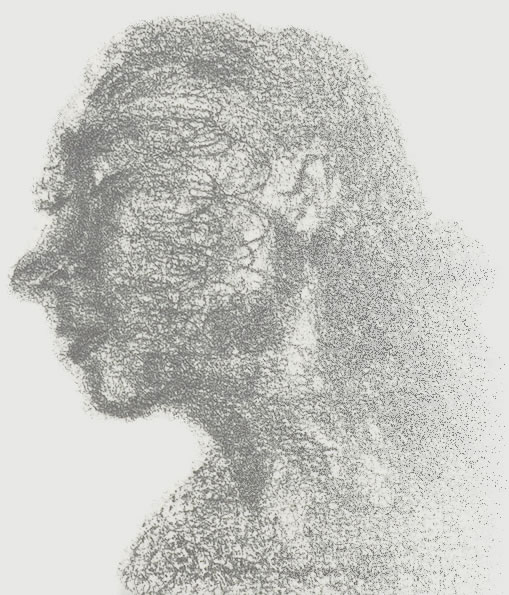
I recently wrote a post about a small Celia Paul etching I came across in the Marlborough Gallery. I have since been looking at her drawings and amongst several very different images found the self portrait drawing above. I really find it fascinating, as it has echoes of some of the things I have been trying to do myself. The head feels as if it could be made out of mixing and flowing gases, different textural energies merge into each other, so that the head appears to drift into visibility. At the same time it is still a head, the eyes seem shut and a moment of stability occurs around the ear. As the head twists away from me, I decide something in my own mind about the internal gaze of this shut eyed figure; thinking that what it is doing is in some way asserting its own internal gaze over my own. It is powerful without having to be constructed with all the usual signs of power. Instead of making a drawing of a head as solid as a rock, by drawing it from a low viewpoint, carving it out with tonal masses or by using cross contour lines, this portrait arrives by using fumage like techniques. I have been asking myself, how do you draw energy? How do you draw a body and at the same time reflect on it as a particular set of events that emerge out of and back into the energy flow? This drawing seems to pulse with psychic energy and has a presence, so becomes for myself, a pointer, an indication of a possible direction to take.

The issue of 'presence' and what that actually is, is another of those conundrums that has been on my mind recently. What type of presence can you give to someone or something that is depicted within an image? How does it relate to the actual presence of the person or thing portrayed? Celia Paul is unfortunately sometimes known more for her relationship with Lucien Freud than for her own work, Gwen John was initially known more as a model or 'muse' in relation to the much more famous Rodin. Gradually over the years Gwen John has been seen less and less as a lover of Rodin and more and more as an important artist in her own right. This reflects a shift in society and what was at one point seen as a series of attributes of the 'feminine' and therefore not important, is now read in a very different way. The 'quiet' portraits of Gwen John, express dignity, the importance of an inner voice and calm control. The curve that the composition below is based on, is rather like a strung bow, it is taut and full of controlled energy. The 'presence' of the sitter is undoubted, but it is not the type of presence you associate with the grand portrait tradition of important people. This painting acknowledges and presents the presence of a mortal soul, one that still manages to project a distinct aura, despite a lack of bravura paint energy. In fact the energy pulse comes from the restricted palette, the greys that surround the face and hands, allowing the subtle warms of perceived skin tones, to glow with life.  

Gwen John: Chloë Boughton-Leigh: Leeds City Art Gallery

When you look at Gwen John's drawings you also see this observation of quietness. The fragility of life is glimpsed in her portraits of other women and girls, but it is not a weak fragility, it is one maintained via a steely resolve that sits beneath a quiet exterior. 

Gwen John: Study of a girl

Gwen John: Study of a child

Celia Paul has a similar tough fragility. I like the way that she stares back at you from these drawings. She knows the value of her own presence, she doesn't need to glorify her existence, it simply is. 

Celia Paul: Self portrait: 2007

Celia Paul: Self portrait: Watercolour and coloured pencils

Celia Paul's self portrait, made with watercolour and coloured pencils above, not only 'just exists' or floats into being, it seems to balefully stare out as if acknowledging her own uneasiness about being an artist. This soft almost not there presence, after a while becomes rather uncomfortable to look at; she seems to ask, "What are you looking at?" Her presence defiantly present in what is such an initially insubstantial seeming image. 

Curtis Holder was the 2020 winner of the Sky Arts Portrait Artist of the Year competition. A televised competition that I have previously criticised for being about television and not painting or drawing. Even so I think it is worth looking at some of Holder's drawings, as I believe he is an artist that has managed to come through because of real merit, his work holding up on the TV screen as well as in the flesh. In the context I'm writing about today, it is in the way he draws what I am beginning to think of as energy fields, or how to draw light as both particle and wave, that interests me. He is also drawn to Gwen John as an artist and has made a portrait of her.

Curtis Holder: Gwen John: 2021

Holder's portrait of Gwen John is one of those images that emerges from a flickering 'rain' of lines. He must have worked from a flat image, as Gwen John is long dead, but he raises her back into being by discovering her image in these lines as they cut through the surface of his paper. I am slightly worried about the dark line that curves around an edge of hair, it feels as if it is a leftover from an earlier approach, (one you can also see outlining the shoulders) but besides that I think the drawing is an excellent approach to making a homage of an artist that has obviously had an influence on him. 


The best of Holder's drawings have a quality that allows you to hold mass and energy as two things in your mind at once, in particular I thought the way that the orange of the what I think is a self-portrait below, drifted out into the space around the figure, was an interesting device, as it added an alternative way of dealing with time. The pale residue of orange powder, (I presume it is from faint dustings of pastel, but as I haven't seen the actual drawing it could be traces of a watercolour wash) sits next to the heightened intensity of his orange pullover, in a similar way to an afterimage. Not as an optical opposite, but as a suggestion of an orange moving through space, of a former existence. 

Curtis Holder

The soft orange in the image above I also began to read as a sort of ghost, and it reminded me of another small drawing of Celia Paul's, 'Mandy with wings'. 

Celia Paul: Mandy with wings 2007

Her drawing 'Mandy with Wings' is a beautiful small reminder of how to find magic in the everyday. I suspect the wings that Mandy now has in this image were initially Mandy's shadow cast onto a wall behind her, but Paul has seen another possibility and in the tilt of the head and suggestion of a monk's habit made by a couple of lines traced over Mandy's shoulder, a delicate spiritual idea has floated into being.  

Celia Paul: Mother with clasped hands 2007

In Paul's drawing of her mother with clasped hands above, the 'punctum' for myself is the dark line that stretches from her mother's neck down to her hands. It's like a scar that cuts the figure in two. The vertical lines of the laid paper reinforce the thinness of the image and the hand clenching the other hand's fingers, suggests a nervous awareness of a situation that the eyes can barely look at. I found another drawing of Paul's mother on a scrap of torn paper, its informality suggesting that she didn't want to make too much of the situation, a note made in a moment, perhaps in such a way that she didn't disturb her mother. Perhaps I'm reading my own narrative into the drawing, as I well remember how other people used to react if I decided to draw them, it always seemed such an intrusion, so I tended to make drawings of people surreptitiously. 

Celia Paul: Mother

Celia Paul also draws using watercolour and etching. Again I found her approach fascinating. Whoever Mandy is, Celia Paul seems to be able to find the spiritual in her. In this instance, 'Mandy in Sunlight' she gives her friend a yellow halo, and the 'sunlit head' below, which I presume is also an image of Mandy, suggests even deeper spiritual awareness, closed eyes in both cases intimating the presence of someone who is deeply concerned with her inner world. 

Celia Paul: Mandy in sunlight

Celia Paul: Sun lit head

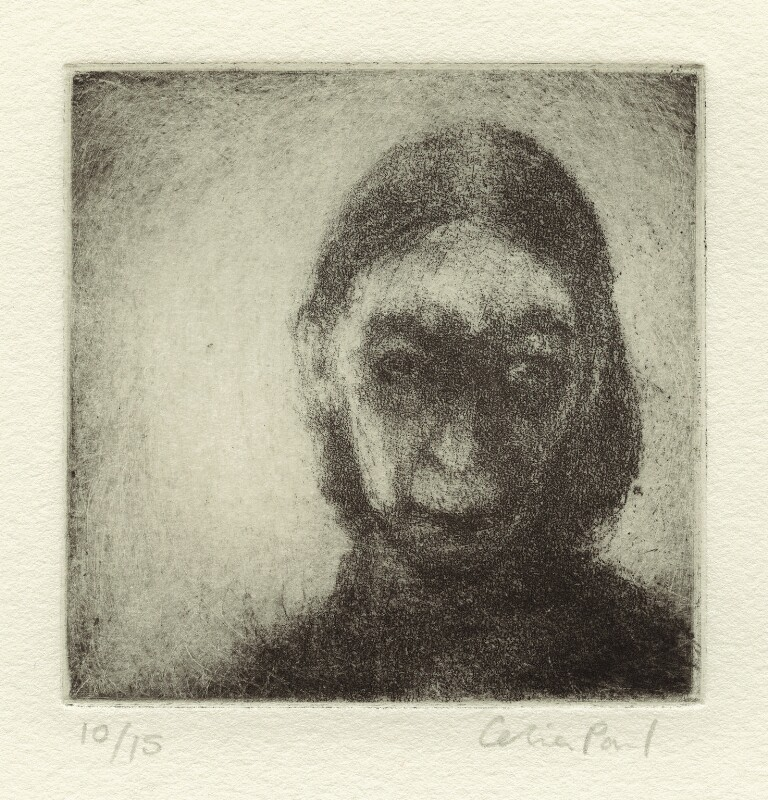
In the small etching below it is Paul that stares out at us again, her face off centre, unable to 'face' filling the frame, somehow avoiding direct face to face contact, yet at the same time able to stare you out. One eye slightly lower than the other, the image emerging like others out of a haze of marks, this time the ones that an etching plate allows you to make, especially when it is wiped by hand. 

Celia Paul: Self-portrait Etching

See also: 

Friday, 4 September 2020

The diagram as art and spirit guide


Walter Russell

Walter Russell was an impressionist style painter, but his most important contribution to visual imagery and its ability to carry ideas was in the development of a range of diagrammatic descriptions of mystic energy forces. These diagrams have recently come back into fashion, probably because of a rise in interest of artists such as Hilma of Klint. 


Hilma of Klint

Both Walter Russell and 
Hilma of Klint were in their own ways influenced by Theosophy and they were drawn to an exploration of alternative ways of envisioning the world that were attempts to uncover the underlying spiritual and metaphysical aspects of reality. At the time they were regarded initially as 'interesting' but very quickly dismissed as odd balls but we must not forget that many artists at the time were involved in theosophy including Kandinsky and Mondrian. Perhaps artists like Walter Russell and Hilma of Klint asked too many difficult questions of the art dealers and art audience of the time, because they were not just making images, they were producing diagrams for action, their art was part of a much larger ideal, one that would have involved participants in massive social change. In times of upheaval like the one we are in now we often need to look for an alternative understanding of reality. The one we have seems to be failing, in particular truth seems to be something for people to make up as they go along and this has caused many of us to distrust 'the powers that be' and we therefore perhaps need to forge another vision that seems more spiritually up-lifting. However to do this artists need to think of their practice as being not an isolated reflection on our times, but as a way of working that is integral to the forging of new ways to think. Our current undermined social systems and belief structures, need new foundations if we are to move onwards and become able to deal with huge issues such as global warming and the failure of our democratic processes. At the end of the 19th century theosophy seemed to offer an answer to a series of failing belief systems, and several artists at the time saw in its belief system an opportunity to rethink their practices, both as artists and as social thinkers. However it was to be Dada and Surrealism that carried the anti-rationalist flag into the centre of twentieth century art practices, and as Rosalind Krauss stated, it soon became “embarrassing to mention art and spirit in the same sentence". However Massimiliano Gioni’s 2013 Venice Biennale, entitled 'The Encyclopedic Palace' was a turning point in critical reception amongst the art community. As you entered the first pavilion in the Arsenale you were confronted with Marino Auriti's museum of imaginary knowledge, a three dimensional diagram that echoed the structure of memory theatres. We were being informed that it was ok to once again be in touch with that other side of creativity, the one we never talk about, but which we often draw upon when feeling spiritually exhausted. Since that time several artists have emerged from obscurity who put spirituality at the centre of their practices, such as Marjorie Cameron a follower of Thelema, a spiritual practice developed by Aleister Crowley, Agnes Pelton, Georgiana Houghton, who's 'spirit drawings' were shown at the Courtauld and Emma Kunz who's work was shown at the Serpentine Gallery recently. The exhibition 'Language of the birds' at New York University’s 80WSE Gallery, was an exploration of art inspired by Kabbalah, alchemy, hermeticism, and Tarot and Grisha Bruskin's work (someone I have been looking at and been influenced by for some time) is now becoming much more well known. 

Grisha Bruskin

In Bruskin's work we find a conjunction between the structures of soviet Russian society and the imagery of Jewish mysticism and he has in the past set out his ideas in diagrammatic form. 

However it is probably in the diagrams of Rudolf Steiner that we see the most powerful influence of the spiritualist/socialist mind on contemporary art. 


Rudolf Steiner diagrams

Steiner developed a system of thinking that he called anthroposophy and he aimed to regain traction in the the spiritual world by mirroring the information obtained by science when investigating the physical world. This split between the world of the social (spiritual) and that of science, would be raised yet again in the work of both Joseph Beuys and Bruno Latour. 
Beuys was deeply influenced by Steiner's diagrams, in particular those produced during his blackboard lectures. In fact a Beuys diagram at first sight looks very like one of Steiner's. 


Joseph Beuys diagrams

Bruno Latour has developed a system of thinking that is an "anthropology of science". It explores the dualistic distinction that modernity has made between nature and society. Pre-modern peoples argues Latour, made no such division and a tidy nature/culture dualism was in fact never possible. He cites a particular moment in time as the beginning of this separation, the argument between Hobbes and Boyle as to what constitutes evidence. Hobbes is someone that saw evidence as something that comes from the masses of people that experience the world, evidence being something that emerges from social discourse, while Boyle points to another type of evidence, that which was embedded within a scientific experiment, such as in his case the proof of the existence of a vacuum by experiment. The tacit practice of the air pump and the dexterity it required is witnessed not by texts or languages but by silent things such as air pumps and Hobbes could not accept that this type of evidence could outweigh the voices of many people. 


It was Beuys as an artist that made us aware that being an artist was more akin to being a shaman type figure, one that operated as a catalyst between people and the various ways that they came to understand the world. He was very interested in systems and saw his work as interventions that might change what were becoming ossified systems that pervaded Western society. As well as looking back to Steiner he looked as Eastern philosophies and religions as signs of alternative approaches to living and he began to integrate various aspects of his life into a larger diagram that was continually evolving. For instance he might focus on money and how it could be both used to lever change and at the same time be subject to a rethinking, whereby as a capitalist form of support for commercial exchange it was becoming redundant. This particular tendency within the various strands of contemporary practice has been brought together in the net exhibition, Diagrams of Power which showcases a range of artists working in this territory at the moment. However what seems to be missing is the touch of the esoteric, we need to remember that Thomas Edison was fascinated with the occult and that he initially invented the telephone to talk to the dead. The existence of an invisible, non-material realm is still with us but we now call it 'dark matter', these unknown territories will hopefully always be with us, they are the gaps in our knowledge that allow us as artists to do the things we do, without having to always justify ourselves in the court of rationality. 


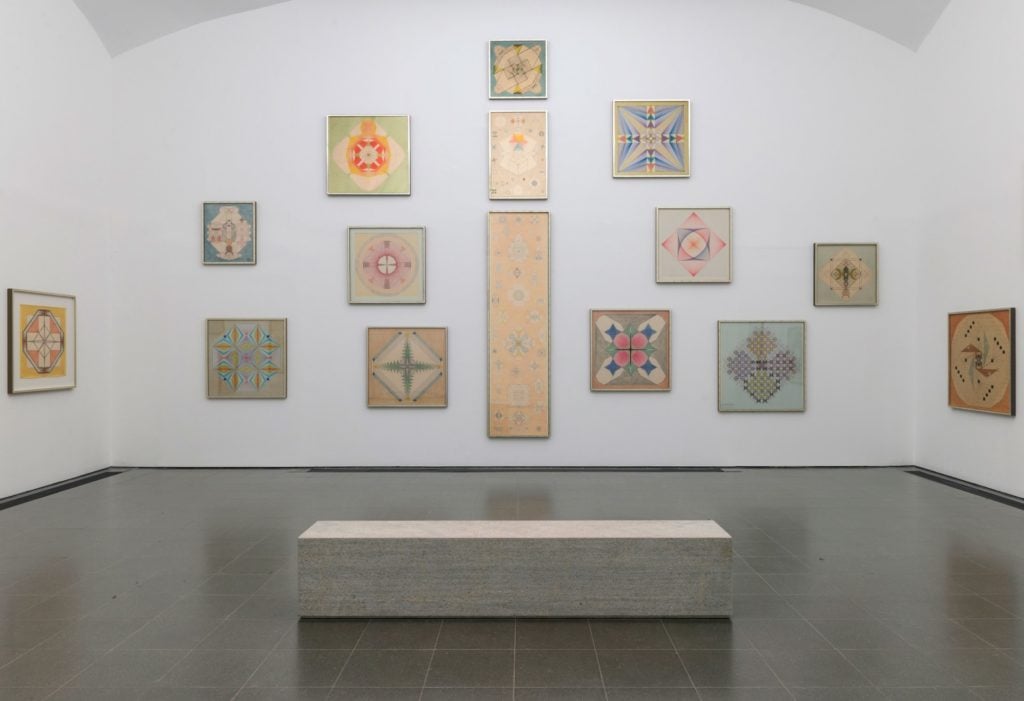
Installation view of "Emma Kunz - Visionary Drawings: An exhibition conceived with Christodoulos Panayiotou" at the Serpentine Galleries. Courtesy of the Serpentine.
Emma Kunz Visionary Drawings: Serpentine Galleries

Coda:

I have looked at this area of work myself at times, in particular now that I'm part of the group, 'Life hacks for a limited future', I have developed a diagram for the group to help envisage the various stages of ageing.

The stages of ageing

The idea was to create a diagram with an image embedded within it, in this case a scarab beetle was the rough guide to the overall shape. In Egyptian times it was a symbol of immortality, resurrection, transformation and protection, so seemed a good model on which to base a diagram that was designed to get older people to think about facing up to death. Because this is an age of the mobile phone I then had to redesign my diagram to fit a phone screen, a note to self about the fact that technology moves on. 

Louise Despont is perhaps the artist who is working most powerfully in this area at the moment. She uses stencils to create large scale 'spiritual diagrams' often using old ledger paper as a surface to work on.


Louise Despont 

Another addition:

My old friend Terry Hammill on seeing this post sent me a story about when in 1971 he was in the USA and came across the work of Soleri, who had published a wonderful book called ‘Arcology: the city in the image of man’. Paolo Soleri had published his ‘Arcology' book just two years before in 1969 and his spiritual ideas are very similar to the ones introduced above, the difference being that Soleri was an architect and was determined to erect real buildings that would reflect his cosmological ideas. 


Paolo Soleri: Diagrams from Arcology: the city in the image of man

See also: